Tag: News – Al Jazeera

  • Strategic oil release may calm markets but cannot fix Hormuz disruption

    Strategic oil release may calm markets but cannot fix Hormuz disruption

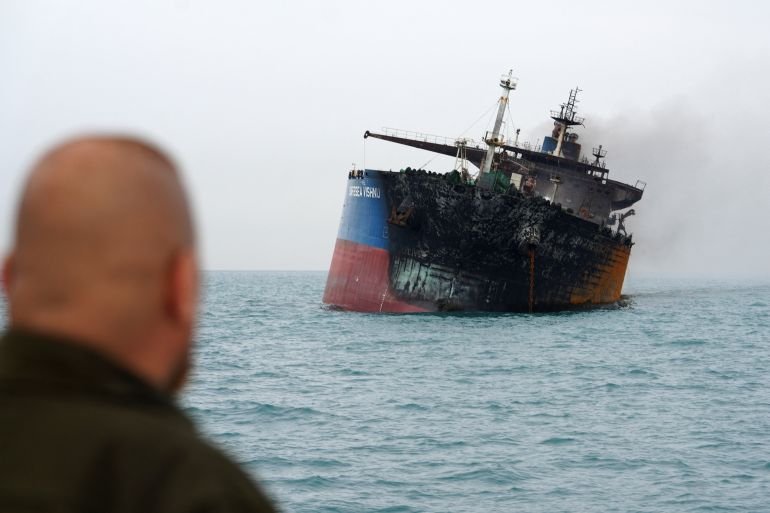
    Hundreds of tankers sit idle on both sides of the Strait of Hormuz as Iran has effectively closed the waterway, pushing oil prices above $100 – the highest since 2022, after the start of the Russia-Ukraine war.

    Oil tanker traffic in the strait, through which one-fifth of global oil passes, has plunged after Israel and the United States launched attacks on Tehran on February 28. Asian countries, including India, China and Japan, as well as some European countries, source large portions of their energy needs from the Gulf. A disruption in supply will rattle the global economy.

    With an aim to cushion from the shock, the International Energy Agency (IEA) has decided to release 400 million barrels of oil from emergency reserves, the largest coordinated drawdown in the agency’s history. But it has failed to push the prices down.

    The agency had released about 182 million barrels after Russia’s invasion of Ukraine to stablise the oil prices.

    According to the agency, oil shipments through the strategic waterway have fallen to less than 10 percent of pre-war levels, threatening one of the most critical arteries in the global energy system.

    IEA members collectively hold about 1.25 billion barrels in government-controlled emergency reserves, alongside roughly 600 million barrels in industry stocks tied to government obligations.

    A large number in a massive market

    The figure may appear vast, but it shrinks quickly against the scale of global energy demand.

    “This feels like a small bandage on a large wound,” energy strategist Naif Aldandeni said, describing the world’s largest coordinated emergency oil release as governments scramble to steady markets shaken by war.

    The US Energy Information Administration (EIA) estimates world consumption of petroleum and other liquids will average 105.17 million barrels per day in 2026. At that rate, 400 million barrels would theoretically cover just four days of global consumption.

    Even when compared with normal traffic through the Strait of Hormuz – around 20 million barrels per day – the released oil equals only about 20 days of typical flows.

    Aldandeni told Al Jazeera that emergency reserves can calm panic in markets but cannot replace the lost function of a disrupted shipping corridor.

    “The release may soften the shock and calm nerves temporarily,” he said, “but it will remain limited as long as the fundamental problem — the freedom of supply and tanker movement through Hormuz – remains unresolved.”

    Oil prices reflect those anxieties. Brent crude ended trading on Friday at $103.14 per barrel, after surging to nearly $120 earlier as fears of disrupted production and shipping intensified.

    Geopolitical risk premium

    Oil expert Nabil al-Marsoumi said the price surge cannot be explained by supply fundamentals alone.

    “The closure of the Strait of Hormuz added roughly $40 per barrel as a geopolitical risk premium above what market fundamentals would normally dictate,” he told Al Jazeera.

    From that perspective, releasing strategic reserves serves primarily as a temporary tool to dampen that premium rather than fundamentally rebalance the market.

    Prices above $100 per barrel are uncomfortable for major consuming economies already struggling to curb inflation and protect economic growth.

    Recent EIA projections suggest global demand has not yet declined significantly because of the war, remaining close to 105 million barrels per day. The market pressure, therefore, stems less from falling consumption and more from fears of supply shortages and delays in deliveries to refineries and consumers.

    Threats to oil infrastructure

    The latest escalation could deepen those fears.

    United States President Donald Trump said on Friday that the US Central Command (CENTCOM) had “executed one of the most powerful bombing raids in the History of the Middle East and totally obliterated every MILITARY target in Iran’s crown jewel, Kharg Island”.

    He added that “for reasons of decency” he had “chosen NOT to wipe out the Oil Infrastructure on the Island”, but warned Washington could reconsider that restraint if Iran continues to disrupt shipping through the Strait of Hormuz.

    CENTCOM confirmed the operation, stating US forces had struck “more than 90 Iranian military targets on Kharg Island, while preserving the oil infrastructure”.

    Iranian officials have meanwhile warned they would target energy facilities linked to the US across the region if Iranian oil infrastructure comes under direct attack.

    Kharg Island is not simply a military location. It serves as the primary export terminal for Iranian crude, making it a critical node in the country’s oil supply network.

    If attacks move from obstructing shipping to targeting export infrastructure itself, the crisis could shift from a chokepoint disruption scenario to one involving direct losses of production and export capacity.

    In such circumstances, the oil released from emergency reserves would act only as a temporary bridge rather than a lasting solution to lost supply.

    Major oil companies such as QatarEnergy, the world’s largest producer of liquefied natural gas (LNG), Kuwait Petroleum Corporation and Bahrain state oil company Bapco have shut production and declared force majeure, while Saudi Aramco, the world’s largest oil producer, and UAE state oil company ADNOC have shut down their refineries.

    Limits of emergency reserves

    Even under a less severe scenario – where maritime disruption persists but infrastructure remains intact — the ability of strategic reserves to stabilise markets remains constrained by logistics.

    The US Department of Energy said the US Strategic Petroleum Reserve held 415.4 million barrels as of 18 February 2026. Its maximum drawdown capacity is 4.4 million barrels per day, and oil requires about 13 days to reach US markets after a presidential release order.

    That means even the world’s largest emergency stockpile cannot flood the market with crude immediately. The release must move through pipelines, shipping networks and refining capacity before reaching consumers.

    Aldandeni said the current intervention would likely produce only a temporary stabilising effect, while al-Marsoumi warned that prolonged disruption in the Strait of Hormuz – or the spread of threats to other chokepoints such as the Bab al-Mandeb Strait in the Red Sea could quickly send prices further higher.
  • Bahrain and Saudi Arabia F1 race cancellations confirmed due to Iran war

    Bahrain and Saudi Arabia F1 race cancellations confirmed due to Iran war

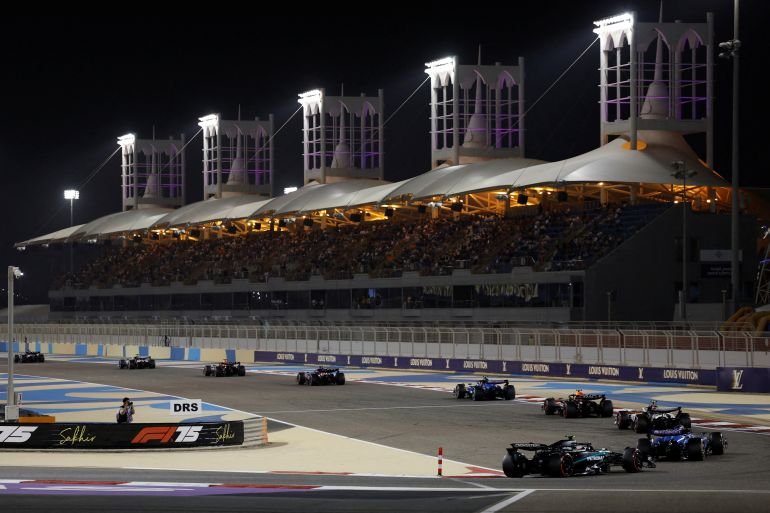
    Bahrain and Saudi Arabia’s Formula One Grands Prix races will not be held in April on safety grounds due to the war.

    Formula One and its governing body, FIA, said the Grands Prix races in Bahrain and Saudi Arabia will not happen in April due to safety concerns related to the Iran war.

    Both countries have been hit during Iran’s retaliatory attacks after the United States and Israel launched a wave of strikes on Iran.

    Recommended Stories

    list of 4 itemsend of list

    The announcement was made early on Sunday morning in Shanghai ahead of the Chinese Grand Prix.

    “Due to the ongoing situation in the Middle East region, the Bahrain and Saudi Arabian Grands Prix will not take place in April,” F1 said. “While several alternatives were considered, it was ultimately decided that no substitutions will be made in April.”

    F1 was due to race in Bahrain on April 12 and in the Saudi Arabian city of Jeddah on April 19.

    “While this was a difficult decision to take, it is unfortunately the right one at this stage considering the current situation in the Middle East,” said Stefano Domenicali, president and CEO of F1.

    “The FIA will always place the safety and well being of our community and colleagues first. After careful consideration, we have taken this decision with that responsibility firmly in mind,” FIA’s president, Mohammed Ben Sulayem, said.

    The FIA did not explicitly rule out rescheduling the races and, along with F1, did not use the words “cancel” or “postpone” in announcing that the series would not be in Bahrain or Saudi Arabia next month.

    “Bahrain and Saudi Arabia are incredibly important to the ecosystem of our racing season, and I look forward to returning to both as soon as circumstances allow,” Ben Sulayem said.

    The promoters of the races in Bahrain and Saudi Arabia said they supported the decision.

    F1’s packed schedule does not have any obvious open dates for rescheduled races this year.

    Calling off the Bahrain and Saudi Arabian races means there will be a five-week gap from the Japanese Grand Prix on March 29 and the next race, the Miami Grand Prix, on May 3. Without any rescheduling, the 22-race schedule would be the shortest since 2023.

    The two Middle East races were not to happen until next month, but F1 faced making a decision earlier because it typically flies in the first staff and cargo to tracks weeks in advance. F1 was also faced with the difficulty of selling tickets at short notice, which makes it almost impossible to set up a replacement race in other countries.

    Kimi Antonelli, the Mercedes driver who qualified on pole position for Sunday’s race in Shanghai, said his thoughts were “with the ones that are suffering from this situation” and that safety needed to be the priority.

    “I’m sure they will do the right thing,” he said of FIA and F1.

    The schedule is a joint matter for FIA and for F1’s commercial rights holder, and teams had signalled a willingness to follow their lead.

    “I think we follow the guidance of the FIA and Formula 1, as we always do. They’ve always led us in the right direction,” Audi team principal Jonathan Wheatley said on Friday. “Nobody’s going to compromise on anything that would put teams into an uncomfortable situation.”

    Bahrain had already hosted two preseason F1 tests this season, before Israel and the US launched attacks on Iran. A smaller-scale test of wet-weather tyres was called off in the immediate aftermath of the strikes.

    A travel shutdown affecting major airports in the Middle East also caused disruption for Europe-based F1 and team staff heading to Melbourne for the season-opening Australian Grand Prix.

    The last time a scheduled F1 race was cancelled was in 2023, when the Emilia Romagna Grand Prix in northern Italy was called off at short notice due to deadly floods in the area.

    In 2022, F1 continued with its race weekend in Saudi Arabia, even after Yemen’s Houthi rebels attacked an oil depot during a practice session, with black smoke visible from the Jeddah circuit.

    The same year, F1 cancelled the Russian Grand Prix’s contract after Russia’s full-scale invasion of neighbouring Ukraine.

  • Trump administration to drop charges against US veteran who burned flag

    Trump administration to drop charges against US veteran who burned flag

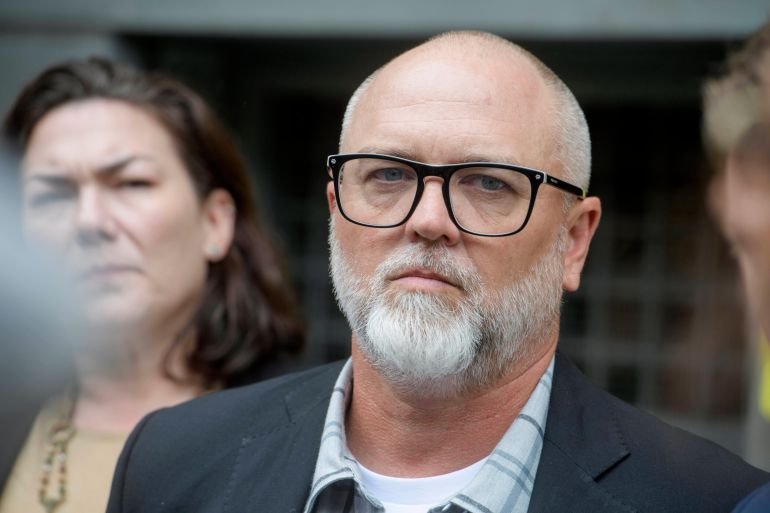
    The administration of President Donald Trump has moved to end its prosecution of a United States Army veteran who burned a national flag to protest one of the president’s executive orders.

    Court filings this week show that the Department of Justice has moved to drop the charges against defendant Jan “Jay” Carey, following his motion to dismiss last October.

    Recommended Stories

    list of 3 itemsend of list

    Carey had been charged with two misdemeanours: one for lighting a fire outside of designated areas, and the second for lighting a fire in a manner that creates a public safety hazard or threatens property.

    The incident unfolded on August 25, in the hours after Trump signed an executive order calling for the prosecution of flag-burners.

    The Supreme Court has long upheld flag burning as an act of protected free speech. In the 1989 case Texas v Johnson, for instance, the high court held that “flag desecration is inconsistent with the First Amendment”, which protects free speech.

    It reaffirmed that decision a year later in 1990, when Congress passed a new Flag Protection Act to outlaw such destructive behaviour. The high court struck down that law as unconstitutional.

    But Trump has maintained that flag burning is akin to the incitement of violence, which is not protected under the First Amendment of the US Constitution.

    Since his first term, he has pushed for steep prison sentences for any protester who knowingly destroys a US flag.

    “If you burn a flag, you get one year in jail,” Trump said as he signed his executive order last August. “No early exits, no nothing.”

    Though his executive order acknowledged the Supreme Court’s precedents protecting flag burning as an act of free speech, it nevertheless called on the US attorney general to “prioritise enforcement to the fullest extent of our Nation’s criminal and civil laws”.

    In short, critics say it calls on the attorney general to prosecute flag-burners by searching for laws that fall outside the First Amendment’s scope.

    In an interview last year with the Al Jazeera programme UNMUTE, Carey explained he had been outraged that the president would seek to circumvent the free-speech rights he had fought for as a veteran.

    “I served for over 20 years. I defended that flag, served under that flag, fought for that flag,” Carey told Al Jazeera.

    “The flag is a symbol. It’s not our democracy. I didn’t burn it to desecrate the flag or protest America. I did it as a direct reaction to what our treasonous, fascist president did by signing that executive order.”

    Carey recalled that, after seeing the executive order, he turned to a friend. “I was like, I think I need to go burn a flag in front of the White House.”

    Video captured the incident that followed. At about 6:20pm US Eastern time (22:20 GMT) on August 25, Carey appeared in Lafayette Park, directly across from the White House.

    He took out a bullhorn and identified himself as a US veteran, protesting Trump’s executive order. He then placed a US flag on a brick pathway in the park and set it alight, using rubbing alcohol as an accelerant.

    Four federal law enforcement agents then approached Carey. One used a fire extinguisher to put out the flames. The others handcuffed Carey and led him away.

    Body camera footage released by law enforcement showed the four officers discussing Trump’s executive order as they detained Carey.

    “So the president just today signed an executive order [that] says we’re arresting him,” one says. “We got that going for us.”

    The Partnership for Civil Justice Fund, a legal nonprofit, ultimately took up Carey’s defence, arguing that charging the veteran was evidence of “vindictive prosecution”. It also called the Trump administration’s actions “a direct attack on dissent”.

    Carey himself pleaded not guilty to the charges in September.

    In his interview with Al Jazeera, Carey emphasised that Trump’s executive order is unenforceable — but that it does threaten to dampen free speech.

    “This executive order was nothing but a bunch of fluff,” Carey said. “The First Amendment means that I am able to exercise my rights, my voice, my opinions. I can protest peacefully and have my grievances redressed.”

    “As long as I’m not causing violence, I’m well within my rights within the First Amendment.”

  • US Embassy in Baghdad, Iraq attacked with missile that hits helipad

    The missile attack causes damage on the mission, according to sources, as smoke is seen rising from the building.

    The United States Embassy in the Iraqi capital Baghdad has been hit by a missile attack that caused smoke to rise from the building.

    An Iraqi security source told Al Jazeera on Saturday that the attack destroyed part of its air defence system, without giving further details.

    Recommended Stories

    list of 4 itemsend of list

    A missile struck a helipad inside the US Embassy in Baghdad, two security officials told The Associated Press news agency.

    The projectile landed within the embassy’s boundaries in the Green Zone, the heavily fortified district in central Baghdad that houses Iraqi government institutions and foreign embassies, added the security officials, who spoke on condition of anonymity as they are not authorised to speak with the press.

    There was no immediate comment from the US Embassy in Baghdad.

    Videos posted by social media users showed smoke rising from the compound after the attack.

    Al Jazeera’s Mahmoud Abdelwahed, reporting from Baghdad, said there was no immediate statement on whether there were casualties or the exact extent of damage in the attack.

    “But we understand that Iran-aligned armed groups in Iraq have always pledged to attack US facilities, especially the embassy,” he said, adding that they want to avenge the death of Ayatollah Ali Khamenei, the former supreme leader, who was assassinated, along with family members, by a US-Israeli air strike at the beginning of this war.

    “In fact, yesterday, they issued a statement putting $100,000 as a reward to anyone who provides information leading to any US diplomatic personnel inside the country,” our correspondent said, adding that some of the personnel were “taking shelter in civilian houses”.

    Second attack

    It is the second time the US Embassy has come under attack in Baghdad since the start of the war.

    On Friday, the embassy renewed its Level 4 security alert for Iraq, warning that Iran and Iran-aligned armed groups have previously carried out attacks against US citizens, interests and infrastructure, and “may continue to target them”.

    The sprawling embassy complex, one of the largest US diplomatic facilities in the world, has been repeatedly attacked by rockets and drones in the past.

    Several Tehran-backed armed groups, which Washington has designated as “terrorist organisations”, allied under an umbrella movement known as the Islamic Resistance in Iraq, have claimed daily drone and rocket attacks against US bases in the region.

    Since the start of the war, several attacks against members of those groups across Iraq have been blamed on the US and Israel.

    Saturday’s attack took place shortly after two strikes hit the powerful Iran-backed group Kataib Hezbollah and killed two of its members, including a “key figure”, according to security sources speaking to the AFP news agency.

    Iraq has seen attacks from both sides of the conflict: Iran and its proxies target US bases while the US has bombed pro-Iran groups.

    Iraq, long a proxy battleground between the US and Iran, was quickly dragged into this sprawling Middle East war triggered by US and Israeli strikes on Iran on February 28.

  • Bolivian authorities capture drug kingpin Sebastian Marset in police raid

    Bolivian authorities capture drug kingpin Sebastian Marset in police raid

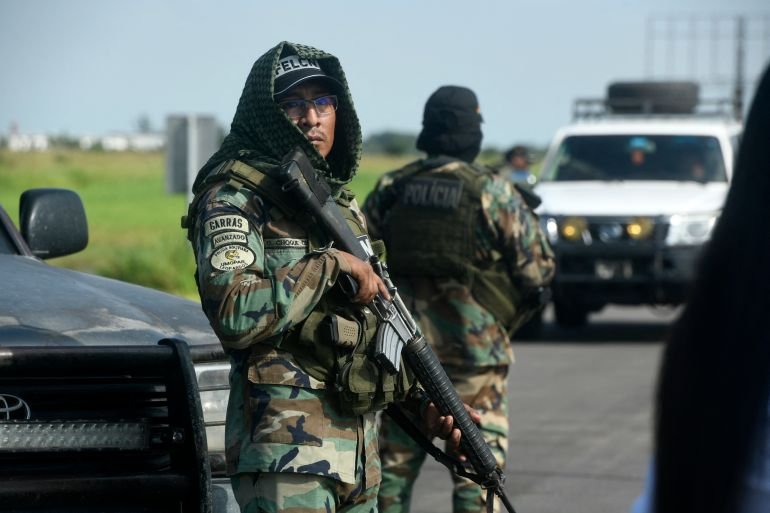
    One of the most wanted drug kingpins in South America, Sebastian Enrique Marset Cabrera, has been arrested in Santa Cruz de la Sierra in Bolivia, after a morning raid involving hundreds of police officers.

    Following Marset’s capture on Friday, Bolivian President Rodrigo Paz celebrated the arrest as a milestone in the fight against drug trafficking on the continent.

    Recommended Stories

    list of 3 itemsend of list

    “One of the drug traffickers and criminals considered among the four biggest on the continent has fallen,” Paz said during a news conference in La Paz, Bolivia.

    “The capture of Mr Marset marks a turning point in the fight against organised crime, and it also reaffirms the government’s determination to confront international and domestic mafias.”

    Paz’s leadership is part of a trend in South America, which has seen longtime left-leaning governments flounder in recent elections, in favour of right-wing alternatives.

    Marset’s arrest also coincides with a renewed push from the United States to more aggressively address drug trafficking across the Western Hemisphere.

    Paz’s nascent government has demonstrated a willingness to partner with the US on those efforts.

    Paz was sworn into office in November, ending nearly 20 years of leadership from Bolivia’s Movement for Socialism (MAS), and in late February, his government reinstated ties with the US Drug Enforcement Administration (DEA) after a rupture in 2008.

    US President Donald Trump recently hosted Paz and other right-wing leaders from Latin America at his Mar-a-Lago resort in South Florida to discuss shared efforts to combat drug cartels and other criminal networks.

    One of Trump’s top advisers, Stephen Miller, reiterated the president’s hardline stance that drug traffickers should not be treated as criminals, but as unlawful combatants in an armed conflict.

    “The cartels that operate in this hemisphere are the ISIS [ISIL] and the al-Qaeda of the Western Hemisphere and should be treated just as brutally and just as ruthlessly as we treat those organisations,” Miller said.

    “We have learned after decades of effort is that there is not a criminal justice solution to the cartel problem.”

    After his arrest on Friday, Marset was transferred into US custody, and he was seen boarding a US-tagged plane.

    The DEA did not participate in his capture, which was led by local law enforcement. No injuries or deaths were reported after the operation.

    Who is Marset?

    The DEA considered Marset, a 34-year-old Uruguayan citizen, to be “one of South America’s most notorious drug traffickers”.

    On March 7, 2024, he was indicted on money laundering charges, for allegedly using US-based financial institutions to process millions in drug-trafficking proceeds.

    The indictment also accused Marset of leading a transnational criminal group, the First Uruguayan Cartel, responsible for shipping cocaine across the world, including to destinations such as Belgium and Portugal.

    One drug bust in the Belgian port of Antwerp turned up nearly 16 tonnes of cocaine linked to Marset’s criminal network.

    Prosecutors have also alleged that Marset solicited advice about disposing of the bodies of his enemies over text messages.

    Both Paraguay and Bolivia had also sought to detain Marset on criminal charges. In 2023, Bolivia, for instance, posted a $100,000 reward for information leading to his capture.

    The US, meanwhile, offered a $2m bounty in May of last year for help arresting or convicting him.

    Marset appeared to relish his reputation as one of South America’s “most wanted” criminal suspects. The Washington Post reported that he stamped his drug shipments with the label, “The King of the South”.

    Media reports also indicated that Marset was a diehard football fan, investing in lower-level sports teams in Latin America and Europe. He had been on the run since July 2023, ahead of a planned operation at the time to detain him.

    In 2021, he was briefly stopped in Dubai, in the United Arab Emirates, for travelling under a fake passport. But Uruguayan authorities ultimately issued him new travel documents that allowed him to leave the country, prompting outcry.

    Since his arrest on Friday, Paraguay has said it too would seek Marset’s extradition so he could stand trial in the country.

    Marset’s arrest follows another major operation last month in Mexico to capture the drug kingpin Nemesio Oseguera Cervantes, known as “El Mencho”, a leader of the Jalisco New Generation Cartel.

    That operation, however, resulted in El Mencho’s death and a wave of retaliatory attacks across Mexico.

  • Alcaraz sets up Medvedev Indian Wells semifinal, Sabalenka also advances

    Alcaraz sets up Medvedev Indian Wells semifinal, Sabalenka also advances

    Carlos Alcaraz will meet Daniil Medvedev in the Indian Wells semifinals, while Jannik Sinner faces Alexander Zverev.

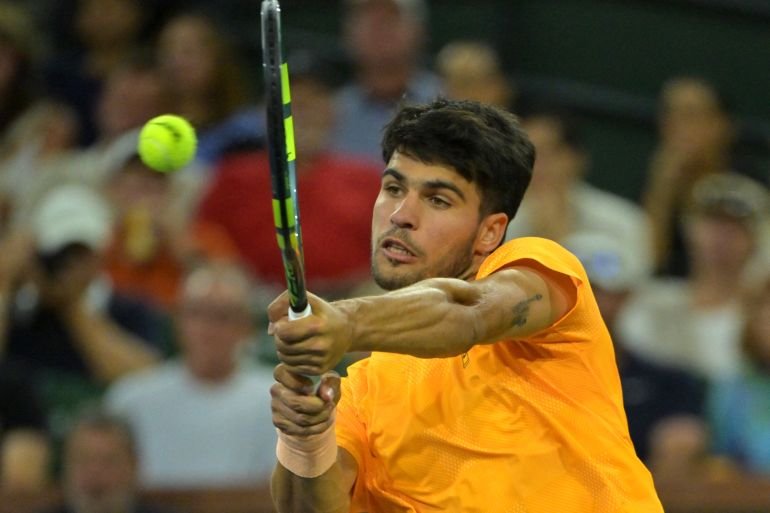
    World number one Carlos Alcaraz charged past Cameron Norrie 6-3 6-4 on Thursday to ⁠set up an Indian Wells semifinal with ⁠Daniil Medvedev after the Russian ended Jack Draper’s title defence with a 6-17-5 win following a controversial umpiring call.

    Top-ranked Aryna Sabalenka also reached the last four in the women’s draw with a 7-6(0) 6-4 victory over 19-year-old Canadian Victoria Mboko, but Iga Swiatek was unable to ⁠find her way past Elina Svitolina and fell 6-2 4-6 6-4.

    Recommended Stories

    list of 4 itemsend of list

    Australian Open champion Alcaraz improved his record to 16-0 to start the year with a solid display against a tricky opponent in the final contest of the evening, remaining on course for a third Indian Wells crown.

    The Spaniard eased through the opening set, and though he ⁠was briefly in trouble at 0-2 down in the second, he quickly regained the momentum to see off Briton Norrie and set up a meeting with twice runner-up Medvedev.

    “It was really difficult, I struggled with Cameron’s style,” Alcaraz said.

    “His forehand has super top-spin, and his backhands are flat, so it’s tricky to play against him and find the correct shots. I played solid and aggressive when I could, and I’m happy to be at this level.”

    Russian 11th seed Medvedev was also in impressive form against Briton Draper, who had ‌little time to recover after his stunning three-set win over Novak Djokovic on Wednesday.

    Draper raised his level in the second set and stayed with his opponent up to 5-5, but Medvedev secured a late break after a controversial hindrance call from chair umpire Aurelie Tourte.

    Medvedev was awarded a point to go 30-0 up following a late video review request, after the Russian said he was distracted by Draper’s raised arm during the rally when the Briton thought the ball went out.

    Draper insisted he had not caused a major distraction, but the umpire stuck with her decision to award Medvedev the point, prompting jeers from the crowd when the call was made.

    “If you look at the first forehand I did after it happened, I think I could have done a better shot if there was no gesture ⁠from Jack,” Medvedev told reporters.

    “Was I distracted big time? No. Do I feel good about it? Not really. But I also ⁠don’t feel like I cheated or something. I got a bit distracted. I let it go and I let the umpire decide.”

    Fourth seed Alexander Zverev beat Frenchman Arthur Fils 6-2 6-3 to make the semifinals for the first time, and become only the fifth man to complete the set of last-four appearances at all nine ATP Masters 1000 events.

    The German faces a big challenge in the next round, ⁠however, as he takes on world number two Jannik Sinner after the Italian made light work of American Learner Tien 6-1 6-2.

    Svitolina upsets Swiatek, while Rybakina could await Sabalenka

    World number two Swiatek struggled early against Svitolina, with the Ukrainian capitalising on five double faults to secure three breaks ⁠and take the opening set in 38 minutes.

    She found her rhythm in the second to force a ⁠decider, but Svitolina regained the upper hand by securing the only break in a tight third set before confidently closing out the match to return to the semis for the first time in seven years.

    Belarusian Sabalenka had a battle on her hands against Mboko, and the top seed was taken to a first-set tiebreak, which she won to love – a career first.

    The second set followed a similar script with Mboko clawing ‌her back to 5-4 and threatening another tiebreak, but four-time Grand Slam champion Sabalenka held firm.

    “She’s a future Grand Slam champion,” Sabalenka said. “It’s incredible to see how brave these young girls are these days.”

    Sabalenka next plays Linda Noskova, who ended Australian qualifier Talia Gibson’s fairytale run 6-2 4-6 6-2, the Czech reaching her second WTA 1000 semifinal.

    Australian ‌Open ‌champion Elena Rybakina advanced with a 6-1 7-6(4) victory over Jessica Pegula to reach another Indian Wells semifinal, where she will play Svitolina.

    Victory ensured Rybakina will leapfrog Swiatek and reach a career-high world number two when the WTA rankings are updated on Monday.

  • Advocates push for major probe as US boat strikes in Latin America kill 157

    Advocates push for major probe as US boat strikes in Latin America kill 157

    Washington, DC – In September, the United States began launching dozens of deadly military strikes against alleged drug-smuggling boats in the Caribbean Sea and eastern Pacific.

    Nearly half a year later, remarkably little is known about the strikes. The identities of the nearly 157 people killed have not been released. Any purported evidence against them has not been made public.

    Recommended Stories

    list of 3 itemsend of list

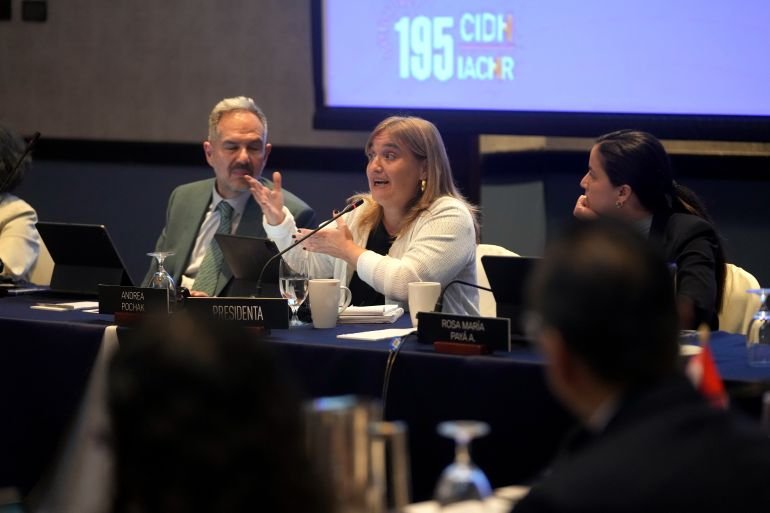
    But a group of United Nations and international law experts are hoping to change that on Friday, when they testify at the Inter-American Commission on Human Rights (IACHR).

    The international hearing will be the first of its kind since the strikes began on September 2, and rights advocates hope it can help lead to accountability as individual legal cases related to the strikes proceed.

    Steven Watt, a senior staff lawyer with the American Civil Liberties Union’s human rights programme, said the goal of the hearing will be threefold.

    “Our ask will be to conduct a fact-finding investigation into what’s going on,” Watt said.

    The second aim, he continued, would be “to assert or to arrive at a conclusion that there is no armed conflict here”, in what would be a rebuke to US President Donald Trump’s previous claims.

    Finally, Watt said, he hopes the proceedings will yield long-sought transparency from the Trump administration on “whether or not they have a legal justification for these boat strikes”.

    “We don’t think there are any,” Watt added.

    ‘We don’t know the names’

    The experts set to testify at Friday’s hearing said the IACHR has a unique mandate to uncover the truth behind the US strikes.

    The commission, based in Guatemala City, Guatemala, is an independent investigative body within the Organization of American States, of which the US was a founding member in 1948.

    While the Trump administration has claimed it has a right to carry out the deadly attacks as part of a wider military offensive against so-called “narco-terrorists”, rights groups have decried the campaign as a series of extrajudicial killings.

    They argue that Trump’s deadly tactics deny those targeted of anything that approaches due process.

    Legal experts have also dismissed Trump’s claims that suspects in drug-related crimes are equivalent to “unlawful combatants” in an “armed conflict”.

    Few details have emerged from the air strikes. Several families have come forward, however, to informally identify the dead as their loved ones.

    Victims are said to include 26-year-old Chad Joseph and 41-year-old Rishi Samaroo, who were sailing home to Trinidad and Tobago when they were killed in October, according to relatives.

    A complaint filed against the US government said both men travelled often between the islands and Venezuela, where Joseph found work as a farmer and fisherman, and Samaroo laboured on a farm.

    The family of Colombian national Alejandro Carranza, 42, have also said he was killed in September when the US military attacked his fishing boat off the country’s coast.

    The US has yet to confirm the victims’ identities, and only two survivors have ever been rescued in the 45 reported strikes.

    A clearer picture of what happened will be a significant step towards accountability, according to experts like Watt.

    “[The IACHR] is uniquely positioned to identify who all these persons are,” Watt said. “We just know the numbers from the United States. We don’t know the names or the backgrounds of these people.”

    The IACHR has launched a range of human rights investigations in recent decades, including probes into the 2014 mass kidnapping of 43 students in Iguala, Mexico, and a series of murders in Colombia from 1988 to 1991 dubbed the Massacre of Trujillo.

    The commission has also examined US policies, including extrajudicial detentions at Guantanamo Bay, Cuba, during its so-called “global war on terror”.

    The IACHR has the power to seek resolutions to human rights complaints or refer them for litigation before the Inter-American Court of Human Rights.

    Just last week, the court ordered Peru to pay reparations to the family of a woman who died during a government-led forced sterilisation campaign in the 1990s.

    The Carranza family has filed its own complaint to the IACHR, and the families of Joseph and Samaroo have also lodged a lawsuit against the US in a federal court in Massachusetts.

    Angelo Guisado, a senior staff lawyer at the Center for Constitutional Rights (CCR), said a fuller accounting of the US actions is needed to prevent future abuses. He is among the experts testifying on Friday.

    “You can’t normalise assassinating fishermen off the coast of South America,” Guisado told Al Jazeera. “That’s just sadistic and an abomination to the rules-based order that we’ve created.”

    “So we hope that the commission can do some investigation.”

    A war against ‘narco-terrorists’?

    One of Guisado’s goals for Friday’s hearing will be to unpack the Trump administration’s argument that the attacks are necessary from a national security standpoint.

    Even before the US strikes began, the Trump administration began framing the Latin American drug trade as an existential threat to the US.

    As part of that re-framing, the administration borrowed messaging from its “global war on terror”, taking the unorthodox approach of labelling several cartels “foreign terrorist organisations”.

    Speaking last week at a meeting of Latin American leaders, White House security adviser Stephen Miller maintained there is no “criminal justice solution” to drug cartels.

    Instead, he affirmed that the US would use “hard power, military power, lethal force, to protect and defend the American homeland”, even if that meant carrying out deadly operations throughout the Western Hemisphere.

    Guisado, however, noted that the administration has admitted that the targeted boats were largely carrying cocaine, not the highly addictive fentanyl responsible for the majority of US drug overdoses.

    He explained that the administration has done little to prove its claims that drug traffickers are part of a coordinated effort to destabilise the US.

    Such hyperbolic language, Guisado added, could be used as a smokescreen to conceal illegal actions.

    “When you invoke national security interest, it seems as if scrutiny and any legitimate analysis or condemnation gets pushed to one side in favour of an ersatz martial law,” Guisado said.

    “The idea that you could just proclaim anyone a narcoterrorist and do whatever you want with them is just so repugnant to our system of fairness, justice and law.”

    Watt, meanwhile, said he hopes the IACHR will draw a clear “line in the sand”, separating drug crimes from what is conventionally considered an armed conflict.

    He also would like to see the IACHR clearly outline the US’s human rights obligations.

    “But even if there was an armed conflict — of which there isn’t — the laws of war would prohibit the type of conduct that the United States is engaging in here,” Watt explained.

    “It would be an extrajudicial killing. It would be a war crime.”

    Transparency or accountability

    Friday’s hearing will only be an initial step towards accountability, and critics question how effective the IACHR will ultimately be.

    The US has regularly shrugged off human rights probes at international forums, and it is not party to entities like the International Criminal Court in The Hague, raising barriers to the pursuit of justice.

    Despite being a member of the OAS, the US has also not ratified the American Convention on Human Rights, one of the organisation’s founding documents.

    It is, therefore, unclear how binding any IACHR decisions could be, although Watt argued that it is “longstanding jurisprudence of the commission that the declaration imposes obligations on non-ratifying member states”.

    Still, legal experts said Friday’s hearing may yield clarity on the Trump administration’s legal argument for the boat strikes.

    The IACHR has said US government representatives are set to appear at the hearing.

    To date, the US Department of Justice has not released the Office of Legal Counsel’s official reasoning for the boat strikes, considered the foundational legal document for the military actions.

    A separate memorandum from that office addressed the US abduction of Venezuelan President Nicolas Maduro on January 3, which it framed as a drug enforcement action.

    That memo touched on the boat strikes, but it only served to raise further questions about Trump’s rationale.

    “This will be an opportunity for the United States to put its case before the commission,” Watt said.

    “But of course, it depends on US cooperation,” he continued. “They’re going down there, but it’ll be interesting to see what they actually say.”

  • UN Security Council adopts resolution condemning Iran’s attacks in the Gulf

    UN Security Council draft resolution demanding Iran end its attacks on Gulf nations was cosponsored by 135 countries.

    The United Nations Security Council adopted a draft resolution condemning Iran’s attacks on Gulf countries and Jordan, demanding that Tehran immediately halt hostilities.

    Thirteen of the 15 members of the UNSC voted on Wednesday in favour of the resolution sponsored by the Gulf Cooperation Council (GCC) and cosponsored by an extraordinary 135 other UN member states.

    Recommended Stories

    list of 4 itemsend of list

    No countries voted against the draft.

    “It was overwhelming. It was 13 votes on the Council in favour, two abstentions,” Al Jazeera’s Gabriel Elizondo said, reporting from UN headquarters in New York.

    “Both China and Russia abstained but notably decided not to use their veto power to block this resolution, probably because it got a lot of support, not only in the Security Council but with other member states – 135 other countries cosponsored this resolution that has now been adopted,” Elizondo said.

    “We believe that this is the largest number of countries ever to cosponsor a Security Council draft resolution,” he said.

    The resolution condemns Iran’s attacks, demands an immediate halt to hostilities, and deplores Tehran’s targeting of infrastructure such as ports and energy facilities in the Gulf region.

    “The resolution is very clear; it is now part of international law. The question becomes, will Iran abide by it? We will find out in the coming hours and days,” Elizondo said.

    ‘Profound regret’

    After the vote, Iran’s UN Ambassador Amir-Saeid Iravani addressed the Council, expressing his “profound regret” at the adoption of the resolution.

    “This is a deeply regrettable day for the Security Council and for the international community. Today’s adoption is a serious setback to the Council’s credibility and leaves a lasting stain on its record,” Iravani said.

    “Today’s action represents a blatant misuse of the Security Council mandate,” he said, blasting the United States for its “barbaric war against the Iranian people” and for starting the conflict, including killing Iran’s Supreme Leader Ali Khamenei.

    “This resolution is a manifest injustice against my country, the main victim of a clear act of aggression. It distorts the realities on the ground and deliberately ignores the root causes of the current crisis,” Iravani said, accusing the US and Israel of being behind the resolution.

    Iravani also said more than 1,348 civilians have been killed and more than 17,000 injured since the US and Israel launched their attack on February 28, including the “massacre of 170 schoolgirls in Minab”.

    More than 19,000 civilian sites, including residential homes and hospitals, have also been damaged, he added.

    Addressing the council, Russia’s ambassador to the UN, Vassily Nebenzia, said his country abstained from the vote on the draft resolution “because it was extremely unbalanced” and would not fulfil the purpose “of meeting international peace and security”.

    “We regret the situation that Middle Eastern countries find themselves in. Moreover, we think it unacceptable to strike civilian infrastructure of Arab states in the Gulf,” Nebenzia said.

    China’s ambassador to the UN Zhang Jun told the council that the conflict had “neither legitimacy nor legal basis” and the US and Israel must cease their attacks to prevent further deterioration of the regional situation.

    The UNSC also voted, but failed to pass, a draft resolution put forward by Moscow on Wednesday that called on all sides to cease military action in the Middle East.

  • FIFA World Cup: US war on Iran, Mexico violence, visa bans, Iraq qualifier

    FIFA World Cup: US war on Iran, Mexico violence, visa bans, Iraq qualifier

    The 2026 edition of the FIFA World Cup kicks off in three months, but what was set to be one of the most straightforward editions to organise in the tournament’s history appears to be growing more complicated by the day.

    The Israeli-United States war on Iran has created massive uncertainty across the globe, and FIFA’s showpiece event is already feeling the ramifications along with policy and political issues that were already rumbling in the Americas.

    Recommended Stories

    list of 4 itemsend of list

    Al Jazeera Sport takes a look at the five issues the competition – cohosted by the US, Mexico and Canada – must resolve before the first match on June 11 between Mexico and South Africa.

    Will Iran participate at FIFA World Cup 2026 in US?

    Iran’s sports minister said on Wednesday that the country cannot ⁠⁠participate in the FIFA World ⁠Cup after the ⁠US killed its supreme leader.

    Ayatollah Ali Khamenei was assassinated on the first day of the US-Israel war, and all of its national football team’s World Cup group games are to be played in US cities.

    The US and Israeli attacks began on February 28. So far, 1,255 people have been killed in Iran and more than 12,000 wounded.

    Iran has hit back with strikes on Israel, US military bases in neighbouring Middle East states and infrastructure in the region.

    “Considering that this corrupt ⁠regime [the US] has ⁠assassinated our leader, under no circumstances ⁠can we ⁠participate in ⁠the World Cup,” Sports Minister Ahmad Donyamali told ‌state television.

    The American flag flutters near a sign pointing to the soccer stadium at Kino Sports Complex, where the Iranian men’s soccer team is scheduled to practice for the FIFA World Cup, in Tucson, Arizona
    The US flag flies near a football stadium at the Kino Sports Complex in Tucson, Arizona, where the Iranian national team is scheduled to practise for the World Cup [Rebecca Noble/Reuters]

    Is the US willing to host Iran at World Cup in time of war?

    US President Donald Trump would “welcome” Iran’s participation in the World Cup, according to FIFA President Gianni Infantino.

    Before Iran’s announcement, Infantino took to Instagram on Wednesday to state that despite the war in the Middle East, Trump had reiterated his stance on Iran’s involvement during a meeting between the pair to discuss the upcoming tournament.

    As the draw stands, the US and ‌Iran could come head-to-head at the tournament if they both ‌finish second in their respective groups. A July 3 elimination match in Dallas would be the outcome.

    Meanwhile, if the US themselves refused to host the Iranian team, then FIFA could remove them as a World Cup host – a fate the Indonesia already befell.

    As hosts of the men’s Under-20 World Cup three years ago, Indonesia refused to welcome Israel. FIFA dropped the tournament host just weeks before the scheduled first game and moved that competition to Argentina.

    What is the latest on Iraq’s qualifications playoff match?

    Iraq are facing major logistical issues as a result of the war before their March 31 qualifier for the World Cup.

    The winner of Iraq’s intercontinental playoff against either Suriname or Bolivia will advance to the 2026 edition, but Iraqi airspace is closed until April 1 due to the war, and the squad is predominantly made up of players from the domestic league.

    With the squad struggling to fully gather for the match, the head coach of the national team, Graham Arnold, asked FIFA on Monday to delay his team’s qualifier.

    The match is due to be played in Monterrey, Mexico, and the host country issued some visas to Iraq’s players at their embassy in Qatar on March 8.

    In a further complication, Mexico does not have an embassy in Iraq for the remaining players.

    Mexico has issued an assurance to Iraq that it will “provide all necessary assistance in documenting the members of the Iraqi national team”.

    Mexico violence raises questions over it hosting World Cup games

    While the US and the rest of the world face complications related to the war on Iran, Mexico is facing its own internal issues.

    A wave of violence was triggered in the country on February 23 after the killing of a drug lord who led one of the most powerful Mexican criminal organisations.

    Gunmen torched cars and blocked highways in more than half a dozen states in the immediate aftermath of news of his killing.

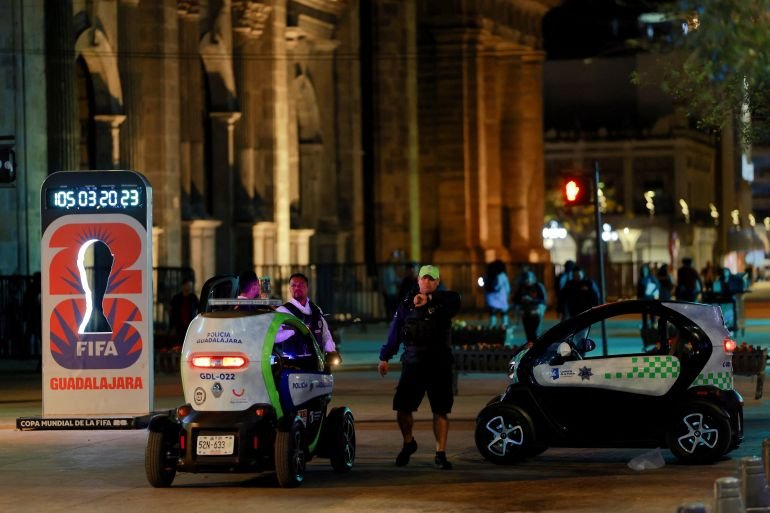
    The first match of the World Cup is being staged in Mexico City with a second on the same day in Guadalajara, which was rocked by last month’s violence.

    Mexican officials thereafter sought to assure FIFA authorities and potential travellers that the tournament would be safe.

    On Friday, President Claudia Sheinbaum said Mexico would deploy as many as 100,000 members of its security forces during the competition, assuring football fans that there was “no risk” in coming to the country.

    Brazilian former soccer player Jose Roberto Gama de Oliveira 'Bebeto' shakes hands with Mexico's President Claudia Sheinbaum in front of the FIFA World Cup trophy during her morning press conference at the National Palace, in Mexico City
    Former Brazilian football player Jose Roberto Gama de Oliveira shakes hands with Mexican President Claudia Sheinbaum during the FIFA World Cup trophy tour [Reuters]

    What are the FIFA World Cup 2026 ticketing issues?

    As with numerous global events in sport and entertainment, the availability and pricing of World Cup tickets for standard seats is a sore point for the general public.

    Nearly 2 million tickets were sold in the first two sales phases for the 2026 edition, and demand was so intense that tickets were oversubscribed more than 30 ‌times.

    The most expensive tickets for the opening game are being advertised at almost $900 while for the final, that figure is more than $8,000

    Tickets in general cost at least $200 for matches involving leading nations. The cheapest tickets for the final cost $2,000 and the best seats $8,680.

    Then there is FIFA’s official resale site, where one category three seat for the final in New Jersey on July 19 was being advertised for an eye-watering $143,750, more than 41 times its original face value of $3,450.

  • Oil prices swing wildly amid mixed messages over Iran war

    Oil prices swing wildly amid mixed messages over Iran war

    Crude oil prices fall sharply as energy markets remain on tenterhooks over effective closure of the Strait of Hormuz.

    Oil prices are seeing dramatic swings as traders struggle to make sense of mixed messages about the impact of the United States and Israel’s war on Iran.

    Brent crude, the international benchmark, on Tuesday plunged 17 percent to fall below $80 a barrel, then rebounded to near $90 after US Secretary of Energy Chris Wright posted on the X platform – but then quickly deleted – a claim that the US Navy had escorted an oil tanker through the Strait of Hormuz.

    Recommended Stories

    list of 4 itemsend of list

    White House Press Secretary Karoline Leavitt later told reporters that there had been no armed escort through the strait, which has been effectively closed to shipping in the region due to Iranian threats.

    Oil prices fell sharply again early on Wednesday after The Wall Street Journal reported that the International Energy Agency was considering the largest release of oil reserves in its history to help keep global supplies stable.

    Brent crude futures were hovering below $85 a barrel as of 02:00 GMT following the news.

    After rising as much as 50 percent to nearly $120 a barrel before falling, oil prices still remain about 17 percent higher than they were before the US and Israel launched joint strikes on Iran on February 28.

    Global energy markets have been on tenterhooks amid the near halt of traffic through the Strait of Hormuz, through which about one-fifth of the global oil supply transits, as well as attacks on energy facilities across the Middle East.

    The effective closure of the waterway has forced Saudi Arabia, the United Arab Emirates, Kuwait and Iraq to cut oil production amid a growing stock of barrels with nowhere to go and depleting storage capacity.

    Hormuz
    A cargo ship sails off the coast of the city of Fujairah, the UAE, on February 25, 2026 [Giuseppe Cacace/AFP]

    Threat of Iranian sea mines

    A sustained rise in oil prices would have serious knock-on effects for the global economy, pushing up the cost of everyday goods and dragging down growth.

    According to an analysis by the International Monetary Fund, every 10 percent rise in oil prices corresponds with a 0.4 percent rise in inflation and a 0.15 percent reduction in economic growth.

    US petroleum prices have risen about 17 percent since the start of the war, while authorities in South Korea, Thailand, Bangladesh and Pakistan have introduced measures such as price caps and rationing to keep costs down.

    US President Donald Trump has repeatedly stated that the US Navy could be deployed to keep the strait open “if necessary”.

    Some analysts have cast doubt on the feasibility of such plans due to the massive backlog of ships in the region and the threat of drone and missile attacks from nearby Iranian shores.

    The US military said on Tuesday that it had attacked 16 Iranian mine-laying vessels near the strait after Trump had earlier warned Tehran against placing mines in the waterway.

    Trump and administration officials have also given conflicting accounts of how long the war might last, exacerbating unease in energy markets.

    On Tuesday, Trump said he expected the war to be over “very soon”, but he also said that US attacks on Iran would not stop “until the enemy is totally and decisively defeated”, and US forces had still not “won enough”.

    “Analysts talk about geopolitical risk constantly, but most of the time, it remains hypothetical. What we saw this week was the market briefly treating that risk as real and repricing supply disruption in earnest,” Chad Norville, president of industry publication Rigzone, told Al Jazeera.

    “At the same time, escorting a single tanker does not materially change the supply equation when well over a hundred vessels typically move through the strait each day. What the market is really trying to determine is whether the overall flow of oil can revert to normal operations,” Norville said.