In an eight-to-one decision, the high court ruled against a law banning the discredited practice on free speech grounds.
Published On 31 Mar 202631 Mar 2026
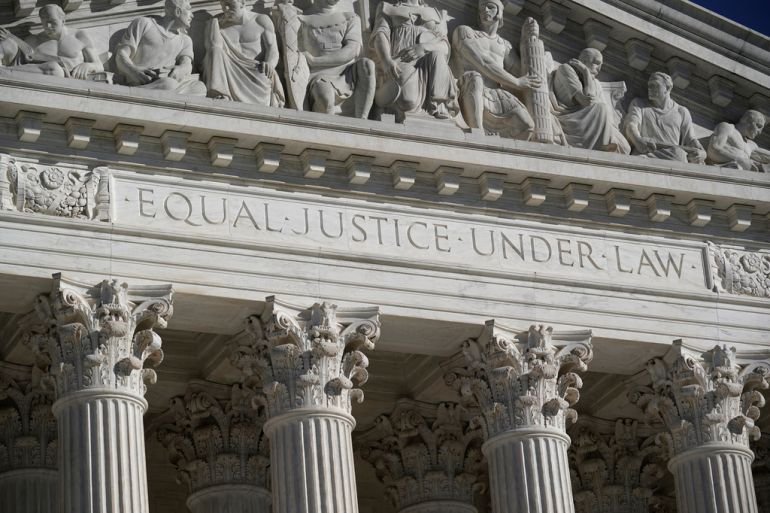
The United States Supreme Court has ruled against a law in the state of Colorado that bans the controversial practice of “conversion therapy” for LGBTQ children, a discredited practice that has been linked to serious harm for participants.
Tuesday’s ruling was an eight-to-one decision, with two of the court’s three liberal justices joining its six conservatives in opposing the ban.
Recommended Stories
list of 3 itemsend of list
The court majority argued that restricting talk therapy could violate the free speech protections enshrined in the First Amendment of the Constitution.
“Once again, because the State has suppressed one side of a debate, while aiding the other, the constitutional issue is straightforward,” Elena Kagan, a left-leaning justice, wrote in a supporting opinion.
About two dozen US states have laws banning conversion therapy, which aims to “convert” the gender identity or sexual orientation of individuals to reflect heterosexual, cisgender norms.
Studies have linked the practice to higher rates of depression and suicidal thoughts for LGBTQ people.
Justice Neil Gorsuch, one of the court’s conservatives, argued that the First Amendment “stands as a shield against any effort to enforce orthodoxy in thought or speech in this country”.
That, in turn, prevents any state from limiting what a therapist might talk about with a patient, even if that therapist seeks to dissuade a child from their LGBTQ identity.
Only one justice, the left-leaning Ketanji Brown Jackson, cast a dissenting vote in Tuesday’s case.
She argued that the ruling “threatens to impair states’ ability to regulate the provision of medical care in any respect”, and she highlighted the dangers of conversion therapy to the health of LGBTQ youth.
In the lead-up to Tuesday’s ruling, Christian counsellor Kaley Chiles successfully argued that the Colorado law banned her from offering voluntary, faith-based talk therapy for children. Her case was supported by the administration of President Donald Trump.
Colorado, meanwhile, maintained that, while its law barred any “practice or treatment” to “convert” LGBTQ youth, discussions about religion, gender and sexuality were in general not prohibited.
Talk therapy, it argued, is also different from other forms of speech, as it represents a form of healthcare. Colorado maintained it had the ability to regulate it as a result.
Nobody has been sanctioned under Colorado’s law, which was passed in 2019. Tuesday’s ruling will likely make similar laws more difficult to enforce. LGBTQ advocates slammed the decision as a step backwards.
“This is a dangerous practice that has been condemned by every major medical association in the country,” Polly Crozier, director of family policy at the advocacy group GLAD Law, said in a statement.
“Today’s decision does not change the science, and it does not change the fact that conversion therapists who harm patients will still face legal consequences.”
Plea comes hours after sheriff’s report said the golfer showed signs of impairment at the scene of last week’s crash.
Published On 31 Mar 202631 Mar 2026
Golfer Tiger Woods pleaded not guilty in his driving under the influence case in Florida on Tuesday, hours after a sheriff’s report said he had pain pills and showed signs of impairment at the scene of the crash last week.
The online court docket for Martin County, Florida, showed that Woods entered a written plea of not guilty and planned to waive his appearance during an arraignment hearing next month.
Recommended Stories
list of 4 itemsend of list
Woods’s eyes were bloodshot and glassy, his pupils were dilated, and he had opioid pills in his pocket when interviewed at the scene of the crash, according to the arrest report released by the Martin County Sheriff’s Office.
The golfer’s movements were slow and lethargic, and he was sweating as he talked to deputies and told them he had taken prescription medication earlier in the morning, according to the report. Woods told deputies he had been looking at his phone and fiddling with the radio before he clipped a truck in front of him, the report said.
Deputies found two white pills, which were identified as the opioid hydrocodone, used to treat pain, in his pocket, the report said.
When asked by a deputy if he took any prescription medications, Woods said, “I take a few.”
Woods’s agent at Excel Sports, Mark Steinberg, has not responded to multiple messages seeking comment.
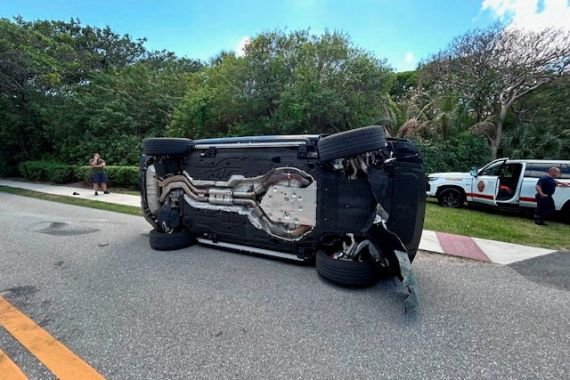
The golfer was travelling at high speeds on a beachside, residential road on Jupiter Island when his Land Rover clipped the truck and rolled onto its side, according to the sheriff’s office, which noted that Woods had shown signs of impairment.
The truck had $5,000 in damage, according to the report.
The truck driver and another person helped Woods out of his vehicle, with the golfer needing to climb out from the passenger side. Neither Woods nor the truck driver was injured.
During a field sobriety test, deputies noticed Woods limping and that he had a compression sock over his right knee. The golfer explained he had undergone seven back surgeries and more than 20 leg operations, and that his ankle seizes up while walking. Woods, who was hiccupping during the questioning, continuously moved his head during one of the sobriety tests, and deputies had to instruct him several times to keep his head straight, the report said.
“Based on my observations of Woods, how he performed the exercises and based on my training, knowledge, and experience, I believed that Woods’ normal faculties were impaired, and he was unable to safely operate the motor vehicle,” the deputy wrote after the tests.
Woods, 50, is the most influential figure in golf and has become as recognisable as any athlete in the world. The first person of Black heritage to win the Masters in 1997, he has captivated golf fans with records likely never to be broken.
But his injuries kept him from accomplishing more, including those suffered in a 2021 car crash that damaged his right leg so badly he said doctors considered amputation.
At this latest crash, Woods agreed to a breathalyser test, which showed no signs of alcohol, but he refused a urine test, authorities said. He was arrested and released on bail eight hours later.
No one from Woods’s camp or the PGA Tour – he is on the board and is the chairman of the committee reshaping the competition model – has commented since his arrest.
Woods, who has been involved in many crashes over the years, is charged with driving under the influence, with property damage and refusal to submit to a lawful test. He is scheduled for arraignment on April 23. Online court records do not list a lawyer for him.
Under a change to Florida law last year, refusing a law enforcement officer’s request to take a breath, blood or urine test has become a misdemeanour, even for a first offence.
Former agents say that they were fired for work on probe into Trump’s efforts to stay in power after 2020 election loss.
Published On 31 Mar 202631 Mar 2026
Three former agents with the Federal Bureau of Investigation (FBI) have filed a class-action lawsuit alleging that they were wrongfully fired in retaliation for their work in the United States.
The lawsuit, filed on Tuesday, marks the latest legal challenge against efforts under President Donald Trump to purge staff at the federal law enforcement agency.
Recommended Stories
list of 3 itemsend of list
The three agents involved — Michelle Ball, Jamie Garman and Blaire Toleman — argue that their employment was terminated as a result of their work on an investigation into Trump’s efforts to stay in power after losing the 2020 election.
Career agents at the FBI are nonpartisan employees. The three plaintiffs argued that agents should not be required to show “fealty to any political party, movement, or figure”.
“Serving the American people as FBI agents was the highest honor of our lives,” the agents said in a statement.
“We took an oath to uphold the Constitution, followed the facts wherever they led and never compromised our integrity. Our removal from federal service — without due process and based on a false perception of political bias — is a profound injustice that raises serious concerns about political interference in federal law enforcement.”
Each of the former agents had between eight and 14 years of experience at the FBI.
In their 48-page complaint, they explain they were abruptly fired in October and November in what they describe as a “retribution campaign” under the Trump administration.
The lawsuit explains they received termination letters, signed by FBI Director Kash Patel, that “baselessly accused them of ‘weaponizing’ their positions within the government”.
The three agents had been assigned to offer FBI support to an investigation led by special counsel Jack Smith, an independent prosecutor assigned to probe Trump’s actions.
As a result of that investigation, Trump was indicted in 2023 on charges he had taken part in an illegal effort to overturn his loss in the 2020 election.
Smith eventually dropped that case, along with another focused on Trump’s retention of classified documents, after the Republican leader was re-elected for a second term in 2024. The Department of Justice has an internal policy prohibiting the prosecution of sitting presidents.
Smith also resigned his position before Trump took office in January 2025.
But since returning to the White House, Trump has faced criticism for allegedly seeking retribution against employees involved in policies he disagrees with.
“President Trump made clear that upon his return to office, he expected top officials in federal law enforcement to carry out his retribution,” Tuesday’s lawsuit asserts.
Nonpartisan members of both the FBI and Department of Justice who were involved in Smith’s work have seen their jobs cut in the aftermath of Trump’s inauguration.
But Tuesday’s class-action lawsuit (PDF) could pave the way for more agents fired for perceived disloyalty to return to their jobs.
By accusing the agents of “weaponising” the FBI, the lawsuit argues that the Trump administration not only damaged their individual reputations but those of all law enforcement officers in similar situations.
“This false and defamatory public smear impugned the professional reputation of Plaintiffs and the proposed class members, suggesting they were something other than faithful and apolitical law enforcement officials,” the lawsuit argues.
A group of 12 former FBI workers also sued the agency in December, alleging that they were wrongfully terminated for taking a knee during a Black Lives Matter protest in 2020.
Iran’s top diplomat Araghchi has told Al Jazeera that, despite contacts, Iran is not in negotiations with the US.
Published On 31 Mar 202631 Mar 2026
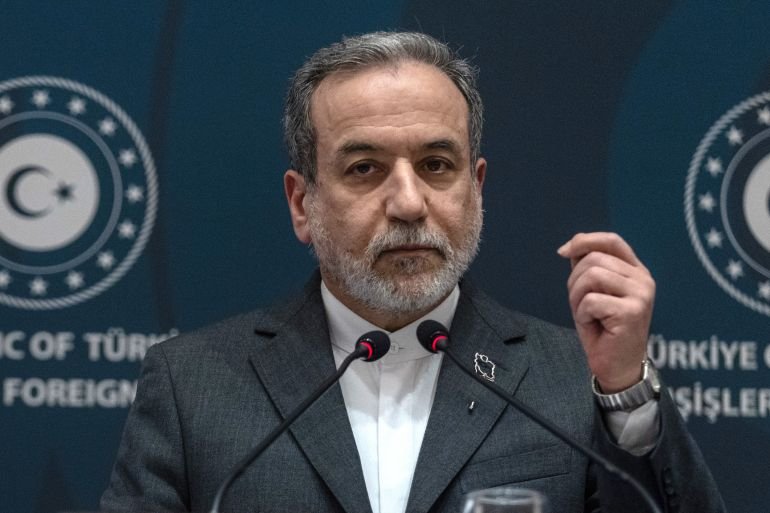
Iranian Foreign Minister Abbas Araghchi has confirmed that messages had been exchanged with the United States, either directly or through countries in the region, amid the ongoing US-Israel war on Iran.
During an interview with Al Jazeera, Araghchi said that the contacts with the US did not mean that Tehran was in negotiations with Washington.
Recommended Stories
list of 3 itemsend of list
“I receive messages from [US special envoy Steve] Witkoff directly, as before, and this does not mean that we are in negotiations,” he said.
“There is no truth to the claim of negotiations with any party in Iran. All messages are conveyed through the Foreign Ministry or received by it, and there are communications between security agencies,” he said, adding that Tehran has not made any decision about negotiating with Washington as it has reservations about them.
The foreign minister also clarified to Al Jazeera that Tehran has not yet responded to the 15-point proposal that was sent by the US, “nor have we submitted any proposals or conditions.”
Reporting from Tehran, Al Jazeera’s Ali Hashem said that much of what Araghchi talked about was not new, but the significant update was the contact with Witkoff.
“The new piece of information is that he’s in touch directly with Witkoff and that there are some security discussions going on,” he said.
Last week, a senior diplomatic source told Al Jazeera that Iran had received a 15-point plan from the US that was aimed at ending the war.
The plan included proposals ranging from calls on Iran to commit to never acquiring a nuclear weapon to limiting its missile stockpile in both range and quantity.
Still, the Iranian foreign minister reiterated that Iran will only accept an end to all attacks in the region rather than a ceasefire.
The chief of global football’s governing body says US-Israeli war on Iran will not affect scheduling of 2026 World Cup.
Published On 31 Mar 202631 Mar 2026
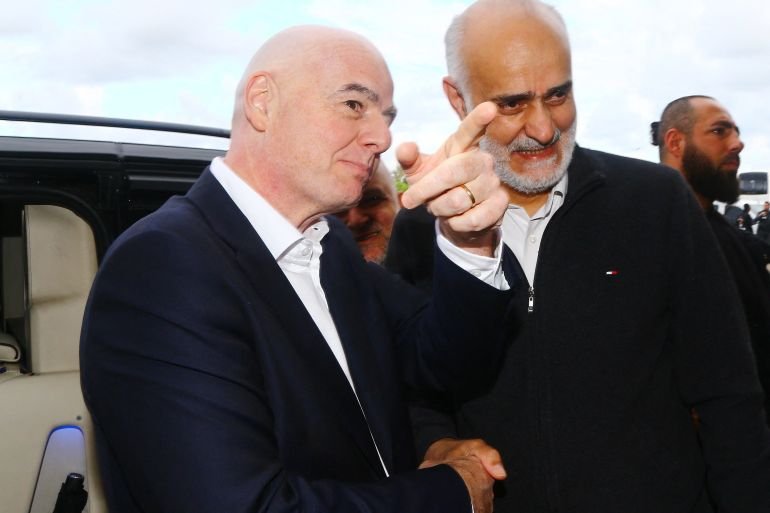
Iran will play their World Cup 2026 games at US venues as scheduled, FIFA President Gianni Infantino has insisted.
The Iranian football federation said earlier this month that it was “negotiating” with FIFA to relocate the country’s World Cup matches from the United States to Mexico, due to the US and Israel’s war with Iran.
Recommended Stories
list of 4 itemsend of list
Mexican President Claudia Sheinbaum also said that her country is prepared to host Iran’s first-round matches at the tournament if needed.
“The matches will be played where they are supposed to be, according to the draw,” the chief of football’s global governing body said on Tuesday.
The World Cup, being hosted by the US, Mexico and Canada, gets under way on June 11, with Iran set to play their first Group G game against New Zealand in Los Angeles on June 15.
They are then scheduled to play Belgium in Los Angeles on June 21 and Egypt in Seattle on June 27.
Iran’s participation had been thrown into doubt by the war with the US and Israel that broke out on February 28.
Speaking at half-time of Iran’s friendly match against Costa Rica on Tuesday, Infantino also moved to quell concerns that Iran will not feature at the next edition of the World Cup at all.
“Iran will be at the World Cup … That’s why we’re here,” Infantino told the news agency AFP at Iran’s warm-up match being staged in Turkiye.
“We’re delighted because they’re a very, very strong team. I’m very happy.
“I’ve seen the team, I’ve spoken to the players and the coach, so everything is fine,” added Infantino, whose attendance at Tuesday’s game was unannounced.
Infantino initially said that US President Donald Trump had given assurances that the Iranian team would still be welcome.
But Trump then stated that Iran’s team should not travel to the tournament “for their own life and safety”.
Iran hit back at Trump’s comments, saying that “no one can exclude Iran’s national team from the World Cup”.
On March 19, Infantino said FIFA was committed to making sure the World Cup goes ahead “as scheduled” with “all teams” taking part.
“FIFA is looking forward to all teams participating at the World Cup to compete in a spirit of fair play and mutual respect,” Infantino said from Zurich during an online FIFA Council meeting.
“FIFA can’t solve geopolitical conflicts, but we are committed to using the power of football and the World Cup to build bridges and promote peace as our thoughts are with those who are suffering as a consequence of the ongoing wars,” added Infantino.
Iran also played a friendly against Nigeria in the Turkish town of Belek last Friday.
Iran’s players wore black armbands and posed with school rucksacks as the national anthem played to remember the victims of a strike on a primary school in Iran on the first day of the Middle East war.
The air strike on the school in the southern Iranian city of Minab on February 28 killed at least 170 people, including students and teachers.
The New York Times has reported that the preliminary findings of a US military investigation indicate that a US Tomahawk cruise missile hit the school due to a targeting mistake.
United States President Donald Trump is considering asking Arab countries to cover the cost of the US-Israel war on Iran, White House spokesperson Karoline Leavitt has said.
“I think it’s something the president would be quite interested in calling them to do,” Leavitt told reporters at a news briefing on Monday.
“I won’t get ahead of him on that, but certainly, it’s an idea that I know that he has and something that I think you’ll hear more from him on.”
Such a mechanism would be similar to how US allies helped fund Washington’s intervention during the Gulf War in 1990.
On Monday, Trump also indicated that he may be satisfied with bringing the war to a close even without the reopening of the Strait of Hormuz, suggesting that “other partners” who rely more heavily on exports shipped through the narrow waterway, which Iran closed shortly after the war began at the end of February, should take on the burden of managing that crisis.
In peacetime, about 20 percent of the world’s oil and liquefied natural gas supplies are shipped through the strait. This has forced the price of Brent crude oil, the global benchmark, as high as $116 per barrel this week, compared with a pre-war price of about $65 and has sparked major supply concerns across the globe. The US, however, is largely self-sufficient when it comes to these resources.
For its part, Tehran has stated that the US should pay reparations to compensate victims of the war in Iran as a condition for any ceasefire to take effect.
So far, there has been no indication from Middle Eastern governments – particularly members of the Gulf Cooperation Council (GCC), which have themselves been directly affected by Iranian strikes on US military assets and infrastructure in their territories – about whether they are prepared to help fund the war. The overall cost, which could run to tens of billions of dollars, analysts said, is still unclear.
Unlike in the 1990-1991 Gulf War, GCC and other Arab states did not ask the US to intervene in Iran before strikes began on February 28, experts pointed out.
“This would have made sense if it was those GCC states that advocated for this war to happen, but they actually advocated for the war not to happen in the lead-up to the war. They continue to call for diplomacy and de-escalation,” Zeidon Alkinani, founding director of the Arab Perspectives Institute, told Al Jazeera.
“The country that seems to be worthy to take and handle the costs would be Israel. The Israeli government … is the party and the agency that has convinced and pushed the United States to take this war on,” Alkinani added.
If the US were to press Arab countries to fund the war on Iran, it would not be the first time the US has tried to – often successfully – make other nations pay for wars it has started or been heavily involved in.
Gulf War
In August 1990, then-Iraqi President Saddam Hussein ordered the invasion of Kuwait, accusing it of overproducing oil to drive down prices and harming its northern neighbour’s war-battered economy after its protracted conflict with Iran for much of the 1980s.
Iraq also revived a longstanding territorial claim over Kuwait dating back to Ottoman- and British-era borders to justify its invasion.
The Iraqi army rapidly overran Kuwait, occupying its capital within days and forcing the 13th emir of Kuwait, Sheikh Jaber al-Ahmad al-Sabah, to flee to Saudi Arabia, where he led the government in exile while Iraqi forces controlled the country.
In January 1991, the US led a global coalition of several dozen countries, including Western, Arab and other Muslim-majority states, to force out Iraqi forces at the request of Kuwait and several of its Gulf neighbours, especially Saudi Arabia. The invasion was named Operation Desert Storm.
The conflict lasted just over six weeks with its main combat phase running from mid‑January to the end of February 1991. The war cost the coalition $61bn at the time, worth about $140bn today.
The war was mostly funded as it progressed by a group of nations comprising Kuwait, Saudi Arabia, the United Arab Emirates, Germany and Japan. Together, they provided $54bn, about 88 percent of the cost of the war.
Most of those contributions were footed by Saudi Arabia, which paid $16.8bn at the time, covering 27 percent of the war costs, and Kuwait, which provided $16bn, or 26 percent of the war costs.
Japan contributed $10bn (16 percent), Germany spent $6.4bn (10 percent), the UAE provided $4bn (6.5 percent) and South Korea chipped in $251m (0.5 percent).
The US covered 12 percent of the costs of the war – $7.3bn, according to figures published by the Pentagon in the early 1990s.
Post-World War II
World War II officially began when Germany invaded Poland in 1939 amid Nazi expansionism.
As a result, Britain and France declared war on Germany a couple of days later.
Japan had already been at war in China since 1937, and in 1941, Japan attacked the US naval base at Pearl Harbor in Hawaii. This pulled the US into the war.
The war ended in 1945: Soviet troops took Berlin, and Germany surrendered; weeks later, the US dropped two atomic bombs on Japan, which too then surrendered.
From 1948 to 1951, the US implemented the Marshall Plan, a US aid plan for Europe’s recovery from the devastation of the war. The US provided more than $13bn in economic support to rebuild Western European economies and contain Soviet influence.
But war reparations were also paid by Japan and Germany, who were forced to accept occupation.
Japan paid more than $1bn from the 1950s to the 1970s to several Asian countries through a patchwork of bilateral treaties and “economic cooperation” agreements.
Germany paid tens of billions of dollars of reparations and compensation. However, there is no single, universally agreed total figure.
While Japanese and German reparations did not go to the US, both countries have spent billions of dollars on the upkeep of US military bases on their territories since World War II. Japan spends about $1.4bn a year, and Germany in excess of $1bn annually, on these bases.
While it was not an instigator of this conflict, the US was at first a key ally of Ukraine, providing Kyiv with military support to counter Russian attacks.
Indeed, the US committed the largest amount of aid to Ukraine – 114.64 billion euros ($134bn) – from January 24, 2022, to June 30, 2025.
This included 64.6 billion euros ($75bn) in military aid, 46.6 billion euros ($54bn) in financial aid and 3.4 billion euros ($4bn) in humanitarian aid.
The European Union has been the second biggest donor at 63.19 billion euros ($74bn), followed by Germany (21.29 billion euros or $25bn), the United Kingdom (18.6 billion euros or $21bn) and Japan (13.57 billion euros or $15bn).
At the same time, Washington has urged European allies to supply weapons to Ukraine and ramp up their own defence spending, helping drive US foreign arms sales to a record $318.7bn in 2024.
Since returning to office in January 2025, Trump has withdrawn 99 percent of US support, shifting the financial burden to European nations instead.
Rather than provide aid, Washington is now selling weapons to Ukraine’s European allies. In July, for example, the US and Germany struck a deal through which Germany will buy US-made air defence systems, such as Patriot systems, to make them available to Ukraine.
(Al Jazeera)
That same month, Trump announced he had approved $10bn in sales of weapons for Ukraine to be paid for by Ukraine’s European allies.
He told reporters that after spending billions to help Ukraine since 2022, “we’re getting our money back in full.”
The Kiel Institute’s Ukraine Support Tracker shows that support to Ukraine has remained stable since the withdrawal of nearly all US funding because Europe has ramped up its support by about two-thirds.
In 2025, Europe contributed about $70bn in military and financial aid to Ukraine while the US contribution fell to $400m.
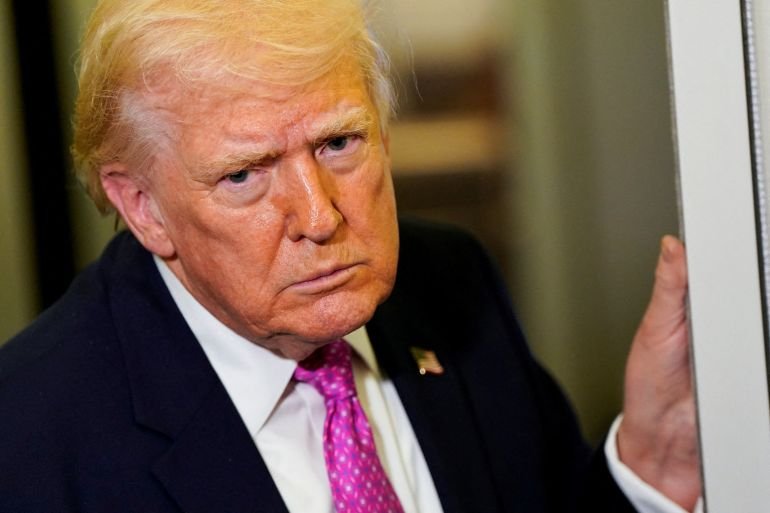
United States President Donald Trump has renewed his threat to “blow up” a range of civilian infrastructure in Iran, including all of the country’s desalination plants, in a move that would threaten the water source for millions of people and that experts say would be illegal.
Trump has been regularly warning Iran about possible US strikes against energy and electricity facilities, but he added water stations to the list of targets in his latest threat on Monday.
Recommended Stories
list of 3 itemsend of list
“The United States of America is in serious discussions with A NEW, AND MORE REASONABLE, REGIME to end our Military Operations in Iran,” Trump wrote in a social media post.
He added that “great progress” has been made in the talks.
“But, if for any reason a deal is not shortly reached, which it probably will be, and if the Hormuz Strait is not immediately ‘Open for Business,’ we will conclude our lovely ‘stay’ in Iran by blowing up and completely obliterating all of their Electric Generating Plants, Oil Wells and Kharg Island (and possibly all desalinization plants!), which we have purposefully not yet ‘touched’,” the US president said.
International law explicitly bans making civilian sites the “object of attack or of reprisals”.
Yusra Suedi, assistant professor in international law at the University of Manchester, said Trump’s threat “reinforces the climate of impunity around collective punishment in warfare”.
“This is clearly an act of collective punishment, which is prohibited under international humanitarian law. You can’t deliberately harm an entire civilian population to pressure its government,” Suedi told Al Jazeera.
Fears of collective punishment and war crimes
The Fourth Geneva Convention says: “Collective penalties and likewise all measures of intimidation or of terrorism are prohibited.”
Raed Jarrar, advocacy director at the rights group DAWN, said Trump’s threats represent “clear, public evidence of criminal intent”.
“Threatening to obliterate a nation’s power grid, oil infrastructure and water supply to coerce its government is not a negotiating tactic; it is textbook collective punishment and a war crime,” Jarrar told Al Jazeera.
Trump first issued a threat to target Iran’s electrical grid and energy infrastructure on March 21 while also giving Tehran a 48-hour deadline to reopen the Strait of Hormuz.
The US president later pushed the deadline back by five days before extending it again until April 6.
Over the past week, Trump has insisted that Iran is “begging” to make a deal and talks between Washington and Tehran are under way.
While Tehran has acknowledged receiving a 15-point ceasefire proposal from Washington through intermediaries, several Iranian officials have denied direct negotiations with the US.
Both Iran and the US have suggested that they are winning the war.
Despite the killing of several top Iranian officials, including Supreme Leader Ali Khamenei, by the US and Israel, there is no public evidence to back Trump’s claim that there is a new government in the country.
Khamenei was replaced by his son Mojtaba, an appointment that Trump denounced.
Iran has also continued to fire missiles and drones across the region and close down the Strait of Hormuz, sending energy prices soaring across the world, despite Trump’s frequent threats.
The Iranian ruling system has not faced any major antigovernment protests or defections during the conflict as the Islamic Revolutionary Guard Corps spearheads the country’s war effort.
So far, Trump’s threats to “obliterate” Iran’s civilian infrastructure have not deterred Tehran’s strikes or affected the public defiance Iranian officials are expressing.
This month, Iran accused the US and Israel of striking a desalination plant on Qeshm Island in the Strait of Hormuz. Separately, authorities have said Iranian attacks damaged water facilities in Bahrain and Kuwait.
Iran, which is less dependent on desalination plants for drinking water than some of its Gulf neighbours, has threatened civilian infrastructure across the region if its own facilities are targeted by the US and Israel.
The upcoming FIFA World Cup will be held at a time of “acute human rights crisis” and will pose significant risks to travelling fans, local communities and those working at the tournament, Amnesty International has said.
The rights group on Monday laid out the threats faced by millions of local and international football fans who will travel to Canada, Mexico and the United States for the six-week tournament.
Recommended Stories
list of 4 itemsend of list
“The US – where three-quarters of World Cup matches will be held – is facing a ‘human rights emergency’ and a recognisable pattern of authoritarian practices,” Amnesty said.
The scathing report was released 10 weeks ahead of the tournament amid immigration crackdowns, protest restrictions and deaths at the hands of US law enforcement officials.
“Armed agents are breaking down doors, detaining children and have deported hundreds of thousands of people,” it said, referring to US immigration policies.
FIFA, host nations urged to take action
Amnesty International said that though FIFA had judged the World Cup to be a “medium risk” tournament, it could become a “stage for repression and a platform for authoritarian practices”.
At least six people have died in the custody of US Immigration and Customs Enforcement (ICE) in 2026, and a seventh person was fatally shot by an off-duty ICE officer. Last year, 32 deaths were reported in ICE custody.
While most of the deaths were due to health complications, some of the late detainees’ families have made accusations of abuse and medical neglect.
The acting director of ICE said last month that the agency will be “a key part of the overall security apparatus for the World Cup”.
The report from London-based Amnesty urges FIFA and World Cup host countries to take urgent action to protect fans, players, journalists, workers and local communities.
FIFA has promised a tournament where everyone “feels safe, included and free to exercise their rights”. But Amnesty said incidents of forced protest shutdowns, gender bias, indiscriminate raids, ethnic profiling, arbitrary arrests, mass detention, cartel violence and unlawful deportations paint a different picture of the host nations.
It accused the US, which will host 78 of the 104 tournament fixtures, of closing civic space while dehumanising and criminalising marginalised people under the administration of President Donald Trump.
“The administration has aggressively advanced an anti-migrant, anti-refugee agenda, subjecting migrants, asylum seekers and refugees to a litany of human rights violations,” the report said.
Amnesty also raised concerns over the Trump administration’s visa ban for nationals of 12 countries, of which four have qualified for the World Cup, saying the “blanket bans target individuals based on their race, religion, nationality and focus on countries with predominantly Black, Brown and Muslim-majority populations, constituting racial discrimination under human rights law”.
People stand next to a sign on the pavement that reads ‘World Cup of dispossession in Mexico City, Mexico [File: Yuri Cortez/AFP]
Mexico, which will host the opening game of the tournament, is facing its own internal issues following a wave of violence that was triggered in the country on February 23 after the killing of a drug lord who led one of the most powerful Mexican criminal organisations.
Gunmen torched cars and blocked highways in more than half a dozen states in the immediate aftermath of the news of his killing.
Mexican officials thereafter sought to assure FIFA authorities and potential travellers that the tournament would be safe.
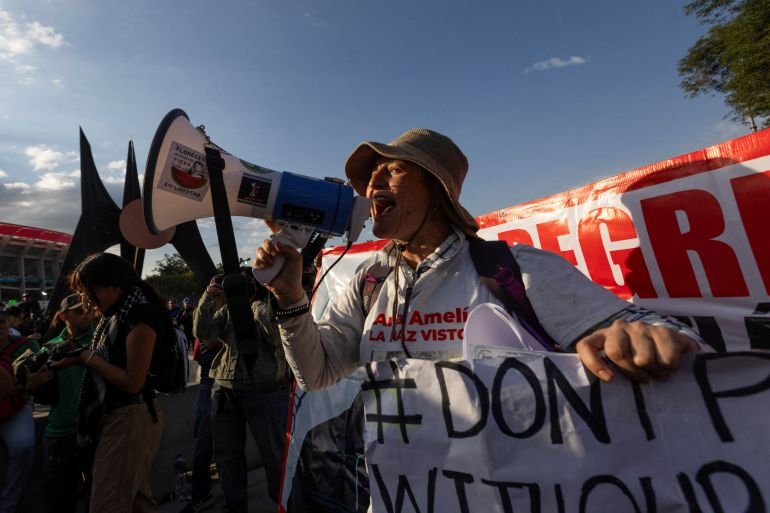
In addition to warning of potential violence, Amnesty’s report said a movement of women – mothers seeking truth, justice, and a remedy for the country’s 133,500 disappeared people – is planning a peaceful protest outside the opening match at the Banorte Stadium in Mexico City.
Meanwhile, in Canada, it is feared that people experiencing homelessness will be displaced amid a growing housing crisis. Amnesty’s report also pointed out “violence and harassment” against the LGBTQ community.
Trump administration censured
Amnesty’s report also criticised President Trump, who was awarded the newly created FIFA Peace Prize in December 2025, when FIFA President Gianni Infantino heaped praise on Trump.
Infantino, a close ally of Trump, had made it clear that he thought the US president should have won the Nobel Peace Prize for his efforts to broker a ceasefire in Israel’s genocidal war on Gaza.
“This is your prize, this is your peace prize,” Infantino said at the glitzy, celebrity-studded ceremony.
But Amnesty said the Trump administration has “actively sought to dismantle and defund existing systems of international cooperation, committed an act of aggression in Venezuela, launched air strikes that constitute extrajudicial executions in Latin America and initiated, jointly with Israel, large-scale attacks against Iran – killing civilians as well as putting the country’s participation in the tournament in doubt”.
Amnesty said none of the published US host city plans address how fans or local communities will be protected from ICE operations.
The global football governing body, which has been heavily criticised over its decision to present the award to Trump, stands to earn $11bn from the tournament cycle.
“While FIFA generates record revenues from the 2026 World Cup, fans, communities, players, journalists and workers cannot be made to pay the price,” said Steve Cockburn, Amnesty’s head of economic and social justice.
“It is these people – not governments, sponsors or FIFA – to whom football belongs, and their rights must be at the centre of the tournament.”
The World Cup kicks off on June 11 at the Mexico City Stadium in Mexico, with the final scheduled for July 19 at the MetLife Stadium in New Jersey in the US.
The announcement comes after Madrid refused to let Washington use jointly operated military bases for the US-Israel war on Iran.
Published On 30 Mar 202630 Mar 2026
Spain has closed its airspace to planes of the United States involved in the US-Israel war on Iran, the latest step in the country’s opposition to the conflict.
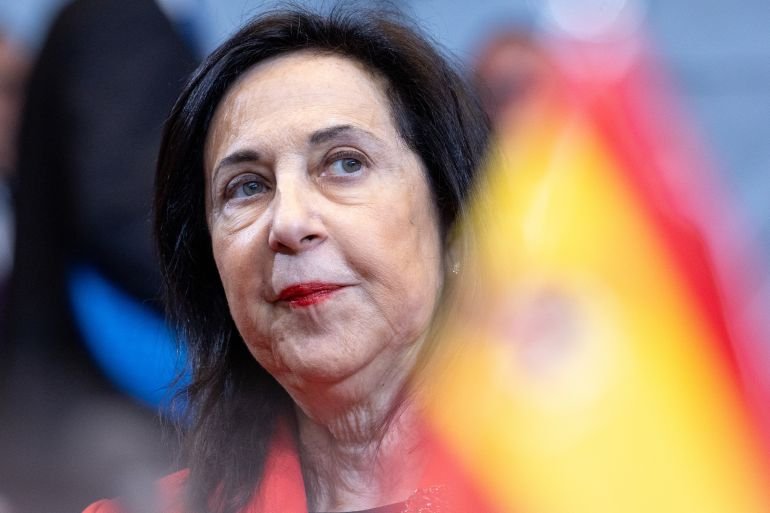
Defence Minister Margarita Robles confirmed the airspace closure to reporters on Monday after Spain’s El Pais newspaper first reported on it, quoting military sources.
Recommended Stories
list of 3 itemsend of list
“This was made perfectly clear to the American military and forces from the very beginning. Therefore, neither the bases are authorised, nor, of course, is the use of Spanish airspace authorised for any actions related to the war in Iran,” Robles said.
“I think everyone knows Spain’s position; it’s very clear,” the minister added, calling the war on Iran “profoundly illegal and profoundly unjust”.
US President Donald Trump threatened to cut trade with Madrid after the Spanish government denied the US use of the Rota and Moron military bases in southern Spain, forcing 15 US aircraft to relocate.
Under the left-wing government led by Sanchez, Spain has been Europe’s loudest opposing voice against US and Israeli military actions in the Middle East, at a time when the European Union vaguely called for de-escalation and protecting civilians without rejecting the assault on Iran.
Commenting on the war earlier this month, the prime minister said: “This is how humanity’s great disasters start … The world cannot solve its problems with conflicts and bombs.”
Spain has also been a vocal critic of Israel’s genocidal war on Gaza. In October, its parliament approved the enshrinement in law of a total arms embargo on Israel, permanently banning the sale of weapons, dual-use technology and military equipment.
That announcement drew a furious response from Israel, which had already withdrawn its ambassador when Spain recognised a Palestinian state in May 2024.
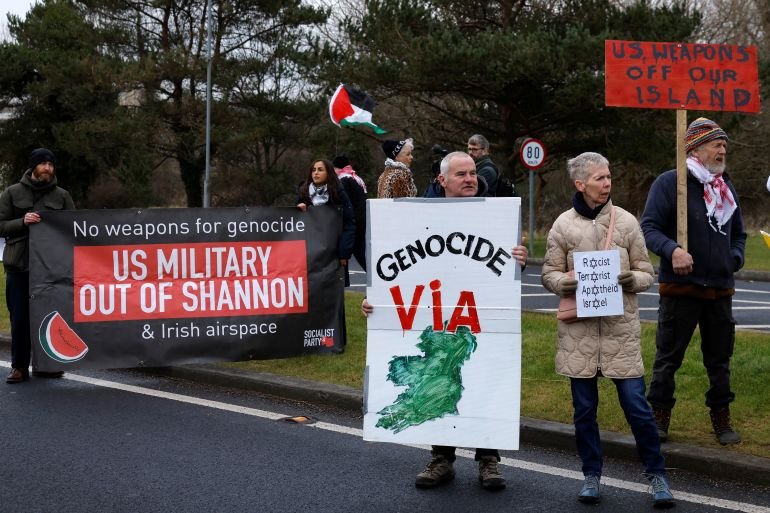
In November, three activists from Palestine Action Eire crashed a modified van through a barrier at Shannon Airport, drove onto the runway towards a United States military aircraft and sprayed green paint on a parked Boeing 737-700.
The action was in protest against what they saw as Ireland’s complicity in Israel’s genocide against Palestinians in Gaza through the US military’s continued use of Shannon Airport. At the time, Israel’s onslaught had killed more than 69,000 Palestinians.
Recommended Stories
list of 4 itemsend of list
According to data collected by the military plane tracker Shannonwarport, at least 1,300 US military and military-contracted civilian aircraft have flown within 60km (37 miles) of Shannon Airport since January 2024, including at least 45 flights that travelled to or from Israel.
“I took part in the action out of a general frustration with the Irish establishment and society,” activist Conan Kavanagh told Al Jazeera.
After spending two days in Limerick Prison on remand, he paid 10,000 euros ($11,500) in bail money. The three activists awaiting trial have been charged with criminal damage and interfering with the “operation, management or safety of an airport”.
“For a country that prides itself on a shared history of colonialism and resistance, I think we’re incredibly limited in how we express support for the Palestinian people,” Kavanagh said. “A lot of Palestinian activism in Ireland is centred around marches, speeches and rallies, which while good needs to be escalated upon with more actively disruptive protests if we hope to actually force the hands of the state.”
Aine Ni Threinir, another of the activists, believes protesting against the US military’s use of the airport in western Ireland “should be something that we all mobilise strongly around”.
“That hasn’t happened,” she told Al Jazeera. “But there are people, myself included and the 11 others in the past two years who have done actions at Shannon, who are now being criminalised and dragged through the courts by the Irish state. So we [Irish people] absolutely could do more, but it has come at a price for those of us who have taken these actions.”
Ireland’s support for Palestine has historic roots. Among its recent actions are recognising the state of Palestine in May 2024, supporting South Africa in its genocide case against Israel before the International Court of Justice, and welcoming dozens of students and medical evacuees from Gaza.
But critics argued that there are still some areas where it could enact meaningful policy to limit Israeli aggressions – such as the use of its airspace.
Protesters hold regular demonstrations at Shannon Airport to call on the Irish government to inspect US military and military-contracted planes for weapons destined for Israel.
In a United Nations report published in October, Francesca Albanese, the UN special rapporteur on occupied Palestinian territory, listed Ireland among the countries that permitted weapons transfers through ports and airports, indicating “an intent to facilitate Israeli crimes”. In an interview with the Irish broadcaster RTE, she urged Ireland to stop the transit of weapons.
In 2024, the Department of Transport approved 1,354 applications for civil aircraft or Irish-registered aircraft to carry military weapons or ammunition through Ireland, representing a 14 percent increase over 2023, The Irish Times reported in April. Only two applications were refused in 2024.
During an interview in April with the Irish radio station Newstalk, Alice Mary Higgins, a member of the Irish Seanad, or Senate, said: “While the full records of all the flights are not available, it is known that the largest number of exemptions have been sought by Germany and the United States.”
Data gathered by Shannonwatch, which tracks US military stopovers, confirm that most aircraft passing through are US military and military-contracted with flights by Germany’s Luftwaffe also appearing in its logs.
Officials maintained that they do not routinely inspect foreign military aircraft landing at the airport and no exemptions have been granted for civilian aircraft to carry munitions bound for Israel.
After the US and Israel attacked Iran, Irish Prime Minister Micheal Martin said Shannon was not being used to assist that war. However, he said while there was not “strong evidence” that US military weapons were being transported, it was difficult to “intervene” or “investigate” if there were any “transgressions” of rules.
Ireland ‘looking the other way’
Shannon Airport has been a key US military refuelling and transit point in Europe for more than two decades.
During the Iraq War, more than two million US soldiers passed through the airport in western Ireland, fuelling controversy and allegations that the site facilitated the transport of weapons and detainees, John O’Brennan, director of Maynooth University’s Centre for European and Eurasian Studies, told Al Jazeera.
While most European Union countries facilitate weapon transfers for allies through NATO or EU security frameworks, Ireland’s official policy is to not allow the transit of weapons through its airspace to maintain its traditional military neutrality.
Under Irish law, all civil aircraft carrying weapons or ammunition must apply for exemptions from the Department of Transport before landing at Irish airports or travelling through Irish airspace.
Irish-registered aircraft carrying munitions anywhere in the world must also seek permission. Foreign military aircraft are only authorised to land or fly through Ireland by the Department of Foreign Affairs on the condition they are not carrying weapons.
While Irish authorities said no prisoners during the Iraq War were transported through the airport, human rights groups such as Amnesty International Ireland said the country’s failure to actively inspect planes meant it had violated its human rights obligations.
The full extent of what passed through Shannon was never established “as the government shut down all investigations”, O’Brennan said.
O’Brennan said the government’s strategy of “looking the other way” has resulted in revelations that weapons have transited illegally.
The Irish investigative site The Ditch reported in August 2024 that Israeli-Belgian Challenge Airlines had illegally transited ammunition and military explosives bound for Israel through Irish airspace, based on documents obtained via Freedom of Information requests by the Belgian antiwar NGO Vredesactie.
After this report, the Department of Transport launched a probe that found nine unauthorised flights had carried munitions through Irish airspace destined for Israel since October 2023.
Opposition parties condemned the findings, accusing the government of “turning a blind eye” and failing to uphold international law and Ireland’s policy of military neutrality.
Eoghan McNeill, an editor at The Ditch, told Al Jazeera that these unauthorised flights were operated by a mix of military contractors and commercial carriers, including Israel’s national airline El Al, US carriers FedEx Express and Omni Air International, and Germany’s national airline Lufthansa. It reported that Challenge Airlines alone made 21 flights carrying weapons to Israel through Irish airspace from October 2023 to January 2025.
The Irish government said the Department of Transport is continuing to examine reports of alleged nonexempted flights. It has also pledged to introduce new laws to enable random physical inspections of aircraft and warned the concerned airlines against carrying Israeli munitions through Irish airspace without authorisation.
In October, Ireland granted an exemption for a US military-chartered Omni Air International flight to carry munitions to the Israeli military’s Nevatim Airbase in southern Israel. This marked the first time since 2006 that the Irish government had acknowledged authorising an Israel-bound weapons flight to fly through Shannon Airport, The Ditch reported.
At the time of publication, neither the Irish prime minister’s office nor the Department of Transport had responded to Al Jazeera’s request for comment.
O’Brennan said Ireland is cautious about provoking Washington due to its economic ties with the US, citing the issues around Shannon and a long-debated Occupied Territories Bill, which would ban trade with Israeli settlements, which are illegal under international law. The legislation is yet to pass despite strong parliamentary support.
Last month, Shannon Airport faced renewed criticism after The Guardian reported that several Palestinians arrested in the US were deported to the occupied West Bank on flights chartered by US Immigration and Customs Enforcement that refuelled at the airport.