Tag: News – Al Jazeera

  • US military kills three in new Eastern Pacific boat strike

    US military kills three in new Eastern Pacific boat strike

    The attack is the latest in a string of killings by the United States that rights groups say are ‘unlawful’.

    The United States military says it has attacked a new vessel in the Eastern Pacific, killing three people it accuses of “narco-trafficking”.

    The attack announced on Wednesday is the latest in dozens of such strikes carried out by the US military in recent months, a pattern rights groups have slammed as “extrajudicial killings”.

    Recommended Stories

    list of 3 itemsend of list

    US Southern Command said the latest vessel targeted was operated by unnamed “Designated Terrorist Organizations” who were “transiting along known narco-trafficking routes” in the region.

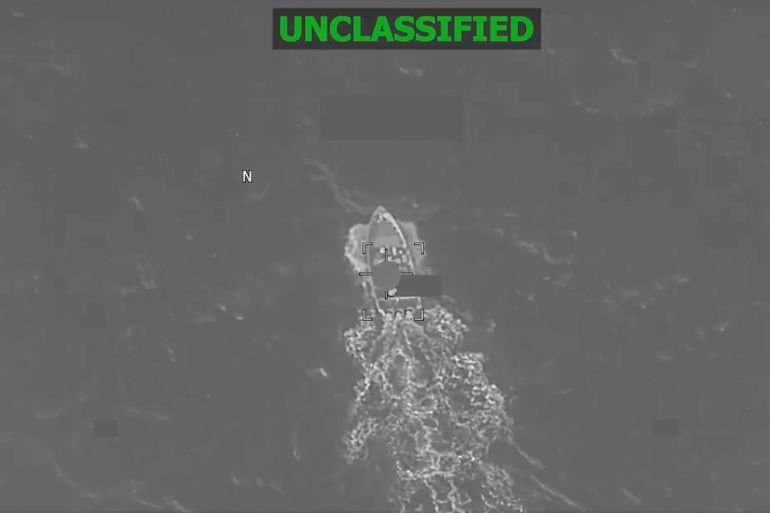
    It shared a video of an air strike appearing to tear into the vessel, which burst into flames.

    The US military said none of its forces was harmed in the operation.

    The attack comes a day after the US military said another of its strikes ⁠in the eastern Pacific killed four ⁠people, while a separate strike on Monday in the region had killed two.

    In total, US attacks on vessels accused of narco-trafficking have killed at least 178 people since September, when US President Donald Trump ordered the attacks to stop what the White House claims are Latin American cartels transporting drugs to the US.

    ‘US cannot summarily kill people’

    Experts and human rights advocates, both in the US and globally, have questioned the legality of the strikes, some of which they say have targeted civilian fishing boats.

    Human Rights Watch has ‌said the strikes amount to “unlawful extrajudicial killings”, while the American Civil Liberties Union has cast the assertions by ‌the ‌Trump administration against those it targets as “unsubstantiated, fear-mongering claims”.

    Legal experts have said that if some vessels were involved in drug trafficking, those on board should face the law, rather than deadly attacks.

    “US officials cannot summarily kill people they accuse of smuggling drugs,” said Sarah Yager, Washington director at Human Rights Watch.

    “The problem of narcotics entering the United States is not an armed conflict, and US officials cannot circumvent their human rights obligations by pretending otherwise.”

    Critics have also questioned the effectiveness of the US military operation in part because the fentanyl behind many fatal overdoses in the US, which Trump has used to justify his campaign, is typically trafficked to the US over land from Mexico, where it is produced with chemicals imported from China and India.

  • US jury finds Ticketmaster and Live Nation had anticompetitive monopoly

    US jury finds Ticketmaster and Live Nation had anticompetitive monopoly

    A New York jury has found that concert giant Live Nation and its subsidiary Ticketmaster had a harmful monopoly over big concert venues, dealing the company a loss in a lawsuit over claims brought by dozens of states in the United States.

    A Manhattan federal jury deliberated for four days before reaching its decision on Wednesday in the closely watched case, which gave fans the equivalent of a backstage pass to a business that dominates live entertainment in the US and beyond.

    Recommended Stories

    list of 4 itemsend of list

    At the end of the proceeding, the judge told lawyers on both sides to arrange with one another “and the United States” to provide a joint letter proposing a schedule for motions and how the remedies phase of the case would occur. He told them to deliver it by late next week.

    Live Nation Entertainment owns, operates, controls booking for or has an equity interest in hundreds of venues. Its subsidiary Ticketmaster is widely considered to be the world’s largest ticket-seller for live events. Its lawyers did not immediately comment as they left the court, but said a statement would be issued shortly.

    The verdict could cost Live Nation and Ticketmaster hundreds of millions of dollars, just for the $1.72 per ticket that the jury found Ticketmaster had overcharged consumers in 22 states. The companies could also be assessed penalties. In addition, sanctions could result in court orders that they divest themselves of some entities, including venues, such as amphitheatres that they own.

    Smothering competition

    The civil case, initially led by the US federal government, accused Live Nation of using its reach to smother competition by blocking venues from using multiple ticket sellers, for example.

    “It is time to hold them accountable,” Jeffrey Kessler, a lawyer for the states, said in a closing argument, calling Live Nation a “monopolistic bully” that drove up prices for ticket buyers.

    Live Nation insisted it is not a monopoly, saying that artists, sport teams and venues decide prices and ticketing practices. A company lawyer insisted its size was simply a function of excellence and effort.

    “Success is not against the antitrust laws in the United States,” lawyer David Marriott said in his summation.

    Ticketmaster was established in 1976 and merged with Live Nation in 2010. The company now controls 86 percent of the market for concerts and 73 percent of the overall market when sporting events are included, according to Kessler.

    Ticketmaster has long drawn ire from fans and some artists. Grunge rock titans Pearl Jam battled the business in the 1990s, even filing an antimonopoly complaint with the US Department of Justice, which declined to bring a case at that time.

    Decades later, the Justice Department, joined by dozens of states, brought the current lawsuit during Democratic former President Joe Biden’s administration. Days into the trial, Republican President Donald Trump’s administration announced it was settling its claims against Live Nation.

    The deal included a cap on service fees at some amphitheatres, plus some new ticket-selling options for promoters and venues — potentially allowing, but not requiring, them to open doors to Ticketmaster competitors such as SeatGeek or AXS. But the settlement does not force Live Nation to split from Ticketmaster.

    A handful of the states joined the settlement. But more than 30 pressed ahead with the trial, saying the federal government had not gotten enough concessions from Live Nation.

    The trial brought Live Nation CEO Michael Rapino to the witness stand, where he was questioned about matters that included the company’s Taylor Swift ticket debacle in 2022, when a massive demand for pre-sale tickets for her concert led to major issues on Ticketmaster. Rapino blamed a cyberattack.

    The proceedings also aired a Live Nation executive’s internal messages declaring some prices “outrageous,” calling customers “so stupid”, and boasting that the company “robbing them blind, baby”. The executive, Benjamin Baker, apologetically testified that the messages were “very immature and unacceptable”.

  • What are Iran’s $100bn in frozen assets and where are they held?

    What are Iran’s $100bn in frozen assets and where are they held?

    As momentum builds for a second round of talks between the United States and Iran aimed at ending their war, one central issue has emerged as a bone of contention: Tehran’s frozen assets held in other countries.

    Iran’s economy has been ailing for years due to sanctions imposed on the country by the US and other nations. These sanctions have been imposed since 1979, first over the US hostages held at the American embassy in Tehran following the Islamic revolution, and then amplified over Iran’s nuclear and ballistic missiles programmes. These measures have restricted Tehran’s ability to access its own assets, like revenues from oil sales, which have been frozen in foreign banks.

    Recommended Stories

    list of 3 itemsend of list

    On April 10, before the first round of ceasefire talks began in Pakistan, the speaker of Iran’s parliament, Mohammad Bagher Ghalibaf, said on X that Iranian frozen assets (revenues frozen in foreign banks) must be released before any negotiations could begin.

    A day later at the ceasefire talks in Pakistan’s capital, Islamabad, some reports emerged suggesting that Washington had agreed to unfreeze at least some of the Iranian assets being held outside the country. But the US government quickly dismissed those reports, insisting that those assets remained frozen.

    With talks expected to resume in the coming days, ahead of the expiry of the current US-Iran ceasefire in the early hours of April 22 in the Middle East, that tension is expected to resurface.

    But how many Iranian assets are frozen, why is Tehran unable to access them, where are these funds at the moment, and why are they important to Iran?

    What’s the volume of Iran’s frozen assets?

    While the exact amount of Iran’s frozen assets is unclear, official Iranian reports and experts have set the total amount of frozen Iranian assets overseas at more than $100bn.

    Frederic Schneider, a nonresident senior fellow at the Middle East Council on Global Affairs told Al Jazeera that these assets are about four times what Iran earns annually from the sale of hydrocarbons.

    “This is a very substantial sum, especially for a society that has been suffering under decades of US-led sanctions,” he said.

    But he added that it remains unclear whether the US — even if it were to release these assets — would make that conditional on how they are used.

    “Iran definitely has a dire need for the assets but given the very chaotic history of sanctions and the lack of specialists on the US side to negotiate the details, Iran is sceptical,” he said.

    Jacob Lew, who was secretary of the Treasury under former US President Barack Obama, said in 2016 that Iran would not be able to access all of its assets frozen abroad even if all sanctions were lifted. At the time, Iran had agreed to a landmark deal with the US and other nations, capping its nuclear programme in exchange for sanctions relief.

    Lew had told Congress that in reality, Iran would be able to access only about half of its frozen assets at best, because the rest were already committed to previously promised investments or for loan repayments.

    Currently, Tehran’s key demand in the ceasefire talks is to release at least $6bn of its frozen assets, as a confidence-building measure.

    What are frozen assets?

    When the funds, property or securities of a person, company or country’s central bank are temporarily retained by another nation’s authorities or a global body, that constitutes the freezing of assets.

    This restricts the owners’ ability to sell these assets due to sanctions, court orders or other regulatory reasons.

    Assets could be frozen by a court, by another country or international body or a banking institution. Officially, countries say that they freeze the assets of another nation or company over accusations of criminal activities, money laundering or violations of international law.

    But critics of the practice point to its selective use to target rivals of the West — Israel, for instance, has faced repeated accusations of carrying out rights abuses, waging illegal wars and perpetrating apartheid. Yet its overseas assets have not been frozen by any country.

    By contrast, Iran, Russia, North Korea, Libya, Venezuela and Cuba are some of the countries whose assets have been frozen by foreign governments. The common thread that binds them all: they’re opposed — or have been opposed — to the US dominance of the international order.

    Why does Iran have frozen assets?

    According to US government archives, the first asset freeze took place in November 1979 when the US president at the time, Jimmy Carter, said that Iran “constitutes an unusual and extraordinary threat to the national security, foreign policy and economy of the United States”.

    At the time, Iranian students were holding 66 American citizens hostage in the US embassy in Tehran.

    The secretary of the Treasury at the time, William Miller, told reporters that Iran’s liquid assets back then amounted to less than $6bn, the largest component of which was $1.3bn in Treasury notes held by the Federal Reserve Bank of New York. In 1981, the Algiers Accords, brokered by Algeria between the US and Iran, resulted in the US unfreezing a significant portion of these assets in return for Iran releasing the 52 American captives who were still being held at that point in Tehran.

    In the following years, however, relations between the US and Iran continued to sour, with Washington uneasy over Tehran’s nuclear programme.

    Iran has always maintained that its uranium enrichment programme is for civilian energy purposes only, despite having enriched uranium far beyond the threshold required for that.

    Israel and the US have repeatedly accused Iran of enriching uranium to develop nuclear weapons. The US and its allies, especially Europe, have slapped multiple rounds of sanctions on the country, even though Israel — the only Middle Eastern country widely believed to already hold nuclear weapons built through a clandestine programme — has faced no such scrutiny.

    In 2015, Iran struck a pact with world powers negotiated by the US under President Barack Obama, called the Joint Comprehensive Plan of Action (JCPOA). Under the pact, Tehran agreed to scale down its nuclear programme and, as a result, regained access to most of its assets abroad at the time.

    But in 2018, during his first term as president, Donald Trump unilaterally pulled the US out of the pact, calling it “one-sided” and reimposing sanctions on Iran, freezing its foreign assets once again.

    In 2023, the US and Iran agreed to a prisoner swap deal, which saw Tehran release five US-Iranian citizens in exchange for the US releasing several Iranians jailed in the country, and giving Iran access to billions of dollars in frozen funds. The funds in question were $6bn in oil revenue that was frozen in South Korea due to US sanctions.

    Under the scheme, the money was transferred to Qatar to oversee. But the following year, United States President Joe Biden imposed new sanctions on Iran in response to its missile and drone attack on Israel, leading to Iran’s losing access to these assets in Doha yet again.

    Besides the US, the European Union has also partially frozen Iran’s central bank assets on grounds of Iran allegedly committing human rights violations, and over accusations of nuclear-related noncompliance, terrorism and its drones programme supporting Russia’s war against Ukraine.

    Which countries hold Iran’s frozen assets?

    Iran’s frozen assets are held by multiple countries.

    The exact amount each country currently holds is unclear, but Iranian media have previously reported that Japan, another important Iranian oil customer, holds about $1.5bn, Iraq holds around $6bn, China holds at least $20bn and India holds $7bn.

    The US also holds approximately $2bn in directly frozen Iranian assets, while EU countries like Luxembourg hold about $1.6bn.

    Qatar holds about $6bn — the amount that was moved from South Korea to pay Iran, but subsequently blocked by the US.

    Why is unfreezing the assets important to Iran?

    Iran’s economy is in crisis, with decades of sanctions limiting its oil exports and stalling its ability to attract investments and modernise its industry and technology.

    A surge in inflation and a fall in the value of the currency, the rial, led to massive protests in December and January that then grew into a larger campaign challenging the ruling establishment. Thousands were killed amid a crackdown by security forces. Iranian officials claim that “terrorists” funded and armed by the US and Israel were responsible for the killings. Trump recently confirmed that the US had armed some protesters.

    Against this backdrop, the frozen assets are locked cash that Iran could readily use: $100bn represents almost a quarter of the country’s GDP.

    Roxane Farmanfarmaian, academic director and lecturer in international politics specialising in Iran at the University of Cambridge, told Al Jazeera that unfreezing Iran’s assets would be significant to the country.

    “It would mean being able to repatriate its funds earned in hard currency from oil sales, for example, back into its own economy. It would also give it control over its currency fluctuations, and hence avoid the vulnerability to currency swings that, for example, set off the December 2025 protests,” she said.

    She noted that significant industries, including its oil fields, water systems and electricity grids, are facing infrastructure decline and would all benefit from upgrades if the country gets free access to its assets. With the assets, Iran could pay foreign companies and its own industries to begin improving, she said.

    “Obviously, it [Iran] will also have to rebuild after the war, and freed-up assets would immediately make that process quicker and more efficient,” she said.

    “Having access to its frozen funds will also jump-start the economic growth it needs, improving the government’s relationship with the public and begin the long process of draining out the corruption that is the inevitable accompaniment to sanctions regimes,” she added.

    The US decision on whether to unfreeze Iranian assets would also serve as a critical diplomatic message, Chris Featherstone, a political scientist at the University of York, told Al Jazeera.

    “Internationally, unfreezing the assets could signal a lessening of the US pressure on the Iranian economy,” Featherstone said. “This could enable increased engagement from other international actors and regional neighbours, developing trade and integration.

    “However, with the Trump administration’s unpredictable approach to international politics and the war with Iran, this could also be interpreted as further evidence of how difficult it is for allies and enemies of the US to predict the Trump administration’s next move.”
  • US-Iran talks: What’s the latest on mediation efforts?

    US-Iran talks: What’s the latest on mediation efforts?

    A renewed diplomatic push is under way to revive talks between the United States and Iran amid a fragile two-week ceasefire agreed last week following nearly six weeks of fighting in the US-Israeli war on Iran.

    The truce, which expires on April 22, has created a small window for negotiations to end the war, which has killed more than 4,000 people across the Middle East, overwhelmingly in Iran and Lebanon.

    Recommended Stories

    list of 3 itemsend of list

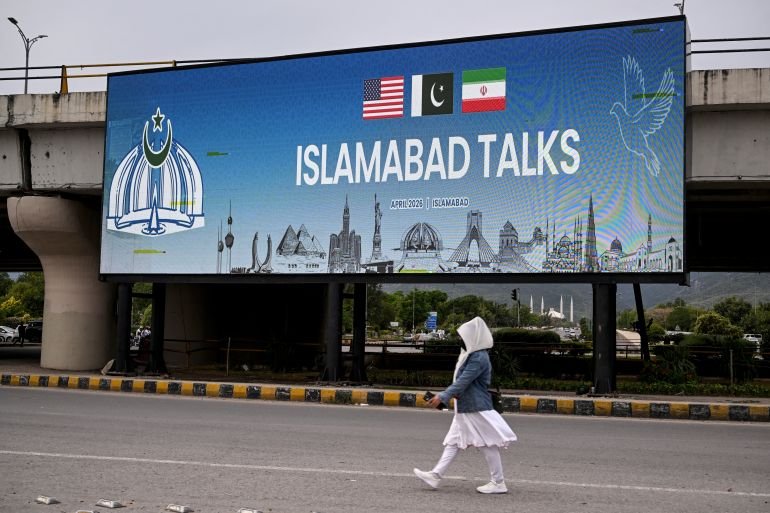
    The first round of talks was held on Saturday in Islamabad under Pakistani mediation, but failed to secure an understanding or agreement between Tehran and Washington.

    Pakistan’s Prime Minister Shehbaz Sharif is on tour this week, making a flurry of stops including in Saudi Arabia and Turkiye, to shore up support for the process and prevent a return to all-out war.

    Meanwhile, US President Donald Trump says the war is “very close to being over” and has signalled that a second round of talks could resume within days, again potentially in the Pakistani capital.

    Here is what we know about the latest mediation efforts:

    What happened in the first round?

    The first round of high-level talks took place in Islamabad on April 11 and 12, and marked the most significant direct engagement between the US and Iran in decades.

    Mediated by Pakistan, the talks lasted more than 20 hours and included both indirect and direct exchanges between delegations led by US Vice President JD Vance and senior Iranian officials.

    According to reports, the discussions focused on several core issues, including Iran’s nuclear programme, sanctions relief, Iran’s frozen assets, and control of the Strait of Hormuz.

    The talks concluded without a resolution or memorandum of understanding, with Vance claiming Iran chose “not to accept our terms”, adding that the US needs to see a “fundamental commitment” from Tehran not to develop nuclear weapons.

    Iran’s Parliament Speaker Mohammad Bagher Ghalibaf, the leader of Tehran’s delegation, said it raised “forward-looking” initiatives, but the US had failed to gain the ‌‌‌‌trust of his delegation in the talks.

    What do we know about the next round of potential talks?

    Reports in US and international media suggest there are growing prospects for a second round that could take place in a matter of days.

    On Wednesday, the AP news agency reported that Washington and Tehran had given an “in principle agreement” to extend the ceasefire to allow for diplomatic overtures, citing unnamed regional officials.

    However, a US official was quoted by Reuters as saying that ⁠⁠Washington has not ⁠⁠formally agreed to ⁠⁠the extension of its ceasefire with ‌‌Iran. There is “continued engagement ⁠⁠between the ⁠⁠US and Iran to reach ⁠⁠a deal”, the US official said.

    Meanwhile, world leaders have made differing statements over the past week about the ceasefire and the chance for further talks.

    On Tuesday, US President Trump suggested talks could resume within days. “You should stay there, really, because something could be happening over the next two days, and we’re more inclined to go there [Islamabad],” he told a New York Post reporter in Islamabad.

    However, Pakistan’s PM Sharif began a four-day trip to Saudi Arabia, Qatar and Turkiye on Wednesday to rally support for the negotiations, making it unlikely that talks could be held in the timeframe Trump was suggesting.

    On Wednesday, Turkish President Recep Tayyip Erdogan said he ⁠⁠⁠⁠was hopeful about negotiations despite roadblocks.

    “We are conveying the necessary suggestions and carrying out initiatives to ease tensions, extend the ⁠⁠⁠⁠ceasefire and maintain talks. There can be no negotiating ⁠⁠⁠⁠with clenched fists,” Erdogan said.

    While reports, including Trump’s own remarks, suggest that Islamabad would be the likely host, no announcement has been made.

    What are the main sticking points in negotiations?

    Nuclear programme

    The thorniest issue remains Iran’s nuclear programme. In particular, the US and Israel are pushing for complete restrictions on uranium enrichment, and have accused Iran of working towards building a nuclear weapon, while providing no evidence for their claims. In March 2025, Tulsi Gabbard, the US director of National Intelligence, testified to Congress that the US “continues to assess that Iran is not building a nuclear weapon”.

    Iran insists its enrichment effort is for civilian purposes only. It is a signatory to the 1970 Treaty on the Non-Proliferation of Nuclear Weapons (NPT)

    In 2015, the US was a signatory to the Joint Comprehensive Plan of Action (JCPOA) under then-US President Barack Obama. In that agreement, Iran pledged to limit its uranium enrichment to 3.67 percent and to comply with inspections by the International Atomic Energy Agency (IAEA) in return for the removal of international sanctions.

    However, in 2018, during his first term, Trump withdrew the US from the JCPOA despite the IAEA saying Iran had complied with the agreement up to that point.

    Strait of Hormuz

    Access to and control of the vital waterway connecting the Gulf to the Arabian Sea remains a major flashpoint. One-fifth of the world’s oil and liquefied natural gas (LNG) supplies are shipped through the Strait of Hormuz in peacetime. Since the US and Israel launched strikes on Iran at the end of February, shipping through the passage has fallen by 95 percent as Iran has threatened to target tankers. During the conflict, Iran has allowed some ships it sees as friendly, as well as others that pay a toll, to pass.

    The US wants free passage through the waterway, while Iran insists on its sovereignty over the strait, saying all “non-hostile” ships can pass through.

    Moreover, Iranian officials insist on having the authority to levy tolls on ships passing through the strategic strait, including after the war concludes.

    In a further escalation, Trump imposed a naval blockade on Iranian ports on Monday, creating another obstacle to the prospects of talks restarting.

    INTERACTIVE - Strait of Hormuz - March 2, 2026-1772714221
    (Al Jazeera)

    Lebanon

    A key demand from Iran is that Israel end its offensive against Iran’s ally Hezbollah in Lebanon. Tehran said the ceasefire agreed last week included the war in Lebanon, but the US and Israel have both rejected that. Trump has called Israel’s assaults on its neighbour “a separate skirmish” even though Hezbollah entered the war in defence of Iran.

    An initial social media post by Pakistani PM Sharif announcing the ceasefire included Lebanon. Following that announcement, however, Israel launched its most widespread attacks since March, when fighting with Hezbollah began, striking more than 100 targets across the country in just one day – Wednesday – last week.

    Hezbollah is Tehran’s most powerful regional ally and a central part of the “axis of resistance”, a network of armed groups across the Middle East aligned with Iran against Israel, including Yemen’s Houthis and a collection of armed groups in Iraq.

    While Israel and Lebanon held direct talks in Washington on Tuesday, the first formal meeting between the two countries, Israel says it will not stop its attacks on Hezbollah.

  • Avdija scores 41 as Trail Blazers upset Suns in NBA West play-in

    Avdija scores 41 as Trail Blazers upset Suns in NBA West play-in

    Deni Avdija scored 41 points, and his ‌three-point play with 16.1 seconds remaining capped the Portland Trail Blazers’ comeback from an ⁠11-point fourth- quarter deficit ⁠for a 114-110 victory over the host Phoenix Suns in a National Basketball Association (NBA) play-in game on Tuesday.

    The Trail Blazers ended a four-year playoff drought and will open a best-of- seven ⁠Western Conference playoff series against the No 2 seed San Antonio Spurs on Sunday.

    Recommended Stories

    list of 4 itemsend of list

    The Suns will have another chance to make the playoffs on Friday, when they will host the winner of ⁠the Wednesday play-in game between the Golden State Warriors and the Los Angeles Clippers.

    The winner of the Friday contest will be the No 8 seed and will meet the defending league champion and No 1 seed Oklahoma City Thunder in the first game of a seven-game set on Sunday.

    Jordan Goodwin ‌sank a reserve layup with 32.5 seconds left to put the Suns up 110-109, but he missed a free throw after being fouled on the play. The Blazers rebounded and called a timeout to set up Avdija’s drive through the lane.

    Phoenix’s Jalen Green missed a 3-point attempt with six seconds remaining. On the rebound, Portland’s Matisse Thybulle stole the ball from Goodwin and found Jerami Grant alone for a dunk with six-tenths of a second remaining.

    Avdija had 14 ⁠points in the fourth quarter, and he finished with 12 ⁠assists and seven rebounds.

    Jrue Holiday added 21 points and Grant had 16, including two late 3-pointers as the Blazers finished the game on a 17-5 run.

    Green scored 35 points, Devin Booker had 22 and Dillon Brooks added 20 for ⁠the Suns.

    The Suns trailed 83-82 entering the fourth quarter but scored the first 11 points for a 10-point edge, extending a longer 24-4 run ⁠that began after Avdija made a layup to give the Blazers ⁠a 79-69 lead midway through the third quarter.

    Holiday and Avdija hit 3-pointers as the Blazers closed the deficit to 100-97 with 4:15 left, before Donovan Clingan was called for a flagrant-1 foul for pulling Brooks down on Avdija’s make.

    Grant made a ‌3-pointer, and Shaedon Sharpe hit two free throws with 2:29 left, bringing the Trail Blazers within 105-104 with 2:29 left.

    Grant’s next trey put the Blazers in front 107-106 before Booker’s ‌free ‌throws gave the Suns a 108-107 lead with 1:34 to go. After a Portland turnover and a Booker miss, Avdija hit a driving lap for a 109-108 lead, with 37.3 seconds remaining before Goodwin’s layup.

    Deni Avdija in action.
    Avdija, left, shot 15-for-22 from the field in his 41-point performance along with 12 assists and seven rebounds [Mark J. Rebilas/Imagn Images via Reuters]

    Ball lifts Hornets against Heat in elimination play-in

    Earlier on Tuesday, LaMelo Ball hit a go-ahead layup with 4.7 seconds ‌left, and Miles Bridges blocked Davion Mitchell’s shot at the buzzer, as the Charlotte Hornets beat the visiting Miami Heat 127-126 ⁠in overtime to ⁠advance in the play-in tournament.

    Ball scored 30 points and Bridges added 28 for ninth-place Charlotte, which forced overtime when Coby White made one of his five 3-pointers with 10.8 seconds remaining in regulation.

    “He’s been huge since he got ⁠here,” Hornets coach Charles Lee said of White. “He showed who he is again tonight in a big moment, in a win-or-go-home game. He didn’t have a great first half, but he continued to stick with it and came up with big plays down ⁠the stretch.”

    Brandon Miller had 23 points for the Hornets and White finished with 19. Moussa Diabate added eight points and 14 rebounds.

    The Hornets will travel to face the loser of Wednesday’s matchup between the seventh-place Philadelphia 76ers and the eighth-place Orlando Magic on Friday for a chance to meet the top-seeded Detroit Pistons in the first round of the Eastern Conference playoffs.

    “It just shows the character of the team at the end ‌of the day,” Lee said. “Execution is not always going to be perfect, but these guys find a way to stick with it … And that winning effort and competitiveness and togetherness to come up with a big-time block at the end of the game just shows who we are.”

    Mitchell led 10th-place Miami with 28 points and Andrew Wiggins added 27. Heat centre Bam Adebayo exited with a lower-back injury after taking a hard fall early in the second quarter when Ball appeared to swipe at Adebayo’s left foot. Adebayo did not return.

    “I don’t think it’s cute. I don’t think it’s funny. I think it’s a stupid play,” Miami coach Erik Spoelstra ⁠said. “It’s a dangerous play. He should be penalised for that. I don’t think that belongs in ⁠the game, tripping guys. Somebody has got to see that. He should have been thrown out of the game for that.”

    Ball denied trying to intentionally trip Adebayo.

    “I apologise for that one,” Ball said afterwards. “I got hit in the head, didn’t really know where I was, but I’m going to check on him and see if ⁠he is OK.”

    Herro scored 23 points, Jaime Jaquez Jr added 13 points, Kelel Ware had 12 points and 19 rebounds and Norman Powell chipped in 11. Miami’s season came to an end in a game ⁠that featured 17 ties and 16 lead changes.

    LaMelo Ball in action.
    LaMelo Ball #1 of the Charlotte Hornets drives to the basket for the game-winning shot in overtime against the Miami Heat on April 14, 2026, at Spectrum Center in Charlotte, North Carolina, US [Brock Williams-Smith/Getty Images via AFP]
  • Trump turns on Meloni, saying she lacks ‘courage’ over US-Israel war on Iran

    Trump turns on Meloni, saying she lacks ‘courage’ over US-Israel war on Iran

    The US president says he is ‘shocked at her’, delivering a blunt public rebuke to one of his closest European allies.

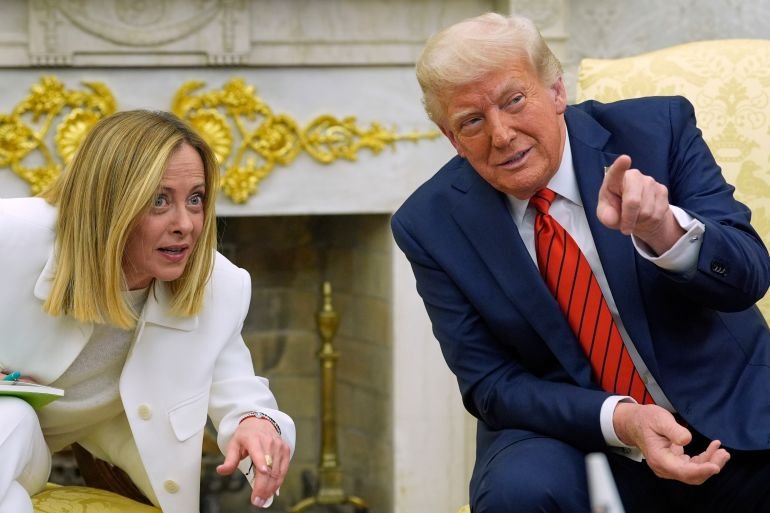
    United States President Donald Trump has attacked Italian Prime Minister Giorgia Meloni, one of his main European allies, over her unwillingness to join the war on Iran.

    “I’m shocked at her. I thought she had courage, but I was wrong,” he said in an interview with Italian daily Corriere della Sera on Tuesday.

    Recommended Stories

    list of 4 itemsend of list

    The interview was published the day after Meloni condemned as “unacceptable” Trump’s criticism of Pope Leo XIV, following the pontiff’s repeated calls for an end to the war in the Middle East.

    “She’s unacceptable because she doesn’t mind that Iran has a nuclear weapon and would blow up Italy in two minutes if they had the chance,” Trump said in English.

    Meloni, Italy’s leader since October 2022, used to be one of Trump’s closest allies in Europe and often sought to act as a mediator between diverging US and European views.

    But the president said they had not spoken this month, “not in a long time”, saying: “She doesn’t help us with NATO.

    “She doesn’t want to help get rid of a nuclear-weaponed Iran. Very sad … She’s much different than I thought,” Trump added.

    He described the NATO military alliance as a “paper tiger” and criticised Europe, in general, for not being “willing to fight for the Hormuz Strait, which is where they get their energy”.

    Trump said Meloni was “not the same person. Italy is not the same country. Immigration is killing Italy and all of Europe.”

    Local support for Meloni

    The Italian prime minister’s allies and political opponents were swift to offer their support.

    “We are and remain staunch supporters of Western unity and steadfast allies of the United States, but this unity is built on mutual loyalty, respect, and honesty,” Foreign Minister Antonio Tajani said on X.

    He said that until now, Trump considered Meloni a courageous person, and “he was not mistaken, but she is a woman who never shies away from saying what she thinks.”

    Elly Schlein, leader of the centre-left Democratic Party, condemned Trump’s “serious lack of respect”.

    “Our constitution is clear – Italy repudiates war,” she added in parliament.

    Separately on Tuesday, Italy suspended a defence agreement with Israel that involves the exchange of military equipment and technology research.

    “In view of the current situation, the government has decided to suspend the automatic renewal of the defence agreement with Israel,” Meloni said, according to Italian media.

    Tensions between Italy and Israel have been high after the Italian government accused Israeli forces of firing warning shots at a convoy of Italian peacekeepers in Lebanon last week.

  • Fifth woman accuses former US lawmaker Eric Swalwell of sexual misconduct

    Fifth woman accuses former US lawmaker Eric Swalwell of sexual misconduct

    The Democratic representative from California has resigned his seat in Congress over multiple sexual misconduct allegations.

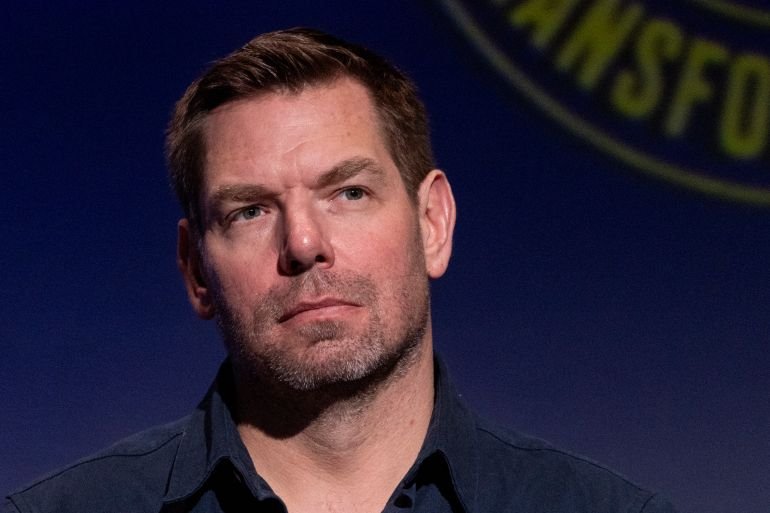
    Democratic Representative Eric Swalwell has resigned from the United States Congress, amid mounting allegations of sexual misconduct.

    On Tuesday, a fifth woman came forward to accuse Swalwell of unwanted sexual contact, saying the Democratic lawmaker drugged and raped her during an encounter in 2018.

    Recommended Stories

    list of 3 itemsend of list

    “My delay in taking action against Eric was driven by fear, not doubt – fear of his political power,” Lonna Drewes said during a news conference in Los Angeles.

    Drewes’s lawyer, Lisa Bloom, said her firm would be filing a police report with the Los Angeles County Sheriff’s office.

    Swalwell has denied allegations of wrongdoing. But on Monday, he announced he would resign from Congress, one day after suspending his gubernatorial campaign.

    Polls had shown the 45-year-old leading the race to replace Gavin Newsom as governor of California.

    But his campaign imploded last week after reports from the San Francisco Chronicle and CNN detailed allegations of sexual misconduct from several women.

    One woman, identified as a former staffer, told CNN that Swalwell raped her in a New York City hotel in 2024, an encounter that left her bleeding and bruised.

    Three other women told US news outlets that they had received inappropriate messages from Swalwell on the app Snapchat, which automatically deletes interactions.

    Lonna Drewes, followed by her lawyer Lisa Bloom, arrives to a press conference where she described her claims about sexual misconduct by former US Representative Eric Swalwell, Democrat of California, in Beverly Hills, California, on April 14, 2026.
    Lonna Drewes, followed by her lawyer Lisa Bloom, arrives at a news conference in Beverly Hills, California, on April 14 [Patrick T Fallon/AFP]

    The accusations quickly prompted backlash to Swalwell’s gubernatorial campaign. Supporters withdrew their endorsements, and a handful of bipartisan lawmakers said they would push for a vote to expel Swalwell from Congress.

    The Manhattan District Attorney’s Office also announced on Saturday that it is investigating the sexual assault allegations.

    In a statement on Monday, Swalwell apologised to his family, staff and constituents for what he called “mistakes in judgment”.

    Although he confirmed he would resign his seat in Congress, he nevertheless criticised his colleagues for seeking his expulsion.

    “I will fight the serious, false allegations made against me,” Swalwell wrote.

    “I am aware of the efforts to bring an immediate expulsion vote against me and other members. Expelling anyone in Congress without due process, within days of an allegation being made, is wrong.”

    Republican Representative Anna Paulina Luna had said she would withdraw her motion to expel Swalwell once he stepped down, and she confirmed on Tuesday that he had submitted a resignation letter, “effective immediately”.

    Republican Representative Tony Gonzales also announced on Monday that he would retire from Congress amid calls for his expulsion over allegations of sexual misconduct.

  • Global oil demand to plunge amid disruptions caused by war on Iran: IEA

    Global oil demand to plunge amid disruptions caused by war on Iran: IEA

    The IEA’s oil ‘demand destruction’ report comes after its chief said unnamed countries are hoarding stocks.

    The International Energy Agency (IEA) has sharply cut its forecasts for global oil supply ⁠and demand growth, saying both are expected to fall from last year’s levels as ⁠the United States-Israel war on Iran disrupts oil flows and weighs on the global economy.

    According to its report published on Tuesday, the IEA sees global oil demand falling ‌by 80,000 barrels per day (bpd) this year, compared with a projected year-on-year rise of 640,000 bpd in its previous monthly report.

    Recommended Stories

    list of 3 itemsend of list

    The forecast was released after the International Monetary Fund, World Bank and IEA urged countries on Monday to avoid hoarding energy supplies and imposing export controls that could worsen the shock.

    IEA chief Fatih Birol on Monday told reporters that several countries were holding onto stocks and imposing export restrictions, and appealed to all countries to let energy stocks flow to the markets. He did not name the countries.

    “Demand destruction will spread as scarcity and higher prices persist,” the IEA report said on Tuesday, adding ⁠that the deepest cuts ⁠in oil consumption have come from the Middle East and Asia Pacific so far, for naphtha, ‌LPG and jet fuel in particular.

    The Paris-based watchdog said a projected 1.5 million bpd drop in demand in the second quarter of this year would mark the deepest contraction since the COVID-19 pandemic.

    On Monday, the Organization of the Petroleum Exporting Countries (OPEC) lowered its prediction for world oil demand in the second quarter, but kept its full-year outlook unchanged.

    Hormuz disruptions

    Attacks on energy infrastructure in the Middle East and Iran’s closure of the Strait ‌of Hormuz have led to the largest oil supply disruption in history, the ‌IEA ‌said, with 10.1 million bpd lost in March.

    Iran brought traffic through the strait – a key route for global energy shipments – to a near-total halt in response to US-Israel attacks on its territory since February 28.

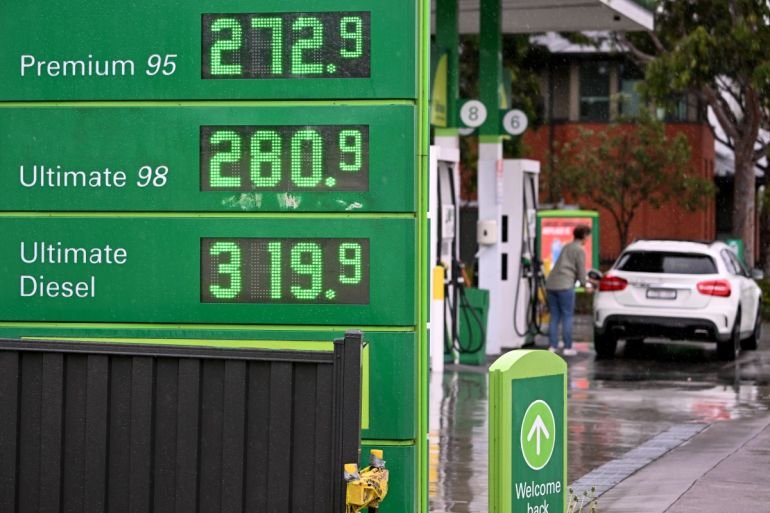
    The Iranian de facto control over the chokepoint sent gas and petrol prices skyrocketing around the world.

    Now, Washington aims to take control of the strait from Tehran by making it impossible for Iranian tankers, which have continued to pass each day, to transit.

    For this, US President Donald Trump announced a blockade on Iranian ports on Sunday, after weekend peace talks ⁠in Pakistan’s capital, Islamabad, between the US and Iran failed to reach a deal.

    The IEA report said the US blockade has further clouded the outlook for global energy security and the supply of a vast array of goods that rely on petroleum.

    Oil demand could plunge even further if the strait remains closed, the IEA said.

    “In this case, energy markets and economies around the world need to brace for significant disruptions in the months to come,” it warned.

    “Resuming flows through the Strait of Hormuz remains the single most important variable in easing the pressure on energy supplies, prices and the global economy,” the IEA added.

    Russia’s gains

    It also noted that a chief beneficiary of the disruptions has been Russia. Thanks to the surge in prices, Moscow’s ‌revenues from crude oil and refined products ⁠rose in ⁠March, rebounding from February when they fell to their lowest level since the start of the all-out war on Ukraine in 2022.

    Russia’s commodity revenues are a vital part of the state budget and are needed to support rising military spending.

    The IEA said Russia’s crude oil ‌exports rose by 270,000 bpd last month from February to 4.6 million bpd, mostly driven by higher seaborne shipments as the Druzhba pipeline remained offline.

    Flows via the Druzhba pipeline to Hungary and Slovakia across Ukrainian territory have remained shut following ⁠the attacks on the pipeline infrastructure at ⁠the end of January.

  • Indonesia, US sign ‘major’ defence cooperation agreement

    Indonesia, US sign ‘major’ defence cooperation agreement

    Signing of defence partnership follows reports that Washington is seeking overflight access in Indonesia for US military planes.

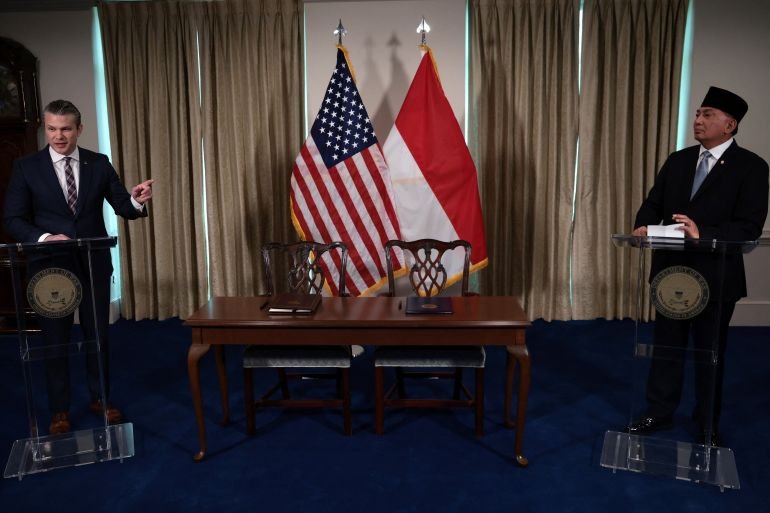
    ⁠US ⁠Secretary of Defense Pete Hegseth ⁠has hailed the establishment of a “major defence cooperation partnership” with Indonesia, saying it underscores the “strength and potential” of ties with Jakarta to maintain stability in the Asia Pacific region.

    Hegseth hosted Indonesian Minister of Defence Sjafrie Sjamsoeddin at the Pentagon on Monday, where the deal was signed.

    Recommended Stories

    list of 4 itemsend of list

    “This [partnership] signifies the strength and potential of our security relationship… bolsters regional deterrence, and advances our shared commitment to peace through strength,” Hegeseth said, according to a Defense Department statement.

    The US defence secretary also said Washington and Jakarta’s security relationship was “active and growing”, noting that both countries’ armed forces participate in more than 170 military exercises together each year.

    A joint statement on the new partnership said the two sides had agreed to work on co-developing “sophisticated asymmetric capabilities, pioneering next-generation defence technologies in the maritime, subsurface and autonomous systems domains”, and improving operational readiness.

    “We are here as Indonesian delegates… with very great enthusiasm to continue to develop our defence relationship, [which] should be enduring for our next generation in Indonesia and the United States of America,” Sjafrie was quoted as saying.

    “We’re working on behalf of mutual respect and mutual benefit to enhance [the] value of our national interests,” he added.

    The signing of the partnership comes a day after reports in Indonesia that both countries are discussing a proposal to ⁠give US military aircraft access to Indonesian airspace.


    The US is seeking “blanket” overflight access for military aircraft through Indonesian airspace, several ‌media outlets reported on Sunday, adding that Indonesian President Prabowo Subianto had approved the proposal.

    Responding to the reports, the Ministry of Defence in Jakarta said in a statement that the two countries are still discussing a “Letter of ⁠Intent”, and only a preliminary draft on overflight was being discussed internally. The draft is neither final nor binding, the ⁠ministry added.

    Control over Indonesian airspace belongs to Indonesia, the Defence Ministry added, saying that deals ⁠with other countries would protect Indonesia’s sovereignty and adhere to Indonesian law.

    “The deal is not final. It is not legally binding. It cannot be used as a basis for official government policy,” Defence Minister Sjafrie’s spokesman, Rico Ricardo Sirait, told the Jakarta Globe.

    “Authority, control, and oversight over Indonesian airspace rest entirely in our country. Any potential regulation shall guarantee Indonesia’s full authority to approve or reject any activity in national airspace,” he told the news outlet.

    Prabowo is due to meet his French counterpart, Emmanuel Macron, in Paris on Tuesday, just a day after he held talks with Russia’s Vladimir Putin about oil, the government in Jakarta said, according to the AFP news agency.

    Last month, Prabowo’s government announced fuel rationing and mandated a day-per-week work-from-home policy for civil servants to conserve energy stocks as prices surge amid the US-Israel war on Iran.

  • World faces food ‘catastrophe’ if Strait of Hormuz disruption persists: FAO

    World faces food ‘catastrophe’ if Strait of Hormuz disruption persists: FAO

    Global agriculture is highly exposed to the waterway blockage, risking higher commodity prices and food inflation.

    A prolonged disruption in the Strait of Hormuz could result in a global food “catastrophe”, the Food and Agriculture Organization (FAO) has warned, as shipments of critical agricultural inputs remain blocked in the key waterway due to the US-Israel war on Iran.

    Food prices have not risen yet because existing stocks are absorbing the shock, the United Nations body’s chief economist, Maximo Torero, said in an interview on Monday, alongside David Laborde, director of FAO’s agrifood economics division.

    Recommended Stories

    list of 3 itemsend of list

    But if traffic through the strait does not resume, the shocks to energy and fertiliser markets will translate into higher commodity and retail prices later this year and into 2027, Laborde added.

    Exports of 20 to 45 percent of key agrifood inputs rely on sea passage through the Strait of Hormuz, according to the FAO.

    “We are in an input crisis; we don’t want to make it a catastrophe,” said Laborde. “The difference depends on the actions we take.”

    “Right now, we don’t have a food crisis because we have food availability,” Torero added, noting that the increase in gas and oil prices has not translated yet into higher costs for bread and wheat, for example, thanks to ample supplies coming out of a good harvest season. “But this is now,” the economist said.

    Fertilisers

    Nearly half of the world’s traded urea – the most widely used fertiliser – and large volumes of other fertilisers are exported from Gulf countries via the Strait of Hormuz, making global agriculture highly exposed to any disruption there.

    Recent disruptions to gas supplies and shipping have already forced fertiliser plants, which use natural gas to manufacture fertiliser, in the Gulf and beyond to shut or cut their output.

    Should traffic continue to stall in the chokepoint, farmers will be forced to produce with less fertiliser or increase the cost of their product, Torero said.

    “This is why it’s so essential that the ceasefire continue and is so essential that it is not just a ceasefire, but also that vessels start moving,” he said. “The clock is ticking.”

    Torero added that poorer countries were most exposed because planting calendars meant delays in access to key inputs could quickly translate into lower output, higher inflation and slower global growth.

    Iran has brought traffic through the strait to a near-total halt in response to attacks from the United States and Israel, which launched a war on Tehran on February 28, killing Supreme Leader Ayatollah Ali Khamenei.

    The move has triggered a global energy crisis, doubling at times the prices of oil and gas compared with pre-war levels.

    Over the weekend, Iranian and US representatives held a 21-hour marathon negotiation to reach an agreement for a permanent ceasefire, but failed to achieve a breakthrough.

    US President Donald Trump then decided to impose a naval blockade on the strait. He said the navy would hunt down and interdict ships in international waters that had paid Iran a toll to traverse the strait.

    Later, the US military said it would block all maritime traffic entering and exiting Iranian ports, including those in the Gulf and the Gulf of Oman.