Tag: News – Al Jazeera

  • Iran reasserts control of Hormuz Strait as Trump warns against ‘blackmail’

    Iran reasserts control of Hormuz Strait as Trump warns against ‘blackmail’

    Top negotiator Mohammad Bagher Ghalibaf says US naval blockade of Iran’s ports is ‘a clumsy and ignorant decision’.

    Iran’s Islamic Revolutionary Guard Corps Navy (IRGC) says the Strait of Hormuz is closed and that any ship that attempts to pass through the waterway will be targeted, a dramatic reversal less than 24 hours after the critical shipping lane was reopened.

    In a statement carried by Iran’s Student News Agency, the IRGC navy said on Saturday the strait will be closed until the United States lifts its naval blockade on Iranian vessels and ports. It said the blockade was a violation of the ongoing ceasefire agreement in the US-Israel war on Iran.

    Recommended Stories

    list of 4 itemsend of list

    “We warn that no vessel of any kind should move from its anchorage in the Persian Gulf and the Sea of Oman, and approaching the Strait of Hormuz will be considered cooperation with the enemy, and the offending vessel will be targeted,” it said.

    Mohammad Bagher Ghalibaf, Iran’s parliament speaker and a senior negotiator in talks between Washington and Tehran on ending the war, said in a television interview that “the Strait of Hormuz is under the control of the Islamic Republic”.

    “The Americans have been declaring a blockade for several days now. This is a clumsy and ignorant decision,” he added.

    The reassertion of control came just hours after Iran had briefly reopened the strait, in line with a 10-day ceasefire between Israel and Lebanon. Oil prices dropped on global markets after Iranian Foreign Minister Abbas Araghchi said on Friday that the waterway was “completely open for all commercial vessels.”

    More than a dozen commercial ships passed through the waterway before the IRGC reversed course.

    Iranian gunboats reportedly fired on two commercial ships on Saturday, according to United Kingdom Maritime Trade Operations (UKMTO). India’s Ministry of External Affairs also said that two Indian-flagged ships were involved in a “shooting incident” in the strait.

    Some merchant vessels in the region received radio messages from the IRGC Navy, warning that no ships were being allowed through the strait.

    US President Donald Trump said Tehran could not blackmail Washington by closing the waterway and warned that he would put an end to the ceasefire if a deal before its expiry on Wednesday is not reached. Trump added that the naval blockade would “remain in full force”.

    Iranian Supreme Leader Mojtaba Khamenei, meanwhile, said the navy was ready to inflict “new bitter defeats” on its enemies.

    ‘Two competing blockades’

    Al Jazeera correspondent Zein Basravi said that Iran and the US are back where they were the previous day.

    “Less than 24 hours ago, world leaders were praising what they thought was a breakthrough in this conflict, hoping Iran was signalling a confidence-building measure by opening the Strait of Hormuz, potentially leading to a ceasefire deal and a permanent end to the war,” he said.

    “As disappointed as people may be, this isn’t entirely surprising. What we’re seeing now is a return to square one,” he added, saying there are now “two competing blockades in place”.

    Al Jazeera’s Ali Hashem, reporting from Tehran, said Iran was using the strait to send a message.

    “It’s clear that Iran is dealing with a situation in which they are not sure what’s on the table. So the Strait of Hormuz is once again the only space for engagement, even if it’s a negative engagement. And it’s the space where they are sending and conveying messages to the Americans, showing their leverage,” he said.

  • Israel says established a ‘yellow line’ in Lebanon, as it has in Gaza

    Israel says established a ‘yellow line’ in Lebanon, as it has in Gaza

    Israeli forces say they have established a so-called “yellow line” in southern Lebanon, similar to an Israeli military measure in the besieged Gaza Strip.

    The Israeli military said in a statement on Saturday that over the previous 24 hours, its forces “operating south of the Yellow Line in southern Lebanon identified terrorists who violated the ceasefire understandings and approached the forces from north of the Yellow Line in a manner that posed an immediate threat”.

    Recommended Stories

    list of 3 itemsend of list

    It is the first time the Israeli military has referred to such a “yellow line” in Lebanon, and comes after a 10-day ceasefire between Israel and Lebanon came into effect on Thursday.

    Since a ceasefire in Gaza took effect in October, Israel’s so-called “yellow line” has divided the Palestinian territory into separate zones, with an eastern area controlled by the Israeli military and a western area where Palestinians face fewer restrictions on their movement.

    Israeli troops routinely fire on anyone approaching the line, and they have demolished hundreds of homes in the zone under their control.

    Reporting from Ramallah, in the occupied West Bank, Al Jazeera’s Nour Odeh said the Israeli military’s announcement of a “yellow line” in Lebanon appeared to represent the “continuation of the ‘Gazafication’ of southern Lebanon”.

    “Israeli Minister of Defence Israel Katz had said that the army has been instructed to demolish the Lebanese villages on the border based on the Beit Hanoon and Rafah models, and we know exactly what that looks like because there’s nothing left there,” she said.

    “In Lebanon, it may not be, at least for now, to expand the area occupied in southern Lebanon. But, certainly, the demolition of Lebanese villages continues, and the minister of defence has also drawn an equivalence between Shia villages and Hezbollah infrastructure in the same way he considered Palestinians in Gaza to represent Hamas and to be an equal threat to Israel,” she added.

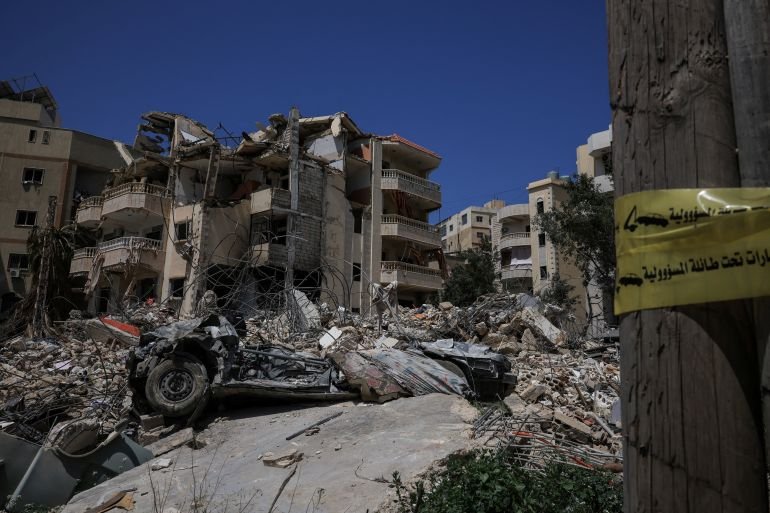
    Despite the ceasefire, Israel has continued to carry out attacks in southern Lebanon. Israeli artillery attacks on Saturday hit the southern Lebanese towns of Beit Leif, Qantara and Touline, while the military has continued razing homes across several areas.

    In a statement, the military said it waged the attacks in response to fighters approaching areas where Israeli soldiers are still stationed in southern Lebanon, claiming they posed “an imminent threat”.

    “Actions taken in self-defence and to remove immediate threats are not restricted by the ceasefire,” the military added.

    Ceasefire ‘must be from both sides’

    Later on Saturday, Hezbollah Secretary-General Naim Qassem said that the ongoing 10-day truce with Israel cannot continue unless both sides uphold it.

    “A ceasefire means a complete cessation of all hostilities. Because we do not trust this enemy, the resistance fighters will remain in the field with their hands on the trigger, and they will respond to violations accordingly,” Qassem said in a statement read out on TV.

    “There is no ceasefire from the side of the resistance only; it must be from both sides.”

    Qassem also demanded that Israel completely withdraw from Lebanon.

    The next steps, Qassem said, would focus on the release of prisoners and the return of residents to their homes in the border areas.

    A final step, he said, would involve a significant reconstruction campaign, coupled with international Arab support.

    He also added that Hezbollah is “open to cooperation with the [state] in Lebanon on a new page” based on achieving their “national sovereignty and preventing strife”.

    Thursday’s ceasefire between Israel and Hezbollah comes after a previous one, which had ostensibly been in effect since November 27, 2024. But the United Nations has counted more than 10,000 Israeli ceasefire violations since then, as well as hundreds of Lebanese deaths.

    Israel has repeatedly told the Lebanese government that Hezbollah must be disarmed for any truce to last.

    For its part, Hezbollah has said that Israel needs to withdraw from the country’s southern region first as part of the 2024 ceasefire deal agreed between the armed group and Israel.

    The Lebanese government has been uneasy about Hezbollah’s influence in the country. Last December, the government said it was close to completing the disarmament of Hezbollah south of the Litani River before a year-end deadline as part of the 2024 ceasefire deal with Israel.

    At the start of the latest conflict, the Lebanese government also outlawed Hezbollah’s military wing. But the government has also always been apprehensive of Israel’s actions. Lebanon’s President Joseph Aoun also previously refused to speak directly with Israeli Prime Minister Benjamin Netanyahu about their differences.

    On Thursday, while announcing the ceasefire between Lebanon and Israel, US President Donald Trump revealed that Israel’s Prime Minister Netanyahu and Lebanon’s President Aoun could meet ⁠in Washington over ⁠the ⁠next week or two for negotiations on ending the fighting.

  • Mexico, Spain and Brazil call for Cuba’s sovereignty to be protected

    Mexico, Spain and Brazil call for Cuba’s sovereignty to be protected

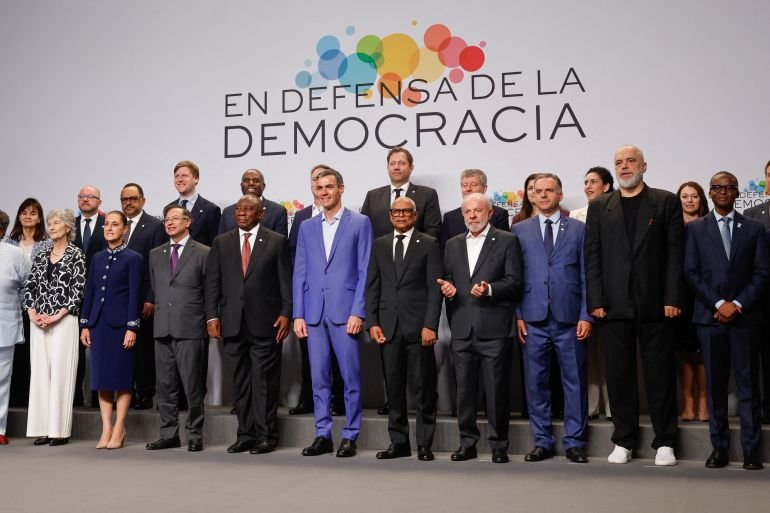
    The leaders of Mexico, Brazil and Spain have pledged more aid to Cuba, while appealing for the island nation’s sovereignty to be respected amid an ongoing pressure campaign from United States President Donald Trump.

    The joint statement on Saturday was released as leftist leaders from across the globe met in Barcelona.

    Recommended Stories

    list of 3 itemsend of list

    The three countries expressed “great concern about the serious humanitarian crisis that the people of Cuba are going through”.

    The US has imposed a trade embargo on Cuba since Cold War tensions emerged in the 1960s.

    But the Trump administration has ratcheted up pressure on the island’s communist government, in an apparent attempt to prompt leadership change.

    Since January, Trump has barred the import of oil from Venezuela. He also threatened other countries with sanctions if they deliver oil to Cuba, leading to fuel shortages and energy blackouts.

    The campaign against Cuba’s government follows similar pressure tactics against Venezuela’s former President Nicolas Maduro, who was abducted and imprisoned in a US military operation on January 3.

    Trump, meanwhile, has floated the removal of Cuba’s President Miguel Diaz-Canel.

    In Saturday’s statement, the governments of Mexico, Spain and Brazil — represented by President Claudia Sheinbaum, Prime Minister Pedro Sanchez and President Luiz Inacio Lula da Silva, respectively — warned against any actions that run “contrary to international law”.

    “We are committed to coordinating an increase in our humanitarian response, aimed at alleviating the suffering of the Cuban people,” the trio said.

    While the statement did not directly reference the US, it called for respect for “territorial integrity, sovereign equality and peaceful settlement of disputes”, as outlined in the United Nations Charter.

    The three countries further said that any solution in Cuba must “ensure that it is the Cuban people themselves who decide their future in full freedom”.

    Trump says Cuba could be next

    Earlier this week, Trump again suggested the US could use military force against Cuba, saying his attention could turn to the island following the conclusion of the US-Israel war against Iran.

    “We may stop by Cuba after we finish with this,” he said.

    The Trump administration has repeatedly denied US policy has contributed to the humanitarian situation in Cuba, instead framing the crisis as the product of decades of economic mismanagement.

    Diaz-Canel, meanwhile, was defiant as he spoke on Thursday during a gathering marking the 65th anniversary of Fidel Castro’s declaration on the socialist nature of the Cuban Revolution.

    “The moment is extremely challenging and calls upon us once again, as on April 16, 1961, to be ready to confront serious threats, including military aggression,” Diaz-Canel said.

    “We do not want it, but it is our duty to prepare to avoid it and, if it becomes inevitable, to defeat it.”

    Trump takes aim at Spain

    Saturday’s joint statement came as leaders gathered in Barcelona to portray a united front in support of the multilateralism Trump has long railed against.

    Spain’s Sanchez, an outspoken critic of Trump, did not mention the president by name as he railed against right-wing populism.

    “They know their vision of how the world should be ordered is falling apart due to the tariffs and wars,” he said. “Their embrace of climate change denial, of xenophobia, or of sexism is their greatest error.”

    “They have tried again and again to make us embarrassed of our beliefs. That ends now. From now on, they can be the ones who feel ashamed.”

    Trump, meanwhile, took aim at Sanchez in a post on Truth Social. The president has repeatedly criticised Spain for not allowing the US military to use its bases in the US-Israel war with Iran and for not increasing its defence spending.

    “Has anybody looked at how badly the country of Spain is doing. Their financial numbers, despite contributing almost nothing to NATO and their military defense, are absolutely horrendous. Sad to watch!!!” Trump wrote.

  • Trump joined by Joe Rogan as he signs order to speed up psychedelic review

    Trump joined by Joe Rogan as he signs order to speed up psychedelic review

    The order calls on the federal government to relax restrictions on psychedelics, including ibogaine, for potential treatments.

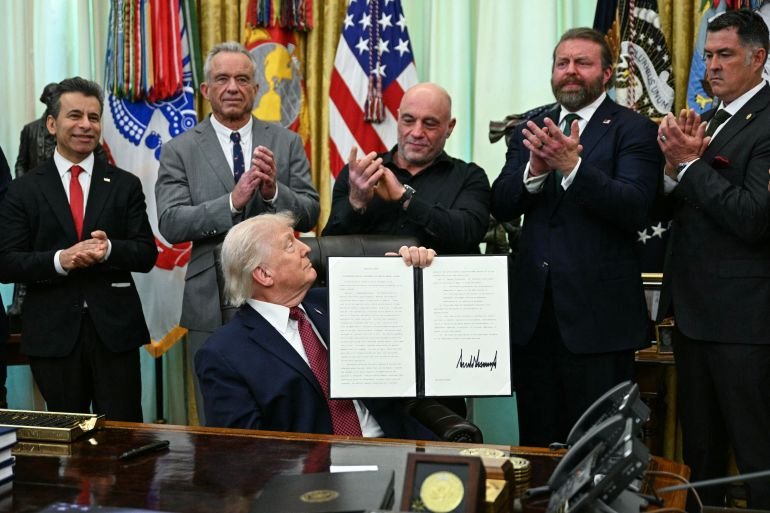
    United States President Donald Trump has signed an executive order to speed up the review of a handful of psychedelic drugs, including the controversial ibogaine.

    Trump was joined by podcaster Joe Rogan during Saturday’s Oval Office event.

    Recommended Stories

    list of 3 itemsend of list

    Rogan, considered one of the most influential podcasters in the country, has been a leading proponent of ibogaine, which is derived from a plant that grows in West Africa and has been embraced by some military veteran groups as a treatment for post-traumatic stress.

    Speaking at the event, Rogan recounted how he had previously texted information to Trump about ibogaine.

    He recalled that the president quickly texted back: “Sounds great. Do you want FDA [Food and Drug Administration] approval? Let’s do it.”

    Advocacy groups have long pushed for more research into the possible use of psychedelics to treat an array of issues, including depression.

    “Today’s order will ensure that people suffering from debilitating symptoms might finally have a chance to reclaim their lives and lead a happier life,” Trump said at the signing.

    “If these turn out to be as good as people are saying, it’s going to have a tremendous impact.”

    At one point, the president quipped that he would be open to taking psychedelics himself: “Can I have some, please? I’ll take some.”

    But he quickly pivoted away from the joke. “I don’t have time to be depressed. You know, if you stay busy enough, maybe that works, too. That’s what I do,” he said.

    Increasing research into psychedelics has proven a rare issue with bipartisan support in the US, where ibogaine and other psychedelics remain banned under the federal government’s most restrictive category for illegal drugs.

    Health Secretary Robert F Kennedy Jr had previously pledged to ease access to psychedelics for medical use.

    Trump’s executive order calls on the Department of Health and Human Services to direct at least $50m to states that have enacted or are developing programmes to advance psychedelic drugs for serious mental illness.

    It also arrives ahead of several actions from the FDA to loosen restrictions.

    This week, the agency will issue so-called “national priority” vouchers for three psychedelics, which the agency’s commissioner, Marty Makary, said will allow certain drugs to be approved quickly “if they are in line with our national priorities”.

    The FDA is also taking steps to clear the way for the first-ever human trials of ibogaine in the US. Previous research had been stalled by concerns over the drug potentially triggering fatal heart problems.

    Ibogaine was first used by members of the Bwiti religion in African nations like Gabon for religious ceremonies.

    Rogan’s endorsement helped boost Trump ahead of the 2024 presidential election. He has since publicly questioned the administration’s war with Iran, saying it runs counter to Trump’s campaign pledges.

    Also present on Saturday was Marcus Luttrell, a former Navy SEAL whose memoir about his time in Afghanistan, Lone Survivor, was later made into a film.

    He praised ibogaine during the ceremony: “It absolutely changed my life for the better.”

  • As fentanyl crisis evolves, experts say US is still ‘behind the eight ball’

    As fentanyl crisis evolves, experts say US is still ‘behind the eight ball’

    Dallas, United States – Michael Watkins wipes sweat from his brow as he steps up to a stranger’s door. It’s a scorching day in Dallas, Texas; the sun has been hammering the pavement for hours.

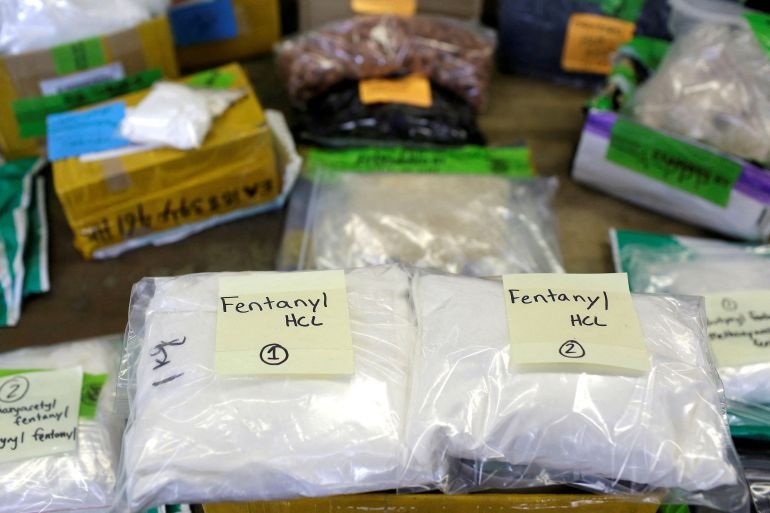
    Watkins, a 50-year-old man with glasses, a goatee and a gauge in both earlobes, doesn’t know what to expect beyond the door of the single-storey house. He doesn’t even know if the person on the other side will answer. But these door knocks are a critical part of his job. Within 72 hours of a reported overdose from the dangerous opioid fentanyl, Watkins shows up on a stranger’s doorstep with a brochure full of substance abuse resources and some of the life-saving medication known as Narcan.

    Recommended Stories

    list of 4 itemsend of list

    He works for the Recovery Resource Council, an addiction treatment nonprofit that’s been tackling the fentanyl crisis in North Texas since it began more than 10 years ago. Their grassroots approach has yielded great results: In 2023, Dallas County — the largest county in North Texas — recorded 280 deaths from fentanyl. Last year, that number was 203.

    This is in line with a nationwide decrease in fentanyl overdoses that began several years ago, after the rate of overdose deaths in the United States doubled between 2015 and 2023. However, some show the number of overall overdose deaths once again climbing, as experts warn a disruption in the fentanyl market has been repaired.

    Dallas, like all major US cities, has been ravaged by fentanyl overdoses. Because of its relative proximity to the US-Mexico border, and its extensive highway infrastructure, Dallas also has the unfortunate distinction of being a major hub in the drug smuggling routes stretching from Mexico to other major US cities.

    Becky Devine, the director of Recovery Resource Council, says her team calls these door-knocks “uninvited interventions”.

    “We show up wanting to bridge the gap between where they are in this moment of desperation and isolation to all of the services that are available in our community,” she said.

    “The majority of the people we encounter are receptive to us showing up, but they just don’t know what they want yet. We get phone calls weeks, months down the road that say, ‘Hey, I met you on my doorstep six, seven, 10 months ago, and I wasn’t ready then, but I’m ready now.’”

    Recently, their work, like the work of similar nonprofits across the country, has been hindered by the administration of US President Donald Trump, just as the country was making consistent progress in the fight against fentanyl.

    Despite declaring fentanyl a “weapon of mass destruction”, the Trump administration has slashed hundreds of millions of dollars in addiction services and drug-related research across multiple federal agencies.

    Elon Musk’s DOGE team fired a team that rigorously tracked Americans’ drug use for decades, and in January, officials abruptly cancelled roughly $2bn in grants through the Substance Abuse and Mental Health Services Administration (SAMHSA), only to reverse course within days. The whiplash left providers scrambling and deepened uncertainty across the treatment system.

    What’s more, in the past year, the Trump administration has reduced SAMHSA’s staff by half. Estimates vary as to how much money in total has been cut from essential treatment programmes, but in late 2025, the health news website STAT reported that at least $1.7bn in block grants for state health departments had been cut, as had about $350m in addiction and overdose prevention funding.

    All this comes at a time when the fentanyl threat is evolving, with the market for the chemicals used to manufacture fentanyl largely shifting from China to India.

    Chrissie Julianno is the executive director of the Big Cities Health Coalition, which represents health departments in major cities across the US. According to her, the Trump administration has created rampant chaos with far-reaching consequences.

    “I think one piece that people don’t necessarily think about is, particularly in large jurisdictions, large counties and large cities, a lot of the dollars that they get from the federal government are then contracted out to community partners,” she said. “It’s not just the health department that can’t do something. It’s not just the health department that’s forced to lay off staff. It’s all of the other pieces that come together in these jurisdictions where there’s partnerships.”

    Weapon of mass destruction

    Last year, Watkins’s organisation tried to establish an addiction resource team devoted to Plano, one of the largest suburbs in Dallas. The team was put on hold because of a spate of federal funding cuts, including the elimination of $345m in addiction and overdose prevention.

    Watkins, for his part, is trying to be the kind of person he needed when he was at the lowest point of his own addiction journey.

    He once called the police on himself because, in his words, “If I go to jail, maybe I won’t drink any more.” Instead of lock-up, he wound up in a hospital, where he received an offer for a state-funded treatment programme. He took the rep’s business card, went home, and drank for four days straight.

    “But after those four days, all of a sudden it just dawned on me, ‘Yes, I’m going to die, and I really don’t know what to do,’” he said.

    He called the number on that business card and entered the treatment programme. Now, 13 years later, he’s the one handing out cards and offers of help.

    “I just want to be there for people,” he said. “I want to be there to help them connect the dots.”

    Experts say initiatives like this are critical to the US continuing a trend that began in 2023, when fentanyl overdoses started falling nationwide for the first time in a decade. Instead, the Trump administration has focused on a militaristic approach that’s frustrated healthcare professionals and policy experts.

    Trump and his cabinet members claim recent military actions against Venezuela, including the boat strikes that have drawn war crime accusations, are part of the fight against fentanyl — despite that no fentanyl comes from Venezuela. Experts say the “weapon of mass destruction” label is a political move meant to bolster the equally dubious claim that drug cartels are “terrorist organisations”, a term reserved for groups with ideological or political motives.

    “I’m inclined to push back against the hijacking of terms that have a specific meaning just to harness the emotional impact,” Jonathan Caulkins, a professor and researcher on drugs and violence at Carnegie Mellon University, told STAT. “By those arguments, cigarettes would be weapons of mass destruction — cigarettes kill more Americans every year than fentanyl does.”

    Caulkins isn’t alone in those concerns. Other people interviewed by Al Jazeera worried that the “weapons of mass destruction” label further stigmatises addiction and discourages people from seeking help.

    “I just don’t really understand what kind of message that’s supposed to send to the person that’s still using it,” said Kristin, a Dallas woman who has struggled with opioid addiction. She asked Al Jazeera to use a pseudonym because of pending legal cases surrounding her drug usage.

    “Are people who have struggled with drugs in the past or have used fentanyl, are they terrorists? And good luck getting people to talk about it with you if they are addicted to it now.”

    Ben Westhoff, the author of Fentanyl, Inc, says military and law enforcement tactics are a crucial part of stopping the flow of fentanyl, especially when it involves the countries where fentanyl actually comes from.

    But he stresses that investing in healthcare and local support services is equally critical.

    “Even if we’re seeing 20 percent less, 30 percent fewer deaths than at the worst part of the crisis, that’s still an unprecedented amount of death,” he said. “Putting people in treatment is definitely what needs to happen. People need to receive medications for opioid use disorder, and not just after they have an overdose, but before they have an overdose.”

    Behind the eight ball

    Before he became a fentanyl expert and documentarian, Westhoff was the music editor for an alternative weekly in Los Angeles. When he investigated a rise in deaths at raves in LA, he discovered typical party drugs weren’t the culprit; it was fentanyl, mostly originating from China.

    Westhoff’s subsequent research exposed the role of Chinese companies — especially one called Yuancheng — in the production of the precursor chemicals necessary to create the lethal drug. As a result of his work and pressure from the US government, China cracked down on those companies, and the CEO of Yuancheng was indicted. A new paper in the academic journal Science — authored in part by Caulkins — argues that the Chinese crackdown led to a drop in overdose deaths.

    However, in an interview with Al Jazeera, Westhoff says this progress could be short-lived. The precursor chemical trade has migrated to India, which has a large and less-regulated pharmaceutical and chemical industry. Those precursors are exported to Mexico, where they are then used to produce drugs that are smuggled across the US-Mexico border.

    The author sees history repeating itself: For much of the fentanyl crisis, much of the focus from DC and the media fell on Mexico, not China. Now, he says there isn’t enough of a focus on the role India plays in producing fentanyl precursors — and unlike its tensions with China, the US has a relatively strong relationship with India.

    “I think we’re definitely behind the eight ball,” Westhoff said. “I don’t think India is even really on the radar of many people in the position in the United States to do something about it.”

    Meanwhile, Watkins says any kind of nationwide focus or discussion of fentanyl has “fallen off” in recent years, perhaps because the US is not currently in the middle of a heated presidential race, or perhaps because of the decrease in deaths.

    “People are still dying,” he said, “and it’s not being pointed out like it was two to three years ago.

    When asked what he thought of the classification of fentanyl as a “weapon of mass destruction,” Watkins avoided sharing a political opinion.

    “Any attention to this is good regardless of the intentions behind the declaration,” he said. “With the administration’s stand, I am hoping that it could open more funding avenues.”

    For him, more funding would mean a broader team and, ultimately, the chance to knock on more doors and help more people.

    Back in Dallas, beneath that punishing sun, he took a deep breath, stepped forward, and knocked on the door.

    He hopes they answer, and if they do, he hopes they’ll be open to support.

    But if they’re not, he’ll wait. He knows the phone could ring months from now, with someone on the other end asking for help.

  • Trump claims on Iranian concessions trigger questions, rejections in Tehran

    Trump claims on Iranian concessions trigger questions, rejections in Tehran

    Tehran, Iran – United States President Donald Trump’s announcements about securing major concessions from Tehran have riled supporters of the Iranian establishment, prompting rejections and clarifications from the authorities.

    Several current and former senior officials, state media and the Islamic Republic’s hardcore backers expressed anger, frustration, and confusion after the US leader made a series of claims, with days left on a two-week ceasefire reached on April 8.

    Recommended Stories

    list of 4 itemsend of list

    Trump on Friday said Iran and the US would jointly dig up the enriched uranium buried under the rubble of bombed Iranian nuclear sites, and transfer it to the US. He claimed Iran had agreed to stop enriching uranium on its soil.

    He also said the Strait of Hormuz had been opened and would never be closed again, while the US naval blockade of Iran’s ports remained in place, and sea mines were removed or were in the process of being removed.

    Trump also emphasised that Iran would not receive billions of dollars of its own frozen assets abroad due to US sanctions, and that the 10-day ceasefire between Israel and Lebanon was completely unrelated to Iran.

    Amid Pakistan’s ongoing efforts to mediate another round of negotiations, Iran’s Parliament Speaker Mohammad Bagher Ghalibaf, who led the Iranian delegation to the Islamabad talks earlier this month, rejected all of Trump’s claims.

    “With these lies, they did not win the war, and they certainly will not get anywhere in negotiations either,” he posted on X early on Saturday.

    By Saturday noon, the Khatam al-Anbiya Central Headquarters of the Islamic Revolutionary Guard Corps (IRGC) released a statement, saying the Strait of Hormuz is once again heavily restricted and under “strict management” of the armed forces. It cited continued “acts of piracy and maritime theft under the so-called label of a blockade” by Washington as the reason.

    ‘Haze of confusion’

    In the hours it took between Trump’s flurry of announcements on Friday and official responses from Iranian authorities, supporters of the establishment voiced serious concerns about any major concessions.

    “Is there no Muslim out there to talk to the people a bit about what is happening?!” Ezzatollah Zarghami, a former state television chief and current member of the Supreme Cyberspace Council that controls the heavily restricted internet in Iran, wrote on X.

    Alireza Zakani, the hardline mayor of Tehran, said if any of Trump’s claims are true, then the Iranian establishment must beware “not to gift the vile enemy in negotiations what it failed to achieve in the field”.

    A fan account on X for Saeed Jalili, an ultrahardline member of the Supreme National Security Council who has opposed any deals with the US for decades, said “dissent” may be at play. It said Supreme Leader Mojtaba Khamenei, who has not been seen or heard from outside of several written statements attributed to him, must release a voice or video message to confirm what is happening.

    Jalili’s main account distanced itself from the comment, saying the fan account – which was subsequently deleted – was a sign of “infiltration” by enemies of Iran who were trying to sow discord.

    Iranian state media released another written statement attributed to Khamenei on Saturday to mark Army Day, but made no mention of the political drama unfolding hours earlier, or the negotiations with the US.

    The dissonance was clearly on display on state television and other state-linked media on Friday, especially those affiliated with the IRGC.

    Multiple state television hosts and analysts harshly attacked Foreign Minister Abbas Araghchi because he tweeted on Friday that the Strait of Hormuz was “declared completely open for the remaining period of ceasefire, on the coordinated route as already announced by Ports and Maritime Organisation”.

    One of the hosts demanded Araghchi must immediately clarify. Another said the top diplomat’s tweet was in English, and since the Iranian people do not have access to X due to the state-imposed near-total internet shutdown for seven weeks, the message was not directed at the people.

    With a huge Hezbollah flag in the background, a furious presenter on state television’s Channel 3 claimed that Araghchi was somehow “the representative of the people of Lebanon, Yemen and Iraq” because they are a part of Iran’s “axis of resistance” of armed forces, so he should demand concessions on their behalf from Trump.

    Morteza Mahmoudvand, a representative for Tehran in the Iranian parliament, went as far as saying Araghchi would have been impeached had it not been for “the excuse of war”.

    The Fars and Tasnim news sites, which are affiliated with the IRGC, also heavily criticised Araghchi and called for further explanations on Friday evening, with Fars arguing that “Iranian society was plunged into a haze of confusion.”

    Armed supporters in the streets

    Critical comments from supporters of the Iranian government also flooded social media, including local messaging applications and the comments section of state-run sites.

    “We took to the streets every night with clear demands, but you shook hands with the killer of our supreme leader and handed our strait to the Zionists,” one user wrote on Friday in the local app Baleh, in reference to Israel.

    “After all these years of sanctions and war and costs imposed on the people, if you are to give up the uranium and the strait, then why did you play with the people’s livelihoods and the blood of the martyrs for so long?” another user wrote.

    A large number of analysts and media personalities, including Hossein Shariatmadar, the head of the Kayhan newspaper, who was appointed by late Supreme Leader Ayatollah Ali Khamenei, also voiced criticism and demanded answers on Fars and other outlets.

    Regardless of whether there will be more mediated negotiations in Pakistan or whether the war will continue, Iran continues to encourage and arm backers to take to the streets to maintain control.

    State media on Friday aired footage of more armed convoys moving through the streets of Tehran while waving the flags of Lebanon’s Hezbollah, Iraq’s Hashd al-Shaabi and other groups. The video below shows women and children crewing heavy machineguns mounted on the back of pick-up trucks during a rally in downtown Tehran.

    With no end in sight to the state-imposed internet shutdown that has wiped out millions of jobs in Iran, in addition to steel factories and other infrastructure that were destroyed, the Iranian economy continues to suffer.

    The timing of the back-and-forth between Trump and the Iranian officials meant that oil prices dropped before Western markets closed on Friday, and the Iranian currency experienced more volatility.

    The rial was priced at about 1.46 million against the US dollar on Saturday morning, the first day of the working week in Iran. But it shot back up to about 1.51 million after the IRGC announced the repeated closure of the Strait of Hormuz.

  • Iran closes Strait of Hormuz again over US blockade of its ports

    Iran closes Strait of Hormuz again over US blockade of its ports

    Reports of Iranian gunboats opening fire on a tanker in strait, after Tehran said it is closing the waterway until the US lifts the blockade of its ports.

    Iran says it has closed the Strait of Hormuz again, calling the decision a response to a continued blockade of its ports by the United States.

    The Iranian military on Saturday said control of the strategic waterway, through which 20 percent of the global oil flows, has “returned to its previous state”, with reports saying Iranian gunboats fired at a merchant vessel as it attempted to ‌cross.

    Recommended Stories

    list of 4 itemsend of list

    The closure of the strait came hours after it was reopened, with more than a dozen commercial ships passing through the waterway, after a US-mediated 10-day ceasefire deal was reached between Israel and Lebanon.

    The Islamic Revolutionary Guard Corps (IRGC) on Saturday said in a statement, cited by the Iranian media, that the ongoing US blockade of Iranian ports represented “acts of piracy and maritime theft”, adding that the control over Hormuz is “under the strict management and control of the armed forces”.

    “Until the US restores full freedom of navigation for vessels travelling from Iran to their destinations and back, the status of the Strait of Hormuz will remain tightly controlled and in its previous condition,” it said.

    By 10:30 GMT on Saturday, no fewer than eight oil and gas tankers had crossed the strait, but at least as many ships appeared to have turned back, having begun to exit the Gulf, the AFP news agency reported.

    The toing and froing over the strait cast doubt on US President Donald Trump’s optimism the day before, that a peace deal to end the US-Israel war on Iran was “very close”.

    Trump had celebrated the reopening of the strait on Friday, but warned the US attacks would resume until Iran agreed to a deal, which included its nuclear programme.

    “Maybe I won’t extend it,” Trump told reporters on board Air Force One about the temporary ceasefire agreement in place. “So you’ll have a blockade, and unfortunately we’ll have to start dropping bombs again.”

    Asked whether a potential deal could be made in this short timeframe, Trump said: “I think it’s going to happen.”

    But Iran says no date has been agreed for another round of peace talks, accusing the US of “betraying” diplomacy in all negotiations.

    The conflicting and changing reports about the strait and how much freedom ships have to transit through it have deterred many vessels from crossing, according to John-Paul Rodrigue, a maritime shipping specialist at Texas A&M University.

    “Ships have been attempting transit since the announcement, but it looks like many of them are heading back because the situation is unclear,” Rodrigue told Al Jazeera. “There is contradictory information being issued by all parties.”

    Reporting from Tehran, Al Jazeera’s Tohid Asadi said “uncertainty is the name of the game” as far as the Strait of Hormuz is concerned.

    “Iran is looking for a comprehensive end to the war across the region, security assurances, sanctions relief, the unfreezing of frozen assets, regional relations – and on top of all of that – the nuclear dossier and Iran’s stockpile of highly enriched uranium,” he said.

    “But right now, uncertainty is the name of the game. The fragile situation makes it hard to talk about the possibility of successful negotiations down the road.”

  • Pakistan PM, army chief wrap up key trips in push for more US-Iran talks

    Pakistan PM, army chief wrap up key trips in push for more US-Iran talks

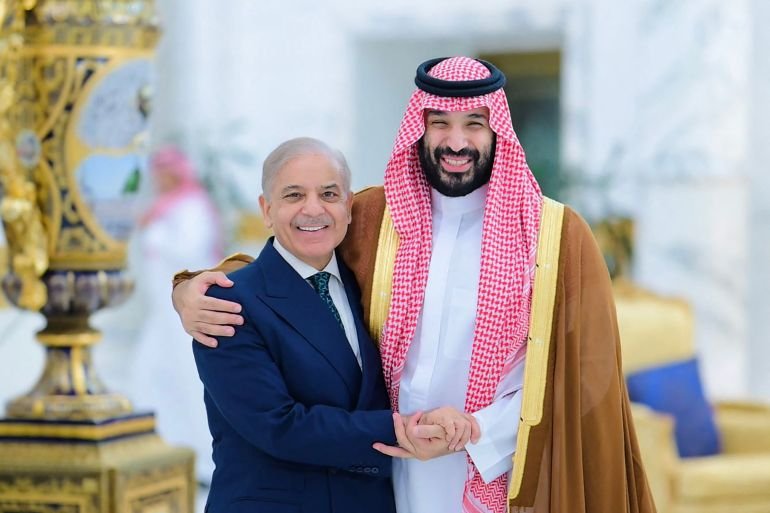
    Field Marshal Asim Munir leaves Tehran while premier Shehbaz Sharif heads home from Turkiye amid hopes of another round of US-Iran talks.

    Pakistan’s army chief and the prime minister have wrapped up separate diplomatic visits aimed at advancing efforts to end the United States-Iran conflict, with Field Marshal Asim Munir leaving Tehran and Prime Minister Shehbaz Sharif returning from Turkiye.

    Munir met Iran’s leadership and peace negotiators during a three-day visit to Tehran, a Pakistani military statement said on Saturday.

    Recommended Stories

    list of 4 itemsend of list

    The visit demonstrated Pakistan’s “unwavering resolve to facilitate a negotiated settlement… and to promote peace, stability and prosperity,” the military said ahead of expected US-Iran talks in Islamabad in the coming days.

    Munir held talks with the country’s president, foreign minister, parliament speaker and head of Iran’s military central command centre.

    Parliament Speaker, Mohammad Bagher Ghalibaf, and Foreign Minister, Abbas Araghchi, led the Iranian delegation to Islamabad for peace talks with the US last week, the highest level face-to-face contact between Washington and Tehran in decades.

    Those talks ended without agreement, and a ceasefire is due to expire on April 22.

    But diplomacy has continued, with Pakistan’s Prime Minister, Shehbaz Sharif, visiting Saudi Arabia, Qatar and Turkiye to push the peace process.

    His three-country trip concluded on Saturday, with Sharif and Foreign Minister Ishaq Dar departing a diplomacy forum in Antalya, according to statements from both officials.

    “I leave Antalya [Turkish city] with fond memories and a renewed commitment to further strengthening the enduring fraternal bonds between our two nations, and to continuing our close cooperation to advance dialogue and diplomacy for lasting peace and stability in the region,” Sharif posted on X.

    The flurry of diplomacy comes as further negotiations are expected in Pakistan in the coming days as Islamabad intensifies contacts with regional and global leaders in an effort to sustain momentum towards a US-Iran deal.

    Pressure for a deal between the two countries has grown after Iran reimposed restrictions on the Strait of Hormuz, hours after its reopening following the start of a ceasefire in Lebanon. Tehran accused the US of violating a deal to reopen the strategically important waterway.

    Donald Trump has said a second round of talks with Iran could be held in Pakistan in the coming days. The New York Post reported that Trump praised Munir, saying he was “doing a great job”.

    Reporting from Islamabad, Al Jazeera’s Kamal Hyder said Munir landed back home on Saturday as Pakistan prepared for another round of US-Iran talks expected “within the next few days”.

    “We have also seen a lot of praise from the Trump administration on social media, praising the Pakistani leadership. So all eyes are on Islamabad. Serious differences remain, but there is a flurry of diplomatic activity and a hope and expectation that some sort of breakthrough may happen,” he said.

  • Curry, Warriors knocked out of NBA play-in tournament by Suns

    Curry, Warriors knocked out of NBA play-in tournament by Suns

    Jalen Green’s 36 points helped lift the Phoenix Suns into the playoffs with a 111-96 play-in win over the visiting Golden State Warriors on Friday.

    The Suns earned the Western Conference’s eighth postseason seed. They will visit the defending champion and top-seeded Oklahoma City Thunder on Sunday to open a first-round series.

    Recommended Stories

    list of 4 itemsend of list

    Phoenix scored 30 points off the Warriors’ 21 turnovers.

    After Phoenix let a late lead slip away against the Portland Trail Blazers in the play-in opener, the Suns held on this time.

    There was some late drama, though.

    With the outcome already decided, Golden State’s Draymond Green fouled out with just more than a minute remaining. Warriors coach Steve Kerr shared a moment with Draymond Green and Stephen Curry, embracing both. The three were part of four NBA championship runs.

    However, as action resumed, Draymond Green and the Suns’ Devin Booker began a heated discussion that carried on for several moments before the whistle blew and both players were issued a technical foul. Green was ejected.

    Phoenix jumped out to a big lead with a 13-0 run after the Warriors scored the game’s first two points, then closed the quarter with eight consecutive points to lead 33-15.

    Golden State’s 15 first-quarter points were their fewest in a quarter since scoring 14 in the fourth quarter on March 7 against the Thunder.

    The Suns, who shot 52.4 percent in the first quarter, struggled in the second quarter as the Warriors roared back.

    Phoenix was just 5 of 20 from the field in the second, and Golden State pulled within two on Curry’s free throws with 19.6 seconds remaining in the half.

    As time ran down, Jalen Green elevated for a 3-pointer from the wing and drained it for the Suns’ first field goal in more than five minutes to give Phoenix a 50-45 lead at the break.

    Golden State’s Brandin Podziemski scored 10 of his team-high 23 points in the second. He also led the Warriors with 10 rebounds.

    The Suns used an 11-1 run – featuring two 3-pointers from Jalen Green – to regain control in the third quarter.

    Booker finished with 20 points, eight assists and six rebounds. Phoenix’s Jordan Goodwin added 19 points, nine rebounds and six steals.

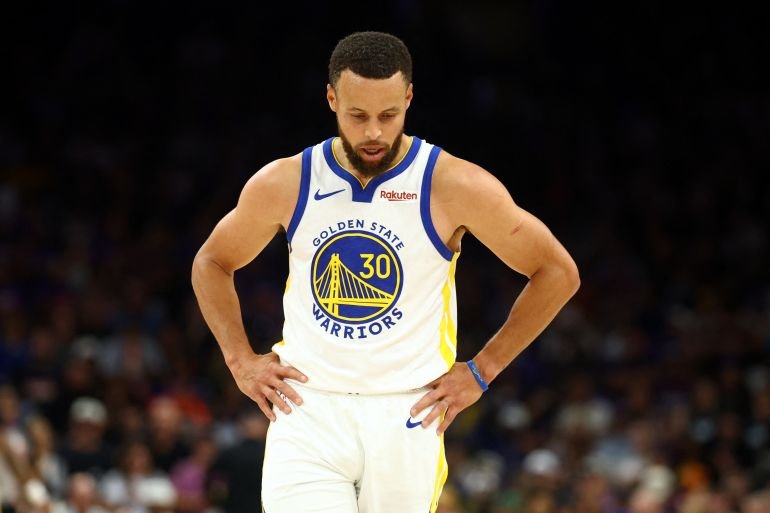
    Curry recorded 17 points in the loss but was just 4 of 16 from the floor and 3 of 10 from 3-point range.

    Stephen Curry in action
    Stephen Curry #30 attempts a shot under pressure from Oso Ighodaro #11 of the Phoenix Suns during the NBA play-in tournament game at Mortgage Matchup Center on April 17, 2026, in Phoenix, Arizona [Christian Petersen/Getty Images via AFP]

    Magic extend Hornets’ playoff drought, face Pistons next

    Paolo Banchero scored 25 points to lead ‌five players in double figures for the host Orlando Magic, who advanced to the ⁠Eastern Conference playoffs ⁠by routing the Charlotte Hornets 121-90 in the earlier play-in game on Friday.

    The Magic, who finished eighth during the regular season, earned the eighth seed and will ⁠face the top-seeded Pistons in a best-of-seven first-round series beginning Sunday night in Detroit.

    This is the third straight trip to the playoffs for the Magic – the longest streak for the franchise since ⁠a team-record six straight appearances from 2007-12.

    LaMelo Ball scored 23 points for the Hornets, who finished ninth in the East. Charlotte earned a dramatic 127-126 overtime win over the Miami Heat in the first play-in game on Tuesday but missed the postseason for the 10th straight season – the NBA’s longest active drought.

    Franz Wagner ‌had 18 points while Wendell Carter Jr. finished with 16 for the Magic, who also received 13 from Desmond Bane and 12 from Jalen Suggs. Orlando shot 50 percent (42 of 84) from the field and 29.6 percent (8-for-27) from 3-point range.

    “When you play with a sense of desperation and urgency, when you know you’re either going home or you’re extending your season, that’s what it looks like,” Magic head coach Jamahl Mosley said.

    Miles Bridges scored 15 points, Brandon ⁠Miller had 14 and Kon Knueppel added 11 in Charlotte’s most lopsided ⁠loss of the season. The visitors shot just 33.7 percent (28 of 83) from the field and 26.7 percent (12 of 45) from beyond the arc.

    Miller’s 3-pointer gave the Hornets their only lead at 5-4 with 9:58 left in the first quarter. The ⁠Magic scored the next 10 points, after which Bridges and Miller combined for five consecutive points.

    The Magic responded by taking control with a ⁠13-0 run as Carter and Banchero combined for 11 points ⁠to take a 27-10 lead. Goga Bitadze’s layup gave Orlando its first 20-point lead at 36-16 with 54 seconds left.

    The Magic led by as many as 35 in the second before entering the half with a 68-37 advantage. Orlando led ‌102-71 at the end of the third and by as many as 33 in the fourth.

    “I hope that this fuels us this offseason, because we did a tonne of really good things ‌and ‌gave ourselves an opportunity – you’re one step away from being in the playoffs, so I don’t want to discredit that,” Hornets head coach Charles Lee said. “But this has got to, like, hurt a little bit.”

    Paolo Banchero in action.
    Paolo Banchero led all scorers with 25 points as the Orlando Magic ended the Charlotte Hornets’ NBA season [Fernando Medina/Getty Images via AFP]
  • US judge blocks Justice Department bid to seize voter data in Rhode Island

    US judge blocks Justice Department bid to seize voter data in Rhode Island

    Ruling is latest loss for Trump administration, which has sought access to state voter data ahead of the US midterms.

    A federal judge in the United States has dismissed a Department of Justice lawsuit seeking to access voter data from Rhode Island.

    The decision on Friday was the latest loss for the administration of President Donald Trump, which has sought to access voter data in dozens of states across the country.

    Recommended Stories

    list of 3 itemsend of list

    In the ruling, US District Court Judge Mary McElroy sided with election officials and civil rights groups, writing that the Justice Department does not have the authority “to conduct the kind of fishing expedition it seeks here”.

    Rhode Island Secretary of State Gregg Amore praised the ruling in a statement afterwards.

    “The executive branch seems to have no problem taking actions that are clear Constitutional overreaches, regularly meddling in responsibilities that are the rights of the states,” Amore wrote.

    “But the power of our democratic republic, built on three, coequal branches of government, is clearer than ever before.”

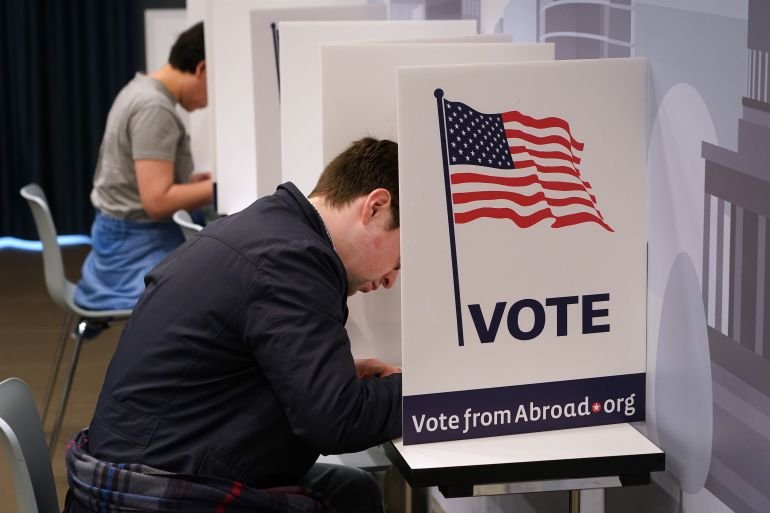
    The Justice Department has sued at least 30 states for their voter information, maintaining it needs the information to secure election security. State officials have said that turning over the data raises an array of privacy concerns.

    Under the US Constitution, state officials administer elections. Only Congress can pass laws related to how states oversee voting.

    But Trump has sought to transform election administration, claiming that voting has been marred by widespread fraud.

    In particular, Trump has continued to maintain that the 2020 election, in which he lost to former President Joe Biden, was “stolen”.

    No evidence has ever been put forward to support the claims.

    Federal judges have rejected attempts in California, Massachusetts, Michigan and Oregon to force the states to hand over voter files to the federal government. At least 12 states, however, have willingly provided or pledged to provide voter information to the Trump administration.

    The push for voter information is one of several actions that have raised concerns over how the Trump administration will approach the midterm elections in November, which will decide the makeup of the US Congress.

    He is currently calling on Republicans to pass the so-called SAVE America Act, a bill that would create higher documentation standards for voters to prove their citizenship when registering to vote and casting ballots.

    The majority of Republican lawmakers have embraced Trump’s claim that the law is needed to prevent non-citizens from registering to vote, despite studies showing that instances of voter fraud are glancingly rare.

    Critics say the measure would risk disenfranchising millions of voters, particularly those who have legally changed their names, which is a common practice in US marriages.