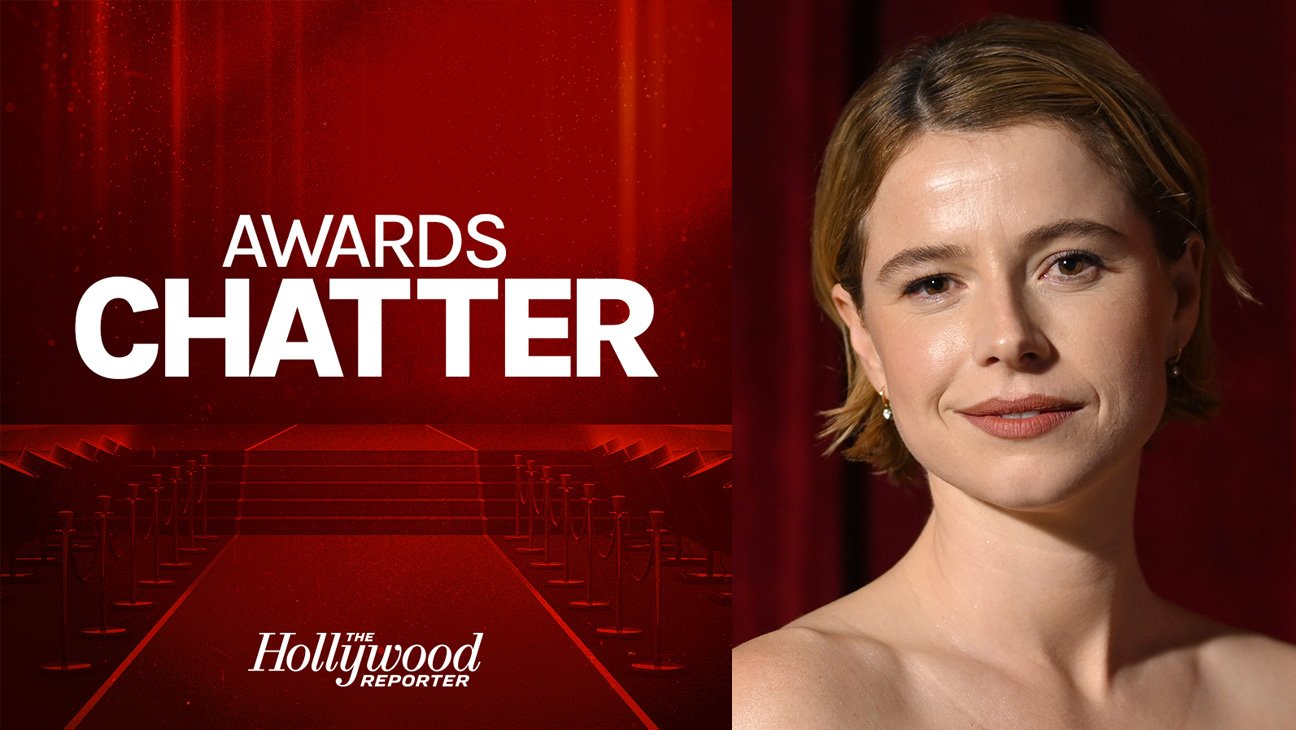
Jessie Buckley, this year’s best actress Oscar frontrunner for her portrayal of Agnes Shakespeare in Chloe Zhao’s Hamnet and the guest on this episode of The Hollywood Reporter’s Awards Chatter podcast, is an Irish stage and screen actress who has been described by Sight & Sound as “born to be a star,” by The Observer as “one of the most exciting actors of her generation,” by The Guardian as “reliably excellent,” by Vanity Fair as possessing “both dazzling charisma and a remarkable authenticity” and by Interview magazine as “one of Hollywood’s brightest stars, capable of delivering performances that burn hot and contain multitudes.” The New York Times, for its part, has noted that she has “a reputation for playing complicated roles with devastating power,” adding, “Few other actresses of her generation can gain access to such a wide spectrum of emotions, or seem as willing to risk being disliked for exploring the tougher ones.”
Over just a decade on the big screen, Buckley, 36, has already given a host of memorable performances. She earned particular acclaim for her work in 2018’s Wild Rose, in which she played a Scottish ex-con who dreams of being a country music star, and for which she received a best actress BAFTA Award nomination; 2021’s The Lost Daughter, in which she played a young academic feeling conflicted about motherhood, and for which she received best supporting actress BAFTA, Spirit and Oscar noms; and 2022’s Women Talking, in which she played one of the women in a Mennonite community who debate what to do after discovering that the community’s men had been drugging and raping them, and for which she received a best supporting actress Critics Choice Award nom and she and her castmates received a best ensemble Actor Award nom.
But it is her turn in Hamnet, as the earthy wife of playwright William Shakespeare and the mother of their three children, that has catapulted her career to another level — Rolling Stone, in its review of the film, wrote, “They will be talking about Jessie Buckley’s performance for years” — and her to the center of the awards conversation. Indeed, she has already won best actress Golden Globe, Critics Choice and BAFTA awards, and is nominated for best ensemble and best actress Actor awards, to say nothing of the best actress Oscar, which she is widely expected to win.
Over the course of a conversation earlier this month in Santa Barbara, where Buckley was being honored with a career-retrospective at the Santa Barbara International Film Festival, she reflected on how she wound up, at just 17, as a finalist on a BBC talent show, and how that, in turn, led her to relocate to London, where she ultimately was accepted at the Royal Academy of Dramatic Art; what she learned from early jobs in the theater alongside the likes of Dame Judi Dench, and how she then moved into screen acting; how her Hamnet performance was shaped by her prior filmmaking experiences, including a film that she shot right before Hamnet but that won’t be released until March 6, The Bride!, Maggie Gyllenhaal’s reimagining of Bride of Frankenstein; plus much more.
You can listen to the conversation via the audio player above or read a lightly edited version of it below.
* * *
Jessie, thanks so much for doing the podcast. Can you share where you were born and raised, and what your folks did for a living?
I was born in Cork, which is the county next to where I grew up. I grew up in Killarney, which is this beautiful town on the west coast of Ireland surrounded by lakes and mountains. In the beginning of my life, I lived in the shed behind my dad’s guest house. Me and my brother and my mom and dad lived in the shed, one bed, rambling around this guest house.
The guest house was like a hotel?
Yeah. I think there were 28 rooms. It was an exotic place to grow up because these people from outside of your world come in. Me and my family were reminiscing the other day about what this guest house would bring in. I remember at one point there was this American barbershop quartet that arrived, and I can still remember the song that they were singing [sings it]; they used to practice in the back for hours, and me and my brother would sit and watch, and then we’d be part of serving and making the beds. Yeah, it was really a bit like an Alice in Wonderland place, but it was also a job.
We just got a sampling of your beautiful voice. Vocal talent runs in the family as well?
Well, my mom is a musician. She works as a music psychotherapist for people in palliative care, and she is a harpist and a singer. She wanted to be an opera singer. When I was a tiny baby, she had gone to London to try and become an opera singer, and we lived in this convent in Roehampton in London, because obviously every Irish family has a nun in their family. [laughs] I remember she’d go off to do workshops in Covent Garden, and I’d be looked after the nuns, my dad waiting around London. And her singing and how she performed — it’s what I’ve always tried to reach for in telling stories, needing to tell a story as a way of emancipating something in yourself that you probably don’t even understand what it is. But I have such a strong memory of seeing her sing in church and feeling like it was essential to her. I remember how she would touch people so much that these strangers would come up with tears in their eyes and want to say, “Thank you.” I really viscerally remember seeing that. And that was probably the beginning of me going, “Whatever that is, I want to do that.”
Could you just as easily have wound up focusing on singing as acting?
I honestly never thought I would be just an actress. I never in a million years thought I’d make a movie.
Even with all the Irish greats like Maureen O’Hara?
No, that was like a fairy tale. Nobody gets to do that! I was exposed to music, but I was also, very early, exposed to theater and musical theater, because there was an amateur dramatics company in my hometown. I really remember going to see my first play, Jesus Christ Superstar. I thought music had the capacity to hold the amount of feeling I felt inside me when I was a kid — until I met Shakespeare.
From what I’ve read, you started doing school plays and summer theater programs and things like that from a pretty early age. Were teachers and classmates saying, “Obviously, Jessie’s going to become an actress” or “you should become an actress” or things like that?
They were. Largely people really encouraged me, especially my parents. There was never, “You should do something safe.” I think they saw how much this meant to me, even at such a young age. Obviously, a few people would be like, “Just make sure you get all your exams…” But I found school incredibly stressful. I just couldn’t learn linearly like that. And formulaically, I mean, my mind is wild.
There are fork in the road moments in many people’s lives, and it seems like there was one for you around the time you first auditioned for drama school. Can you take me into the 48 hours around that?
Well, first to preface it, I used to watch, on repeat, Judi Dench sing “Send in the Clowns.” If you haven’t watched it, you should watch it — the one in Royal Albert Hall, at a Sondheim event — because it’s such a powerful performance, such a simple performance. She just sits on a stool and there’s a spotlight. I might be wrong, but I think she had just lost her husband. And you see somebody distill themselves down to the rawness of their own humanity inside the vessel of a story, and at times you think she’s not going to survive. You can also see her reaching out, like there’s a journey that’s happening beyond herself. I couldn’t understand it. I just wanted to do that. It was so pure. I think I’d heard that she’d gone to one of these drama schools, Mountview or Guildford, the two best musical theater drama schools in the UK, so I applied and went over to do the auditions. My first audition was at the Guildford School of Music and Drama, and that was the one I really wanted to go to. And they wouldn’t let me in. They told me right away.
That was crushing?
Yeah, it broke my heart. But those moments are really important because I think you begin to have a conversation with yourself about— That it’s a long journey. It’s a marathon, your life. It’s not something that just instantaneously happens. And they were absolutely right not to let me in.
Why do you say that?
Because I wasn’t ready, and it wasn’t probably meant to be for me — musical theater — like just that. But it crushed me. I had another audition, for Mountview, coming up the following weekend. But on the weekend that I didn’t get into Guilford, there was an open audition for a TV talent show called I’d Do Anything, which was looking for somebody to play Nancy in a West End production of Oliver Twist. Andrew Lloyd Webber and Cameron Mackintosh and Barry Humphries were involved. I joined the queue for that on the weekend that I didn’t get into Guilford, to practice for my Mountview audition that was coming up, with no expectation at all. And I ended up coming in second.
This was in 2008, you were 17, the show aired on the BBC over the course of 12 weeks, right, starting with thousands of contestants, then 12, and then two. On the one hand, getting to the final two must have felt like an incredible achievement. On the other hand, you’ve said that you came away from that whole process rather depressed.
I don’t think I was depressed because of the show. I think depression — I’ve used that word in a way to protect myself, but I think it’s a bit general around what I was experiencing outside of what that show was, which was a woman discovering herself — a young woman discovering her body, being out in a world, and really asking questions about who she was, what she wanted to say, what her mind thought about things, what she was going to offer into a world. Not from an idea of what it is to be accepted by the world, but actually really from the inside of herself. And for me, that was a very uncomfortable moment of self-discovery. There were moments of huge lows and huge highs, in a very public space.
Was your family throughout this whole time able to be with you in London, or were they back in Ireland?
They were back at home, because my mom had just had a baby. But in the best way, I was getting to peek behind the curtain — I thought I would at least have to be 50 to be allowed to be peek behind the curtain — and all of a sudden I was doing the thing that I saw my mom do, that I experienced when I saw my first ever play. I was part of it! That was extraordinary to me. I was very raw with my feelings at that time, and I had no structure or technique around me, and I was in this new city, which was incredibly exciting because I could reinvent myself, and I did. And if somebody said, “Do you want to come through that door?” I’d be like, “Yeah, sure. What’s in that door?” And sometimes that was dangerous and I probably shouldn’t have gone through that door, but it was a real moment of discovery. I’ve become a mom recently, and the thing that it’s reminded me of is awe. Awe isn’t just like bliss. It’s actually quite a vulnerable state because you’re in such discovery. And in many moments of my life, I’ve felt that rawness of discovery and of awe. That was definitely a moment of that. And I look at that young woman and I think, “You are so brave.” I don’t know if I would be able to do that now in such an open-hearted way. I hope I would, but I don’t know.
So you didn’t get to play the part of Oliver, but it seems like Cameron Mackintosh still had significant interest and confidence in you. How did RADA enter the picture?
Well, RADA entered the picture from Cameron Mackintosh, in such an incredible generous act. After I finished doing the show [I’d Do Anything], he offered to send me to do a Shakespeare workshop in RADA for four weeks during the summer.
Now, this was not something he was doing for every contestant. He did it because he saw something in you.
Yeah, I guess he wanted to nurture something he saw in me. And I went and it changed my life, and it changed how I saw myself. It was the moment that I really recognized myself as an actress, because the power of Shakespeare’s words were bottomless. Music was my only experience of something to fill the fire that I felt inside me until I met Shakespeare and his words, which were just like liquid lava.
You did attend and graduate from RADA, but there was an interregnum between this four-week session there and then going back 2010 to 2013. What was going on then?
I never moved back to Ireland after I’d Do Anything. Once I was in London, I just ended up there. I was doing lots of stuff. It was a great time of my life. Like I did my first ever job, which was A Little Night Music in the Menier Chocolate Factory with Maureen Lipman, Hannah Waddingham and Alex Hanson. Hannah actually reminds me often that she told me to pick up my costume off the floor, which is very good life lesson. [laughs] I did many things — worked in markets, sang jazz — but I wanted to go back and train. I wanted to mess up in private. I wanted to study scripts. I wanted to know what cinema was. I wanted to go to the pub on a Friday evening with people my own age.
And the fact though, that you were able to go back to RADA as a full-fledged three-year student — I think I read that, yet again, something about you inspired a belief in somebody else that made them want to support your dreams, no?
Yeah, I am from a family of five, and my parents always did their best, but when you were out [of the home], you were out. And I loved that responsibility, but it was hard to live in a city like London and be able to afford it. At the Ivy Club [where she performed], there was a man called Tony who had seen me sing, and he loved theater, and he wanted to support young talent. He said, “I want to help you.” And he very kindly paid for my training at RADA and staying in London. If he didn’t, I probably wouldn’t have been able to stay.
That’s amazing. And is he still around?
Yeah.
That’s great that he’s gotten to see that he bet on the right—
—horse!
You graduated from RADA in 2013, and quickly began working at a high level in the theater. Your first job was doing Shakespeare at the Globe. Then Henry V with Jude Law. Then, in a full-circle moment, working with Judi Dench in The Winter’s Tale. When you think back to that time, what did you make of it all? And would you have been content to spend the rest of your career like that, or was there always an ambition to see what was possible in screen acting as well?
I don’t know if I’ve ever had my eyes on the horizon like that. I feel like I arrive where I’m at, and I want to be absolutely there. I remember doing Winter’s Tale with Judi Dench and realizing my education hadn’t finished. Every single night, I’d run down to the wings when Judi Dench was doing her piece as Paulina and I’d watch her — I never missed it. I would sit and just watch her and be like, “Come spirits of Judi Dench, come.”
Were you able to figure out what makes her so good?
She’s just deeply human and mischievous. I mean, I don’t know. Do you know why some people are really good and some people aren’t? I just think she has a river to her heart that is in motion, and her container is gigantic.
I believe she spent the majority of her career primarily in the theater, and then had this amazing second and third act of screen acting. Were you curious about screen acting?
I was definitely curious about it, and I definitely remember those early years in London getting possessed by early cinema — going to the BFI and buying all of Katharine Hepburn’s films and watching The Philadelphia Story, and watching a lot of Spencer Tracy, Barbara Stanwyck and Bette Davis. And then when I was at RADA, this librarian, James, introduced me to Lars Von Trier and Dancer in The Dark and Breaking the Waves, which is the first time I saw Emily Watson [later her costar in Hamnet]. I was probably shy of it. I remember my agent calling me when I was about 22 or 23 saying, “Do you want to go to America? Like do you want to meet some American agents?” And I said, “No, I’m not ready.” And I think what I meant by that is, “I need to get to know myself in order to meet what that might be. I don’t want to go and not have something to say in that world.”
That’s a level of self-awareness or humility that’s highly unusual.
Well, I guess I didn’t really know what that meant anyway like, “Do you want to go to America?” In the scripts that I choose and the people I work with, I want a visceral reaction that feels embodied. I am nothing without the people that have come before me. Maybe that’s why I watched Katharine Hepburn and Judi Dench; their stories were my education, and I just hadn’t metabolized that yet in myself. But then I do remember the moment I got the script Beast. Those moments are so special and so rare in a career, where the alchemy of where you are meets the alchemy of a story, and where that character was and where I was — it was such an incredible entry point. And it was such a pure experience making that. And it was Michael Pearce’s first film. It was my first film. We were like, “There’s no money. There’s no consequence. You’re making art.” [laughs] I was playing a young woman who was, I would say, imprisoned in a pretty conservative idealism, and she meets a man who is wild, dangerous feral, has a monster inside him. I think she recognized something monstrous inside her too. And this collision is very intense, but full of life and disobedience, and ruptures morality.
And this was the first screen project that you were sent or the first one that you reacted to?
I can’t remember if it was the first screen project that I was sent, but it was definitely the first script that I got sent that I became obsessed with. I’d read that Marion Cotillard had kept the script of Rust and Bone under her bed, so I put the script of Beast under my bed until I got the part.
That was your first film, released in 2017. But the first screen work of yours that anyone saw, I believe, was the limited series War & Peace, which came out in 2016. And then the project that really was a breakthrough for you was the 2018 film Wild Rose, which was directed by Tom Harper, who had directed War & Peace. After that, you were nominated for best newcomer at the British Independent Film Awards and best rising star at the BAFTA Awards. What stands out to you when you think back to that one?
It was my first mother. I’ve played quite a few mothers — disobedient, naughty mothers — and the struggle of that role when you also want to be in the world. It was very small film, but I was surrounded by these incredible musicians. It was such an amazing thing to study country music and the great country music singers like John Prine, Emmylou Harris and Bonnie Raitt, who was a huge thing for me during this — their stories are about every man, every woman, and their struggle. It’s so simple. There’s no flounce. It really is distilled down to the essence of how you just be alive and love with a weight on your back. And that was a great lesson: how can you distill what you’re trying to say down in the simplest way?
The next year, you had two projects that a lot of people saw you in. You played an aid to Judy Garland in Judy, for which Renee Zellweger wound up winning her second Oscar, so a lot of people in the business also saw you in it. And you were also in an excellent limited series that wound up winning a lot of Emmys, Chernobyl, playing a pregnant woman who, along with her husband, was affected by the meltdown.
God, this is a real trip, Scott! It was so beautiful to see Renee do what she did on that film. Also, what I really remember of working with her was how she led a set with so much generosity, and that she could do what she did and go to the places that she went, but be in contact with every single person that was working on that set, whether that be the extras or the crew or me — there was just this generosity and bravery. And Chernobyl was a pretty extraordinary experience. I mean, it’s hard to know what you’re doing when you’re in the middle of it. I was in Lithuania putting a wig on and a pregnant belly, and my husband’s got these wild scars on, and you’re just in the moment of it. The word “Chernobyl” was very much present in my childhood because in Ireland they have this scheme called Chernobyl Children where children that had been affected by the nuclear explosion would come and be fostered by Irish families, so I had a really strong relationship with just the word and what that was. But I remember the feeling on set, how it was directed, how it was shot — it felt giant, but also curated, and it had an identity. It had a point of view and was a little bit dangerous and it was beautiful. I loved playing her, this uncompromising lover.
The next year was I’m Thinking of Ending Things, a very surreal film from Charlie Kaufman in which you’re playing a young woman going to meet her boyfriend’s parents, but then characters’ names and all sorts of things start changing; I’ll also note that it was shot by Łukasz Żal, who later shot Hamnet. And then also that year was season four of TV’s Fargo, in which you played a nurse who was not always great with her patients.
I’m Thinking of Ending Things — I loved doing that. I mean, I got to go to work with David Thewlis, Jesse Plemons, Toni Collette and Charlie Kaufman every day! And Charlie’s worlds are so broad. I think that was probably the first moment where I started working more as an artist than an actor, in a way, because he was questioning so many things, and the possibility to create from his brilliance is endless. It was really alive. I mean, I remember the first note he ever gave me, for the camera test that I sent in, and feeling like, “Whoa, I’m in a different territory here of myself and my work, and this is really exciting.” And I remember doing that scene with David Thewlis up in the attic, and the beauty of him as an artist, and just feeling so lucky. And Fargo? She was a laugh. My instinct with her walk and all that came super clearly. I just was like, “She’s a bird [as far as her walk] — she’s obsessed with Edith Piaf [who was nicknamed “The Little Sparrow”] — and also it’s going to be freezing, so I can walk really quickly between takes.” Yeah, it was great fun, that.
Another big milestone was The Lost Daughter, Maggie Gyllenhaal’s directorial debut, in 2021. You play the younger version of the academic who Olivia Colman plays at a later stage of her life. You were, I believe, suggested to Maggie by Olivia, who you already knew?
We’d met at a festival, we’d got drunk. [laughs]
Well, that’s always good way to break the ice! In giving the performance that brought you your first Oscar nomination, was there any sort of coordination between you and Olivia, with or without Maggie, as far as playing the same character at different stages of her life? And what was it about the heavily female set that caused you to grow a lot as a person, according to other things you’ve said?
We didn’t have any conversations about this character, other than the accent — that’s all we talked about — and I love Maggie not shoehorning us in. I think it would’ve become less alive. Maggie has been and is one of the most important women in my life, because I think she’s looking to fill the spaces that we [women] are not allowed to fill or haven’t been allowed to fill. She wants the full story. She wants the shadowy bits to come to the surface so that as a woman, you’re not deciphered off. And especially in this role. This is a woman who really is hungry. Her mind is hungry, her body’s hungry. I felt she loves being a mother, but she also wants to be a woman in the world. And that’s the truth, right? It’s not always going to be easy. I think Maggie provoked the most uncomfortable questions in order to realize something.
That same year going into the next year, you had a real triumph on the stage with Eddie Redmayne in Cabaret, winning the Olivier for that. That led into 2022, in which the theme of your projects was toxic masculinity, between a movie called Men, written and directed by Alex Garland, and then a movie called Women Talking, written and directed by Sarah Polley, which took a similar path to the one later taken by Hamnet, from Telluride to the Oscars.
Yeah, that was really interesting. In Men, it’s a fable, it’s a fever dream, it’s a genre piece, but a kind of nightmare, in which a woman is invaded by toxic masculinity. And then I got offered Women Talking at the same time, and Mariche was a woman who was actually in the opposite place of where Harper was. She was a woman who was defending her experience in a patriarchy and in a violent space. I was very curious about what both these things might reveal to me.
Both of these films were coming right on the heels of the beginning of the #MeToo era. That’s not a coincidence, right?
No. I believe the stories came from the culture that was surrounding us at that time, and it was super interesting, and I loved doing them. I mean, they were very intense pieces to do, and Women Talking and playing that character shook me in a way that I didn’t expect. When I got that script, I almost didn’t believe that it could be possible — I was like, “Who’s going to watch women talking? Twelve women in an attic in Mennonite dresses?” It was a pretty amazing experience.
We will soon see you in Maggie Gyllenhaal’s next film, The Bride!, which is apparently a new interpretation of Bride of Frankenstein. I don’t know too much about it yet — I don’t know that anybody does — but the fact that it was shot right before you went and shot Hamnet, I imagine, must have, in some ways, shaped your performance in Hamnet, no?
I think doing Bride and playing in a sandpit that was bigger than I had played in in many ways — in the character, in what I had to create, in working with Christian [Bale] and with Maggie, it’s the biggest budget film I’ve ever done — it felt like it was such an embodied experience that something got born in me a little bit. I guess, the confidence to take a space, to tell a story from a female point of view. In other iterations, she’s born to be a wife, but without any autonomy, with no voice, with not even an option to say “No” — she just screams, which, if you didn’t get the picture from that, we’ve got some serious problems! They didn’t do The Bride 2 after that — they were like, “Oh, shit. We’re in some dodgy territory here. This girl is screaming? Shut it down!” [laughs] And really, this is about love. “If you really want to love, and if you really want to be in a relationship with me, how much of me can you actually love? Not just the nice bit, the bit that’s palatable to you. You want to know the truth? This is the truth.” It cracked me wide open and brought me to my knees. Maggie was ferociously in it with me and demanding of me. And Christian was the same. And we were the same with each other. It really was the most intense ride of my life and made me, I think, step into a different body of myself.
I don’t know how much longer after that you went to go do Hamnet. But would you have played Agnes the same way had you not done The Bride! right before?
I think she would have been absolutely different if I hadn’t done The Bride! before. And I had two weeks after I finished Bride going into Hamnet — that’s all I had. I came to rehearsals with bleached eyebrows — they were having production meetings about my eyebrows, wondering if they’d grow back or change color. And actually, the muscle was very alive. [laughs] It was a gift. I had this love, and I also was deeply, uncompromisingly embodied in myself, which Agnes is. She is in touch with her elemental force.
I believe that you and Chloé first crossed paths at the edition of the Telluride Film Festival that you attended with Women Talking, which she was attending as a movie buff. What did she say to you about why she thought you were the person who should play Agnes?
I don’t know if she has ever said. She just asked me to do it, and I was like, “Yes.”
Maybe Paul Mescal was there too that year—
I think he was there for Aftersun that year.
Did you two know each other before you were cast in this? Was there any test before you were cast, or did they just say, “Hey, it’s two great actors, let’s see what happens.”
We knew each other a little bit. We’d both been in Lost Daughter, but we hadn’t actually worked together in that. And then just from being Irish. But we didn’t know each other. And we did do a chemistry test together. And that was very, very exciting. It was actually a great way to start that relationship, because there was unknowability and incredible possibility and a real care and trust and a meeting of minds. There was no hierarchy. We were going to jump off the cliff. And wherever either of us was being led, I think we both instinctively felt that we would hold each other in that exploration and go there with each other. And that’s how we moved through the whole filming.
As you alluded to earlier, you’ve recently become a mother for the first time, so congratulations on that. When you made Hamnet, you had not yet become a mother. Was that important, or is it all imagination? I mean, you weren’t previously the bride of a monster either.
I have never died and been reinvigorated, for any of our listeners who are concerned how Method I was. [laughs] Sometimes as an actor, you do those stupid things where you buy a book on how to be a Tudor, and you read a page and you think, “Oh no, it’s pointless,” and it lives on your shelf and gathers dust. The midwife in the film was actually a real midwife, so she came and spoke to us and talked about that, and that was helpful. But when I was working on this and when I was really trying to find Agnes’s language in her unconscious, I did a lot of writing and I really was listening to my dreams a lot, and using my dreams as compasses for the scenes and for the relationships.
I think, from talking to Chloe, you were the one who inspired her to incorporate dream work with everyone on Hamnet, right?
Yeah.
There are things that I’ve heard about her doing with the actors — and everybody — on the set that I’d never heard of anyone else doing on a film, like a guided meditation or something to start the day. And there’s a behind the scenes photo that’s been released of you preparing to do one of the birthing scenes out in the forest, and Chloé seems to be literally lying down next to you. That’s not exactly conventional, but it clearly worked! It seems like you and Chloé are on the same wavelength, in terms of being open to outside the usual box ideas.
Yeah. I want to ground what that might sound like, because that feels a bit untangible. I think what that offered on set was presence, a way to enter into a world and to be out of your head and in your body. In the same way with school, I’m not good with linear thought and a projected idea. I don’t know who my character is until I’ve lived inside them. And I think the more I’ve done it, the braver I’m trying to be, to really get out of my own way. But you still have to stir the waters a little bit. And I find dreams, or even taking a scene in a script as if it was a dream, and writing around that in an abstract way, just stir the water to help you enter into an essence of where you think you might travel. Because in the best moments, you don’t know where your final destination is going to be, which happened time and time again on this set — like the end, and the scream at Hamnet’s death.
It’s so funny you say, because those are the two specific moments I wanted to ask you about. First, the scream — was that in the script?
No, that wasn’t in the script. And also, those moments don’t come from just an empty space. We’d gone on an absolute ginormous journey by the time I got to that place, and I was in a really strong relationship with Jacobi [Jupe, who played Hamnet] and with the other kids and with Emily and with Paul and with Chloe and Stash, our camera operator. We were really vibrating on a level together. Are those scenes scary when you meet them on the day or preceding them? Yes. You’re like, “Okay. Right. How do I gently move towards this place?” I like to use music quite a lot, and we had found a piece of music that, on most of the scenes, we would play, so really, we were all moving together at a moment. Jacobi Jupe is an incredible actor, an extraordinary little man, and his heart and our hearts were so available to each other. And I am also conscious, as an actress who’s done it longer than him, to protect him, because it is make-believe and children are so in the belief. And we were able to step out of it and come into it. But I don’t know, man, you look into his face and you’ve gone on this journey? I think that scream came out on the second of three takes, and I didn’t expect that to come out. I don’t know where grief begins and ends. We all know grief, in a way, and I don’t know how to describe what that was. It was out of body, but absolutely catalyzed by this incredible young boy in front of me who was with me every step of the way, and vice-versa. And those moments — they’re very rare, and they’re an amazing thing to even touch the side of it.
And then the scene at the end, which is single-handedly responsible for the stock of Kleenex skyrocketing, with your hand reaching towards the stage and the whole way that one goes down. I wonder, again, where, emotionally, that came from, and if Agnes has ever seen her husband’s work on the stage before that day.
No, I didn’t believe she had seen her husband’s work. I mean, their relationship was really incredible. And I think she had the foresight to know that this man has so much inside him that is bigger than the place that they live, and even their relationship, and he needs somewhere to share that. But I intimidated by that. Was it better, the devil you know, to walk into that place that in its very name, the Globe, is intimidating, where you have access to heaven and earth and 400 strangers that are holding a piece of paper that contains the name of your son who’s lost, and you can’t find him? Yeah, it was hard. And there were moments that I was lost as an actress, but also she was lost. And I think Chloé felt the same, in terms of how to land the plane of this moment. But I think the thing that where the pin dropped is even if you are in the most intense, isolated experience of grief where you’ve really, you can’t find your son, you can’t find your husband in your heart. You’re kind of floating in midair. And I guess, when I realized through Max Richter’s music “On the Nature of Daylight” on day four, that I was not on my own, I was surrounded by 400 other people who’ve probably experienced grief. And for some reason we have come to this place like we come to cinema or a theater or listen to piece of music or a book in an unconscious way to need the vessel of a story to hold the parts of ourselves that are too hard to hold in her own, and to use that space, to use that theater. And when she realizes that her husband has pulled off the greatest magic trick of her life, that he has reincarnated her lost son through the vessel of a story, that she can actually touch him again, she can see him again, that he’s immortalized in his nature by this story. Which I think when we get affected by a story in a film or in a piece of theater, that’s our experience. It’s like we can’t even really understand why, but it’s touched us. And I think that’s what got revealed in us as we were moving through that last sequence. And that wasn’t on the page, there was no reaching out. Even the camera operator at the beginning, there was cranes and big objects and probably fear. And I think by day four, Chloe, to go to the producers being like, “Yeah, we don’t want any of them anymore. Sorry, I know that costs lots of money.” And we ended up shooting the whole thing on a ladder and a handheld camera, and brought right back down to humanity.
For Hamnet, you have won a ton of awards and are nominated for an Oscar. Everybody in the world, or at least “our world” of this business, has seen the film and is talking about it — I mean, I’ve never heard anything like what Jane Fonda said about it and you at the recent Palm Springs International Film Festival’s Awards Gala. But my sense is that you’re quite a private person and not really seeking attention. So I just wonder, what are you making of this moment? Are you able to enjoy it? Is it fun? Is it intimidating? What’s your state of mind?
I have very different moments at different times. Sometimes you can’t take it in. Sometimes you’re just changing a nappy, and you’re really grateful for that nappy — you’re like, “I’m a real person, I’m a real person!” And then you have moments where you’re like, “What?! This doesn’t happen in a life.” I had that moment yesterday at the Oscar Nominees Luncheon, when everybody was getting up on that stage to be in the class photograph. There was something so innocent about it, but also, I’m there with Paul Thomas Anderson and Chloe and Delroy Lindo, these incredible artists. In my wildest imagination when I was a young woman, I never thought I would be remotely near that. I had a moment where I was like, “Whoa, don’t for a second take for granted what this is.” And it is a community. And yes, the Critics Choice and Golden Globes, they’re scary — people spend two hours after you’ve changed a nappy trying to make you look great, when you feel like, “I wish the ground would swallow me up” or “How am I meant to be in these rooms? I shouldn’t be here.” But then you get into these rooms and you know that everybody’s just made something, and to make anything at all is an absolute triumph. I’m so proud and honored to stand beside these incredible artists who have inspired me throughout my life in ways that I don’t think I have the vocabulary or the ability to tell them. This is like a moment in time, and I’ll move on, and I’ll make more things, and I’ll try and be brave, and I hope I can continue to work with the people who’ve really woken me up to my life in working with these people. In so many ways I’m changed by what I do, and I want to offer something into that world. We only get one life. And I think when I look back I will go, “Oh my God!”