Tag: CRYPTOS FoxBusiness

  • Uniswap launches Earn with Morpho lending vaults

    Uniswap launches Earn with Morpho lending vaults

    Uniswap has launched Earn, a self-custodial lending product that allows users to deposit $USDC, $USDT, and $ETH into Morpho vaults without leaving its app.

    Uniswap Earn supports $USDC, $USDT and $ETH

    Earn is available through the Uniswap Web App and Wallet, extending the platform beyond token swaps and liquidity provision into onchain lending.

    Users can select a supported asset, choose an amount and authorize the deposit with one signature. Deposits then earn interest paid by borrowers across lending markets selected by the underlying vault.

    $USDC, $USDT and $ETH are supported at launch, with all three vaults operating on Ethereum mainnet. Users can withdraw at any time because the product has no mandatory lockup or cooldown period, according to Uniswap’s launch announcement.

    Uniswap does not charge a separate fee for using Earn. However, depositors remain responsible for standard Ethereum transaction costs, which can make smaller positions less economical when network fees rise.

    Deposits appear alongside users’ other assets in the Uniswap portfolio interface. The dashboard displays the amount deposited, the current yield rate and total earnings, while recording deposits and withdrawals in the account’s activity history.

    Morpho and Gauntlet manage the lending infrastructure

    Morpho supplies the permissionless lending infrastructure behind Earn, while Gauntlet curates the vaults and determines how deposits are distributed across eligible markets.

    Vault curation can reduce the need for depositors to compare individual lending pools, collateral types, and utilization rates. Gauntlet can set exposure limits and rebalance capital as market conditions change, but depositors still carry the risks associated with those allocation decisions.

    Morpho currently reports about $11.79 billion in deposits and $4.15 billion in active loans across its network. The protocol previously said deposits increased from $5 billion at the beginning of 2025 to $13 billion by the end of that year’s third quarter.

    Active loans rose from $1.9 billion to $4.5 billion over the same period. Annualized interest paid to Morpho lenders reached $227 million in 2025, representing a 400% increase from 2024, according to Morpho’s annual review.

    Earn broadens Uniswap beyond token swaps

    Earn gives Uniswap another way to retain users between trades. Instead of transferring unused stablecoins or $ETH to a separate lending protocol, users can now access lending vaults through the same interface used for swaps and portfolio tracking.

    The integration places Uniswap in closer competition with established lending platforms such as Aave and Compound. Its main distribution advantage is an existing base of traders who can move from swapping to lending without navigating to another application.

    For US users, Earn is an onchain lending service rather than a bank savings account. Deposits do not carry FDIC insurance, and self-custody does not remove smart contract, collateral, liquidity, or stablecoin risks.

    Vault yields are also variable. Rates can fall when lender deposits grow faster than borrowing demand, meaning the displayed annual percentage yield is not guaranteed for the duration of a deposit.

    $UNI price shows limited reaction to Earn launch

    $UNI traded near $4.30 at the time of writing, declining approximately 2.8% over the previous 24 hours. The token remained up about 12% over seven days.

    Its market capitalization stood near $2.68 billion, while 24-hour trading volume reached roughly $376 million. The latest move does not establish a direct link between the Earn announcement and $UNI’s price performance.

    Adoption will depend on the yields offered by the Gauntlet-curated vaults, Ethereum transaction costs, and users’ willingness to accept lending-market risks. Uniswap has not announced that Earn revenue will flow directly to $UNI holders, making deposits and user retention the main metrics to watch initially.


  • MarsCat Partners with Cwallet to Expand Web3 Wallet Ecosystem

    MarsCat Partners with Cwallet to Expand Web3 Wallet Ecosystem

    MarsCat, a renowned Web3 network for blockchain connectivity, has partnered with Cwallet, an inclusive Web3 crypto wallet entity. The partnership attempts to delve into exclusive opportunities that enhance blockchain connectivity and offer a relatively consumer-friendly digital asset experience. As MarsCat mentioned in its official social media announcement, the development is set to bolster Web3 expansion across diverse blockchain ecosystems. Additionally, the development underscores a mutual commitment to advancing decentralized interactions via innovative technologies.

    Ecosystem Collaboration 🌐

    MarsCat 🤝 @CwalletOfficial@CwalletOfficial is building an all-in-one Web3 wallet experience, trusted by millions of users with support for multi-chain assets, swaps, payments, trading, and seamless Web3 interactions.

    Together, both ecosystems will… pic.twitter.com/OXq6iCHuja

    — MarsCat (@MarsCat_Global) July 31, 2026

    MarsCat and Cwallet Partnership Simplifies Web3 Experience and Adoption

    In partnership with Cwallet, MarsCat endeavors to streamline the wider Web3 experience, specifically for consumers driving blockchain adoption. Instead of introducing a single product rollout, the joint effort is establishing a framework for further such initiatives to integrate services as well as broaden functionality across networks. In this respect, Cwallet has developed a comprehensive Web3 wallet network to support numerous users worldwide. Additionally, the wallet delivers access to different multi-chain digital assets, letting users manage crypto across several blockchains from an inclusive interface.

    Apart from the fundamental asset management, Cwallet also enables token swaps, trading tools, crypto payments, and different Web3 functionalities for seamless blockchain and DeFi interactions. With this partnership, both entities focus on unique ways to develop a widely connected and seamless decentralized environment. The shared objective of both platforms is to minimize barriers that usually keep users away from entering the Web3 market. For this purpose, it makes blockchain services more convenient to navigate and access.

    As the market keeps evolving, consumer experience has turned into a crucial element in advancing mainstream adoption. Keeping this in view, this move underscores the rising trend where blockchain projects are collaborating to expand networks rather than working autonomously. Such strategic partnerships permit them to merge technical expertise, infrastructure, and user communities while pushing forward interoperable services.

    Advancing Blockchain Interoperability with User-Centric Innovation

    According to MarsCat, the partnership prioritizes ecosystem adoption and connectivity. If effectively implemented, this development could boost interactions between diverse blockchain apps while also complementing a relatively user-centric and integrated Web3 ecosystem. Overall, amid the growing adoption of the blockchain technology, such collaborations are becoming a very common strategy to deliver improved functionality while also establishing broadly accessible decentralized experiences.

  • Cryptocurrency Project Backed by 140 Companies Including Visa and BlackRock Launched! This Giant Altcoin Was Selected!

    Cryptocurrency Project Backed by 140 Companies Including Visa and BlackRock Launched! This Giant Altcoin Was Selected!

    Open USD (OUSD), a next-generation stablecoin project targeting institutional investors, is preparing to launch.

    OpenUSD (OUSD), a stablecoin aimed at institutional investors and backed by a consortium of over 140 companies including Visa, Mastercard, and BlackRock, will initially be launched on Ethereum.

    The news was announced by Ethereum Institutional, an independent non-profit organization focused on the adoption of Ethereum by institutional investors, in a statement from its official X account.

    “Visa, Mastercard, Stripe, BlackRock, BNY Mellon, and over 140 participating companies are bringing OUSD to Ethereum for the first time.”

    Corporate Payment Infrastructure Targeted!

    According to the statement, Open USD (OUSD) is positioned as a stablecoin designed to make it easier for companies to conduct digital dollar transactions.

    Open Standard, the company behind the project, aims to enable businesses to mint and redeem OUSD without fees or volume limits.

    One of the notable features of this stablecoin is its reserve revenue model. Open USD plans to share the returns from its reserves with partners participating in the ecosystem after deducting operational management fees. This structure stands out as a different revenue sharing approach compared to some existing large stablecoin models.

    Finally, the launch of OUSD on the Ethereum network is of great importance in further solidifying the platform’s leading position in the institutional finance space. This is because Ethereum stands out as a significant infrastructure for institutional use in stablecoins, real-world assets (RWA), and tokenization applications.

    *This is not investment advice.

  • US Treasury sanctions Iran’s Bitcoin-backed shipping insurance scheme

    US Treasury sanctions Iran’s Bitcoin-backed shipping insurance scheme

    The US Treasury’s Office of Foreign Assets Control (OFAC) announced a new round of sanctions targeting Iran’s maritime revenue network, including two firms accused of operating an IRGC-backed insurance scheme for ships transiting the Strait of Hormuz.

    Treasury said Persian Gulf Marine Insurance Company and HormuzSafe Marine Services Authority sold mandatory insurance policies covering risks such as vessel seizures while accepting payments in Bitcoin and other digital assets to circumvent sanctions.

    According to the Treasury, the insurance scheme was designed to generate revenue for the IRGC while giving Iran greater influence over commercial shipping through one of the world’s busiest waterways. The sanctions were imposed under Executive Order 13902 as part of the US campaign to increase economic pressure on Iran.

    In addition, OFAC sanctioned eight shipping companies and blocked eight oil tankers that allegedly transported millions of barrels of Iranian crude oil and petroleum products to destinations including China and the UAE. Treasury said it has now sanctioned more than 100 vessels associated with Iran’s shadow fleet in 2026.

    The latest measures freeze assets subject to U.S. jurisdiction and prohibit transactions involving designated entities. Treasury also warned that non-US persons may face penalties if they assist sanctioned parties or facilitate efforts to evade US sanctions.

  • RWA perps will outpace tokenization

    RWA perps will outpace tokenization

    Traders have no way to react to events after markets close on TradFi venues. Perps on the other hand run 24/7. The Iran conflict was reflected in oil perps on Hyperliquid before CME reopened. Perps offer a continuously running, efficient market in a simple interface. Futures and options come with expiry dates, complicated greeks and interfaces. Perps remove all of that while keeping the speculative upside potential intact.

    Martin Lee is Market Insights Lead of DWF Labs, one of the most active market makers and investors in digital assets.

    Derivatives always outgrow spot

    Derivatives volumes always outgrow their underlying spot market. It’s what we see in equities, commodities and crypto. RWAs are following the same trend. Equity perp volume on Hyperliquid ran 13-20x tokenized equity spot volume between March and May 2026.

    You could argue that the number of traders matter more, a metric that spot usually wins out across most markets (except commodities). Looking into the numbers, tokenized equities have the bigger base: 180,845 wallets against 24,378 for equity perps. But perp holders are compounding at roughly 33% a month against spot’s 17%. Even in the domain where spot dominates, perps are rapidly closing the gap.

    Perps innovate faster

    The biggest factor driving the acceleration is the rapid rate of experimentation that RWA perps are able to have. Launching tokenized assets takes much longer and is more legally complex than launching a new perp market. The ease of launching perp markets creates opportunities for novel synthetic markets to be spun up. Markets that unlock fresh opportunities that didn’t exist before. A true 0 to 1 moment.

  • Coinbase’s weak quarter leaves Wall Street split on timing of a recovery

    Coinbase’s weak quarter leaves Wall Street split on timing of a recovery

    Coinbase said it captured a record 10.3% share of global crypto trading volume during the quarter, its third consecutive quarterly gain. Analysts at Benchmark, Oppenheimer, Clear Street and Cantor all highlighted the figure as evidence that trading activity is consolidating onto larger regulated exchanges during periods of market stress.

    Several also pointed to derivatives, where Coinbase reported flat trading volumes despite management saying the broader derivatives market declined by double digits.

    Diversification shows progress, but isn’t enough

    Analysts viewed Coinbase’s push beyond spot trading as encouraging, even though the newer businesses remain too small to offset weakness in core trading revenue.

    The company is trying to diversify through prediction markets, derivatives, subscriptions, stablecoins and its Base blockchain. Prediction markets surpassed a $100 million annualized revenue run rate, while Coinbase One topped one million paid subscribers. Its Circle partnership for USDC also renewed on existing terms, removing a key concern for investors.

    Still, there was broad agreement that diversification has not yet become large enough to replace lost trading revenue.

    Clear Street noted new businesses continue gaining traction but remain “optionality” rather than meaningful earnings contributors. Barclays was more critical, arguing prediction markets and retail derivatives “did not” provide the boost they offered last quarter. Compass Point similarly said emerging businesses “barely moved the needle.”

  • New York sues Kalshi, alleges it offers a gambling platform ‘plain and simple’

    New York sues Kalshi, alleges it offers a gambling platform ‘plain and simple’

    James’ office described Kalshi’s event contracts as bets and said the platform takes wagers on professional and college sports, elections and culture. The lawsuit alleges Kalshi allows users aged 18 to 20 to wager and lists markets involving New York college teams, both prohibited for licensed sportsbooks in the state.

    “New York’s gambling ⁠laws protect children from underage betting and help combat gambling addiction,” James said in the statement. “No matter what they call themselves, prediction markets like ​Kalshi are gambling platforms, plain and simple.”

    The World Cup helped boost Kalshi’s numbers, adding 3 million during the course of the tournament, according to CNBC. That’s more than double the 2 million the firm said it had at the start of May.

    According to the attorney general’s statement, the lawsuit follows an October cease-and-desist order from the New York State Gaming Commission.

    A federal judge denied Kalshi’s bid to block state regulators on July 7 and rejected an injunction pending appeal on July 27.

    CoinDesk approached Kalshi for comment outside of regular U.S. office hours, and had not heard back by publication time.

  • Critical Day in the Crypto Market: A $10.5 Billion Option Surge in Bitcoin and Ethereum! What Are Investors Expecting?

    Critical Day in the Crypto Market: A $10.5 Billion Option Surge in Bitcoin and Ethereum! What Are Investors Expecting?

    The leading cryptocurrency, Bitcoin, is struggling to find direction around the $64,000 level amid ongoing uncertainty surrounding US monetary policy and geopolitical risks in the Middle East.

    As $BTC continues to move within a narrow range, attention in the cryptocurrency markets has turned to the high-volume option contracts expiring today.

    These options are particularly significant because they fall on the last Friday of both the week and the month.

    According to weekly data, approximately $9.7 billion worth of crypto options will expire on the Deribit derivatives exchange on July 31.

    According to Deribit data, $9.69 billion worth of Bitcoin and $830 million worth of Ethereum options will expire.

    Accordingly, the Put/Call ratio for $BTC options is 0.28, while the maximum loss point is $64,000 and the intrinsic value is $9.69 billion.

    Looking at Ethereum, $ETH options have a Put/Call ratio of 0.63, a maximum stop-loss point of $1,850, and a nominal value of $830 million.

    What Do Options Mean for Bitcoin and Ethereum?

    The put/call ratio is 0.28 for Bitcoin and 0.63 for Ethereum, indicating that investors are generally betting on higher returns and expecting an upward trend.

    For $BTC, this indicates that the majority of investors are positioned for prices to rise, or that bullish expectations are more dominant. A low ratio like 0.28 points to an optimistic (bullish) market outlook.

    In contrast, while call options still dominate for $ETH, this indicates that investors are more cautious compared to Bitcoin. However, according to experts, the put/call ratio and the expiration of options are not considered the sole determining factors of price direction. Macroeconomic developments and investor sentiment also continue to be decisive in pricing.

    *This is not investment advice.

  • XRP Price Nears Key Breakout Zone as Short Liquidation Cluster Builds Above $1.10

    XRP Price Nears Key Breakout Zone as Short Liquidation Cluster Builds Above $1.10

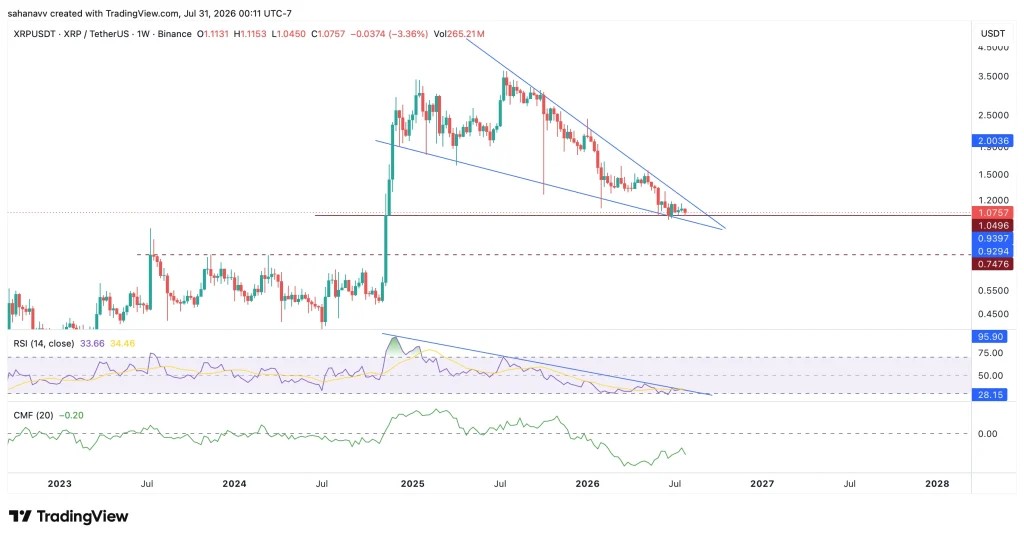
    The $XRP price traded around $1.07 on Thursday, continuing to consolidate below a key descending trendline that has capped price action for months. The token remains stuck between a crucial support zone and overhead resistance, with the narrowing range signaling that a decisive move could be on the horizon.

    While the broader trend has remained weak, traders are closely watching the $1.10 resistance level, as a breakout above it could shift market sentiment and open the door to further upside. Conversely, losing nearby support could expose $XRP to another leg lower.

    $XRP Technical Analysis: Weekly Chart Nears a Critical Turning Point

    $XRP continued to trade within a descending triangle on the weekly timeframe, with the price hovering around $1.07. The token has consistently formed lower highs since its rejection from the yearly peak, while buyers have defended the $1.04-$1.05 support zone, keeping the broader consolidation intact.

    The immediate resistance lies between $1.10 and $1.12, where the descending trendline intersects with a previous support-turned-resistance zone. A weekly close above this range could invalidate the recent sequence of lower highs and pave the way for a move toward $1.20, while a break below $1.04 could expose $XRP to the next support near $0.93.

    The RSI is hovering near 33, indicating that bearish momentum remains dominant, although selling pressure has eased compared with earlier declines. Meanwhile, the CMF remains below the zero line, suggesting capital outflows still outweigh inflows despite signs of stabilization. Together, these indicators point to weakening bearish momentum, but they have yet to confirm a sustained bullish reversal.

    $XRP Derivatives Data Signals Cautious Optimism

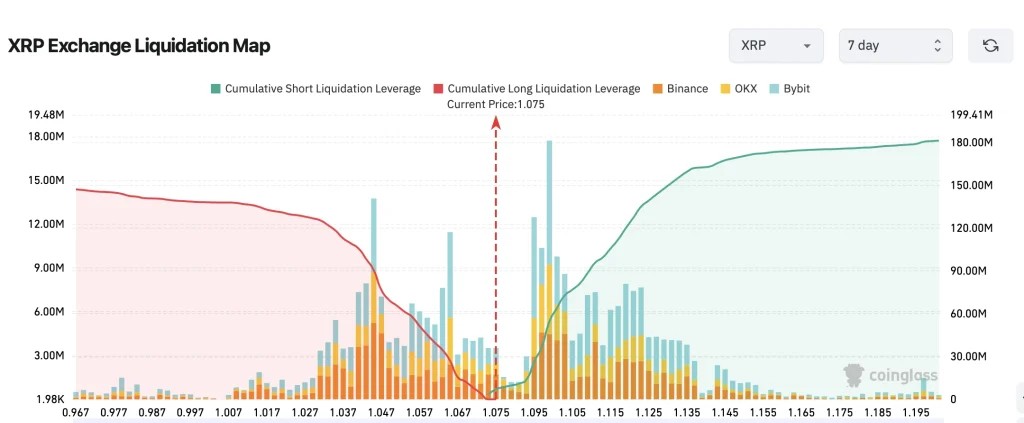
    Beyond the price chart, $XRP’s derivatives data points to a market waiting for a catalyst. CoinGlass’ liquidation heatmap shows a significant cluster of short liquidations stacked above the $1.10-$1.12 resistance zone. If buyers manage to push the token above this level, forced short liquidations could amplify buying pressure and accelerate $XRP’s move toward the next resistance levels.

    On the downside, long liquidation pockets are concentrated around $1.04 and below. A breakdown beneath this support could trigger another round of long liquidations, potentially extending $XRP’s decline toward the $0.93 support zone.

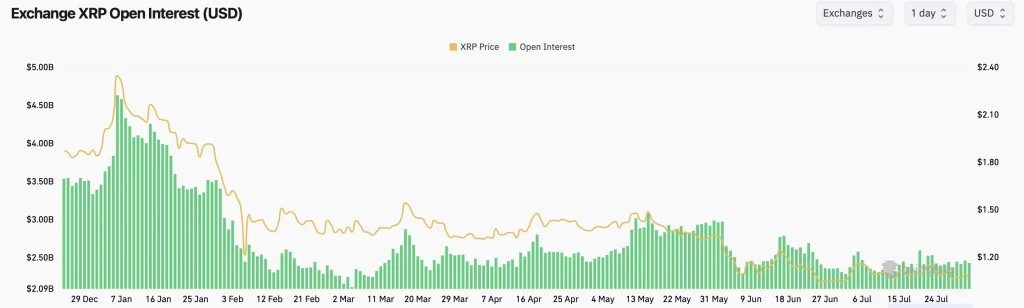
    Meanwhile, Open Interest (OI) has stabilized after declining sharply from its earlier highs, suggesting leveraged positions have cooled. While the recent uptick in OI indicates traders are gradually returning to the market, it remains well below previous peak levels. A sustained increase in both $XRP’s price and Open Interest would indicate fresh capital entering the market, strengthening the case for a bullish breakout. Conversely, a price rally without a meaningful rise in OI could suggest the move is driven primarily by short covering rather than new buying interest.

    Together, the liquidation heatmap and Open Interest data suggest traders are positioning for higher volatility, with the $1.10-$1.12 resistance zone likely to determine $XRP’s next directional move.

    $XRP Price Outlook: Can Price Rise Above $1.2?

    $XRP price remains at a critical technical juncture, with price continuing to consolidate below a key descending trendline while holding above the $1.04 support zone. Although momentum indicators suggest selling pressure is easing, bulls still need to reclaim $1.10-$1.12 to confirm a shift in market structure.

    A decisive breakout above this resistance, supported by rising volume and Open Interest, could trigger a short squeeze and open the door for a move toward $1.20 in the near term. If buying momentum strengthens further, $XRP could extend its rally toward the $1.45 resistance level.

    On the downside, failure to hold the $1.04 support could invalidate the bullish setup and expose $XRP to the next support at $0.93. A deeper sell-off could see the token revisit the $0.75 zone if bearish momentum accelerates.

    For now, the $1.10-$1.12 resistance and $1.04 support remain the key levels to watch, as a breakout from this range is likely to determine $XRP’s next major move.

  • Ripple will unlock 1 billion XRP tomorrow

    Ripple will unlock 1 billion XRP tomorrow

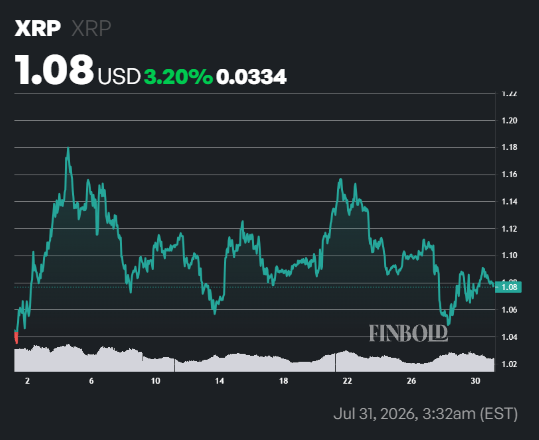
    Ripple is getting ready to unlock 1 billion $XRP from escrow tomorrow, August 1, worth about $1.08 billion based on the $XRP price of $1.08 at the time of writing.

    The upcoming unlock is part of Ripple’s long-standing escrow schedule, according to which the company typically unlocks 1 billion $XRP on the first day of each month.

    With the token’s circulating supply currently at about 62.52 billion $XRP, the new release will increase it by roughly 1.6%, although Ripple is likely to return a large portion of the unlocked tokens to escrow.

    How much $XRP will Ripple unlock tomorrow?

    Indeed, although the company unlocks 1 billion $XRP every month, it usually re-locks a large portion of the batch (between 60% and 80%) to a new escrow contract.

    So far, Ripple has re-locked on average 700 million $XRP every month in 2026, reducing the amount that went into circulation to just 300 million $XRP per month.

    At press time, roughly 32.44 billion $XRP is held in escrow, valued at approximately $34.72, according to data from XRPSCAN.

    What does the Ripple escrow mean for $XRP prices?

    As the upcoming release follows a strict schedule introduced in 2017, the market is unlikely to react in any meaningful way to what amounts to a routine event. Indeed, previous monthly escrows generated very little immediate volatility in $XRP’s price.

    $XRP’s performance this year is more dependent on broader cryptocurrency market trends, regulatory developments, and Bitcoin (BTC) moves.

    $XRP price 1-month. Source: Finbold

    A more important short-term catalyst has come in the shape of the U.S. CLARITY Act , which remains a major factor in every $XRP price prediction 2026, some of which see the cryptocurrency trading somewhere between $1.15 and $1.25 by next week’s voting date.

    Featured image via Shutterstock