An ARK Invest analyst says the cryptocurrency industry is entering what he describes as its biggest consolidation phase yet, with revenue increasingly concentrated among a handful of dominant protocols.
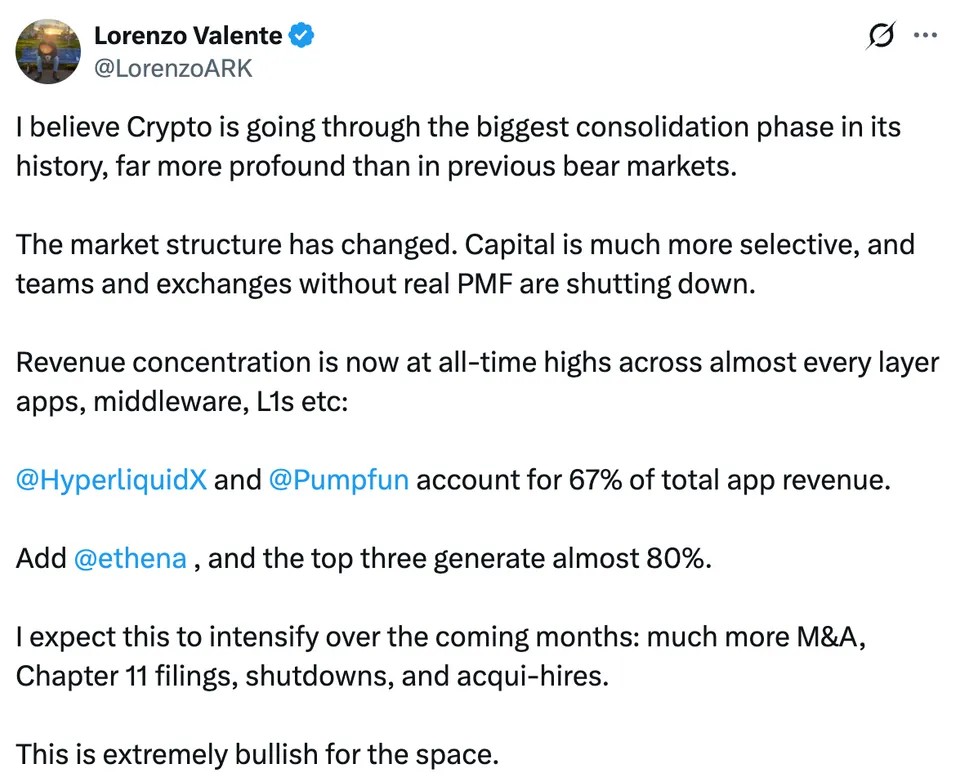
In a Wednesday post on X, Lorenzo Valente, a research associate at ARK Invest, said investors have become increasingly selective, making it harder for crypto projects and exchanges without strong product-market fit to attract capital. As weaker projects struggle or shut down, revenue is becoming concentrated among a small number of dominant protocols, he said.
As evidence, Valente said perpetual futures exchange Hyperliquid and memecoin launchpad Pump.fun account for roughly 67% of total crypto application revenue. Including synthetic dollar protocol Ethena raises the top three’s combined share to nearly 80%, highlighting what he described as record-high revenue concentration across the sector.
Source: Lorenzo Valente
Valente added that he expects the trend to accelerate in the coming months, leading to more mergers and acquisitions, Chapter 11 bankruptcies, project shutdowns and acqui-hires. Despite the shakeout, he described the consolidation as “extremely bullish” for the crypto industry.
Related: ARK pushes back against a16z’s ‘TradFi wants blockchain, not DeFi’ claim
Exchange closures add to consolidation narrative
The comments come as several crypto exchanges have announced plans to wind down operations in recent days, underscoring mounting pressures across parts of the industry.
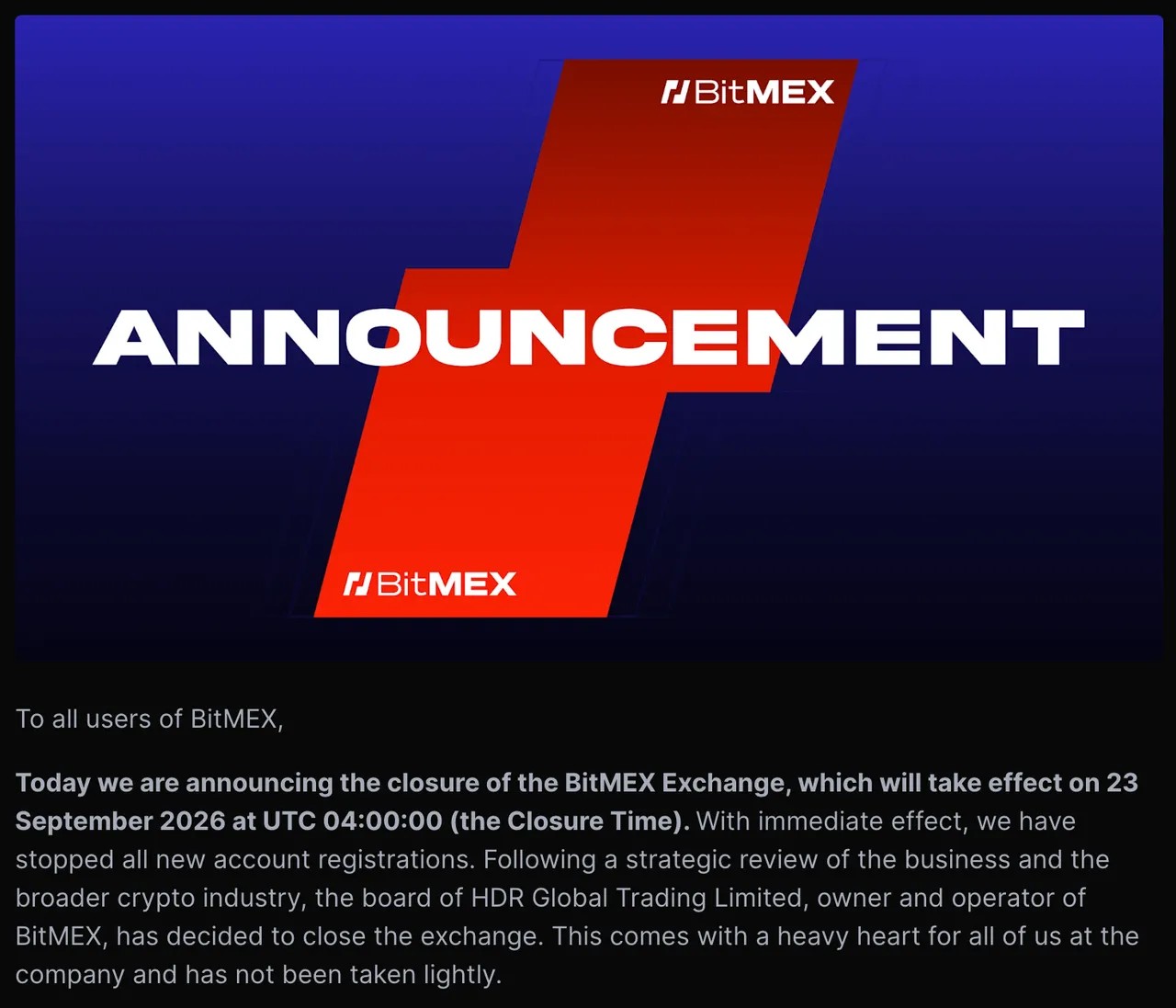
Last week, BitMEX announced it would shut down its exchange in September after a strategic review by owner HDR Global Trading. The exchange had recently accelerated the delisting of trading pairs and derivative contracts, citing insufficient trading interest.
Days later, BitMart announced it would end trading services on Aug. 26 before winding down operations entirely in January 2027. The exchange said the decision followed a review of its operating conditions, market environment and future strategic direction.
Consolidation has also come through acquisitions. Earlier this month, Bybit launched a locally operated exchange in Indonesia after acquiring a majority stake in local digital asset firm NOBI, expanding its presence in one of Asia’s largest crypto markets.
Source: BitMEX
Magazine: The 100x obsession: Fundamentals grow in importance as crypto matures
Binance.US plans to apply for a designated contract market license from the Commodity Futures Trading Commission next month as the exchange prepares to expand into prediction markets.
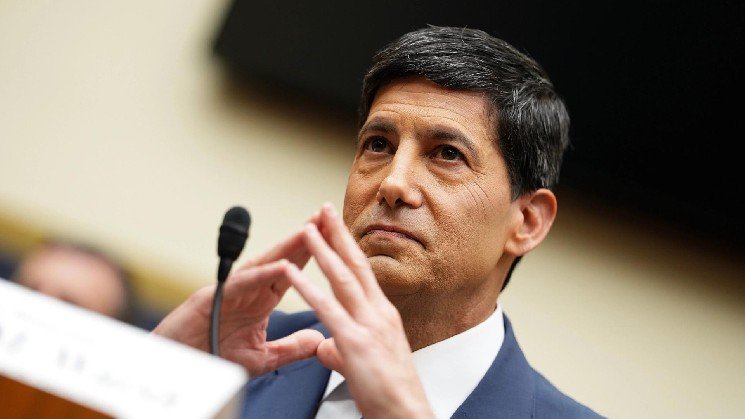
Chief executive Stephen Gregory disclosed the plan Wednesday during the Rare Evo conference in Las Vegas, according to Bloomberg, citing a Binance.US spokesperson.
Receiving designated contract market status would allow Binance.US to operate a derivatives exchange under CFTC oversight and potentially list event contracts for retail customers.
A designated contract market is a federally regulated exchange that can offer futures, options, and other derivative contracts. Applicants must satisfy CFTC requirements covering market surveillance, customer protection, financial resources, and safeguards against manipulation.
Binance.US has not yet appeared on the CFTC’s public list of pending designated contract market applications, consistent with Gregory’s statement that the filing is planned for next month. Approval is not guaranteed and the company has not disclosed a timeline for launching any products.
The planned application advances a broader comeback strategy centered on lower trading fees and an expansion beyond spot crypto trading.
Gregory previously said the exchange was exploring retail derivatives and event based products as it attempts to regain market share lost during several years of regulatory uncertainty.
At its peak in 2022, Binance.US controlled roughly 20% of the US crypto exchange market, according to CoinDesk Indices data. Its share has since fallen to nearly zero.
Binance.US operates separately from the larger global Binance exchange, although the businesses share branding and beneficial ownership.
The US company lost substantial trading activity following regulatory actions involving the broader Binance organization. The global exchange reached a $4.3 billion settlement with US authorities in 2023 over violations related to sanctions and money transmission rules.
The prediction market sector has expanded rapidly as financial and crypto companies compete to offer event contracts tied to sports, elections, economic data, and other outcomes.
However, the industry remains subject to legal and regulatory disputes. State authorities, consumer groups, and traditional gaming operators have challenged whether certain event contracts should be treated as federally regulated derivatives or gambling products governed by state law.
The CFTC has also reminded designated markets that event contracts must comply with existing product submission, market integrity, and anti manipulation requirements.
The Federal Reserve left its benchmark fed funds rate range unchanged at 3.50%-3.75% on Wednesday, extending its pause for a sixth consecutive meeting as policymakers continue to grapple with stubborn inflation.
The decision came after one of the most uncertain pre-meeting setups in years. Futures markets had assigned roughly a 65% probability to a hold and 35% odds of a quarter-point increase, according to CME FedWatch data.
It was an unusual setup, as for years, the Fed had typically tried to communicate to markets the direction it was going to take on policy
Attention now turns to Chair Kevin Warsh’s post-meeting press conference. Warsh has been openly critical of the Fed’s traditional use of forward guidance and the quarterly “dot plot,” and investors will be watching closely for signs that the central bank’s communication strategy is changing under his leadership.
For years, Ethereum has been synonymous with decentralized finance. It pioneered onchain financial tools like lending protocols and tokenized assets, which today underpin much of the crypto economy. But one of crypto’s fastest-growing sectors, perpetual futures, or “perps”, has largely flourished elsewhere.
Ask traders where onchain perpetuals live today, and the answer is more likely to be Hyperliquid or Solana than Ethereum. That is because perpetuals demand something Ethereum’s base layer was never designed to optimize for: extremely fast, low-cost, high-frequency trading.
“Perps require frequent transactions, fast execution, and deep liquidity,” said AJ Warner, chief strategy officer at Offchain Labs, the main developer firm behind the layer-2 Arbitrum. “That makes them a natural use case for the Arbitrum platform.”
The distinction has become increasingly important as decentralized perpetual exchanges mature from crypto-native products into markets attracting institutional attention.
Why Ethereum L1 fell behind
Perpetuals are one of the most demanding applications in crypto. Their exchanges require thousands of rapid-fire updates, liquidations, funding payments, and order executions, all without interruption.
“Perps onchain are really hard,” said Brian Smith of the Jito Foundation. “It’s not just the average performance that matters, it’s the 99.99% success rate. If your perps platform goes down, that’s existential risk.”
Ethereum’s security-first architecture made it an ideal settlement layer, but historically, its block times and gas costs made it an expensive place to run latency-sensitive trading applications.
When decentralized perps exchange GMX launched on Arbitrum in 2021,, it helped establish a template that many others would follow. “Ethereum mainnet fees were prohibitively expensive, which naturally attracted perps builders to Arbitrum,” Warner said. Offchain Labs then leaned into that momentum, actively prioritizing perpetuals as a strategic category.
“By prioritizing the vertical, we were able to attract a concentration of builders and capital to the ecosystem.” Today, much of Ethereum’s perpetual trading activity lives not on the Ethereum mainnet, but on layer-2 networks like Arbitrum and, increasingly, Base.
Ethereum’s layer-2 ecosystem has become something of a compromise: preserving Ethereum’s security while dramatically improving trading performance. Networks like Arbitrum and Base have reduced block times while also becoming an increasingly attractive trading destination because of their growing user base and liquidity.
Chris Boulous of Dromos Labs, the main developer firm behind Aerodrome, a decentralized exchange that lives on the Base network, argued that technical performance is only part of the story.
“Trading is effectively a network-effects business,” he said. “You have to build where the liquidity and users currently exist.” That dynamic has become self-reinforcing: protocols launch where traders already are, liquidity providers follow the traders, and then new applications build around existing liquidity. It’s one reason Boulous sees Aerodrome as complementary to perpetual exchanges rather than competitive with them.
“You can kind of think of perps as a customer of spot exchanges,” Boulous said. Spot exchanges provide pricing, liquidity and hedging opportunities that perpetual markets depend on. “Spot and perps are two sides of the same liquidity coin.”
Why Solana and Hyperliquid surged
Still, Ethereum’s layer-2 ecosystem isn’t the only place where developers can build high-performance trading infrastructure. Hyperliquid built an application-specific chain optimized almost entirely for perpetual trading. Solana, meanwhile, combined low fees with a large base of retail traders already actively trading memecoins and other speculative assets.
According to Smith of Jito, that user base matters as much as the technology. “The most important ingredient for any exchange platform, but especially perps, is retail organic flow,” he said. “Solana is the king of retail trading activity.”
Smith also argues Ethereum faces an additional challenge: fragmentation. “You need to be able to trade everything in a single spot,” he said. “What Ethereum is suffering from is a level of fragmentation.”
Ethereum’s scaling strategy largely relied on layer-2 networks like Arbitrum and Base to handle high-volume activity. While that approach dramatically reduced costs and improved performance, it also dispersed users and liquidity across multiple ecosystems. Traders often need to bridge assets between networks, making the experience less seamless than on single-chain ecosystems such as Solana. Earlier this year, Ethereum co-founder Vitalik Buterin acknowledged that the original layer-2 roadmap vision “no longer makes sense” as layer 2s have decentralized more slowly than expected and Ethereum’s base layer has itself become more scalable.
Not everyone sees that fragmentation as a fatal flaw, however. Some Ethereum proponents argue the focus on execution misses the network’s longer-term role in the onchain financial stack. Matthieu Saint Olive, a staff product manager at MetaMask, argues the framing itself misses what’s happening. “I’d push back gently on the premise that it’s a competition in the first place,” he told CoinDesk.
Purpose-built trading chains may ultimately win on execution speed, but they still require somewhere to source collateral, liquidity, stablecoins, and settlement. “Ethereum’s role is the settlement and collateral base where the deepest liquidity, the widest range of assets, the stablecoins, and the most mature DeFi primitives live.”
Several leading perpetual trading platforms either operate directly on Ethereum layer 2s or remain closely connected to Ethereum’s ecosystem for collateral, settlement, and developer tooling. “L2s are how Ethereum scales into use cases like active trading without giving up the thing that makes the base layer valuable,” Saint Olive said.
The institutional question
As institutions begin paying closer attention to onchain derivatives, the conversation is shifting from whether decentralized perpetuals can work to whether they can compete with traditional infrastructure. “It comes down to execution, custody, and predictability, not ideology,” Saint Olive said.
Institutions, Warner of Offchain Labs argued, still need deeper liquidity, more efficient capital usage, and better execution before deploying significant trading volume onchain. “Capital is still fragmented across venues,” Warner said. “Institutions will want better access to credit, cross-margining, and the ability to trade across venues without leaving large amounts of capital idle.”
For Boulous, the next milestone is straightforward: “You have to be able to do things onchain that you can’t do, or can’t do as cheaply, in traditional markets.”
While much of today’s decentralized perpetual volume still revolves around crypto assets, market participants increasingly see the infrastructure supporting perps as the foundation for broader capital markets. Saint Olive believes perpetuals are already demonstrating what programmable markets can become.
“Perps are the leading indicator, the first place you can watch traditional financial activity genuinely migrate onchain,” Saint Olive said.
That may also explain why Ethereum’s role in the market is evolving rather than diminishing.
Solana and purpose-built chains like Hyperliquid have established themselves as the venues where traders execute high-speed transactions. Ethereum, meanwhile, is increasingly positioning itself as the settlement and collateral layer that underpins those markets through its layer-2 ecosystem and broader DeFi infrastructure.
Whether that division of labor persists will depend on how quickly Ethereum can solve some of the challenges its critics point to: fragmented liquidity across layer 2s, better interoperability between networks, and a smoother user experience. If it can, proponents argue Ethereum doesn’t necessarily need to become the fastest place to trade perpetuals. It simply needs to remain the deepest and most trusted place to settle them.
Read more: Perpetual futures could become crypto’s next ETF moment
The Solana Policy Institute (SPI) has formally urged the U.S. Senate to pass the CLARITY Act, a bill aimed at providing legal certainty for digital asset developers, institutions, and consumers. In a letter addressed to Senate Republican Leader John Thune and Democratic Leader Chuck Schumer, SPI argued that the time to act is now, warning that delays could erode American competitiveness in the global blockchain industry.
What the CLARITY Act Proposes
The CLARITY Act, whose full name is the Clarifying Lawful Overseas Use of Data Act, is designed to establish clear jurisdictional rules for digital assets and blockchain-based transactions. The bill seeks to resolve ongoing regulatory ambiguity that has left many U.S.-based crypto firms uncertain about compliance requirements. SPI emphasized that the legislation would give developers and institutions the legal confidence needed to innovate and scale within the United States.
Why the Senate Letter Matters
The letter from SPI, reported by The Block, comes at a critical juncture for U.S. crypto policy. The industry has faced a patchwork of state-level regulations and conflicting federal guidance, which many argue has driven talent and capital overseas. SPI’s direct appeal to Senate leadership signals that the Solana ecosystem views the CLARITY Act as a foundational piece of legislation that could unlock broader adoption and investment.
Broader Implications for the Crypto Industry
If passed, the CLARITY Act could serve as a model for future digital asset regulation. It would not only clarify legal boundaries but also potentially reduce litigation risks for companies operating across state lines. For consumers, clearer rules could mean better protections and more transparent markets. However, the bill’s path through the Senate remains uncertain, with competing priorities and differing views on crypto regulation among lawmakers.
Conclusion
The Solana Policy Institute’s call for swift passage of the CLARITY Act reflects a growing sense of urgency within the blockchain industry. As other nations advance their own regulatory frameworks, the U.S. risks falling behind without decisive action. The Senate’s response to this appeal will be closely watched by developers, investors, and policymakers alike.
FAQs
Q1: What is the CLARITY Act? The CLARITY Act is a proposed U.S. federal law that aims to clarify legal jurisdiction and regulatory rules for digital assets and blockchain transactions, reducing uncertainty for developers and institutions.
Q2: Why did the Solana Policy Institute send a letter to Senate leaders? SPI urged Senate Republican Leader John Thune and Democratic Leader Chuck Schumer to pass the CLARITY Act, arguing that legal certainty is essential for the U.S. to remain competitive in the global crypto industry.
Q3: What impact could the CLARITY Act have on the crypto market? The bill could reduce regulatory risk, encourage innovation, attract investment, and provide clearer consumer protections, potentially boosting the U.S. digital asset ecosystem.
Related Reading
SEC Commissioner Peirce’s Remarks on Crypto Vaults Signal Move Toward Formal DeFi Regulation, Sentora CLO Says
White House Crypto Official Says BRCA Amendment Conflicts With Administration Policy
BNY Mellon Brings Blockchain-Based Transfer Agency to $8.6 Trillion Fund Services Unit
Grayscale: Hyperliquid’s HYPE Token Remains Undervalued Compared to Fintech Peers
CES Organizer Pushes Senate to Advance CLARITY Act for Blockchain Regulation
Gate US joined BitGo’s Go Network Off-Exchange Settlement service on July 28, giving eligible institutional clients access to the exchange’s U.S. liquidity while their assets remain in custody at BitGo Bank & Trust, National Association.
The integration extends a broader partnership announced five days earlier. Gate US said BitGo would provide institutional custody, wallet management and risk-control technology as the exchange expands its U.S. business. Neither company disclosed financial terms, expected trading volume or a separate rollout schedule for the OES connection.
Gate US clients can trade without pre-funding the exchange
Under the arrangement, an institution allocates part of its balance held at BitGo Bank & Trust for trading on Gate US. BitGo then projects the available balance to the exchange for order execution, while the underlying assets remain in segregated custody until settlement.
.@GateUS_Official is now part of BitGo’s Go Network Off-Exchange Settlement.
How it works 👇
🏛️Assets stay in segregated, regulated custody at BitGo Bank & Trust throughout the trading lifecycle
Completed trades settle through Go Network rather than requiring customers to transfer assets into a conventional exchange wallet before each transaction. BitGo’s technical documentation says Go Network settlements occur off-chain while assets remain in its cold-storage system.
Gate US Chief Operating Officer Laura Liu said the connection gives clients a framework built around regulated custody. Her description of the service as a “secure and efficient path” is a company claim. The firms have not published performance data comparing settlement speed, failure rates or costs with ordinary exchange deposits.
BitGo separates custody from trade execution
BitGo Bank & Trust provides custody and settlement, while Gate US continues to operate the market and execute orders. BitGo’s disclosures identify the subsidiary as a national trust bank chartered and regulated by the Office of the Comptroller of the Currency.
The OCC’s corporate applications database shows that BitGo’s conversion from a South Dakota trust company became effective on Dec. 12, 2025. The charter authorizes fiduciary and custodial services but does not make digital assets eligible for federal deposit insurance.
The model resembles traditional-market structures where a custodian holds assets while another venue executes trades. As crypto.news previously reported, OKX US added BitGo OES for institutional clients in April. In related coverage, Binance connected to Anchorage Digital’s Atlas platform under a similar structure.
Off-exchange settlement reduces but does not remove risk
Keeping assets away from an exchange can reduce exposure if the venue experiences insolvency, withdrawal restrictions or a custody breach. However, BitGo’s annual SEC filing says its OES services still create operational, regulatory and counterparty risks.
BitGo lists possible trade-data errors, delayed asset transfers, insider misconduct, cyber incidents, technology disruptions and reconciliation failures. It also warns that a participating exchange or its clients could fail to meet obligations or provide inaccurate transaction data.
Those disclosures qualify broader claims that off-exchange custody eliminates counterparty exposure. Settlement still depends on BitGo’s systems, Gate US’s execution records and enforceable agreements between the parties. The announcement did not specify supported assets, margin arrangements, settlement frequency, default procedures or separate OES fees.
Gate US said in July that it held 36 state money-transmitter licences and served 47 U.S. jurisdictions. Its legal page states that cryptocurrency accounts are not protected by the Federal Deposit Insurance Corporation or Securities Investor Protection Corporation.
Gate US expands BitGo’s institutional venue network
BitGo now lists Gate US alongside Crossover Markets CROSSx, Deribit through Copper ClearLoop, Finery Markets, Gate Global, HTX, INX, KuCoin, OKX US and STS Digital. Clients may trade directly with connected venues or use BitGo Prime for aggregated access to exchanges, market makers and over-the-counter liquidity providers.
BitGo calls the expanding system its “Global Liquidity Layer.” That remains a strategic description rather than a regulated market category. Its value will depend on institutional adoption, reliable settlement and the amount of usable liquidity available through each connected venue.
The next measurable updates will be the start of client activity, the assets supported on Gate US and any disclosed settlement or volume data. The companies have not announced deadlines for those disclosures. No verified market-price reaction was directly attributable to the integration.
Morpho, the DeFi lending protocol with about $7.6 billion in total value locked, will complete a full deployment on HashKey’s HSK Chain and become the network’s official onchain credit partner, HSK Chain said in a post on X on Tuesday.
The deal gives Morpho its first anchor in Hong Kong, one of the few jurisdictions running a licensed regime for virtual asset trading, and gives HashKey, the licensed Hong Kong crypto group behind the chain, a battle-tested credit engine to build regulated lending products on. The two said they will develop onchain credit products for institutional and retail users, explore CeDeFi and yield products backed by Bitcoin and real-world asset collateral, and bring more institutional-grade assets into Morpho as eligible collateral.
“HashKey becomes our anchor partner in one of the world’s most important capital markets,” Shan, who leads APAC growth at Morpho, said in a post on X. “This is proof that onchain credit infrastructure is ready to expand via licensed, institutional rails in APAC.”
Morpho’s infrastructure lets HashKey layer KYC, wallet screening and access controls on top to meet local regulatory requirements, Shan said, calling Hong Kong “a strategic entry to APAC.”
MORPHO rose 0.7% in the past 24 hours while HSK slipped 0.8%, both trailing Bitcoin’s 1.3% gain, according to CoinGecko. Morpho’s TVL stands at roughly $7.6 billion, per DefiLlama.
Compliance Meets Permissionless
The structure the partners describe keeps Morpho’s base contracts permissionless while pushing compliance to the edges — a licensed operator gates who gets in, while the credit engine underneath stays open infrastructure.
HashKey Group operates a licensed virtual asset trading platform and holds a Type 9 asset management license from Hong Kong’s Securities and Futures Commission, making it one of the most heavily regulated crypto operators in Asia.
The partnership extends a year in which Morpho has leaned hard into distribution through regulated channels rather than direct-to-DeFi growth, powering lending products for exchanges and fintechs. HSK Chain framed the deal as accelerating “the adoption of open, efficient on-chain financial services in Asia and beyond.”
Play-to-earn gaming is evolving beyond crypto rewards as developers prioritize sustainable economies, stronger gameplay, and long-term player retention.
The play-to-earn (P2E) genre of games has witnessed a lot of popularity since the 2021–2022 crypto boom. The concept was pretty straightforward: spend time playing a game but get something valuable in return. The use of NFTs, crypto tokens, and the whole blockchain technology has become one of the biggest selling points for the genre.
With the rise in popularity of crypto, numerous P2E games emerged. While some were able to form a strong community around themselves, most of them faced challenges related to sustainability. They relied on the constant flow of new users, which declined with the decrease in interest in the crypto market. Earning money was not enough to retain players.
A different approach to play-to-earn
As a result, many of the developers have changed their approach. Rather than developing game mechanics based on costly NFTs or quick gains, they have placed much emphasis on designing entertaining games. The incentives are still a part of the game, but not the only motivation for playing anymore.
Rollercoin provides a perfect example. It is a mining simulator that can be accessed through one’s web browser. In this simulator, people are required to engage in mini-games and build virtual mining projects to earn rewards. The idea is to encourage regular participation and consistent gains instead of focusing on immediate gains. This is in line with what many gaming applications are doing.
How traditional gaming is influencing P2E Design
Most modern play-to-earn projects are taking inspiration from classic video games and not the earlier attempts in the cryptocurrency space. Concepts like season-specific battle pass, daily missions, achievements system, ranking battles, and cosmetic customization have all found their way into blockchain games.
This shift reflects changing player expectations. Rather than viewing crypto rewards as the primary attraction, developers are incorporating blockchain elements into gameplay loops that players already understand. The result is a model where digital ownership and token incentives support the experience instead of defining it, potentially making blockchain games more accessible to mainstream audiences.
What has changed?
There are a few features that distinguish some of the most successful P2E games from others:
They prioritize gameplay before rewarding the player.
The economy of the game is well-balanced.
It’s possible for new players to start without spending much money.
Progress comes from regular play rather than pure speculation.
The developers care about keeping players interested in the game.
None of these factors is a recipe for success, but they make the games look more sustainable than many P2E projects were at their beginning.
Why mining simulators are growing
In this new form of P2E, mining simulators have taken root. Instead of acquiring costly NFTs, players establish their own mines and make money through consistent upgrades to both themselves and their gear.
The game is for those individuals who are interested in management and idle gaming, and at the same time, some concepts of cryptocurrency will be introduced in an easy manner. Since the main idea is to upgrade and optimize, such games can be fun even during crypto market downtimes.
How regulation could shape the next generation of P2E
With the evolution of blockchain-based gaming, regulation is gradually becoming an essential consideration for developers. Various jurisdictions have become more interested in digital currencies, token issuance, and in-game economies featuring monetary value. Although play-to-earn games have been made primarily for entertainment purposes, those games issuing tokens or NFTs will be subject to differing legal considerations according to their jurisdiction.
For developers, this means balancing innovation with compliance. Features such as KYC requirements, regional restrictions, or transparent token disclosures may become more common as the industry evolves. Although regulation introduces new challenges, it could also help improve trust among players and institutional partners by establishing clearer standards for blockchain-based games.
Looking ahead
The play-to-earn game industry has evolved significantly within a relatively short period of time. Initially concentrated around the use of NFTs and rapid profits, it has been shifting its attention to creating games for extended player engagement.
Much experimentation is left to do, yet one thing is evident: people will stay involved in the process if the game is fun by itself. Getting some sort of reward could be an additional element, but it certainly is not enough anymore to drive everything.
It was sometime in 2015, on a hiking trail in Hong Kong, that the perpetual swap — also called a perpetual future or a “perp” for short — was born. Ben Delo, the mathematician and co-founder of BitMEX, was walking with a friend called Bavik, a derivatives trader, wrestling with a problem that had been nagging at him for months.
BitMEX had been trying everything. Quarterly futures, monthly futures, weekly futures, 48-hour futures, even a contract that lasted just 24 hours before resetting. Nothing was working. Customers kept complaining that their positions were closing without warning. They wanted something that looked like spot, traded like spot, but gave them the leverage that only a derivatives exchange could offer.
“What if a future never expired?” Delo asked.
Bavik’s answer was immediate. “Mathematically, it would be worth infinity,” Delo recalls him saying.
Technically, he was right. A futures contract’s value is partly derived from the time remaining until expiry and the cost of carrying the position. Remove the expiry date and that carrying cost compounds indefinitely, making the theoretical value infinite. But then Bavik offered a solution: just charge traders the bitcoin overnight rate, the way you might charge LIBOR (London Interbank Offered Rate) in traditional finance.
There was one problem. “I said, what’s that?” Delo recalls. “He said, ‘Hm, just charge them the overnight bitcoin interest rate’. I said, ‘I don’t think that exists.’”
So Delo built it. And in doing so, he invented one of the most consequential financial products of the 21st century.
Building BitMEX
To understand why the perpetual swap mattered, you have to understand what BitMEX was trying to be before it became the most liquid bitcoin market in the world.
When Delo and Arthur Hayes founded the exchange in 2014, they were not thinking about retail traders chasing 100x leverage. They were thinking about institutional hedgers. Hayes had worked at Deutsche Bank, while Delo spent years building high-frequency trading systems at JP Morgan. Their thesis was that bitcoin miners and payment companies needed a way to hedge their exposure, and BitMEX would provide the professional infrastructure to do it.
“We built it basically to look like a Bloomberg terminal,” Delo said. “We used Reuters instruction codes. Z14 meant expiring December 2014.”
The institutions never came. What came instead were traders, sophisticated but retail, people who had financial experience but were playing with their own money. And what they wanted was not guaranteed settlement or low leverage. They wanted to speculate, and they wanted to do it with as much size and leverage as possible.
BitMEX listened. By Halloween 2015, the exchange was offering 100x leverage, made possible by a real-time margining system that Delo had built from scratch. “I built the order matching engine, the position keeping system, the margining system, the PnL system, the settlement system,” he says. “Everything on that was me.”
The issue with futures, even short-dated ones, is basis, the premium at which a futures contract trades above the spot price of the underlying asset. A futures contract trades at a premium to the underlying asset, and that premium reflects an implied interest rate. In traditional finance, this is well understood. In crypto, in 2015, it confused almost everyone.
“Our customers would be like, why is bitcoin so expensive on your exchange?” Delo recalled “And we would say, ‘Well, if it is expensive, why don’t you short it?’ And that would blow some of their minds. You could short something rather than just long it.”
BitMEX kept shortening the expiry of its listed futures contracts. Weekly futures. Then 48-hour. Then a contract that relisted every single day.
“Every 24 hours, it would expire or settle. And people would say, ‘Why did you liquidate me?’ And we’d say, ‘We didn’t liquidate you. Your position closed at the index price. You got exactly the spot price,’” Delo said. “They’re like, ‘We don’t understand.’”
The customers knew what they wanted, even if they could not articulate it. They wanted a leveraged product that never went away. Delo’s hiking trail conversation gave him the framework to build one.
Inventing the funding rate
The perpetual swap launched in May 2016 with little ceremony. The core mechanic was straightforward: a futures contract with no expiry date, anchored to the spot price through a daily funding rate. Longs paid shorts, or vice versa, depending on whether the swap was trading above or below spot. BitMEX took no cut. The rate was purely a balancing mechanism.
The early funding rate was derived from third-party lending markets, primarily Bitfinex, where traders could borrow dollars or lend out Bitcoin. Take the dollar borrow rate, subtract the Bitcoin borrow rate, and you had something approximating the cost of holding a long position.
It worked, until it did not. As Bitcoin began its rise through 2016 and into 2017, demand for long exposure on BitMEX overwhelmed the funding mechanism. The swap started trading at a persistent premium to spot, causing the contract price to drift away from the actual price of bitcoin and undermining the mechanism designed to keep them aligned. The interest rate being imported from Bitfinex was simply not high enough to reflect what was happening on BitMEX itself.
“We had to dynamically adjust how we calculated that funding rate,” Delo said.
The original funding rate had been imported from external lending markets, a fixed reference point that could not respond to conditions on BitMEX itself. The new approach replaced that with a dynamic one, looking inward at how the swap was actually trading rather than outward at what Bitfinex was charging to borrow dollars.
The solution was elegant. Rather than looking outward to other markets, BitMEX would look inward. The exchange began measuring how far the swap was trading above or below spot over an eight-hour window, treating that gap as an implied basis, and back-calculating the annualized rate from it. That rate would then be charged at the end of the next eight-hour window.
“This was very important because you gave market makers notice of how you were calculating it, what it would be, and then when you would charge it,” Delo said. “Because it was paid from longs to shorts, if the swap was trading at a 1% premium, you would charge longs 1% but give 1% to shorts. And then immediately the market makers, knowing that, would come in, short the swap, and anchor it back down to the spot price. It was a dynamic equilibrium.”
This is, in essence, the funding rate mechanism that every major derivatives exchange in the world now uses.
The product that took over
By 2017, BitMEX was the most liquid bitcoin market on the planet. The exchange was processing $3-4 billion a day, and the perpetual swap was at the center of it all. Price discovery for bitcoin was happening not on Coinbase or Bitstamp but on the BitMEX order book.
The concentration of liquidity was itself a product of the swap’s design. Before it launched, BitMEX had been running quarterly, monthly, weekly, 48-hour and 24-hour contracts simultaneously, spreading market maker capital thin across six different tenors. The swap collapsed all of that into one instrument.
“By offering one product, they [traders] were able to consolidate their liquidity, which meant a more liquid market, tighter spreads,” Delo said.
Competitors noticed. Another competitor exchange copied so literally that it reproduced portions of the BitMEX FAQ without understanding how the product worked, Delo told CoinDesk. Others took the concept more seriously. Eventually, every major exchange in crypto offered its own perpetual swap, each one built on the funding rate architecture that Delo had begun assembling on that Hong Kong hiking trail.
“The fact that every other exchange has copied the swap just proves what a financial innovation it is,” he said. “I think it now does $40, 50 trillion dollars a year of turnover. It’s one of the most successful products in the history of capitalism.”
What comes next
BitMEX chose not to patent the perpetual swap. Delo says they considered it and decided the startup’s time was better spent building.
“We were a scrappy startup,” he says. “We thought, just get it out there. If it was any good, the market would show us.”
And show them the market did. Now, a decade on, the product is starting to attract the attention of traditional finance regulators. The CFTC is reportedly making room for perpetual swaps under its framework, and there is speculation that the CME could eventually list them on equities.
For Delo, that prospect is the final validation of something that started as a question on a hillside above Hong Kong, asked by someone who had grown tired of watching his customers complain about positions that kept disappearing.
“I think once traditional finance sees the benefits of this financial product,” he said, “it’ll be impressive.”
Today, all eyes in Bitcoin and altcoins are on the critical FED meeting. While the main scenario expected in the market is that interest rates will remain unchanged, a rate hike is not entirely ruled out. According to CME FedWatchTool, the probability of a 25 basis point increase by the FED in July is priced at 31.5%.
While expectations remain mixed, leading cryptocurrency analysis firm K33 Research suggested that the impact of the Fed’s upcoming interest rate decision on Bitcoin may be less significant and more limited compared to previous cycles.
The Impact of the FED Decision on Bitcoin May Be Limited!
K33 Research head Vetle Lunde stated in the report that the Nasdaq entered July with strong upward momentum and heavy positioning, while Bitcoin continued to trade sideways with volatility near multi-year lows.
According to Lunde, this situation has caused the correlation between Bitcoin and Nasdaq to approach its lowest levels in recent years, suggesting that the price movements of the two assets may increasingly diverge.
Therefore, Lunde stated that this FED decision may not be as decisive for the $BTC price as it has been in the past. According to Lunde, Bitcoin’s low volatility and sideways movement (causing a reduced reaction to macroeconomic developments) and its price behavior diverging from the Nasdaq may limit the impact of FED decisions on $BTC and the crypto market.
Bitcoin’s Rise May Continue After FOMC Meeting!
Besides K33 Research, another analyst believes the FED decision will have a limited impact on $BTC. Popular analyst Michaël van de Poppe predicts that the rise in $BTC will continue after the FOMC meeting.
Poppe argues that Bitcoin has shown a solid recovery and is likely to continue its upward movement after the FOMC meeting. Van de Poppe added that the market has priced in excessive fear ahead of the FOMC meeting, and Bitcoin’s strong resilience supports the view that the rally will continue.