Tag: CRYPTOS FoxBusiness

  • Donald Trump’s Memecoin “TRUMP” Under Scrutiny: SEC Called Upon to Implement “Rug Pull”!

    Donald Trump’s Memecoin “TRUMP” Under Scrutiny: SEC Called Upon to Implement “Rug Pull”!

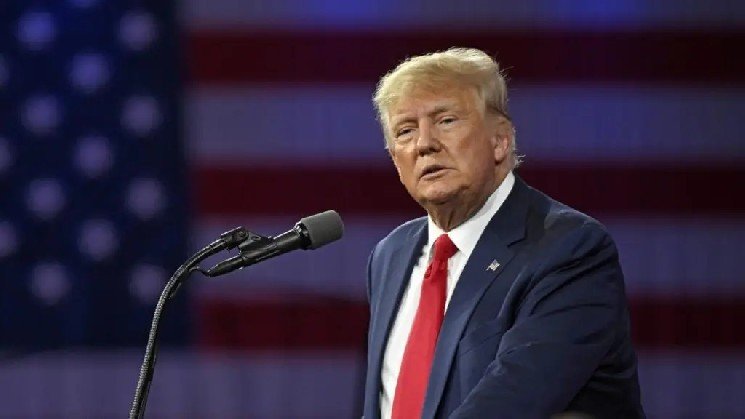
    US President Donald Trump has stood out in recent headlines for his support of Bitcoin and cryptocurrencies. In fact, Trump and his wife have altcoins bearing their own names, and his family also has cryptocurrency projects.

    While some anti-crypto US Democratic senators have opposed this, most recently Democratic senators Elizabeth Warren and Richard Blumenthal sent a formal letter to the SEC regarding Donald Trump’s Solana-based memecoin, Official Trump ($TRUMP).

    According to CNN, senators have written a letter requesting an investigation into Trump’s altcoin for potential market manipulation and practices that could harm investors.

    According to the report, Warren and Blumenthal stated in the letter that it should be investigated whether Trump poses a risk of “rug pull,” citing the irreversible losses suffered by millions of investors.

    No Rug-Pull Symptoms!

    As the Trump controversy continues, blockchain analytics firm TRM Labs stated that there is no definitive evidence that the Trump token was designed specifically for rug-pulling purposes.

    However, TRM Labs emphasized that the concentration of a significant portion of the token supply among insiders or linked addresses is a risk factor that needs to be closely monitored.

    TRM Labs stated in its assessment that while early investors and the issuer of the $TRUMP token made significant gains, numerous individual investors who bought later faced substantial losses.

    At this point, the company noted that a structure in which approximately 1 million retail investors suffered losses, even if not technically classified as a rug pull, could become more controversial over time.

    *This is not investment advice.

  • Layer-1 Blockchain Network Aptos Announces the Deployment of Privacy Feature on its Mainnet! Here Are the Details

    Layer-1 Blockchain Network Aptos Announces the Deployment of Privacy Feature on its Mainnet! Here Are the Details

    The Layer-1 blockchain network Aptos has announced the rollout of its new privacy solution, “Confidential $APT,” on its mainnet, which allows users to selectively keep their transaction data private.

    In a statement released on its social media platform X, the company said the new feature is optional and was specifically developed for corporate and regulatory compliance use cases.

    According to Aptos, Confidential $APT allows users to choose which information in their transactions is public and which remains private. This ensures the transparency of the blockchain while also allowing for the confidentiality of transaction details when needed.

    The company stated that the new feature is specifically intended for use in sensitive financial processes such as payrolls, corporate finance transactions, and business-to-business (B2B) payments. While privacy is paramount in the traditional financial world, the fact that all transaction data is publicly visible on open blockchains has been considered a significant obstacle for many organizations. With this solution, Aptos aims to offer an alternative to this problem.

    Recently, there has been a growing interest in privacy-focused technologies within the blockchain sector. Corporate companies and financial institutions, in particular, are showing increased interest in networks that develop infrastructure capable of protecting trade secrets while complying with regulatory requirements. Aptos aims to enhance its competitive edge in this area with its Confidential $APT.

    The company emphasized that the feature is entirely optional, stating that users can continue to conduct their transactions within the existing transparent structure if they wish. This provides a flexible usage model tailored to the diverse needs of both individual users and corporate clients.

    Industry experts believe that solutions that strike a balance between privacy and regulatory compliance can accelerate the enterprise adoption of blockchain technology. These features are particularly critical for businesses to be able to utilize blockchain infrastructure in sensitive processes such as payroll payments, internal financial transactions, and commercial payments.

    *This is not investment advice.

  • Bhutan’s GMC puts part of its bitcoin treasury to work after 10,000 BTC pledge

    Bhutan’s GMC puts part of its bitcoin treasury to work after 10,000 BTC pledge

    Gelephu Mindfulness City (GMC), a special administrative region in southern Bhutan, awarded 3iQ Corp. a mandate to manage part of its bitcoin $BTC$63,607.21 treasury, the firms said in an email.

    GMC declined to disclose the size of the mandate to CoinDesk.

    How the money will be run is the new information. GMC told CoinDesk it selected the Toronto-based company to generate long-term returns through a low-risk, market-neutral investment approach, meaning the reserve is to be deployed for yield rather than simply held.

    A market-neutral strategy covers a range of possibilities, including basis trades and lending. Such strategies usually yield at least 5% annually in the general market. GMC did not say whether any specific approach has been selected.

    In December, when Bhutan’s king, Jigme Khesar Namgyel Wangchuck, pledged up to 10,000 $BTC, then worth about $1 billion, the allocation was called a long-term national asset for the city’s development, with collateralization, treasury strategies or holding all listed as options still under consideration.

    The mandate’s size matters because the pledge behind it has been in question for months.

  • Why Jim Cramer’s quantum panic isn’t rattling bitcoin as price holds steady around $64,000

    Why Jim Cramer’s quantum panic isn’t rattling bitcoin as price holds steady around $64,000

    This reputation is not without foundation. Cramer’s prediction history is marked by notable flip flops and high profile misses.

    In December 2017, right as bitcoin was climbing toward its first run at $20,000, he called it “monopoly money” and said buying it was pure gambling and not investing. In September 2020, he supposedly bought the cryptocurrency around $10,000 after a podcast conversation with investor Anthony Pompliano, and later added more that year.

    The reversals kept coming. In June 2021, he sold most of his bitcoin holdings, citing China’s crackdown on crypto mining. Prices went on to hit lifetime highs near $70,000 by November 2021.

    In January 2024, he warned of a “nasty” bitcoin selloff following the debut of spot bitcoin ETFs in the U.S. While prices did drop slightly to $40,000, the decline was anything but nasty and by March, prices had rallied to $70,000.

    Cramer changed his view in January 2025, calling bitcoin “a great thing to have in portfolio” and urging investors to own the token themselves instead of seeking an indirect exposure through bitcoin-holding firm Strategy (MSTR).

    Last month, he swung bearish, calling bitcoin and gold “bad money” that’s being liquidated in favor of high-growth names like SpaceX, Apple and Nvidia. Now, in August 2026, he’s planning a full exit.

  • Strategy Says MSTR Beat Bitcoin in Every Four-Year Holding Period

    Strategy Says MSTR Beat Bitcoin in Every Four-Year Holding Period

    Strategy Charts MSTR’s Performance Against Bitcoin

    Strategy Inc. (Nasdaq: MSTR) CEO Phong Le shared on Aug. 3 that MSTR outperformed bitcoin across every rolling four-year holding period since adopting its bitcoin strategy. The company compared annualized returns for investments made between August 2020 and August 2022, showing the stock generated stronger returns than bitcoin across every rolling four-year investment window.

    Le stated:

    “MSTR has outperformed $BTC in every four-year holding period since adopting the bitcoin Strategy. This is by design and aligns with our long-term objective.”

    Rolling holding periods compare returns from many starting dates instead of relying on a single entry point, providing a broader view of long-term performance. Bitcoin’s historical four-year cycle is often associated with halving events, making Strategy’s rolling-window analysis a different way to evaluate long-term returns.

    Le’s comments also align with Strategy Executive Chairman Michael Saylor’s view that institutional capital, exchange-traded funds, and corporate treasury adoption are reshaping bitcoin’s historical trading patterns. His recent comments describe a market increasingly driven by sustained demand rather than traditional four-year cycles.

    Institutional Ownership Continues to Expand

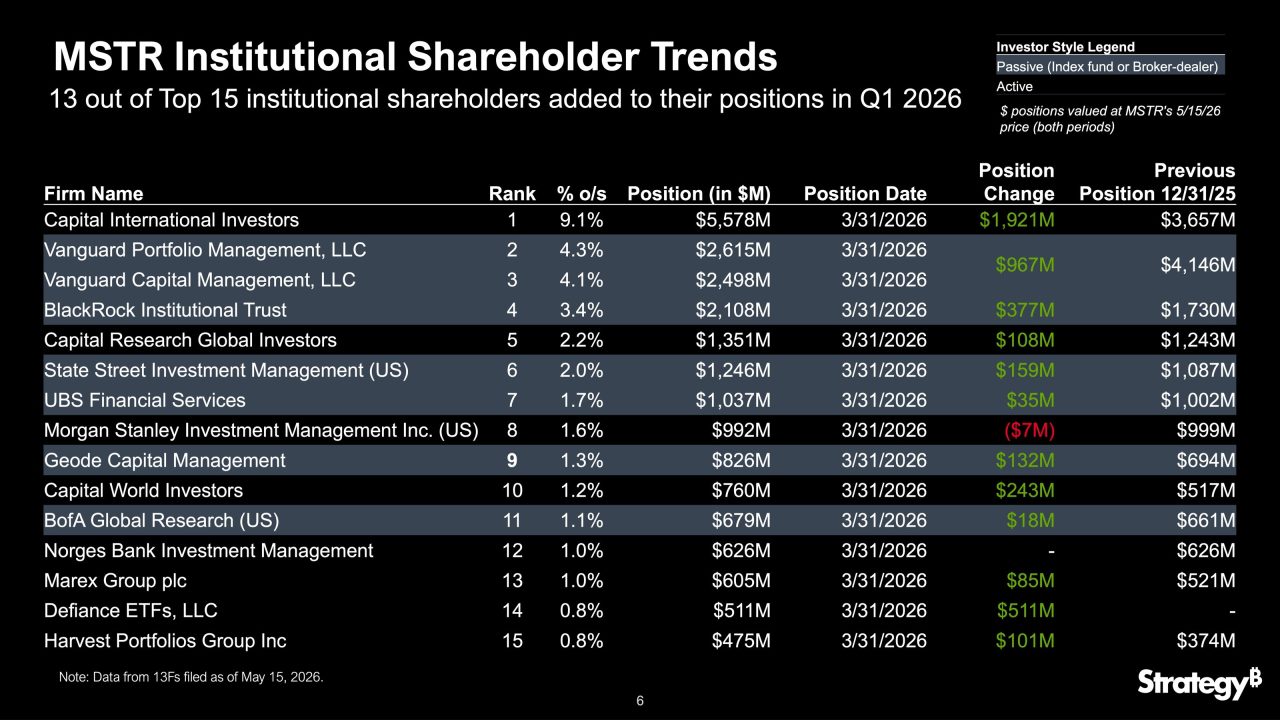
    Institutional investors continued adding MSTR shares during the first quarter, with 13 of Strategy’s 15 largest shareholders increasing their combined positions by 27%. Capital Group, Vanguard, Blackrock, Fidelity, and State Street ranked among the largest firms expanding their exposure, according to Le’s May 20 update on first-quarter institutional holdings.

    MSTR institutional holdings. Source: Strategy CEO Phong Le via X.

    Those positions contribute to broader indirect bitcoin exposure through mutual funds, pension plans, retirement accounts, and exchange-traded funds (ETFs) serving millions of investors.

    Investors have increasingly valued MSTR beyond the market price of its bitcoin holdings, reflecting Strategy’s ability to issue equity and preferred securities, raise capital efficiently, and use those proceeds to acquire additional bitcoin. The company argues those financing capabilities create value beyond the underlying treasury.

    Second-Quarter Results Show Strategy’s Capital-Market Scale

    In its second-quarter earnings release, Strategy reported holdings of 843,775 bitcoin as of July 27, a 4.5% year-to-date $BTC yield through July 26, and $17.06 billion raised through its capital programs during 2026.

    The company’s financing model also carries balance-sheet and dilution risks alongside its potential to increase bitcoin exposure per share. Its latest filing with the U.S. Securities and Exchange Commission (SEC) notes that changes in bitcoin prices, capital market conditions, financing costs, and future securities offerings could materially affect the company’s financial results and shareholders.

    Investors can monitor $BTC Yield, $BTC Gain, bitcoin per diluted share, leverage, and net asset value premium to assess whether the company’s financing strategy is increasing bitcoin exposure over time. The latest performance metrics are updated alongside changes in the company’s bitcoin treasury and capital structure.

    Bitcoin Sales Intensify Debate Over Preferred Financing

    Following the second-quarter update, Strategy completed its third bitcoin sale of 2026 to meet obligations tied to preferred securities. The transaction reduced its treasury from 843,775 bitcoin to 842,138 bitcoin while preserving most of the company’s accumulated holdings.

    That use of treasury assets has intensified scrutiny of a financing model built around preferred stock, equity issuance, and bitcoin-backed capital allocation. Economist Peter Schiff argues that selling bitcoin to fund preferred dividends transfers value away from MSTR shareholders, challenging management’s claim that diversified financing supports long-term treasury expansion.

    Current obligations show how the company’s preferred securities can influence capital allocation even while it maintains a substantial bitcoin reserve. Preferred dividend payments are backed by a $3.75 billion reserve covering more than 2.1 years of dividends and interest. Strategy also authorized separate $1 billion repurchase programs for MSTR and its digital credit securities, while the MSTR program remained unused through July 26.

  • Dogecoin’s Billy Markus Drops a One‑Word Reaction to Fresh Bitcoin Bear Calls

    Dogecoin’s Billy Markus Drops a One‑Word Reaction to Fresh Bitcoin Bear Calls

    • Bearish sentiment: Polymarket shows rising odds of Bitcoin dropping below $60,000, prompting Markus’ one-word reaction.
    • Mixed forecasts: Traders also see a chance of $BTC rising above $65,000 or $67,500, underscoring uncertainty.
    • Market weakness: $BTC and Dogecoin continue to slide amid fading legislative momentum and weak corporate earnings.


    Dogecoin co-founder Billy Markus offered a brief but telling response to new bearish chatter surrounding Bitcoin, reacting with a single word that captured the mood of many traders watching the market drift lower. His comment surfaced as prediction markets showed rising expectations that $BTC could slip under $60,000 before August ends.

    sigh

    — Shibetoshi Nakamoto (@BillyM2k) August 3, 2026

    Markus Reacts to Polymarket’s Bearish Odds

    Markus, known as “Shibetoshi Nakamoto” on X, replied “sigh” to a Polymarket post highlighting a 59% chance that $BTC might fall below $60,000 this month. The platform shared a screenshot showing traders increasingly positioning for a downside move. Markus’ reaction echoed the fatigue felt across the market, where prolonged uncertainty has replaced the sharp swings that often define crypto cycles. He has recently described the current environment as “boring,” framing it as a typical bear phase rather than a moment of panic. That sentiment aligns with the flat price action seen across major assets, including Bitcoin, which has struggled to regain momentum.

    Traders Split on August Price Scenarios

    Polymarket’s odds shifted further at the time of writing, with the probability of Bitcoin dropping below $60,000 rising to 63%. Yet traders remain divided. The platform also shows a 42% chance of Bitcoin climbing above $67,500 and a 71% chance of it pushing past $65,000 in August. Additional downside levels are in play as well, including a 37% chance of Bitcoin falling below $57,500. These mixed signals underscore a market searching for direction, with participants weighing both macro pressures and fading enthusiasm around recent US crypto legislation.

    Market Slump Extends Across Major Assets

    In the last 24 hours, Bitcoin traded down 0.68% to $62,707 after dipping to $62,210 intraday. The weekend brought further weakness, driven by disappointing earnings from Coinbase and Strategy, adding to concerns that speculative traders may be stepping back from riskier assets. Bitcoin is now down roughly 30% on the year, mirroring declines across several major cryptocurrencies. Dogecoin also slipped, falling 0.67% in the past day to $0.069 and dropping 4.35% over the week, reinforcing the broader cooling trend across the market.

  • BlackRock Launches 2 Tokenized Money Funds, Seeks License Under GENIUS Act

    BlackRock Launches 2 Tokenized Money Funds, Seeks License Under GENIUS Act

    BlackRock has unveiled two new tokenized money market assets as it further develops its digital asset strategy. It is now aiming to meet the standards set by the $GENIUS Act to be considered a reserve asset. The products have been previously submitted to the U.S. Securities and Exchange Commission (SEC) in May and will be targeted at the growing crypto stablecoin market.

  • How Indian Banks Are Using Blockchain While Keeping Crypto at a Distance

    How Indian Banks Are Using Blockchain While Keeping Crypto at a Distance

    Indian banks are increasingly integrating blockchain into core banking operations to speed up payments, trade finance, and securities settlement while the country continues to keep cryptocurrencies at arm’s length. Instead of building around public crypto networks, lenders have largely focused on permissioned blockchain networks developed for regulated financial services.

    The shift comes as banks gain practical experience from the RBI’s Digital Rupee pilot and expand the use of distributed ledger technology across more financial services. While blockchain is finding wider acceptance inside the banking system, policymakers continue to take a cautious approach to cryptocurrencies because of concerns over financial stability and regulation.

    Banks Separate Blockchain From Cryptocurrency

    Indian banks are using blockchain to solve practical business problems instead of expanding into cryptocurrencies. The technology is helping lenders cut paperwork, speed up trade finance and reduce the risk of document fraud or duplicate financing. Inland letters of credit, which have traditionally taken more than a week to process, can now move much faster on shared digital networks while giving all participants a clearer view of each stage of the transaction.

    The RBI has consistently drawn a clear line between distributed ledger technology and cryptocurrencies. While supporting blockchain in regulated financial services, the central bank has warned that cryptocurrencies could threaten financial stability, weaken monetary policy and increase the risks of money laundering. It has also maintained support for policies “leaning towards prohibition” on banks’ exposure to crypto assets and privately issued stablecoins.

    That cautious approach extends beyond the central bank. Reuters reported that government officials continue to favor tighter oversight of virtual digital assets even though India has yet to introduce a comprehensive crypto law. Cryptocurrencies have operated in a regulatory grey area since the Supreme Court overturned the RBI’s banking restrictions in 2020, but policymakers continue to weigh the potential benefits of innovation against concerns over financial stability.

    Digital Rupee Gives Banks Practical Experience

    The RBI’s Digital Rupee (e₹) pilot has become one of the country’s largest real-world tests of distributed ledger technology in payments. It introduced the wholesale pilot in October 2022 and rolled out the retail version a month later. Since then, the project has expanded steadily. By 2025 and into 2026, about 19 banks were participating in the retail pilot, which had attracted an estimated six to seven million users.

    Customers of major lenders such as SBI, ICICI Bank, HDFC Bank, Axis Bank and Bank of Baroda can use e₹ wallets to load, redeem and spend the digital currency. Beyond basic transactions, banks have experimented with programmable payments, offline transfers and government benefit disbursements. Those trials have helped banks understand how distributed ledger technology could support everyday banking.

    The wholesale program has followed a different path. Instead of focusing on consumer payments, it has examined how banks settle transactions with one another and whether tokenized financial assets can be exchanged more efficiently.

    Some of the work has also explored cross-border payment scenarios. As the trials have progressed, banks have built technical experience that can be applied to blockchain projects outside the Digital Rupee initiative, including future settlement and tokenization efforts.

    Consortium Model Expands Enterprise Blockchain

    India’s adoption of blockchain in banking has also expanded through industry-wide collaboration. In 2021, 15 major lenders formed the Indian Banks’ Blockchain Infrastructure Company (IBBIC) to develop shared digital networks for financial services. The organization was later renamed the Indian Banks’ Digital Infrastructure Company (IBDIC) as it expanded its work to trade finance, payments, lending and compliance.

    One of its flagship projects digitizes the entire trade finance process, from issuing letters of credit and verifying documents to financing and settlement. Early pilot programs reduced processing times by as much as 75%, cutting transactions that once took eight or nine days to as little as two or three days. The platform has also lowered messaging costs while reducing fraud by assigning every transaction a unique digital identity.

    ICICI Bank was among the first Indian lenders to deploy blockchain for trade finance. It further developed the TradeChain technology as a paperless platform for handling the Indian letter of credit process. Other big banks, like SBI, HDFC Bank, Axis Bank and Bank of Baroda, still support IBDIC initiatives while being participants of the RBI Digital Rupee program.

    However, the IBDIC consortium has moved forward beyond trade finance. In 2025, its financing system based on blockchain technology successfully passed the RBI Regulatory Sandbox. The platform transforms invoices issued by approved suppliers into digital tokens and enables the banks to offer better financing to micro, small and medium-sized enterprises working with larger companies.

    Tokenization Emerges as the Next Phase

    As banks gain experience with distributed ledger systems, attention is gradually shifting from payments toward tokenized versions of traditional financial assets. As part of that work, the RBI is testing tokenized certificates of deposit alongside wholesale Digital Rupee settlements. The trials are designed to examine how digital versions of traditional financial instruments could function within the country’s regulated banking system without depending on public cryptocurrencies.

    Government officials have also recognized that the global financial system is changing. Speaking at the Kautilya Economic Conclave in October last year, Finance Minister Nirmala Sitharaman said stablecoins “are transforming the landscape of money and capital flows,” adding that countries may soon have “to make binary choices: adapt to new monetary architectures or risk exclusion.”

    The RBI has taken a more guarded view. Reuters reported that internal documents prepared by the central bank warned that stablecoins could create parallel payment networks and weaken India’s financial system. The documents also recommended against introducing legislation that would legitimize cryptocurrencies. Union Minister Piyush Goyal has echoed that cautious approach, saying, “While there is no ban [on crypto], we don’t encourage it.”

    Together, those positions illustrate India’s approach to financial innovation. Banks are moving ahead with blockchain, tokenization and central bank digital currency projects under regulatory oversight, while policymakers continue to keep cryptocurrencies outside the core of the country’s financial system.

    Related: India’s Gen Z Is Fueling Record Crypto Adoption; Here’s How They’re Investing
  • LayerZero Has Moved More Than $200 Billion. Now It’s Chasing Global Payments.

    LayerZero Has Moved More Than $200 Billion. Now It’s Chasing Global Payments.

    LayerZero is no longer just a protocol for moving crypto between blockchains. The interoperability network says it has processed more than $200 billion in value across 165 blockchains, making it one of the largest pieces of infrastructure connecting the digital asset economy.

    That scale is drawing comparisons beyond crypto. LayerZero’s historical transaction volume now exceeds the roughly $62 billion sent annually through the US-Mexico remittance corridor, the world’s largest single remittance route.

    While the two figures measure different things—LayerZero reports cumulative value transferred, whereas remittance data is annual—they illustrate how blockchain settlement networks are approaching the scale of major payment corridors.

    Beyond Bridges

    LayerZero started life as an interoperability protocol, allowing applications to send messages and assets between blockchains.

    Its best-known product is Stargate, the cross-chain liquidity network that has handled more than $70 billion in historical transfer volume and now supports hundreds of digital assets across dozens of blockchains.

    Today, however, the company is pitching something much bigger. Instead of focusing on crypto bridges, LayerZero increasingly describes itself as infrastructure for stablecoins, tokenized deposits and cross-border settlement.

    Recent partnerships include PayPal, Paxos, Ondo Finance, Tether and Keeta, while financial infrastructure companies such as Worldpay have launched verification services on the network.

    Stablecoins Are Driving the Shift

    The timing reflects a broader change in how digital assets are being used. Stablecoins have become one of the fastest-growing payment rails in finance, with institutions increasingly exploring blockchain settlement for treasury operations, foreign exchange and international payments.

    Rather than replacing banks, many projects now focus on connecting regulated financial infrastructure with public blockchains.

    LayerZero has positioned its Omnichain Fungible Token (OFT) standard at the centre of that strategy, allowing issuers to move assets across multiple blockchains while maintaining a single token supply.

    The protocol says it now carries roughly 70% of all cross-chain stablecoin flows, making interoperability a growing part of institutional digital asset infrastructure.

    From Crypto to Financial Infrastructure

    LayerZero’s ambitions now extend well beyond decentralized finance. The protocol underpins Tempo, the payments blockchain backed by Stripe and Paradigm, where MoneyGram serves as the anchor remittance validator to help connect stablecoin settlement with real-world payment flows.

    Earlier this month, LayerZero also partnered with Keeta to make tokenized commercial bank deposits transferable across Ethereum, Solana, Base and the Keeta Network, another sign that banks are beginning to treat interoperability as core financial infrastructure rather than experimental blockchain technology.

    For years, interoperability was viewed as a crypto problem. LayerZero is betting it becomes a payments problem instead.

  • A Signal Seen Once a Year in Bitcoin: “The Calm Before the Storm…”

    A Signal Seen Once a Year in Bitcoin: “The Calm Before the Storm…”

    Crypto analyst Luke Martin noted that Bitcoin’s volatility over the past 30 days has fallen below that of technology stocks, indicating a rare signal in the market.

    According to Martin, Bitcoin’s realized volatility falling below that of the QQQ fund, which tracks the Nasdaq 100, stands out as a development seen only once or twice a year. The analyst stated that Bitcoin has remained unusually calm during a period when other assets have exhibited similarly sharp movements to the cryptocurrency market.

    According to shared historical data, Bitcoin rose by an average of 20.58% over a seven-day period following 12 instances where this signal emerged. The average 30-day return after the signal was 141.81%, showing that Bitcoin gained value in all 12 instances examined.

    Related News BREAKING: Michael Saylor Comments on Today’s Bitcoin Sale – “I Said I Would Never Sell Any of My ‘Personal’ Bitcoins”

    Looking at longer-term data, the 60-day average return was recorded at 359.72%, and the success rate at 91.67%. In the 90-day period following the signal, all 11 events examined showed an increase, with an average return of 635.94%. In the 180-day period, all 10 events resulted in a positive outcome, with an average return of 731.96%.

    Martin argued that similar periods in the past have favored Bitcoin bulls, describing the current low volatility as “the calm before the storm.”

    However, it should be remembered that past performance does not guarantee future price movements and high ratios are based on a limited number of historical observations.

    *This is not investment advice.