Tag: CRYPTOS FoxBusiness

  • Ripple Pushes Full XRPL Stack as Tokenized Assets Expand

    Ripple Pushes Full XRPL Stack as Tokenized Assets Expand

    Ripple Expands Its Institutional Tokenization Infrastructure

    Ripple President Monica Long outlined the company’s broader strategy on Aug. 4 after Ripple announced strategic investments in Zilo and Licuido to expand institutional capital markets infrastructure connected to the $XRP Ledger. She described a rapid transition from bank pilots toward production-grade activity and positioned Ripple’s digital asset stack across the full tokenized asset lifecycle.

    “In the last year, we’ve seen the veritable light switch flip – from bank pilots to production, from issuing tokenized assets like money market funds and liquidity funds to using them! Institutional capital markets are moving in one direction — onchain 24/7,” Long stated on X, adding:

    “At Ripple, our goal remains to provide the full stack of digital asset infrastructure – allowing institutional participants to take advantage of the entire lifecycle of a tokenized asset on the $XRP Ledger.”

    Those investments in ZILO and Licuido add fund tokenization and institutional liquidity infrastructure to Ripple’s broader capital markets strategy, supporting fund issuance, trading, and settlement on the $XRP Ledger.

    Ripple’s Mint platform complements that strategy. Launched on July 23, it provides financial institutions with a unified interface to access, mint, redeem, and manage Ripple USD, or $RLUSD, while issuing and transferring the stablecoin across fiat and blockchain settlement systems.

    Institutional issuers can also use Ripple’s tokenization platform to create securities, stablecoins, fund units, bonds, commodities, and other real-world asset (RWA) tokens. Its infrastructure combines issuance, redemption, compliance screening, transfer restrictions, audit trails, freeze controls, clawbacks, and multichain distribution.

    Tokenized Funds Move Into Trading, Lending, and Yield

    A partnership among DBS, Franklin Templeton, and Ripple shows how tokenized assets can support continuous portfolio management after issuance. The arrangement allows eligible DBS clients to trade $RLUSD for Franklin Templeton’s tokenized money market fund within minutes while retaining access to yield.

    DBS also plans to explore accepting these tokenized fund units as collateral through bank repurchase agreements or third-party lending platforms. That structure would let institutional investors move between a stable settlement asset and an income-producing instrument throughout the day.

    Real-world asset tokens can represent bonds, funds, commodities, and property on blockchain networks, opening those assets to faster transfers and around-the-clock settlement.

    Credit Infrastructure Could Extend the XRPL Stack

    The proposed XRPL Lending Protocol would add standardized institutional lending to the network’s tokenization infrastructure. The design keeps underwriting and compliance decisions offchain while managing servicing, repayments, interest, and defaults onchain for treasuries, stablecoins, commodities, money market funds, and private credit.

    Separate XRPL infrastructure is connecting $XRP and $RLUSD liquidity with tokenized U.S. Treasury products offering regulated, reserve-backed yield. A Doppler Finance and Openeden partnership plans to integrate Openeden’s TBILL token and yield-bearing USDO stablecoin into an XRPL-native protocol using audited reserves, regulated custody, and compliance controls.

    The Bank for International Settlements (BIS) identified tokenization as a potential source of faster, programmable payments and more efficient financial intermediation. The organization’s 2026 assessment also called for trusted settlement instruments, coordinated oversight, and stronger safeguards, while warning that current stablecoin structures present financial-integrity and monetary risks.

    Ripple’s next expansion point rests with validator decisions on the proposed lending standards, which would determine whether tokenized XRPL assets can support protocol-level institutional borrowing.

  • SpaceX tops Wall Street revenue forecast, posts $540 million loss on bitcoin holdings

    SpaceX tops Wall Street revenue forecast, posts $540 million loss on bitcoin holdings

    SpaceX (SPCX), Elon Musk’s space technology company, reported its first quarterly results as a public company on Tuesday, announcing second-quarter revenue of $7.8 billion.

    That figure topped Wall Street expectations of $6.9 billion, while narrowing its quarterly loss to to $541 million as growth accelerated across its launch, Starlink and AI businesses.

    The company reported a net loss of $541 million, an improvement from a $1.0 billion loss a year earlier, while adjusted EBITDA nearly tripled to $3.5 billion.

    Crypto investors were also watching for changes to SpaceX’s bitcoin BTC$64,089.16 holdings.

    The company reported $1.10 billion in digital assets at the end of the second quarter, down from $1.64 billion at the end of 2025.

    SpaceX’s IPO filing disclosed that it held 18,712 bitcoin as of March 31, acquired for about $661 million and valued at $1.29 billion at the time. Tuesday’s earnings release reported only the value of its digital asset holdings and did not disclose the number of bitcoin held or explain the decline.

    SPCX was down 6% immediately following the report after closing the session nearly 10% higher on the day’s trading, while the Nasdaq 100 gained 3.3%.

  • Blame lands on Coinkite CTO as BTC exploit loss nears $120M

    Blame lands on Coinkite CTO as BTC exploit loss nears $120M

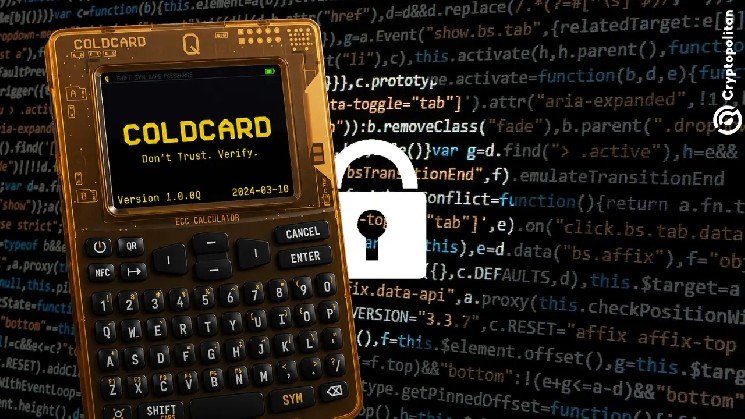
    Researchers have tied the faulty randomness code at the center of the Coldcard wallet breach to Coinkite co-founder and CTO Peter Gray, who Bitcoin developer James O’Beirne says brushed off a warning about the defect in May 2025.

    The exploit has now drained roughly $114 million across more than 5,200 Bitcoin addresses, and Coinkite says it is still live.

    The GPG signatures that point at one person

    The buggy library, called libngu, was published on GitHub under a pseudonymous account named Switch. An analysis posted on August 4 by Bitcoin developer James O’Beirne laid out cryptographic evidence that the account belongs to Gray.

    O’Beirne’s write-up rests on GPG commit signatures. According to the analysis, there are 58 commits that are authored as “Switck” that carry valid signatures from Gray’s personal key, the same key that signs his commits under the name Peter D. Gray in the same repository.

    The Switch account, by contrast, has uploaded no key of its own. The analysis states that it has been cryptographically proven that the two identities are one person.

    The connection matters because Coldcard’s production firmware pulls libngu in as a dependency, according to O’Beirne’s analysis, which also cites security firm Wizardsardine’s finding that the library is one of three repositories involved in the vulnerability.

    A report from May 2025 that went nowhere

    O’Beirne flagged the risk more than a year ago while auditing Coldcard’s firmware in May 2025.

    He said that he wanted to pin down where the wallet sourced its randomness and traced it back to libngu, after which he informed Coinkite about the possible defect at the time.

    “This is the same guy that shrugged off my report of the possibility of the defect in May 2025,” O’Beirne wrote, referring to Gray. He added that he had not yet told the full story of that exchange.

    Coinkite has yet to respond to the identity claim of the report.

    One commit in 2021, unnoticed for five years

    Block’s Bitcoin engineering and security teams traced it to a commit dated March 1, 2021, that changed how Coldcard built a wallet’s seed. The change swapped a call that pulled from the device’s hardware random number generator for one that fell through to MicroPython’s software randomizer.

    The mistake hid in a single preprocessor check. Firmware version 4.0.0 shipped with the flaw on March 17, 2021.

    The seeds were built with too little entropy, so attackers could regenerate them offline and drain funds without ever touching a device. None of the thefts involved stolen hardware, phishing, or malware.

    Coinkite tells owners to move funds now

    Coinkite has told users to act with urgency. “Please treat this as urgent. Migrate your funds,” the company posted, while confirming that the exploit is still in progress and asking holders to alert others who are “less online.”

    Not every wallet is exposed. Reports say that Mk3 devices set up on firmware 4.0.1 or later are at risk, while Mk4, Mk5, and Q owners running firmware below 5.6.0 or 1.5.0Q should update, create a new seed, and move their coins.

    Wallets built with the device’s dice-roll option, where a user enters at least 50 physical rolls, never ran the broken path and are considered safe. A strong BIP-39 passphrase and multisig setups where the Coldcard key is only one of several signers also held up.

    Losses near $114 million across four waves

    The theft has come in bursts. The first wave on July 30 moved about 1,083 $BTC out of 1,196 addresses inside 41 minutes, worth roughly $70 million. Three more waves followed over five days, with Galaxy Research counting a fourth sweep early on August 3 that pushed the running total to about 1,816 $BTC.

    Some reports put the value near $116 million, while others cite $114 million at prevailing prices.

    Bitcoin itself has barely moved, trading near $63,800 during U.S. hours on August 4. Vincent Bouzon, a cybersecurity expert at rival wallet maker Ledger, stated that the episode was “a failure of one implementation rather than a verdict on self-custody,” adding that entropy “must be anchored in secure hardware.”

  • Why Did Bitcoin’s Price Remain Resilient and Not Fall Despite the Recent Major Hack? Here’s the Secret

    Why Did Bitcoin’s Price Remain Resilient and Not Fall Despite the Recent Major Hack? Here’s the Secret

    In an interview broadcast on “The Wolf Of All Streets,” a well-known channel in the sector, the institutional transformation that the cryptocurrency market has undergone and the price dynamics of Bitcoin were discussed in detail.

    The program, moderated by Andrew Parish, featured Bitwise Chief Investment Officer (CIO) Matt Hougan, Bitwise Research Analyst Ryan Rasmussen, and Arch Public CEO Tillman Holloway. The broadcast discussed the reasons behind Bitcoin’s lack of reaction to the $100 million security breach in the individual cold wallet ecosystem, and how Wall Street dominates the sector.

    At the program’s opening, Andrew Parish questioned why the $100 million cold wallet vulnerability didn’t cause any market crash, noting that a similar incident a few years ago could have caused sharp drops of 10% to 20%.

    Commenting on the situation, Bitwise Research Analyst Ryan Rasmussen stated that the market has clearly matured from individual Bitcoin holders to institutional investors. Rasmussen said that the vast majority of new investors are entering the market through spot ETFs or licensed and regulated custody services such as Coinbase and Anchorage. Therefore, he added, vulnerabilities focused on individual cold wallets affect only a very small fraction of the total market participants and do not create widespread panic.

    Related News Jim Cramer Announced That He Will Sell All of His Bitcoin

    Matt Hougan, Investment Director at Bitwise, stated that the market has become resilient to negative news in the current cycle. Hougan noted that sellers have been exhausted and the remaining investor profile is exhibiting an unwavering stance, adding that the presence of institutional capital is reducing the pressure of bad news on prices.

    Arch Public CEO Tillman Holloway stated that a “changing of the guard” is taking place in the cryptocurrency sector. Recalling that in the past, price movements were driven by miners and individual crypto exchanges, Holloway said that today, control has completely passed to Wall Street and institutional capital.

    Commenting on market expectations, Matt Hougan argued that there is a huge gap between the pessimistic atmosphere on social media and the approach of Wall Street financial giants. He noted that giant institutions like Morgan Stanley, Wells Fargo, and UBS operate with long-term, 10-year strategies, and that the traditional financial world views the current price pullbacks not as a collapse, but as a normal buying opportunity within a four-year cycle.

    Ryan Rasmussen reported that portfolio managers with decades of experience are beginning to include crypto assets in their portfolios, similar to past technology revolutions. Rasmussen stated that research teams at major banks are recommending Bitcoin allocations of between 1% and 6% to their clients, and that the risk factor has decreased at the career and institutional level as the asset has become integrated into traditional financial indices.

    *This is not investment advice.

  • At least 15 attackers exploited Coldcard vulnerability: Galaxy

    At least 15 attackers exploited Coldcard vulnerability: Galaxy

    At least 15 different attackers have exploited the Coldcard vulnerability, according to Galaxy Digital’s head of research, Alex Thorn, citing new victim reports received since the incident.

    Thorn said Tuesday that the victim reports helped the company label new attackers that would have gone undiscovered, as the nature of the exploit was different from a hack on a centralized exchange.

    “Due to one single victim’s report of less than 1 $BTC stolen, we identified a new attack with 12 $BTC siphoned from 126 addresses,” Thorn wrote in a Tuesday X post.

    The estimated losses from the Coldcard exploit have grown to $100 million across three confirmed attack waves, according to Galaxy Research. The company also identified a suspected fourth wave that could bring total losses to about $130 million in Bitcoin ($BTC).

    The ongoing attack reignited debate about the security of cold storage wallets and whether users are safer by holding their own Bitcoin.

    $2 worth of AI hardening could have prevented the exploit: Dragonfly partner

    Roughly “$2 of AI hardening” could have prevented the Coldcard exploit, wrote Dragonfly managing partner Haseeb Qureshi, citing social media reports that some AI models rediscovered the vulnerability that led to the attack in less than 20 minutes.

    Qureshi’s remarks came in response to multiple social media users claiming that Claude was able to regenerate the vulnerability in just eight minutes. He argued that these results may have been contaminated by web search and added that open-source AI model GLM 5.2 was able to rediscover the attack in 20 minutes with web access turned off.

    However, it is unlikely that AI models would have independently discovered this vulnerability before it was made public, crypto analytics platform Tokenomist’s data lead, Tatsapat Saerejittima, told Cointelegraph. He said:

    “The claim that AI found it in 2 mins came from a pseudonymous Reddit user who scanned the code after the vulnerability had already become public. There was no blind test, no documented methodology, and no assessment of the model’s false-positive rate.”

    Vulnerability seen in private key setup

    Crypto research company Castle Labs’ co-founder, Francesco, said that the growing capabilities of AI models are drastically reducing the cost and time it takes to discover new cryptocurrency vulnerabilities, but added that Coldcard’s private key may have played a role in the vulnerability.

    Coldcard used a “level of private key entropy (40 bits) much lower than the standard adopted by other wallets (a 12-word seed is 128 bits), a result of a firmware bug, making the job easier,” he told Cointelegraph.

    Francesco, who asked that Cointelegraph not use his last name, said he expects the cost of bug discovery to continue decreasing as AI models gain more capabilities and become more prominent in both cybersecurity and exploits.

    Magazine: Does Botanix’s failure prove Bitcoiners don’t care about DeFi?

  • Bitcoin’s 2017, 2021 macro signal returns – But this cycle has a catch

    Bitcoin’s 2017, 2021 macro signal returns – But this cycle has a catch

    History has a way of repeating itself, and right now, that’s exactly what the market seems to be pricing in. Of course, there’s no guarantee that past events will play out the same way again.

    But in trading, investors often look at historical patterns and previous cycles to guide their decisions. This sometimes creates the illusion of “history repeating itself,” when in reality, it could simply be a market coincidence.

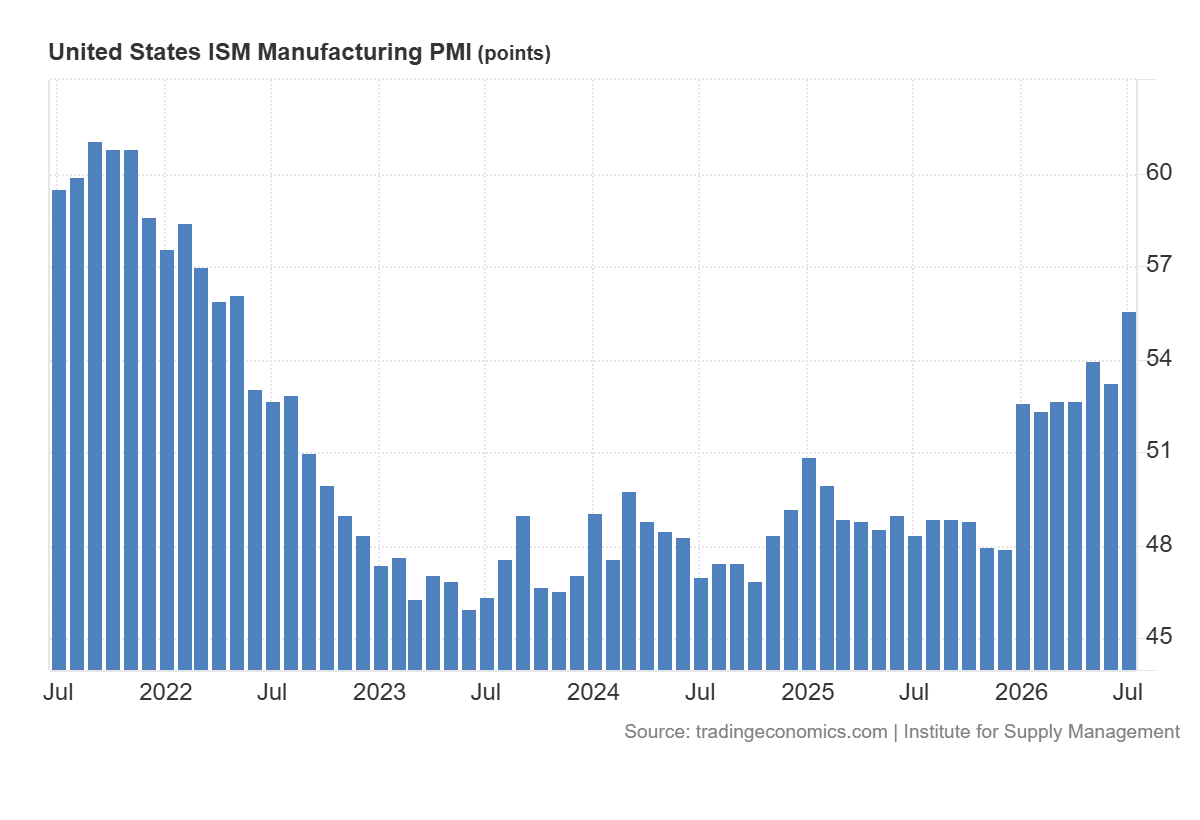
    Now, with the latest PMI data, a similar setup appears to be forming. As the chart below shows, the U.S. ISM Manufacturing PMI came in at 55.6, above the expected 54. This marked its highest level since June 2022.

    A stronger PMI typically points to improving manufacturing activity and a healthier economic backdrop, which could influence risk assets like Bitcoin.

    Source: TradingEconomics

    Notably, this is where historical patterns start becoming interesting.

    Can PMI repeat Bitcoin’s 2017 and 2021 rallies?

    According to one analyst, every time the ISM PMI has sustained levels above 55, the crypto market has entered a major upside phase. The analyst highlighted that the same signal behind the 2017 and 2021 crypto bull runs has resurfaced.

    During those cycles, the total crypto market cap broke above $500 billion and $2 trillion, respectively, while Bitcoin rallied 1,336% and 59% in those periods.

    That said, this signal alone does not guarantee that Bitcoin is about to repeat the same move, especially with $BTC still stuck in a broader bearish phase and down more than 25% in 2026.

    However, the timing of the stronger PMI data is notable, arriving as markets are closely watching rate expectations, with the odds of a rate hike at the next FOMC meeting currently sitting at 64%.

    Meanwhile, Bitcoin’s ability to hold strong despite rising on-chain selling pressure adds another layer to the setup, suggesting that the improving macro backdrop from the PMI report could be laying the foundation for a potential shift in market momentum.

    Bitcoin’s resilience meets rising selling pressure

    Calling Bitcoin’s [$BTC] resilience above $60k a potential bull trap is not entirely far-fetched.

    From an on-chain perspective, selling pressure is picking up across multiple cohorts.

    BlackRock recently moved 1,948.07 $BTC, worth around $122.03 million, into Coinbase Prime, while Bitcoin miners sold roughly 1,774 $BTC, valued at around $112 million, over the past week. Adding to the bearish narrative, Jim Cramer also warned about selling his Bitcoin holdings over quantum computing concerns.

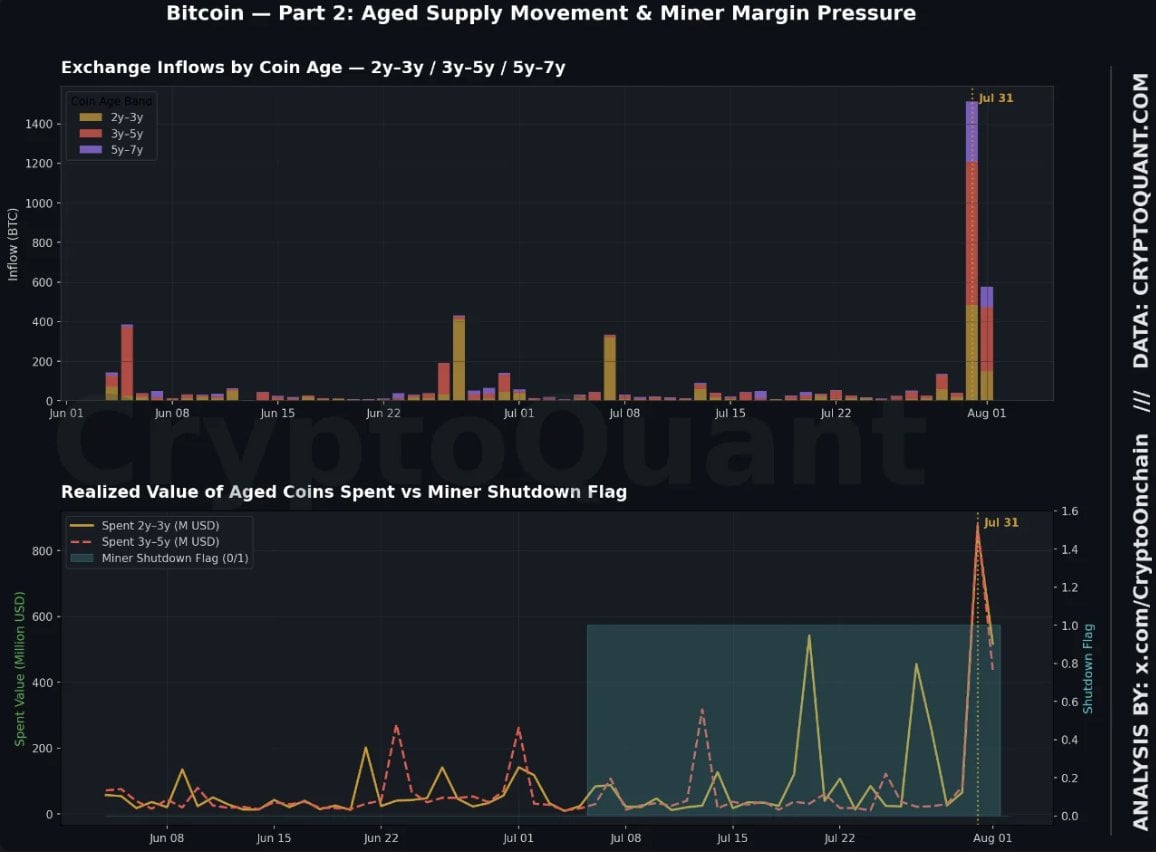
    But the bigger takeaway is the sudden reactivation of dormant cohorts after years of inactivity. As the chart below shows, the long-dormant Bitcoin supply is beginning to move again.

    Bitcoin aged 2-7 years has started flowing back into exchanges, with the 3-5 year and 5-7 year cohorts surging by 595% and 1,016%, respectively. This suggests that some LTHs are taking action, adding another layer of uncertainty around Bitcoin’s current price resilience.

    Source: CryptoQuant

    Can PMI offset Bitcoin’s selling pressure?

    Against this backdrop, the latest PMI report starts to carry more significance.

    The logic is straightforward: Key macro data releases this week could shape expectations heading into the September FOMC meeting. As mentioned earlier, rate hike odds have recently climbed above 64%.

    In this environment, the stronger PMI print could be the first bullish signal, suggesting that the macro backdrop may be turning more supportive for Bitcoin and other risk assets.

    This is why $BTC’s resilience despite rising selling pressure may not be just another bull trap. Instead, it could signal that improving macro conditions are helping Bitcoin absorb the pressure.


    Final Summary

    • Bitcoin is holding above $60k despite heavy selling pressure.
    • A strong PMI report could give $BTC a boost by improving market confidence.

  • ‘I’m a 23-year-old paranormal investigator and can smell ghosts’

    ‘I’m a 23-year-old paranormal investigator and can smell ghosts’

    Harvey More says ghosts have thrown objects at him and tampered with his car (Picture: Cover Media)

    It’s an unusual career for someone who trained as an electrician.

    But when Harvey More fell into a ghost-related TikTok hole during lockdown, he realised he was closer to the spirit world than he had originally thought.

    Long before he began investigating haunted locations, he says he repeatedly saw a mysterious figure walking across the upstairs landing of his parents’ West Midlands home.

    ‘When I went upstairs onto the upstairs landing, I would see a man dressed all in black, walking from one bedroom door to another. It happened a few times, and I could hear unexplained footsteps outside my bedroom,’ the 23-year-old said.

    It was Harvey’s first spiritual experience. When he told his parents, they told him that vicars used to live at the address, and that it was likely to be their spirits.

    ‘I thought, there is definitely another world out there that we don’t know about,’ he said.

    ‘That experience was just crazy. From there I have believed there is something out there, that there’s an afterlife.’

    Harvey during a paranormal investigation (Picture: Cover Media)

    Harvey started watching paranormal live streams on TikTok during a boring lockdown and became intrigued.

    He decided he wanted to find out more and immersed himself in learning about crystals, spiritualism and what he describes as alternative realities.

    Today, the content creator spends his time investigating locations believed to be haunted, searching for evidence that spirits are still present.

    Harvey believes he has witnessed things that cannot be explained.

    ‘I have seen apparitions, from white mists to black figures in the corner of the eye. But when you look, they vanish,’ he said.

    ‘And I’ve experienced random smells and scents coming up out of nowhere.’

    Follow Metro on WhatsApp to be the first to get all the latest news

    Apps With More Than One Million Users
    Follow us to receive the latest news updates from Metro (Picture: Getty Images)

    Metro’s on Whatsapp! Join our community for breaking news and juicy stories.

    After filming footage, he often notices noises on the edits that he didn’t originally hear.

    ‘You often hear taps and bangs that you didn’t hear at the time. You might hear a lady humming or a droning sound,’ Harvey added.

    ‘Once I heard a girl laughing when none of the team heard it. But when I edited I picked it up again. It is amazing the things you pick up.’

    Boredom during the Covid lockdowns led Harvey down a ghostly TikTok scroll hole (Picture: Cover Media)

    During investigations, Harvey and his team ask what they believe are spirits to make their presence known.

    ‘When they go on a hunt, they ask the spirit world to affirm their presence with a noise,’ Harvey, who hosts the Unexplained Mysteries Paranormal podcast,’ said.

    ‘Often we get unexplainable footsteps and knocks. You can tell when it is something paranormal. The majority of what we catch is supernatural.’

    One location that continues to draw him back is a former 17th century burial ground near his home which has since become a public park where families picnic and children play.

    ‘I have always felt that there is an energy there that has called me to investigate. Every time you go there, you pick up new information, evidence of the spiritual world.’

    Harvey says one investigation there produced what he considers some of his strongest evidence. Using a paranormal voice box, a handheld electronic device that paranormal investigators believe spirits use to manipulate radio signals, he started picking up words to do with crime, justice, water and pipes.

    Harvey originally trained as an electrician before joining the world of paranormal investigation (Picture: Cover Media)

    ‘When I got back and started researching who I was connecting with. It emerged that Richard Jesson, who is buried there, was a well-known attorney. And he was one of the founders of South Staffs Waters, a water work company,’ Harvey said.

    ‘I couldn’t believe it. I always go to a location with an empty head with no background. Any information I get I then go back and research it. Nearly every time it links to historical records.’

    He also visited the site of Jesson’s grave, where the temperature dropped ‘significantly’ and his team detected ‘a really strong, musky scent, almost like incense, even though nobody was around us’.

    Harvey said investigations rarely end when the team decides to leave, as often spirits will try to pull them back.

    ‘There are some spirits that are reluctant to come forward and communicate, whether they’ve got low energy or they just don’t want to talk to us,’ he says.

    ‘But when we’re leaving the location, when we’ve turned our backs, things get thrown at us. I’ve had twigs, stones and other debris thrown as I tried to leave. That is the point of an investigation where we have to set up a boundary and say “no more”, because it takes our energy.’

    His most frightening experience was at Cannock Chase, a Staffordshire beauty spot known for ghost stories and alleged sightings, where his car was unlocked while he was investigating.

    ‘I saw a light in the corner of my eye. And I saw my car unlocked itself. That frightened me. I thought, it’s messing with the car. If it wants your attention it can go to your property.

    ‘Thankfully the battery hadn’t gone flat. It was completely dark and we contemplated abandoning the investigation and going home. That will stay with me for the rest of my life because it was so bizarre.’

    Despite the unsettling moments, Harvey says paranormal investigation has brought him comfort rather than fear, particularly after the death of someone close to him.

    ‘Paranormal investigation brings me so much peace. It’s not all scary and spooky. I have been able to contact spirits who have left a legacy. Being able to connect with roots of where I am from is comforting,’ he said.

  • Senior Analyst Shares What to Expect Next for Bitcoin and XRP Prices – “Critical Thresholds…”

    Senior Analyst Shares What to Expect Next for Bitcoin and XRP Prices – “Critical Thresholds…”

    Crypto analyst Ali Martinez shared critical technical levels for Bitcoin, Hyperliquid, and $XRP, noting that the amount of $BTC being moved to exchanges and miner sales could increase selling pressure in the market.

    According to Martinez, Bitcoin is testing the upper boundary of a descending channel formation. Therefore, the $64,300 level stands out as a critical threshold for short-term price movements.

    The analyst stated that a four-hour candle close above $64,300 would confirm a breakout from the descending channel. In such a scenario, the $BTC price could initially reach $65,500, and if the uptrend continues, it could advance further to $66,500.

    However, Martinez also pointed out on-chain developments that could increase selling pressure on Bitcoin. According to data shared by the analyst, more than 20,000 $BTC were transferred to cryptocurrency exchanges in a short period of time.

    The influx of Bitcoins into exchanges is being interpreted as an increase in potential selling pressure in the market, as it could signal that investors are preparing to sell. Martinez stated that $BTC inflows to exchanges should be closely monitored.

    Bitcoin miners have also been seen selling recently. According to Martinez, miners sold approximately 1,774 $BTC worth about $112 million in the last week. The analyst interprets this movement as a new wave of profit-taking among miners.

    Related News BREAKING: Michael Saylor Comments on Today’s Bitcoin Sale – “I Said I Would Never Sell Any of My ‘Personal’ Bitcoins”

    Martinez also warned that the technical outlook for Hyperliquid’s native token, $HYPE, could weaken.

    The analyst noted that the $HYPE price has reached a significant resistance trend line, and that the TD Sequential indicator has generated a sell signal in the same area.

    He stated that if sellers gain control of the market in the resistance zone, the $HYPE price could fall towards the $50 level.

    According to Ali Martinez, the most important price level that will determine the direction of $XRP in the coming period will be $1.06.

    The analyst stated that if $XRP manages to stay above the $1.06 support level, buyers could regain strength, and the price could target the $1.35 and $1.64 levels respectively.

    However, Martinez stated that if the $1.06 support level is lost, selling pressure could accelerate, warning that the $XRP price could fall first to $0.80 and, if the decline deepens, to $0.62.

    *This is not investment advice.

  • How Would Investors Respond to the Upcoming NFP Data?

    How Would Investors Respond to the Upcoming NFP Data?

    Prevailing crypto market trends suggest an ongoing decoupling of the ecosystem from its original FOMO-based speculative undertone. The influx of institutional investors via spot ETFs seems to have adjusted Bitcoin’s price patterns and those of top cryptocurrencies.

    It is now common to find experts and market analysts combining Bitcoin and mainstream assets such as the S&P 500 and Nasdaq. These assets are often highly influenced by mainstream economic indicators. One of the strongest market indicators expected this week is the Non-Farm Employment Change, also known as Non-Farm Payroll (NFP), on Friday.

    NFP Expectations for August

    This is one of the most significant indicators for the crypto market. It measures the change in the number of employed people during the previous month, and analysts consider it a significant metric for gauging the nation’s economic heartbeat.

    The consensus forecast as of the time of writing expects the economy to add between 85,000 and 91,000 jobs, showing a slight rebound from June’s highly disappointing print of 57,000. Meanwhile, the national unemployment rate is projected to edge up slightly to 4.3%. Meanwhile, the public and investor sentiment going into this event is highly anxious and cautious.

    The Federal Reserve’s latest actions have systematically stretched the market, with participants actively trying to price in the financial regulator’s potential monetary decisions. A strong print above 100,000 jobs could reinforce bets on a Q3 rate hike, while a second consecutive weak print would amplify fears of an economic slowdown.

    Investors’ Approach to the August NFP

    Despite these expectations, public confidence in the initial monthly data remains low. June’s figure missed estimates by over 50%, and prior months—April and May—suffered severe downward revisions totaling 74,000 jobs. This leaves investors cautious, knowing that things could change no matter the initial outcome.

    For most digital asset investors, a safe approach would be to monitor leading indicators such as the ISM Services PMI and Initial Jobless Claims scheduled for release before Friday. They could also consider tightening stop-losses on high-beta tech stocks (Nasdaq) and volatile crypto holdings (Bitcoin) before Friday morning to insulate against heavy>Investors would do well to analyze the indicator’s post-release revisions, looking beyond the headline and checking for any revisions. That would help in understanding the true trajectory of US employment, enabling better investment and trading decisions.

    Potential NFP Effect on Assets

    For context, the S&P 500 is up approximately 1.1%, riding an early August geopolitical relief. A stronger job market may trigger selling on rate-hike fears, while a moderate print keeps the “soft-landing” narrative alive. Meanwhile, the Nasdaq has rebounded from a 3.2% loss in July, reflecting a gain of roughly 1.7% in August. It is crucial to note that tech valuations are vulnerable to interest rate projections. Therefore, hot wage growth or high NFP could suppress recent tech gains.

    Bitcoin, the largest cryptocurrency by market cap, is hovering around $63,700 at the time of writing. The cryptocurrency has diverged from stocks in 2026, dropping significantly from highs due to high real interest rates. Investors believe a weak NFP that stops Fed hikes would benefit BTC the most.

    Related:Crypto Markets Brace for Volatility as Key Economic Data Arrives

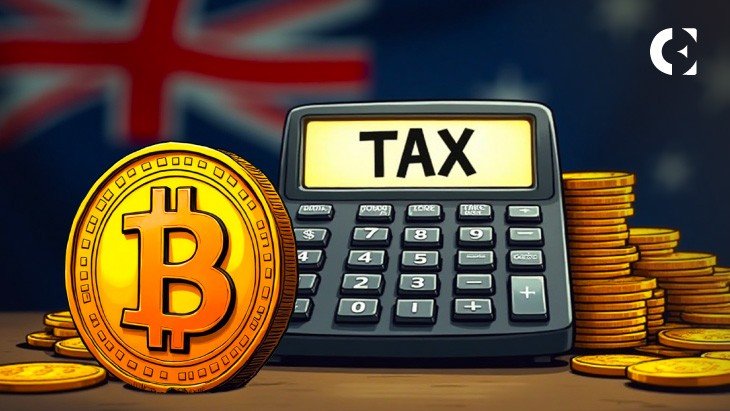
  • Australia Crypto Tax Guide: Capital Gains Tax, Staking and DeFi Explained

    Australia Crypto Tax Guide: Capital Gains Tax, Staking and DeFi Explained

    Australia taxes cryptocurrencies under its existing income tax and capital gains tax rules rather than through a separate crypto tax regime. Depending on the transaction, investors may owe capital gains tax, ordinary income tax, or both.

    As of 2025-26, people who own crypto assets must report the following transactions: selling, trading, using, earning through staking, and using crypto in DeFi.

    The outcome of taxation will vary depending on the type of activity. Selling, swapping, spending, or gifting crypto can produce a capital gain or loss, while staking and some DeFi activities may create ordinary income.

    How Does Australia Tax Crypto?

    The Australian Taxation Office (ATO) considers investment cryptocurrency as a capital gains tax asset. CGT is not a separate tax; its rate depends on an individual’s marginal tax rate, and the investor simply includes net capital gain in assessable income.

    Australian residents for tax purposes, excluding temporary residents, report crypto income and capital gains from Australian and overseas platforms. Using a foreign exchange does not remove this reporting obligation.

    The 2025–26 income year ran from July 1, 2025, to June 30, 2026. Taxable crypto income and CGT events that occurred during this period belong in the 2026 tax return.

    Which Crypto Transactions Are Taxable?

    A CGT event happens when an investor disposes of crypto. This includes selling it for dollars, swapping it for another token, spending it, or giving it away. Using investment crypto to buy an NFT also disposes of the payment tokens.

    This does not automatically mean tax is payable. It means the investor must calculate whether the disposal produced a gain or loss.

    If an investor acquires Bitcoins for A$8,000 and subsequently exchanges them for Ethereum with a value of A$10,500, there will be an A$2,500 capital gain prior to any applicable deductions. Ethereum is a new asset with its own cost base and acquisition date.

    A cryptocurrency exchange is a disposal and an acquisition of a new asset in the eyes of the ATO. There is no CGT event when buying crypto assets using Australian dollars and holding them. Transferring crypto assets from one wallet to another under the same beneficial ownership is not a disposal.

    Capital gains may be exempt if crypto qualifies as a personal-use asset and was acquired for less than A$10,000. However, the ATO states that investment crypto generally does not qualify as a personal-use asset.

    How Capital Gains Tax Is Calculated

    Once a disposal is identified, the investor compares the capital proceeds with the cost base. The cost base includes the purchase price and eligible expenses such as exchange commissions.

    An investor buys Ethereum for A$4,000 and pays a A$40 fee. If the investor later sells it for A$6,500 with A$20 of eligible selling costs, the gain is A$2,440.

    Investors then combine their gains and losses for the year. Capital losses are applied before any CGT discount. An A$4,000 gain reduced by an A$1,000 loss leaves A$3,000. If the investor qualifies for the 50% discount after holding the asset for at least 12 months, the net gain falls to A$1,500.

    Capital losses can offset eligible capital gains, but not salary, staking rewards, or other ordinary income. Unused losses can be carried forward. The ATO provides the order in its crypto CGT guidance.

    How Staking Rewards Are Taxed

    Staking works differently because the investor earns new tokens. Their Australian-dollar market value is ordinary income when received, even if they stay in a wallet. That value also becomes the tokens’ cost base.

    Suppose an investor receives rewards worth A$500 and later sells them for A$700. The first A$500 is ordinary income, while the sale creates an A$200 capital gain before fees. A sale for A$350 would instead create a A$150 capital loss.

    The loss cannot cancel the earlier income because it only offsets capital gains. Reward tokens begin a new holding period when received.

    How DeFi Transactions Are Treated

    DeFi can combine income, asset exchanges, and new legal rights in one transaction. A protocol’s name does not decide the tax result. The key questions are whether the investor gave up an asset, received a different token or right, or earned a reward.

    Consider a liquidity pool. Depositing crypto can trigger a CGT event if the investor receives LP tokens representing a new CGT asset or legal right. Returning those LP tokens to withdraw crypto can trigger another CGT event.

    Wrapping ETH into WETH can trigger a CGT event. The treatment of lending, bridging and liquid staking depends on whether beneficial ownership remains unchanged or the original asset is exchanged for a receipt token or another right.

    Interest, yield, and incentive tokens can also be ordinary income when received. Selling them later creates a separate capital gain or loss. The ATO provides examples covering DeFi lending, liquidity arrangements, and wrapped tokens.

    ATO Tracking and Record Keeping

    The ATO’s>Crypto investors should keep complete records of wallet transactions, overseas trades, cost bases and DeFi activities.

    Records should show the date, token quantity, transaction type, Australian-dollar value, and fees. Investors should also retain exchange receipts, wallet addresses, account statements, and transaction IDs.

    Crypto Tax Filing Deadlines and Reporting Rules

    In myTax, disposals go in the “Capital gains or losses” section. Staking rewards and similar non-business receipts go under “Other income.” A reward reported as income still requires a later gain or loss calculation when sold.

    For most self-lodgers, the deadline is Monday, November 2, 2026, because October 31 falls on a Saturday. Tax-agent deadlines can differ.

    The new 30% minimum CGT rate does not affect the 2025–26 return. It applies to affected real capital gains accruing from July 1, 2027, alongside cost-base indexation. It is not a flat tax on every crypto gain

    Tax rules apply to crypto transactions even when no cash enters a bank account. Selling, swapping, spending, or gifting investment crypto triggers a CGT event. Staking and certain DeFi rewards count as ordinary income when received.

    Disposing of those rewards later triggers a separate CGT event. The calculation determines whether the disposal produces a capital gain, a capital loss, or neither.

    Relevant transaction values and taxable amounts must be recorded in Australian dollars. Investors uncertain about ownership changes or DeFi arrangements should consult an Australian tax professional.

    Related: US Crypto Exchange Licensing Explained From FinCEN to State Rules