Some details of the Clarity Act itself are still being negotiated. Provisions addressing illicit finance and agriculture issues are still under discussion, a legislative staffer told CoinDesk on Wednesday, not to mention the ethics provision aiming to block senior government officials like President Donald Trump from profiting off of the crypto industry.
The White House is still pondering a proposal on ethics language from Senators Thom Tillis and Ruben Gallego, which the senators sent to the White House last week. If the White House accepts the proposal, or has feedback on it, that could move the needle for Democrats on the vote.
Tillis told reporters on Wednesday that the White House had begun to engage with the proposal, Punchbowl News’ Brendan Pedersen reported.
Outside of the Clarity Act, the Senate is currently grappling with the nomination of Todd Blanche to become the next Attorney General, a continuing resolution to fund the federal government, a Russia sanctions bill and possibly a college sports bill.
Possible futures
If the Senate does leave town on Friday, then Wednesday night is essentially the final moment where Majority Leader John Thune can file for cloture, given that the Senate needs to let the motion ripen for a full day before it can take a first procedural vote. However, Thune can also announce that the Senate will continue working into the weekend or until next week on Thursday, which would give the Senate more time for Clarity.
INCUCAI, Argentina’s national organ transplant coordinator, is introducing decentralized identity and document notarization. The system connects INCUCAI with 24 provincial procurement agencies, hospitals, and transplant centers across the country. $IOTA was selected as the public infrastructure for the system.
Extrimian, a Latin American decentralized identity company, developed the infrastructure using self-sovereign identity technology. The company focuses on digital identity, data control, and verifiable credentials.
Authorized officials can sign documents electronically and notarize them on $IOTA. Only cryptographic proofs are stored on-chain, while patient-identifiable information remains private.
The system went live on the $IOTA Mainnet on June 10, 2026. In June, INCUCAI also introduced electronic signatures across processes managed through SINTRA, Argentina’s national transplant information system. The official IncucaiID wallet allows patients, healthcare professionals, and other authorized users to manage credentials and sign documents electronically.
Legislative work in the US Senate regarding the cryptocurrency sector is at a critical juncture.
Speaking at the Rare Evo Conference in Las Vegas, veteran journalist Eleanor Terrett discussed the latest developments regarding the highly anticipated “CLARITY Act” and the likelihood of its passage this year.
The US Senate is working intensely before the August recess, but the fate of the CLARITY Act hangs on procedural hurdles and intra-party vote calculations. The bill needs 60 votes to pass the cloture vote and be considered in the Senate plenary session.
Because Republicans hold 53 seats in the Senate, the bill needs the support of at least seven Democratic senators to pass. Terrett noted that Senate Leader John Thune’s call for a vote could force the parties to compromise, and that policymakers might even postpone the August recess to finalize the bill.
One of the biggest obstacles to the bill’s progress lies in ethical regulations. Democratic senators argue that the prepared ethics text is insufficient to prevent former President Donald Trump from profiting from his own crypto projects (platforms like memecoin TRUMP and World Liberty Financial).
Related NewsColdcard Issues New Statement Regarding the Major Bitcoin Hack
Democrats are calling for state attorneys general to be authorized to sue the Department of Justice (DOJ) for potential ethics violations. Republicans and the White House oppose the proposal, arguing that this authority would lead to politically motivated lawsuits at the state level.
The draft text includes a provision, valid until 2029, that prevents government officials and members of Congress from issuing digital assets while in office.
Another important point of contention in the Senate is the BRCA (Blockchain Regulatory Certainty Act) provisions, drafted by Representative Tom Emmer. These provisions would grant immunity from criminal liability to programmers who write protocols or code if their code is misused by third parties or illegal actors (such as North Korean hacker groups). While the crypto sector considers this provision “essential,” prosecutors and law enforcement oppose it.
While the probability of the CLARITY Act being enacted before the end of 2026 is priced at around 30% in the forecast markets, Eleanor Terrett stated that she sees a higher chance of the law being passed this year.
To view this video please enable JavaScript, and consider upgrading to a web
browser that supports HTML5
video
An adrenaline junkie filming a rollercoaster ride was taken by surprise when he was hit in the face by a flying shoe.
The theme park fan was on the Goliath ride at Six Flags Over Georgia in the US, which reaches speeds of around 70mph, on Sunday.
While up in the air, as the thrillseeker was recording their time on the coaster using Meta glasses, the white trainer flew off a rider in front of them and came whizzing towards the camera lens.
The filmmaker said: ‘I filmed this POV while riding Goliath at Six Flags Over Georgia on Sunday August 2, 2026.
‘Shortly after the ride began, a rider in the front row lost one of their shoes. As the coaster reached speeds of approximately 70mph, the shoe flew back toward my row.’
The white trainer hit the man clean in the face (Picture: Newsflare)
The proud thrillseeker clutched the shoe for the rest of the ride (Picture: Newsflare)
In footage of the moment, the rider can be heard shouting: ‘Oh, my god,’ as the shoe makes impact with a thud.
Luckily, as the shoe ‘crashed into’ the rider, he was able to catch it before it dropped into the lake beneath the ride.
‘The catch was completely unexpected and was not staged or planned in any way,’ he added.
‘The video recorded on my Meta glasses captures the entire moment from my point of view, including my reaction after catching the shoe.’
He held onto the shoe until the rollercoaster came to a stop (Picture: Newsflare)
The rider said the incident was ‘completely unexpected’ (Picture: Newsflare)
In the film, he can be heard saying: ‘I got it!’ after nabbing the airborne accessory. Later, he holds the shoe out in front of him, proudly declaring: ‘I got the shoe!’
He then holds it up in the air, refusing to let go even as the ride speeds up.
‘I got hit in the face and caught a shoe!’ he can be heard telling grinning fellow riders as the rollercoaster comes to a gradual stop.
Once everyone had disembarked from the ride, the rider managed to locate the owner of the runaway garment, whose friends screamed and clapped as it was returned.
‘After the ride ended, I returned the shoe to its owner,’ he added.
While expectations regarding the Fed’s September interest rate decision lack a clear direction, forecasting markets and leading Wall Street banks are pricing in different scenarios. According to forecasting market data, investors are almost equally divided between the Fed keeping rates unchanged and raising them by 25 basis points.
In the forecasting markets, the probability of the Fed not changing interest rates at its September meeting is priced at 49 percent, while the probability of a 25 basis point rate increase is at 47 percent. A rate increase higher than 25 basis points is only considered a 2 percent probability.
Wall Street banks’ forecasts similarly show significant differences. Bank of America expects the Fed to implement a total of three interest rate hikes in September, October, and December. JPMorgan forecasts that rates will remain unchanged in September and that the final rate hike of the year will occur in December.
Related NewsJim Cramer Announced That He Will Sell All of His Bitcoin
Goldman Sachs, Morgan Stanley, and Barclays all predict the Fed will not raise interest rates again until the end of the year. Citi, however, expects rates to remain unchanged in September, followed by rate cuts in October, December, and January.
Bank of America CEO Brian Moynihan also reiterated the bank’s expectation of three interest rate hikes. Moynihan stated that the US labor market remains strong and that inflation needs to fall further, suggesting the Fed could raise rates in September, October, and December.
Moynihan also stated that spending habits among high-income and low-income consumers are beginning to converge. The Bank of America CEO considered this development a positive sign for the US economy.
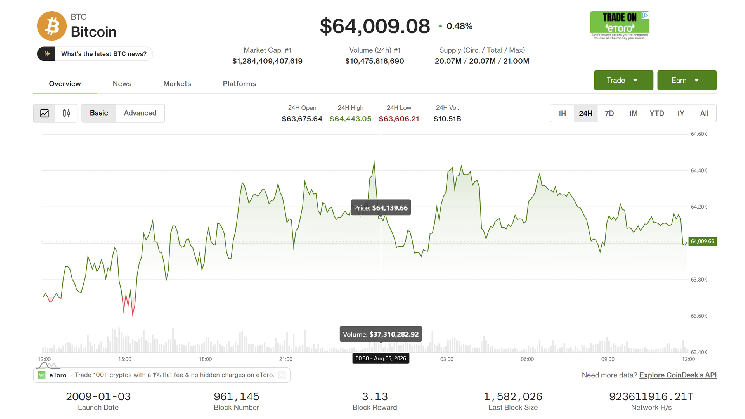
Bitcoin $BTC$64,032.87 was little changed, adding 0.16% since midnight UTC to trade near $64,000, even as global equities hit new highs, fueled by optimism over AI and progress toward reopening the Strait of Hormuz, which pushed oil prices lower.
MSCI’s All Country World Index rose 0.4% toward another record close, its Asia Pacific benchmark gained 2.2%, and Australian shares hit a new peak after the S&P 500 and Dow Jones Industrial Average closed at all-time highs Tuesday.
The broader CoinDesk 20 (CD20) is unchanged since midnight, with 11 components rising and nine declining.
The divergence points to crypto-specific weakness. U.S. spot bitcoin ETFs recorded $5.4 billion of net outflows in the first half of the year as capital rotated into AI-linked assets.
“Institutional and retail interest in crypto as an investment has cooled as AI absorbs a disproportionate share of capital and attention; most sectors, not just crypto, have underperformed AI over the past year,” DWF Labs wrote in a report.
Today’s direction may find a catalyst in U.S. employment figures and ISM services PMI due later.
Circle (CRCL) shares rose about 10% in premarket trading Wednesday after the stablecoin issuer reported second-quarter earnings that topped profit expectations, even as revenue came in slightly below Wall Street forecasts.
The company posted adjusted earnings of 18 cents a share, beating analysts’ consensus estimate of 16 cents, while revenue and reserve income rose 7% from a year earlier to $701 million, missing expectations of $712 million. Net income from continuing operations reached $48 million, topping analysts’ estimates of $43 million, while adjusted EBITDA climbed 8% to $143 million.
$USDC, Circle’s dollar-backed stablecoin, continued to expand. Circulation reached $73.3 billion at the end of June, up 19% from a year earlier, but down from its 2026 peak of nearly $80 billion. Onchain transaction volume surged 151% to $14.8 trillion during the quarter.
“Our quarterly financial results reflect the current rate environment and a crypto market that has slowed,” CEO Jeremy Allaire said in a statement. “But the institutions using $USDC today, like BlackRock, BNY and Standard Chartered aren’t piloting, they are expanding.”
The earnings also offered the clearest update yet on Arc, Circle’s blockchain network scheduled to launch its public mainnet on Sept. 16.
There’s an old saying that “every coin has two sides.” It applies perfectly to the multimillion-dollar hack of the hardware wallet Coldcard that began on July 30 and is still in progress.
On one hand, the hack raised questions about the safety of taking direct custody of coins in hardware wallets as a long-term holding strategy, a technique that became popular following the collapse of the FTX exchange in 2022.
On the other hand — and this is the bright side — it spurred the shuffling and reshuffling of coins to exchanges and multiple wallets alike by holders.
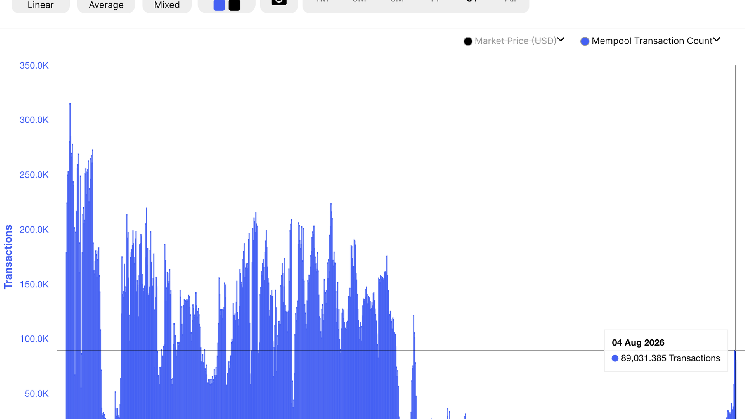
This bright side is evident from key data, starting with the number of transactions sitting in Bitcoin’s memory pool awaiting confirmation from miners. That count has spiked since late July, reaching 89,031 on Tuesday, the most since February 2025, according to data from Blockchain.com (check the Daily Signal).
Other metrics reveal the same picture. According to>
Increasing network activity is often said to support valuations for the network’s native coin, bitcoin BTC$64,032.44. So far, the token has neither rallied nor dropped significantly and remains boxed in the recent range of $62,000–$65,000.
Analysts continue to point to the fate of the Clarity Act as the immediate catalyst while citing longer-duration government bond yields as a more macro and longer-lasting one.
“CLARITY is still the immediate policy binary. The Senate has a three-day window before its August 10 recess, while the implied probability of passage by year end has fallen to 23% from around 75% in mid-May. A push to attach prediction-market restrictions adds another process risk,” analysts at Marex said.
Meanwhile, Bitfinex said the bullish macro case for bitcoin could collapse if the real or inflation-adjusted yield on the U.S. 10-year Treasury note tops 2.5%.
“The 10-year real yield has not stayed above 2.5% since before Bitcoin existed, so there is no price history above that line. It is now at 2.41%, nine basis points below,” the exchange said.
Stay alert!
Read more: For analysis of today’s activity in altcoins and derivatives, see Crypto Markets Today . For a comprehensive list of events this week, see CoinDesk’s “Crypto Week Ahead.”
$NEAR Protocol is building momentum after a governance proposal introduced a new long-term vision for the network’s token economy.
According to the $NEAR founder Illia Polosukhin, there are plans to establish the Sovereign Fund, which will be financed using 30 million $NEAR tokens.
The proposal arrives as $NEAR records its fourth consecutive day of gains, with buyers returning to both the spot and derivatives markets.
$NEAR whales are adding exposure
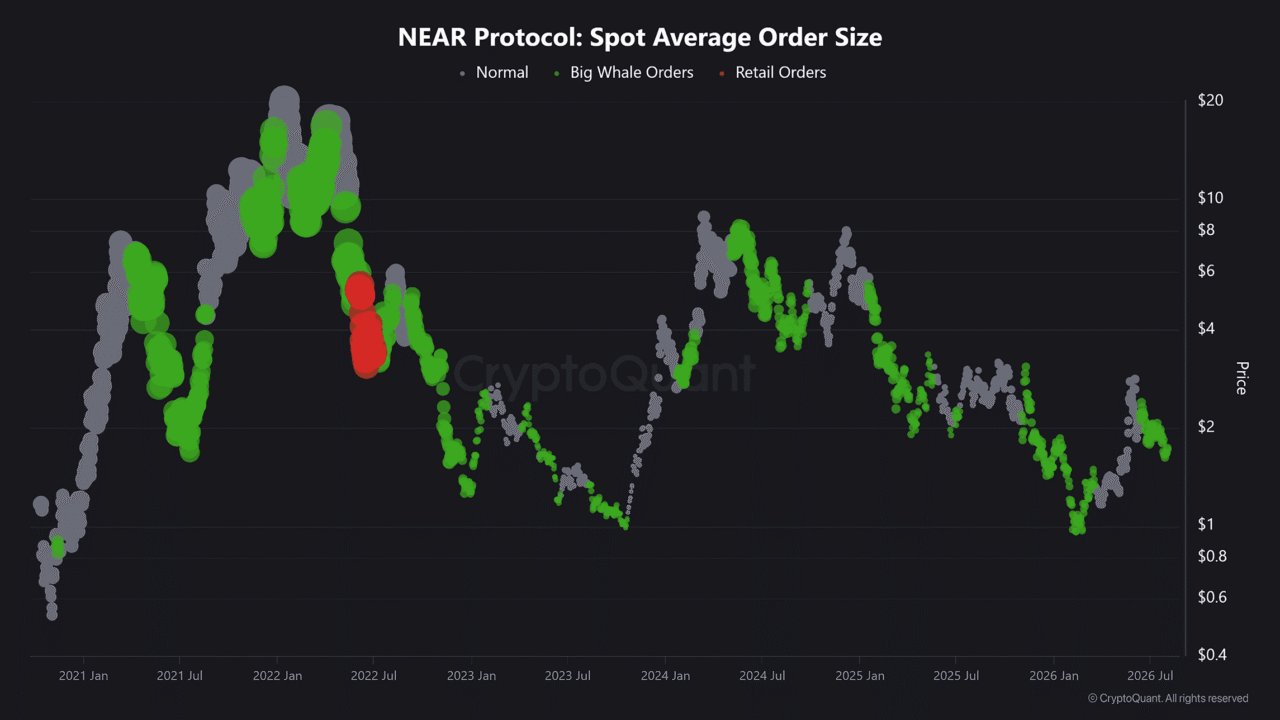
According to the recent Average Order Size data, Near Protocol’s large holders have become increasingly active during the latest rally.
The data indicates that a significant surge in the number of whale orders at the current trading prices, suggesting that institutional-sized investors are positioning alongside the improving market sentiment rather than locking in profits.
Source: CryptoQuant
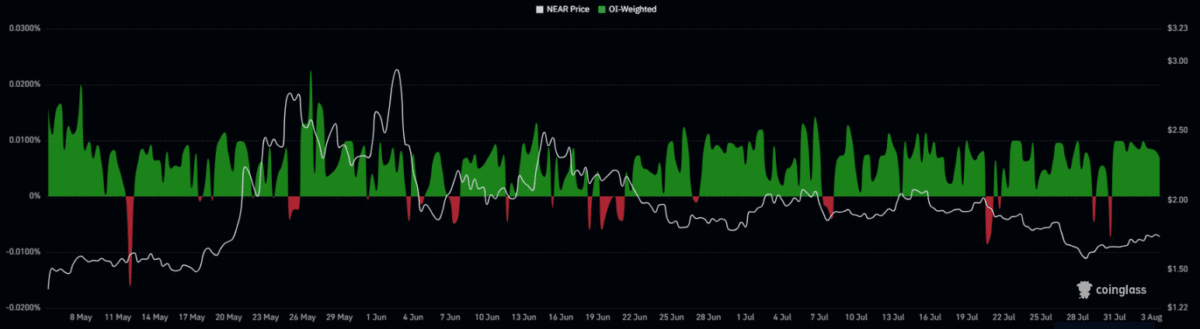
The derivatives market sparks the same signals. $NEAR’s Funding Rates have remained above 0% for several weeks, indicating long traders continue paying a premium to keep bullish positions open.
The persistent positive funding generally reflects an increased market confidence that higher prices are still expected, particularly when accompanied by steady spot accumulation.
All in all, both metrics point to strengthening conviction behind the current move.
Source: CoinGlass
Is a breakout on the cards?
The long-term technical setup continues to favor buyers.
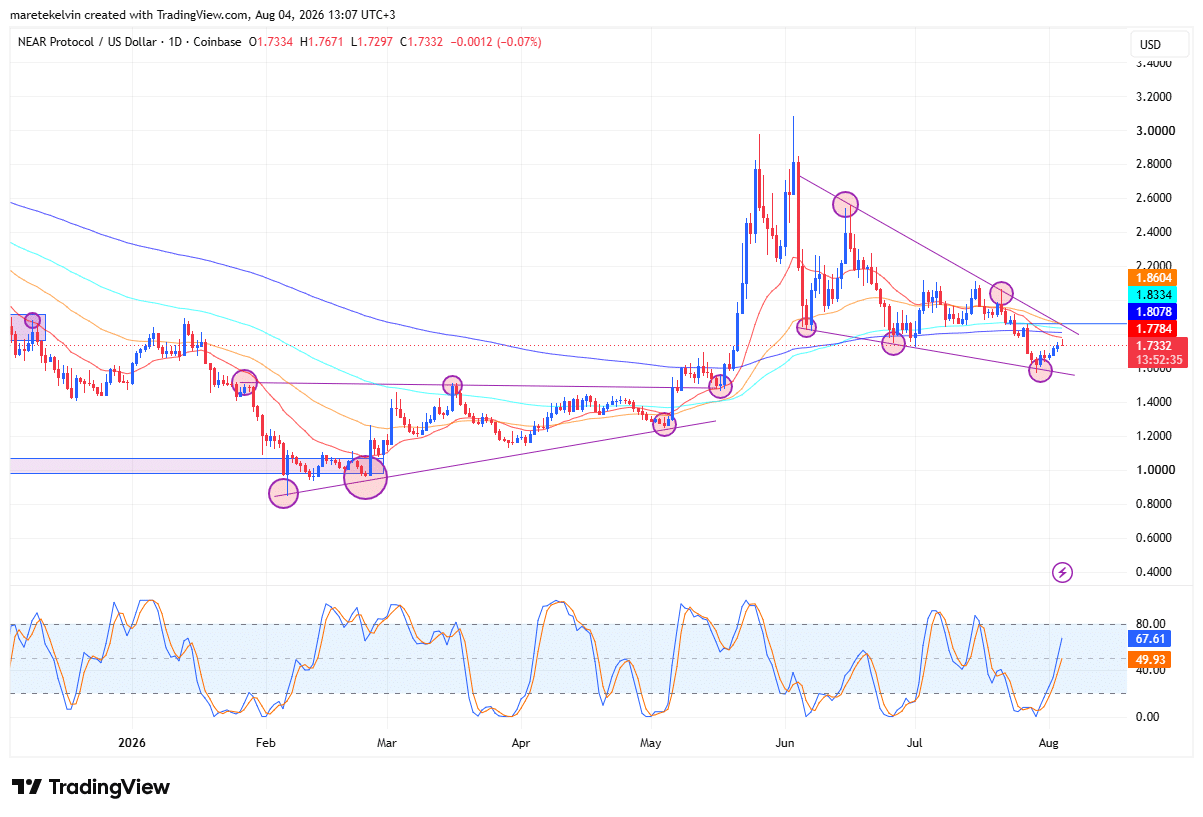
$NEAR has spent months consolidating inside a bullish pennant, a pattern that has repeatedly produced rebounds from support before another attempt at the upper boundary.
The latest rejection came near $1.60, where buyers successfully defended the pennant support. Since then, the token has posted a week of steady gains, preserving its higher-low structure and reinforcing bullish momentum.
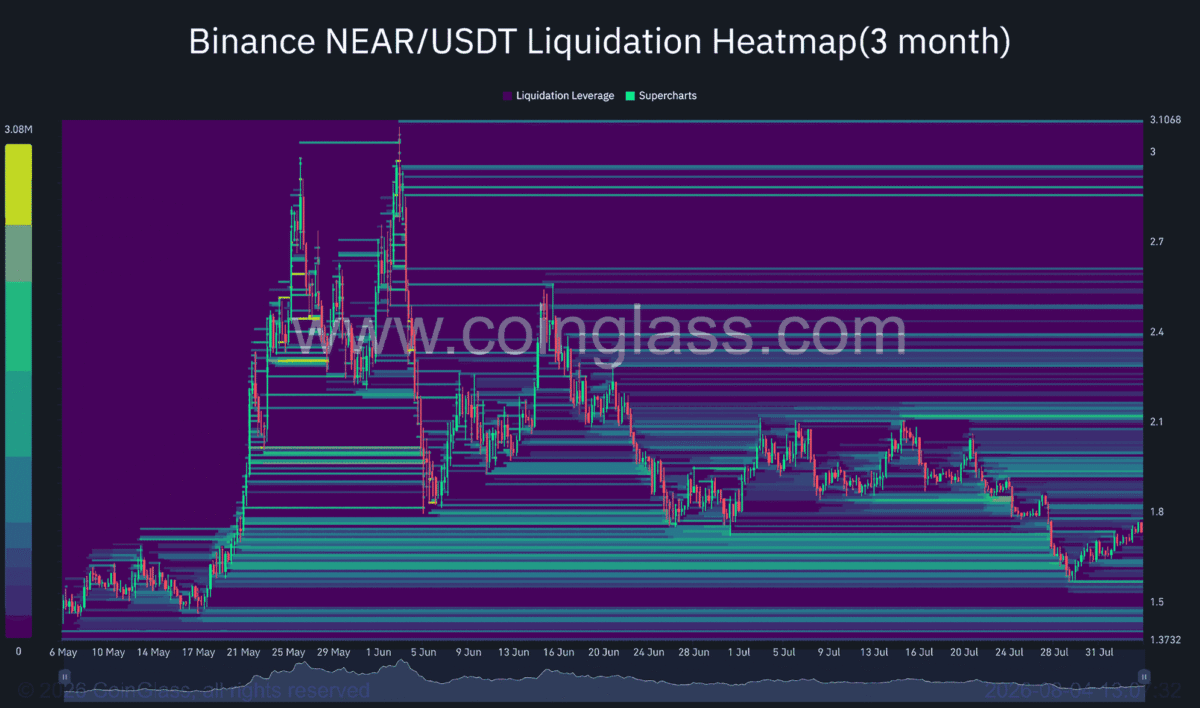
If the current trend continues, attention shifts to the next major liquidity zone. A liquidity cluster exceeding $1 million sits around $1.85, making it the next significant area where sellers could emerge.
Source: TradingView
As it stands, the combination of whale accumulation, persistently positive Funding Rates, and the proposed Sovereign Fund has improved market sentiment.
If buyers defend the pennant support, they could drive $NEAR toward $1.85 before it faces its next major resistance.
Source: CoinGlass
Final Summary
$NEAR extends its rally as a proposed 30 million token Sovereign Fund boosts sentiment.
Whale orders surge, and positive Funding Rates put the $1.85 liquidity zone on buyer radar.
BitMEX cofounder Arthur Hayes published a new essay, “Situationship,” on Aug. 4, 2026, arguing that the artificial intelligence (AI) infrastructure boom could end as a credit crisis rather than a dot com style equity collapse.
Hayes framed data centers as leveraged real estate containing computing equipment that can lose economic value as newer chips become more efficient.
Hayes said an eventual slowdown in data center construction could expose weak borrowers and financiers, prompting government intervention and broader monetary easing. He believes the resulting liquidity could support a renewed Bitcoin bull market. However, the scenario remains his personal forecast, not a confirmed crisis or an official policy outlook.
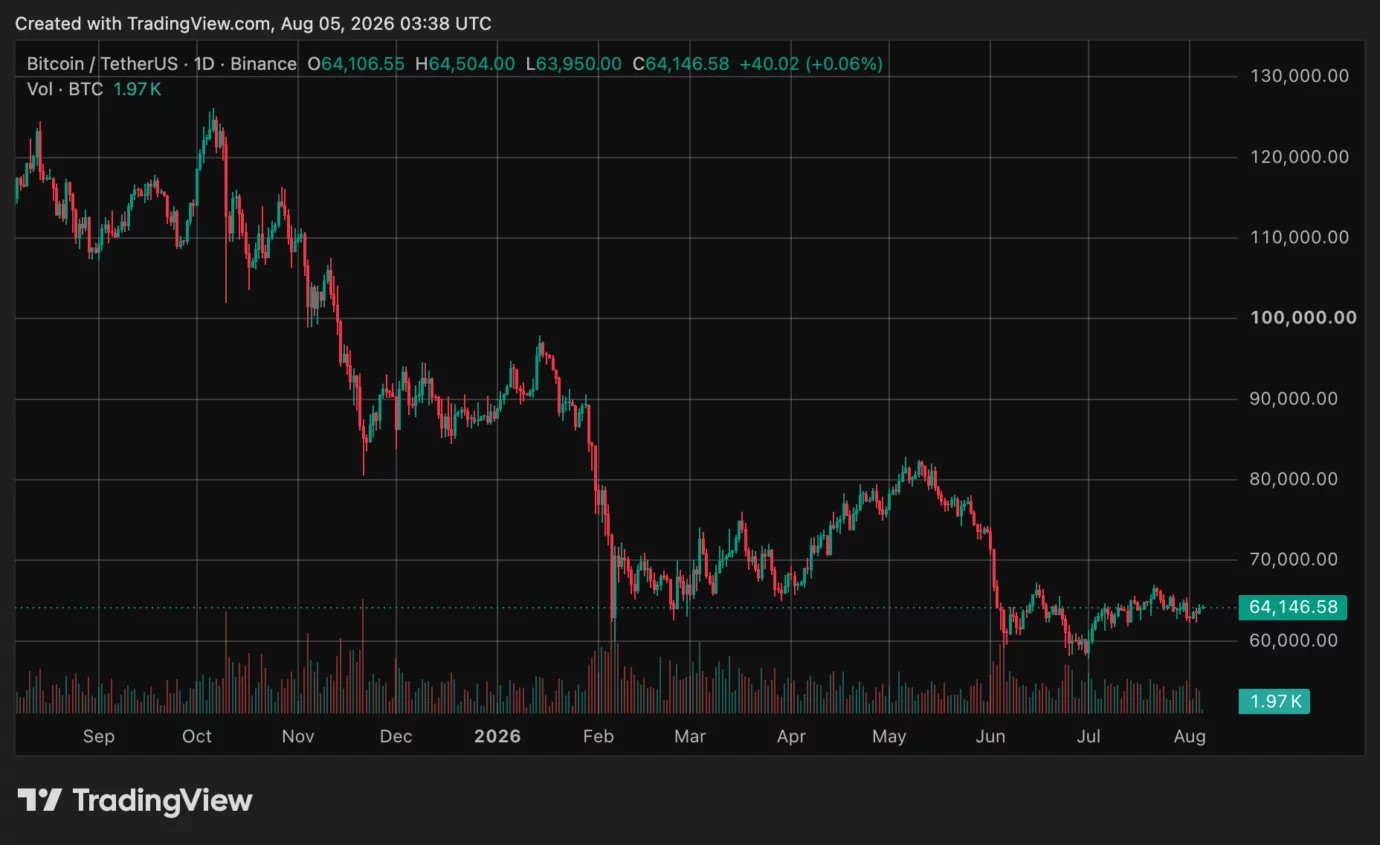
Bitcoin traded around $64,150 early on Aug. 5. No evidence reviewed for this report linked the immediate price move to Hayes’s essay. Hayes also acknowledged that he cannot identify the borrower that might trigger a crisis or determine Bitcoin’s precise bottom.
Bitcoin ($BTC) price chart, source: crypto.news
Arthur Hayes says AI spending is a real estate credit trade
Hayes’s central argument is that investors are treating AI capital expenditure as if every dollar supports a high margin technology business. He views much of the spending differently. Data center land, buildings, power connections and cooling systems resemble property development, while processors can become less valuable when newer equipment delivers more computing power at a lower cost.
“Situationship” is my $BTC bull porn essay on how the AI bubble will burst, and why the money printer will go hyper brrrr and take us back to a rip roaring bull market.
“The question of internal framing is the key variable that determines whether AI is a bubble. But before we… pic.twitter.com/ix5SGiAcuv
— Arthur Hayes (@CryptoHayes) August 5, 2026
This distinction leads to his comparison with the global financial crisis. Hayes described the AI boom as a “credit story like 2008 and not an earnings story like 2000.” In his scenario, banks, insurers, private credit funds and infrastructure investors continue financing construction after profitable demand begins slowing.
Losses would then emerge when weaker projects cannot generate enough cash to meet debt, lease or interest obligations. Financial stress could spread to lenders and investors holding AI infrastructure exposure, even if leading technology companies remain profitable.
Hayes expects announced AI capital spending growth to begin slowing during the second half of 2027 and become clearer in 2028. He also expects markets to eventually reward companies that reduce construction plans. Those dates are forecasts. No company filing reviewed for this report confirms that an industrywide contraction has begun.
His Bitcoin case follows from the expected policy response. Hayes argues that U.S. authorities would protect strategically important AI companies and their lenders because computing capacity has become part of the country’s economic competition with China.
He discussed a possible Bitcoin trading range between $60,000 and $70,000, with downside near $50,000, before an eventual rise toward $1 million. Those levels are not guaranteed targets and depend on monetary policy, credit creation and investor demand developing as Hayes expects.
The essay extends an earlier argument. As crypto.news previously reported, Hayes warned that major technology listings, including possible OpenAI, Anthropic and SpaceX offerings, could absorb liquidity that might otherwise enter crypto markets.
In related coverage, crypto.news examined the expanding bond and credit exposure behind AI infrastructure. That analysis noted that financial risks could spread beyond technology shares if data center construction relies more heavily on debt and private financing.
Official filings show AI spending is still accelerating
The latest company results do not show an AI capital spending collapse. Alphabet reported $44.9 billion of capital expenditure during the second quarter. About 60% of its technical infrastructure investment went toward servers, while 40% went toward data centers and networking equipment.
Alphabet raised its 2026 capital spending guidance to between $195 billion and $205 billion, up from its previous range of $180 billion to $190 billion. The company attributed the increase to faster capacity delivery required to meet demand.
Google Cloud revenue rose 82% from the previous year to $24.8 billion. Cloud operating income reached $8.8 billion, while backlog increased to $514 billion. Alphabet said it expects capital expenditure to increase again in 2027.
Microsoft also reported continued expansion. Its quarterly capital expenditure reached $41 billion, with roughly two thirds directed to CPUs and GPUs. Microsoft Cloud revenue increased 27% to $59.3 billion, while commercial remaining performance obligations reached $678 billion.
The company said it expects capital expenditure to grow during fiscal 2027. Microsoft also expects more than $50 billion of spending in its next quarter, although part of that figure reflects a change in how some data center leases will be classified.
Amazon reported a similar mix of rising investment and stronger cloud income. AWS revenue increased 37% to $42.2 billion in the second quarter, its fastest growth in 18 quarters. AWS operating income reached $16.6 billion.
However, Amazon’s trailing twelve month free cash flow moved to an outflow of $7.6 billion. The company attributed the change mainly to a $66.1 billion increase in property and equipment purchases, largely connected to AI investment.
These results cut both ways for Hayes’s thesis. Strong cloud growth and large customer backlogs weaken the argument that demand is already failing. At the same time, lower free cash flow, rising depreciation and growing contractual obligations show how the buildout can pressure finances even while revenue expands.
Heavy spending alone does not create a credit crisis. Such a crisis would require weaker cash generation, refinancing problems, defaults or impaired infrastructure assets across several companies and lenders.
U.S. financing exposure is growing, but 2008 is unproven
Regulatory filings support Hayes’s narrower claim that AI infrastructure increasingly involves leases, guarantees, joint ventures and outside capital.
Alphabet disclosed $85.2 billion of future payments for leases, mainly connected to data centers, that had not started as of June 30. These leases are scheduled to begin between 2026 and 2031, with contract terms reaching as long as 26 years.
Alphabet also reported $811 billion of purchase commitments and other contractual obligations. Most relate to technical infrastructure, inventory, energy agreements and other long term contracts. The company had $98.2 billion of long term debt and issued more than $51 billion of fixed rate notes during the first half of 2026.
Microsoft disclosed $62.9 billion of finance lease liabilities as of March 31. It also reported another $196.6 billion of leases, mainly for data centers, that had not yet commenced.
Meta reported approximately $182.88 billion of uncommenced lease obligations and $237.67 billion of noncancelable contractual commitments as of March 31. The company entered another $24 billion of infrastructure contracts during April.
Private financing is also becoming more visible in U.S. data center projects. Meta and BlackRock announced a venture for a one gigawatt campus in El Paso, Texas. Meta described the project as representing more than $10 billion of investment.
An earlier Meta venture with Blue Owl Capital covered an estimated $27 billion data center campus in Louisiana. Blue Owl funds received an 80% interest, while Meta retained 20%. Part of the outside funding came through debt sold privately to PIMCO and other bond investors.
Meta agreed to lease the Louisiana facilities and provided a capped residual value guarantee under certain conditions. Such arrangements show how data center exposure can be distributed among technology companies, insfrastructure funds, landlords and debt investors.
They do not prove that a 2008 style chain of insolvencies has started. Alphabet, Microsoft, Amazon and Meta remain profitable businesses with large operating cash flows and growing customer commitments. The reviewed filings did not report widespread defaults on AI infrastructure debt or an official government rescue program.
The 2008 comparison therefore remains a stress scenario rather than a present diagnosis. Mortgage losses became systemic because weak lending, securitization, leverage and opaque counterparty exposure spread through major financial institutions.
An AI infrastructure downturn could follow a different route involving unused capacity, falling rental values, obsolete equipment, tenant concentration and long power commitments. Whether those risks become systemic will depend on utilization, refinancing conditions and where losses ultimately settle.
Bitcoin’s outcome depends on policy, liquidity and timing
The Federal Reserve held its federal funds target range at 3.5% to 3.75% on July 29. The decision passed by a 9 to 3 vote. The central bank did not announce an AI rescue facility, emergency lending program or new asset purchase plan.
The Fed has conducted reserve management purchases of Treasury bills to maintain ample banking system reserves. Its July monetary policy report said Treasury bill purchases since early January totaled nearly $250 billion, including about $160 billion of reserve management purchases.
Those operations are not officially described as quantitative easing or an AI bailout. The Fed says they are intended to maintain an adequate level of reserves and support control over short term interest rates.
Hayes interprets balance sheet growth and stable policy rates as supportive for bank credit and future market liquidity. That interpretation remains open to debate because reserve management can expand the Fed’s assets without representing the broad crisis response assumed in his forecast.
Bitcoin could benefit if a future downturn produces rate cuts, emergency lending or larger asset purchases. However, the first stage of a credit shock could hurt Bitcoin as investors sell liquid assets, meet margin calls and reduce leverage.
As crypto.news reported in its examination of Bitcoin’s changing market cycle, Federal Reserve policy and global liquidity now compete with the halving cycle as major drivers of crypto prices.
The next evidence will come from company guidance and credit markets rather than from Hayes’s essay. Investors can watch 2027 spending plans, cloud backlog conversion, data center occupancy, lease commitments, private credit spreads and any defaults tied to AI infrastructure.
The Fed’s next scheduled meeting will take place on Sept. 15 and Sept. 16. Unless company demand weakens or financing stress begins appearing, Hayes’s argument remains a forward looking Bitcoin thesis built around a credit crisis that has not occurred.
FAQs
Is the AI bubble already bursting?
The latest filings do not show an industrywide contraction. Alphabet raised its spending guidance, Microsoft expects continued capital expenditure growth and AWS reported accelerating revenue. Financial pressure is visible in free cash flow and contractual commitments, but those conditions do not constitute a credit bust.
Why does Hayes compare AI with 2008 instead of 2000?
Hayes believes the main vulnerability lies in debt, leases and infrastructure financing rather than technology companies earning little or no revenue. The comparison depends on credit losses spreading through financial intermediaries, which has not been established.
Would an AI crash automatically raise Bitcoin’s price?
No. Bitcoin could decline during an initial liquidation period. A later recovery would depend on the scale, speed and form of monetary support, along with continuing demand for Bitcoin. Central bank easing would not guarantee any particular price.
What would weaken Hayes’s thesis?
Sustained cloud revenue, strong data center utilization, profitable AI services and stable credit performance would weaken the argument. The thesis would also lose force if companies fund construction without creating stressed borrowers or concentrated lender losses.