Tag: CRYPTOS FoxBusiness

  • Major Ethereum Bull Tom Lee Hints at Another ETH Rally

    Major Ethereum Bull Tom Lee Hints at Another ETH Rally

    BitMine Chairman Tom Lee stated that a significant breakout is approaching in Ethereum’s ($ETH) technical outlook, reiterating his bullish outlook for $ETH.

    According to the technical analysis highlighted by Lee, the Ethereum price is only about 3.5% away from breaking above the upper boundary of the Ichimoku Cloud on the daily chart. If $ETH surpasses this level, it will mark the first breakout above the Ichimoku Cloud since October 9, 2025.

    Ethereum is trading at around $1,906, with the upper boundary of the cloud, which technical analysts are monitoring as a significant resistance zone, also near the current price.

    Breaking above the upper band of the Ichimoku Cloud is considered a significant signal in technical analysis, indicating a weakening of the current trend or the potential start of a new uptrend. Therefore, a sustained breakout could pave the way for Ethereum to move towards higher price levels.

    Tom Lee Continues to Be Bullish on Ethereum

    Tom Lee maintains his previously expressed optimistic view on Ethereum. In his assessment in July, Lee stated that he expected the $ETH/BTC pair to strengthen in the second half of 2026.

    Lee’s long-term thesis for $ETH is based on the strengthening of $ETH’s position as a monetary asset, the growth in stablecoin adoption, and the increasing prevalence of tokenization of traditional assets on the blockchain.

    *This is not investment advice.

  • Nvidia commits up to $105 billion to support OpenAI Ohio AI campus

    Nvidia commits up to $105 billion to support OpenAI Ohio AI campus

    Nvidia has agreed to guarantee as much as $105 billion in lease payments tied to a major OpenAI data center project in Ohio being developed by SoftBank backed SB Energy, according to Reuters.

    The chipmaker will also invest $1.5 billion in SB Energy and secure up to 8 gigawatts of AI computing capacity at the site. SB Energy will build, own and operate the campus for OpenAI under a 20 year lease.

    The project will initially provide 4.25 gigawatts of capacity in Pike County, Ohio, with operations expected to begin in phases starting in 2028. Nvidia will exclusively supply the AI computing infrastructure and provide credit support for land, power and construction tied to the initial development.

    Nvidia also has an option to secure the remaining 3.75 gigawatts of capacity.

    SoftBank and SB Energy plan to build at least 10 gigawatts of new power generation and invest $4.2 billion in regional grid infrastructure through a partnership with AEP Ohio.

    OpenAI said the project is expected to create about 35,000 construction jobs through 2032 and roughly 2,500 permanent operating jobs.

    Nvidia CEO Jensen Huang said OpenAI’s spending on Nvidia chips is expected to represent about $600 billion of computing capacity through 2030.

    The investment follows a $1 billion commitment from OpenAI and SoftBank to SB Energy in January to expand data center and power infrastructure supporting the Stargate AI initiative.

    Last week, Nvidia also partnered with six major financial institutions on computing financing platforms targeting more than $500 billion in third party funding for AI infrastructure.

  • US Treasury proposes rules for stablecoin issuance and sales under GENIUS Act

    US Treasury proposes rules for stablecoin issuance and sales under GENIUS Act

    The US Treasury Department proposed new rules Monday detailing how stablecoin issuers and digital asset service providers would comply with key provisions of the $GENIUS Act.

    The Notice of Proposed Rulemaking focuses on Section 3 of the law, defining when a payment stablecoin is considered issued in the United States and when a platform is considered to offer or sell a stablecoin to someone in the country.

    The proposal is scheduled for publication in the Federal Register on Aug. 18, with comments accepted for 60 days.

    Under the proposal, a stablecoin would generally be considered issued in the US if the issuer is located in the country at the time of issuance or if the stablecoin is issued to someone located in the US.

    For individuals, Treasury would generally look at physical presence, while US incorporation or a principal place of business in the country would determine the location of companies.

    Foreign issuers could avoid being treated as issuing in the US if they reasonably believe recipients are outside the country, maintain controls designed to prevent issuance to people located in the US, and do not target US users through advertising or solicitation.

    The $GENIUS Act is expected to take effect on Jan. 18, 2027. From that point, companies generally will not be allowed to issue payment stablecoins in the US without authorization under the federal or state regulatory framework, subject to exceptions for qualifying foreign issuers.

    Beginning July 18, 2028, digital asset service providers would generally be prohibited from offering or selling stablecoins to people located in the US unless they were issued by a permitted payment stablecoin issuer or a qualifying foreign issuer.

    Foreign issuers would also need the technological capability to comply with lawful US orders and applicable reciprocal arrangements.

    Treasury’s proposal gives several examples of what could constitute offering or selling a stablecoin in the US, including directly soliciting US users, advertising that a stablecoin is available to them, responding to purchase inquiries from people in the country, and helping users bypass location restrictions such as IP address checks.

    Platforms could receive protection if they reasonably believe the customer is outside the US, maintain controls designed to prevent sales to people in the country, and avoid advertising or solicitation targeting US users.

    The proposal also exempts certain direct transfers between individuals and transactions involving self custody wallets from the Section 3 prohibitions.

    Treasury is also seeking industry feedback on how the framework should apply to activities including airdrops, stablecoin buybacks, wrapped tokens, blockchain bridges, market makers and transfers to exchanges or liquidity providers.

    The proposal is one part of a broader implementation of the $GENIUS Act. Treasury, FinCEN and OFAC previously proposed rules covering anti money laundering and sanctions compliance requirements for permitted stablecoin issuers in April.

    The $GENIUS Act was signed into law in July 2025 and requires payment stablecoins to maintain reserves backing their outstanding tokens on a one to one basis using eligible assets including cash, deposits and short term Treasury securities.

  • BitMart founder dismisses calls for audit as users report blocked funds, unpaid employees

    BitMart founder dismisses calls for audit as users report blocked funds, unpaid employees

    “We have collected full evidence of the content on X, all of which is fabricated rumors,” Lee said. “During daytime US time, we will file a police report and send a lawyer’s letter to X, demanding technical and data forensics.”

    Regarding unpaid staff, the founder of the Cayman Islands-based crypto exchange said, employee assets “are not prioritized over client assets, everyone is a client, and there are no privileges.”

    An X user known as BeardStaff said their assets had been inaccessible since the July 26 announcement, and that a dedicated VIP manager removed them from Telegram the day withdrawals stalled. “Where is my $10 million?” they posted.

    Another user cut straight to Lee’s hacked account claim.

    “No one asked you if the account was hacked or not,” wrote @chicha_liam. “Answer what people have been asking you since July 26. When will users be able to withdraw their funds?”

    Onchain investigator ZachXBT also pushed back. “If you actually have the liquidity, then simply return the funds to everyone instead of posting vague statements.”

    Roshan Dharia, CEO of distressed investment firm Echo Base, told CoinDesk via Telegram that his firm has offered BitMart a funded restructuring package including debtor-in-possession financing and equity at emergence, underwritten by Echo Base as a claimholder. He said BitMart has not responded.

  • NEAR AI Adds Independent Verification

    NEAR AI Adds Independent Verification

    $NEAR AI Cloud has integrated Intel Trust Authority, adding independent verification to its confidential AI inference infrastructure. The service allows customers to receive an Intel-signed attestation token confirming that their workloads are running inside a genuine Intel TDX trusted execution environment.

    $NEAR AI Cloud uses Intel TDX to isolate AI workloads in confidential virtual machines. Their memory is encrypted and protected from the host operating system, hypervisor, and infrastructure operator. $NEAR AI already validates the hardware attestation and makes the underlying evidence available for inspection.

    The new integration adds a separate verification layer. Intel Trust Authority checks the cryptographic signatures and compares the trusted computing base with Intel’s reference values and policies. It then issues a signed JWT containing the verification result.

    $NEAR AI Cloud is a platform for private AI inference and agents. Intel develops hardware and security technologies for confidential computing and enterprise infrastructure. Intel Trust Authority provides independent attestation services for confidential computing environments.

    The verification token can be used by other systems to control access to protected workloads. For example, key management and security platforms can require a valid token before releasing sensitive data or encryption keys. This also gives enterprises third-party evidence that can be used in security and compliance processes.

    $NEAR AI Cloud already serves organizations including Brave, Venice AI, Abound, the Government of Bermuda, OpenMind and Corbits.

    Image: Magnific

  • Zebec Adds Rewards to Payroll Balances

    Zebec Adds Rewards to Payroll Balances

    Zebec Network, an onchain payroll and payments platform, has partnered with Solstice Finance, an institutional yield protocol on Solana, to introduce $USX across its payroll infrastructure. The integration will allow companies to earn rewards on payroll funds held before they are paid out.

    Companies usually add funds to their payroll balances before payday, leaving the money unused until payments are processed. With $USX, these prefunded balances can earn rewards through Solstice’s programme during this period. Employees will continue to receive their pay through Zebec without changing how they use the service.

    $USX can also be received directly through a Zebec debit card. Users can spend the balance in the real world or withdraw it to a wallet when needed, while one $USX is treated as one dollar for spending.

    Image: Magnific

  • Another Manipulation Alert in the Cryptocurrency Market! Analyst Points to 4 Altcoins! Here Are the Details

    Another Manipulation Alert in the Cryptocurrency Market! Analyst Points to 4 Altcoins! Here Are the Details

    As allegations of manipulation in the cryptocurrency market resurface, on-chain analyst EmberCN made some noteworthy statements.

    At this point, an important warning came from the analyst regarding the altcoins SIREN, $AKE, $XPIN, and BTR.

    EmberCN stated that it examined the wallet addresses associated with the altcoins in question and detected suspicious signs indicating that the same active market maker played a role in the price movements of the four tokens. According to the analyst, all of these tokens experienced sharp increases exceeding tenfold.

    $AKE, SIREN, $XPIN, and BTR are on the list!

    One of the tokens that EmberCN particularly highlighted was $AKE. According to the analyst, after experiencing a sharp drop of approximately 60% at the beginning of July and a large number of leveraged investors exiting the market, $AKE gained approximately 52 times its value in the following month.

    Noting that this rise is remarkable, the analyst suggests that this movement in $AKE is linked to a suspicious market maker.

    In this context, the analyst notes that there are linked addresses indicating that the suspicious market maker traded not only on $AKE but also on SIREN, $XPIN, and BTR.

    The analyst noted that these four altcoins have in common a history of experiencing controlled price increases exceeding tenfold.

    The analyst also noted that some of the addresses associated with $AKE had previously been used in SIREN transactions and most recently in the transfer of $XPIN to Binance Alpha.

    EmberCN concludes by stating that their findings regarding these altcoins are not definitive, but merely suspicions. The analyst notes that on-chain address relationships and price movements raise suspicions of manipulation.

    *This is not investment advice.

  • Blockstream launches swaps service after Boltz suspends operations

    Blockstream launches swaps service after Boltz suspends operations

    Blockstream has launched Blockstream Swaps in beta testing after noncustodial swap provider Boltz suspended its services following months of automated probing and several exploits.

    Blockstream said in an Aug. 10 announcement that the in-house service is already being tested with select participants, with development now being accelerated after Boltz stopped processing swaps on Aug. 3. The Bitcoin infrastructure company said the product was under development before the shutdown and is intended to add another option for users moving funds between Bitcoin, Lightning and Liquid.

    Boltz said its suspension followed a steady increase in automated, AI-assisted attempts to probe its infrastructure, along with several exploits that the team said were contained. The company kept its swap services offline because attackers were iterating faster than its developers could identify and patch weaknesses.

    “Attackers now iterate faster than a team our size can find and patch,” Boltz said in the statement quoted by Blockstream.

    The swap provider said customer funds were never at risk because its architecture is self-custodial. Refund mechanisms also remained available while normal swap operations were disabled.

    As crypto.news reported on Aug. 4, Boltz initially restricted swaps involving assets such as USDT, USDC, WBTC, TBTC and RBTC after identifying a bug in its Ethereum Virtual Machine integration on Aug. 1. Bitcoin, Lightning and Liquid swaps remained available at that stage before the company suspended all swap services two days later.

    Blockstream Swaps enters beta after Boltz shutdown

    Blockstream described its new service as an in-house swaps feature built for the Lightning and Liquid networks, with organizations now able to request access to the beta program.

    Development was already “well into” its testing process before the Boltz suspension, according to the company. Blockstream said the recent disruption reinforced its decision to speed up the rollout, while stressing that the product is not intended to displace existing providers.

    “We are not seeking to replace any providers,” Blockstream said. “We see Blockstream Swaps as a much-needed addition to improve redundancy and resilience to the ecosystem.”

    Boltz had previously worked with Blockstream and other Bitcoin applications that relied on its infrastructure to move assets between Bitcoin mainnet, Lightning and Liquid. Its Aug. 3 shutdown also affected services at Bull Bitcoin, Aqua and ZEUS that depended on the provider’s swap infrastructure, according to the earlier report.

    For Blockstream, adding its own implementation gives its ecosystem another swap provider without requiring users to hand custody of their bitcoin to an intermediary during the transaction.

    The company said Blockstream Swaps can support users holding $BTC on Bitcoin mainnet or LBTC on Liquid who need to interact with Lightning without managing Lightning channels directly.

    Atomic swaps let users move bitcoin between networks

    At the technical level, Blockstream said an atomic swap lets two parties exchange assets without relying on a trusted intermediary to hold both sides of the trade.

    The transaction is structured so that both transfers complete or neither one does. If the swap cannot be completed within its specified conditions, the funds remain recoverable by their original owners.

    Boltz uses a form built around hashed time-locked contracts, or HTLCs. Under the setup described by Blockstream, one party generates a secret and publishes its cryptographic hash, while payments on both sides of the swap are locked to the same condition.

    Revealing the secret to claim one payment allows the other side to use it to complete the corresponding transaction. Timelocks provide a refund route when the swap is not completed within the required period.

    Boltz later incorporated Taproot and MuSig2 into the construction, according to Blockstream, allowing cooperative transactions to settle through a normal key-path spend while keeping the script path available as a fallback.

    Different transaction directions also use separate swap types. A submarine swap moves $BTC or LBTC into Lightning, while a reverse submarine swap takes Lightning funds back to Bitcoin mainnet or Liquid. Chain swaps allow $BTC and LBTC to be exchanged without a custodial intermediary.

    Atomic swaps have formed part of Bitcoin development for years. An earlier Liquid Network launch report covered Blockstream’s 2018 rollout of the Bitcoin sidechain, which introduced L-$BTC as a bitcoin-pegged asset designed for faster transfers and other functions outside the main chain.

    Blockstream also developed LiquiDEX, a separate swap protocol for exchanging two assets issued on Liquid in a single transaction. According to the company, LiquiDEX does not require the same hashlock and timelock structure used in HTLC-based swaps.

    Instead, a maker signs an input using SIGHASH_SINGLE and SIGHASH_ANYONECANPAY, allowing a taker to add inputs and outputs without invalidating the maker’s signature. Blockstream said the protocol is already used by platforms including SideSwap and can support trustless over-the-counter trading and order books.

    Blockstream Swaps targets Lightning channel complexity

    Lightning users normally need access to channels with enough liquidity to send or receive payments. Running Lightning directly can require users or service providers to operate a node, open channels, commit capital and obtain inbound liquidity.

    Blockstream said its swap model is designed to handle that conversion when a payment is made, allowing a user to keep $BTC or LBTC and exchange it into the required Lightning payment as part of the transaction.

    Under one example given by the company, a user can pay a Lightning invoice using a balance already held on Bitcoin mainnet or Liquid without first opening and funding a Lightning channel.

    Incoming Lightning payments can also be converted into LBTC. Blockstream said its wallet setup allows an incoming Lightning transaction to settle as LBTC into a wallet secured with its Jade hardware device while Jade remains offline during receipt of the payment.

    Merchants can similarly accept a Lightning payment and settle the funds on their preferred supported network, according to the company.

    Blockstream’s own product lineup already spans the three networks involved in the swap service. Its current wallet supports on-chain Bitcoin, Lightning and Liquid, while the company also develops Core Lightning and operates the Liquid Network.

    Boltz, meanwhile, has not announced a date for restoring its swap services. Its Aug. 3 notice said the API would remain available for cooperative refunds, while unilateral refunds would continue to work without depending on Boltz infrastructure. Support services also remained available while the team assessed the attacks and its next steps.

  • Bitcoin tracks equity bounce, but $390 million ETF outflow week keeps bulls on back foot

    Bitcoin tracks equity bounce, but $390 million ETF outflow week keeps bulls on back foot

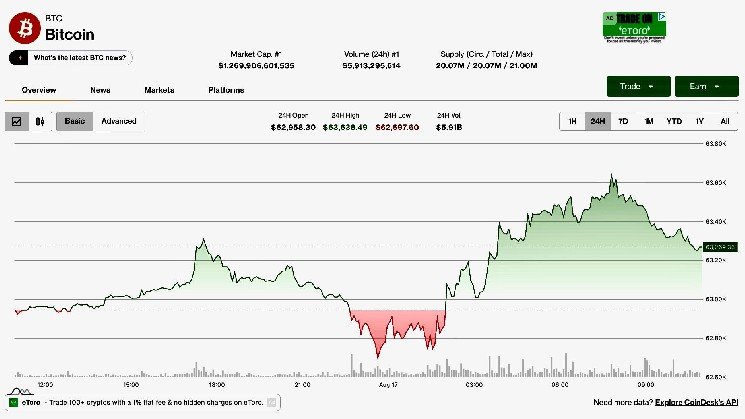
    Bitcoin $BTC$63,558.97 steadied above $63,000 on Monday, clawing back a fraction of last week’s losses with a 0.8% gain since midnight UTC.

    Without an obvious catalyst, the largest cryptocurrency appears to be tracking U.S. equities. Nasdaq 100 index futures are up 0.5% to their highest point since July 2.

    Any positive reading will need to take into account last week’s net $390 million outflow from spot exchange-traded funds, including the first three-day stretch since the end of July. That was the largest weekly withdrawal from U.S. spot bitcoin products in six weeks.

    Ether $ETH$1,903.86 ETFs flows were limited, and solana ($SOL) ETFs bucked the trend with their strongest weekly inflows since mid-May.

    The bigger picture is the Clarity Act. Galaxy Research’s head of research, Alex Thorn, cut his odds of the landmark crypto bill becoming law in 2026 to roughly 10% on Aug. 14, joining prediction markets that now put the probability at around 17%. A cloture vote is scheduled for Sept. 15 when the Senate returns from recess, although market observers are expecting another delay.

    Derivatives positioning

    • Taker ratio stays balanced: the 24-hour long-short volume ratio for takers hangs in balance again, extending Friday’s trend. Takers are entities that pull liquidity from the order book by trading at available prices.
    • Thin liquidity raises swing risk: $BTC‘s notional open interest, at $48 billion, is now nearly double its 24-hour trading volume. $XRP‘s market shows a similar pattern. That gap means any mass liquidation event could run into thin liquidity, raising the odds of wild price swings.
    • $BTC OI pulls back, $XRP holds firm: in contract terms, $BTC‘s open interest (OI) has pulled back to 750,000 $BTC from Friday’s 760,000 $BTC. That’s been a pattern since April, with spikes above 750,000 $BTC often proving short-lived. $XRP futures show the opposite dynamic, with OI holding steady at 10-month highs. Positioning in $ETH and $SOL remains relatively light in comparison.
    • CC shows bearish buildup: Canton Network’s CC token has dropped over 1.5% in 24 hours, making it one of the biggest losers among the top 100 coins by market value. OI in futures tied to the token has risen more than 5% over the same period. That combination points to shorts, or bearish bets, being built up. Negative annualized perpetual funding rates and a negative OI-adjusted 24-hour cumulative volume delta (CVD) both support that read, indicating bears are leading the market.
    • $ZEC bucks the trend: Privacy-focused $ZEC is also an OI gainer. In this case, a positive 24-hour CVD, is a sign bulls are being more aggressive, taking longs via market orders rather than passive limit orders. $ZEC‘s funding rate is also positive at +10%, indicating a growing bias toward bullish bets.
    • Volatility and fear stay low: Bitcoin and ether’s 30-day implied volatility indexes remain pinned near year-to-date lows, suggesting fear levels and demand for options-based insurance against price swings are both muted. Wall Street’s VIX tells a similar story, sitting at its lowest level since January.
    • Options positioning leans bullish near-term: On Deribit, the skew for $BTC and $ETH shows a bid for calls, or bullish bets, at the front end of the curve. The implied volatility term structure shows no signs of short-term stress either, despite Wednesday’s scheduled release of the Fed minutes.
    • Volume rankings show a split: 24-hour volume rankings show a mixed profile, with both $BTC calls and puts among the top five most-traded instruments. The same holds for ether.

    Token talk

    • Pump.fun PUMP$0.002880 is one of the standout performers on Monday, adding 7.80% since midnight UTC with daily trading volume rising 55% to $90 million.
    • $ZEC has gained 4.70% since midnight at $508, extending a notable stretch for privacy coins following XMR’s strong run last week.
    • MORPHO advanced by 5% at $2.07, reversing some of Friday’s weakness and leading the DeFi names higher.
    • HYPE rose 3.53% to $59.08, continuing its steady grind and now up around 2% on the week.
    • FET is one of the weakest altcoins on Monday, down 1.56% since midnight at $0.1196, giving back some of last week’s gains as AI-adjacent tokens lose momentum.
    • CoinMarketCap’s “Altcoin Season” indicator is at 46/100, recovering from the Aug. 7 low of 36/100 as optimism slowly returns to the altcoin sector. CoinMarketCap’s Fear and Greed index sits at 38/100, a “fear” reading.