Jane Street, a leading market maker on Wall Street, made a notable investment in Bitcoin exchange-traded funds (ETFs) in the second quarter of 2026.
According to a 13F filing submitted to the U.S. Securities and Exchange Commission (SEC), the company purchased approximately $630 million worth of Bitcoin ETF shares during that period. This brought Jane Street’s total Bitcoin ETF holdings to $1.06 billion.
The data released indicates a reversal of the strategy the company followed in the first quarter of the year. Jane Street reduced its Bitcoin ETF positions by approximately 71 percent in the first three months of 2026 and adopted a cautious stance towards the cryptocurrency market. However, strong purchases in the second quarter have increased expectations that institutional investor interest in Bitcoin may be revived.
Market experts say Jane Street’s move is significant not only in terms of investment size but also its timing. Despite the volatility in Bitcoin prices in recent months, the company’s increase in positions is seen as a signal that long-term expectations remain positive.
Spot Bitcoin ETFs traded in the US have become a significant tool for institutional investors to access the cryptocurrency market. Products offered by major financial institutions like BlackRock and Fidelity, in particular, are facilitating the flow of traditional capital into Bitcoin.
Analysts say Jane Street’s second-quarter purchases indicate that institutional demand has not completely disappeared. However, investors will closely monitor upcoming 13F announcements to see if other major funds and financial institutions make similar changes to their Bitcoin ETF positions.
The continued shift of institutional investors towards Bitcoin through ETFs is considered a key indicator of the market’s medium- to long-term outlook.
Bitcoin $BTC$64,087.35 scored a rare achievement on Monday by outperforming the S&P 500.
The largest cryptocurrency rose 2.6% to over $64,000, registering its best daily performance in over a month, according to CoinDesk data. Wall Street’s benchmark equity index, S&P 500, fell by 0.52%.
Bitcoin, therefore, not only outpaced equities but moved in the totally opposite direction. This was once a norm. Bitcoin has spent most of its history being the higher-beta asset relative to stocks, meaning it typically moves more than stocks in both directions.
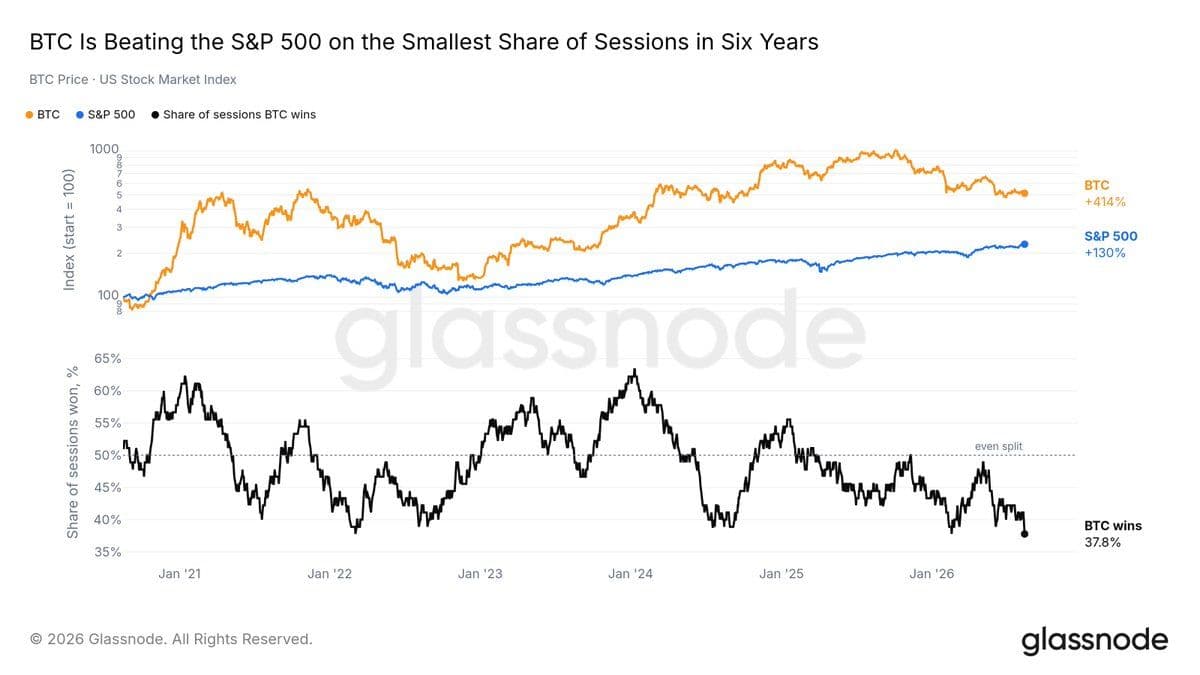
“$BTC outperformed the stock market today. This has become a less common occurrence lately. 1/2 In fact, $BTC only outperformed the S&P 500 on around one third of trading days over the last three months,” blockchain analytics firm Glassnode said in a Telegram chat.
$BTC has mostly underperformed the S&P 500 in recent three months. (Glassnode)
Underperforming two-thirds of the time means $BTC has been acting less like a higher-beta asset relative to stocks and more like a laggard. Key reasons for that include the AI stock frenzy on Wall Street that has sucked out capital from other corners of the financial market, including cryptocurrencies.
The bear market phase of bitcoin’s self-fulfilling four‑year cycle has also played a role in keeping demand for $BTC subdued. $BTC peaked above $126,000 in October last year and quickly entered the bear market, which is expected to bottom out by October this year.
Peter Schiff, CEO of Euro Pacific Capital, known for his anti-Bitcoin views, said that Bitcoin’s recent price recovery should be seen as a selling opportunity rather than a buying opportunity for investors. Schiff, who has been in the spotlight for many years for his critical statements about Bitcoin, made noteworthy assessments regarding the cryptocurrency market in a post on the social media platform X.
Schiff stated that he was unsure why Bitcoin hadn’t experienced a decline in the last trading day, arguing that the price increase presented an opportunity for long-term investors to reduce their positions. The renowned economist noted that he couldn’t see the fundamental factors supporting the current rise and that it was unclear what factors were keeping the price afloat.
In his statements, Schiff specifically drew attention to the $65,000 level, arguing that this area represents a significant resistance point for Bitcoin. According to the experienced investor, Bitcoin does not have significant upside potential above this level. Conversely, he stated that if the price remains below $65,000, the downside risks outweigh the downside risks.
Schiff’s comments come amid ongoing debate about whether Bitcoin’s recent recovery is sustainable. While some investors in the cryptocurrency market believe the rally will continue, others remain cautious due to macroeconomic uncertainties and market volatility.
According to CoinMarketCap data, Bitcoin was trading at $64,405 at the time of writing, having gained 2.49% in the last 24 hours. Despite its recent surge, the largest cryptocurrency is still hovering near critical technical levels, with investors closely watching how the price will react to the $65,000 resistance.
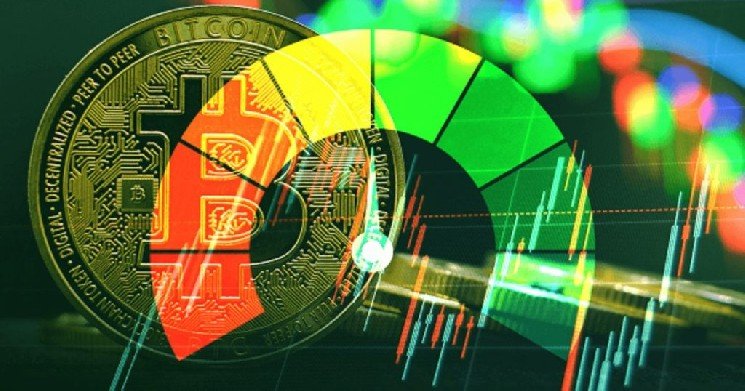
The Crypto Fear and Greed Index, a key indicator measuring investor sentiment in the cryptocurrency markets, rose to 41 today, signaling a limited improvement in market sentiment.
According to the data, the index rose by 10 points compared to the previous day. However, despite this increase, the indicator is still in the “fear” zone.
The index is used to measure investors’ risk perception and overall sentiment towards the market. As the indicator approaches zero, it shows increased fear and selling pressure in the market; as it approaches 100, it indicates that investors are more optimistic and willing to take risks. Therefore, the current level of 41 reveals that market participants remain cautious but exhibit a more positive outlook compared to previous days.
Analysts note that the rise in the index could signal a gradual recovery in investor confidence. However, the fact that the indicator is still in the fear zone suggests that the market has not fully transitioned to an optimistic outlook and that investors continue to closely monitor macroeconomic developments and price movements in the cryptocurrency market.
Investors were allocated about 19.7 billion $MON, nearly 20% of the original supply. Those tokens were locked when Monad’s public network launched last November and begin unlocking after a one-year wait, followed by monthly releases over the remainder of a four-year schedule.
That makes November the first point at which early investors begin receiving tokens they can sell normally.
$MON traded around $0.021 on Tuesday, about 16% below the $0.025 price of last year’s public sale. Roughly 11.8 billion $MON are currently circulating, giving the token a market value near $250 million against a fully diluted value of about $2.1 billion.
As such, the token price has struggled while activity on the network has grown.
The amount of money deposited in Monad-based decentralized finance apps has climbed to about $895 million from roughly $360 million on July 2, according to DeFiLlama, an increase of almost 150% in about six weeks. Stablecoins on Monad are worth about $707 million, while decentralized exchanges on the network handled roughly $79 million of trading over the past day.
That growth does not explain why investors rejected the Foundation’s offer. And without knowing how steep a discount they were asked to take, the lack of sellers cannot be read simply as a bullish call on $MON.
Fiona Murray, Ripple’s managing director for Asia Pacific, said the deal reflects growing momentum across Korea’s institutional financial sector, with banks building digital asset capability and looking for long-term infrastructure partners. Regional banks play a vital role in the real economy, she said.
The company has spent the past year pushing $RLUSD, the dollar-pegged token it issues, as the settlement asset for institutional work. CoinDesk asked Ripple which asset the Jeonbuk deployment uses and did not immediately receive a reply.
That distinction helps explained why a steady run of Ripple partnerships has done little for the token.
$XRP traded above $3 at last year’s highs and has spent August drifting toward and now through $1, while Ripple has been signing asset managers, custodians and banks.
The same split shows on Ripple’s own ledger. Tokenized real-world assets on the $XRP Ledger are worth about $1.38 billion, as CoinDesk reported earlier in the month, of which $845 million is $RLUSD. The stablecoin accounts for more than three fifths of everything issued there.
Meanwhile, traders are betting the price turns anyway. Futures open interest stood at about $2.78 billion this week, with more than three accounts holding long $XRP positions for every one holding a short on Binance and a similar ratio on OKX, even as commentary about the token across social channels turned its most negative in three months.
“$57,000 is a key region to watch. If Bitcoin trades down into that area, we could see a massive wave of long liquidations,” Joao Wedson, CEO of crypto analytics platform Alphractal, said.
The risk is amplified by thin trading volumes. As CoinDesk reported Monday, the number of active contracts is unusually large relative to trading volume. That combination matters a scenario, where a large batch of leveraged longs get liquidated and thin order books make it harder to absorb those liquidations at stable prices. The result could a sharper, faster drop rather than a orderly pullback.
The question is whether $BTC will fall to $57,000.
Past crypto bear cycles have seen severe crashes of 76% to 84%. The latest one, which began at highs above $126,000 last October, has so far only cut prices in half. If history is any guide, there may be another leg lower still to come.
Analysts at crypto exchange Bitfinex noted that bitcoin is showing mid-to-late bear market characteristics, with price trading between the long-term holder realized price of $52,699 and the short-term holder realized price of $67,176. The realized price median, near $63,200, has provided support over the past two weeks; a break below that level could put the June low of $57,803 back in focus.
A Solana whale address that had remained inactive for nearly two years has resurfaced, purchasing 47,535 $SOL worth approximately $3.6 million, according to blockchain tracking platform Lookonchain. The transaction marks a notable return for an investor who previously capitalized on Solana’s price swings in 2023.
Whale’s Historical Trading Pattern
Lookonchain data reveals that the wallet, identified by the prefix GvHYQQ, accumulated a total of 291,790 $SOL during market downturns in August and October 2023, when the average price was $23.37. During the subsequent rally, the whale sold 191,789 $SOL at an average price of $128.36, realizing profits exceeding $20 million. This recent purchase suggests a renewed interest in Solana, possibly reflecting confidence in the network’s current fundamentals or market conditions.
Context and Market Implications
Whale activity often garners attention from retail investors and analysts as large transactions can influence market sentiment and liquidity. While a single purchase of this size is not enough to significantly alter Solana’s price, it may signal that high-net-worth individuals are positioning for future gains. Solana has experienced volatility in recent months, with price movements tied to broader crypto market trends, network developments, and macroeconomic factors.
Why This Matters to Investors
For everyday investors, tracking whale movements can offer insights into potential market directions, but it is not a reliable predictor. The whale’s previous success underscores the importance of timing and patience in crypto investing, but it also highlights the risks involved—the same strategy could have resulted in significant losses if the market had moved differently. This event adds to the ongoing narrative of institutional and high-net-worth participation in digital assets, which may influence regulatory discussions and mainstream adoption.
Conclusion
The return of this dormant whale to the Solana market is a noteworthy data point for on-chain analysts and crypto enthusiasts. It demonstrates the potential for substantial returns in volatile markets, while also reminding investors of the speculative nature of cryptocurrency trading. As with all market movements, due diligence and risk management remain essential.
FAQs
Q1: Who is the whale that bought $SOL? The whale is an anonymous cryptocurrency address beginning with GvHYQQ, tracked by Lookonchain. The identity of the owner is unknown.
Q2: How much profit did the whale make previously? According to Lookonchain, the whale sold 191,789 $SOL at an average price of $128.36, realizing over $20 million in profit from an initial investment made at an average price of $23.37 per $SOL.
Q3: What does this whale activity mean for Solana’s price? A single large purchase may create short-term sentiment shifts, but it does not guarantee future price movements. Investors should consider broader market conditions and not rely solely on whale transactions.
Jeong Sang-ho, the chief executive of the South Korean digital-asset deposit platform Delio, has formally appealed the 15-year prison sentence handed down in the first trial on fraud charges linked to approximately 70 billion won (around $51 million) in customer digital assets. The appeal, filed on Aug. 14 with the Seoul Southern District Court, was confirmed through the Supreme Court’s case search system on Aug. 16. This legal move prolongs a case that has already drawn significant public attention and raised questions about the regulation of crypto deposit services in South Korea.
Background: The Collapse of Delio and Its Aftermath
Delio, once promoted as a leading crypto deposit platform, abruptly suspended withdrawals in June 2023, leaving thousands of customers unable to access their funds. The suspension triggered a wave of complaints and legal actions, as well as broader scrutiny of the unregulated crypto deposit sector. The company had marketed itself with rhetoric emphasizing stability, including references to being a ‘crypto bank,’ which the court later criticized as excessive and misleading.
The first-trial ruling, delivered on Aug. 13 by the 11th Criminal Division of the Seoul Southern District Court, sentenced Jeong to 15 years in prison and ordered his immediate remand. The court found that Delio had consistently shifted blame to other companies and avoided responsibility for the losses, while failing to protect customer assets. The sentencing came two years and three months after the initial indictment, reflecting the complexity of the case and the challenges of prosecuting crypto-related fraud.
Legal Implications and the Road Ahead
With the appeal now filed, the case will move to a higher court, likely the Seoul High Court, where a panel of judges will review the first-instance decision. The appeal process could take several months or longer, depending on the court’s schedule and the arguments presented by both the defense and the prosecution. For the victims, this means a further delay in any potential compensation or restitution, as the final resolution of the criminal case is a prerequisite for civil claims.
Legal experts note that the appeal is a standard procedural step in serious criminal cases, especially those involving significant prison sentences. The defense may argue that the sentence is excessive or that the court erred in its factual findings, particularly regarding the intent to defraud. The prosecution, on the other hand, is likely to defend the original ruling, emphasizing the scale of the losses and the impact on victims.
Why This Case Matters for the Crypto Industry
The Delio case is one of the most prominent crypto fraud cases in South Korea, a country with a high rate of digital asset adoption. The outcome could set a precedent for how courts treat similar cases involving deposit platforms and other crypto intermediaries. It also highlights the regulatory gaps that allowed such platforms to operate without clear oversight, a concern that has prompted lawmakers to consider stricter legislation.
For investors and users of crypto deposit services, the case serves as a cautionary tale about the risks of entrusting digital assets to platforms that promise high returns or stability without proper regulatory safeguards. The prolonged legal battle also underscores the importance of due diligence and the need for clearer consumer protections in the evolving crypto landscape.
Conclusion
Jeong Sang-ho’s appeal of his 15-year sentence marks another chapter in a case that has already had a significant impact on South Korea’s crypto industry. As the legal process continues, the focus remains on the victims who have yet to recover their funds and on the broader lessons for regulators and market participants. The final outcome of this appeal will be closely watched, not only for its implications for Jeong but also for the future of crypto regulation in the country.
FAQs
Q1: What was Delio and why did it suspend withdrawals? Delio was a South Korean digital-asset deposit platform that allowed users to earn interest on their crypto holdings. It suspended withdrawals in June 2023, citing operational issues, leaving customers unable to access their funds. The suspension led to investigations and eventually criminal charges against its CEO, Jeong Sang-ho.
Q2: What are the specific charges against Jeong Sang-ho? Jeong was indicted on charges including fraud, related to the loss of approximately 70 billion won in customer digital assets. The court found that Delio had misrepresented its stability and shifted blame to other companies, failing to take responsibility for the losses.
Q3: What happens next in the appeal process? The appeal will be reviewed by a higher court, likely the Seoul High Court. Both the defense and prosecution will present their arguments, and the court will issue a new ruling. This process can take several months, and the final decision could be appealed again to the Supreme Court.
Payward, the parent company of cryptocurrency exchange Kraken, joined Anthropic’s Project Glasswing on Aug. 17 and gained restricted access to Claude Mythos 5 for defensive cybersecurity work.
The company plans to use the artificial intelligence model to scan its software environments for vulnerabilities over the coming weeks. Findings will enter Payward’s existing security review process rather than automatically producing software changes.
Payward also said it intends to disclose validated vulnerabilities affecting third party open source projects to their maintainers. The company did not identify its first scanning targets, publish a deployment schedule or disclose the cost of its Mythos 5 access.
Payward will scan its software environments
Payward said Claude Mythos 5 will examine all company environments for software weaknesses. Its infrastructure supports digital asset trading, custody and settlement services that remain available continuously.
The announcement does not specify whether Mythos 5 will receive access to production systems, isolated copies of source code or controlled testing environments. Payward also did not describe how its security team will validate findings before approving fixes.
Payward has joined @AnthropicAI’s Project Glasswing, and are actively incorporating Claude Mythos 5, Anthropic’s most capable model for finding and fixing software vulnerabilities, into our defensive cybersecurity work. pic.twitter.com/37qOkAIGeQ
— Payward (@Payward) August 17, 2026
False positives remain a practical concern when artificial intelligence systems review complex software. A model may identify unreachable code, duplicate an existing report or misunderstand how a component operates in production. Human review is therefore required before teams classify an issue as a vulnerability.
The Ethereum Foundation reached a similar conclusion while testing AI security agents. As crypto.news reported, its researchers found that AI generated vulnerability reports still required independent human validation, particularly when agents examined complex protocol code.
Payward cochief executive Arjun Sethi said AI could change the imbalance between attackers and defenders by reading code at greater scale.
“A model can read every line of code the way an attacker would, at machine scale, so we find the flaw before anyone can build the exploit,” Sethi said.
The statement describes Payward’s intended defensive advantage. The company has not yet published results showing how many valid flaws Mythos 5 found within its systems.
Project Glasswing restricts access to vetted partners
Anthropic launched Project Glasswing in April 2026 to give selected infrastructure providers and software maintainers early access to its strongest cybersecurity models.
Initial participants included Amazon Web Services, Apple, Cisco, CrowdStrike, Google, JPMorganChase, Microsoft, Nvidia, Palo Alto Networks and the Linux Foundation. Anthropic later expanded the initiative to approximately 150 organizations across more than 15 countries.
The company says participating organizations must meet security requirements before receiving access. Mythos 5 is not generally available because the same capabilities used to identify vulnerabilities can also help produce working exploits.
As previously reported, Anthropic restored Mythos access only to vetted U.S. organizations after the U.S. government lifted temporary export restrictions. The safeguarded Claude Fable 5 model returned to wider availability.
Payward said its access followed the U.S. decision allowing Mythos 5 to reach organizations that operate and defend critical infrastructure. Anthropic’s official model page confirms that access was restored for a set of U.S. organizations following government approval.
Neither Anthropic nor the U.S. government has publicly designated every digital asset platform as critical infrastructure. Payward’s statement that such platforms “belong on that list” represents the company’s position rather than a formal government classification.
Claude Mythos 5 carries defensive and offensive risks
Anthropic describes Claude Mythos 5 as its most capable model for cybersecurity and biology research. The model can inspect code, identify weaknesses, suggest patches and assist approved researchers with testing exploit paths.
Project Glasswing’s earlier Mythos Preview reportedly found more than 10,000 flaws classified as high or critical severity across widely used software. Anthropic’s coordinated disclosure dashboard showed 1,596 vulnerabilities reported across 281 open source projects as of May 22.
Those figures are Anthropic’s measurements and do not mean every initial model finding was valid. Its dashboard recorded a 90.8% true positive rate among 1,900 candidates reviewed by external security firms.
Anthropic said independent human triage remains the limiting stage. Only 97 listed findings had been patched upstream at the time of the dashboard update, while 88 had received a public advisory identifier.
The model can also create exploit components and combine them into attack chains. Anthropic cited this dual use capability when explaining why Mythos 5 remains limited to approved partners.
In related coverage, researchers found that Mythos class models could turn software flaws into working exploit chains. Wider access would therefore give attackers some of the same capabilities available to defenders.
Open source findings will go to maintainers
Payward said vulnerabilities discovered in shared third party code will be sent to the relevant project maintainers. It presented that process as a way to protect other organizations using the same software.
The company did not publish a coordinated disclosure policy for the initiative. Important unanswered details include how long maintainers will have to patch flaws, which findings Payward may disclose publicly and how it will handle projects that do not respond.
Responsible disclosure normally requires researchers to verify a vulnerability, contact the maintainer privately and allow time for remediation before releasing technical information. Premature publication can expose users before a patch becomes available.
Payward has previously faced disputes over security research. As crypto.news reported, Kraken patched a deposit flaw that researchers used to withdraw nearly $3 million. The exchange later recovered the funds following a public disagreement with CertiK.
That episode was unrelated to Project Glasswing, but it shows why clear testing and disclosure rules matter. AI scanning can increase the number of reported findings, creating additional work for security teams and maintainers.
What happens next for Payward’s AI security rollout
Payward plans to begin scanning its environments within weeks. The next verifiable updates would include confirmed vulnerabilities, completed patches or public disclosures coordinated with affected open source projects.
No performance targets were announced. Payward did not say how frequently Mythos 5 will scan its systems or whether the model will review new code before deployment.
Anthropic requires Mythos 5 customers to accept thirty day data retention for safety monitoring. Payward has not explained what code or system information will be submitted, how sensitive data will be separated or whether customer information falls outside the scanning process.
For now, the confirmed development is Payward’s admission to Project Glasswing and planned use of Claude Mythos 5. Whether the model improves the company’s security will depend on the quality of its findings, human verification and the speed of subsequent patches.