Tag: CRYPTOS FoxBusiness

  • Bitpanda fined €70,000 in Austria’s first published MiCA enforcement case

    Bitpanda fined €70,000 in Austria’s first published MiCA enforcement case

    Austria’s Financial Market Authority fined Bitpanda GmbH 70,000 euros ($81,150) for breaches of the European Union’s Markets in Crypto-Assets (MiCA) regulation in the regulator’s first penalty over the rules.

    The FMA said Bitpanda failed to submit a cryptocurrency white paper at least 20 working days before publishing it. The regulator did not identify the cryptocurrency involved.

    Bitpanda also circulated a marketing communication before publishing the required white paper. Another communication omitted a statement that regulators had not reviewed or approved the document and that the provider was solely responsible for its contents, as well as a telephone number and email address.

    The firm told CoinDesk in an emailed statement the regulator’s findings “related exclusively to timing and formal specifications surrounding the publication of the whitepaper and an accompanying information document.”

    “For the token launch in question, we prepared a comprehensive whitepaper in accordance with MiCAR requirements, submitted it to the FMA, and continuously coordinated the entire process with the authority,” Bitpanda said. “The points cited related exclusively to timing and formal specifications surrounding the publication of the whitepaper and an accompanying information document.”

    The white paper was submitted early last year, the firm told CoinDesk.

  • Strategy CEO Phong Le Points to the Date When the Cryptocurrency Market Will Regain Momentum! Here Are the Details

    Strategy CEO Phong Le Points to the Date When the Cryptocurrency Market Will Regain Momentum! Here Are the Details

    Phong Le, CEO of Strategy, known for its Bitcoin-focused institutional investment strategy, said the cryptocurrency market has been quiet late in the summer but could become active again in the fall. In his assessment shared on the social media platform X, Le highlighted a number of key developments that could shape the market in the coming months.

    According to Phong Le, regulatory steps could play a decisive role in the cryptocurrency market regaining momentum. In particular, the implementation of regulatory exemptions for innovative financial technologies and progress on the Clarity Act, which is expected to shape the legal framework of the cryptocurrency market in the US, are among the factors that could increase investor confidence.

    Le also noted that banks beginning to adopt Bitcoin on a wider scale, and the growth of digital credit and digital currency markets, could be important catalysts for the sector. In addition, he stated that strengthening stability in the global economy and a decrease in geopolitical tensions could increase appetite for risky assets.

    Strategy CEO emphasized that the upcoming US midterm elections could also influence investor behavior, while arguing that the cryptocurrency sector is still in its early stages of development. According to Le, although current market conditions appear stagnant in the short term, the sector retains its long-term growth potential.

    On the other hand, Strategy’s recent transactions are also attracting the attention of investors. The company announced that it sold approximately 3,327 BTC in the last two weeks. These sales are being closely monitored within the scope of the company’s long-standing Bitcoin-focused balance sheet strategy.

    *This is not investment advice.

  • 10x Research Founder Explains It’s Mathematically Impossible for Bitcoin to Reach $1 Million by 2030! Here’s Why

    10x Research Founder Explains It’s Mathematically Impossible for Bitcoin to Reach $1 Million by 2030! Here’s Why

    A noteworthy assessment has emerged regarding the long-debated question in the cryptocurrency market: “Can Bitcoin reach $1 million by 2030?” Markus Thielen, founder of the research firm 10x Research, argued on the Trade Secrets program that it is mathematically unrealistic for Bitcoin to reach $1 million in the coming years.

    In recent years, many industry representatives and investors have suggested that Bitcoin could reach $1 million in the long term due to increasing institutional adoption, demand for spot Bitcoin ETFs, and growth in the global money supply. However, Thielen noted that the market capitalization required for this scenario to materialize is extremely high under current conditions.

    According to the analyst, for Bitcoin to reach the $1 million level, its total market capitalization would need to rise many times over its current level. Thielen stated that such a large increase in value would require much larger changes in global capital flows and investor behavior, and that current data does not support such a scenario.

    However, Thielen’s statements do not mean that Bitcoin has no long-term bullish potential. The analyst acknowledges that the digital asset continues to be adopted by institutional investors and is increasingly accepted in the traditional financial world. But according to him, investors need to act with more realistic expectations rather than overly optimistic price predictions.

    While disagreements persist regarding price predictions in the cryptocurrency market, some analysts argue that Bitcoin could reach new highs in the coming years, while others believe that current macroeconomic conditions point to more limited upside potential. Thielen’s statements have added a new dimension to this debate.

    *This is not investment advice.

  • Bitcoin tops $64,000 in Asia morning hours as HYPE jumps 8% on the week

    Bitcoin tops $64,000 in Asia morning hours as HYPE jumps 8% on the week

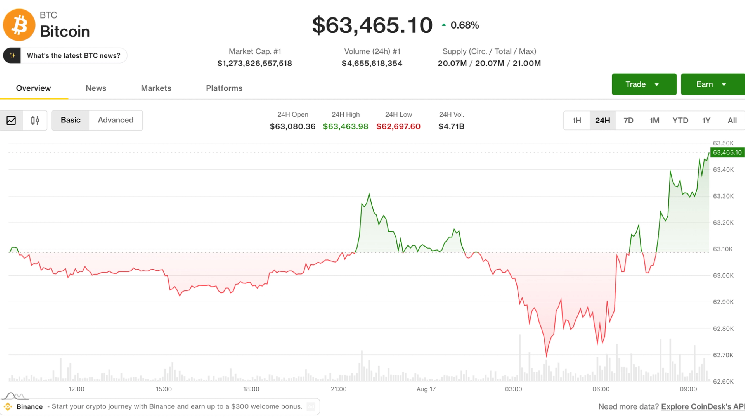
    Bitcoin crossed $64,000 in Asian morning hours Monday, up half a percent on the day but down almost 3% over the week, as a softer dollar and fading rate-hike bets failed to lift crypto out of its recent range.

    Hyperliquid’s HYPE was the standout, up over 3% to $59 and almost 9% on the week, the only major with a meaningful weekly gain. Ether rose over 1% to just under $1,900 but is down 1% over seven days.

    Dogecoin added almost 1% to 7 cents, tron under half a percent to just over 33 cents and $XRP marginally to $1, though $XRP is down 3% on the week. Solana edged up to just over $75 and is down almost 2% over seven days. BNB slipped marginally to just over $604 and was flat on the week.

    The macro backdrop turned friendlier without moving crypto. A Bloomberg gauge of the dollar slipped 0.1% toward a third straight decline and levels last seen in May, while MSCI’s emerging-market currency index hit an intraday record, led by the Taiwanese dollar and Thai baht.

  • XRP traders bet on a rebound as price slips to $1 and bearish chatter surges

    XRP traders bet on a rebound as price slips to $1 and bearish chatter surges

    The scale of the positioning is easier to see measured in tokens. About 2.77 billion $XRP now sits in futures positions, up from closer to 2 billion earlier this summer and nearing the levels last seen when the token was worth several times more.

    The ledger is getting busier too. Nearly 50,000 addresses were active over one 24-hour stretch, the most in more than two months, per Santiment, after activity slid close to its 2026 lows in July.

    An active address is a wallet that sent or received anything during the period. It shows more wallets are using the ledger, but not whether the people behind them are buying, selling or shuffling tokens between their own accounts.

    CoinGlass data shows the long-to-short ratio across all venues at about 0.93 over 24 hours, meaning positioning market-wide is close to balanced. The heavy long bias sits on Binance, OKX and among their bigger accounts.

    Watch what happens if $XRP breaks below $1, as leveraged longs that run out of collateral get closed by the exchange, which could mean selling into the market.

    $XRP trades around $1 in Asia morning hours Monday, with bitcoin topping $64,000.

  • The bitcoin futures market looks like a crowded club with a tiny exit – and it could cause pain

    The bitcoin futures market looks like a crowded club with a tiny exit – and it could cause pain

    Volume, meanwhile, is dead simple as it measures the number of contracts that changed hands during a given period. Think of it as measuring how many times the front door of that exclusive club opened and closed over a given period, regardless of who stayed. It thus represents the degree of churn or liquidity available to manage positions.

    So, the latest case of volume falling far behind OI is like a large club with a tiny exit door. What happens if a large number of people try to rush out?

    Because overall investor positioning is massive, a sudden catalyst could trigger a wave of contract closures, such as forced liquidations due to margin shortages. Without the underlying daily volume to provide liquidity, the market may not be able to absorb the rush smoothly, leading to volatile, exaggerated price swings.

    “The risk is mechanical. When open interest towers over daily volume, liquidations meet little resting flow to absorb them, and adverse moves extend further than they otherwise would. Traders have added substantial risk, most of it long, into a market that shows no matching demand,” blockchain analytics firm Glassnode said in a report.

    The risk of an exaggerated move is particularly likely to the downside because of weakening demand and a lack of resting bids or buy orders at lower price levels.

  • SafePal Data Breach: 39,798 Customers’ Personal Information Exposed, Funds Secure

    SafePal Data Breach: 39,798 Customers’ Personal Information Exposed, Funds Secure

    SafePal, a cryptocurrency wallet provider, has disclosed a data breach that exposed the personal information of approximately 39,798 customers. The company announced the incident via its official X account, stating that names, email addresses, shipping addresses, phone numbers, and purchase histories were compromised. The breach affected customers who placed orders between March 2, 2025, and April 11, 2026.

    What Caused the Breach?

    SafePal attributed the breach to a code flaw in an order-tracking plugin. The company said it has since fixed the vulnerability and completed additional security measures to prevent similar incidents. While the exposed data includes sensitive personal details, SafePal emphasized that wallet systems, seed phrases, and private keys remain securely protected. This distinction is crucial for users concerned about the safety of their crypto assets.

    Implications for Affected Users

    Although the breach did not compromise funds, the exposure of personal information poses significant risks. Cybercriminals could use the stolen data for phishing attacks, identity theft, or social engineering schemes. SafePal urged affected users to remain vigilant against phishing or impersonation attempts. This incident highlights the broader challenges of data security in the cryptocurrency industry, where customer trust is paramount.

    Why This Matters to the Crypto Community

    For crypto users, this breach serves as a reminder that even non-financial data can be a target. The fact that SafePal’s core wallet infrastructure remained secure is reassuring, but the leak of personal details can still lead to targeted scams. Users should be cautious of unsolicited communications that reference their SafePal orders or request sensitive information. This event also underscores the importance of using strong, unique passwords and enabling two-factor authentication across all accounts.

    Conclusion

    SafePal’s data breach is a serious incident that exposed personal information of nearly 40,000 customers. While the company has fixed the vulnerability and assures that funds are safe, affected users must stay alert to phishing risks. This event serves as a critical reminder of the importance of robust security practices in the crypto space. SafePal’s response, including the swift fix and communication, is a positive step, but ongoing vigilance is essential.

    FAQs

    Q1: What data was exposed in the SafePal breach?
    Personal information such as names, email addresses, shipping addresses, phone numbers, and purchase histories of customers who ordered between March 2, 2025, and April 11, 2026, was exposed.

    Q2: Are my crypto funds at risk after the SafePal breach?
    No, SafePal has confirmed that wallet systems, seed phrases, and private keys remain securely protected. The breach only affected personal information, not financial assets.

    Q3: What should I do if I was affected by the SafePal data breach?
    Stay alert for phishing or impersonation attempts. Do not click on suspicious links or provide personal information in response to unsolicited messages. Consider changing your passwords and enabling two-factor authentication for added security.

  • Cardano sets Dijkstra hard fork roadmap: code completion by Q4 2026, Peras finality in 2027

    Cardano sets Dijkstra hard fork roadmap: code completion by Q4 2026, Peras finality in 2027

    Cardano ($ADA), the layer-one blockchain, has officially released a phased roadmap for its upcoming ‘Dijkstra’ hard fork era, outlining key technical milestones and tentative timelines. The roadmap, published through the project’s official channels, sets a target for completing code development by the fourth quarter of 2026, followed by a mainnet upgrade preparation phase. This first phase includes an upgrade to protocol version 12 and the introduction of related features designed to enhance the network’s capabilities.

    Understanding the Dijkstra Era and its technical phases

    The Dijkstra era is named after the renowned computer scientist Edsger Dijkstra, reflecting Cardano’s focus on rigorous, research-driven development. The roadmap divides the upgrade into two main phases. The first phase concentrates on foundational code completion and protocol upgrades, aiming to have all necessary components ready for a mainnet launch by the end of 2026. However, the actual deployment will depend on approval through Cardano’s on-chain governance mechanism, a key feature of the network’s decentralized decision-making process.

    The second phase, targeted for the second quarter of 2027, involves the activation of Ouroboros Peras through an internal hard fork. Ouroboros Peras is a consensus protocol enhancement designed to significantly increase transaction finality speed, a critical factor for scalability and user experience. This phase builds on the groundwork laid in the first phase, integrating the new consensus mechanism into the live network.

    Implications for $ADA and the broader blockchain ecosystem

    This roadmap is significant for Cardano stakeholders and the wider blockchain industry. The Dijkstra upgrade represents a substantial technical evolution, aiming to address long-standing challenges such as transaction speed and finality. For developers and projects building on Cardano, the upgrade promises improved performance and a more robust infrastructure. The emphasis on on-chain governance also underscores Cardano’s commitment to community-driven development, ensuring that major network changes are transparent and democratically approved.

    For the broader market, Cardano’s progress is a notable indicator of ongoing innovation in the layer-one space. While other blockchains pursue different scaling solutions, Cardano’s methodical, peer-reviewed approach continues to differentiate it. The timeline, extending into 2027, suggests a long-term vision rather than a rushed deployment, which may appeal to investors and enterprises looking for stability and thoroughness.

    Why this roadmap matters to $ADA holders and developers

    For $ADA holders, the roadmap provides clarity on the network’s future direction, potentially influencing sentiment and long-term value perception. The successful implementation of Ouroboros Peras could enhance Cardano’s competitive position by offering faster finality, a feature increasingly important for DeFi and other time-sensitive applications. Developers, meanwhile, can begin planning for the protocol version 12 upgrade, ensuring their applications remain compatible and leverage new features.

    It is crucial to note that the announced dates are targets for code completion and readiness, not guaranteed deployment dates. The actual mainnet activation will require governance approval, which introduces a layer of community oversight and potential timeline adjustments. This governance-first approach is a hallmark of Cardano’s philosophy, but it also means that the roadmap is subject to change based on community consensus and technical readiness.

    Conclusion

    Cardano’s Dijkstra hard fork roadmap outlines a clear, phased path toward enhanced network performance, with code completion targeted for Q4 2026 and Ouroboros Peras activation planned for Q2 2027. The upgrade, subject to on-chain governance, aims to improve transaction finality and protocol capabilities, reinforcing Cardano’s commitment to rigorous, community-driven development. As the timeline unfolds, stakeholders will be watching closely for governance decisions and technical milestones that will shape the network’s future.

    FAQs

    Q1: What is the Dijkstra hard fork?
    The Dijkstra hard fork is a planned upgrade to the Cardano blockchain, named after computer scientist Edsger Dijkstra. It introduces protocol version 12 and the Ouroboros Peras consensus mechanism, aiming to improve transaction finality and overall network performance.

    Q2: When will the Dijkstra upgrade be deployed?
    Code development is targeted for completion by Q4 2026, with mainnet readiness preparation following. The activation of Ouroboros Peras is targeted for Q2 2027. However, actual deployment requires approval through Cardano’s on-chain governance, so dates may shift.

    Q3: How will Ouroboros Peras benefit Cardano users?
    Ouroboros Peras is designed to significantly increase transaction finality speed, meaning transactions are confirmed faster and more securely. This can improve user experience and enable more efficient decentralized applications, particularly in areas like DeFi where speed is critical.


  • Solana adds $378M in tokenized T-bills – Is Ethereum losing ground?

    Solana adds $378M in tokenized T-bills – Is Ethereum losing ground?

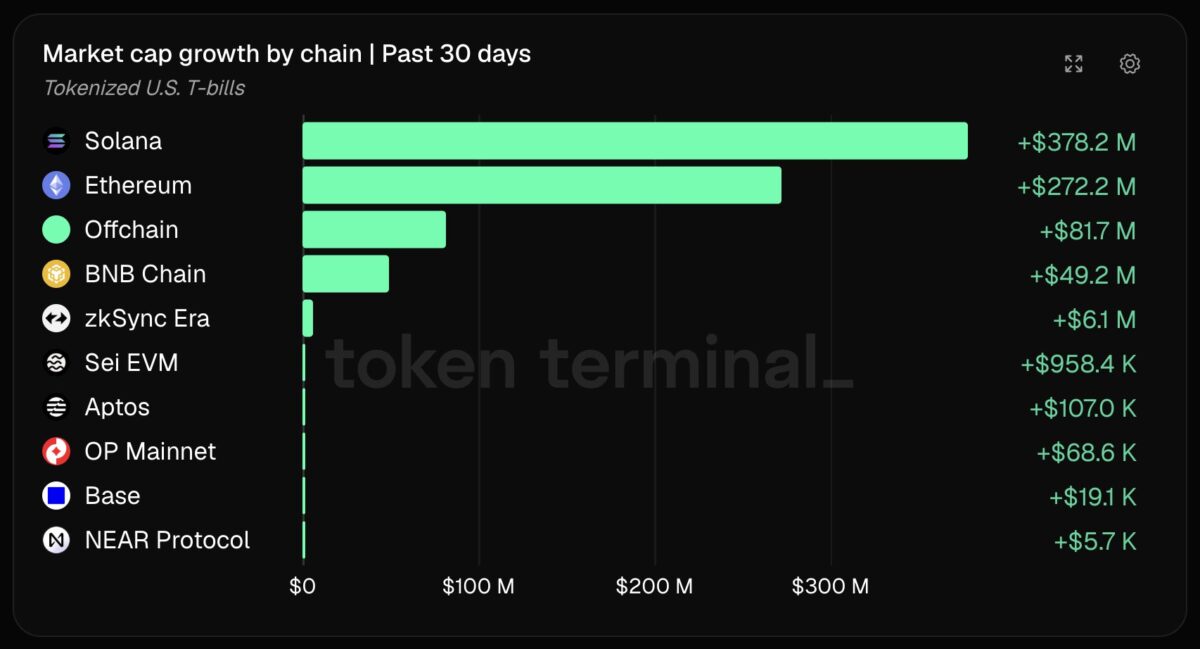
    The latest expansion in tokenized U.S. T-bills shows that new issuance is increasingly spreading across major blockchain ecosystems. Over the last thirty days, Solana [SOL] added $378.2 million, leading Ethereum’s [$ETH] $272.2 million increase by roughly $106 million.

    This suggests that Solana has taken the lead over Ethereum [$ETH] as far as adding new treasury value to its users’ accounts.

    Meanwhile, off-chain holdings expanded by $81.7 million, while $BNB Chain added $49.2 million, extending growth beyond the two leaders.

    Token Terminal

    Smaller increases followed on zkSync Era at $6.1 million, while other networks remained below $1 million.

    Additional treasury products will create multiple paths for users to engage in trading, use as collateral, or integrate into DeFi applications. However, it is clear that current issuances have created a large amount of concentration for this market.

    Therefore, we believe that future growth will be key in identifying whether tokenized Treasuries evolve into a broader multichain market.

    Capital flows into tokenized U.S. T-bills

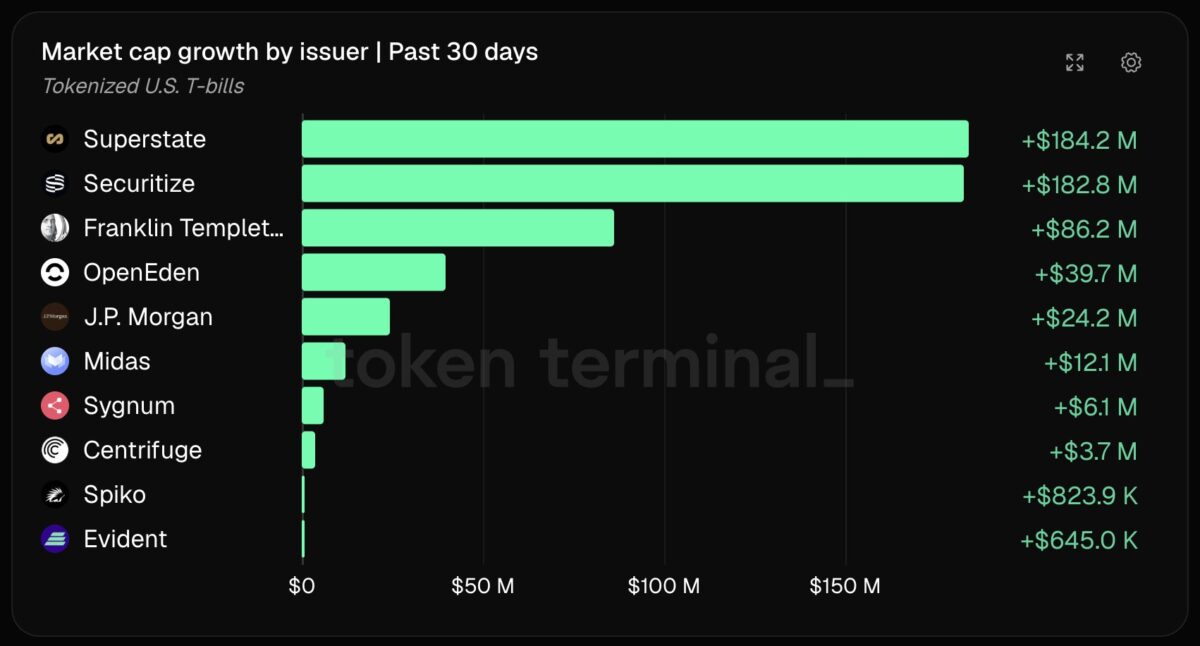
    That expansion across blockchain networks is being supported by fresh issuance from several major tokenized treasury providers. Superstate led 30-day growth with $184.2 million, narrowly ahead of Securitize at $182.8 million.

    Franklin Templeton followed with $86.2 million, bringing their combined increase to $453.2 million. Meanwhile, OpenEden added $39.7 million, while J.P. Morgan contributed another $24.2 million.

    Source: Token Terminal

    More so, this data also indicates that capital is being concentrated in established companies rather than spreading evenly across the market.

    This is as opposed to having a broad distribution across the markets. However, it’s worth noting that other, smaller issuers continue gaining traction, indicating slow but continued diversification of participants within the market.

    Tokenized equities extend beyond issuance

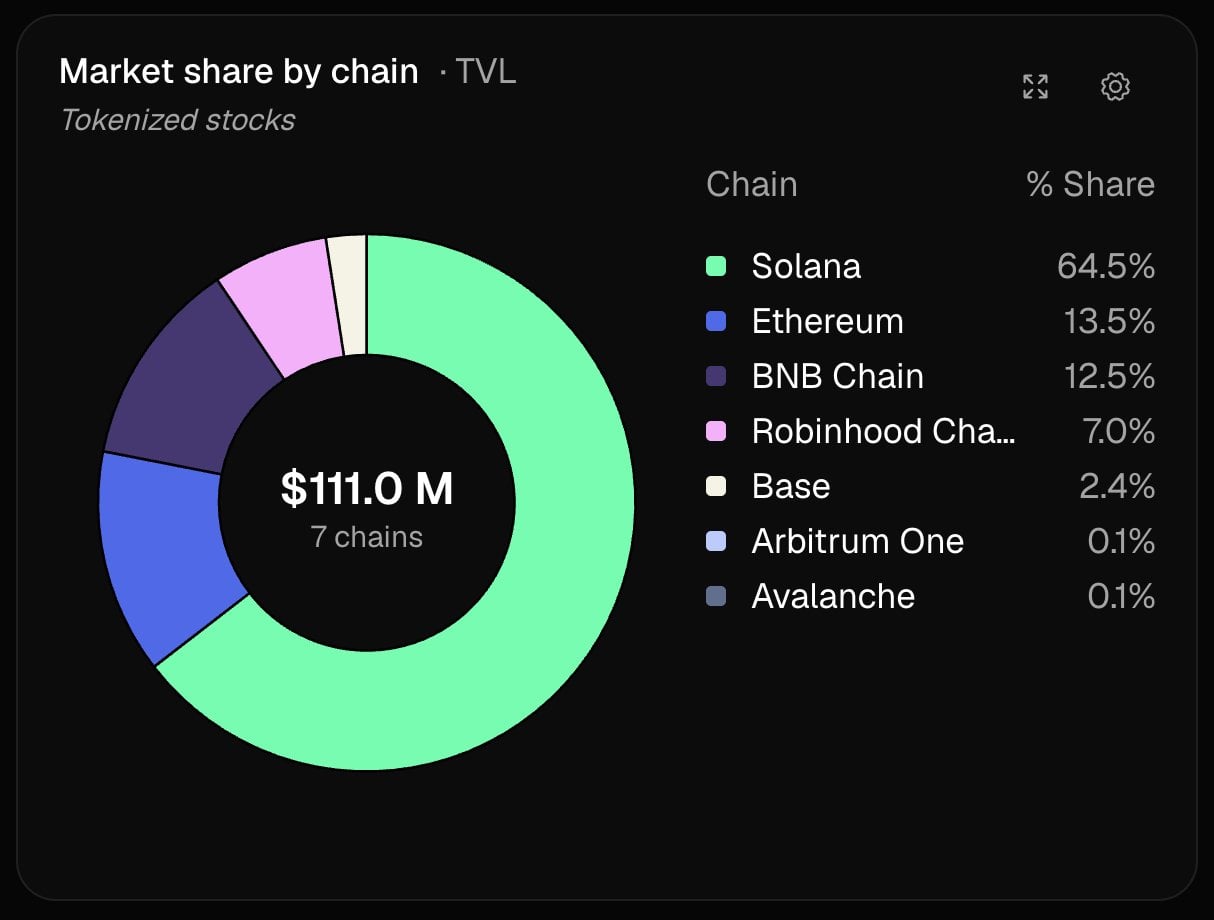
    Continued T-bill issuance shows tokenization adding supply, but tokenized equities reveal whether those assets can gain utility after issuance. Currently, around $111 million in tokenized stocks is deployed across DeFi. This is from a total market near $2.3 to $2.4 billion, according to RWA data.

    Although still a small share, this brings equities into lending, liquidity, and trading rather than leaving them idle. Solana leads with $71.6 million, accounting for roughly 64–65% of deployed value according to Token Terminal data. Ethereum follows at $15 million, ahead of $BNB Chain at $13.9 million.

    Source: Token Terminal

    This concentration also carries into trading, with Solana recording $5.8 billion in spot DEX volume. Looking forward, rising DeFi balances would show whether tokenization is progressing from issuance toward sustained on-chain use.


    Final Summary

    • Solana led tokenized T-bill growth as major issuers drove most new supply across chains.
    • Tokenized equities are moving beyond issuance, with $111 million already deployed across DeFi markets.