Tag: CRYPTOS FoxBusiness

  • Binance Ends Transactions With 16 Platforms, Warns of Wallet Reviews

    Binance Ends Transactions With 16 Platforms, Warns of Wallet Reviews

    Binance Sets Three Deadlines for Transaction Restrictions

    Transactions involving 16 crypto-asset service providers will no longer be processed through Binance under restrictions announced Aug. 14. The exchange instructed users not to send funds to, receive assets from, or otherwise engage directly or indirectly with the named entities after their respective effective dates.

    Restrictions took effect Aug. 7 for Shelbit, operated by Shelbit General Trading LLC, and Aban Tether Exchange. Binance applied a second deadline on Aug. 13 to A7 Nigeria, A7 Africa and Pilotfinance Ltd., followed by an Aug. 23 cutoff covering 11 more platforms, including HTX, EXMO, Rapira, Aifory Pro, ABCeX, and WhiteBird.

    The remaining Aug. 23 entities are Noonecrypto Inc., Tradex, Monease Ltd., Bitpapa and Exnode, including Exnode Pay. Binance cautioned:

    “Any transactions attempted on or after these dates, may be held and subject to a compliance review. Restrictions may be applied to the impacted wallet(s) while the review is ongoing and such activity may also constitute a breach of Binance Terms of Use.”

    Sanctions Target Iranian and Russian Crypto Networks

    U.S. authorities imposed sanctions on Shelbit and Aban Tether through an Office of Foreign Assets Control (OFAC) action on Aug. 7. The Treasury Department alleged that Shelbit addresses exchanged more than $3 million with Islamic Revolutionary Guard Corps addresses, while Aban Tether processed transactions involving previously designated Iranian exchanges.

    Earlier enforcement against Nobitex, Wallex, Bitpin and Ramzinex increased screening requirements surrounding Iranian exchange exposure. The June 2 sanctions action involving four Iranian platforms covered businesses that OFAC later identified among Aban Tether’s transaction counterparties, connecting the August restrictions to a broader campaign targeting Iran-linked digital asset flows.

    U.K. authorities separately targeted cryptocurrency exchanges and the Kremlin-backed A7 network through 18 sanctions designations announced May 26. Officials alleged that A7 supported sanctions evasion, military procurement and oil-related payments, while the network claimed it moved more than $90 billion during the previous year.

    The U.K. package included several entities appearing on Binance’s list, such as EXMO Exchange Ltd., Rapira Group LLC, Sooty Ltd., Bitpapa, Nueva Cryptologia and Huobi Global. The sanctions also reached exchanges and payment providers associated with Russia-facing settlement routes, stablecoin infrastructure and cross-border liquidity channels.

    A7 Expands Alternative Payments as Compliance Pressure Rises

    A7 has promoted alternative cross-border settlement systems as Western governments tighten access to established financial channels. A7 says it serves more than 10,000 trade partners and intermediates nearly one-fifth of Russia’s international settlements market. Its A7A5 ruble-backed stablecoin has reportedly surpassed $100 billion in aggregate transaction volume.

    Binance has expanded compliance operations while responding to scrutiny over transactions involving restricted parties. The company previously reported a 96.8% decline in sanctions-related transaction exposure between January 2024 and July 2025. Its compliance operation includes more than 1,500 workers, representing about 25% of its global workforce.

    Users remain responsible for confirming the destination, network, and counterparty before initiating an irreversible blockchain transfer. A small test transaction can expose address or network errors, although it would not eliminate the compliance risks associated with transferring assets to a restricted platform or wallet connected to one.

    Centralized exchanges retain custody over customer assets and can delay, review, or prevent withdrawals under applicable rules. A self-custodial wallet gives its owner control of the private keys, but it does not remove sanctions obligations or protect users who transact with restricted counterparties. Binance’s final group of platform restrictions takes effect Aug. 23.

  • Why the world’s second-largest Bitcoin mining power is shutting down rigs in its capital city

    Why the world’s second-largest Bitcoin mining power is shutting down rigs in its capital city

    Crypto mining was banned in Moscow, the surrounding Moscow Region and parts of Kursk, with the restrictions set to run through Dec. 31, 2032.

    The measure, established under government decree No. 936, also prohibits participation in crypto mining pools. The decree was signed on July 25 and published on July 31, local media reports.

    Russia as a whole accounted for an estimated 175 exahashes per second, or 16.4% of Bitcoin’s global computing power, in the first quarter, according to Luxor’s Hashrate Index. That placed it second behind the U.S., although it’s unclear what capacity was located in the newly restricted region.

    The country’s Energy Ministry said a year-round restriction was needed to reduce the risk of power-capacity shortages as energy-intensive mining facilities connect to regional grids. Mining currently consumes roughly 1 gigawatt in the Moscow power system, while the region’s target=”_blank” rel=”noopener noreferrer”>Interfax reported after the decree was first signed.

    Mining is also linked to the country’s Western sanctions.

    Russian companies had been using domestically mined bitcoin in international payments after legal changes designed to counter Western restrictions, Finance Minister Anton Siluanov said in December 2024.

  • Robot maker Unitree is going public. Hyperliquid traders see 4x upside from IPO price

    Robot maker Unitree is going public. Hyperliquid traders see 4x upside from IPO price

    Crypto traders are betting that Unitree Robotics will be worth more than four times its IPO valuation when the Chinese robot maker debuts on the public markets.

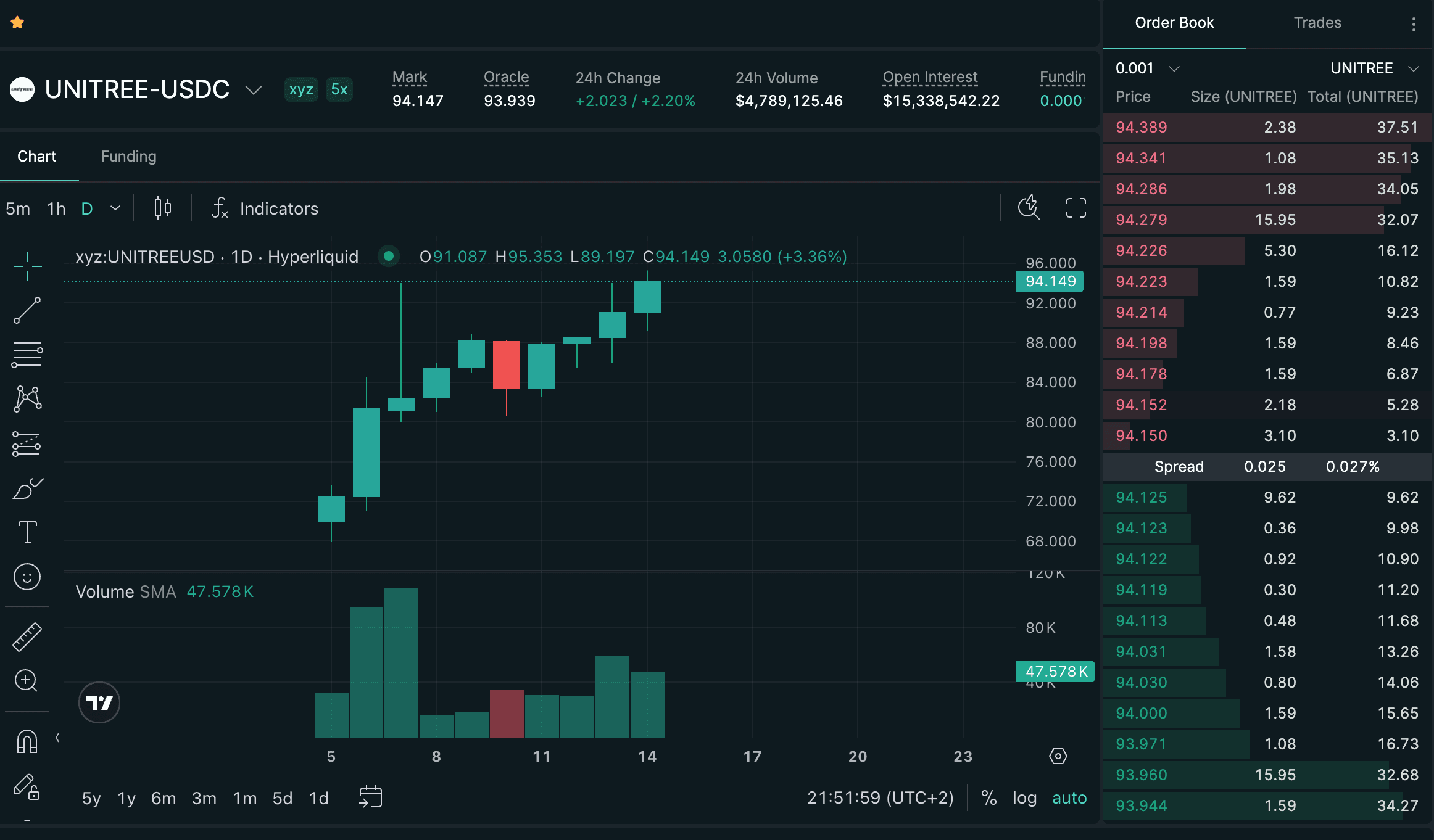
    Unitree priced its Shanghai STAR Market offering at 150.80 yuan ($22.37) per share, valuing the company at roughly $9 billion. Pre-IPO perpetual contracts trading through Hyperliquid, however, were between $92 and $94 on Friday, equivalent to a valuation of about $38 billion, blockchain analytics firm Allium said in a report.

    The premium reflects lofty expectations for one of China’s closely watched robotics companies. Founded in Hangzhou in 2016, Unitree makes four-legged and humanoid robots for research, industrial and consumer applications. Revenue reached $253 million last year, up 335%, while humanoid robot shipments topped 5,500, according to Allium’s report.

    The firm’s IPO was reportedly 8000 times oversubscribed by retail traders, with trading expected to begin between Aug. 17 and Aug. 21.

    Unitree pre-IPO market on Hyperliquid

    Pre-IPO perps

    Unitree’s public-market debut is also shaping up to be the latest in a corner of crypto derivatives that has recently expanded rapidly: pre-IPO perpetual futures.

  • Swiss mega-bank UBS ramps up its Bitcoin exposure with a massive 24-fold surge in ETF call options

    Swiss mega-bank UBS ramps up its Bitcoin exposure with a massive 24-fold surge in ETF call options

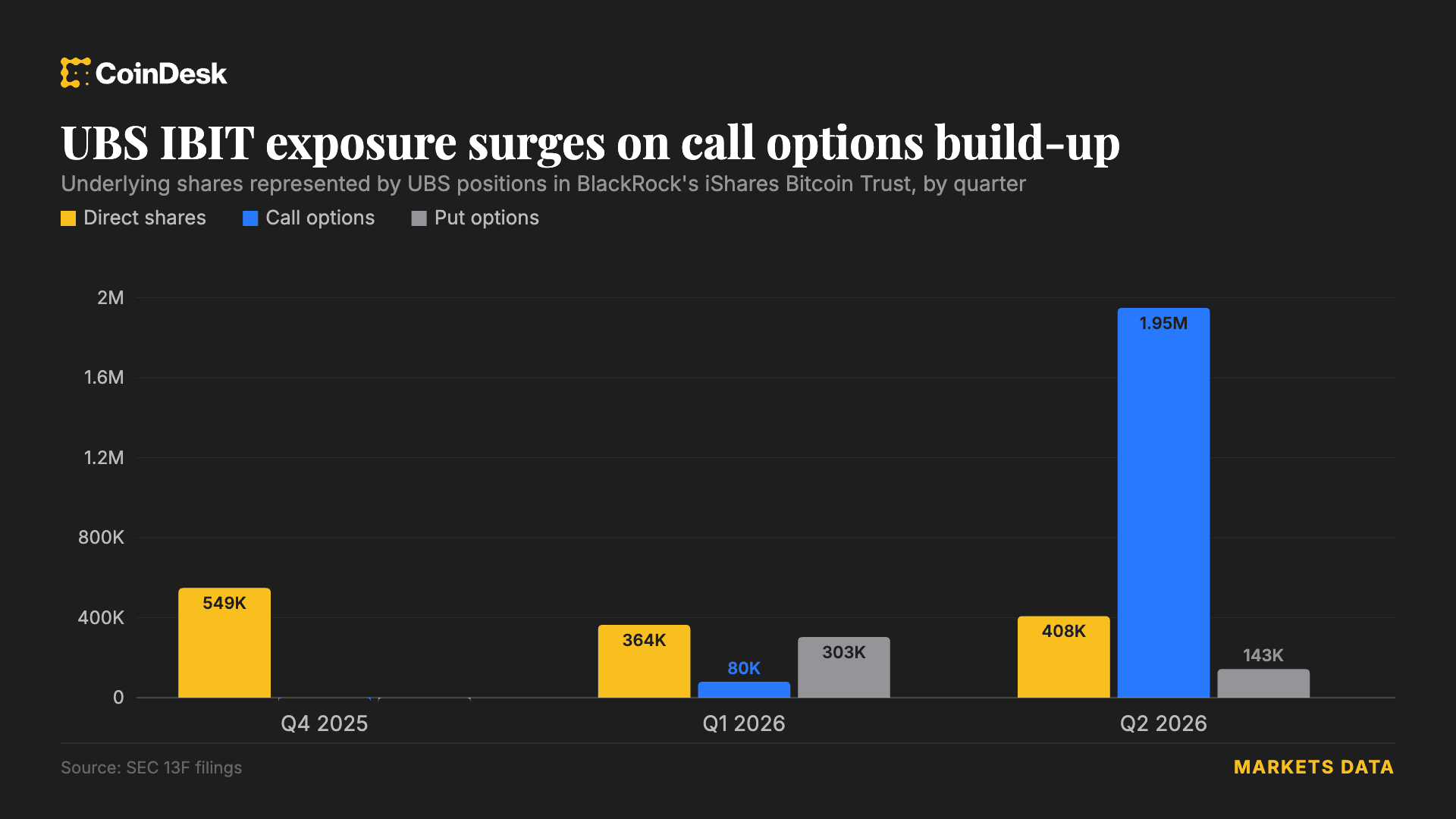
    Banking giant UBS, with over $7 trillion in assets under management, has reported a more than 24-fold quarterly increase in call option exposure tied to BlackRock’s iShares Bitcoin Trust (IBIT) in the second quarter.

    That increase, which gives it the right to acquire IBIT shares at a later date at a set price, came as its outright IBIT holdings rose about 12%, according to a regulatory filing this week.

    The Swiss banking group reported calls representing 1.95 million underlying IBIT shares as of June 30, up from 80,000 three months earlier. UBS separately held 407,890 IBIT shares worth about $13.6 million, compared with 364,371 shares at the end of the first quarter, according to its Q1 filing.

    Put option exposure, giving UBS the right but not the obligation to sell IBIT at a set date and price, moved in the opposite direction. UBS reported puts representing 143,300 underlying shares, down about 53% from 303,300 at the end of March.

    Its direct IBIT position also remained below the 548,614 shares reported at the end of 2025, according to its fourth-quarter filing.

    UBS 13-filing for IBIT. (CoinDesk)

    The disclosure also does not include strike prices or expirations, making it difficult to determine UBS’s net directional exposure from the filing alone.

  • Strategy: Index Providers Should Measure Markets, Not Dictate Corporate Assets

    Strategy: Index Providers Should Measure Markets, Not Dictate Corporate Assets

    For a company that runs a corporate treasury around bitcoin, the most important gatekeeper is no longer a bank or a securities regulator. It may be the committee that decides which public companies belong in benchmarks watched by trillions of dollars in passive capital. Strategy, the bitcoin treasury company, is now pressing that point in public: index providers should reflect markets, not police corporate balance sheets.

    According to the CoinDesk report, Strategy said index providers should measure markets rather than determine which assets public companies are allowed to own.

    The statement speaks to a structural tension that gets little attention in ordinary market coverage. MSCI and other index creators have become de facto regulators of corporate behavior. Inclusion decisions shape passive fund flows, cheap index-tracking capital, and sometimes access to certain investor bases. When that power extends into what a company can keep on its balance sheet, the index provider stops being a neutral yardstick and starts making allocative choices.

    The Benchmark Gatekeeper Problem

    Benchmark methodology is usually framed as a technical exercise. Sector classifications, liquidity screens, and investability rules determine whether a stock enters a major index. For corporate treasuries holding bitcoin, that framing creates a practical risk. A company could meet every conventional test but still face scrutiny because a committee views treasury assets as outside the normal course of a public company’s business.

    Strategy’s position is that this is backwards. The company has made bitcoin the central reserve asset on its balance sheet, a model that some investors treat as a leveraged bitcoin proxy and others view as a structural anomaly. From Strategy’s perspective, the market should price that choice. Index providers should then measure the resulting company, not validate or reject the treasury strategy.

    The distinction matters because passive investment has grown enough to make index inclusion a funding channel. When a decision about eligibility changes, it can alter demand for that stock before the company changes anything about its operations. That is exactly the kind of market impact that normally belongs to investors, not to a committee publishing a rulebook.

    The specific asset class matters less than the broader principle. If an index provider can label certain treasury holdings as disqualifying, it creates two classes of public companies: those whose assets are considered ordinary and those whose assets require special permission. That is a strange role for a company whose main product is a ranking system.

    Why This Flares Up Now

    The pushback arrives while institutional exposure to crypto has been migrating from private funds into more visible public markets. Tokenized real-world assets have moved past milestone levels on-chain, and even non-bitcoin sectors have been absorbing institutional flows, as recent tokenization data showed. In that environment, more public companies are likely to hold digital assets directly, making benchmark treatment a live question rather than a hypothetical one.

    There is also a Washington thread. Crypto market structure remains unsettled in the United States, and banking interests are already fighting landmark legislation before a Senate vote. If lawmakers and bank lobbyists are still negotiating what crypto participation looks like, it is not surprising that index providers are being watched as another layer of gatekeeping.

    Institutional demand has also broadened beyond a single asset. Some platforms are pulling in capital through institutional staking and payments integrations, suggesting that corporate and fund-level exposure will keep expanding. The more that expansion reaches public company treasuries, the more index methodology will affect actual issuance and balance sheet decisions.

    The Risk of a Quiet Precedent

    There is no public sign that MSCI has proposed a specific rule against bitcoin treasury companies. The danger is not necessarily an explicit ban, but a slow drift in which methodology language treats certain assets as abnormal, forcing companies to justify their reserves to a committee rather than to their shareholders.

    That drift would be hard to reverse. Benchmark rules are sticky by design. Investors want stable classification systems, but stability can turn into orthodoxy when committees become reluctant to adapt. Strategy’s complaint is essentially that market participants should own that adaptation, not subcontract it to a small group of index researchers.

    What remains uncertain is whether index providers signal any willingness to explicitly exclude or constrain companies with large crypto treasury positions. Without that signal, Strategy’s statement reads as an early warning rather than a response to an announced change. For investors, the key question is whether that warning becomes a broader corporate campaign or remains a single company defending its balance sheet.

  • Former Bybit CEO startup ABFinance cancels launch plans

    Former Bybit CEO startup ABFinance cancels launch plans

    ABFinance, the U.S. finance startup founded by former Bybit co-CEO Helen Liu, has announced that it will begin winding down.

    17 major crypto businesses and about 95 total projects have already closed so far in 2026.

    Why is ABFinance closing down?

    Helen Liu unveiled ABFinance in mid-March, days after Bybit confirmed her exit. Liu was building the platform in the United States with full U.S. licensing in place from day one. The idea behind the product was to create a single platform that would handle deposits, trading, earning, and payments while linking fiat currency to crypto.

    ABFinance announced on August 14, about four months after its initial unveiling, that it will not move forward with its launch and said it is “winding down in an orderly manner” on its X (formerly Twitter) account.

    The company thanked its community, partners, and people who “built” alongside it.

    No specific reason was given for the shutdown, and the company also did not say what would happen to its education program.

    The program, ABF Learn, was ABFinance’s only export, designed for students and people early in their careers to help them understand how banking, AI, and digital assets work together.

    How bad has 2026 been for crypto companies?

    ABFinance is just one of many crypto companies that closed in 2026. By late July, Cryptopolitan counted 17 major crypto ventures that had closed. In total, about 95 projects shut down during the year. Industry experts blame the shutdowns on a long bear market and on the fact that businesses are merging into fewer big platforms.

    Other companies that shut down this year include Bitmart, which said in July that it would close its worldwide operations. The exchange had been running for nine years.

    BitMEX ended its 11-year run around the same time while Bitwise cut about 14% of its staff in August. The company’s main index fund lost a lot of value. Its net assets fell 48.27% to $532.8 million in the first half of the year.

    In May, Syndicate Labs, Everclear and ZERO Network closed within hours of each other.

  • XRP Ledger’s XAO DAO Plans Major Governance Upgrades to Boost Community Participation

    XRP Ledger’s XAO DAO Plans Major Governance Upgrades to Boost Community Participation

    XAO DAO is preparing a series of governance changes for the $XRP Ledger over the next two to three months, according to Fabio Marzella, the organization’s co-founder.

    The planned changes would let members delegate voting power, adjust quorum rules, and access community mini-grants, as the DAO looks to make participation easier and more representative, at a moment when several XRPL projects have already scaled back or shut down.

    XAO DAO Targets Broader Participation

    Marzella said the first change would introduce wallet delegation, allowing members to hand their voting power to others when they lack the time or expertise to vote on individual proposals.

    The DAO is also reviewing its quorum requirements, including how inactive wallets count toward proposal thresholds. The stated aim is to prevent inactive participation from blocking decisions while keeping governance tied to the active community.

    Community mini grants are another planned addition. Under the proposal, members would be able to submit smaller initiatives and seek funding for projects that contribute to the XRPL ecosystem.

    “These aren’t changes for the sake of change,” Marzella wrote. He said the broader goal is to create a DAO where the community has “the ability to act” rather than simply having a vote.

    The timing comes as questions around developer support have grown within the XRPL community. On August 13, Marzella said the shutdown of Gen3’s retail platforms showed that funding developers alone does not solve the problem of building lasting businesses.

    You may also like:

    • Attacker Drains 200K $XRP From Bridge Using Fake Deposit
    • Important Ripple News and $XRP Price Update: August 11
    • Major $XRP Ledger Upgrade Targets Institutional Adoption But There’s a Catch

    Gen3, an XRPL infrastructure team, said on August 12 it would spin down two of its retail products, aigent.run and AxiomProtocol, citing weak user demand and rising infrastructure costs. Gen3 said the platforms will stay live for another month, until September 13, so users can withdraw remaining funds, and that it will keep running its core XRPL infrastructure and take part in the ledger’s amendment process.

    Marzella pointed to the Gen3 news as evidence of a bigger problem, arguing that funding developers only solves half the issue if there’s no path from a funded project to a sustainable business. Builder Handy Andy, replying in the same thread, described colleagues quietly calculating how much longer they can keep funding their own work without support, calling it “the last roll of the dice” for some.

    Activity Is Up

    The reshuffle comes as $XRP closed near a 21-month low this week, and Santiment data shows daily active addresses averaging 35,700 in August, up from 26,400 in July, even though the number of new wallets has stayed almost flat.

    That distinction may matter for XAO DAO’s participation plans. More activity among existing users does not automatically mean a larger pool of people taking part in governance.

    As it stands, Marzella has not provided a final timetable or detailed voting mechanics for the proposed changes, instead promising that more information will follow as each initiative progresses, leaving the community to see how delegation, quorum changes and mini grants are eventually implemented.

  • HBAR price breaks $0.065 support — Is a 35% drop to $0.042 next?

    HBAR price breaks $0.065 support — Is a 35% drop to $0.042 next?

    The Hedera [$HBAR] token price has slipped below a local low at $0.065 and continued its bearish descent. Throughout 2026, the token has only seen a bearish side to its price action.

    Bounces, such as the 34.2% move toward the end of May, were quickly sold off. It appeared likely that the price would plunge another 35% in the coming weeks.

    In other news, Hedera highlighted the Web3 platform Kabila built for content creators, natively on Hedera. This will help target a problem in Web3, which is creators generating value while platforms control monetization.

    The long-term $HBAR price woes

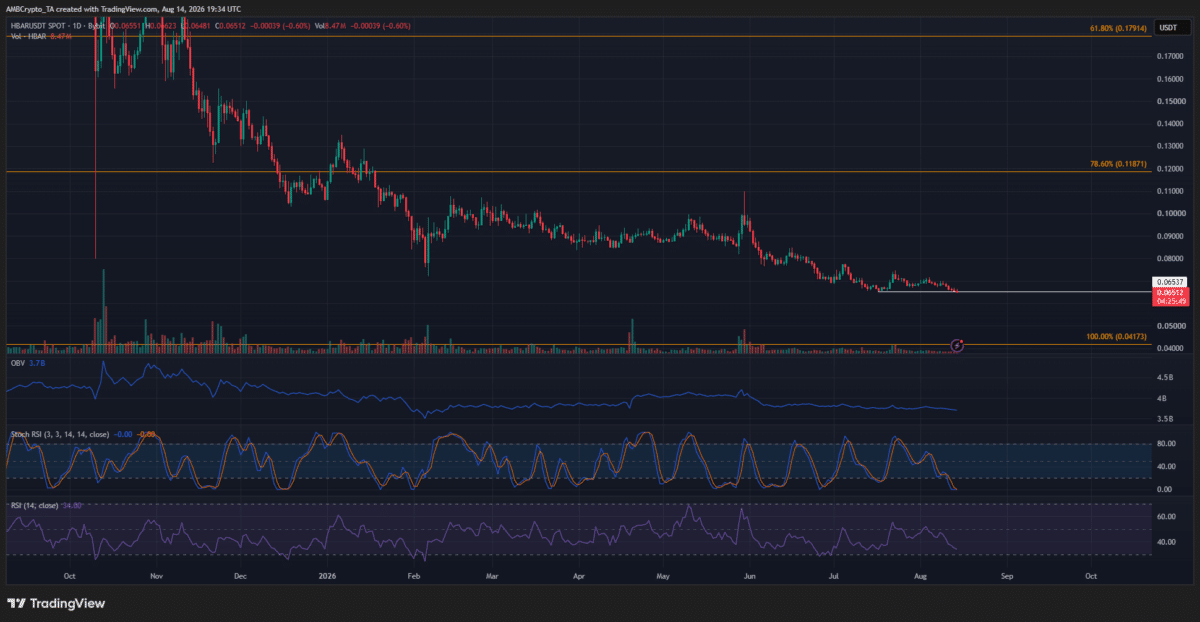
    Interestingly, the Hedera token had rallied from $0.0417 to $0.4015 in November 2024 to January 2025. It has been retracing the move since then and has fallen below the 78.6% retracement level of this bullish move.

    This meant that, despite the persistent 18 months of bearish price action, the $HBAR long-term bias was bullish.

    That would be little solace to underwater investors and swing traders, though. As things stand, they can maintain a bearish bias for the coming weeks.

    Source: $HBAR/USDT on TradingView

    The price has slipped below the July low at $0.0653. The Stochastic RSI was in the bearish depths even on the daily timeframe, and the RSI was well below neutral 50. The RSI has been below neutral 50 for the majority of 2026, highlighting persistent downward momentum.

    The OBV was also in a slow decline, showing sellers have the upper hand.

    Seller dominance is evident on the price charts, too. As the daily timeframe highlighted, the $0.118 level, the 78.6% Fibonacci retracement on the HTF, was ceded very early in the year.

    Hence, a 35% move down to the $0.0417 area can be anticipated.

    Traders’ call to action- Sell

    The $HBAR price has slipped below July’s low, and further drawdown is likely, the technical indicators showed.

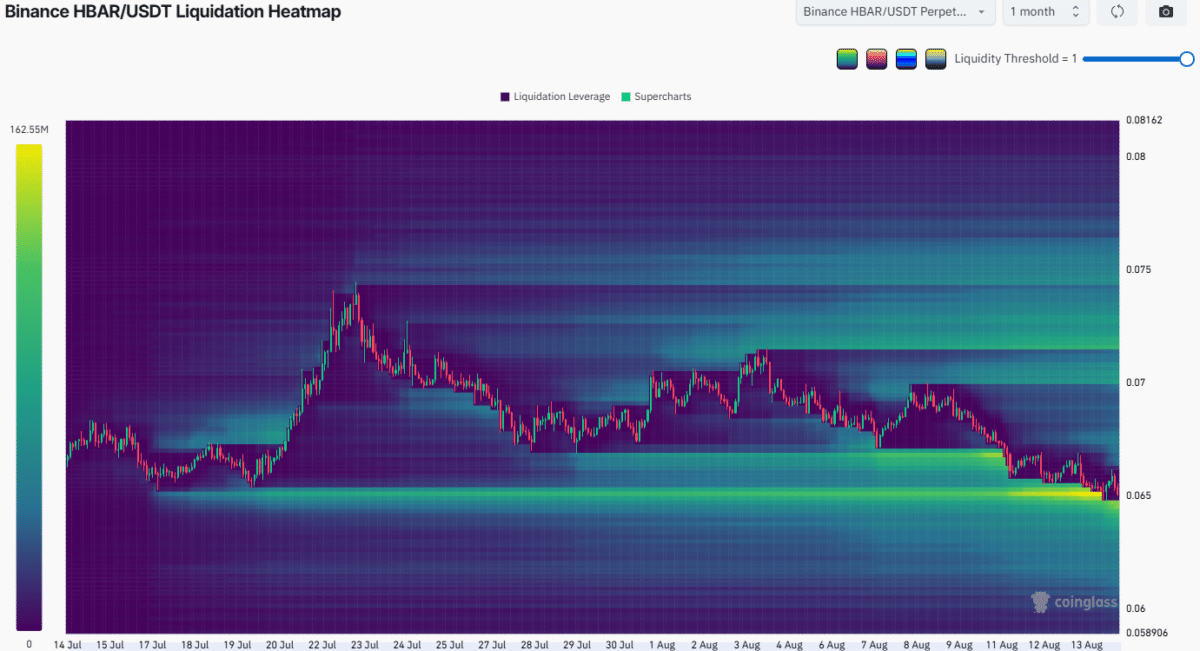
    Source: CoinGlass

    The 1-month liquidation map showed that the cluster of long liquidations around $0.065 has been hunted down for the most part. This can set up a potential price bounce toward a magnetic zone to the north.

    In this case, the $0.070-$0.073 area would be a target in case of a bounce.

    Yet, from a $HBAR price action perspective, the $0.0665-$0.0685 area represented a challenging supply zone. A bounce to either of these two regions would represent a selling opportunity.


    Final Summary

    • The $HBAR price action has been bearish throughout 2026.
    • The recent drop below the July swing low meant that a 35% slide can be expected in the coming weeks and months.

  • Germany’s Crypto Holding Period: Two Tax Models Are on the Table, and €21,100 Separates Them

    Germany’s Crypto Holding Period: Two Tax Models Are on the Table, and €21,100 Separates Them

    The information provided in this article is for informational purposes only and does not constitute financial advice. Cryptocurrency investments carry a high degree of risk.

    Germany’s one-year rule is the best-known crypto tax rule in Europe: hold a coin for more than twelve months, sell it, owe nothing. Since the German cabinet’s 2027 budget decision, one sentence has appeared in almost every report about its future: crypto gains will be taxed like stock gains. That sentence is wrong twice over, and both errors can be checked against documents anyone can download.

    It is wrong first because, as of 12 August 2026, there is no law and not even a ministry draft on crypto taxation. It is wrong second, and this matters far more, because two entirely different models are circulating. On a €100,000 gain held for more than twelve months, the two models are €21,100 apart. Which one ends up in the statute book is genuinely open, so anyone talking about “the” German reform is talking about nothing in particular.

    Key facts at a glance

    • As of 12 August 2026 there is no law and no ministry draft on crypto taxation. The working draft of Germany’s Annual Tax Act 2026, published on 13 July 2026, contains no crypto provision at all.
    • Two models are in circulation: moving crypto into capital income under section 20 of the Income Tax Act (cabinet decision of 6 July 2026), and keeping it in section 23 but deleting the one-year rule (bill 21/5752 of 5 May 2026).
    • On a €100,000 gain that is €26,375 versus up to €47,475, a difference of €21,100.
    • The bill was rejected in the finance committee on 20 May 2026. Only Die Linke voted for it; the conservatives, the AfD and the Social Democrats voted against.
    • Under that bill, gold, antiques, artworks, historic vehicles and foreign currency keep the one-year rule explicitly. Exactly one asset class is carved out.
    • Revenue estimates range from roughly €300 million to €11.4 billion a year. That is a factor of 38.

    How the German rule works today

    Under section 23 of the German Income Tax Act, crypto assets count as “other economic goods”. A private sale is taxable only if fewer than twelve months passed between purchase and disposal. Sell earlier and the gain is added to your ordinary income at rates up to 45% plus the solidarity surcharge. Sell later and the gain is not taxed at all.

    One detail matters for the debate that follows: this is not a preferential crypto regime that someone invented for Bitcoin. It is the general rule for privately held assets such as physical gold or a classic car, and Germany’s Federal Fiscal Court confirmed in February 2023 that crypto falls under it (case IX R 3/22).

    Nothing about that has changed. Whatever comes next, the documentation burden lands on the taxpayer, which is why acquisition records are the practical bottleneck in every scenario. Tools that produce a German-compliant tax report are listed in our crypto tax software comparison.

    Model 1: capital income under section 20

    This is the finance ministry’s line. Crypto would be lifted out of private disposals and treated like interest, dividends and stock gains, at the flat withholding rate of 25% plus the 5.5% solidarity surcharge on that tax, giving 26.375%. Add church tax and the burden lands near 28%, depending on the federal state.

    No legal text exists for this model. Not a draft, not a paragraph. Everything written about it rests on a budget document and on the finance minister’s public statements. That leaves open exactly the questions that decide the real burden: whether the €1,000 saver’s allowance would apply, how losses could be offset, and whether crypto exchanges would become paying agents that withhold tax at source.

    Model 2: staying in section 23, without the deadline

    This model has one advantage over the first: it exists as finished statutory language. The bill from the Green parliamentary group carries the number 21/5752, is dated 5 May 2026, and is titled, in translation, a bill “to close a fairness gap in the taxation of crypto assets”.

    Article 1 number 1 inserts a new sentence into section 23:

    “The one-year deadline in sentence 1 does not apply to disposals of crypto assets.”

    Crypto would remain an “other economic good”. The explanatory memorandum states the consequence plainly: gains would be taxed “regardless of the holding period, on disposal, at the personal income tax rate”. Depending on other income, that is up to 45% plus the solidarity surcharge.

    The bill was rejected in the finance committee on 20 May 2026. Only Die Linke supported it. The Social Democrats, who share the goal, voted against it because they wanted to wait for their own finance minister’s proposal. That makes the text dead as a vehicle but very much alive as a blueprint: it is the only fully drafted statutory language anyone has produced on this question.

    The comparison: €21,100 on the same gain

    The following assumes a sale with a €100,000 gain after more than twelve months, no church tax, and no other private disposals in the same year.

    The gap between the ministry’s model and the drafted bill at the top rate is therefore €21,100 on an identical gain.

    One detail almost every summary omits: the solidarity surcharge behaves differently in the two models. On the flat withholding tax it is levied without any threshold. On assessed income tax it only kicks in above a threshold that most taxpayers no longer cross. At the 42% and 45% marginal rates assumed above the threshold is comfortably exceeded, so the surcharge applies. On smaller gains and lower other income the arithmetic changes, which is precisely why the blanket claim “crypto is about to get more expensive” is worth so little.

    Three ways the bill is worse than stock taxation, not equal to it

    The rate. Stock gains face 25% plus surcharge. The bill applies personal rates up to 45% plus surcharge. That is not parity; it is a penalty of up to 21.1 percentage points.

    Loss offsetting. Losses from private disposals under section 23 may only be netted against gains from other private disposals. They sit in their own narrow bucket and cannot be set against interest or dividends. Under the section 20 model, crypto losses would join the much wider capital-income bucket.

    Withholding. Section 23 has no withholding mechanism by design. Every single disposal has to be declared, with acquisition date, cost basis and proceeds. The section 20 model could in principle withhold at source, but only through a domestic paying agent. How that would work for exchanges based elsewhere in the EU appears in neither document.

    Gold, art and classic cars keep the one-year rule

    The most revealing passage of the bill is not in the statutory text but in the reasoning, where the drafters explain why singling out crypto is justified:

    “The provision is appropriate because other economic goods such as physical gold, antiques, artworks, historic vehicles or foreign currencies are used for speculative gains to a considerably lesser extent.”

    So the bill does not clean up the system. It removes one asset class and justifies that with an assumption about how investors behave. That is where the constitutional exposure sits: Germany’s Article 3 equality clause requires an objective reason for unequal treatment, and whether a behavioural assumption qualifies would be for the courts to decide. The same section states that crypto assets have “not proven themselves as a digital equivalent to gold and other precious metals”.

    The reasoning also contains a claim that does not survive checking. It says Germany is “almost the only country within the European Union” that exempts gains after a short holding period. Portugal exempts after 365 days and taxes shorter holdings at 28%. Czechia has exempted disposals after three years since the 2025 tax year. Luxembourg applies a six-month speculative period. Holding-period exemptions are not the German anomaly the bill describes.

    The cut-off date is already in the past

    The bill’s application clause turns solely on when an asset was acquired. The new rules would first apply to disposals of assets “acquired or created after 31 December 2025”.

    The bill is dated 5 May 2026. The cut-off was therefore more than four months in the past when the text was introduced, and the reasoning says so openly: the new rules apply to crypto acquired from 1 January 2026, because for those assets “the one-year holding period existing until the law enters into force has not yet expired”. The drafters lean on a 2010 ruling of the Federal Constitutional Court, which held that the “mere possibility of collecting gains tax-free at a later date” creates no legally protected position.

    There is also a gap the bill simply does not address. Under the finance ministry’s circular of 6 March 2025, holding periods for identical crypto assets are determined asset by asset where possible and otherwise first-in-first-out, wallet by wallet. The bill writes that consumption order into law only for foreign currency amounts, not for crypto. With an acquisition-based cut-off, the protected older holdings would in case of doubt be consumed first. How that interacts with the political promises of grandfathering is a story of its own, and we will take it apart separately.

    The reform paradox: day traders would pay less

    The argument that turns the debate on its head comes from the conservative side. On 31 July 2026, CDU member of parliament Olav Gutting spelled out what the ministry’s model does to short-term sellers: today, someone selling inside the one-year window pays their personal rate of up to 45%. Under the section 20 model it would be a flat 25% plus surcharge.

    The reform would therefore relieve the high-earning day trader and burden the long-term holder who could previously sell tax-free after twelve months. That is the opposite of the stated intention, and it holds whatever you think of the holding period itself.

    Nobody knows what this raises: estimates differ by a factor of 38

    The distance between the lowest and the highest figure is a factor of 38. That is no longer estimation uncertainty; it means nobody knows the order of magnitude.

    Two qualifications, both important. The Austrian figure first: the Austrian finance ministry reports around €33.84 million of capital gains tax from crypto for 2024, and that is the total collected since service providers began withholding on 1 January 2024. It is not the isolated yield of Austria’s 2022 abolition of its holding period, so it functions as a ceiling on that yield rather than a measurement of it. Scaled to Germany by population it gives the €300 million above, and that stays a ceiling too. Austria also shows what grandfathering looks like in practice, because holdings bought before March 2021 stayed outside the new regime, as we set out in our piece on Austrian pre-2021 holdings.

    Second, the €11.4 billion. On 15 March 2026 the Bitcoin Bundesverband published an open letter with 15 questions about the €11.4 billion estimate, addressed to Blockpit and to the study’s author Co-Pierre Georg, covering data provenance, sample representativeness, extrapolation method and the absence of error margins. Its core line: the greater the political impact of a number, the higher the standard of transparency it has to meet. To our knowledge the questions remain unanswered.

    The path that number travelled is instructive. In the finance committee session of 20 May 2026 the Greens cited the study and its €11.4 billion, then halved the amount in their own calculation and wrote “at least about €5 billion” into the bill. The bill gives no reason for the halving.

    Why this is not only a German story

    Two threads reach beyond Germany. The bill’s own reasoning points to the European Parliament’s proposal for the 2028 to 2034 budget framework, which includes a levy based on a uniform rate on capital gains from crypto assets as a possible new EU own resource. Germany’s domestic argument is being made with one eye on Brussels.

    The second thread is data. Under DAC8, centralised crypto service providers in the EU have been collecting reportable information since 1 January 2026, with the first exchange of data scheduled for September 2027, as we set out in our piece on automatic crypto tax reporting in Germany. Whatever rate a country lands on, the visibility question is already settled, and self-custodied holdings sit outside that reporting net rather than outside the tax law.

    What this means in practice

    None of this produces an instruction, and anyone handing you one knows the statutory text no better than everyone else does. Three sober points remain.

    Acquisition records are the bottleneck in every scenario. If the deadline survives, they prove the exemption. If it goes, they establish the gain. If grandfathering arrives, the acquisition date decides the treatment of every single lot. Export the transaction histories from your trading venues while the accounts are open and store them off the platform; Germany’s filing deadlines do not wait for the political process, as our note on the German crypto tax deadline showed. The tax-report capabilities of each venue are listed in our exchange comparison, and holdings on a hardware wallet need their address mapping documented by you.

    Selling as a precaution is a bet on an unknown rule. Selling today to get ahead of a cut-off date nobody has defined can trigger a tax that holding would never have caused. That is an observation, not a recommendation in the other direction.

    Watch the wording, not the headline. The two models differ on rate, on loss offsetting, on withholding and on the cut-off date. Any report that does not say which model it is describing is not telling you what you need to know.

    Our managing director Dennis Weidner has worked through the primary documents, the arithmetic and the European comparison in his statement on the crypto holding period and the finance committee’s reply. Individual tax questions belong with a qualified tax adviser; this article does not replace one.

    FAQ

    Has Germany abolished the crypto holding period? No. As of 12 August 2026, section 23 of the Income Tax Act applies unchanged: after more than twelve months of holding, the gain is untaxed. There is no adopted law and no finance ministry draft on crypto taxation. The working draft of the Annual Tax Act 2026 of 13 July 2026 contains nothing on the subject, though a provision could still be added before the cabinet stage or later in the parliamentary process.

    What is the difference between the two models? Under the section 20 model, crypto becomes capital income taxed at a flat 25% plus solidarity surcharge, giving 26.375%. Under the section 23 model it stays an “other economic good” but loses the one-year deadline and is taxed at the personal income tax rate of up to 45% plus surcharge.

    How much tax would €100,000 of gains attract? Today, after twelve months, nothing. Under the section 20 model, €26,375. Under the section 23 model, €44,310 at a 42% marginal rate and €47,475 at the 45% top rate, in each case before church tax.

    Would new rules apply to coins I already hold? The only fully drafted bill, 21/5752, turns on the acquisition date and captures everything acquired after 31 December 2025. No text exists for the ministry’s model. The conservatives have promised protection for existing holdings, while Die Linke explicitly rejects any transition period. The state of that debate is in our piece on petition 201716.

    Does physical gold stay tax-free after a year? Under the Green bill, yes. It removes only crypto assets from the one-year rule and names gold, antiques, artworks, historic vehicles and foreign currencies as goods that keep it.

    Does this affect me if I am not a German tax resident? Generally no; these rules govern German income tax. The reason to follow it anyway is that Germany’s one-year exemption is the reference point other European debates measure themselves against, and the same bill points to an EU-level levy on crypto capital gains as a possible own resource from 2028.

    When could a new rule take effect? 1 January 2027 is the announced date. That would require a ministry draft, an association consultation, three readings in the Bundestag and the federal council to be completed by December 2026. None of those dates is confirmed.


    None of this is settled: the ministry draft is still outstanding, the consultation of associations follows, a first reading is pencilled in for 7 to 11 September and the federal council for 18 December. Each of those steps can change which of the two models applies and which cut-off date sits inside it. We read every new text against the primary sources and summarise weekly what actually changed in the wording, in English and in German. Stay with it on cryptoticker.io.

    Sources

    • German Bundestag: Bill 21/5752, on closing a fairness gap in the taxation of crypto assets (PDF in German, statutory text and reasoning, 5 May 2026)
    • German Bundestag, heute im bundestag: Greens fail with their push on crypto asset taxation (finance committee vote, 20 May 2026)
    • Federal Ministry of Finance: Individual questions on the income tax treatment of certain crypto assets (PDF in German, circular of 6 March 2025, replacing the 10 May 2022 circular)
    • Section 23 of the German Income Tax Act as currently in force
    • Federal Constitutional Court: decision of 7 July 2010, 2 BvL 14/02 and others (paragraph 64, relied on in the bill’s reasoning)
    • Bitcoin Bundesverband: The €11.4 billion question (open letter with 15 questions, 15 March 2026)
    • Dennis Weidner: The crypto holding period and the finance committee’s reply (model comparison, revenue range, holding periods in Europe, 12 August 2026)
    • Austrian Federal Ministry of Finance, capital gains tax collected on cryptocurrencies in 2024 (€33,839,499.66 in total, withholding by service providers since 1 January 2024)

    Note on AI use: AI tools were used for this article – in research and drafting, and for the header image, which is AI-generated and does not depict a real event. All figures, claims and sources are editorially checked before publication.


  • Trump-backed World Liberty wins conditional bank charter from federal regulator

    Trump-backed World Liberty wins conditional bank charter from federal regulator

    A federal bank regulator has granted World Liberty Trust Co. a conditional bank charter, it announced Friday.

    The Office of the Comptroller of the Currency, the U.S. banking agency that grants federal charters, said in a letter posted to its website that World Liberty could operate fiduciary and other trust company-related activities as a national trust bank.

    “This preliminary conditional approval is granted based on a thorough evaluation of all information available to the OCC, including the representations and commitments made in the application and by the Bank’s representatives,” the letter said.

    Final approval won’t be granted until the company meets additional “preopening requirements,” the letter said.

    According to the letter, World Liberty Trust Company will focus on services tied to World Liberty Financial’s $USD1 stablecoin.

    “The bank plans to issue $USD1, a fiat currency-backed stablecoin, to institutional clients on a nationwide basis, assuming this role from BitGo Bank & Trust, National Association (BitGo), the current exclusive issuer and custodian for $USD1,” the letter said. “The bank plans to provide its digital asset custody services as a fiduciary, primarily to $USD1 customers and other institutional clients.”