Tag: CRYPTOS FoxBusiness

  • Wall Street is making it easier for bitcoin whales to ditch self-custody: report

    Wall Street is making it easier for bitcoin whales to ditch self-custody: report

    BlackRock has made it a lot cheaper for bitcoin whales to swap self-custody for shares in its Nasdaq-listed spot $BTC ETF, IBIT, a shift that’s accelerating due to crypto crime, according to a report by Bloomberg.

    The minimum value of bitcoin needed to swap directly into IBIT shares slipped to $1 million in July. It used to be $25 million, the report said, adding that ETF issuer Bitwise has also cut its threshold to $3 million from $100 million.

    The swapping works through a process called “in-kind creation,” where investors hand over their $BTC to the fund and get ETF shares back. This way they don’t need to sell their $BTC and then buy ETF shares, which attracts capital gains tax.

    Such transactions are already booming. IBIT alone has processed more than $5 billion of these swaps, up from $3 billion back in October, according to Robbie Mitchnick, BlackRock’s head of digital assets.

    Driving the trade is crypto kidnappings, hacks, and custody failures. “People see things happen in the outside world… that motivate them to make this switch for all or some of their holdings,” Mitchnick told Bloomberg.

  • CEO Managing Millions of Dollars Speaks Out on Bitcoin’s Rise: “The Dollar Has No Bottom, but Bitcoin Has No Top”

    CEO Managing Millions of Dollars Speaks Out on Bitcoin’s Rise: “The Dollar Has No Bottom, but Bitcoin Has No Top”

    Anthony Pompliano, Chairman and CEO of ProCap Financial, assessed the key factors behind the recent rally observed in the cryptocurrency market. Pompliano, a leading figure in the crypto asset ecosystem, argued that macroeconomic factors, monetary policies, and changes in global cash flow are behind the upward trend.

    According to Pompliano, Bitcoin is the financial asset most sensitive to the ongoing global money printing and currency devaluation. Central banks, particularly in the United States, are reportedly taking monetary expansion steps to address debt burdens and budget deficits, leading investors towards assets with limited supply. This situation makes Bitcoin, with its fixed supply of 21 million, stand out as a digital store of value.

    It is stated that the increase in market liquidity, as well as the interest of institutional investors, has accelerated the rise. The entry of traditional financial institutions into the market through spot Bitcoin ETFs and direct treasury strategies increases demand pressure on the limited supply, creating an upward mechanism in price formation.

    Pompliano said, “As long as they keep printing money, Bitcoin will continue to rise in the long term,” and added:

    “There’s a saying, ‘Since the dollar has no bottom, Bitcoin has no top either.’ I think people have been reminded of that again.”

    *This is not investment advice.

  • Banks Unveil ‘BankChain’ Alliance to Rival Crypto Stablecoins

    Banks Unveil ‘BankChain’ Alliance to Rival Crypto Stablecoins

    39 banking associations in the United States have jointly formed the “BankChain Alliance” to curb their fears of client and capital flight into blockchain-based stablecoins.

    Banks compete with stablecoins via on-chain banking

    Initiated by the Texas Banking Association, the consortium represents thousands of community and mid-sized commercial banks looking to develop a 24/7, nationwide, bank-governed and permissioned blockchain by the year 2027.

    The network would be characterized by security and compliance just like a traditional banking setup, with the addition of blockchain infrastructure. This modus operandi would enable banks to conduct near-instant settlement of digital assets, appealing to the evolving fintech space that now favors blockchains over legacy infrastructure.

    Additional features

    The blockchain will feature tokenized deposits for clients to convert standard bank deposits into digital tokens on a shared ledger. This unlocks instant liquidity and transactions, while eliminating the need to withdraw funds from the bank.

    Secondly, the banks plan to issue native FDIC-compliant and fully backed stablecoins. This will give clients a regulated alternative to private stablecoins like USDT and USDC.

    Thirdly, the new network would embed smart contracts for automatic settlements upon the fulfilment of predefined conditions such as escrow releases.

    The group is now headhunting for a technology partner to construct the network with all the features above.

    Interaction with the CLARITY Act

    The news comes amid a fierce, high-stakes political standoff in Washington over the CLARITY Act. Banks now seem to be taking advantage of the legislation’s stalling to provide corporations with a compliant blockchain system.

    The selection of Kathy Kraninger as interim chair of the consortium is especially significant since she is a former Director of the Consumer Financial Protection Bureau (CFPB). Under her leadership, the BankChain Alliance aims to develop infrastructure that is ever-compliant with the evolving regulatory environment.

  • Treasury Targets Iran Crypto Sector and $100M Oil Payment Network

    Treasury Targets Iran Crypto Sector and $100M Oil Payment Network

    OFAC Opens Iran’s Digital Asset Sector to Sanctions

    Foreign crypto businesses now face broader sanctions exposure when dealing with Iran-linked counterparties following the Treasury Department’s latest economic campaign. The Treasury launched Operation Economic Outcast on Aug. 24, targeting nearly 60 entities, individuals, and vessels connected to Iranian nuclear, missile, cyber, and oil networks.

    Blockchain analytics firm Chainalysis wrote:

    “One of the most sweeping components of the package is a first-of-its-kind sectoral determination that allows OFAC to sanction anyone globally that operates in or supports Iran’s digital assets sector.”

    “OFAC additionally targeted individuals supporting Iran through crypto-enabled trade payments and theft,” Chainalysis added.

    The Office of Foreign Assets Control (OFAC) expanded its authority under Executive Order 13902 to cover five Iranian economic sectors. The determination includes Iran’s digital asset sector alongside aviation, gold, shipping, and technology, allowing OFAC to sanction people found to operate in those sectors.

    The designation extends an enforcement campaign that previously focused on specific exchanges and transactions tied to sanctioned Iranian parties. OFAC sanctioned four major Iranian crypto exchanges in June, including Nobitex, which handled more than half of Iran’s digital asset inflows during 2025, according to the Treasury.

    $100M Crypto Network Supports Iranian Oil Sales

    The latest package targets Ukrainian national Ivan Obukhov, a United Arab Emirates-based broker accused of facilitating oil shipments for Iran’s military and its proxies. Since 2023, Obukhov has processed more than $100 million in cryptocurrency payments supporting oil sales for the Islamic Revolutionary Guard Corps-Qods Force, according to Treasury and Chainalysis.

    Maritime service providers received updated guidance on Iranian demands for Strait of Hormuz transit fees, revising an OFAC alert first issued May 1. Companies risk penalties even when no money changes hands, by accepting insurance or answering demands for safe-passage guarantees from three Iranian bodies designated since May.

    Tolls sought for passage can take any form, including fiat currency, digital assets, informal swaps, or donations routed to Iranian charities and embassy accounts. Chainalysis previously described Iran’s crypto tolls for Hormuz passage as a potential milestone in state cryptocurrency adoption, with stablecoins expected to play a larger role than bitcoin in high-volume transactions.

    Iranian Cyber Operations Leave Cryptocurrency Trail

    OFAC also designated a cyber espionage group inside Iran’s Ministry of Intelligence and Security (MOIS) for hacking U.S. critical infrastructure on behalf of the regime. Bitcoin, Ethereum, and TRON wallets belonging to group co-leader Behzad Mesri and member Keyvan Fayyaz Gareh Blagh were blocked, along with bitcoin and ether addresses for member Arman Kahzadian.

    Some group members also acted in their own interests, according to OFAC, while Chainalysis traced a ransomware payment arriving directly at one of the newly sanctioned addresses. Blagh sent cryptocurrency deposits to at least two bulletproof hosting providers, infrastructure that criminal and state-backed hackers rely on.

    A superseding indictment unsealed Aug. 18 named 17 members of the Iran-based hacking-for-hire operation Mabna Institute as defendants, four of whom OFAC designated on Aug. 24. The document describes several defendants’ alleged involvement in the 2017 HBO hack, while Mesri was charged separately with attempting to extort the company for approximately $6 million in bitcoin.

    The sanctions follow earlier actions involving substantially larger volumes of Iranian-linked cryptocurrency. Treasury Secretary Scott Bessent stated in May that the government had seized approximately $1 billion in Iran-linked crypto through a broader campaign targeting sanctioned wallets, oil revenue, and financial networks associated with the Iranian government and the IRGC.

    Chainalysis noted the expanded sanctions exposure:

    “For the first time, OFAC has designated digital assets as a sector of the Iranian economy subject to secondary sanctions under E.O. 13902. This means OFAC can now sanction any foreign person, anywhere in the world, that operates in or provides support to Iran’s digital asset sector, expanding secondary sanctions exposure for global crypto businesses.”

    Public blockchain records allow investigators to follow transfers between addresses even when wallet owners are not immediately identified. A blockchain explorer displays transactions, addresses, balances, and transfer histories, helping investigators and compliance teams identify exposure after authorities connect particular wallets to sanctioned actors.

  • First US privacy-coin ETF lists as Grayscale’s ZCSH opens ZEC to Wall Street

    First US privacy-coin ETF lists as Grayscale’s ZCSH opens ZEC to Wall Street

    Grayscale’s Zcash ETF (Ticker: ZCSH) listing began on NYSE Arca on Tuesday (August 25). According to Grayscale, ZCSH is the first ETF to provide spot access to Zcash ($ZEC), thus allowing the privacy-oriented cryptocurrency to be traded through a regular brokerage account, as no regulated products have made use of it until now.

    Having seen the usage of spot ETFs by institutions to accumulate Bitcoin and Ether holdings in 2026, the crypto market understands the possible direction where this trend is headed now. Privacy currencies have to face a different regulatory system than those which are used for major currencies; therefore, the introduction of Zcash-based fund opens new market possibilities.

    Prior to the launch of this fund, the price of $ZEC reached $880, which was the highest point for the last eight years. By Wednesday morning, the cryptocurrency was trading for $784, according to CoinMarketCap.

    Leverage piled in as the token ran to an eight-year high

    There was significant leverage during the rally. According to statistics from Loris Tools, $ZEC’s perpetual-futures open interest soared from $962.5 million on August 19 to nearly $1.8 billion as of Monday, and the overall daily futures volume was $5.3 billion.

    Financing was also encouraging on the primary exchanges, for instance, a rate of 0.0100% on both Binance and OKX and a 0.0180% on Bybit. Overall average rate was at 0.0106%. It meant that leveraged traders paid higher costs to stay long.

    According to CoinMarketCap on Wednesday morning, $ZEC had a market cap of $13.2 billion, which made it the 11th largest cryptocurrency. Despite the rise in value, it was still far below CoinMarketCap’s record of $5,941.80 from back in October 2016. Furthermore, the rise came at a time of recovering cryptocurrencies in general, with Bitcoin trading around $78,500.

    Why allocators are starting to name Zcash

    Interest is being seen in both institutional surveys and market data. The August fund manager survey by CoinShares, with 30 participants controlling around $1.16 trillion, reported digital asset allocations increasing to 1.2% of portfolios, marking the first uptick since the beginning of sell-off in October 2025.

    The “other” category of the survey have seen the highest increase of any segment. Among all cryptocurrencies, respondents specifically mentioned Zcash, together with HYPE and SUI.

    Corporate treasuries are also increasing their exposure to $ZEC. Cypherpunk Technologies (Nasdaq: CYPH) revealed it holds 323,394.38 $ZEC as of August 11, which is about 1.92% of the circulating supply, with an average price of $341.83. The company recorded a $46 million unrealized gain from the change in the fair value of its $ZEC exposure in its second-quarter results.

    What the ETF actually wraps

    In 2016, Zcash entered the market with a supply limit of 21 million coins that is similar to the one that has been set for Bitcoin, while also adopting the Proof-of-Work mining process. The option of using zero knowledge cryptography helps to conceal the identity of the parties involved in the transaction as well as the amount that is being transferred.

    Viewing keys allow a partial disclosure of information related to the transaction in order to provide necessary data for auditing purposes without revealing too much information on what has happened before.

    The introduction of a publicly traded instrument has put this balance between privacy against public disclosure more under the regulatory spotlight. In fact, Grayscale’s Head of Index Steve Vanourny has linked its launch to a wider concept of privacy, saying:

    “As AI reshapes how financial activity can be monitored, we believe demand for genuine financial privacy will only grow.” — Steve Vanourny, Head of Index, Grayscale

    ZCSH gives investors price exposure without requiring them to custody $ZEC directly. Its prospectus also makes clear that the trust is not registered under the Investment Company Act of 1940, so investors do not receive the same protections available to shareholders in registered mutual funds and ETFs.

    The upgrade backdrop investors are watching

    The timing also comes with technical risk. In late May, security researcher Taylor Hornby discovered a critical flaw in Zcash’s Orchard shielded pool that could have allowed unlimited counterfeit $ZEC to be created inside the pool. The vulnerability was closed by early June.

    Developers found no evidence of unauthorized value creation, although Orchard’s privacy properties mean earlier exploitation cannot be completely ruled out through cryptographic analysis.

    Zcash’s longer-term response was Ironwood, the NU6.3 upgrade activated on July 28, 2026 at block 3,428,143. It introduced a formally verified shielded pool and requires funds leaving the original Orchard pool to pass through Zcash’s turnstile into Ironwood, allowing circulating supply integrity to be independently checked.

    A separate coinholder sentiment poll on NU7 opened August 25 and runs until September 14 at 19:00 UTC. Questions include whether Zcash should move from periodic halvings toward a smoothed issuance curve and when $ZEC removed from circulation should return to future block rewards. The poll can shape NU7’s direction, but it is advisory rather than binding.


  • Bitwise Creates 3 Tokenized Stock Portfolios With Coinbase and Glider

    Bitwise Creates 3 Tokenized Stock Portfolios With Coinbase and Glider

    Bitwise Brings Automated Stock Portfolios Into Crypto Wallets

    Bitwise is taking a different route into tokenized equities, launching model portfolios that live directly inside investors’ crypto wallets rather than inside a traditional fund.

    The new Automated Token Portfolios (ATPs) are designed by Bitwise, with Coinbase providing the underlying tokenized stocks and and executed through Glider. Investors retain custody of the assets throughout the process.

    “When an investor signs up, they’re going to replicate a strategy designed by an institutional investment firm like Bitwise,” Chief Investment Officer Matt Hougan said in a video announcing the product. “They hold tokenized stocks in their own personal wallet, and then it automatically follows the strategy that they’ve selected.”

    The products are available only to non-U.S. persons in eligible jurisdictions outside the United States.

    Bitwise Starts With AI, Robotics and Mega-Cap Themes

    Bitwise said it is launching three initial portfolios. The Mag7X ATP provides equal-weighted exposure to Apple, Microsoft, Nvidia, Alphabet, Amazon, Meta and Tesla, plus SpaceX.

    The Robotics ATP focuses on companies developing humanoid robots, autonomous vehicles and warehouse automation, including Tesla, Nvidia and Amazon.

    The AI Leaders ATP includes Nvidia, Microsoft, Alphabet, Meta, Amazon, SpaceX, Tesla and Sandisk.

    The structure gives Bitwise more flexibility than a conventional ETF, which can take months to launch and may be constrained by diversification or fund-design requirements.

    “For one, you can be more precise. Traditional funds and ETFs often have requirements to hold 10, 20, 30, 40 stocks. What if you want to design a strategy that only has three or four names in it?” Hougan said, adding that the tokenized format can be faster and more responsive to changing markets.

    Tokenized Stocks Blur the Line Between Funds and Wallets

    The bigger distinction is custody.

    Unlike an ETF, where investors own shares in a pooled vehicle, ATP users hold the individual tokenized stocks directly. Glider adjusts the portfolio without taking control of the assets.

    Hougan said that creates additional possibilities because the securities are designed to trade around the clock, with potential for lending and margin use, where available.

    Bitwise framed the launch as a reversal of its earlier strategy. Its ETFs helped bring crypto assets into traditional finance. ATPs instead bring institutional portfolio construction into crypto-native wallets.

    If the model gains traction, tokenization may begin changing not just how securities trade, but how investment products themselves are assembled and distributed.

  • Lighter rejects $3.79 – Can THIS absorb Cumberland’s $6.94M LIT transfer?

    Lighter rejects $3.79 – Can THIS absorb Cumberland’s $6.94M LIT transfer?

    Lighter faced rejection at $3.79 and dropped to $3.2. This marked a major pullback after five consecutive daily closes at higher highs.

    As of this writing, Lighter traded at $3.4 after sliding 4.5% on the daily chart. Its Trading Volume also dropped 24% to $122 million, suggesting reduced market activity.

    Did Cumberland’s $LIT transfer increase selling pressure?

    It seemed that Lighter [$LIT] retraced amid potential selling pressure from major market participants.

    Onchain Lens reported that Cumberland had recently sold $LIT on behalf of its clients.

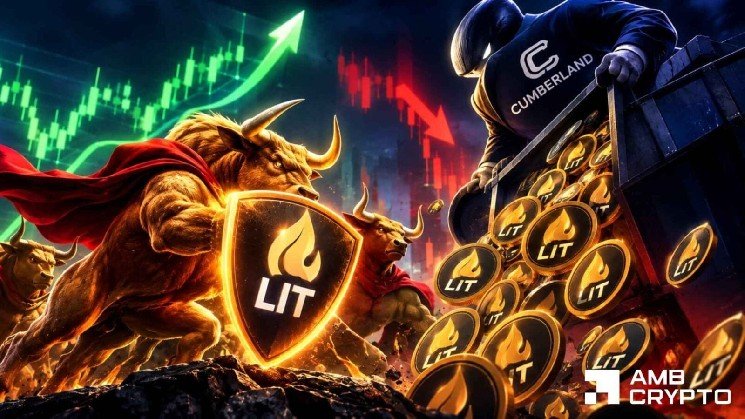
    Cumberland deposited 2 million $LIT worth $6.94 million to OKX and Bybit through four 500,000-token transfers. Large transfers from liquidity providers such as Cumberland can attract market attention. They may also increase potential selling pressure.

    Such transactions could contribute to short-term price declines if the deposited tokens enter the market.

    Is $LIT demand absorbing the selling pressure?

    Interestingly, although Cumberland is selling, other market players are buying. And it seems the pullback has created another buying opportunity.

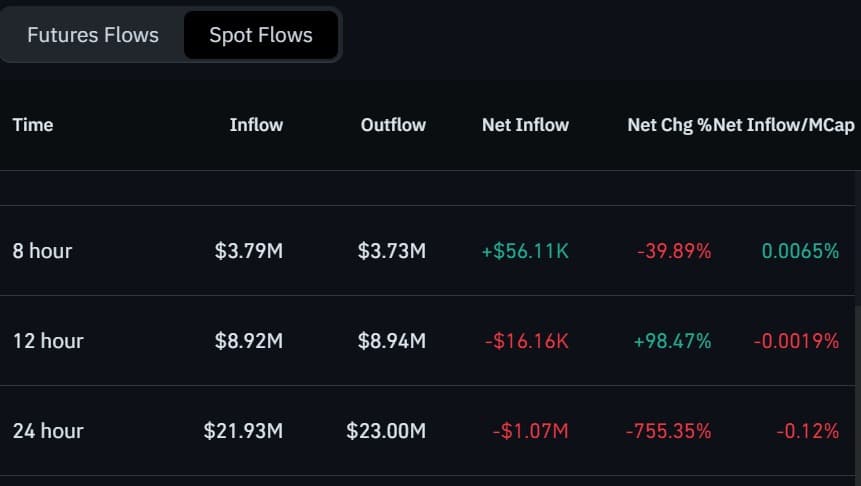
    Furthermore, exchange activity also echoes this spot buying activity. According to Coinglass data, Lighter saw $23 million in Spot Outflow compared to $21.93 million in inflows.

    Source: CoinGlass

    As a result, Spot Netflow fell 755% to negative $1.07 million. A negative Spot Netflow indicated that more $LIT left exchanges than entered them. That flow could signal accumulation if traders moved the tokens into private wallets.

    Buying during a dip can absorb selling pressure and strengthen demand. That could create room for a potential recovery.

    Onchain activity on the rise too

    Lighter’s on-chain activity also increased significantly.

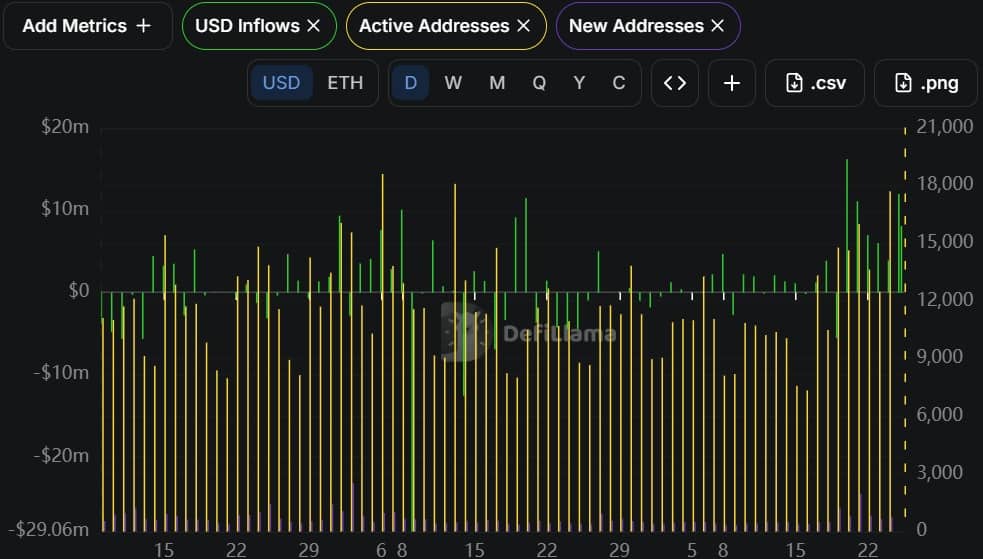
    According to DeFiLlama, Lighter’s Active Addresses climbed to a monthly high of 17,600. New Addresses rose to 743. The rising Address count suggested increased network usage and adoption.

    Source: DeFiLlama

    The rising user base also brought about increased capital inflow into the network. Over the past 24 hours, the altcoin saw $20 million in USD Inflows, a clear sign of strong network activity.

    What’s next?

    Although we have seen Cumberland sell $LIT, the market demand remains steady. As a result, the altcoin’s bullish structure remains intact.

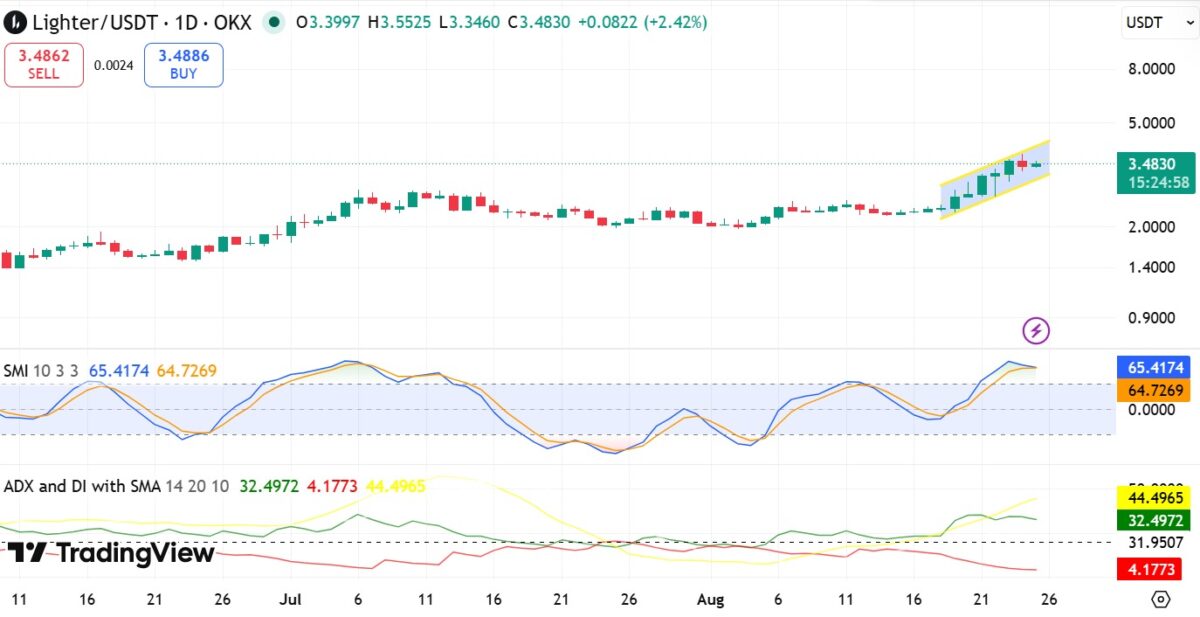
    Lighter’s Stochastic Momentum Index (SMI) remained in the bullish zone near 64.

    The SMI was falling while its signal line was rising. However, the indicators had yet to form a bearish crossover. That suggested buyers still maintained control of the market.

    Source: TradingView

    The ADX DI with SMA indicator further confirms the above view. Therefore, if demand holds, the altcoin’s recent pullback will be short lived, thus the altcoin will flip $3.7 and target $4.

    However, if the selling activity from major players such as Cumberland continues, $LIT will retest $3.1 support level.

    Final Summary

    • Cumberland deposited 2 million $LIT worth $6.94 million to OKX and Bybit.
    • $LIT’s bullish structure remained supported by Spot demand and rising on-chain activity.
  • Sony-Backed S.BLOX Lists Cardano’s ADA and Midnight’s NIGHT in Japan

    Sony-Backed S.BLOX Lists Cardano’s ADA and Midnight’s NIGHT in Japan

    Sony-linked Japanese exchange S.BLOX formally enabled trading for Cardano’s $ADA on Monday, Aug. 24, and simultaneously listed $NIGHT, the native token of the Midnight sidechain, Crypto Economy reported.

    The listings

    S.BLOX operates under Sony On-Chain Technologies Inc., a Sony Group subsidiary that completed its acquisition of the exchange platform in August 2023. Through an announcement on X, the exchange confirmed the immediate availability of $ADA transactions and the listing of $NIGHT. The technical integration lets local users access the new trading pairs inside an environment regulated by Japanese financial authorities.

    The addition of $NIGHT marks the first time the token has entered a domestic exchange in Japan, with S.BLOX documentation confirming no other domestic operator had technical support for the asset beforehand. The Midnight protocol launched its mainnet technical operations in March, and the $NIGHT token was issued in December 2025.

    Promotions to drive adoption

    To encourage uptake, S.BLOX launched two promotional programs: registered users can qualify for rewards of up to 10,000 yen in $ADA and bonuses of up to 14,000 yen in $NIGHT upon meeting the exchange’s operational requirements. The campaigns are scheduled to run throughout August, according to the schedule published on the exchange’s official channels.

    Why the listing matters

    Cardano founder Charles Hoskinson described the listing as significant given the rigorous technical evaluation and compliance processes required by Japan’s Financial Services Agency, addressing the integration during a recent livestream. Market observers said enabling the assets on a Sony-backed exchange could bolster liquidity for both tokens across the Asian region during the current quarter, and the move gives a major corporate backer a foothold in Cardano’s ecosystem. Cardano has been expanding its footprint in Asia as regulators there formalize digital-asset frameworks, and a listing with a Sony-backed operator gives the network a visible on-ramp for Japanese retail investors. The move also arrives as Japanese exchanges face stricter listing and custody standards than many offshore venues, making domestic approval a meaningful signal for the tokens involved.

    The listing arrives even as the shifting U.S. regulatory treatment of Cardano remains in focus for investors.

  • Ethereum Price Experiences a Dramatic Rally—What Happens Next? A Warning Has Been Issued

    Ethereum Price Experiences a Dramatic Rally—What Happens Next? A Warning Has Been Issued

    Benjamin Cowen, a leading analyst in the cryptocurrency market, analyzed recent technical charts and macroeconomic developments affecting Ethereum ($ETH). He highlighted Ethereum’s recent strong rebound, sharing his insights on potential market bottoms and the critical risks facing the crypto asset in the coming period.

    Cowen, analyzing Ethereum’s price structure through regression channels and fair value models, stated that the asset reacted from its lows around the $1,500 level. Recalling that similar instances of touching the lower boundary of the regression band have occurred in past cycles, the analyst indicated that the current fair value zone for Ethereum lies between $2,300 and $2,400. However, he added that for the price to sustain its upward momentum, it needs to decisively break above critical technical resistance levels such as the 200-day moving average.

    Beyond Ethereum’s individual performance, the analysis specifically highlighted the $ETH/BTC pair, demonstrating its strength against Bitcoin. Cowen stated that the pair breaking above its 20-month moving average is a crucial technical signal, and that this level needs to be sustained. Referring to past false breakouts, the expert said that for the rally to be confirmed, Ethereum must maintain its gains against Bitcoin for the next 1-2 months.

    Cowen also touched upon the impact of macroeconomic risks on the crypto market, stating that a potential correction in the S&P 500 index would directly affect the price of Ethereum. While a 10% pullback in the stock market index might be limited to a higher bottom formation in Ethereum, the analyst warned investors that a deeper 20% decline could trigger sharp pullbacks exceeding 50% in $ETH. Highlighting the second half of the year, particularly the end of the third quarter and the fourth quarter, Cowen indicated that a negative signal from the macroeconomic front could lead to one final wave of decline in the crypto market.

    *This is not investment advice.

  • Analytics Firm Claims Bitcoin Bull Run Has Begun: “There’s Just One Level Left; If It Breaks Through This One…”

    Analytics Firm Claims Bitcoin Bull Run Has Begun: “There’s Just One Level Left; If It Breaks Through This One…”

    The recent strong surge in Bitcoin’s price signals the beginning of a new bull run in the market, according to the on-chain analytics platform CryptoQuant. The company noted that its Bitcoin Bull Score indicator rose from 30 to 80 in just one week, marking the fastest market regime change in the past year. According to CryptoQuant, the final significant hurdle to officially confirm this new bull market is around $83,000.

    Bitcoin has surged approximately 24% since Monday, August 17th, reaching as high as $80,000. This marks BTC’s highest level since May 15th. CryptoQuant attributes the rise to two key macro catalysts that have been strongly priced positively by the market.

    The first of these was the US Treasury’s announcement that it would increase the size of its long-term government bond buybacks to at least $4 billion per transaction starting September 9th. The second significant development was US President Donald Trump’s statements suggesting that the US government might consider purchasing Bitcoin.

    According to CryptoQuant data, Bitcoin’s valuation indicators have seen a significant improvement. The platform’s Bull Score Indicator jumped from 30 to 80 in a week, reaching its highest level since October 6, 2025. At that time, Bitcoin was trading at approximately $124,000. Eight out of the ten indicators tracked are currently signaling a bullish trend.

    Demand-side data also supports the market shift. CryptoQuant reported that apparent spot Bitcoin demand recorded its fastest monthly growth since late December. Furthermore, demand in both the spot and futures markets began growing simultaneously for the first time since early October 2025.

    According to the platform, the simultaneous upward turn in valuation, demand, and liquidity indicators suggests that Bitcoin has entered the initial phase of a new bull market. However, CryptoQuant stated that for the change in market regime to be definitively confirmed, Bitcoin needs to close above its 365-day moving average, which is currently around $83,000.

    CryptoQuant warned that while the medium- to long-term outlook has improved, the Bitcoin market may be overheated in the short term.

    Traders’ unrealized profit margin rose to 20.5%, reaching its highest level since June 2025. Meanwhile, whales achieved a record realized profit of $614 million on August 20th.

    Simultaneously, the increase in Bitcoin, Ethereum, and XRP inflows to cryptocurrency exchanges suggests that investors may be moving their assets to exchanges for sale. Therefore, CryptoQuant stated that it would not be surprising if Bitcoin struggled in the resistance zone around $83,000 or experienced a correction typical of the early bull market period.

    According to the platform, such a pullback might be a healthy move to digest the recent 24% rally, rather than signaling the end of an uptrend.

    CryptoQuant stated in its assessment that the market regime has now turned bullish, but investors should closely monitor the 365-day moving average at the $83,000 level for confirmation of the new bull market.

    *This is not investment advice.