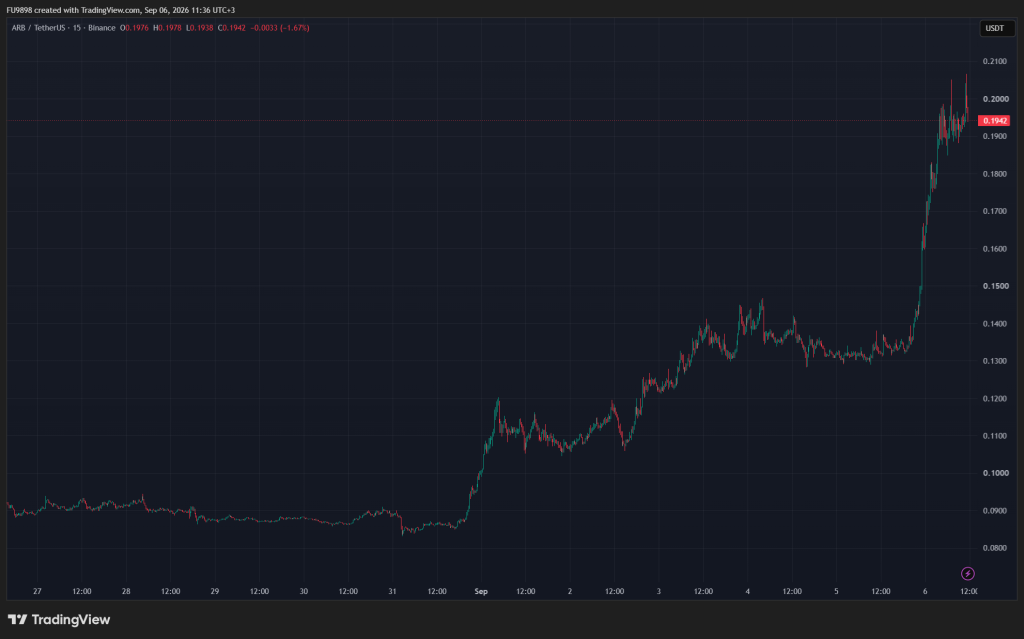
Arbitrum ($ARB) experienced one of the most remarkable price increases in the cryptocurrency market today. Ranked as the 53rd largest cryptocurrency by market capitalization, $ARB rose approximately 49% in the last 24 hours, reaching $0.1972. While the increase exceeded 50% at some points during the day, $ARB still remains approximately 92% below its all-time high of $2.40 recorded on January 12, 2024.
A chart with 15-minute candles showing the recent rise in $ARB price.
One of the main catalysts behind the sharp rise in $ARB is the rapid growth of Robinhood Chain, built on Robinhood’s $ARB technology. Robinhood Chain, an Ethereum Layer 2 network that launched its mainnet on July 1, 2026, uses the Arbitrum Orbit infrastructure. Under the Arbitrum Expansion Program, $ARB-based chains operating outside of Arbitrum One and Nova contribute 10% of their net protocol revenue to the Arbitrum ecosystem. According to Arbitrum Foundation data, in July, the first month of Robinhood Chain’s operation, the $360,000 in licensing revenue generated from this program constituted 35% of Arbitrum DAO’s monthly revenue.
The recent extraordinary acceleration in activity on Robinhood Chain has further increased the importance of this revenue model for Arbitrum. Daily transaction fees on the network surged to millions of dollars in early September, surpassing the Ethereum mainnet and Coinbase’s Base network on some days. Record levels were also seen in Robinhood Chain’s decentralized exchange trading volume, with the network’s 24-hour DEX volume reaching billions of dollars, increasing investor interest in the $ARB ecosystem.
One of Robinhood Chain’s prominent use cases is its “Stock Tokens” product. Issued by Robinhood Assets Limited, these tokens track the economic performance of US stocks such as NVIDIA, Apple, and Alphabet. While not providing users with direct legal ownership of company shares, the products are offered in numerous countries outside the US.
The economic model between Arbitrum and Robinhood also sparked a notable debate on social media between the founders of Solana and Arbitrum. Anatoly Yakovenko, co-founder of Solana, argued that Robinhood Chain’s 10% revenue share paid to the Arbitrum ecosystem was enough to cover approximately four times the transaction fees on Solana, suggesting that if Robinhood chose Solana, it could offer users significantly lower, even subsidized, transaction costs.
Steven Goldfeder, co-founder of Offchain Labs and $ARB, responded to Yakovenko, stating that Robinhood retains approximately 90% of the gas revenue on the $ARB infrastructure, while it does not receive any revenue from basic network transaction fees on Solana. Goldfeder added that by choosing Arbitrum, Robinhood has opted to “become a homeowner instead of a tenant.”
In $ARB’s revenue sharing model, 8% of the 10% share is allocated to the Arbitrum DAO treasury, managed by $ARB holders, and 2% is dedicated to ecosystem development. Therefore, continued growth in transaction volume and network revenue on Robinhood Chain, while not directly distributed to $ARB token holders, is seen as a significant factor strengthening Arbitrum DAO’s revenue and ecosystem economy.
Polish Sejm Fails to Overturn Presidential Veto On Crypto-Asset Market Act
Poland is facing a battle regarding cryptocurrency regulation amid a national scandal involving the demise of Zondacrypto, the largest local cryptocurrency exchange.
Prime Minister Donald Tusk called last month for a revision of the Crypto-Asset Market Act, which President Karol Nawrocki vetoed three times, after he warned the public about the act’s effects on Poles’ freedom and stability. At the time, he stressed that, given the circumstances, he could “no longer imagine that President Nawrocki, Chairman Kaczyński, and former Prime Minister Morawiecki would reject this problem with such incredible lightness.”
On Thursday, pushed by Tusk, the Sejm added the issue to its working agenda, allowing limited discussion, according to official reports. A vote followed on Friday, where the initiative failed to get the needed support for overturning Nawrocki’s veto, managing only to reach 241 of the 266 votes needed.
The motion marks the third time that the Sejm has failed to overturn the presidential veto on this crypto law, meaning Polish crypto operators still face a difficult task complying with the Markets in Crypto Assets (MiCA) framework, registering their activities in other jurisdictions before operating.
The failed initiative follows a corruption probe that involves government officials connected with Zondacrypto, a national exchange that stole up to $94 million in customer funds. Polish Olympic Committee President Radosław Piesiewicz was detained in connection with this investigation.
Tusk blasted Nawrocki’s party representatives, accusing them of colluding with Zondacrypto and turning Przemysław Kral, Zondacrypto’s former CEO, into a local celebrity.
“In a sense, those who opened the door to the man behind Zonda Crypto—that is, you—very specifically: you, who brought him into the mainstream; who made Zondacrypto the de facto owner of the Polish Olympic Committee,” he declared while addressing the Sejm.
“Zondacrypto infiltrated the Polish state—it infiltrated the Polish state for a long time and without hindrance—because leading politicians from your party guided this company and its owners to the very highest echelons of power,” Tusk concluded.
Bitcoin [$BTC] has been on the higher side over the past couple of days, with the asset teasing a potential move past the $80,000 region on the chart.
The case is that the price continues to hover around this region with no definitive push. What market participants do at this level remains crucial to understanding Bitcoin’s next move, but for now, there is no definitive direction.
OG Bitcoin holders sell their bags
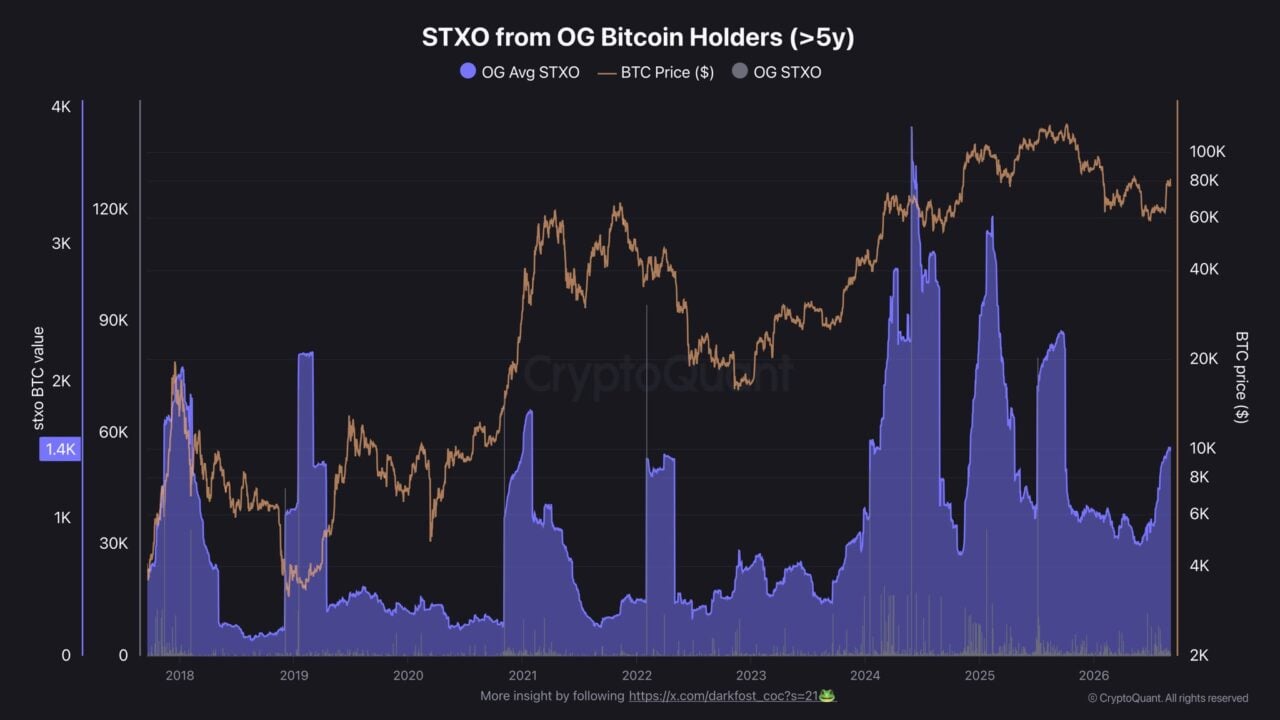
Data from CryptoQuant tracking Bitcoin OG Spent Transaction Outputs (STXO) using the 90-day moving average has significantly spiked, reaching 1,500 Bitcoin.
Bitcoin OGs are holders who have kept their assets for more than five years. When they spend their Bitcoin, it often indicates a shift in sentiment, as seen recently.
These OGs have moved their Bitcoin, which could indicate selling pressure and suggest that their conviction has weakened, especially as $BTC reaches new local highs.
Source: CryptoQuant
Pseudonymous senior market analyst Darkfost described the influencing factor behind the recent rally, saying:
“This consolidation period seems to have introduced some doubt across nearly every type of investor, even the most seasoned ones like the OGs.”
Other factors could have also played a role in the move, including the recent Coldcard hack that has driven investors to switch private wallets.
What’s happening on a small scale
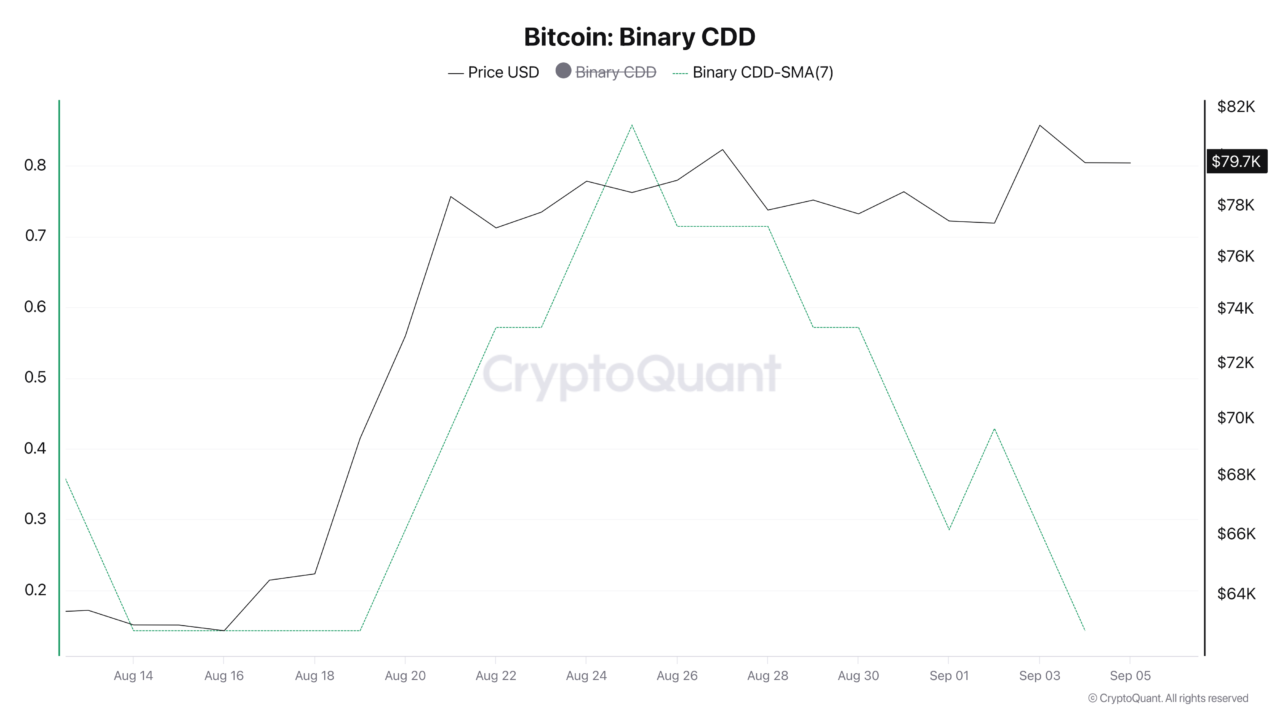
AMBCrypto’s look at Long-Term Holders (LTH), a group of investors who hold an asset for at least 155 days, gives a more detailed insight. The analysis was based on the LTH Binary Coin Days Destroyed (CDD) to track whether dormant tokens have moved or not.
Notably, a majority of the sell pressure that came into the market, using a 7-day simple moving average, came between August 19 and 25, a move that likely reflected when the majority of these LTHs sold.
Source: CryptoQuant
However, since its peak on the 25th of August, the LTH Binary CDD has dropped from a high of 0.85 to the present level of 0.14.
This decline suggests that there is growing calm among these holders, as they have been moving fewer of their tokens over the past few weeks.
The Spot market is holding
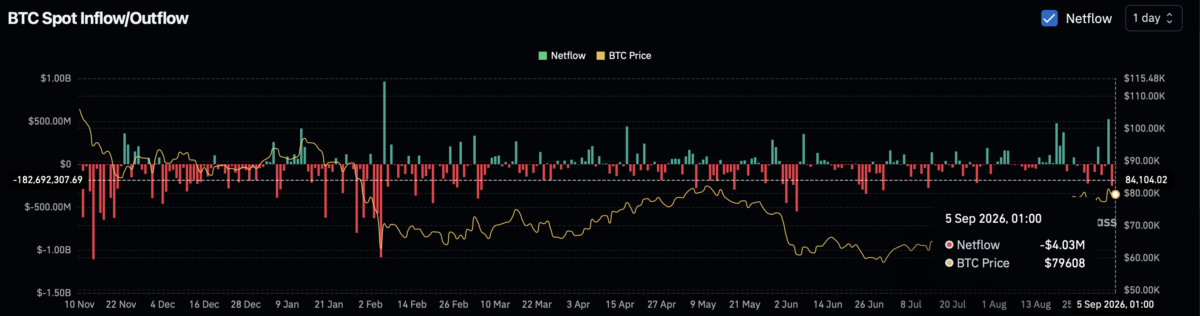
Over the past few days, there has been growing accumulation across the spot market, showing that there has been major buying of the asset.
The Spot netflow hit -$252.40 million on the 4th of September following $2.81 billion in accumulation of the asset in the market. Although, the netflow has dropped significantly to around -$4.03 million as of midday on the 5th of September.
Source: CoinGlass
For now, there is growing accumulation in the market, and if it continues this way, it can help sustain Bitcoin.
Final Summary
Bitcoin OG holders have increased spending activity, suggesting some long-term investors may be taking profits.
Spot market accumulation remains strong, while lower LTH movement points to reduced selling pressure.
El Salvador’s President Nayib Bukele denied a report by El País claiming the government had transferred control of its state Bitcoin reserves, exceeding 7,763 BTC, to a private operator.
Bukele’s objection is based on an interpretation of the wording in the International Monetary Fund’s (IMF) recent statement regarding El Salvador. According to the IMF, the entity whose majority stake and operational control has been transferred to a private operator is not El Salvador’s strategic Bitcoin reserves, but the government-backed Chivo wallet.
The IMF previously stated that El Salvador had submitted documents showing that all of the Bitcoin it had accumulated since its first Extended Funds Facility (EFF) review on June 27, 2025, came from private donations. The institution stated that no public funds were used for Bitcoin purchases during that period and that no additional Bitcoin accumulation beyond the documented donations was expected.
The announcement came after an IMF delegation reached an agreement with El Salvador to combine the second and third reviews of the EFF program. Subject to approval by the IMF Executive Board and fulfillment of the agreed preconditions, El Salvador is expected to gain access to approximately $140 million in additional financing.
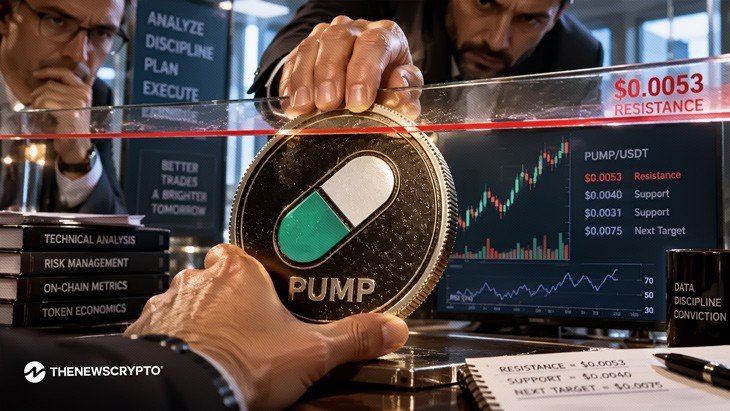
$PUMP is currently hovering around the $0.0041 mark.
There’s a bullish attempt to counter a macro downtrend.
As the first week of September closes, Pump.fun ($PUMP) is trading at $0.004195. Buyers have stepped in and defended the $0.0040 zone twice, printing a double bottom and showing that the sellers can’t push through that floor with any conviction.
The neckline likely sits at $0.00455. A clean breakout above that level with volume behind it confirms the double bottom and opens the door toward the projected target at around $0.0052, a crucial move from current levels. Until that breakout is confirmed, the bulls are in a waiting game.
In the early hours, the asset traded at a bottom of $0.004096. With a shift in momentum, it tested and broke multiple price ranges and gradually drove the $PUMP price to a high level of $0.004405. Besides, the 24-hour volume has potentially reached the $147.17 million zone.
Near-Term Price Levels to Watch for $PUMP
With the negative outlook, the recent trading pattern might slip even deeper and test the key support at the $0.004139 range. Further correction on the downside could likely trigger the emergence of the death cross in the $PUMP market, and the bears would send the price below $0.0040.
On the upside, if the bulls re-entered the market, the asset’s price could instantly rise to its nearest resistance level at $0.004251. Extended bullish pressure might push for the formation of the golden cross. Eventually, it could drive the $PUMP price even higher, above the $0.0043 mark.
Where Will $PUMP Take its Current Momentum?
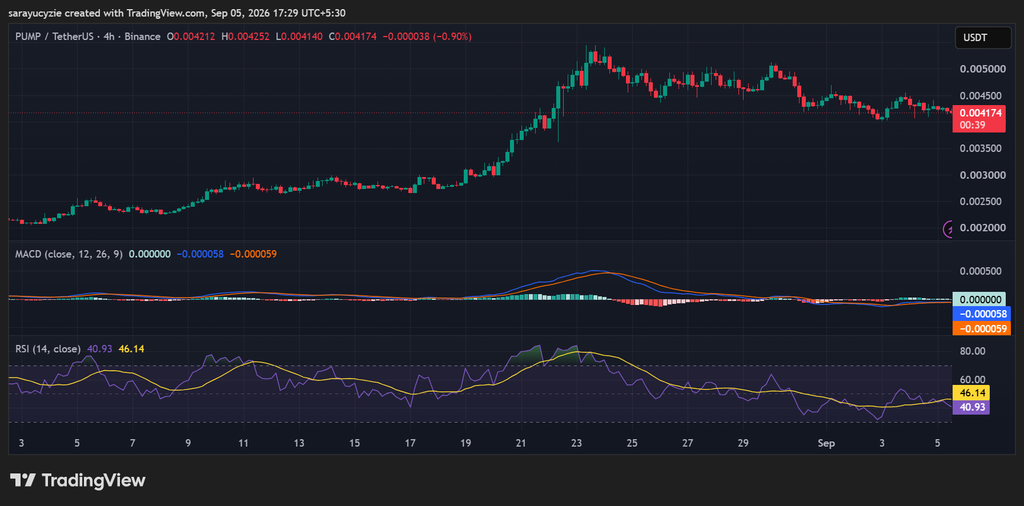
The Moving Average Convergence Divergence line is slightly above the signal line, while both lines remain below the zero line; it is an early sign of bullish momentum forming within a broader downward trend. The overall background of the $PUMP market is still bearish.
Short-term price moving averages are lower than long-term averages, confirming sustained selling pressure. MACD crossing one point above it forms a fresh bullish crossover, showing that buyers are stepping in and driving price up faster than the immediate recent average. This represents a bullish attempt to counter a macro downtrend.
(Source: TradingView)
Moreover, the daily Relative Strength Index reading positioned at 40.93 hints at weak or neutral-bearish territory. The sellers currently hold a slight edge over buyers, with average price losses outperforming average gains over the recent lookback period.
The asset still has room to fall further before becoming overextended to the downside. A drop toward 40 signals a healthy pullback before the broader trend resumes. If the broader market is already bearish, an RSI staying in the 40–30 range confirms sustained selling pressure without enough buying momentum to reverse direction.
Bitcoin holders whose coins have remained dormant for more than five years have doubled their spending activity since May, pushing the cohort’s 90-day average to about 1,500 $BTC.
Bitcoin OG activity doubles from May levels
CryptoQuant analyst Darkfost reported that activity among Bitcoin’s oldest holders has increased during the latest period of price consolidation. The analyst defines the group as investors whose coins had remained unspent for more than five years before moving onchain.
🗞️ OG Bitcoin Holders Are on the Move
OG activity has intensified during this consolidation phase.
The 90-day moving average of spent UTXOs (STXO) from holders who have held $BTC for more than 5 years just climbed to 1,500 $BTC.
As a reminder, a UTXO (Unspent Transaction Output)… pic.twitter.com/8kXvJ06XKH
— Darkfost (@Darkfost_Coc) September 5, 2026
The 90-day moving average of spent outputs from the cohort has reached about 1,500 $BTC, twice the level recorded in May, according to Darkfost. A moving average smooths daily changes, making it less sensitive to isolated transfers from a few large wallets.
At 1,500 $BTC, the current average is also about 56% above the 962 $BTC reported on June 24. At the time, the reading had fallen below 1,000 $BTC for the first time since November 2024, indicating that activity from older holders had slowed to its lowest point in nearly two years.
As previously reported by crypto.news, earlier peaks appeared in May 2024, February 2025, and September 2025. Daily movements during those periods exceeded 10,000 $BTC, 30,000 $BTC, and, in one case, 142,000 $BTC.
Darkfost linked the latest increase to unease created by Bitcoin’s consolidation. Even investors who have held through several market cycles appear more active, the analyst said, although the data cannot identify the reason behind each transaction.
Bitcoin traded near $79,600 at the time of writing, down about 1.8% over 24 hours after moving between an intraday low of $78,723 and a high of $81,370. The price has struggled to establish a lasting move above $80,000 following several sharp swings around the level.
Spent UTXOs do not prove Bitcoin was sold
A spent UTXO records Bitcoin that has been used as an input in a new transaction. Because Bitcoin’s ledger tracks transaction outputs rather than account balances, an output becomes “spent” whenever its owner moves the coins to another address.
Movement alone does not identify the purpose of a transaction. An investor can send $BTC to an exchange for a possible sale, transfer it to a new custodian, consolidate several outputs, divide a balance across wallets or replace an old security setup.
Darkfost cautioned against treating the 1,500 $BTC average as confirmed selling. Some of the transactions may represent holders moving their coins to safer storage after the Coldcard security incident rather than exiting their positions.
Destination data provides more useful evidence when an old wallet sends coins to a labeled exchange or trading firm. Even then, an exchange deposit shows that the Bitcoin became available for trading; it does not establish that the owner completed a sale.
Recent dormant-wallet transfers illustrate the limitation. During a 10-day period in August, six wallets that had remained inactive for almost 12 to more than 15 years moved 553.59 $BTC worth $40.15 million.
Five transfers went to addresses with no identified exchange connection. One wallet sent 40 $BTC to an address labeled Boerse Stuttgart Digital, which provides custody and trading infrastructure. Neither the unlabeled destinations nor the custody provider established whether the owners sold, changed custodians, or reorganized their holdings.
Another 28 dormant wallets moved 1,314.41 $BTC on Aug. 20, including more than 1,200 $BTC from addresses created in 2014. Blockchain records documented the transfers but did not reveal the owners’ intentions.
Coldcard incident complicates onchain readings
The Coldcard incident created an unusual source of Bitcoin activity after a firmware flaw exposed seed phrases generated by affected hardware wallet models. Owners were advised to create new seeds and transfer their holdings because installing corrected firmware could not repair credentials produced by vulnerable software.
In early August, K33 Research found that nearly 890,000 $BTC had moved over seven days, the highest seven-day active supply recorded in 2026. The surge occurred while Bitcoin was trading within one of its narrowest 30-day ranges since 2023, separating the rise in network activity from a major price breakout.
Researchers linked the activity partly to Coldcard users migrating funds and attackers draining vulnerable wallets. Galaxy Research had confirmed the theft of 1,596 $BTC from about 7,300 addresses across three attack waves by Aug. 5.
Galaxy estimated that losses could reach approximately 2,055 $BTC, then worth close to $130 million, if a suspected fourth wave was confirmed. Around 90% of the stolen Bitcoin had not moved after the initial attacks at that stage, according to the research firm.
Transfers made for seed migration still consume old UTXOs, so they can raise spending metrics even when the owner keeps control of the coins. The effect can reach age-based cohorts if affected wallets contain Bitcoin that has remained untouched for five years or longer.
Wallet consolidation can produce a similar result. Combining several old outputs into one new output records the original UTXOs as spent without changing the owner’s total balance, apart from the network fee.
U.S. investors can hold Bitcoin without managing seeds
For U.S. investors, the Coldcard incident has renewed attention on the custody differences between directly held Bitcoin and shares of a spot Bitcoin exchange-traded fund. Direct holders control spendable $BTC but remain responsible for seed creation, backups, firmware updates, and wallet migration.
ETF investors do not manage private keys because the fund and its service providers handle custody. Bloomberg Intelligence senior ETF analyst Eric Balchunas argued in August that the Coldcard losses strengthened the case for ETFs among investors who only want exposure to Bitcoin’s price.
An earlier report on the U.S. custody debate noted that no verified flow data had tied ETF demand directly to the incident. Investor responses could also include multisignature wallets, new hardware devices, institutional custodians, or the division of funds across several storage methods.
BlackRock’s iShares Bitcoin Trust uses Coinbase Custody to hold its Bitcoin in segregated cold-storage wallets, according to the fund’s SEC filing. The trust may also use Anchorage Digital Bank as an additional custodian.
ETF ownership transfers personal seed risk to fund operators, custodians, and other service providers. BlackRock’s filing warns that hacking, employee misconduct, technical failures and unauthorized transfers could still cause losses, while available insurance may not cover every event.
Unlike direct holders, retail ETF shareholders cannot withdraw the underlying Bitcoin to a personal wallet or use it for onchain payments. Fund shares trade during U.S. market hours, while Bitcoin transactions remain available around the clock.
Disclaimer: This is not investment advice. The information provided is for general purposes only. No information, materials, services and other content provided on this page constitute a solicitation, recommendation, endorsement, or any financial, investment, or other advice. Seek independent professional consultation in the form of legal, financial, and fiscal advice before making any investment decision.
Canton is down -5.41% today against the US Dollar
CC/$BTC decreased by -3.65% today
CC/ETH decreased by -3.53% today
Canton is currently trading 30.84% above our prediction on Sep 09, 2026
Canton gained 2.84% in the last month and is down -24.98% since 1 year ago
CC price is expected to drop by -23.20% in the next 5 days according to our Canton price prediction
Canton price today is trading at $ 0.106706 after losing -5.41% in the last 24 hours. The coin underperformed the cryptocurrency market, as the total crypto market cap decreased by -2.56% in the same time period. CC performed poorly against $BTC today and recorded a -3.65% loss against the world’s largest cryptocurrency.
According to our Canton price prediction, CC is expected to reach a price of $ 0.081555 by Sep 09, 2026. This would represent a -23.20% price decrease for CC in the next 5 days.
CC Price Prediction Chart
Buy/Sell Canton
What has been going on with Canton in the last 30 days
Canton has been displaying a positive trend recently, as the coin gained 2.84% in the last 30-days. The medium-term trend for Canton has been bearish, with CC dropping by -34.80% in the last 3 months. The long-term picture for Canton has been negative, as CC is currently displaying a -24.98% 1-year price change. On this day last year, CC was trading at $ 0.142242.
Canton reached its all-time high price on Feb 03, 2026, when the price of CC peaked at $ 0.194076. The current CC cycle high is $ 0.131297, while the cycle low is at $ 0.086983. CC has been displaying low volatility recently – the 1-month volatility of the coin is at 9.84. Canton recorded 14 green days in the last 30 days.
Canton technical analysis for today – Sep 05, 2026
The sentiment in the Canton markets is currently Bearish, and the Fear & Greed index is reading Greed. The most important support levels to watch are $ 0.109879, $ 0.106982 and $ 0.105371, while $ 0.114388, $ 0.115998 and $ 0.118896 are the key resistance levels.
Bearish sentiment for Canton
2 indicators are currently signaling a bullish prediction for Canton, while 24 indicators are showing a bearish forecast. With 92% of indicators favoring a negative prediction. This results in an overall Bearish sentiment for Canton.
Crypto market is currently experiencing Greed
Currently, the Fear & Greed index is at 74 (Greed), which signals that investors have a positive outlook on the market. The Fear & Greed index is a measure of sentiment among cryptocurrency investors. A “Greed” reading suggests that investors are currently optimistic about the cryptocurrency market, but can also be an indication that the market is overvalued. A “Fear” reading, on the other hand, signals that investors are currently hesitant about the cryptocurrency market, which potentially represents a buying opportunity.
Canton moving averages & oscillators
Let’s take a look at what some of the most important technical indicators are signaling. We’ll be going through key moving averages and oscillators that will allow us to get a better idea of how Canton is positioned in the market right now.
The Relative Strength Index (RSI 14) is a widely used indicator that helps inform investors whether an asset is currently overbought or oversold. The RSI 14 for Canton is at 50.90, suggesting that CC is currently neutral.
The 50-day Simple Moving Average (SMA 50) takes into account the closing price of Canton over the last 50 days. Currently, Canton is trading above the SMA 50 trendline, which is a bullish signal.
Meanwhile, the 200-day Simple Moving Average (SMA 200) is a long-term trendline that’s calculated by taking an average of the CC closing price for the last 200 days. CC is now trading above the SMA 200, signaling that the market is currently bullish.
The bottom line about this Canton prediction
After considering the above factors, we can conclude that the current forecast for Canton price prediction is Bearish. CC would have to decrease by -23.20% to hit our $ 0.081555 target within the next five days. Moving forward, it will be important to monitor the CC market sentiment, the key support and resistance levels, and other metrics. However, we have to keep in mind that the cryptocurrency markets are unpredictable, and even the largest crypto assets display a lot of price volatility. For long-term Canton price predictions click here.
Disclaimer: This is not investment advice. The information provided is for general purposes only. No information, materials, services and other content provided on this page constitute a solicitation, recommendation, endorsement, or any financial, investment, or other advice. Seek independent professional consultation in the form of legal, financial, and fiscal advice before making any investment decision.
At the time of writing, Kalshi has not filed anything at the Supreme Court, and its opposition brief is not due for a month – but the company has spent the past week making a clear argument in public through three people, giving legal watchers an idea of their upcoming strategy.
Chief executive Tarek Mansour said in an interview with RotoWire that the Ninth Circuit ruling, which sided with New Jersey, “added more legal uncertainty than there was before.” Per his framing, the courts largely agree on preemption, with “a more narrow disagreement as to whether swaps can be sports,” and much of the reaction “centered on Rule 40.11. The Key: There is likely a new rule coming in the next few weeks or the next few months that is going to clarify matters.
Kalshi’s head of litigation, Jovy Dedaj, writing on X, said the Ninth Circuit agreed with the Third on a fundamental point – with the latter’s decision in favor of Kalshi – but that its decision “rests, in large part, on an incorrect interpretation of the CEA’s Special Rule.” The prediction market’s spokeswoman, Dani Lever, echoed this argument to Bloomberg Law and CNBC: that the Ninth Circuit “agreed with that key principle,” and “where it differed, it did so based on a regulation that’s in the process of being rewritten.”
The new rule Kalshi gestures at is real: the CFTC proposed in June to replace the flat prohibition with a case-by-case public interest review, under which sports would count as gaming, but most game-outcome and prop contracts would survive. The commission has actively filed amicus briefs on the prediction markets’ side in state legal action, asserting exclusive jurisdiction, suing states over their enforcement actions directly. CFTC spokesman Zach Fulton told The Block in a statement that the Ninth Circuit misread the statute and regulations.
In a concurrence to the Aug. 28 opinion, Ninth Circuit Judge Kenneth K. Lee wrote that he did not think the court needed to reach the statutory question at all, because 17 C.F.R. § 40.11 bars gaming contracts, and while the commission has proposed revising it, “it remains in the books and controls the outcome of this appeal.” Third Circuit Judge Ryan D. Nelson’s majority took the harder route, holding the contracts are not swaps because they are bets, and that reading the statute otherwise would assume Congress “hid an elephant in a mousehole.”
Nelson opened his opinion by quoting the company’s own advertising back at it: “the first app for legal sports betting in all 50 states.” Mansour’s attempt to defuse this was to make the following argument to RotoWire: “If you’re using the word ‘bet’ colloquially, you can bet on stocks. When you buy Tesla stock… you say, ‘I’ll just bet on Tesla.’”
The prediction market also has to reckon with its own past legal strategy here. Before the company entered sports, fighting the CFTC in the D.C. Circuit over election contracts, it conceded that gaming includes sports and that an illegal instrument cannot be saved by a public-interest review – which is the precise mechanism the proposed rule would install. The Ninth Circuit quoted the concession back at the company.
New Jersey’s petition is narrower than most coverage suggests. In Flaherty v. KalshiEX LLC, Attorney General Jennifer Davenport framed the question as whether Dodd-Frank “preempted States from regulating sports bets that occur within their jurisdictions if those bets are offered on markets registered with the Commodity Futures Trading Commission” – meaning sports specifically, not event contracts generally. The filing describes a “direct, acknowledged, and irreconcilable split” and says the companies have “already dragged at least 20 States into litigation.”
Because Dodd-Frank also bars companies from offering swaps off CFTC-registered markets, the petition argues that if Kalshi is right, “then state-licensed sportsbooks that everyone has understood to be legal since Murphy – including at brick-and-mortar casinos – have apparently been violating Dodd-Frank all along.” It calls implied displacement of state gambling law an “astonishing” conclusion with grave “economic and political consequences.”
John Holden of Indiana University’s Kelley School of Business, speaking to SBC Americas, set out the upcoming sequence of legal moves: Kalshi’s opposition within 30 days, New Jersey’s reply within 10 days of that, and a conference typically within a month afterward. The justices can then grant, deny, relist, or ask the Solicitor General for analysis – an option Holden said could add months, and one this case may warrant, given that the administration’s own commission is already a party in interest on Kalshi’s side. Bank of America told clients that the Court may still wait for cases pending in other circuits.
Connecticut Links $200,000 Loss to Unregulated DeFi Exchange
A Connecticut resident cannot recover $200,000 deposited into an unregulated decentralized finance (DeFi) cryptocurrency exchange after being deceived by someone claiming to know the person, state officials said Sept. 3. The Connecticut consumer alert did not identify the specific exchange involved or the person who solicited the transfer.
Connecticut Attorney General William Tong issued the alert alongside a statement from state Banking Commissioner Jorge Perez, citing financial losses, high-risk leverage, security threats, and limited avenues for recovering funds. Tong said platforms promising easier access and higher returns may leave investors with little to no recourse if something goes wrong. He noted:
“This isn’t innovation, it’s exploitation. Do research before handing over any money and know what protections are in place if things go wrong.”
The alert named GMX, Gains Network, dYdX, Aevo, Drift Protocol, Vertex Protocol, and Hyperliquid as offshore DeFi platforms that officials said operate beyond U.S. regulatory protections. It did not state that the Connecticut resident used any of those seven services, so the loss cannot be attributed to a named platform.
Officials Focus on Leverage, Synthetic Assets, and Oversight
Many perpetual decentralized exchanges allow traders to obtain leveraged exposure directly from a digital wallet without buying the referenced asset. These perpetual DEX contracts have no expiration dates and introduce liquidation, funding-rate, smart-contract, and oracle risks.
Connecticut officials said some offshore platforms provide leverage of 50x, 100x, or up to 250x, allowing small market movements to erase deposited collateral. The Commodity Futures Trading Commission (CFTC)’s crypto perpetual-contract briefing says high leverage is common at offshore venues but is not inherent to perpetual contracts, while leverage on regulated platforms is governed by risk-management frameworks.
Trading activity on Hyperliquid has shown how quickly leveraged positions can approach forced closure during routine price swings. In May, a trader’s $20.32 million bitcoin short using 40x leverage stood roughly 1.5% from its liquidation price after the trader deposited 499,900 USDC as collateral.
British regulators have raised separate consumer-protection concerns about Hyperliquid, which they list as an unauthorized firm that may be targeting people in the United Kingdom. The Financial Conduct Authority warning says the platform is unauthorized and users would not receive protection from the Financial Ombudsman Service or Financial Services Compensation Scheme if problems occurred.
Connecticut’s alert also covers perpetual contracts tied to companies including Apple, Tesla, Nvidia, and SpaceX, cautioning that buyers hold leveraged bets on synthetic prices rather than actual shares. Centralized owners of those platforms can change prices, remove assets from trading, and halt both trading and customer withdrawals.
State Alert Highlights Scam and Recovery Risks
The state’s warning arrives after another Connecticut resident reported losing $228,000 through a separate fraudulent cryptocurrency opportunity in 2025. That case involved a retired physical therapist whose investment and retirement accounts were depleted after an online operation promised lucrative returns and persuaded him to send repeated payments.
Officials also cautioned that supposed recovery specialists or people presenting themselves as attorneys may demand upfront fees after an initial loss. A July FBI warning about fake agents described criminals using artificial intelligence-generated videos, spoofed government websites, and false promises of recovered funds to target earlier fraud victims.
The consumer alert asks Connecticut residents to verify whether crypto services are registered, retain transaction and communication records, and report suspected scams promptly. Connecticut has also adopted new safeguards governing cryptocurrency ATMs, but state officials said decentralized transactions generally remain irreversible even when other consumer safeguards apply.