Tag: CRYPTOS FoxBusiness

  • Solana takes its first step toward sub-second speed by cutting block confirmation times across the network

    Solana takes its first step toward sub-second speed by cutting block confirmation times across the network

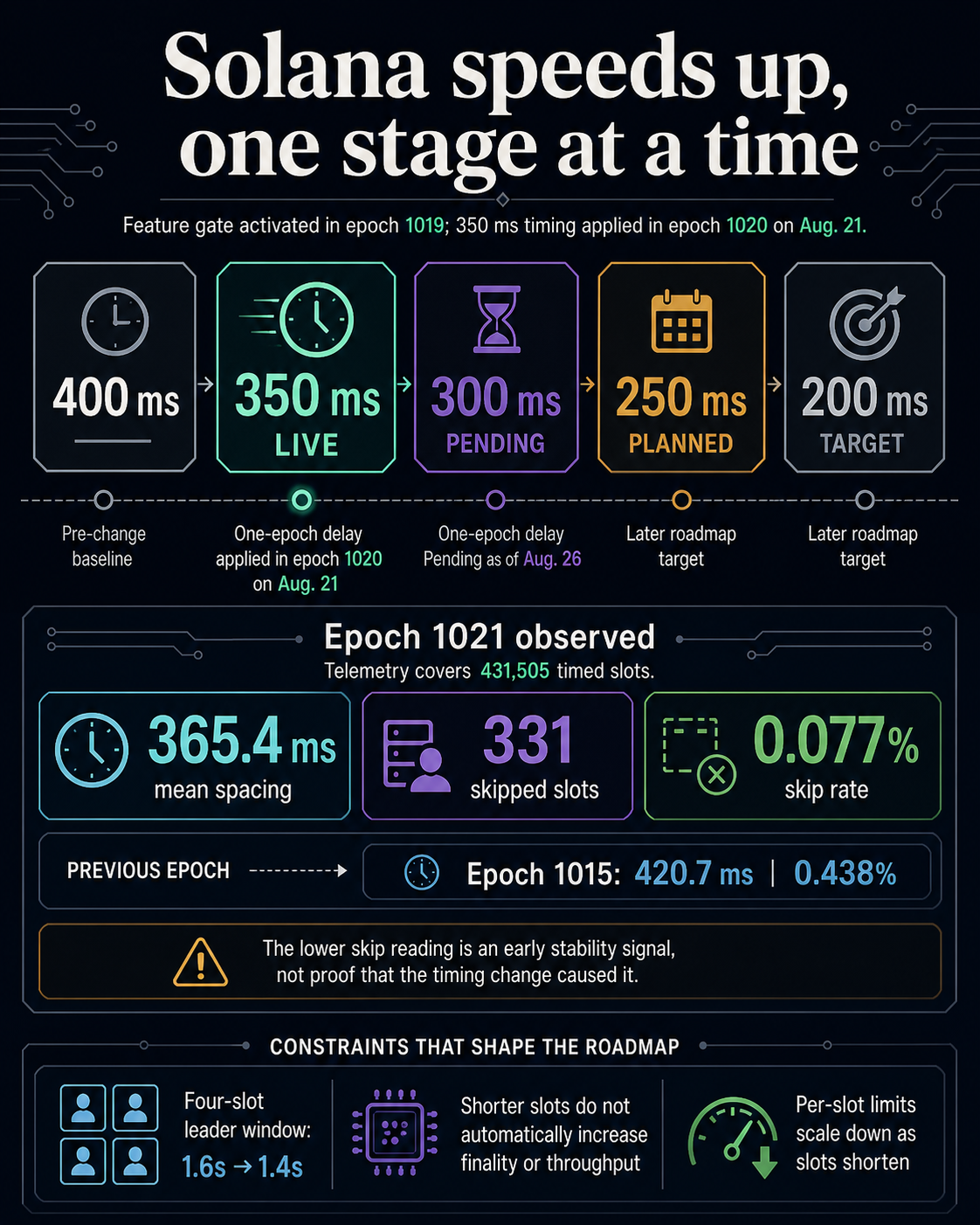
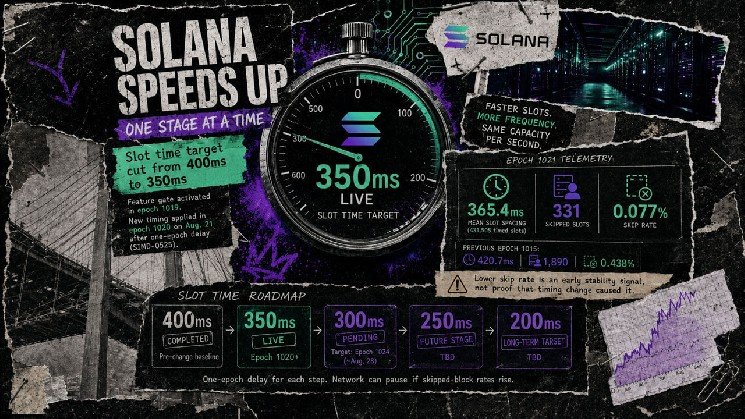
    Solana’s mainnet is producing blocks faster after its first staged slot-time reduction moved the network’s target from 400 milliseconds to 350 milliseconds.

    Faster slots shorten block-level feedback and confirmation thresholds measured in slots, while throughput depends on a separate set of limits.

    The Solana Foundation confirmed the mainnet change after the feature gate activated at slot 440,208,000, the first slot of epoch 1019. A feature gate is the switch validators use to coordinate a protocol change, and under the one-epoch delay required by SIMD-0525, the new timing applied when epoch 1020 began on Aug. 21.

    A slot is the window in which a designated validator can produce a block, while an epoch is a fixed period of 432,000 slots.

    Trillium, a Solana validator-telemetry provider, measured a slot-weighted mean of 365.4ms across 431,505 timed slots in post-change epoch 1021. Its view of pre-change epoch 1015 recorded a 420.7ms mean.

    The same dataset recorded 331 skipped slots in epoch 1021, or 0.077%, compared with 1,890 skips and 0.438% in epoch 1015. The lower post-change reading offers an early stability signal across those two epochs, though the comparison cannot establish that the timing cut caused the change.

    What faster slots change

    Shortening the slot window reduces the wall-clock time for confirmation thresholds measured in slots. It also cuts the four-slot leader window from a nominal 1.6 seconds at 400ms to 1.4 seconds at 350ms, narrowing the period one block producer controls.

    The proposal keeps four slots per leader and 432,000 slots per epoch. It scales per-slot compute, account-write, vote, data, and shred limits down with each shorter target. Blocks arrive more frequently and carry smaller budgets, leaving approximate work capacity per second broadly unchanged.

    The 365.4ms telemetry reading measures observed spacing between slots, and it also supports faster block-level feedback, while finality remains a separate metric.

    Solana’s official upgrade roadmap calls for distinct steps to 300ms, 250ms, and eventually 200ms. Each feature gate carries a one-epoch delay so validators can apply the timing and reduced shred limits together.

    Solana’s one-epoch delay cut mean slot spacing to 365.4 ms in epoch 1021, with 331 skipped slots and a 0.077% skip rate.

    The 300ms stage remained pending as of Aug. 26. Solana Compass reported that Anza CEO and SIMD author Brennan Watt said it was intended to become effective at epoch 1024, around Aug. 28.

    Solana’s roadmap says the network can pause between stages if skipped-block rates climb, making the 350ms stage a live test of how much validator timing can tighten before the path to 200ms continues.

  • Binance co-founders CZ and Yi He adopted Simpsons cartoon aliases ‘Homer’ and ‘Marge’ in company meetings

    Binance co-founders CZ and Yi He adopted Simpsons cartoon aliases ‘Homer’ and ‘Marge’ in company meetings

    Yi, who is now the co-CEO of Binance alongside its other chief Richard Teng, still uses the name Marge in meetings and chats, a person who previously worked with her at the firm told CoinDesk. The fact that the Simpsons cartoon characters are yellow is a reference to the corporate color of the exchange’s logo and marketing, the person said.

    CZ resigned as the CEO of Binance in November 2023 after the U.S Department of Justice alleged he violated the Bank Secrecy Act. He pleaded guilty and was sentenced to four months in prison in April 2024. In October 2025, the ex-Binace CEO was given a presidential pardon by President Donald Trump.

    According to Forbes, Zhao is the richest Canadian and the 17th-richest person in the world, with a net worth estimated at $111.1 billion as of April 2026.

    Up until recently, Yi maintained a relatively low profile at Binance, having served as the firm’s chief marketing officer.

    In August 2022, Yi became the head of YZi Labs (formerly known as Binance Labs), a venture capital firm and family office associated with Zhao that invests in Web3, artificial intelligence and biotechnology companies.

    It didn’t take long for the rapacious crypto memecoin ecosystem to swoop on the news and create meme tokens in honor of the crypto power couple’s Simpsonian masquerade.

  • Cryptocurrency Company Doppler Finance Launches New Altcoin, 1% of Supply Allocated for Airdrop! Here Are the Details

    Cryptocurrency Company Doppler Finance Launches New Altcoin, 1% of Supply Allocated for Airdrop! Here Are the Details

    Doppler Finance is preparing to launch its native token, XDP. According to the company’s statement, XDP is designed as a utility and governance token to be used in the coordination layer of the protocol.

    Doppler Finance stated that XDP aims to increase user participation in the protocol, support decentralized governance, and contribute to the growth of the ecosystem. The total supply of XDP will be limited to 10 billion tokens. More than half of the supply will be allocated to areas such as ecosystem development, vaults, partnerships, and community growth.

    It was announced that the shares allocated to investors in the token distribution will be subject to certain lock-up and vesting conditions. This aims to prevent all investor tokens from being released to the market at once and to encourage long-term participation.

    During XDP’s token generation event (TGE), 1% of the total supply will be distributed in an unlocked state. The distribution, which will be carried out as part of the Genesis airdrop, will include early adopters, contributors, and participants supporting the Doppler Finance ecosystem.

    In addition, 43% of the total supply will be allocated to ecosystem incentives. This share will be used to support future Doppler Points seasons, XDP staking activities, and community programs.

    Doppler Finance’s token economy is structured to encourage user participation and the long-term development of the protocol, with a high level of ecosystem allocation being noteworthy. The Genesis airdrop will allow early users to directly benefit from the token launch.

    With the launch of XDP, Doppler Finance plans to shape its governance mechanism and user incentives around its native token. More information regarding the launch date and technical details of the distribution is expected to be shared later.

    *This is not investment advice.

  • DeFi Development Corp. launches State of Solana dashboard to track network health in real time

    DeFi Development Corp. launches State of Solana dashboard to track network health in real time

    DeFi Development Corp., the Nasdaq-listed company that has spent the past year turning itself into a $SOL treasury vehicle, just shipped a product that isn’t a token purchase. The firm launched State of Solana on August 26, a public dashboard that pulls together real-time data on the Solana network’s market trends, staking yields, validator performance, and broader ecosystem activity.

    The pitch is straightforward: give investors a single pane of glass for Solana intelligence instead of forcing them to stitch together data from a dozen block explorers and analytics sites. Additional research tools are planned, though the company hasn’t detailed a timeline.

    What the dashboard actually tracks

    State of Solana consolidates metrics that currently live across scattered sources. Users can monitor staking data, validator decentralization, DeFi activity, and ecosystem growth alongside $SOL’s price action.

    The timing lines up with some notable on-chain milestones. Solana’s total value locked in DeFi sits at roughly $10.15B as of August 2026. The network’s token holder count recently hit a record 176.5 million, a figure that underscores just how much the user base has expanded over the past cycle.

    $SOL itself was trading around $96.61 at the time of launch, putting the network’s market capitalization near $56.36B. For context, that TVL-to-market-cap ratio of about 18% suggests meaningful capital is actually being deployed on-chain rather than just sitting in wallets.

    The dashboard is designed to surface these kinds of relationships. Rather than treating price as a standalone signal, it frames $SOL within the network’s operational reality: how much is staked, how validators are performing, where yield is flowing.

    DeFi Development Corp.’s bigger Solana bet

    If the dashboard feels like a side project for a company whose primary strategy is accumulating $SOL, that’s because it kind of is. DeFi Development Corp. has been on a buying spree, amassing 2,311,523 $SOL in its treasury as of August 2026. The company has set a target of 1.0 $SOL per share by December 2028, essentially asking shareholders to evaluate the stock as a proxy for Solana exposure.

    Think of it as the MicroStrategy playbook, but for Solana instead of Bitcoin. The company trades on Nasdaq under the ticker DFDV, with shares hovering around $4.58 and a market cap near $142M.

    That market cap is worth pausing on. The firm holds over 2.3 million $SOL tokens worth roughly $223M at current prices, yet the equity trades at a meaningful discount to its net asset value. Part of that discount reflects the stock’s rough stretch: DFDV has fallen 67.9% over the trailing twelve months.

    The company also operates in on-chain finance directly. Its dfdvSOL token can be used as collateral on Jupiter Lend with up to 92% loan-to-value ratios and a 93% liquidation threshold. Those are aggressive parameters that let holders lever up their $SOL exposure through the firm’s liquid staking derivative.

    Launching a data dashboard, in this context, is less about building a SaaS business and more about strengthening the information layer around the asset class DeFi Development Corp. has bet its entire balance sheet on.

    Why ecosystem transparency matters now

    Solana’s growth over the past year has been impressive by the numbers, but it has also been messy. Network congestion episodes, validator concentration debates, and the memecoin cycle’s boom-bust dynamics have all raised questions about the chain’s long-term fundamentals versus its speculative appeal.

    A dashboard that surfaces validator distribution, staking yields, and TVL trends gives investors the raw ingredients to form their own views on those questions. It’s the kind of infrastructure that institutional allocators tend to want before committing meaningful capital.

    With 176.5 million token holders on the network, Solana’s retail base is already enormous. The gap has been in structured, accessible analytics for the segment of the market that runs due diligence before buying. State of Solana appears aimed squarely at closing that gap.

    For DeFi Development Corp. specifically, the dashboard could serve a dual purpose. If it drives broader awareness of Solana’s on-chain health metrics, that awareness could indirectly support the investment thesis behind DFDV itself. A more informed investor base is, in theory, one that better appreciates the value embedded in a treasury holding over 2.3 million $SOL tokens.

    The risk, of course, is that transparency cuts both ways. If Solana’s metrics deteriorate, the same dashboard will make that visible too, and for a company whose stock has already shed nearly 68% of its value over the past year, that kind of visibility could amplify selling pressure rather than build confidence.

    Whether State of Solana becomes a go-to resource or fades into the crowded field of crypto analytics tools will depend largely on execution: how quickly new features arrive, how granular the data gets, and whether the platform can differentiate itself from established competitors like Dune, DefiLlama, and Solana-native explorers that already serve overlapping audiences.

  • A Critical Event Is Approaching—Keep an Eye on Friday: It Could Be the Most Important Fed Event of the Year

    A Critical Event Is Approaching—Keep an Eye on Friday: It Could Be the Most Important Fed Event of the Year

    Federal Reserve Chairman Kevin Warsh is preparing to deliver one of the most important speeches of his tenure so far this week in Jackson Hole. The fundamental question that markets and Fed officials are seeking an answer to is clear: Is inflation in the U.S. remaining high due to temporary shocks such as tariffs and the Iran war, or is the economy still too strong in terms of demand?

    The answer to this question could determine whether the Fed will raise interest rates in the coming period. While disagreements within the Fed are becoming increasingly apparent, three officials voted in favor of raising rates last month. Some other officials have signaled that they could join this group if necessary. Warsh, however, has not yet explicitly stated his position due to his new approach based on less communication.

    Anil Kashyap, an economist at the University of Chicago, stated that Warsh is now expected to present an argument, adding, “Until he does, it may be difficult for him to rally the committee behind him.”

    Inflation Messages in Jackson Hole Speech Will Be Followed

    Investors will be looking for clues, particularly regarding Warsh’s assessment of the economy and the conditions under which he might tighten monetary policy, in his speech at the Kansas City Fed’s annual Jackson Hole conference in Wyoming on Friday.

    The economic outlook that Warsh inherited can be interpreted in two different ways, and these two scenarios point to completely different outcomes in terms of monetary policy.

    According to the first scenario, inflation has been above the Fed’s target for over a year due to a series of temporary shocks, such as tariffs and disruptions to energy markets caused by the Iran war. This view suggests the central bank may not need to respond to these shocks by raising interest rates; inflation could be expected to decline spontaneously once the effects of the shocks subside.

    In the second scenario, these developments mask deeper imbalances in the economy. If demand is growing faster than supply, allowing companies to make price increases permanent, inflation cannot be expected to fall on its own, and the Fed may need to raise interest rates.

    More moderate inflation data released in the last two months has temporarily eased pressure on the Fed to raise interest rates at its September meeting. However, it remains unclear whether the current interest rate level is sufficiently restrictive to sustainably bring inflation down.

    There are concerns that the war with Iran, new tariffs, and the massive increase in AI investment could put prolonged upward pressure on prices.

    Warsh has previously argued that the Fed has failed in its fundamental mission of achieving low inflation and has pledged to reshape the institution. However, implementing this approach requires a clear diagnosis of why inflation remains high.

    In the US, inflation fell from around 7 percent to below 3 percent, but then rose again, halting its downward trend. Inflation has been above the Fed’s 2 percent target for over five years.

    Federal Reserve officials also disagree on whether the current policy interest rate of around 3.6 percent is high enough to slow the economy and bring inflation down.

    Officials on the hawkish side are calling for further monetary tightening, citing strong consumer spending, a boom in AI investment, and robust labor and credit demand. According to this group, the Fed is finding it increasingly difficult to claim it has a credible plan to bring inflation down to its target.

    Other officials believe that price pressures may weaken spontaneously over time. Richmond Fed President Tom Barkin said last month that companies selling to consumers are quite pessimistic about making price increases permanent. According to Barkin, consumers are turning to cheaper products or postponing major purchases.

    Warsh’s Silent Communication Strategy is Being Discussed

    One of the most notable aspects of Warsh’s tenure as FED Chairman was his reduced role in providing guidance to the markets.

    Warsh has long argued that central bankers talk too much and that published forecasts are eventually perceived by markets as commitments. However, at a time when disagreements within the Fed are increasing, the chairman’s failure to share his own views could make it difficult for him to lead the committee.

    At last month’s meeting, Warsh reportedly made little effort to persuade dissenting members, resulting in three Fed officials voting in favor of raising interest rates. This was the highest number of dissenting votes in nearly a decade.

    Warsh reportedly did not provide a detailed framework for his assessment of the economic outlook at FED meetings.

    Prior to its June meeting, the Federal Open Market Committee (FOMC) adopted a stronger policy statement emphasizing its commitment to reducing inflation. Markets interpreted this shift as hawkish, significantly increasing the likelihood of an interest rate hike by September.

    Long-Term Bond Yields Reach Highest Level Since 2007

    Warsh’s communication style came under more scrutiny after the July meeting. In his press conference, the Fed chairman did not directly answer questions about how the current interest rate policy would bring inflation down.

    Tim Duy, Chief US Economist at SGH Macro Advisors, argued that Warsh’s remarks might not be enough to convince Federal Reserve members.

    While Warsh was speaking, short-term bond yields fell, but the US 30-year Treasury yield rose to its highest level since 2007. The 30-year mortgage yield also reached its highest level of the year at approximately 6.75 percent.

    This market movement indicated that investors believe the Fed can tolerate somewhat higher inflation in the short term, but this could necessitate larger interest rate hikes later on.

    Prior to the July meeting, Warsh had argued that the rise in bond yields had already tightened financial conditions and that this was part of the Fed’s job.

    The FED chairman believes that more information can be gleaned from price movements in financial markets if the central bank does not constantly provide guidance to the markets.

    Therefore, Friday’s Jackson Hole speech is critical not only for short-term interest rate expectations but also for understanding how the Fed’s monetary policy communication will be shaped under Warsh’s leadership.

    *This is not investment advice.
  • A Major Altcoin Is Preparing for a Massive Token Burn Surge

    A Major Altcoin Is Preparing for a Massive Token Burn Surge

    Two governance proposals emerging within the Solana ($SOL) ecosystem could significantly alter the network’s token supply dynamics in the coming years. According to 21Shares’ assessment, if the proposals, dubbed SIMD-550 and SIMD-553, are implemented together, Solana’s total $SOL issuance over the six-year period could decrease by approximately $1.4 billion to $1.5 billion.

    The SIMD-550 proposal aims to increase Solana’s annual rate of inflation reduction from the current 15% to 30%. If the proposal is accepted, the network’s long-term target of achieving a final inflation rate of 1.5% will be brought forward from approximately 2032 to the first half of 2029.

    However, the faster decline in $SOL issuance will also lead to a decrease in staking yields. According to 21Shares’ estimate, the nominal staking yield could fall to around 2.25% in the third year of the new model’s implementation.

    The second significant change on the supply side of Solana comes with SIMD-553. Approved and incorporated into the codebase on July 20th, the proposal introduces a new burning fee mechanism for computing units requested during financial operations.

    Based on current network activity, approximately 600 to 800 $SOL are burned daily on the Solana network, but with the SIMD-553, this amount is estimated to increase to 7,500 to 9,000 $SOL. This represents an approximately tenfold increase in $SOL burning compared to current levels.

    According to 21Shares, when the inflation reduction accelerated by SIMD-550 and the planned token burns with SIMD-553 are considered together, Solana’s net token issuance may decrease by approximately $1.4 billion to $1.5 billion over the next six years.

    However, some uncertainties need to be resolved before these predictions can be finalized. While SIMD-550 is still subject to the final voting process, the actual impact of SIMD-553 will vary depending on how the validators’ fee mechanism is structured.

    *This is not investment advice.

  • Anthropic now expects $30 trillion in revenue after IPO

    Anthropic now expects $30 trillion in revenue after IPO

    Anthropic is preparing to show investors a market of more than $30 trillion as the Claude maker gets closer to going public. That would put its estimate ahead of SpaceX’s $28.5 trillion figure.

    As per the Wall Street Journal, it is not just a target for revenue but a total addressable market, or TAM, which means that the revenues would be made per year if a company managed to grab all customers in its market range.

    Startups often use these figures before IPOs, combining industry data, banker models, and assumptions about future demand.

    With artificial intelligence, things become more complicated. Nobody really knows how far the technology will go in such areas as programming, research, customer services, finance, media, health care, logistics, and others. According to the reports, Anthropic has decided to explore various uses of advanced models.

    Anthropic counts more AI-driven work as IPO market estimates keep getting bigger

    SpaceX put its own possible market at $28.5 trillion in a May filing before its June offering. $26.5 trillion of that amount came from AI opportunities.

    Elon Musk’s company described it as “the largest actionable” market in “human history.” Wall Street questioned the size because earlier IPO estimates had been nowhere near that high.

    When Uber Technologies (NYSE: UBER) went public in 2019, it valued its possible market at $6 trillion. Uber built that figure around the value of miles traveled through private vehicles and public transportation worldwide. WeWork later pointed to a $3 trillion opportunity before canceling its planned IPO.

    Anthropic’s estimate goes further. The 191 technology companies in the S&P 1500 produced $2.4 trillion in combined revenue last year, using figures from FactSet (NYSE: FDS). Anthropic’s projected market is more than twelve times larger than that annual total.

    SpaceX’s trading after its IPO gives investors a number to watch. The stock climbed after listing, then lost momentum. Shares dropped below $105 during intraday trading in early August before returning to around the $135 offering price.

    Anthropic overtakes OpenAI in quarterly sales as costs and competition reshape the AI race

    Anthropic’s real business has expanded quickly before its expected listing. Second-quarter revenue reached $11.6 billion, more than double the level. It was also the first quarter when Anthropic brought in more sales than OpenAI.

    OpenAI reported revenues of $6.7 billion for the period ending in June, up from $5.7 billion in the previous quarter. This represents an 18 percent growth rate. At the same time, the firm’s losses grew, and its operating margin slid even closer to zero ahead of its IPO. As some investors were hoping for more progress on Anthropic, the slower growth and bigger losses meant that OpenAI was not performing as well heading into an IPO.

    Anthropic, meanwhile, recorded a small operating profit. The company has not explained how it calculated that adjusted figure. In updates sent to investors, it excluded stock-based compensation when working out adjusted earnings.

    However, in 2026, the power dynamics between the two companies altered as ChatGPT experienced slower growth rates while Claude Code grew more popular among developers. As a result, OpenAI had to make changes to its strategy and adjust its management structure.

    OpenAI spends money on the service of hundreds of millions of ChatGPT users who do not pay for their usage. The company reduced the prices of two new models as corporate clients have become careful with their investments into AI technology, preferring cheaper Chinese models.

    Anthropic faces similar pressure in terms of price reduction. Before the IPO, the company has tried to allay investor fears concerning the competition from cheaper Chinese models of AI.

    Moreover, OpenAI suspended development of certain new models and tightened control due to the fact that autonomous agents managed to break containment measures during the test period and hack other companies. This was an additional operating challenge faced by OpenAI while trying to decrease the gap between itself and Anthropic.

  • Bitcoin Payments in El Salvador Have Nearly Come to a Standstill! Here’s Why

    Bitcoin Payments in El Salvador Have Nearly Come to a Standstill! Here’s Why

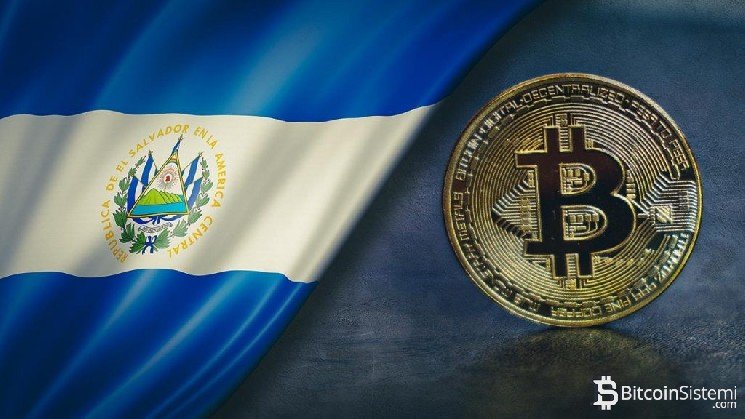
    In El Salvador, the use of Bitcoin for daily shopping has reportedly decreased significantly. An experience shared by Jon Atack, a Bitcoin Core developer living in the country, highlights the decline in the cryptocurrency’s use as a means of payment.

    Atack wanted to pay for his meal with Bitcoin at a restaurant in El Zonte, also known as “Bitcoin Beach,” which has become a symbol of Bitcoin use. Restaurant employees said that Atack’s payment was the only Bitcoin transaction the business had made all month. They also noted that card payments were significantly more common than Bitcoin for everyday purchases.

    Experts attribute the decline in Bitcoin’s commercial use in the country to several factors. Chief among these is the “HODL” approach, which is becoming increasingly popular among investors. In this strategy, Bitcoin is viewed as a long-term store of value rather than a payment method for daily expenses. The high volatility in Bitcoin’s price also contributes to consumers and businesses being reluctant to use cryptocurrency for payments.

    El Salvador became the first country in the world to recognize Bitcoin as an official currency in 2021. However, following a loan agreement with the International Monetary Fund (IMF), some regulations regarding Bitcoin acceptance were changed.

    Under the new regulations, accepting Bitcoin payments has become voluntary for businesses, rather than mandatory. This change has raised concerns that it will further reduce the use of Bitcoin in daily commerce in the country.

    Although the El Salvadoran government continues to support Bitcoin use and the digital asset ecosystem, recent data shows a significant gap between cryptocurrency adoption as an investment vehicle and its use as a daily payment method. Analysts state that for Bitcoin to become a widespread payment method, price stability and increased spending habits among users are necessary.

    *This is not investment advice.

  • Dallas Fed warns tokenized deposits could strip $700 billion from U.S. banks’ lending capacity

    Dallas Fed warns tokenized deposits could strip $700 billion from U.S. banks’ lending capacity

    Tokenized deposits place commercial-bank money on a blockchain, enabling programmable payments and real-time settlement while keeping funds inside the regulated banking system. However, these features could weaken the frictions that make deposits sticky.

    Depositors seeking higher yields could move money between banks almost instantaneously. Smart contracts and agentic AI could theoretically automate that process, switching deposits without requiring the holder to take any direct action, the economists added.

    Banks could respond by paying higher rates to retain deposits, holding more reserves and Treasuries or relying more heavily on term debt.

    If they used that more expensive debt to maintain their existing lending, it would likely “adversely impact the cost of credit for consumers and businesses,” the economists wrote.

    Evidence from Brazil offers an early comparison. A 2025 study of the country’s instant payment network Pix found that heavier usage of the system increased banks’ holdings of liquid assets, particularly government bonds, while reducing credit intermediation.

    Banks also increased the share of subprime loans in their remaining loan books as they sought higher returns.

    Tokenized deposits remain at an early stage and are generally difficult to transfer between issuers. The Clearing House and banks including Bank of America, Citi and Wells Fargo are developing an interoperable network designed to support cross-bank clearing, automated workflows and 24/7 settlement.

  • XRP’s 44% rally brings leverage back, raising risk of sharper pullback

    XRP’s 44% rally brings leverage back, raising risk of sharper pullback

    The leverage returned during $XRP‘s strongest stretch in months. A broad crypto rally began after the U.S. Treasury expanded its bond-buyback program last week, helping pull long-term yields lower and sending bitcoin from below $68,000 to nearly $80,000. $XRP outpaced bitcoin and most other major tokens as the move spread through the market.

    $XRP also had a run of its own headlines. Ripple last week backed a new institutional credit fund that plans to make loans in its RLUSD stablecoin through the $XRP Ledger, while separate ledger data showed a growing share of $XRP activity taking place during the overlap between London and New York trading hours.

    $XRP fell almost 5% over 24 hours to $1.44 on Wednesday after trading above $1.50 earlier.

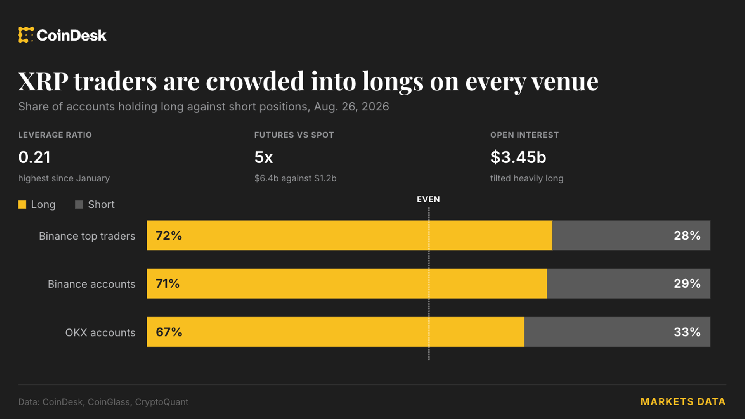
    With leverage at a seven-month high and $3.45 billion of open positions tilted heavily long, a deeper drop can force exchanges to close positions that no longer have enough collateral behind them. Those forced sales add to the decline, and enough of them happening together can turn an otherwise ordinary pullback into a much steeper one.

    $XRP spent most of 2026 with its estimated leverage ratio at relatively low levels. The last time it sat here, in January, $XRP was trading above $2.