Tag: CRYPTOS FoxBusiness

  • Which is a Better Alternative to Bitcoin? Morgan Stanley Prefers This Altcoin to Ethereum!

    Which is a Better Alternative to Bitcoin? Morgan Stanley Prefers This Altcoin to Ethereum!

    Bitcoin rose above $64,000 following weaker-than-expected US CPI and PPI data. However, further gains are limited due to simultaneous selling by both long-term and short-term investors.

    While Bitcoin, Ethereum, and altcoins are also experiencing gains, noteworthy statements have come from the US banking giant Morgan Stanley.

    At this point, a Morgan Stanley analyst compared Solana to Ethereum, the largest altcoin.

    And here, $SOL has historically been highlighted as a better diversification tool than $ETH.

    Speaking to Coindesk, Morgan Stanley investment strategist Denny Galindo argued that Solana has historically been a superior diversification asset compared to Ethereum.

    Galindo notes that with the rise of spot Bitcoin ETFs, followed by Ethereum and Solana ETFs, the question of which digital assets investors should include in their portfolios alongside Bitcoin has come to the forefront.

    Galindo also stated that the correlation coefficient between Bitcoin and $ETH is 0.78 until April 2026, while the correlation between Bitcoin and $SOL is 0.72, explaining that the BTC-$SOL correlation is lower.

    According to the analyst, this suggests that Solana is slightly less likely to move in the same direction as Bitcoin. The lower correlation indicates a higher probability of Solana moving independently of Bitcoin, and therefore contributing more to portfolio diversification.

    The analyst also notes that Solana’s correlation with the S&P 500 is slightly lower compared to Bitcoin and Ethereum.

    Based on these historical correlations, Galindo concluded that $SOL could be a better diversification asset than $ETH. However, the analyst pointed out that Solana has higher price volatility than Ethereum, and investors should consider this risk factor when evaluating the diversification advantage.

    *This is not investment advice.

  • VELVET slides 18% – But key data points to consolidation, not sell-off

    VELVET slides 18% – But key data points to consolidation, not sell-off

    Velvet [$VELVET] has emerged as one of the market’s heaviest losers over the past day, sliding roughly 18% across the session as sellers took control.

    Despite the recent pullback, Velvet has held its position as one of the strongest gainers across the market over the past couple of months.

    Over the last 90 days alone, the token has outpaced every asset in the top 100 by market capitalization, posting a 571% gain that edged out the next-best performer, Audiera [BEAT], which surged 530% over the same stretch.

    Leveraged capital exits Velvet’s Futures market

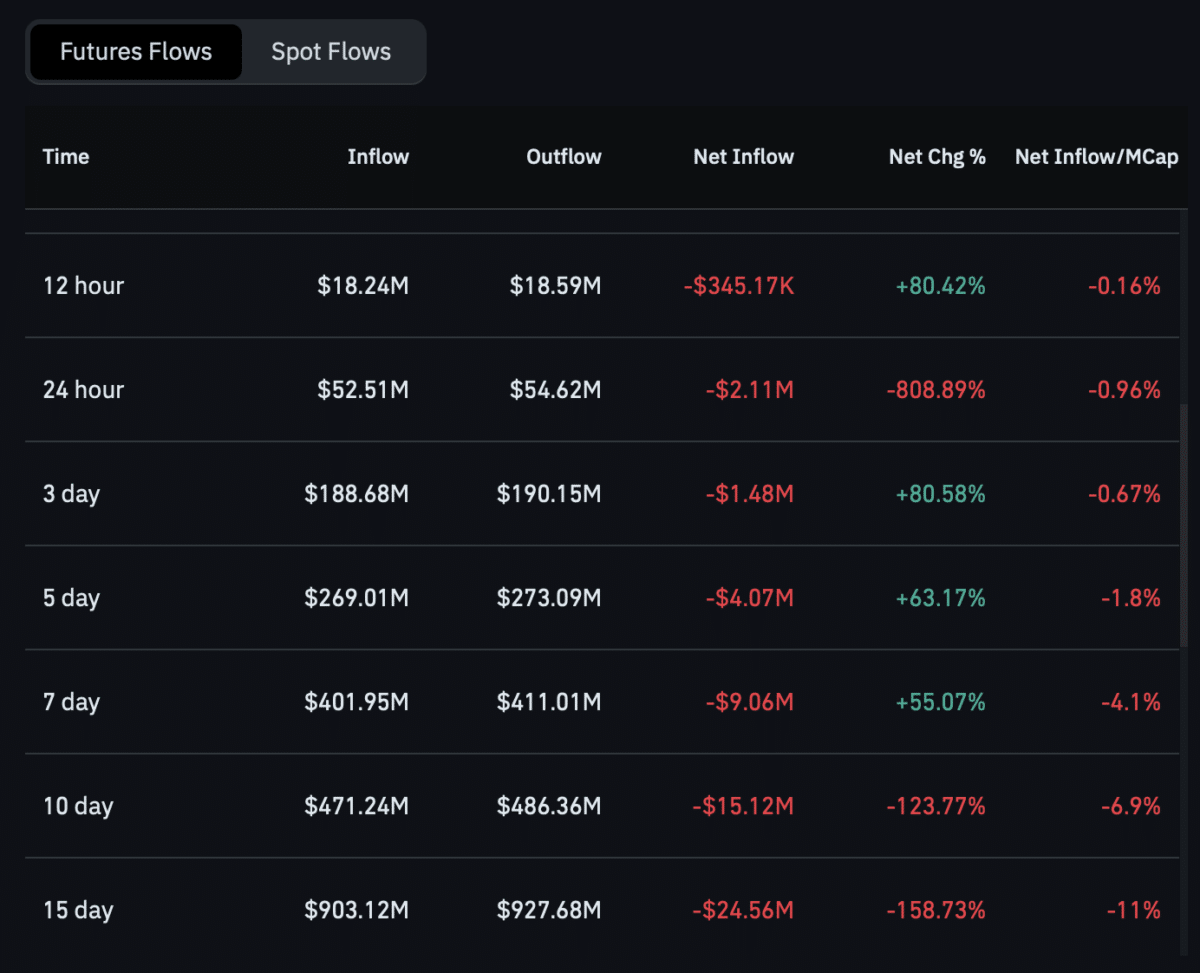
    A leading concern now weighing on Velvet is the capital exodus spreading across its market. The token’s perpetual Futures market shows heavier outflows than inflows, a sign that money is leaving rather than entering.

    Capital draining from a market typically signals that investors are pulling their funds out, a move that often reflects bearish sentiment. Roughly $24 million has flowed out of the perpetual market over the past two weeks, pointing to investors heading for the exits.

    Source: Coinglass

    Rising prices usually breed confidence and draw fresh capital into a market, yet Velvet has seen the opposite, with profit-taking and capital flight dominating the flows and underscoring the prevailing sentiment.

    Spot market investors have failed to keep pace with the move, buying comparatively little $VELVET over the same window. The chart shows a total Spot netflow of roughly $847,000.

    Spot buying of that scale rarely fuels a rally on its own, leaving little chance that price mounts a meaningful move to the upside off the back of it.

    Why Velvet’s decline isn’t bearish control

    On the surface, Velvet’s slide and the capital retreat from its perpetual market look like bearish dominance, yet the data underneath tells a more nuanced story.

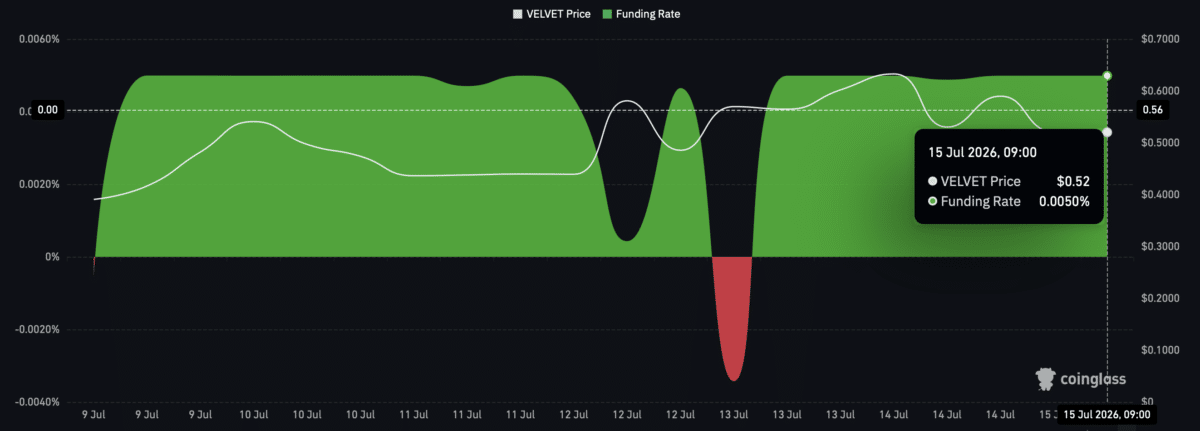
    Chart data shows that even as capital exits mounted over the past two weeks, traders in Velvet’s perpetual market have clung to a bullish outlook.

    Funding Rate data, which reveals which side of the market holds control based on who pays the funding fee, shows that longs have stayed in command.

    Source: Coinglass

    Despite the $2.17 million net outflow recorded over the past 24 hours, the Funding Rate reached 0.0044%, suggesting that the $27.87 million perpetual market balance still sits largely in long positions.

    One side, long or short, typically takes command when strong conviction builds that price will swing higher over the short to near term.

    In this case, the sentiment holds that Velvet’s decline looks more like consolidation and capital management from traders who have banked massive gains.

    This hangs on one key support level

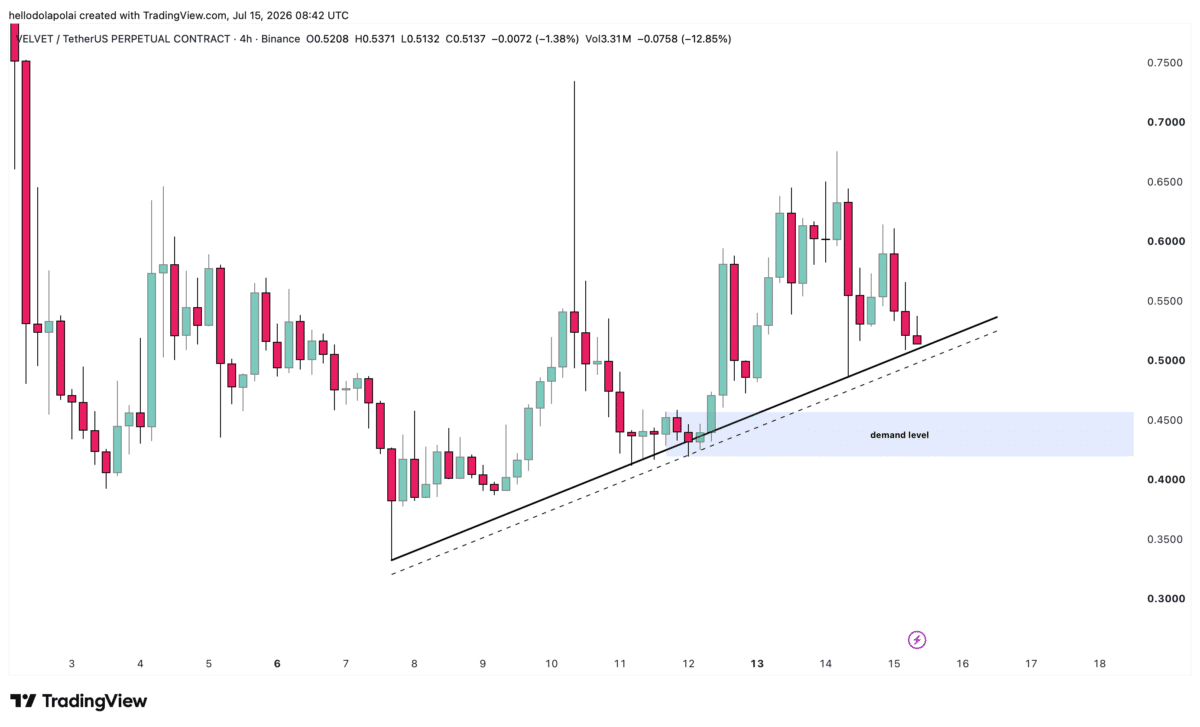
    Chart analysis places Velvet a single key level away from either staging a rebound or extending its slide.

    That read stems from price trading into an ascending support line that has powered rebounds on multiple occasions, at least three times so far.

    A breakdown from this level could send Velvet tumbling once more toward $0.45, where a key demand zone sits and could serve as a rebound catalyst.

    Source: TradingView

    Should the ascending support hold instead, Velvet’s rebound could already be taking shape. The support level remains the chart’s decisive area to watch for the next move.

    Final Summary

    • Velvet fell roughly 18% in a single day, but it remains one of the market’s top performers over the past three months, gaining 571% in 90 days and beating every other top-100 token.
    • $24 million left the perpetual market over 2 weeks, yet longs still control the balance.
  • Kalshi traders price 88% chance of $4 US gas by July end

    Kalshi traders price 88% chance of $4 US gas by July end

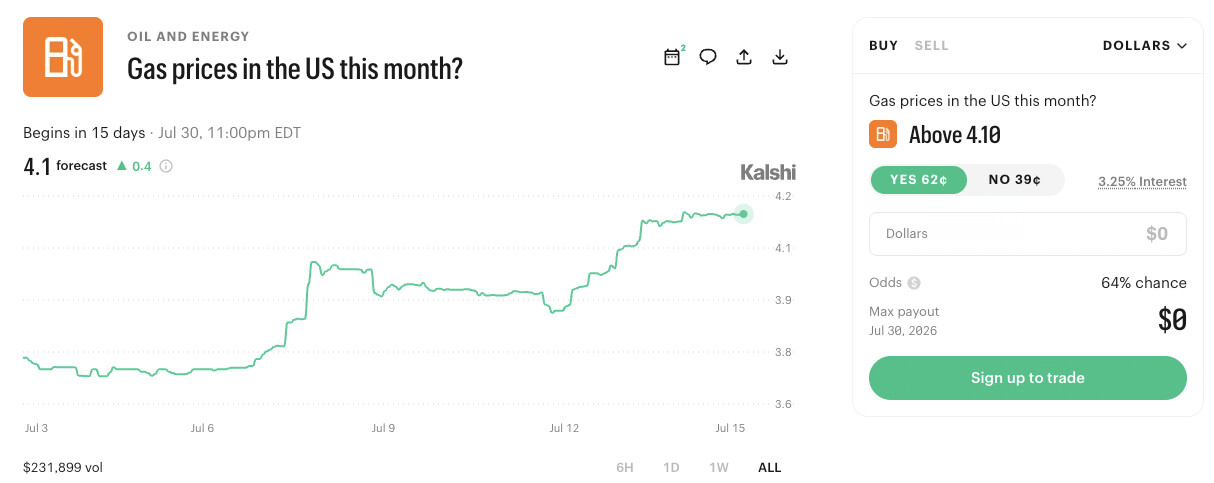
    Kalshi traders now price the odds of the US national average gas price exceeding $4 per gallon by the end of July at 88%, per CNBC’s Wednesday market tracking. The same contract sat at 56% two days ago.

    Source: Kalshi

    Traders also give a 64% chance that the average crosses $4.10 and less than 5% odds of hitting $4.50. The contract resolves using AAA’s daily national average, which stood at $3.89 on Wednesday, up about three cents from Tuesday. This year’s high was $4.56, set on May 21.

    US-Iran strikes push gas-price odds sharply higher

    The move followed the end of the US-Iran ceasefire last week and a fresh wave of strikes on Wednesday. US Central Command posted on X that a second round of strikes launched at 3 p.m. ET, targeting what it called “military capabilities Iranian forces have used to attack commercial shipping in the Strait of Hormuz.”

    The Strait represents the bottleneck for about a fifth of the world’s oil shipments, and the gas contract of Kalshi has followed events in the waterway very closely through 2026. West Texas Intermediate futures for August delivery closed Wednesday at $79.60 per barrel, up 26 cents on the day, marking the third straight session of gains.

    Brent’s September contract settled at $84.95, also up 0.3%. Oil fluctuated to a lesser extent than the Kalshi contract since the difference between pump prices and crude prices is about one week, and Kalshi traders are banking on the difference to catch up by July 31.

    Prediction markets read the shock as more than noise

    As Cryptopolitan earlier reported, Kalshi’s contracts have already tracked the oil-and-Iran story since May, when the platform priced a 2026 US recession at roughly 32.5% odds as oil crossed $100 per barrel.

    A separate Federal Reserve-affiliated study in early 2026 found Kalshi’s forecasts matched Wall Street and New York Fed survey accuracy across multiple Fed decisions and beat professional forecasters on headline CPI. That track record is what makes Wednesday’s 32-point swing worth reading as a signal rather than noise.

    Traders repricing from a 56% coin flip to a near-certainty in 48 hours suggests the crowd sees the Strait disruption as durable enough to push through the two-week window before month-end. On July 9, before Wednesday’s strikes, Kalshi traders gave a 75% chance that gas would still be above $3.50 per gallon on Election Day November 3, and 39% odds it would exceed $3.75.

    Those Election Day contracts have not moved as sharply in response to this week’s escalation, suggesting the crowd expects the near-term supply shock to peak in July and moderate by fall.

    Traders price in a short-term war premium at the pump

    Before the US-Iran war began in late February, US gas averaged below $3 per gallon, per AAA. Wednesday’s $3.89 average is roughly 30% above that baseline. The Kalshi crowd’s 88% odds on $4 gas by month-end means the market has effectively priced the war premium as permanent for at least the next two weeks.

    If the Strait of Hormuz remains a live target for US strikes past July 31, the same crowd will likely reprice the Election Day contracts higher as well.

  • Bitcoin Whales Are Not Selling Over Quantum Fears, Analyst Says

    Bitcoin Whales Are Not Selling Over Quantum Fears, Analyst Says

    Quantum Fears Appear to Be Influencing Buyers, Not Bitcoin Sellers

    Bitcoin’s largest holders have not attributed selling activity to quantum computing risks, according to Alex Thorn, managing director and head of firmwide research at Galaxy Digital, separating the technology debate from recent whale activity.

    On July 15, he wrote on X:

    “We work with a lot of whales and none has mentioned quantum as a reason for selling.”

    The comment suggests that quantum concerns have entered bitcoin’s investment debate without becoming an identified reason for large-holder selling.

    Institutional investors appear to be approaching the issue differently. “Have heard quantum fears as a reason not to buy from institutional investors, though,” Thorn revealed, indicating that concerns may be affecting potential buyers rather than existing holders looking to exit positions.

    The distinction comes as bitcoin investors continue examining the reasons behind major supply movements from older wallets. Galaxy’s research suggests recent whale activity reflects a broader distribution cycle rather than concerns about future quantum computing threats.

    Galaxy’s ‘Great Distribution’ Saw Old Bitcoin Return to Activity

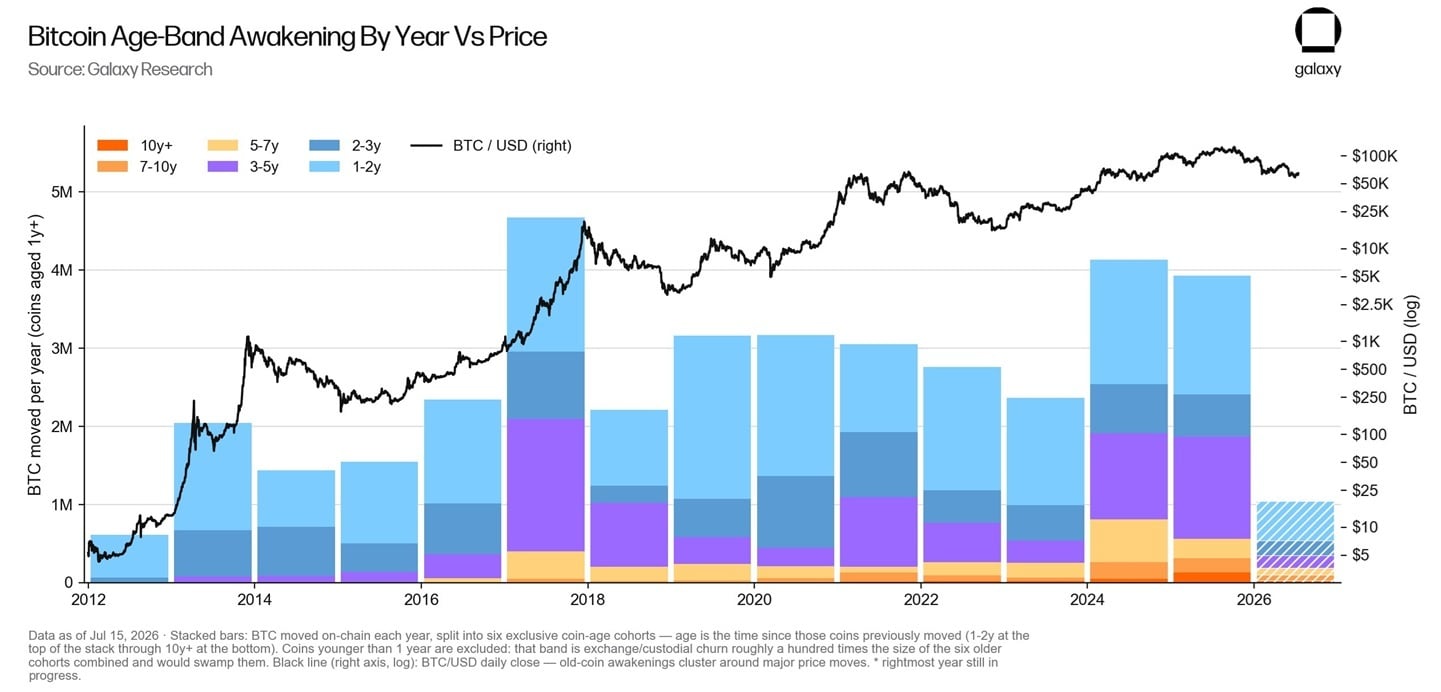
    Galaxy Research data show that large amounts of older bitcoin returned to activity during 2024 and 2025, creating one of the biggest waves of dormant supply movement in the network’s history.

    “An enormous amount of old BTC came online and moved onchain in 2024 and 2025, rivaled only by 2017,” Thorn stated in another July 15 X post. The head of research labeled this period a “great distribution,” describing the movement of previously dormant coins back into circulation. He noted:

    “This ‘great distribution’ is mostly over and 2026 is on pace to see less than half the amount of awakened coins as last year.”

    The decline in awakened coins suggests the large wave of older bitcoin movement has slowed. However, on-chain movement alone does not identify whether coins were sold, transferred between wallets, moved by custodians, or used for other purposes.

    Bitcoin’s Quantum Challenge Remains Focused on Future Preparation

    The quantum computing debate around bitcoin centers on whether future quantum machines could threaten existing cryptographic protections and whether the network can adapt before that becomes a practical risk. Researchers have examined potential vulnerabilities in digital signatures and possible approaches for strengthening blockchain security.

    The challenge for Bitcoin developers is preparing for a potential future threat before quantum computers reach the capability required to compromise existing protections. Any major cryptographic transition would require coordination across bitcoin participants.

    Thorn remarked:

    “Work is being done on quantum and more work is coming, so I think those fears will assuage.”

    The comment reflects the view that continued research and preparation could reduce investor concerns over time.

    Quantum risk has also appeared in institutional research on digital assets. Coinbase Institutional has described quantum computing as a long-term consideration for bitcoin and discussed possible mitigation strategies for addressing the threat.

    The market question now is whether quantum concerns remain a long-term consideration for investors or eventually become a factor in bitcoin positioning. For now, Galaxy’s comments indicate that the issue is influencing some potential buyers while remaining separate from reported whale selling decisions.

  • BREAKING! US PPI Data Released! Here’s Bitcoin’s (BTC) Initial Reaction!

    BREAKING! US PPI Data Released! Here’s Bitcoin’s (BTC) Initial Reaction!

    Yesterday’s lower-than-expected CPI data triggered an upward movement in Bitcoin and altcoins. In this context, $BTC rose above $64,000, while Ethereum and other altcoins also saw significant increases.

    The lower-than-expected CPI data marks the strongest monthly decline since April 2020, with experts noting that the drop in energy prices is the most significant reason for the slowdown in inflation.

    Related News BREAKING! Critical US Inflation Data Released! What Was Bitcoin’s ($BTC) Initial Reaction?

    Following the CPI data, investors’ expectations regarding the Fed’s monetary policy have been reshaped. Prior to the CPI release, the probability of a Fed interest rate hike in July was priced at 40%, but this figure dropped to 16% after the data.

    At this point, the weakening likelihood of a tighter monetary policy from the Fed increased appetite for risky assets like Bitcoin and pushed the $BTC price higher.

    After Bitcoin rose above $64,000 following the CPI data, attention is now focused on the US PPI data.

    In this context, the June data for the US Producer Price Index (PPI), one of the indicators that the FED closely monitors when making its decisions, has also been released.

    The data released is as follows:

    Core Producer Price Index (Monthly): Announced 0.2% – Expected 0.3% – Previous 0.4%

    Core Producer Price Index (Annual): Announced 4.7% – Expected 5.2% – Previous 4.9%

    Producer Price Index (Monthly): Announced -0.3% – Expectation 0.0% – Previous 1.1%

    Producer Price Index (Annual): Announced 5.5% – Expected 6.2% – Previous 6.5%

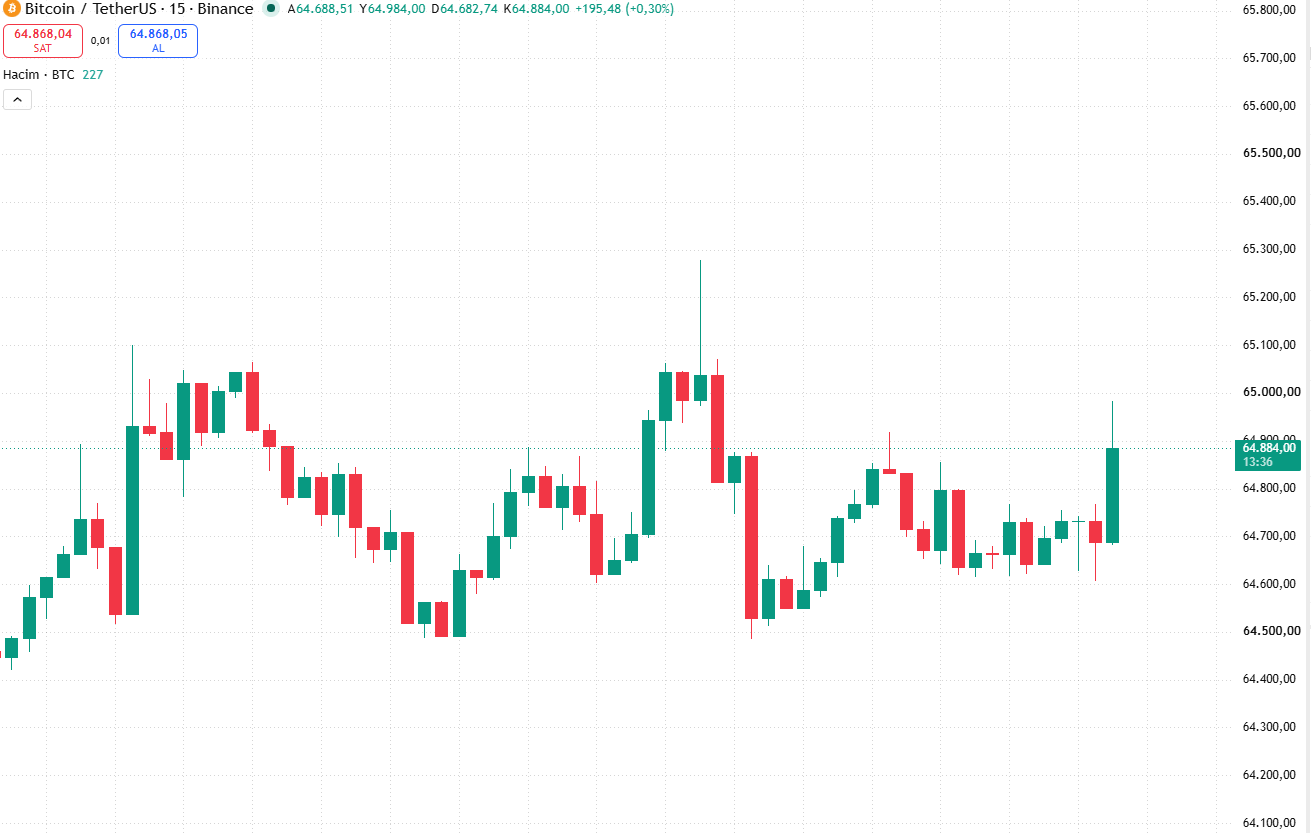
    Bitcoin’s initial reaction after the release of the PPI data was as follows:

    *This is not investment advice.

  • A timeline of the Ethereum Foundation’s ongoing shakeup

    A timeline of the Ethereum Foundation’s ongoing shakeup

    The Ethereum Foundation entered 2026 under mounting pressure. Developers, investors and prominent Ethereum community members had spent months criticizing the organization’s pace of execution, governance and technical priorities, with many arguing Ethereum’s roadmap had become overly focused on layer-2 scaling while neglecting improvements to the base layer.

    The first major shakeup to the foundation came in February, when co-executive director Tomasz Stańczak announced he would step down after helping lead the foundation through its initial restructuring. A few weeks later, the foundation published a new mandate outlining a narrower vision for its role within the Ethereum ecosystem. Built around the CROPS framework — censorship resistance, resilience, openness, privacy and security — the document recast the foundation as a long-term steward rather than the ecosystem’s primary builder or coordinator.

    The leadership transition was followed by a steady stream of departures. Over the following months, nine senior foundation leaders, researchers and executives left the organization, marking one of the largest periods of turnover in its 12-year history. The exits fueled speculation about the foundation’s future even as its leadership insisted the changes were not a sign of decline, but rather a necessary part of a broader organizational reset.

  • First Strong Bullish Signal for Ethereum! German Analysis Company Reveals Must-Break Levels for an Uptrend!

    First Strong Bullish Signal for Ethereum! German Analysis Company Reveals Must-Break Levels for an Uptrend!

    Yesterday’s lower-than-expected CPI data triggered an upward movement in Bitcoin and altcoins. In this context, BTC rose above $64,000, while Ethereum climbed 5% in the last 24 hours to reach $1,870.

    While $ETH investors are hopeful for a continuation of the uptrend, analysts at the German analytics company Makrovision Research shared their technical analysis and stated that the first strong signal for an upward move has arrived.

    According to analysts, Ethereum has given the first long-awaited positive signal on the technical front. With the $ETH price rising above its recent significant peak of around $1,850, the ongoing series of lower peaks in the short term has been broken. This development indicates that buyers are beginning to regain strength.

    However, analysts warn that the current rise alone does not mean the start of a new bull trend.

    Ethereum’s price is still trading below the long-term downtrend line and the critical resistance zone at $2,130. Therefore, the current rise alone cannot be considered a permanent trend reversal.

    Analysts stated that there are currently two critical levels that should be closely monitored: “$1,730 and $1,850”.

    “If Ethereum manages to stay above the $1,730 support level and holds onto the $1,850 level, the possibility of the price testing the $2,130 resistance level may increase.”

    Conversely, if Ethereum falls below $1,730 again, selling pressure may increase, and the possibility of a drop to $1,545 and $1,400 levels may resurface.”

    In conclusion, while the breakout from the short-term bearish pattern is considered a positive development for Ethereum in the technical view, analysts believe that for a true trend reversal in Ethereum, the price needs to both break above the long-term downtrend line and maintain its position above the $2,130 resistance level.

    *This is not investment advice.

  • Binance Announces Addition of 10 New Trading Pairs to its Spot Market Product Range! Here Are the Details

    Binance Announces Addition of 10 New Trading Pairs to its Spot Market Product Range! Here Are the Details

    Binance continues to expand its portfolio in the spot market. The platform, one of the world’s largest cryptocurrency exchanges, announced it will list 10 new trading pairs under its bStocks product family to offer users more trading options. The company also stated that it will reduce the maker trading fee to zero for these newly listed assets for a limited period.

    According to a statement by Binance, the bStocks assets named AAOIB (Applied Optoelectronics), ARMB (Arm), AVGOB (Broadcom), BABAB (Alibaba), HOODB (Robinhood), IBMB (IBM), MRVLB (Marvell Technology), NOKB (Nokia), RKLBB (Rocket Lab), and TSMB (TSMC) will be available for spot trading with $USDT pairs on July 15, 2026, at 16:30. Simultaneously, the Spot Algo Trading Bots service will also be launched for these trading pairs.

    The newly listed trading pairs will be AAOIB/$USDT, ARMB/$USDT, AVGOB/$USDT, BABAB/$USDT, HOODB/$USDT, IBMB/$USDT, MRVLB/$USDT, NOKB/$USDT, RKLBB/$USDT, and TSMB/$USDT. This will allow users to perform both manual trades and utilize algorithmic trading bots for these tokens.

    Binance has also launched a special campaign to support the listing. Accordingly, the maker commission fee for all bStocks trading pairs listed above will be 0% from the listing date until August 31, 2026 at 02:59. This means that investors providing liquidity to the order book will be able to trade without paying maker fees during the campaign period.

    bStocks products stand out as digital assets based on the shares of some major companies in traditional financial markets. Recently, Binance has been expanding this product line, aiming to offer its users blockchain-based investment opportunities in leading companies in the technology and finance sectors.

    Market experts say the new listings could boost trading volume and that the zero-maker commission campaign could particularly appeal to professional investors and market makers. Binance’s move is seen as part of its strategy to strengthen integration between traditional finance and the digital asset ecosystem.

    This is not investment advice.

  • Ledger adds Celo fee abstraction, expands support to 18 token gas payment options

    Ledger adds Celo fee abstraction, expands support to 18 token gas payment options

    Celo has enhanced its collaboration with Ledger by integrating a key network feature into the hardware wallet provider’s platform, offering more flexible transaction fee options to users worldwide.

    Ledger supports Celo’s CIP-64 fee abstraction

    Ledger has implemented support for Celo’s fee abstraction, made possible through the network’s CIP-64 upgrade. This change allows users to pay transaction fees using a variety of Celo-native assets, rather than being restricted to the $CELO token.

    The new functionality builds on Ledger Live’s December 2025 update, where users gained the ability to transact and exchange $CELO and Celo stablecoins through Ledger’s interface.

    With this latest expansion, Ledger’s user base of more than 8 million people in over 200 countries can now settle gas fees in any of 18 supported tokens. These payment options include Tether USD₮, USDC, Wrapped Ether (WETH), and multiple fiat-referenced stablecoins developed by Mento Labs.

    Accepted fiat-backed tokens span a range of global currencies such as the euro, British pound, Japanese yen, Canadian dollar, Australian dollar, Nigerian naira, Kenyan shilling, and South African rand, offering considerably broader payment flexibility.

    Mini dictionary: CIP-64, or Celo Improvement Proposal 64, is an upgrade that enables transaction fees to be paid with approved ERC-20 tokens on the Celo network, rather than requiring users to exclusively use the $CELO token for gas payments.

    Stablecoins overtake $CELO for transactions

    Launched in July 2023 during the network’s Gingerbread hard fork, CIP-64 has allowed users to pay transaction fees with selected stablecoins and other ERC-20 tokens. This approach, now widely adopted across the Celo network, has led to a significant shift in transaction behavior.

    Celo reports that nearly half of all transaction volume on the network now uses stablecoins denominated in US dollars, instead of the network’s native $CELO token.

    By allowing users to handle transaction fees with familiar currencies, Celo aims to lower barriers to entry and streamline the experience of using money across blockchain payments and decentralized finance applications.

    The integration with Ledger is expected to further simplify onboarding, particularly for users interested in exploring Celo payments and DeFi solutions.

    Celo leads in tokenized gold adoption

    Beyond network transactions, Celo highlighted its leading position in the market for tokenized gold. According to network figures, 107,622 users on Celo own Tether Gold (XAUT), positioning the network as the dominant platform for tokenized gold holders.

    Blockchain data estimates a total of 118,500 XAUT holders across seven blockchain networks. Of these, Celo accounts for 90.8%, followed by Solana at 4.5%. Other platforms with measurable XAUT user bases include HyperEVM (1.9%), Arbitrum One (1.8%), Plasma (0.6%), Monad (0.3%), and Ink (0.1%).

    Celo attributes its dominance to a growing ecosystem, including applications such as MiniPay, Squid Router, Uniswap, Featherlend, Morpho, and TheoriqAI, that together drive adoption of real-world asset tokenization.

    Celo, a mobile-first blockchain that aims to make decentralized financial services accessible to anyone with a smartphone, is now advancing into sectors beyond digital-only payments. By making stablecoin-based gas payments easier and leading the charge on tokenized gold, Celo is seeking new use cases for blockchain technology in mainstream finance.

    Celo’s expanding ecosystem and diverse payment options underscore its strategy to position itself as a leading platform for accessible and practical financial instruments on the blockchain.

  • NEAR Governance Vote To Scrap Gas Rebates Puts Developer Incentives Under Review

    NEAR Governance Vote To Scrap Gas Rebates Puts Developer Incentives Under Review

    $NEAR Governance Vote To Scrap Gas Rebates Puts Developer Incentives Under Review is a useful reminder that crypto coverage is not only about token prices. Sometimes the more important story is the infrastructure, regulation, security, or product layer sitting underneath the market noise.

    The immediate point is straightforward: nEAR governance voted to scrap developer gas rebates. That gives readers something concrete to work with, rather than another vague sentiment update.

    TL;DR

    • $NEAR governance voted to scrap developer gas rebates.
    • The change affects developers who relied on protocol gas distributions.
    • It raises a broader question about how chains should reward app builders.

    Why This Matters Now

    The timing matters because $NEAR is already part of a wider conversation across the market. Traders want to know whether the development changes liquidity or risk. Builders want to know whether it changes what can be deployed. Compliance teams want to know whether it changes how platforms operate.

    In that sense, the story is bigger than one headline. It sits inside the ongoing shift from speculative crypto cycles toward more practical questions: who can use these systems, how safe are they, and whether the underlying incentives actually work.

    The best way to read it is with discipline. It is not a guarantee of immediate upside, and it should not be treated as one. But it does add a fresh data point to the way the market is thinking about $NEAR.

    The $NEAR Angle

    For $NEAR, the important part is the specific mechanism. If this is a security issue, the risk sits in dependencies and user protection. If it is a listing or product launch, the question is access and liquidity. If it is a governance or research proposal, the question is whether the idea can survive implementation.

    That is where this update becomes useful. It is not just a label attached to a trend. It gives readers a way to understand what might actually change if the development gains traction.

    Crypto has a habit of turning every announcement into a broad market claim. This one deserves a narrower read. The value is in seeing how it affects the users, developers, institutions, or traders closest to the issue.

    The Risk Side

    There is also a caution attached. Source material can confirm that a development exists, but it cannot prove that adoption will follow. A proposal still needs support. A product still needs users. A chart still needs confirmation. A compliance tool still needs integration.

    That is why the responsible reading is not to oversell the story. The stronger takeaway is that this adds to a pattern. The crypto market is steadily becoming more professional, more technical, and more sensitive to real operational details.

    Readers should also watch for follow-up signals. That could mean developer feedback, exchange support, regulatory response, wallet adoption, liquidity data, or simply whether market participants continue reacting after the first headline fades.

    What Comes Next

    The next stage will decide whether this remains a narrow update or becomes part of a larger market theme. In crypto, that difference matters. Plenty of stories look important for a few hours and then disappear. The ones that last usually show up again through usage, liquidity, enforcement, governance, or developer adoption.

    For now, this gives the market another piece of information to weigh. It is specific enough to be useful, but still early enough that readers should keep the caveats in view.

    That makes it worth covering without pretending it settles anything. The story is a signal, not a final verdict.

    The key is not to confuse coverage with certainty. $NEAR stories can move quickly, especially when they touch security, regulation, listings, infrastructure, or price levels. The useful approach is to track the next confirming detail rather than assume the first update carries the whole market story. That is how traders avoid chasing noise and how readers separate a genuine development from another passing headline.

    This report is based on information from thedefiant.io.

    This article was written by the News Desk and edited by Samuel Rae.