Tag: CRYPTOS FoxBusiness

  • France orders ISPs to block Polymarket after payments ban fails

    France orders ISPs to block Polymarket after payments ban fails

    The president of France’s National Gambling Authority instructed the country’s internet service providers to block access to Polymarket on July 16, according to a statement issued by the authority on Friday.

    The order escalates France’s November 2024 action, when regulators barred financial transactions from French accounts to the site. Even that did not stop traffic. According to the ANJ, Polymarket drew 578,751 visits and 205,057 unique visitors from France in June, French media reported.

    Advertising, by any means whatsoever, in favour of an unauthorised betting or gambling site is a criminal offence, with fines reaching €100,000 ($114,000).

    – ANJ

    France targets Polymarket at the network level

    The move pushes French law enforcement from the transactional level to the network level. According to the order issued in November 2024, the French banks had to block any transactions to Polymarket, but people would still be able to access the website and see the odds. That reading pattern is what the ANJ now classifies as illegal advertising, per the regulator’s statement.

    The novel legal theory here is that the mere display of market prices in real-time to French citizens constitutes solicitation for participation in an illegal gambling market. According to this theory, mere accessibility becomes the crime. The regulator said the site would remain blocked “for as long as authorities considered the platform noncompliant with the country’s gambling regulations.”

    As of last month, Polymarket has generated over $1 billion in annualized revenue through activities predominantly based outside of the 33+ jurisdictions that have banned it.

    One French whale case became a wider traffic problem

    The France crackdown started with a single French trader who placed roughly $30 million in bets on the 2024 US presidential election. As Cryptopolitan earlier reported, the ANJ opened its formal investigation in November 2024, and Polymarket responded by implementing IP-based geo-blocking that displays a restricted-jurisdiction notice to French users. Bettors kept accessing the platform through VPNs.

    France’s national weather agency Meteo-France filed a criminal complaint in April 2026 after one of its weather probes was hacked in an attempt to manipulate weather-related bets on Polymarket.

    Similar concerns are running through parallel enforcement in the US, where a soldier was recently charged with using classified information about the January operation to capture former Venezuelan president Nicolás Maduro to place bets on prediction markets, allegedly netting more than $400,000.

    The White House said Thursday it suspended a teleprompter operator over allegations of placing prediction market bets.

    US regulators protect Kalshi as Europe blocks Polymarket

    France’s escalation occurs three days after the CFTC used its emergency powers to trump a decision by a Michigan state court to void the executed trades of Kalshi. The two sets of regulatory approaches to prediction markets have officially diverged.

    France, Spain, Netherlands, Belgium, Germany, Italy, Portugal, Switzerland, Brazil, Indonesia, Singapore, South Korea, and Japan have moved to block or restrict access, per Cryptopolitan’s June coverage of the FIFA World Cup crackdown.

    The US Commodity Futures Trading Commission has moved the opposite direction, defending federally registered prediction platforms from state-level enforcement while writing new rules to expand event-contract trading.

    Polymarket finds itself on that dividing line.

    The legal jurisdiction of Polymarket is getting narrower, but at the same time, its profits are growing. It was this very contradiction that French regulators found to be unreasonable in the Friday ruling: the website was still making money and attracting French users without using French payment systems.


  • Pump.fun’s SOL sell-offs weigh on Solana as memecoin trade fades

    Pump.fun’s SOL sell-offs weigh on Solana as memecoin trade fades

    Pump.fun transferred another 81,712 $SOL, worth roughly $6.15 million, to crypto exchange Kraken on July 18, 2026, according to on-chain analyst EmberCN. On its own, the move is just another wallet transfer. But in the context of slowing memecoin activity and weakening Solana network revenue, it offers another glimpse into how one of crypto’s biggest success stories is changing.

    Amidst the memecoin trend, Pump.fun emerged as one of the most popular apps on Solana, turning over millions in fees as users created and traded tokens. As trading opportunity slows down, however, the application continues to convert part of its revenue into cash through transfers to Kraken.

    As estimated by EmberCN, Pump.fun has reportedly sold approximately 4.81 million $SOL tokens in the period between January 2024 and July 18, 2026. This translates to sales of around $812 million, with each token being sold at an average cost of $168.70. Together with this milestone, Pump.fun is now reputed to be among the top players in the field of long-term $SOL selling in the current walking stick.

    What was sold, and how much has left

    The latest transaction is part of an emerging pattern, not an isolated incident. According to its X account, Pump.fun launched in January 2024, charging a trading fee of 1% for the swap of tokens. This business strategy has proved to be highly successful in the heyday of the memecoin boom.

    According to CoinMarketCap, Pump.fun has generated more than $1 billion in cumulative revenue since its launch, including approximately $664 million in 2025 alone. The platform also produced about $124.7 million in revenue during the first quarter of 2026, underscoring the success of its 1% fee-based business model despite a broader cooling of the memecoin market.

    Why do the numbers look different?

    When examined closely, the figure put out by EmberCN is much lower than that provided by DefiLlama. This difference is due to the fact that they measure different aspects.

    • EmberCN’s figure ($812 million as of July 18, 2026) is simply the estimated number of $SOL coins (around 4.81 million) that Pump.fun is believed to have sent to Kraken and supposedly sold.
    • DefiLlama’s figures (as of July 18, 2026) indicate a cumulative fee of around $1.86 billion, while cumulative revenue from the protocol stands at over $1.2 billion, representing all fees earned from Pump.fun‘s products.

    In other terms, both sets of figures show different information. EmberCN sees the figures of actual sales of $SOL, while DefiLlama evaluates the total fee income and revenue of the protocol.

    The drag on Solana

    Pump.fun‘s slowdown is also becoming visible at the network level.

    According to an article published on June 16, 2026, by The Block, the platform suffered 80% decline in activity over the past three months. Average revenue per day in June dropped to around $800,000 compared to approximately $4.8 million six months before. Furthermore, only 0.26% of the newly issued tokens managed to reach the market capitalization sufficient to reach other exchanges.

    The downturn is about more than merely a reduced interest in memecoins. Traders have been switching to perpetual futures protocols such as Hyperliquid, leading to a reduced amount of on-chain activity that had once made Solana one of the most active networks in crypto. Whenever there is one application that leads to a significant portion of blockchain activity, a slowdown in its usage will also affect the economics of the blockchain.

    A business past its peak

    As per The Block, the price of PUMP has reduced by nearly 40% over past six months and DefiLlama has suggested that as of July 18, 2026, the token is priced at nearly $0.0016, considerably lesser than its peak value of $0.0088. The total market cap of the token is around $655 million.

    The difference is quite striking when we consider how quickly the interest of investors in the project increased. According to CoinMarketCap, Pump.fun managed to raise $600 million in an ICO that was finished in just 12 minutes.

    The overall concept of Pump.fun has come under fire as well. According to STORM Partners, Pump.fun is the center of the memecoin boom of 2024-2025, with estimates suggesting the platform is responsible for releasing approximately 11 million tokens by mid-2025. However, in the end, just under 1% of released tokens actually make it to exchanges, such as Raydium. During spikes of activity, this constant stream of new tokens translates to significant profits. However, now that the trading activity has eased up, the same model has become reliant on decreasing activity levels.

    What to watch next

    The question that follows is whether or not Pump.fun is going to continue selling $SOL at this rate even as protocol revenue slows down and whether Solana’s network activity starts picking up steady pace.

    According to the wallet tracking by EmberCN, as far as July 18, 2026, Pump.fun still sends $SOL to Kraken from time to time. Such transfers will surely continue being an essential indicator, but they are just part of the total situation. It is DefiLlama’s revenue stats and Solana’s network fee metrics that will tell us better whether user activity stops slowing down and whether the memecoin boom that helped the blockchain achieve astonishing growth is still continuing to fade away.

  • Russia Moves to Restrict Retail Access to Foreign Stablecoins Under New Crypto Bill

    Russia Moves to Restrict Retail Access to Foreign Stablecoins Under New Crypto Bill

    Russia is preparing to tighten oversight of foreign stablecoins through a new cryptocurrency regulation bill that would limit who can purchase the assets. The government’s final draft introduces a separate legal framework for stablecoins, separating them from traditional cryptocurrencies and restricting access for most retail investors.

    The proposal comes in addition to a separate initiative from the Central Bank of Russia to place all stablecoin transactions under state supervision.

    Final Bill Separates Stablecoins From Cryptocurrencies

    The current version of Bill No. 1194918-8, titled On Digital Currencies and Digital Rights, changes how stablecoins are classified under Russian law.

    Earlier drafts treated stablecoins the same as cryptocurrencies, allowing qualified retail investors to purchase them after completing the required testing. The updated proposal, however, identifies stablecoins as a separate category since they are issued by identifiable entities and include redemption obligations to token holders.

    According to the draft, a stablecoin holder has the right to request that the issuer redeem the token at its face value in cash. The legislation states that this characteristic sets apart stablecoins from decentralized cryptocurrencies, which generally have no issuer or contractual obligation to investors.

    New Categories Introduced for Foreign Digital Assets

    The new bill outlines two additional legal concepts for foreign digital financial products. The first category covers foreign digital instruments, defined as rights issued under foreign law through foreign information systems, including tokenized assets.

    The second introduces non-deliverable foreign digital instruments that certify monetary claims and enable financial settlements without transferring the underlying asset.

    Under the proposed framework, only professional or qualified investors would be allowed to purchase foreign digital instruments. Retail investors would instead be limited to products specifically approved and listed by the Bank of Russia.

    Central Bank Proposes State Supervision of Stablecoin Transactions

    The legislative changes follow separate proposals released by the Central Bank of Russia at the end of June outlining how stablecoins could operate under regulatory oversight.

    The regulator proposed that all stablecoin transactions be conducted under state supervision through licensed exchanges or authorized cryptocurrency exchange offices. Under the proposal, operators of information systems would ease transactions involving Russian-issued digital tokens, while licensed crypto exchangers would handle transactions involving foreign stablecoins.

    Central Bank Governor Elvira Nabiullina also stated that the regulator remains concerned about foreign stablecoins because their issuers have the ability to freeze assets held in users’ wallets.

    Related: Russia Moves to Monitor Every Crypto Transaction Above 60,000 Rubles

  • Early Uber Investor: Bitcoin Has Strategy Problem

    Early Uber Investor: Bitcoin Has Strategy Problem

    Prominent angel investor and early Uber backer Jason Calacanis has argued that Bitcoin’s biggest challenge is no longer the asset itself, but the growing influence of Strategy (formerly MicroStrategy) and its outspoken co-founder Michael Saylor.

    “The challenge for $BTC is that one person is causing chaos ($MSTR), while retail is more interested in bets on world-changing products (SpaceX, OpenAI, Anthropic),” Calacanis wrote on X.

    A major problem

    Calacanis has become one of the most vocal critics of Strategy’s Bitcoin-centric corporate model. His argument is not that Bitcoin itself is fundamentally flawed, but that Strategy has become so dominant that it distorts the market narrative.

    The company has transformed itself into what it calls a “Bitcoin treasury company,” financing ever-larger $BTC purchases through repeated equity offerings, convertible debt, and preferred stock issuance. As a result, Strategy has become the world’s largest corporate Bitcoin holder, and its stock is widely viewed as a leveraged proxy for Bitcoin.

    Strategy increasingly dominates institutional discussions about Bitcoin. Meanwhile, MSTR often attracts speculative capital that might otherwise flow directly into spot $BTC or Bitcoin ETFs.

    Calacanis has long been skeptical

    Calacanis has expressed doubts about Bitcoin for years, despite investing early in numerous technology companies.

    In 2022, following the collapse of FTX, he argued that much of the crypto industry had become dominated by speculation and poor governance, calling for stronger regulation while distinguishing between blockchain technology and speculative tokens.

    More recently, he has repeatedly criticized Strategy’s financing model. During previous market selloffs, he urged investors to “sell MSTR and buy bitcoin directly,” describing the company’s structure as resembling a “stunning pyramid scheme.”

  • Why Ethereum’s $76B Staked Value Matters for Investors in 2026

    Why Ethereum’s $76B Staked Value Matters for Investors in 2026

    In a recent tweet, the Ethereum Foundation highlighted that the network is secured by $76 billion worth of $ETH staked. This substantial amount significantly outstrips the staking values of other layer 1 networks reviewed in the OpenZeppelin Report. This level of economic security is crucial as it reflects both the confidence in Ethereum’s infrastructure and its position in the broader cryptocurrency landscape.

    The Latest

    Ethereum’s staking dynamics present a compelling narrative in the current market context. With $76 billion staked, Ethereum demonstrates robust economic security, which could enhance investor confidence during a period of volatility in the crypto market. The recent focus on staking ratios indicates that market participants are increasingly aware of how these figures can influence Ethereum’s price action and overall market sentiment. Observers note that Ethereum’s strong staking position may play a pivotal role in supporting the network’s price stability amidst ongoing fluctuations across major assets.

    Quick Take

    • Ethereum Foundation, highlighted economic security, $76B worth of $ETH staked, significantly larger than other layer 1s.

    What the Data Shows

    The current market environment shows mixed signals, with Ethereum’s strong staking ratio being a vital point of focus for traders. As the crypto market grapples with uncertainty, Ethereum’s substantial staking amount may act as a stabilizing factor. Analysts are closely monitoring Ethereum’s staking dynamics as they assess potential price movements and market confidence.

    Ethereum, as a leading smart contract platform, has seen significant growth and adoption since its inception. Its staking mechanism, particularly after the transition to Ethereum 2.0, has attracted a large amount of capital, making it a critical player in the decentralized finance (DeFi) ecosystem. The $76 billion staked not only enhances its economic security but also positions it favorably against competing networks.

    Eyes on These Levels

    Traders are now watching how Ethereum’s staking dynamics will influence its price trajectory in the coming weeks. The strong staking support could act as a buffer against selling pressure, especially as market participants assess key levels of support and resistance. Analysts suggest that Ethereum’s ability to maintain its staking numbers may be indicative of its resilience in a challenging market environment.

    Cryptocurrency investments are subject to high market risks. Readers should conduct their own research before making investment decisions.

  • Lipreader reveals what really went down during World Cup couple’s viral argument

    Lipreader reveals what really went down during World Cup couple’s viral argument

    The couple were filmed during their country’s World Cup match against South Korea (Picture: TikTok)

    A viral clip of a couple having a bust-up in the stands at the World Cup has sparked countless theories online, with viewers convinced they were witnessing the beginning of a spectacular relationship meltdown.

    Now a professional lipreader believes she has worked out what was actually being said.

    The two South African fans were filmed during their country’s match against South Korea earlier in the tournament in Monterrey.

    What began as enthusiastic flag-waving quickly appeared to descend into a tense exchange after the man was seen looking at his phone.

    The footage spread from TikTok right across all social media, where thousands of viewers happily filled in the blanks themselves.

    ‘How can I file a divorce for someone else?’ one person joked on X. Another quipped: ‘The divorce came out of nowhere.’

    Others were convinced the man had been caught looking at another woman, while some guessed he was secretly placing bets on the match.

    The exchange appeared to begin after the man looked at something on his phone (Picture: TikTok)

    Professional lipreader Nicola Hickling believes the conversation actually started for a very different reason, however.

    Hickling told the Daily Mail the woman accidentally hit a young boy sitting next to her with the flag she was waving. She then apologised and moved the flag away from him.

    According to Hickling’s analysis, the woman then noticed her partner looking at his phone before he showed her what was on the screen.

    ‘There is nothing to see. The lads took pictures and sent them,’ he appeared to say.

    Professional lipreader Nicola Hickling believes she has worked out what the couple said to each other (Picture: TikTok)

    The woman then asked: ‘Why are you looking?’ He replied: ‘I’m not looking at other women.’

    The disagreement continued, with the pair apparently going back and forth while the match carried on around them. At one stage the woman sat down, seemingly attempting to end the conversation.

    The man repeatedly turned to continue speaking to her, appearing increasingly frustrated as the exchange went on. Much to the amusement of many people online.

    The clip quickly spread across social media and prompted plenty of theories over what was going on (Picture: TikTok)

    According to Hickling, he then said: ‘Maybe this is why I don’t mention things.’ The woman responded: ‘That’s enough.’

    Moments later, the man appeared to tell her: ‘Shut up.’ She then replied: ‘I am sick of you always arguing.’

    Neither member of the couple has publicly commented on the clip, meaning Hickling’s interpretation remains the best clue we have as to what went down between them.

    Viewers also questioned why the camera remained focused on the arguing pair (Picture: TikTok)

    Not everyone was focused on the couple themselves, though. Plenty of viewers thought the real villain of the piece was the person operating the camera.

    A number of commenters branded the camera operator ‘nosy’ for keeping the lens trained on the pair instead of the football.

    Others admitted they were grateful they did, given the clip ended up becoming one of the tournament’s most talked-about off-pitch moments.

    Whatever really went on and was sent, here’s hoping they’ve patched things up now. And put down the flag and phone.

  • Seismic Shifts in Securities: DTCC and Ripple Prime Dive into Tokenization

    Seismic Shifts in Securities: DTCC and Ripple Prime Dive into Tokenization

    The Depository Trust & Clearing Corporation (DTCC), a prominent backbone for managing over $114 trillion in securities, has embarked on a groundbreaking journey to modernize financial markets. As of July 15, DTCC has commenced initial trading operations for tokenized securities, marking a pivotal step in financial evolution. Key participants include the likes of Ripple Prime, which plays a significant role in laying the foundations for this new frontier in trade.

    Is Ripple Prime Leading the Charge?

    Indeed, Ripple Prime has cemented its involvement by joining DTCC’s exclusive Industry Working Group, alongside financial powerhouses such as Goldman Sachs, J.P. Morgan, and BlackRock. With an eye on full-scale deployment by October 2026, this consortium aims to establish robust standards that will redefine the settlement and clearing of tokenized assets.

    What Makes $XRP a Key Player?

    $XRP‘s potential in the rapidly advancing tokenization sector is underscored by advocates within the cryptocurrency community. According to CharuSan, a notable analyst, higher $XRP prices may be pivotal for efficiently managing institutional liquidity demands. A surge in $XRP price could dramatically reduce the number of tokens required for vast financial transfers, optimizing liquidity pools for international settlements.

    The logic behind larger transactions using fewer tokens at higher prices has caught the attention of prominent figures, including Ripple’s CTO Emeritus, advocating for the token‘s widespread capability in sustaining large-scale financial operations.

    • DTCC initiates initial phases of tokenized securities trading, indicating forward momentum in finance.
    • Ripple Prime’s alliance with major financial institutions exemplifies progress in blockchain innovation.
    • The CLARITY Act’s possible passage could be a catalyst for digital assets like $XRP, enhancing regulatory frameworks.

    The impending regulatory discussions on the CLARITY Act mark a pivotal moment for the digital asset landscape. It proposes a stabilized framework that could stimulate broader acceptance and integration of digital currencies like $XRP into mainstream financial systems. With DTCC’s project already in flight and Ripple Prime actively engaged, the political environment holds significant implications for the future of tokenized finance.

  • Balaji seeks Malaysia deal, threatens exit after Network School probe

    Balaji seeks Malaysia deal, threatens exit after Network School probe

    Network School founder Balaji Srinivasan is seeking a memorandum of understanding with Malaysia after authorities probed his Forest City tech community over allegations it was hosting Israeli citizens using second passports.

    Malaysia’s Home Affairs Ministry said Tuesday it was investigating Srinivasan’s start-up community in Johor following claims it included Israelis in violation of immigration laws. Initial checks found all 266 foreigners held valid documents.

    Srinivasan said the agreement would give Network School legal certainty to continue investing in Malaysia. Without it, he said, the community could take its capital to countries that are more welcoming.

    “I’d like to have a document which says not just abstractly that tech is welcome … but rather that we’re personally welcome,” Srinivasan said in a video directed at Malaysian Prime Minister Anwar Ibrahim on Thursday.

    The episode highlights a tension faced by many crypto utopias, which aspire to build digital-native communities with their own institutions and economies, but still depend on conventional states for legal certainty.

    Balaji, the former chief technology officer of Coinbase, launched his Network School in August 2024 in Johor’s Forest City, which is located about an hour from Singapore. It is marketed as a physical community of tech builders, creators and founders.

    Srinivasan did not give the specifics of what a deal with Malaysia could include, but suggested it could be a memorandum of understanding or a modification of a special economic zone provision.

    “If not, then we will readily go somewhere else because I don’t want to be where we’re not welcome,” he said.

    Srinivasan also announced that he is putting any further investment in Malaysia, including a $122 million plan to expand its community, on hold until it gets “sufficient assurance” that such issues don’t recur.

    Instagram post led to immigration probe

    Claims that the Network School was harboring Israeli citizens have been traced back to a social media post on Friday from activist group “Malaysian Protest 4 Palestine,” which accused the school of becoming a “gathering place for Israeli entrepreneurs.”

    Israeli passport holders are forbidden from entering Malaysia, a Muslim-majority country, without written permission from the Malaysian Ministry of Home Affairs, as Malaysia does not recognize Israel and does not have any diplomatic relations with the country.

  • Bitcoin, Ethereum and XRP Prices Fall After Trump’s Speech Today

    Bitcoin, Ethereum and XRP Prices Fall After Trump’s Speech Today

    President Trump delivered a primetime address to the nation on July 16, 2026, mixing an economic progress report with a lengthy, controversial announcement about declassified intelligence tied to elections.

    Trump opened by touting economic gains under his administration. “Our country is safer, stronger, and far wealthier than it has ever been before,” he said, contrasting it with what he called “the worst inflation in 48 years” at the start of his term.

    He cited a recent inflation reading: “This week it was announced that inflation saw the largest monthly decline in more than 6 years.” He also pointed to stock market highs, tax provisions in his “Big Beautiful Bill” eliminating taxes on tips, overtime, and Social Security, and a drug pricing initiative he calls “Most Favored Nations.” “Drug prices are coming down by 70, 80, and 90%,” he said.

    Declassifying Election Intelligence

    The core of the speech centered on a set of documents Trump said his administration would begin releasing that night. “I’m announcing the immediate declassification and release of critical intelligence revealing shocking vulnerabilities in our election infrastructure,” he said.

    Trump claimed the documents show China “carried out what is believed to be the largest compromise of election data in history,” alleging the country acquired 220 million U.S. voter files. He also alleged that intelligence officials suppressed this information from him and Congress, saying one internal email described efforts to “deliberately massage daily briefings to withhold Chinese briefings regarding the election.”

    This claim arrives after federal investigators previously concluded foreign interference had no practical impact on the 2020 election’s outcome, and numerous state audits found no evidence supporting the broader fraud claims Trump has made since his 2020 loss.

    Trump also referenced a Department of Homeland Security review he said identified “approximately 278,000 noncitizens who are registered to vote in federal elections,” and alleged a fraudulent voter registration operation in Michigan tied to a 2020 FBI investigation.

    Targeting the Media

    Trump criticized NBC and ABC for declining to air the speech. “In a rare move, NBC and ABC fake news have both said that they would not cover this speech,” he said, adding, “Fraud like this should mean a revocation of their licenses.”

    The Push for the Save America Act

    Trump closed by calling on Congress to pass the Save America Act, which would require photo voter ID and proof of citizenship for voter registration, and would largely eliminate mail-in ballots except for cases involving illness, disability, military deployment, or travel.

    “This landmark bill requires all voters must show a photo voter ID,” he said, urging Americans to “pick up your phone tomorrow, call your representatives in the House and Senate, and demand they pass the Save America Act without delay.”

    Crypto Markets Slip During the Speech

    The crypto market pulled back, with total market capitalization falling 1.41% to $2.19 trillion. Bitcoin held relatively steady near $63,450, down 1.95% on the day, while altcoins took a harder hit. Ethereum slipped toward $1,848, XRP fell to $1.08, and Solana dropped to $75, each down roughly 2% to 3%. The Fear and Greed Index sat at 33, still in “Fear” territory, with the Altcoin Season Index at 52 out of 100.

  • Ethereum eyes $2K after Arthur Hayes’ 1293 ETH buy – Will bulls deliver?

    Ethereum eyes $2K after Arthur Hayes’ 1293 ETH buy – Will bulls deliver?

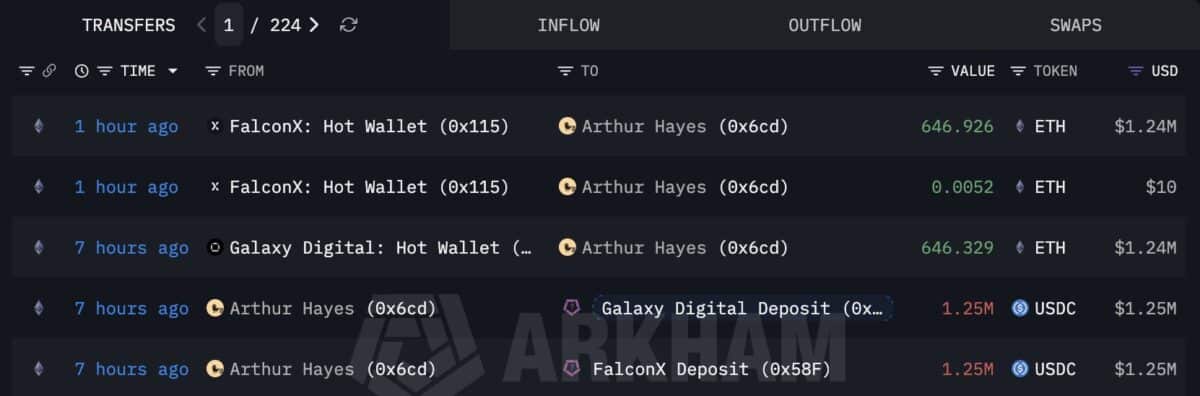
    Arthur Hayes reinforced the Ethereum accumulation narrative after Lookonchain reported that he purchased 1,293 $ETH worth approximately $2.48 million.

    Source: Lookonchain

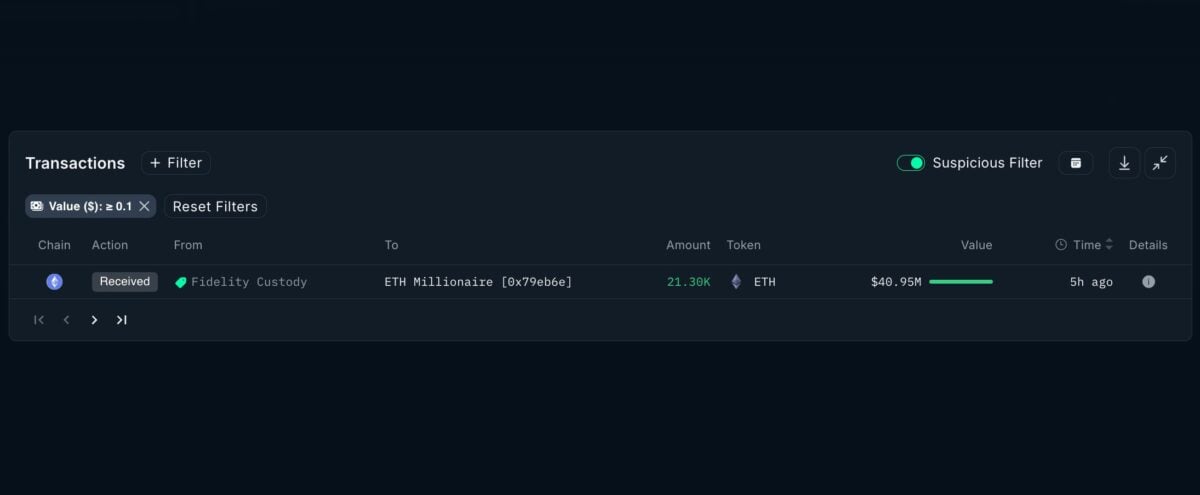
    The transaction followed another notable move, where a separate whale transferred 21.3K $ETH valued at about $40.95 million from Fidelity Custody into a newly created on-chain wallet.

    Source: Onchain Lens

    Rather than signaling exchange withdrawals, the transfer reflected capital moving from traditional institutional custody onto decentralized rails.

    This shift suggested the holder intended to deploy the assets on-chain or maintain direct custody.

    Together, both transactions highlighted growing confidence among large investors despite Ethereum trading below the psychological $2,000 barrier.

    Exchange flows stayed mixed despite outflow trend

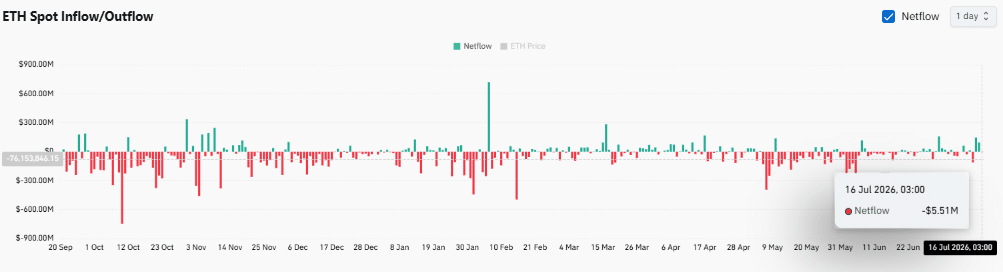
    Ethereum’s spot Netflow data painted a mixed short-term picture while preserving a broader accumulation backdrop.

    The latest daily reading showed a net inflow of approximately $5.51 million on 16 July, indicating more $ETH entered exchanges during that session.

    Even so, the wider chart revealed that exchange outflows had dominated across most trading sessions over recent months, with repeated negative netflow spikes outweighing isolated inflow periods.

    Those persistent outflows suggested investors had continued removing $ETH from trading venues instead of preparing immediate sales.

    Recent inflows therefore appeared limited within the broader trend rather than marking a structural shift in market behavior.

    If exchange balances continue declining over time, available liquid supply would likely remain constrained, supporting Ethereum’s longer-term supply dynamics.

    Source: CoinGlass

    Whale-sized trades kept dominating spot activity

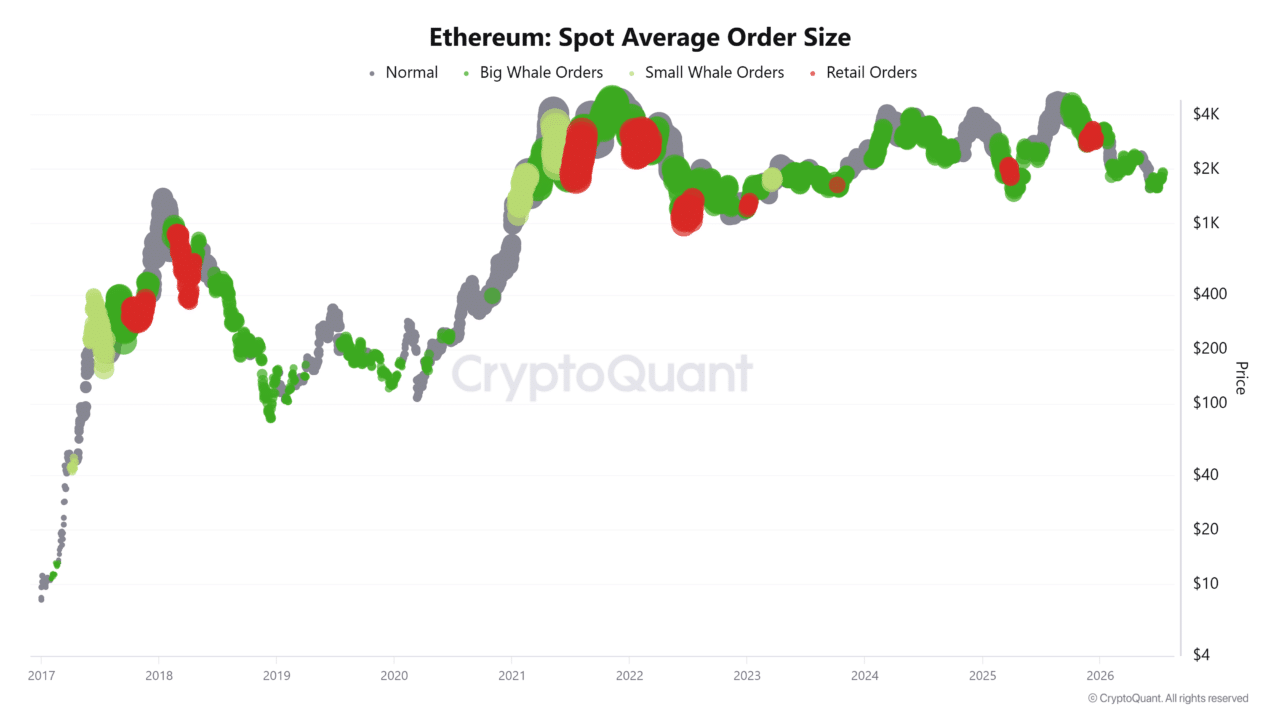
    Spot Average Order Size remained inside the “Big Whale Orders” zone, confirming that large transactions continued dominating Ethereum’s spot market activity.

    The indicator suggested institutional participants and high-net-worth investors accounted for a significant share of executed trades rather than retail-sized orders.

    This reading aligned closely with the latest purchases from Arthur Hayes and the sizeable transfer from Fidelity Custody to a fresh wallet.

    Instead of representing isolated transactions, the activity reflected a broader pattern of whale participation across the market.

    Growing involvement from large buyers often improves market depth and reinforces confidence during recovery phases.

    Even so, sustained accumulation would still require consistent follow-through before translating into a decisive breakout above key resistance levels.

    Source: CryptoQuant

    Can Ethereum finally reclaim $2,000?

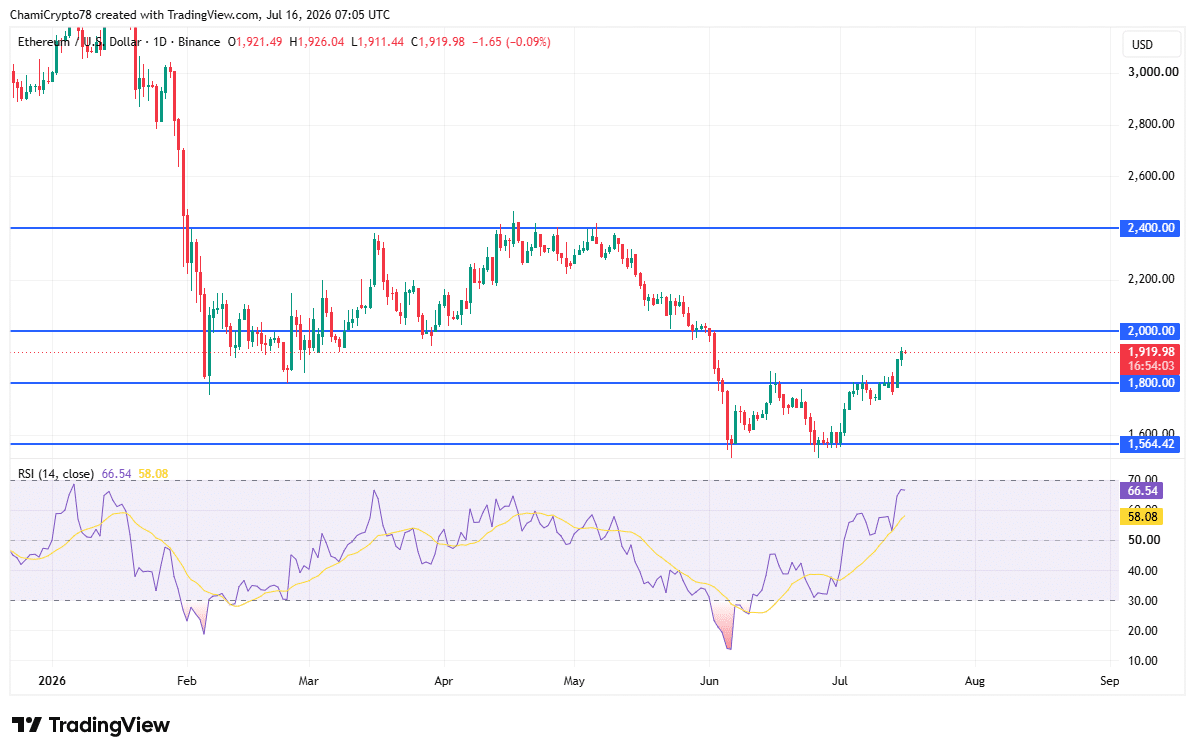
    At the time of analysis, Ethereum [$ETH] traded near $1,920 after recovering strongly from its early-June low around the $1,564 support level.

    Buyers steadily pushed price toward the major $2,000 resistance, although that barrier continued capping advances during the latest session.

    The Relative Strength Index climbed to 66.54, while its moving average stood near 58.08. Those readings showed strengthening buying interest without entering overbought territory above 70.

    Price also formed higher lows throughout July, reflecting improving market structure after the sharp correction.

    Even so, the latest candle closed slightly lower, indicating buyers encountered resistance as $ETH approached $2,000.

    If bulls reclaimed that level, price could challenge the next resistance near $2,400. Otherwise, another rejection could draw $ETH back toward the $1,800 support before another recovery attempt.

    Source: TradingView

    To sum up, Ethereum’s latest whale activity strengthened the broader accumulation narrative instead of weakening it.

    Institutional capital continued shifting onto decentralized rails, while large spot orders remained dominant across the market.

    Although the $2,000 resistance still requires confirmation, the improving technical structure suggested buyers could attempt another breakout if accumulation persists and demand continues supporting price.

    Final Summary

    • Whale accumulation and institutional wallet activity continued supporting Ethereum’s improving market structure.
    • $ETH approached $2,000 as buying strength increased, though resistance remained firmly intact.