Tag: CRYPTOS FoxBusiness

  • Did L2s break Ethereum’s ultrasound money?

    Did L2s break Ethereum’s ultrasound money?

    Ethereum’s best marketing line was that using it destroyed it, that every transaction burned $ETH and shrank the supply. Then the network solved its scaling problem, activity fled to layer 2s, and the burn collapsed. The scaling worked. The scarcity did not survive it.

    For about eighteen months, Ethereum had the best story in crypto, and the story was a paradox: the more people used the network, the rarer its token became. Every transaction burned a little $ETH, and when the network was busy enough, it burned more than it created. Supply went down. The community called it ultrasound money, a deliberate jab at Bitcoin’s “sound money,” complete with a bat emoji and a movement.

    For a while, the data backed it up. Then Ethereum did the thing it had promised to do for years, which was to scale, and scaling broke the story. Activity moved to layer-2 networks that pay almost nothing to the base chain, the burn collapsed, and $ETH quietly went inflationary again. This is the story of how Ethereum’s greatest technical success dismantled its best economic narrative, and whether a December upgrade can put the pieces back.

    What ultrasound money actually meant

    The mechanism is worth getting exactly right, because the whole debate turns on it.

    In August 2021, Ethereum activated EIP-1559, which changed how transaction fees work. Instead of paying miners directly, every transaction now pays a base fee that is burned, permanently removed from circulation. The busier the network, the higher the base fee, and the more $ETH destroyed. On its own, that is just a fee-burning mechanism. It became a monetary thesis when Ethereum switched from proof-of-work to proof-of-stake in the September 2022 Merge, which cut new $ETH issuance by roughly 90%, because the network no longer had to pay energy-intensive miners.

    Put the two together, and you get the ultrasound thesis. Issuance dropped to a trickle after the Merge. Burning continued with every transaction. If burning exceeded issuance, total $ETH supply would shrink over time, making the asset deflationary. And a deflationary asset with growing demand should, in theory, appreciate. Ethereum would become harder money than Bitcoin, whose supply still grows, hence “ultrasound.” The tracking site ultrasound.money existed to display exactly this: supply ticking down, day by day.

    For a stretch after the Merge, it happened. Supply fell back toward and below the level it sat at during the Merge itself. Burns outpaced issuance. The narrative was not hype; it was, for that window, an accurate description of the data. That is what made it powerful, and what made its reversal so awkward.

    NEW: Tom Lee calls Robinhood Chain proof that $ETH is money

    The chain uses Ethereum as native gas, denominates fees in $ETH, and settles on Ethereum L1 while generating volume exceeding many established DEXes pic.twitter.com/Ir2hTsaMiu

    — crypto.news (@cryptodotnews) July 12, 2026

    How scaling broke it

    The break came from Ethereum solving its most famous problem, and the irony is total.

    Ethereum’s scaling strategy is to push transactions off the expensive base layer and onto layer-2 rollups, networks like Arbitrum, Optimism, and Base that process transactions cheaply and then post compressed data back to Ethereum for security. The base layer becomes a settlement and target=”_blank”>daily burn dropped to as low as 50 to 70 $ETH. The base layer had lost its primary fee source. With issuance running around 1,700 $ETH per day and burn collapsing well below that, the equation flipped: Ethereum began creating more $ETH than it destroyed. By various measures across 2025 and into 2026, net annual inflation ran somewhere between roughly 0.2% and 0.8%, depending on the window. $ETH supply crossed back above its Merge-era level. The deflation was over.

    The mechanism that made ultrasound money true, EIP-1559 burning at scale, had not been removed. It had been bypassed. The activity simply moved to a layer where the burn does not happen in any meaningful amount. Ethereum scaled successfully and, in doing so, severed the link between usage and scarcity that the entire thesis depended on.

    The bull case: it still works, just differently

    The response from Ethereum’s defenders is not denial. It is reframing, and parts of it are genuinely strong.

    The first point is that elastic scarcity is the actual feature, not permanent deflation. Ethereum was never designed to deflate forever at a fixed rate. It was designed to burn in proportion to demand, which means it becomes deflationary when the network is busy and mildly inflationary when it is quiet. During periods of high mainnet activity, above roughly 16 gwei average gas, burn still exceeds issuance, and $ETH still goes net deflationary, temporarily. The mechanism works exactly as designed; it is just that a scaled network spends more time in the quiet regime. In this reading, ultrasound money was always conditional, and the condition is demand, not a promise.

    The second point is that issuance is still radically lower than before. Even mildly inflationary, Ethereum issues roughly 90% less $ETH than it did under proof-of-work. Compared to Bitcoin, which currently inflates at around 0.8% annually on a fixed schedule, Ethereum’s roughly 0.2% net inflation in calmer periods is actually lower. Both assets inflate in 2026; Ethereum, by some measures, inflates less. The “harder than Bitcoin” claim survives in a narrow, technical form even without net deflation.

    The third point is that the supply figure overstates the sell pressure. Roughly 28% to 30% of all $ETH is locked in staking, earning yield and not circulating. The tradeable float, $ETH actually available on exchanges, is meaningfully smaller than the headline supply number, and it shrinks as more $ETH is staked. A modestly inflating total supply with a large and growing staked portion is a very different pressure than the raw inflation number suggests. Demand from ETFs, treasury companies, and staking can absorb 0.2% inflation without difficulty.

    NEW: Ethereum ETFs see 58 million dollars in net inflows on July 14

    Fresh capital flowed into spot Ethereum ETFs during the latest session pic.twitter.com/V3vb5Y7x39

    — crypto.news (@cryptodotnews) July 16, 2026

    And the fourth point is simply that the store-of-value case never rested on deflation alone. As long as demand for Ethereum’s blockspace, its role as settlement for stablecoins, tokenization, and DeFi, grows faster than supply, price can rise regardless of whether supply ticks up 0.2% a year. Scarcity was a nice story. Utility is the real thesis.

    The bear case: the narrative was load-bearing

    The skeptical reading is that the ultrasound story was not just marketing, that it was doing real work in the investment case, and that losing it matters more than the reframing admits.

    The blunt version comes from the on-chain data and the people watching it leave. Daily network fee revenue on Ethereum fell from near $40 million in early 2025 to a local low around $10 million in 2026. That is not just a burn problem; it is a value-accrual problem. If the base layer captures little fee revenue because activity happens on rollups that pay it almost nothing, then holding $ETH is a bet on an asset whose own network is monetizing its users poorly. Some analyses have tied this directly to developer attrition and reduced whale support, framing the end of ultrasound money as the end of a period when $ETH had a clean, quantifiable reason to appreciate.

    The deeper problem is structural and hard to argue away: a scaled, efficient Ethereum is less deflationary than a congested, expensive one. This is the tension at the center of the whole debate. The very thing that makes Ethereum better as infrastructure, cheap transactions, more capacity, activity on fast rollups, is the thing that reduces the burn. Ethereum cannot simultaneously be the cheap, high-throughput settlement layer it wants to be and the fee-burning deflationary asset the ultrasound thesis needed. Those are in direct conflict, and the roadmap chose scaling. The asset thesis was, in a real sense, sacrificed to the technology roadmap.

    Then there is the value-capture question that rollups sharpen. Layer 2s use Ethereum for security and pay it a pittance for the privilege. Robinhood’s own chain is an example: analyses of corporate L2s show the base layer capturing a rounding error of the economics while providing the security that makes the whole arrangement credible. If Ethereum’s future is thousands of rollups settling to it cheaply, then Ethereum is providing enormous value and capturing little of it, and no amount of narrative reframing fixes a value-capture problem that lives in the fee structure.

    The fix nobody is talking about

    Which brings us to December 2025, and the upgrade that was designed, in part, to address exactly this, and that most of the market ignored.

    The Fusaka upgrade activated on December 3, 2025. Its headline features were about scaling further, PeerDAS and expanded blob capacity. But buried in it was EIP-7918, the “blob base fee bound,” which is the most direct attempt yet to repair the burn. The problem Dencun created was that blob fees could collapse to near-zero, one wei, when execution costs dominated and blob demand was soft, which meant rollups consumed Ethereum’s capacity almost for free and burned almost nothing. EIP-7918 sets a floor: it ties the minimum blob fee to the execution base fee, roughly the execution base fee divided by 16, so that even in quiet periods rollups pay a meaningful minimum, and a minimum stream of $ETH gets burned.

    The modeling is striking. Fidelity Digital Assets analyzed what would have happened if EIP-7918 had been active since blobs launched, and found that on 93% of days since the 2024 Dencun upgrade, the adjusted fee would have exceeded the actual fee, generating an estimated additional $78.6 million, roughly 24,641 $ETH, in cumulative blob-fee revenue. Blockworks noted that had the mechanism been introduced in June 2025, burnt blob fees would have been nearly 8x higher. The intent is explicit: restore a floor under the burn so that as stablecoins, DeFi, and tokenization migrate to rollups, $ETH still captures value from that activity instead of subsidizing it.

    The honest caveat is that this is a floor, not a restoration. EIP-7918 prevents the burn from collapsing to zero; it does not recreate the thousands-of-$ETH-per-day burn of the congested mainnet era. Whether it produces measurable, sustained deflation depends on how much activity flows through blobs and how high execution base fees run, and the market is still watching. It is a serious, well-designed attempt to reconnect usage and scarcity. It is not a return to 2022.

    Sound money versus ultrasound money, honestly compared

    Because the entire thesis was built as a shot at Bitcoin, it is worth putting the two monetary models side by side without the tribalism, since the comparison is more interesting than either camp admits.

    Bitcoin offers fixed scarcity. The supply schedule is written into the protocol, capped at 21 million coins, and halves on a predictable timetable roughly every four years. A holder knows today, with certainty, what Bitcoin’s issuance will be in 2030 and 2040. That certainty is the entire product. Bitcoin does not react to demand, does not burn, does not adjust; it simply issues on schedule toward a hard cap, and its current inflation runs around 0.8% annually, trending toward zero over decades. The trade-off Bitcoin holders accept is that the base layer offers little native utility and no yield. You hold it for the certainty, and you give up productivity in exchange.

    Ethereum offered, and to a degree still offers, elastic scarcity. Supply responds to network demand: high usage burns more and can push $ETH net deflationary; low usage burns less and lets mild inflation through. The appeal was a token that becomes scarcer precisely when it is most used, tying the asset’s scarcity to the network’s success. The trade-off, which the L2 era exposed, is that elasticity cuts both ways.

    A demand-responsive supply is only deflationary when demand is high on the layer that burns, and Ethereum deliberately moved demand to layers that do not burn. Bitcoin’s rigidity, often criticized as inflexible, turned out to be the thing that made its monetary promise keepable. Ethereum’s flexibility, often praised as sophisticated, turned out to be the thing that made its monetary promise conditional.

    NEW: Eric Trump says $ETH is pumping hard and crypto is the future pic.twitter.com/iVQYUclLz6

    — crypto.news (@cryptodotnews) July 12, 2026

    The honest scorecard is that these are different products for different buyers, not better and worse versions of the same thing. Bitcoin sells certainty and asks you to forgo utility. Ethereum sells utility and asks you to accept that its scarcity depends on how that utility is used. The ultrasound-money era was the brief window when Ethereum appeared to offer both, certainty of deflation and utility of a working network, and that window closed not because Ethereum failed but because it succeeded at scaling.

    A holder choosing between them in 2026 is really choosing between guaranteed scarcity with no yield and demand-driven scarcity with staking yield and network utility. Framed that way, the loss of ultrasound money is less a defeat than a clarification: Ethereum was never going to be Bitcoin, and the burn was hiding how different the two bets actually are.

    What this means for holding $ETH

    Strip away the narrative fight and the practical question is whether the ultrasound story mattered to the price, and the uncomfortable answer is that it is hard to tell, because $ETH has underperformed through the entire period regardless.

    The clean way to see it: the ultrasound thesis was strongest right after the Merge, and it has been dismantled steadily since Dencun in March 2024. Over that same window, $ETH has been a persistent underperformer against both Bitcoin and its own former highs. Either the market was pricing the loss of the deflation narrative, or the market never cared about the narrative and $ETH’s problems lie elsewhere, in L2 value leakage, in competition from Solana, in the sheer difficulty of the modular roadmap. Both readings are defensible, and they point to different conclusions about whether fixing the burn fixes the price.

    The most honest framing is that ultrasound money was a proxy for a real question that has not gone away: does Ethereum capture value from its own success? When the network was congested and expensive, the answer was visibly yes; the burn made it legible. When the network scaled and cheapened, the answer became murky, and the burn stopped telling the story. EIP-7918 is an attempt to make the answer legible again by putting a floor under value capture.

    Whether it works will show up not in the marketing but in two numbers over the next year: net $ETH supply, and base-layer fee revenue. If both turn up meaningfully, the thesis has a second life. If they do not, then ultrasound money was a phase, not a property, and Ethereum’s investment case has to stand on utility alone, which is a harder, slower, less tweetable argument than the one that shrank the supply.

    Frequently Asked Questions

    What is Ethereum ultrasound money?

    It is the thesis that Ethereum’s $ETH token would become deflationary and a superior store of value to Bitcoin. It rests on two mechanisms: EIP-1559, activated in 2021, which burns a portion of every transaction fee, and the 2022 Merge, which cut new $ETH issuance by roughly 90%. When burning exceeds issuance, total supply shrinks. The term was a play on Bitcoin’s “sound money” branding.

    Is Ethereum still deflationary in 2026?

    Not on a net basis, in normal conditions. After the March 2024 Dencun upgrade shifted activity to cheap layer-2 rollups, the burn collapsed, and $ETH became mildly inflationary, with net supply growth around 0.2% to 0.8% annually depending on the period. During bursts of high mainnet activity, it can still turn temporarily deflationary, but the sustained deflation of the immediate post-Merge period ended.

    Why did layer 2s break the burn?

    Because they moved activity off the base layer, where transactions burned meaningful $ETH, onto rollups that pay near-zero fees. The Dencun upgrade introduced cheap “blob” transactions for rollups, cutting their costs 10 to 100 times. Blob space was oversupplied, so blob fees fell close to zero, and the daily burn dropped from thousands of $ETH to as low as 50 to 70. The activity continued; the burn did not follow it.

    Does this mean $ETH is a worse investment?

    Not necessarily, and defenders make several counterpoints: issuance is still about 90% lower than under proof-of-work, roughly 0.2% net inflation in calm periods is actually below Bitcoin’s, nearly a third of $ETH is locked in staking and off the market, and the real case rests on demand for blockspace rather than deflation. Critics counter that base-layer fee revenue collapsed too, raising a genuine value-capture problem.

    What is EIP-7918?

    A change introduced in Ethereum’s December 2025 Fusaka upgrade that sets a minimum price for blob transactions, tied to the execution base fee, roughly that fee divided by 16. It prevents blob fees from collapsing to near-zero during quiet periods, ensuring a minimum stream of $ETH is burned. Fidelity modeled that it would have added roughly $78.6 million in cumulative burn across 93% of days since 2024 had it existed earlier.

    Did Fusaka restore ultrasound money?

    No, it put a floor under the burn rather than restoring the deflation of the post-Merge era. EIP-7918 stops the burn from collapsing to zero and improves value capture as activity migrates to rollups, but it does not recreate the thousands-of-$ETH-per-day burn of the congested mainnet period. Whether it produces sustained net deflation depends on blob activity and execution fees, and remains to be seen.

    Is Ethereum still harder money than Bitcoin?

    In a narrow technical sense, sometimes. In calm periods, Ethereum’s roughly 0.2% net inflation can run below Bitcoin’s roughly 0.8% fixed-schedule inflation. But Bitcoin offers predictable, protocol-guaranteed scarcity indefinitely, while Ethereum’s supply is elastic and responds to demand, so it can inflate more during quiet, scaled periods. They offer different kinds of scarcity: fixed and certain versus elastic and demand-driven.

    What should I watch to know if the thesis recovers?

    Two numbers over the next year: net $ETH supply growth, and Ethereum base-layer fee revenue. If EIP-7918 and rising rollup activity push net supply back toward flat or negative while base-layer revenue climbs from its roughly $10 million lows, the value-capture story recovers. If supply keeps growing and fee revenue stays depressed, ultrasound money was a temporary phase, and $ETH’s case rests on utility and demand alone.

    Disclaimer: This article is for information and educational purposes only and does not constitute financial or investment advice. It describes monetary mechanics and network upgrades whose effects are uncertain and still developing. Nothing here is a recommendation to buy or sell any asset. Always do your own research. Figures on supply, burn, and inflation move continuously and are accurate as of July 17, 2026.


  • SBI Holdings Acquires Majority Stake in Coinhako After Singapore Approval

    SBI Holdings Acquires Majority Stake in Coinhako After Singapore Approval

    SBI Holdings has completed the acquisition of a majority stake in Singapore-based cryptocurrency exchange Coinhako, marking another move in the Japanese financial group’s expanding digital asset strategy across Asia.

    The transaction closed on July 16 after receiving approval from the Monetary Authority of Singapore (MAS), bringing Coinhako under SBI’s corporate structure. The acquisition follows a number of digital asset initiatives by SBI, including its agreement to acquire Japan’s Bitbank and its partnership with Ondo Finance to support the tokenization of Japanese equities using its yen-backed stablecoin.

    Coinhako Becomes Part of SBI’s Digital Asset Business

    SBI Holdings announced that it has acquired a controlling interest in Holdbuild Pte. Ltd., the parent company of Coinhako. The transaction combined a capital injection along with the purchase of shares from existing investors, although the companies did not disclose the financial terms.

    Following the completion of the deal, Coinhako officially became an SBI Holdings subsidiary. Through its entity Hako Technology, the exchange operates under a Major Payment Institution (MPI) license issued by the Monetary Authority of Singapore.

    The acquisition also gives SBI access to Coinhako’s network of more than 400,000 customers, as well as its established operations and regulatory experience across Southeast Asia.

    SBI Outlines Cross-Border Digital Asset Strategy

    SBI Chairman and Chief Executive Officer Yoshitaka Kitao said the acquisition supports the group’s objective of connecting digital asset exchanges across multiple jurisdictions.

    According to Kitao, the company plans to create a global digital asset network that allows investors to participate in markets without being limited by national borders or currency barriers. He also described Singapore as an important market because of its advanced regulatory framework for digital assets.

    SBI said Coinhako will become part of its broader digital finance business, which includes its yen-backed stablecoin JPYSC. The company also plans to expand services related to tokenization, stablecoins, blockchain-based finance, and cross-border payments linking Japan with Southeast Asia.

    Coinhako co-founder and Chief Executive Officer Yusho Liu said the partnership will provide the exchange with broader institutional support and access to SBI’s financial ecosystem. He added that the company intends to use those resources to continue developing digital financial services across the region.

    Related: SBI Holdings to Acquire Crypto Exchange Bitbank in $288 Million Deal

  • DOG Mode explains Bitcoin’s next governance fight

    DOG Mode explains Bitcoin’s next governance fight

    Debates and disputes about Bitcoin’s governance often pivot on the rules baked into the world’s original blockchain network’s code. The latest dispute suggests the reality is more nuanced.

    The alternative Bitcoin client “$DOG Mode”, introduced by Bitcoin developer “Leonidas”, doesn’t attempt to rewrite Bitcoin’s consensus rules. Instead, it targets the default relay policies used by Bitcoin Core and other node software. These are in effect the settings that determine which valid transactions are forwarded around the network before miners include them in a block.

    In doing so, the developer is reopening a philosophical debate over censorship, free markets and who really governs the network.

    Leonidas is an advocate of the Ordinals protocol, which allows data to be stored on the Bitcoin blockchain, often in the form of images or texts to essentially create a version of non-fungible tokens (NFTs).

    The Bitcoin Improvement Proposal (BIP) 110 sought to tighten the network’s rules to make such transactions more difficult, prompting accusations of censorship from its critics.

    Bitcoin consensus rule changes are rare, hence why attempts to alter them seem so seismic. In many ways, $DOG Mode represents the philosophical mirror image of BIP-110.

  • An Altcoin Is Heading to a Vote That Will Have Numerous Implications, Including a Token Burn

    An Altcoin Is Heading to a Vote That Will Have Numerous Implications, Including a Token Burn

    Uniswap management is preparing to vote on a proposal that would enable protocol fees for the first time in select Uniswap v4 liquidity pools. Separately, a proposal plans to extend the fee mechanism implemented in Uniswap v2 and v3 to Robinhood Chain.

    The final on-chain voting process has begun for both proposals. Voting opens on Sunday and will continue until July 26th. Uniswap founder Hayden Adams said they expect the proposals to have a significant impact on the $UNI burning mechanism, particularly highlighting the current trading volumes on Robinhood Chain.

    The Uniswap v4 proposal calls for enabling protocol fees in fixed-fee pools, pools created through perpetual swap auctions, and pools using aggregator hooks. The regulation will cover Ethereum, Arbitrum, Base, BNB Chain, Polygon, Optimism, and Robinhood Chain networks.

    According to the proposal text, a second vote will be held later for the remaining five networks. This is because Uniswap’s GovernorBravo governance agreement allows a maximum of 10 on-chain transactions in a single offer.

    A separate Robinhood Chain proposal by Hayden Adams aims to enable fees on Uniswap v2 and v3 pools on the network. All three protocol versions of Uniswap were made available with Robinhood Chain’s mainnet launch on July 1st.

    Related News Analyst: “The Leverage Cleanup in XRP Is Complete; Conditions Are Similar to the Period When It Surged 8x”

    According to data included in the proposal, the total exchange volume of Uniswap applications on Robinhood Chain exceeded $6 billion as of July 10th. The Ethereum Layer 2 network, developed with Arbitrum infrastructure, recorded approximately $3.1 billion in decentralized exchange volume in its first week. It was noted that memecoins were predominantly traded in the initial transactions.

    The protocol fees collected under both proposals will be transferred to the $UNI combustion mechanism, which was established by the UNIfication governance regulation approved with 99.9% support in December.

    With this governance change, protocol fees were enabled in the Uniswap v2 and v3 pools on the Ethereum mainnet, and 100 million $UNI were burned in the Uniswap treasury. However, the implementation of v4 fees was postponed to a later proposal pending the completion of the necessary technical infrastructure.

    The fee mechanism has reportedly been expanded to 11 different networks to date. According to the Uniswap v4 proposal, the protocol set a daily record last month by burning 186,000 $UNI in a single day.

    Enabling fees in Uniswap v4 requires a more complex infrastructure compared to previous versions. While v2 and v3 used fixed fee tiers, v4’s hook architecture allows pools to change their fees from block to block.

    The new proposal creates a management-controlled system that categorizes pools under specific “families” and calculates the fee for each pool according to predefined rules, rather than setting the fee individually.

    Both proposals utilize the accelerated governance process adopted under UNification. This process skips the request for comments phase and proceeds directly to on-chain voting after a five-day Snapshot voting period.

  • Crypto executives say digital native generations may never need a bank account

    Crypto executives say digital native generations may never need a bank account

    Evidence of that shift is growing. Visa’s stablecoin tracker recorded $6.6 billion in volume across 132.4 million retail-sized transactions (those worth less than $250) during the latest 30-day period. Standard Chartered expects stablecoin circulation to increase about sevenfold to roughly $2 trillion by 2028, while agent-led purchases could rise from 1% of e-commerce in 2025 to 12% in 2029. Neobanks capture nearly 40% of new banking accounts globally, boasting over 1.4 billion users.

    A step further

    Naveen Mallela, Standard Chartered’s global head of payments, also expects the traditional account-based model to change. He believes people will eventually use a wallet tied to their identity instead of separate bank and brokerage accounts.

    “Rather than having bank accounts with individual banks or having separate brokerage accounts, you would have a wallet where you’ll have cash, tokenized deposits of some sort issued by different banks, stablecoins, tokenized money market funds, crypto and funds, all of that in one app, one wallet,” he said, clarifying that this was his personal opinion, not a formal Standard Chartered position.

    His forecast does not remove banks from the system. The wallet he described could hold deposits and tokens issued by several banks, which would continue providing much of the money, infrastructure and controls behind the services.

  • One year later, GENIUS Act just made stablecoins easier to sell

    One year later, GENIUS Act just made stablecoins easier to sell

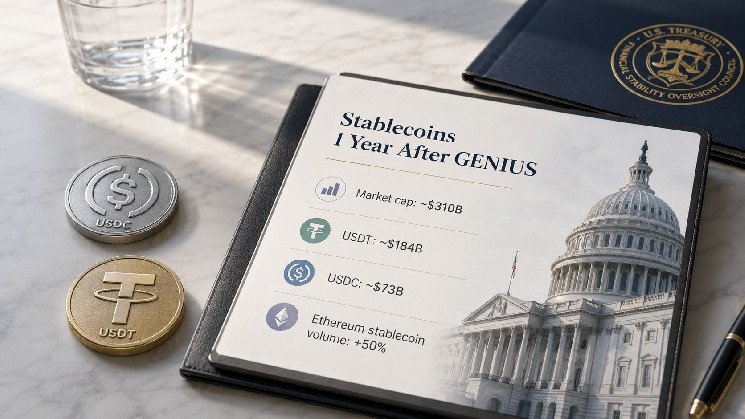
    On the eve of the $GENIUS Act’s first anniversary, the stablecoin market holds about $310 billion, including roughly $184 billion in $USDT and $73 billion in $USDC.

    President Donald Trump signed the law on July 18, 2025, creating a federal framework with one-for-one liquid reserves, redemption rights, and monthly reserve disclosures for a market that moved faster than the rulebook.

    Federal Reserve researchers measured stablecoin capitalization at $317 billion on Apr. 6, up more than 50% from early 2025, and recorded a 50% increase in Ethereum stablecoin transaction volume since enactment. As of July 17, core implementation measures are still in proposal form.

    Kyle Sonlin, president and co-founder of Global Settlement Network, said his conversations with governments and institutions now start from acceptance of stablecoins as financial infrastructure, and his team spends “far less time explaining why stablecoins matter.”

    Permission reached the sales desk

    Sonlin described $GENIUS as a credible federal direction that let banks, payment companies, and infrastructure providers commit money to longer-term plans.

    He said that financial infrastructure rarely reorganizes within 12 months, and companies kept preparing for a regulated stablecoin market as agencies worked through implementation.

    Triple-A CEO Eric Barbier sees the commercial result inside the enterprise sales funnel. His payment company has recorded more businesses moving from evaluation toward implementation, plus a “marked reduction” in sales cycles for enterprise customers that enable stablecoin payments through its platform.

    Barbier’s evidence covers Triple-A’s own pipeline, providing the legitimacy thesis with a concrete operational measure.

    Visa’s expansion offers a larger institutional reference point, as its stablecoin settlement pilot supported nine blockchains by April and reached a $7 billion annualized settlement run rate, up 50% from the previous quarter.

    On July 16, Visa introduced an enterprise platform that provides financial institutions and fintech firms with access to stablecoin storage, redemption, minting, and burning through a single Visa-managed environment.

    The sales environment now has a recognized product, a federal direction, and payment incumbents building access layers.

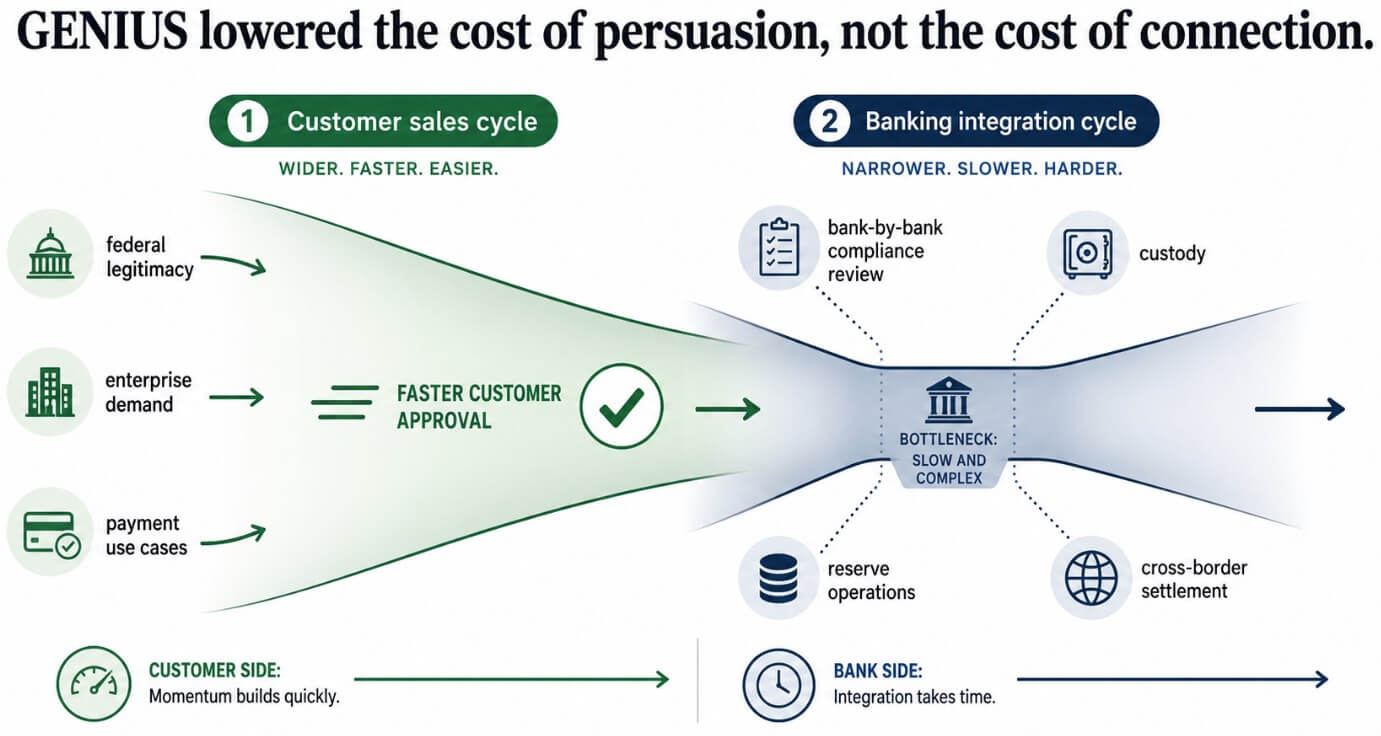
    Deployment depends on banks, custody arrangements, reserve operations, and compliance teams that interpret unfinished rules for each relationship.

    Banking friction survives

    Diogo Cassinelli, sales and partnerships manager at Trace Finance, said that clarity on issuance addressed half of the operating problem.

    Cross-border payment companies still need each banking partner to make an independent compliance judgment about how stablecoins enter accounts, leave accounts and settle across jurisdictions.

    Cassinelli said those reviews add “months to timelines that should take weeks,” and the cost repeats whenever an operator enters a new country or adds another bank.

    Stablecoin providers can close a customer faster under $GENIUS, then spend longer connecting that customer to the banks and payment providers that move the money.

    The $GENIUS Act shortened customer sales cycles as bank-by-bank compliance, custody and settlement reviews continued to slow stablecoin integration.

    Enterprise buyers now understand the use case and accept the federal direction. Banking partners still need a shared legal and supervisory standard that lets compliance teams approve the same activity consistently.

    Edwin Mata, CEO and co-founder of Brickken, placed that plumbing inside a larger capital-markets architecture.

    Regulated dollars can provide the cash leg for tokenized securities, private credit, investment funds, and asset servicing. The US opportunity extends from payment acceptance into issuance, distribution, and settlement across on-chain financial products.

    Regulatory access sets the field

    Alex Witt, general partner at Verda Ventures, gave the first-year verdict a harder edge. He credited $GENIUS with legitimizing the sector and drawing institutional firms into the federal perimeter.

    Witt also argued that charter decisions and product launches can give selected firms an early advantage before regulators complete the operating rules.

    The Office of the Comptroller of the Currency conditionally approved national trust bank applications or conversions involving Ripple, Fidelity Digital Assets, BitGo, Paxos, and First National Digital Currency Bank in December 2025.

    Tether launched USA₮ in January 2026, with Anchorage Digital Bank as the issuer and Cantor Fitzgerald as the reserve custodian and preferred primary dealer.

    Those moves show companies building toward $GENIUS before its effective date. They also concentrate early access among firms that already have capital, legal teams, banking partners, and federal relationships.

    Startups face the same unfinished framework with fewer resources to absorb repeated compliance reviews.

    The OCC opened its broad implementation proposal in February, and Federal agencies published an interagency customer-identification proposal in June. Public comments stay open through Aug. 21, more than a month beyond the anniversary deadline Congress set for regulations.

    The January test

    The Senate Banking Committee advanced the CLARITY Act 15-9 on May 14, leaving the bill short of a floor vote.

    In the bull case, final $GENIUS rules and further CLARITY progress give banks a common compliance reference, contract integration timelines, and turn regulated stablecoins into routine settlement assets for payments and tokenized markets.

    The bear case gives early access durable value, as conditional charter approvals, incumbent payment networks, and established banking partnerships let a small group define distribution before smaller firms can comply at comparable speed.

    $GENIUS then legitimizes the category and channels much of its commercial value toward companies that entered the federal perimeter first.

    The statute takes effect on the earlier of Jan. 18, 2027, or 120 days from the date federal regulators issue final implementing regulations.

    The first year lowered the cost of persuasion, and the six months through Jan. 18 will show whether federal rules can lower the cost of connection too.

  • Ripple President Makes Stablecoin’s Most Influential 2026 List

    Ripple President Makes Stablecoin’s Most Influential 2026 List

    As Ripple continues to emerge as one of the top names in the crypto industry, its President, Monica Long, has also made the list of the top leaders in the stablecoin market this year, curated by Stablecon.

    Following the recent release of its annual leadership recognition list, Stablecon has named Monica Long among the honorees on Stablecon’s Most Influential 2026 list.

    Monica Long as a Top Woman in Stablecoins

    Following Long’s addition to Stablecon’s Most Influential list this year, the Ripple president has earned recognition in two categories, which include Issuer & Protocol Leaders and Top Women in Stablecoins.

    The list is curated every year to recognize leaders across multiple crypto sectors such as stablecoin issuance, blockchain infrastructure, investing, regulation, and ecosystem development.

    Stablecon explained that honorees who make it to the list are evaluated based on five criteria, which include ecosystem influence, impact and reach, innovation, momentum, and peer recognition.

    Notably, Monica Long was listed alongside executives from several major stablecoin and digital asset firms, including Paxos, Ondo Finance, Frax Finance, Custodia Bank, Anchorage Digital, and Monerium in the Issuer & Protocol Leaders category.

    Also, Long made the list in the Top Women in Stablecoins category, being one of only two Ripple-associated executives celebrated as female leaders making major contributions to the stablecoin industry.

    $RLUSD in spotlight as Ripple pushes for wider adoption

    It is not surprising that Monica Long has been recognized as a top leader in the stablecoin sector, as Ripple continues to advance its native stablecoin, $RLUSD, while expanding its use cases.

    Apparently, Monica Long’s recognition as a Top Woman in Stablecoins comes following Ripple’s consistent developments targeted at expanding its presence in the stablecoin market through $RLUSD.

    As Ripple’s president, Long has played a key role in bringing $RLUSD to the global market and driving its adoption for real-world payments and financial applications.

  • Is the Downturn in Strategy Over? Will Bitcoin Buying Resume?

    Is the Downturn in Strategy Over? Will Bitcoin Buying Resume?

    On-chain analytics company CryptoQuant stated that Strategy’s recently announced new capital management framework significantly alleviates the company’s immediate liquidity concerns, but a more disciplined model for Bitcoin buying and selling is needed.

    In a report he published, CryptoQuant Research Director Julio Moreno assessed Strategy’s new plan, called the “Digital Credit Capital Framework,” as a significant shift in direction.

    Moreno stated, “The Digital Credit Capital Framework is a real course correction. However, for this change to be complete, Strategy needs to clarify two more issues: a systematic model for timing Bitcoin purchases and a disciplined framework for selling during bullish periods.”

    Strategy announced its five-part digital credit capital management framework on June 29. As part of the plan, the company created a US dollar reserve that can only be used for preferred stock dividends and interest payments.

    The company has set a coverage target to meet at least 12 months of payment obligations for this reserve. Additionally, the dividend rate for STRC preferred shares has been increased to 12%, subject to monthly review. This step aims to bring the STRC price closer to its nominal value of $100.

    The new framework also allows for the repurchase of up to $1 billion worth of preferred shares if company management deems the repurchase to be a value-enhancing activity. STRC shares are planned to be given first priority under this program.

    Strategy will also be able to repurchase up to $1 billion worth of common shares of MSTR during periods when it believes the company’s shares are undervalued.

    A separate Bitcoin cash-out program created as part of the plan authorizes the company to sell up to $1.25 billion worth of Bitcoin. The funds raised can be used to strengthen dollar reserves, finance dividend and interest payments, and fund share buybacks.

    The company also announced that it will issue shares more cautiously when its mNAV indicator, known as the market value/net asset value ratio, approaches the 1 level.

    Strategy’s new plan was announced just days after CryptoQuant released its recommendations for the company.

    CryptoQuant had previously urged Strategy to pause Bitcoin purchases until its cash reserves and dividend coverage ratio were strengthened. The company also suggested developing a systematic model for timing future Bitcoin purchases and preparing a plan for selling a portion of its assets during bull markets.

    According to Moreno, Strategy has largely followed the first of these recommendations.

    Between June 29 and July 5, the company sold approximately 3,588 Bitcoin, generating around $216 million in revenue. These funds were used to pay preferred stock dividends and strengthen the dollar reserve.

    Strategy raised $466.7 million from the sale of MSTR shares between July 6 and 12. The company did not make any new Bitcoin purchases or sales during this period.

    Related News Analyst Who Claimed to Have Predicted the Previous Drop Reveals New Bitcoin Forecast – “The Fed Will Be Forced to Print $20 Trillion; Bitcoin…”

    Following these steps, Strategy’s dollar reserves increased from $1.44 billion to $3 billion. The company’s dividend coverage period also extended from approximately 14 months to 29 months.

    Strategy’s Bitcoin holdings remained unchanged at 843,775 BTC, and the company has yet to conduct any preferred or common share buybacks.

    STRC shares had fallen to a historical low of around $75 at the end of June. Following the announcement of the new framework and the increase in the dividend rate, the share price rose to approximately $88.

    Despite this, STRC continues to trade below its nominal value of $100.

    Moreno said the discount indicated that investors wanted to see Strategy sustainably implement its new financial discipline.

    Moreno said, “The sustained discount indicates that the market wants to see the reserve strengthened and the new discipline maintained before fully repricing the security.”

    According to CryptoQuant, two key questions remain unanswered in Strategy’s Bitcoin strategy.

    The first is when the company will resume Bitcoin purchases.

    Moreno stated that pausing Bitcoin purchases offered a solution to the short-term liquidity problem, but the new framework lacked a model-based rule for when accumulation should resume.

    Strategy’s announced equity issuance policy, which it will implement when its mNAV ratio approaches 1, defines how the company will raise capital. However, according to Moreno, this rule does not explain when capital should be invested in Bitcoin.

    Moreno stated, “Without a clear and valuation-focused model, the company risks repeating its tendency to buy Bitcoin at consistently local peaks whenever market conditions improve.”

    The second point CryptoQuant highlights is whether Strategy will sell Bitcoin in the next bull market and under what rules those sales will be conducted.

    Moreno stated that the current Bitcoin cash-out program has a defensive structure. The program allows Bitcoin sales to be used to finance dividends, interest, and share buybacks.

    However, according to CryptoQuant, this plan does not offer a strategy for staggered selling or hedging positions as the market cycle approaches its peak.

    Moreno said that such a sales framework could help the company reduce its debt, create value for shareholders, and build up cash reserves to repurchase Bitcoin during periods when the price falls to lower levels.

    Moreno stated, “The disciplined selling approach throughout the market cycle, which constitutes the other half of active capital management, is still not defined.”

    *This is not investment advice.

  • Market Expert ARK Invest Released a Detailed Report on Bitcoin: Have We Hit Bottom, or Are We Yet to See It?

    Market Expert ARK Invest Released a Detailed Report on Bitcoin: Have We Hit Bottom, or Are We Yet to See It?

    ARK Invest stated that despite Bitcoin losing approximately 14% of its value in the second quarter of 2026, on-chain data is signaling the end of selling pressure. The company considered the record-high amount of Bitcoin held by long-term investors as a significant indicator pointing to a potential market bottom.

    According to ARK Invest’s second-quarter Bitcoin report, $BTC closed June at approximately $58,544. During this period, the Bitcoin price fell below the short-term investor realization price of around $70,327, the 200-day moving average of $75,371, and the on-chain average of around $76,660.

    The report stated that Bitcoin remaining below all three key moving averages is historically linked to bearish market conditions. Therefore, it argued that the technical outlook has not yet significantly improved.

    However, on-chain indicators suggest that the sell-off may be nearing its final stages. For the first time in this cycle, the percentage of Bitcoin supply at a loss has surpassed the percentage at a profit, reaching approximately 54%. The percentage of Bitcoin at a profit, meanwhile, has fallen to 46%.

    ARK Invest noted that the supply of shares in losses exceeding the supply of shares in profits has generally been observed in past market cycles near bottom levels. The fact that the rate of realized losses briefly surpassed the rate of realized profits, and that the ratio fell to 0.82, was also considered a sign of exhaustion in selling pressure.

    Another key finding in the report was the amount of Bitcoin held by long-term investors. The supply of Bitcoin held by long-term investors increased by approximately 313,000 $BTC in the second quarter, reaching an all-time high of 14.85 million $BTC.

    According to ARK Invest, long-term investors with high levels of conviction continued to accumulate Bitcoin distributed in the market during the price decline. The company noted that the increase in the supply from long-term investors during the price drop constituted a positive divergence in terms of the fundamental outlook of the market.

    However, the report noted that Bitcoin has not yet fallen back to its historically low on-chain cost levels. It stated that Bitcoin’s current price is approximately $53,000, while its investor price is around $49,000.

    ARK Invest stated that the downside risks have not completely disappeared, as Bitcoin has not yet tested this cost range between $49,000 and $53,000. According to the company, the process of returning to the average, which has accompanied global market lows in the past, has not yet occurred.

    The report also stated that outflows from spot Bitcoin ETFs traded in the US increased pressure on the market. The funds recorded net outflows for seven consecutive weeks towards the end of the quarter, losing approximately 71,000 $BTC in assets throughout the second quarter.

    Related News Net Inflows into Cryptocurrency Investment Products Have Begun Again: Is This a Sign of a Bitcoin Rally?

    During the worst week of late June, approximately 30,000 $BTC were withdrawn from ETFs. ARK Invest stated that the weakening spot ETF demand indicates that one of the most important marginal demand sources supporting the Bitcoin price has lost strength.

    Signs of stress were also seen in the funding conditions of Bitcoin treasury companies. Strategy’s STRC preferred stock, codenamed “Stretch,” fell from its nominal value of $100 to as low as $74.57 during the quarter. STRC finished the second quarter at approximately $84.86.

    ARK Invest stated that STRC trading below its face value could indicate an increase in the cost of capital for leveraged companies building Bitcoin treasuries.

    Bitcoin’s three-month futures base rate remained low but positive at an average of 2.3% throughout the quarter. The fact that the rate occasionally approached backwardation indicated that demand for leveraged long positions and speculative appetite were limited.

    ARK Invest evaluated technical and on-chain indicators as well as the macroeconomic environment. The report argued that technology-driven productivity increases limited inflationary pressures.

    It was stated that although unit labor costs increased by 0.5 percent, productivity rose by 2.8 percent, and core consumer inflation remained at around 2.9 percent despite the increase in oil prices.

    The company also argued that the flattening of the yield curve reflected deflationary trends rather than recession. It stated that artificial intelligence, energy infrastructure, deregulation, and regulations allowing investments to be expensed directly supported capital expenditures.

    According to ARK Invest, new orders for core capital goods hitting a record high and surpassing a 25-year resistance level indicates the formation of a sustained growth cycle driven by technology and energy investments.

    *This is not investment advice.

  • Watch Out: Bankrupt Company FTX Will Pay Its Users Nearly $1 Billion—Here’s the Date

    Watch Out: Bankrupt Company FTX Will Pay Its Users Nearly $1 Billion—Here’s the Date

    The bankrupt cryptocurrency exchange FTX has announced it will launch its fifth round of creditor payments on July 31, 2026, as part of its restructuring plan. This distribution is expected to amount to approximately $900 million in total.

    According to a statement by FTX Trading Ltd. and FTX Recovery Trust, payments will cover creditors with approved receivables in the Convenience and Non-Convenience classes under the restructuring plan who completed the necessary pre-distribution processes by the June 16 registration deadline.

    Creditors who are entitled to receive payments are expected to collect the funds through their previously chosen service providers: BitGo, Kraken, or Payoneer. The distribution service providers are scheduled to transfer payments to accounts within one to three business days after July 31.

    FTX also informed eligible preferred shareholders that a second payment round would be made on the same date.

    Related News Market Expert ARK Invest Released a Detailed Report on Bitcoin: Have We Hit Bottom, or Are We Yet to See It?

    As part of the fifth distribution, Class 5A credit holders representing Dotcom customer receivables will receive an additional 9% payment. This will bring the cumulative distribution rate for this class to 105%.

    Class 5B, which covers US customer receivables, will receive a 5% payout, resulting in a total payout rate of 105%. Class 6A, which includes general unsecured receivables, and Class 6B, which includes digital asset loan receivables, will each receive a 3% payout. The total payout rate across these classes will reach 103%.

    The cumulative distribution to claimants in the Class 7 Convenience Claims group, which includes smaller claims, will reach 120 percent.

    FTX stated that customers and other payees who wish to participate in the distribution on future payment dates must complete the identity verification process, submit the necessary tax forms, and register with one of the BitGo, Kraken, or Payoneer platforms before the registration date.

    The company stated that subsequent registration and payment dates will be announced at a later date.

    *This is not investment advice.