A Bitcoin wallet that had been steadily accumulating the cryptocurrency over the past six years moved 800 $BTC, valued at approximately $52.2 million, to Cumberland, a prominent crypto market maker and over-the-counter (OTC) trading platform, according to onchain analytics firm Onchain Lens. The transfer occurred about one hour ago and is typically interpreted as a potential selling activity.
Whale Activity and Market Implications
Onchain Lens reported that the whale externally moved a total of 2,000 $BTC worth about $130 million today. This includes the transfer to Cumberland and an additional 1,200 $BTC, worth roughly $78.3 million, sent to a new address. The movement of such a significant amount of Bitcoin from a long-term holder to a trading platform often signals an intention to sell, which could influence market sentiment in the short term.
Understanding the Accumulation Pattern
This particular wallet had been accumulating Bitcoin consistently for six years, a strategy often associated with patient, long-term investors. The decision to move a portion of these holdings to Cumberland, a platform known for facilitating large block trades, suggests the whale may be looking to realize gains or rebalance their portfolio. The simultaneous transfer of a larger amount to a new address also indicates that the whale is not liquidating entirely, but rather managing their exposure.
Why This Matters to the Market
Whale transactions, especially from long-term holders, are closely watched by traders and analysts because they can precede price movements. Cumberland’s role as an OTC desk means the sale could occur off-exchange, reducing direct market impact, but the overall signal of distribution can still weigh on sentiment. This event adds to a broader narrative of long-term holders taking profits after Bitcoin’s significant rally from its 2022 lows.
Conclusion
The transfer of 800 $BTC to Cumberland by a six-year accumulator is a notable onchain event that warrants attention. While not a definitive sell signal, the pattern of moving coins to a trading venue suggests potential distribution. Investors should monitor further movements from this wallet and broader market reactions.
FAQs
Q1: What is Cumberland and why does this transfer matter? Cumberland is a major cryptocurrency market maker and OTC trading desk. Transfers to such platforms are often seen as a precursor to selling, as they provide liquidity for large block trades without causing immediate slippage on public exchanges.
Q2: How much Bitcoin did the whale move in total today? According to Onchain Lens, the whale moved a total of 2,000 $BTC, valued at approximately $130 million. This includes 800 $BTC to Cumberland and 1,200 $BTC to a new address.
Q3: Does this mean the whale is selling all their Bitcoin? Not necessarily. Moving coins to a new address while also sending a portion to Cumberland suggests a strategic rebalancing rather than a full exit. The whale may be taking partial profits while retaining a core position.
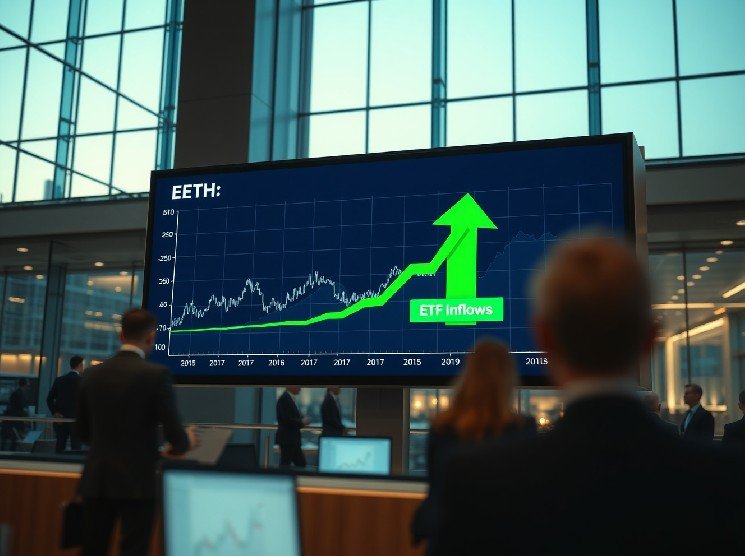
U.S. spot Ethereum exchange-traded funds recorded $38 million in net inflows on July 20, according to data from Farside Investors, extending a positive streak to a second consecutive trading day after a period of mixed activity.
Breakdown of July 20 Inflows
The inflows were led by BlackRock’s iShares Ethereum Trust (ETHA), which attracted $34.3 million. Fidelity’s Ethereum Fund (FETH) added $2.8 million, while the 21Shares Core Ethereum ETF contributed $0.9 million. The remaining spot $ETH ETFs saw no net inflows or outflows for the day.
This marks the second straight session of positive flows following last Friday’s modest gains, suggesting a cautious but steady return of institutional interest after weeks of volatile trading in the broader crypto market.
Context and Market Implications
The two-day inflow streak comes amid a period of relatively subdued Ethereum price action, with $ETH trading in a narrow range between $3,400 and $3,500. Analysts point to the inflows as a signal that institutional investors are gradually allocating to Ethereum exposure through regulated fund structures, even as retail sentiment remains mixed.
Since their launch in late May 2024, spot Ethereum ETFs have experienced uneven demand compared to their Bitcoin counterparts. However, recent data indicates a potential shift: cumulative net inflows across all spot $ETH ETFs have now surpassed $1.5 billion, according to Farside Investors.
Why This Matters for Investors
Sustained inflows into spot Ethereum ETFs are viewed as a barometer of institutional confidence in $ETH as an asset class. Unlike direct cryptocurrency holdings, these ETFs offer exposure through traditional brokerage accounts, making them accessible to a broader range of investors, including pension funds and endowments.
The concentration of inflows in BlackRock’s and Fidelity’s products also underscores the importance of brand trust and fee structures in the competitive ETF landscape. Both funds offer among the lowest expense ratios in the category.
Conclusion
While two days of inflows do not constitute a trend, the $38 million figure on July 20 provides a constructive data point for the Ethereum ETF market. Investors and analysts will be watching closely to see if the momentum can be sustained through the end of the month, particularly as the broader macroeconomic environment — including potential Federal Reserve rate decisions — continues to influence risk appetite.
FAQs
Q1: What are spot Ethereum ETFs? Spot Ethereum ETFs are exchange-traded funds that hold actual Ether ($ETH) rather than futures contracts. They allow investors to gain exposure to Ethereum’s price movements through a traditional stock exchange, without needing to directly buy or store cryptocurrency.
Q2: Why are inflows into spot $ETH ETFs significant? Inflows indicate that investors are actively buying shares, which typically reflects positive sentiment and demand for Ethereum exposure through regulated products. Sustained inflows can support the price of $ETH and signal growing institutional adoption.
Q3: How do spot $ETH ETF inflows compare to Bitcoin ETF inflows? Bitcoin spot ETFs, launched in January 2024, have seen significantly larger cumulative inflows — exceeding $15 billion as of mid-2024. Ethereum ETFs have attracted a smaller share, partly due to lower institutional familiarity and different market dynamics, but recent data suggests a gradual increase in interest.
Two other supports lined up behind the move. U.S. spot bitcoin ETFs have now drawn inflows for five straight sessions totaling more than $600 million, the most sustained institutional buying since mid-July and a reversal of the eight-week outflow run that ran through late June.
And oil, which had climbed for two days on the war, pulled back, with Brent falling 1% to about $88.58 as Iran said mediators were circulating proposals to ease hostilities, including a reported suggestion for a 10-day halt in strikes.
“Current bitcoin and ether prices are low but fair, given the macro uncertainties pervading markets,” said Jeff Mei, chief operating officer at BTSE, who pointed to the Fed meeting as the event traders are positioned around.
“Traders expect rates to hold steady but are looking for more signals as to what’s to come later in the year,” Mei added.
The read on that meeting is where the rally meets its limit. The Federal Reserve gathers July 28 and 29, and markets put the odds of a July rate increase at about 15%, though a September move is still live.
Spot-market volume across crypto stayed subdued even as prices rose, the sign of a tape lifted by returning risk appetite rather than fresh conviction, and higher oil and Treasury yields remain the levers that could keep the Fed hawkish and cap risk assets.
Sui, the Layer-1 blockchain designed for high-throughput decentralized applications, has surpassed 4.5 billion cumulative transactions, according to data from blockchain analytics platform Chainspect. The milestone reflects sustained network activity and growing adoption since the mainnet launch.
Network growth and transaction volume
Reaching 4.5 billion transactions places Sui among the more active blockchain networks in terms of on-chain activity. The figure includes all transactions processed since the network’s genesis, covering transfers, smart contract interactions, and decentralized application usage. Chainspect’s data confirms the tally as of today, marking a steady increase from previous milestones. The network has consistently added hundreds of millions of transactions in recent months, indicating ongoing developer and user engagement.
Market context and $SUI token performance
According to CoinMarketCap, $SUI, the native token of the Sui blockchain, was trading at approximately $0.7634 at the time of reporting, reflecting a 1.33% increase over the previous day. The modest price movement comes amid broader market conditions where many cryptocurrencies have seen mixed performance. The transaction milestone may contribute to positive sentiment, though token prices remain influenced by a range of factors including overall market trends, protocol developments, and investor sentiment toward Layer-1 projects.
Why this matters for the blockchain ecosystem
Transaction volume is a key metric for evaluating blockchain network usage and health. High cumulative transaction counts suggest that a network is being actively used for real-world applications, not just speculative activity. For Sui, which differentiates itself through parallel execution and object-centric data modeling, reaching 4.5 billion transactions provides evidence that its technical design can support substantial on-chain activity. This milestone also positions Sui as a contender among emerging Layer-1 blockchains competing for developer mindshare and user adoption.
Broader implications for Layer-1 competition
The achievement comes at a time when multiple Layer-1 networks are vying for dominance in the smart contract platform space. Sui’s focus on high throughput and low latency has attracted projects in gaming, decentralized finance, and social applications. While transaction count alone does not measure network value or security, it serves as a useful indicator of adoption trends. Continued growth in transaction volume may signal that Sui is gaining traction as a viable alternative to more established platforms.
Conclusion
Sui’s surpassing of 4.5 billion cumulative transactions marks a notable milestone in the network’s development. The data underscores sustained usage and technical capability, while the $SUI token’s modest price uptick reflects cautious market optimism. As the blockchain landscape evolves, Sui’s transaction growth will be one of several metrics to watch for assessing its long-term viability and competitive position.
FAQs
Q1: What is Sui blockchain? Sui is a Layer-1 blockchain platform designed for high throughput and low latency, using a parallel execution model and object-centric architecture to support decentralized applications, particularly in gaming, DeFi, and social media.
Q2: How does the 4.5 billion transaction milestone compare to other blockchains? While 4.5 billion cumulative transactions is significant, it is lower than networks like Ethereum or Solana, which have processed many more transactions over longer periods. However, Sui’s growth rate indicates increasing adoption relative to its launch timeline.
Q3: Does transaction volume affect the $SUI token price? Transaction volume can influence sentiment and perceived network utility, which may indirectly affect token price. However, price is determined by many factors including market conditions, investor demand, and broader macroeconomic trends.
The London Stock Exchange (LSE), operator of the UK’s flagship equities market, plans to offer an overnight trading platform in the first half of 2027 in a bid to attract global retail investors accustomed to round-the-clock access to crypto exchanges, the Financial Times reported Monday.
The platform will function as a standalone market alongside the LSE’s main exchange and initially focus on listing exchange-traded products.
In mid-2024, months after US spot Bitcoin ETFs debuted, the LSE joined the crypto ETP space, launching physically backed Bitcoin and Ethereum ETNs. While access was initially restricted to professional investors, Financial Conduct Authority rule changes have since opened the products to retail buyers.
The planned overnight trading platform will operate outside the LSE’s normal market hours, running from 5:00 p.m. to 7:50 a.m. with a brief nightly pause, giving international retail investors greater flexibility to trade London-listed products. Exchange executives said the move is intended to capitalize on London’s global position while responding to changing investor expectations shaped by digital asset markets.
Alongside extended trading hours, the LSE plans to integrate agentic AI functionality into the venue, allowing AI systems to support portfolio evaluation, market analysis and trade execution. The launch follows similar moves by major US exchanges like Nasdaq, NYSE, CME, and Cboe as traditional financial markets adapt to around-the-clock investing.
Jito [$JTO] climbed 11.59% over the previous 24 hours to $0.6087 as of writing, while its market capitalization reached $304.67 million as investor interest strengthened. Trading activity also accelerated, with daily volume surging 142.17%, indicating that buyers returned aggressively after recent weakness.
The rally followed growing optimism surrounding JIP-38, a proposal that established Jito as a token-centric network by directing 100% of the Jito DAO’s revenue share from JTX Trade toward programmatic $JTO buybacks and burns for at least one year.
Positive sentiment surrounding Solana’s [SOL] institutional adoption and capital rotation into Solana ecosystem tokens further supported the move. As a result, market participants increasingly viewed the proposal as a long-term value driver rather than a short-lived catalyst.
$JTO’s leveraged traders return
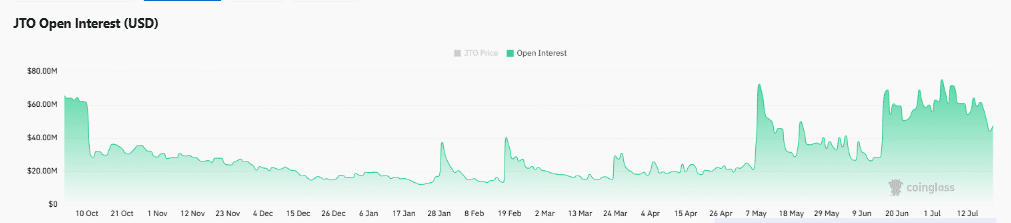
Derivatives traders also increased their exposure as Open Interest (OI) rose 14.53% to $52.05 million at press time, during the rally. The increase suggested that fresh positions entered the market instead of existing contracts simply closing.
Rising OI alongside double-digit price gains often reflected stronger market conviction because both spot and futures participants committed additional capital.
Unlike rallies driven by declining derivatives exposure, $JTO‘s advance attracted broader participation across multiple trading segments. The combination suggested traders expected the bullish narrative surrounding JIP-38 to continue influencing price action.
However, expanding leveraged exposure also increased the probability of sharper volatility should sentiment reverse or profit-taking accelerate after the recent advance.
Source: CoinGlass
Buyers maintained control across spot markets
Spot market activity also favored buyers throughout the latest recovery.
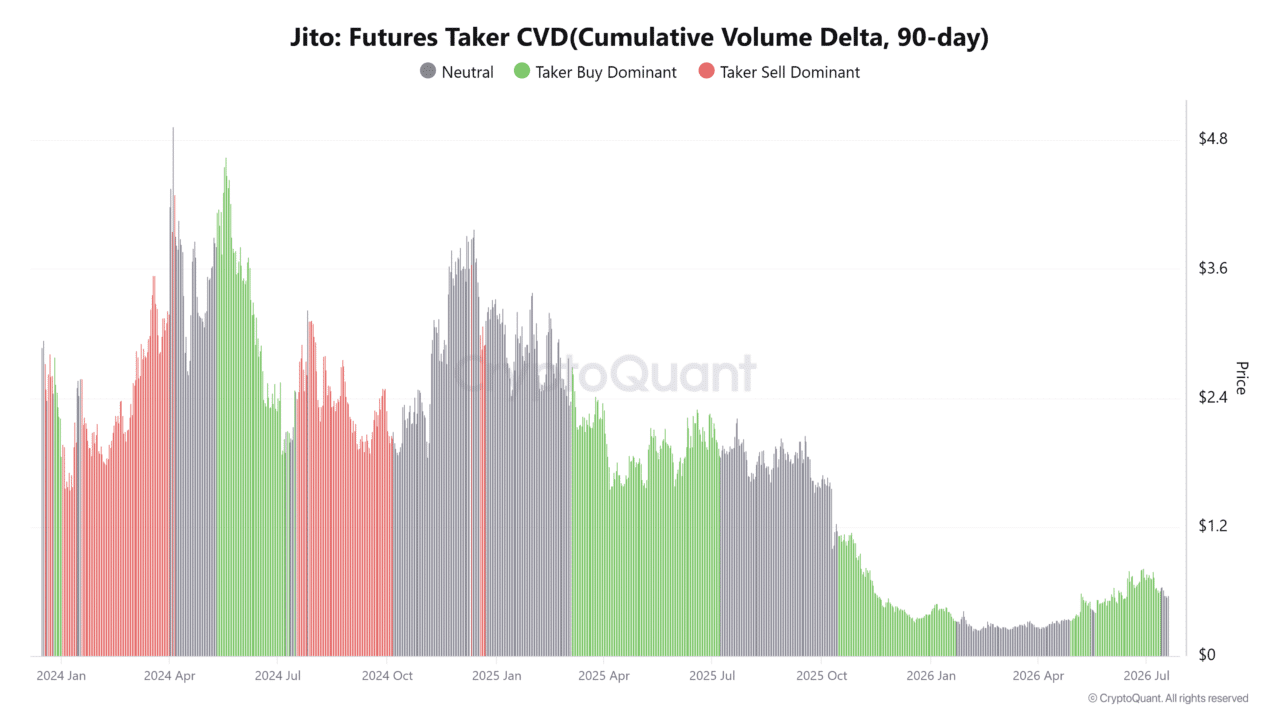
At the time of writing, the 90-day Futures Taker CVD remained buy dominant, showing that aggressive market buyers consistently absorbed available sell orders. The behavior aligned with the sharp increase in trading volume, which expanded 142.17% over the previous day.
Stronger buying pressure supported the price recovery instead of allowing sellers to regain control after recent weakness.
In addition, the sustained demand complemented improving sentiment surrounding Jito’s revised tokenomics and the broader Solana ecosystem. Although buyers held the advantage, continued demand would remain necessary to absorb future profit-taking as speculative participation increased across both spot and derivatives markets.
Source: CryptoQuant
Can $JTO reclaim $0.80 next?
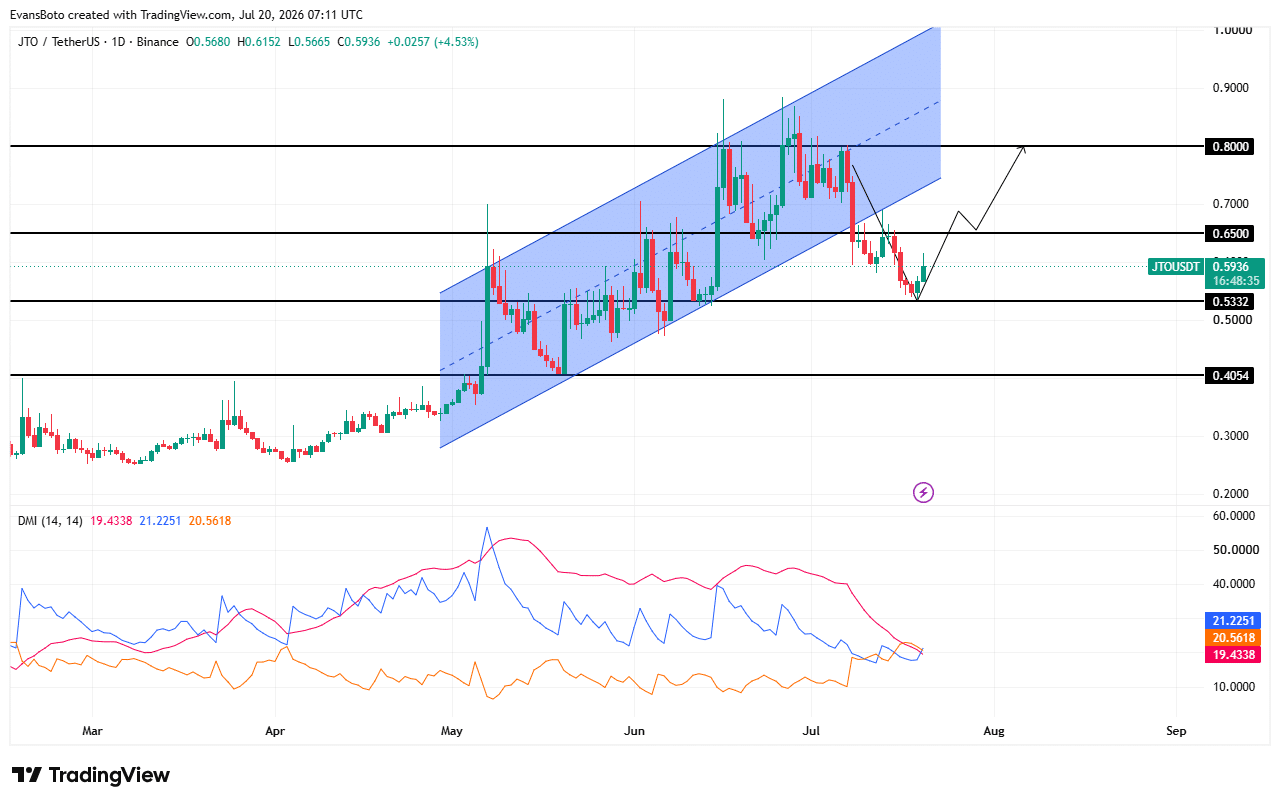
$JTO rebounded from the $0.5332 support area after breaking below its broader ascending channel earlier.
Buyers pushed the token back toward $0.6500, which now represented the nearest resistance before a possible move toward $0.8000. The Directional Movement Index (DMI) also reflected improving conditions.
At press time, the +DI stood at 21.23, remaining above the -DI at 20.56, while the ADX measured 19.43, suggesting bullish strength had started improving but remained below the threshold associated with a strong trend.
If buyers reclaimed $0.6500, the chart suggested a retest of $0.8000 could follow. However, failure to hold above $0.5332 would likely expose $JTO to another test of the $0.4054 support level.
Source: TradingView
Conclusively, $JTO’s rally reflected improving fundamentals, stronger buying pressure, and increasing trader participation rather than a purely speculative bounce.
If buyers continue defending support and overcome the $0.6500 barrier, the token could challenge $0.8000 in the sessions ahead. However, weakening demand would likely delay that recovery and shift attention back toward the $0.5332 support zone.
Final Summary
$JTO’s rally gained support from stronger buying activity and growing confidence after the JIP-38 proposal.
Rising Open Interest and steady spot demand kept bullish pressure intact, though $0.6500 remains the next key hurdle.
Former New York governor Andrew Cuomo has joined the OKX cryptocurrency exchange as a member of its board of directors. Cuomo became a board member after advising the company on US regulatory and institutional matters for three years, since 2023.
Strengthening OKX’s Governance
According to the crypto exchange’s announcement, Cuomo’s appointment strengthens its governance as it expands its presence in the US and builds infrastructure linking traditional finance with digital assets.
Cuomo had served as New York’s attorney general and as the US Secretary of Housing and Urban Development before becoming the state’s 56th governor. According to OKX CEO Star Xu, the former New York governor has influenced OKX’s approach to the US market. He emphasized that it will provide additional expertise on regulatory and institutional engagement as a board member.
It is worth noting that Cuomo’s appointment as a board member at OKX highlights a growing trend among major crypto exchanges. Most of them are shifting from the historical association with innovators, particularly members of the tech ecosystem who focus on disrupting the traditional sectors. They are currently aligning with political and regulatory insiders, suggesting that influence could be crucial in the crypto industry’s next phase of development.
A Trend Among Crypto Industry Giants
Notably, digital asset platforms adopted an anti-establishment posture over the past decade. They posed as alternatives to traditional finance, triggering regulatory friction between the crypto industry and existing laws. However, a recent trend has seen industry giants, such as Binance, elevating Richard Teng, a veteran regulator from Singapore’s MAS and Abu Dhabi’s ADGM, to steer its global operations.
Similarly, Coinbase, the United States foremost crypto exchange, built a formidable advisory board featuring former U.S. Senators, Department of Justice officials, and executive branch veterans to spearhead its legislative push. Meanwhile, Kraken, another top crypto exchange, has steadily institutionalized its leadership team, shifting away from its historically vocal libertarian roots toward traditional corporate governance.
According to Xu, Cuomo’s move to OKX’s board formalizes a relationship that has already shaped how the firm approaches the US market. He noted that it would enhance OKX’s efforts to build the infrastructure layer for both traditional and digital finance. Xu believes Cuomo is one of those who understand how governments, institutions, and markets actually think.
Related: OKX Raise Doubts on Binance’s Regulatory Arbitrage Games Citing Similar Incident in 2022
Vitalik Buterin, co-founder of Ethereum, discussed AI and humans on Farcaster, saying we don’t yet know whether current AI (LLMs plus agents and robotics) is merely another technological wave or the final wave that will eventually replace pretty much everything humans can do.
This is the big question Buterin keeps circling back to. He says people tend to judge humans and AI on just one thing (such as intelligence or productivity), but it’s not the right way to look at the current situation. Instead, he emphasizes that both sides have lots of different skills, where some match up, and others don’t. He believes the real question is how much they’ll eventually overlap.
Ethereum’s co-founder thinks that if AI eventually stalls before replacing every human capability, then society will change dramatically, with humans remaining in a central role.
People Who Leverage AI vs. Those Who Don’t
Buterin’s post offers an interesting perspective, which also points to the possibility that AI could become a productivity amplifier rather than simply taking over human jobs entirely.
At the moment, a large portion of advanced AI functions as a helper for experienced professionals. Someone who understands prompting, automation, AI agents, coding assistants, research workflows, and double-checking results can often accomplish several times more work than someone performing the same tasks manually.
This creates a growing gap between those who use AI and those who don’t.
Notably, Axios (a news website and media company) recently broke down a new kind of class divide forming around AI, putting people into three groups: those who have it, those who don’t, and those who don’t even know about it.
Axios’ take is that the top-tier users are already starting businesses, building companies, writing code, and automating all sorts of complex tasks, while most everyday users still think of AI as a smarter search engine or chatbot.
Adapting to the AI Shift
What’s interesting is that some researchers say AI won’t actually get rid of jobs, but will shift what people do. As opposed to creating things from scratch, humans will spend more time checking and confirming what AI produces.
MIT Sloan’s Christian Catalini recently pointed out that AI can churn out high-quality work for next to nothing, while humans take time and effort to verify things.
As it stands now, those who make the effort to learn how to work with AI today could end up with a real edge down the road. On the flip side, those who ignore the technology might get left behind, not because the machines will take their jobs, but because everyone else who uses AI will be able to get significantly more done in less time.
Related: Meta and Anthropic in Talks Over Up to $10 Billion AI Compute Deal
To view this video please enable JavaScript, and consider upgrading to a web
browser that supports HTML5
video
A meteorite that lit up the skies above New York City before crash-landing through someone’s roof contains evidence of how life was originally brought to Earth from alien worlds.
The space rock produced a sonic boom when it passed just south of the Statue of Liberty on July 16, 2024, before fragments began falling to Earth.
One meteorite weighing more than a kilogram later struck a home in Hillsborough, New Jersey, according to researchers writing in the journal Science Advances.
‘A forensic study of the fragments revealed that they contained preserved bits from near the surface of a small primitive asteroid where it experienced concentrated salty fluids – a process not previously known from this type of proto planet world,’ said lead author and meteor astronomer Peter Jenniskens of the SETI Institute and NASA’s Ames Research Center in California’s Silicon Valley.
This meteorite produced a sonic boom before crash-landing through the roof of a home in New Jersey (Picture: SETI Institute/Cover Images)
Scientists say the object, which was about the size of a large airline suitcase, entered Earth’s atmosphere at around 32,000mph (14.4km/s).
Around 60 people across New York, New Jersey, Connecticut, Rhode Island and Pennsylvania reported seeing the meteor to the American Meteor Society, while 16 people in New York and New Jersey said they felt the resulting shockwave.
The space rock was about the size of a suitcase when it crashed into the house (Picture: SETI Institute/Cover Images)
‘Our cameras in Northford, Connecticut, and Douglassville, Pennsylvania, as well as a doorbell camera in Wayne, New Jersey, captured the meteor, and from that we measured its trajectory,’ said American Meteor Society operations manager Mike Hankey. ‘The path traced back to low in the asteroid belt.’
The rock broke apart rapidly as it descended and was no longer visible at an altitude of about 22 miles (35km).
After the meteor disappeared, Doppler weather radar at Newark Airport briefly detected a long cloud of falling fragments stretching from Staten Island into New Jersey. Hillsborough lay at the far end of that debris trail, where the largest pieces are believed to have landed.
Only one meteorite was recovered after it smashed through the roof of a house. The homeowner described discovering extensive damage inside the property.
“I was at home at the time, heard a loud crash and found a hole in the ceiling of the master bedroom,” they said. “I smelled a strong sulfur-like odor and saw many black fragments along with debris and black dust that covered my bed, carpet and surrounding areas.”
The owner immediately documented the scene and carefully preserved the fragments using disposable gloves, aluminium foil and glass jars, helping to minimise contamination.
Laboratory analysis identified the meteorite as belonging to the rare CM group of carbonaceous chondrites, a class of primitive meteorites rich in carbon and water-bearing minerals.
Co-author Mike Zolensky, a meteoriticist at Nasa’s Johnson Space Center, said the Hillsborough sample showed greater alteration by water than is normally seen in CM2 meteorites.
The Hillsborough meteorite is only the 22nd observed fall of a CM-type meteorite and just the second witnessed fall of a CM1/2 specimen, after the Kolang meteorite in Indonesia in 2020. No witnessed CM1 falls have ever been recorded.
‘Thanks to the homeowner’s quick reaction, these are the most pristine CM1/2 meteorites we know of,’ said Jenniskens.
Scientists also identified small, salt-rich fragments that appear to have originated close to the surface of the meteorite’s parent asteroid, where liquid water is thought to have evaporated and concentrated dissolved salts.
Researchers are now working to identify the minerals within those salts and compare them with samples returned from the asteroids Ryugu and Bennu by the Hayabusa2 and OSIRIS-REx space missions.
Scientists believe highly concentrated salty water, or brine, may have played an important role in the chemistry that preceded the emergence of life on Earth.
To view this video please enable JavaScript, and consider upgrading to a web
browser that supports HTML5
video
‘Isotope studies of carbon and nitrogen suggest that primitive carbonaceous chondrites, including CM-types, delivered organic matter to the early Earth,’ said cosmochemist Queenie Chan of Royal Holloway, University of London, and biogeochemist Nana Ogawa of the Japan Agency for Marine-Earth Science and Technology.
‘The Hillsborough meteorite contained 1.8% by weight of carbon and 0.07% of nitrogen, and had carbon and nitrogen isotopes typical for CM-type meteorites.’
The team found a broad range of soluble organic compounds, indicating that the meteorite had undergone more extensive water-related alteration than most other CM meteorites.
‘A high fraction of compounds were the product of organic chemistry with minerals,’ said organic mass spectrometry specialist Phil Schmitt-Kopplin of the Technical University of Munich.
‘We do not know if these magnesium organic compounds were contributed by brine chemistry or were simply left over from earlier impact shock processes.’
Researchers also detected numerous amino acids, alongside carboxylic acids and other organic molecules.
Astrobiologist Danny Glavin of Nasa’s Goddard Space Flight Center and colleagues concluded that meteorites of this type may have delivered important organic compounds to the early Earth, contributing to the inventory of molecules from which life eventually emerged. Their findings suggest the complex mixture of amino acids found in the Hillsborough meteorite most likely formed within its parent asteroid, with brine chemistry playing a significant role.
Some fragments of the Hillsborough meteorite will be preserved at the American Museum of Natural History in New York.
‘We are thrilled that nature delivered such a precious asteroid sample on our doorstep,’ said curator Denton Ebel.
Binance founder Changpeng Zhao (CZ) stated that while artificial intelligence and Bitcoin are often considered together in investment markets, they fundamentally serve different functions. According to CZ, AI increases productivity, while Bitcoin is a unique asset that can be used to hedge against inflation and preserve wealth.
In a statement on his social media account, CZ said, “AI is amazing, but it can’t protect you from inflation. Bitcoin can.”
CZ stated that while artificial intelligence is a technology that increases business efficiency and overall economic productivity, Bitcoin, as a digital asset with a limited supply, offers a different value proposition.
CZ noted that the artificial intelligence sector is growing rapidly, stating that global companies are investing billions of dollars in AI infrastructure such as software, data centers, and advanced chips. He pointed out that these investments are accelerating transformation in many sectors, particularly healthcare, finance, and manufacturing.
However, CZ reminded that AI companies can issue new shares and raise capital to finance their growth. Therefore, he stated that the investment value of these companies continues to depend on their operational performance, profitability, and intense market competition.
Related NewsTomorrow Is a Critical Day for Cryptocurrencies: A Key Meeting Will Take Place in Russia
CZ stated that Bitcoin’s total supply is limited to 21 million units, a structure that prevents the asset’s supply from being increased and investors’ share from being diluted. According to CZ, Bitcoin’s scarcity makes it stand out as a long-term store of value during periods when the purchasing power of fiat currencies declines due to inflation.
CZ had previously stated that the investment boom in the AI sector could attract some of the capital expected to flow into the Bitcoin market. He noted that with AI companies like OpenAI and Anthropic attracting more investor interest, some investors might sell other assets and allocate resources to AI-focused investments.
However, CZ believes that AI and Bitcoin should not be considered direct competitors. According to the Binance founder, while AI supports technological progress and increased productivity, Bitcoin plays a complementary role by offering a store of value unaffected by supply expansion.