Tag: CRYPTOS FoxBusiness

  • Much-Anticipated Update for Major Altcoin Arrives Today

    The NU6.3 network update, codenamed Ironwood, has been activated on the Zcash mainnet. The new update introduces a new privacy pool to more securely verify the integrity of the $ZEC supply. Zcash has previously faced heavy criticism regarding its inability to verify the supply.

    Zcash Open Development Lab (ZODL) announced that the Ironwood upgrade has been successfully activated on mainnet block 3,428,143. The update introduces a new privacy pool aimed at enhancing the security of the Zcash network and enabling independent verification of the circulating $ZEC supply.

    With the introduction of Ironwood, certain restrictions will be applied to the existing Orchard privacy pool. Funds transferred from Orchard to Ironwood will need to pass through a “transition mechanism” before reaching the new pool. This mechanism aims to detect potential discrepancies in the $ZEC supply and maintain supply integrity.

    According to Zcash, Ironwood was developed as a result of ecosystem-wide efforts following a vulnerability discovered in the Orchard privacy pool at the end of May. While the vulnerability was addressed with an emergency network upgrade, there is no evidence that the vulnerability was exploited, resulting in user funds being lost or the total $ZEC supply being affected.

    Related News BREAKING: A Binance-Listed Altcoin Has Filed for Bankruptcy

    Built on the updated Orchard protocol, Ironwood incorporates formal verification methods and independent security audits. These steps aim to make the protocol more resilient against potential future supply integrity vulnerabilities.

    Users will need to migrate their existing assets from the Orchard pool to the new Ironwood privacy pool. Wallets that support Ironwood will provide a migration method for users. Those using the ZODL application can complete the migration process through the most current version of the application without creating a new wallet or changing their existing address.

    Zcash stated that Ironwood would enhance the verifiability of the $ZEC supply while protecting the network’s privacy features, creating a stronger, long-term security infrastructure for the protocol.

    *This is not investment advice.

  • Wall Street veteran Don Wilson says regulators are getting perps all wrong

    Wall Street veteran Don Wilson says regulators are getting perps all wrong

    Perpetual futures have become one of crypto’s defining financial products, but DRW CEO Don Wilson says much of what people think they know about them is wrong.

    In a series of posts on X, Wilson argued that perpetual futures — or “perps” — are simply futures contracts without an expiration date. The features often associated with crypto perpetuals, such as high leverage, auto-deleveraging (ADL) and around-the-clock trading, are characteristics of how some crypto exchanges chose to implement the products, not the contracts themselves.

    “Most of what people think they know about ‘perps’ … has nothing to do with the contract itself,” Wilson wrote.

    His comments come as interest in bringing perpetual futures into regulated U.S. markets continues to grow. Several exchanges and market participants have explored launching perpetual futures beyond crypto, though questions remain over how the products should be regulated and whether they fit within existing futures or swaps frameworks. Kalshi, which saw perps trading explode shortly after launching, recently submitted a proposal with regulators to expand its offerings to precious metals.

    Unlike traditional futures markets, crypto exchanges like Hyperliquid operate continuously, use digital collateral and can calculate margin requirements in real time. Those technological differences allowed exchanges to offer products with higher leverage and alternative liquidation mechanisms, including ADL, which automatically reduces winning positions when losing traders cannot cover their losses.

    Wilson said those design choices should not be confused with perpetual futures themselves.

    “I’m not a fan of ADL,” he wrote, adding that there is “no reason it needs to be used for perps.”

    Instead, Wilson argued that digital payment rails create opportunities to improve risk management. Traditional clearinghouses generally calculate margin once a day, with market participants often having until the following business day to post additional collateral. Because markets can move significantly during that window, clearinghouses require relatively large initial margin buffers.

    With real-time settlement, however, exchanges can recalculate margin continuously and require traders to post collateral immediately, reducing the need for large upfront margin requirements while maintaining the same level of protection, Wilson said. Whether exchanges choose to translate those efficiencies into higher leverage is a business decision, not a defining feature of perpetual futures.

    Wilson said the real innovation of perpetual futures is that they eliminate the need for investors to repeatedly roll expiring contracts, reducing transaction costs, market impact and roll slippage while allowing positions to more closely track the front of the futures curve.

    He also urged regulators to focus on economic substance rather than legal labels.

    “There’s no reason to treat perpetuals as swaps simply because they don’t expire,” Wilson wrote. “Economically, they’re futures.”

    Wilson concluded by calling for perpetual futures to be available across a broader range of markets, including commodities, securities and crypto, arguing that they should be viewed as another tool for price discovery and risk management rather than as a crypto-specific innovation.

  • The Owner of the Dogecoin Dog Spoke About Another Altcoin: “It Has Nothing to Do With Us”

    The Owner of the Dogecoin Dog Spoke About Another Altcoin: “It Has Nothing to Do With Us”

    Atsuko Sato, the owner of Kabosu, the Shiba Inu dog that inspired Dogecoin, has stated that she has no connection whatsoever with the CATE token projects circulating in the cryptocurrency market.

    Sato stated that a post he made on his Instagram account was used without his permission, and that fake tokens were launched using this content, falsely portraying him as being associated with it. The owner of Kabosu expressed his regret that some accounts with high follower counts on the X platform also contributed to the spread of these posts.

    Related News Analysis Company Issues Bitcoin Warning: “It Could Still Test These Levels”

    Atsuko Sato stated that Own The Doge is the only project she has officially authorized to manage intellectual property rights. Own The Doge acquired the iconic Doge NFT in 2021 and launched the $DOG token. The project also organizes Doge Day events, supports charities, and manages intellectual property rights related to the Doge brand.

    Sato stated that he and the Own The Doge team also launched the COCORO token on the Base network in 2025. Therefore, he clarified that the only cryptocurrency projects officially affiliated with him are $DOG and COCORO.

    Sato stated that the proceeds from these projects would be used for pet care and for animal protection organizations supported by “withkabosu,” and urged users to trust only official statements.

    *This is not investment advice.

  • Tether Signs MoU with the Nairobi Securities Exchange to Explore Digital Assets Use Cases, Tokenization, Blockchain Technology, and Digital Asset Education in Africa

    Tether Signs MoU with the Nairobi Securities Exchange to Explore Digital Assets Use Cases, Tokenization, Blockchain Technology, and Digital Asset Education in Africa

    28 July 2026 –Tether, the largest company in the digital asset industry, has signed a Memorandum of Understanding (MoU) with the Nairobi Securities Exchange (NSE) to explore digital asset education, tokenization, and financial market innovation in Nairobi.

    The NSE, established in 1954, is one of the leading African exchanges, based in Kenya, that offers trading facilities to people seeking exposure to Kenya’s and Africa’s economic growth. With a market cap of approximately $26.4 billion, NSE plays a vital role in Kenya’s economic growth by encouraging savings and investment and helping local and international companies access cost-effective capital. NSE is a member of the Association of Futures Markets and is a partner exchange in the United Nations-led SSE initiative. The NSE provides a world-class platform for trading equities, debt securities, and derivatives for people in Nairobi and the diaspora.

    Tether and NSE aim to close the gap between where Kenyan investors are today and where they need to be by proposing an investor education program through training sessions, workshops, and other accessible, structured knowledge-transfer initiatives on capital markets in the digital age, targeting participants from NSE-listed brokers and retail investor groups, to build awareness and participation in capital markets through digital assets.

    This MoU also aims to support the development and implementation of a blockchain-based market infrastructure for the tokenization and instant settlement of securities within the NSE using Distributed Ledger Technology (DLT) and enable fractionalized access to securities for both local and diaspora investors via the Hadron platform. Tether and NSE will also design and pilot secured onboarding flows tailored to the Kenyan regulatory environment to streamline Anti-Money Laundering (AML) and Know Your Customer (KYC) processes.

    Another key area of focus is the potential development of Real World Asset (RWA) Tokenization, which will explore the Hadron platform’s features and functionality to enable the issuance and trading of tokenized securities and other financial instruments. To promote financial freedom and optimize the institution’s financial workflow, Tether aims to support the integration of instant and atomic settlement mechanisms to reduce the institution’s current three-level settlement cycle. Additionally, both parties will assess the viability of integrating USD₮as a potential digital settlement infrastructure layer to enhance liquidity and attract increased capital flow where permitted by.

    “The use cases for digital assets are evolving, from crypto into real-life applications and, ultimately, cross-border institutional finance. This is what true freedom means. We’re glad to deepen our collaboration with the Nairobi Securities Exchange to advance practical institutional adoption and technological progress. Our goal is to streamline operations and enable efficient, transparent, accountable, and sustainable processes, while protecting data and privacy,” said Paolo Ardoino, CEO of Tether.

    “This MoU is fully aligned with the NSE’s 2025–2029 Strategic Plan, which is anchored on leveraging technology, deepening market participation, and expanding access to investment opportunities for all investors. By collaborating with Tether, we are exploring innovative technologies that have the potential to modernize market infrastructure, enhance operational efficiency, and broaden investor access while maintaining the highest standards of market integrity and regulatory compliance. As we execute our strategy, partnerships such as this will play a critical role in positioning the NSE as a globally competitive exchange and a catalyst for Kenya’s economic growth,”said Frank Mwiti, Chief Executive Officer, NSE.

  • Solana price falls below $75 as traders favor ETH

    Solana price falls below $75 as traders favor ETH

    Solana price fell about 5% from its July 27 high near $77 to $73 on July 28 as a break below short-term support triggered long liquidations.

    Solana price drops back toward $73

    According to data from crypto.news, Solana ($SOL) price traded near $73.20 at the time of writing after falling from an intraday high around $77 during the previous session. The move represented a decline of about 5% from peak to trough.

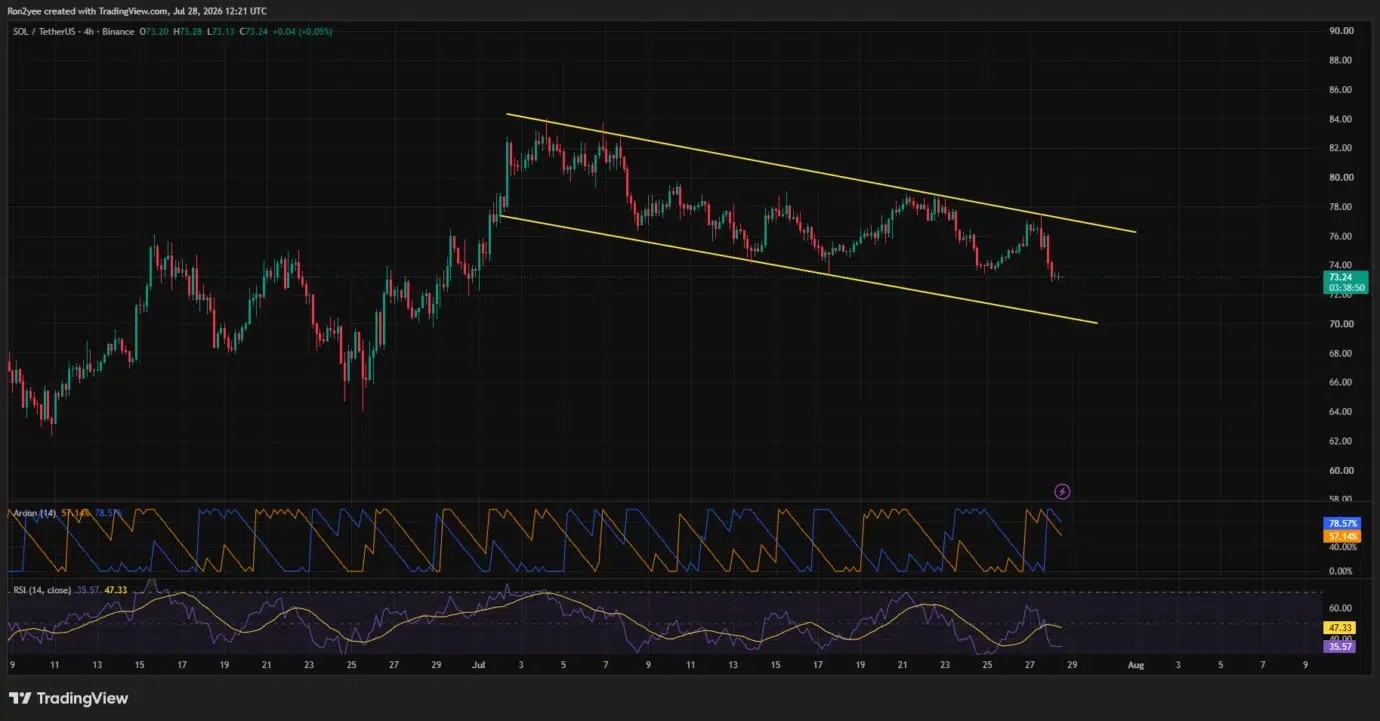
    The pullback followed $SOL’s latest rejection from the upper half of a descending channel visible on the 4-hour chart. Buyers pushed the token toward $77 on July 27 but failed to challenge the channel’s upper boundary or the wider $78 resistance area.

    Selling accelerated after $SOL lost the $75 level, which had supported several earlier intraday rebounds. The token subsequently fell toward $73 before entering a narrow consolidation range.

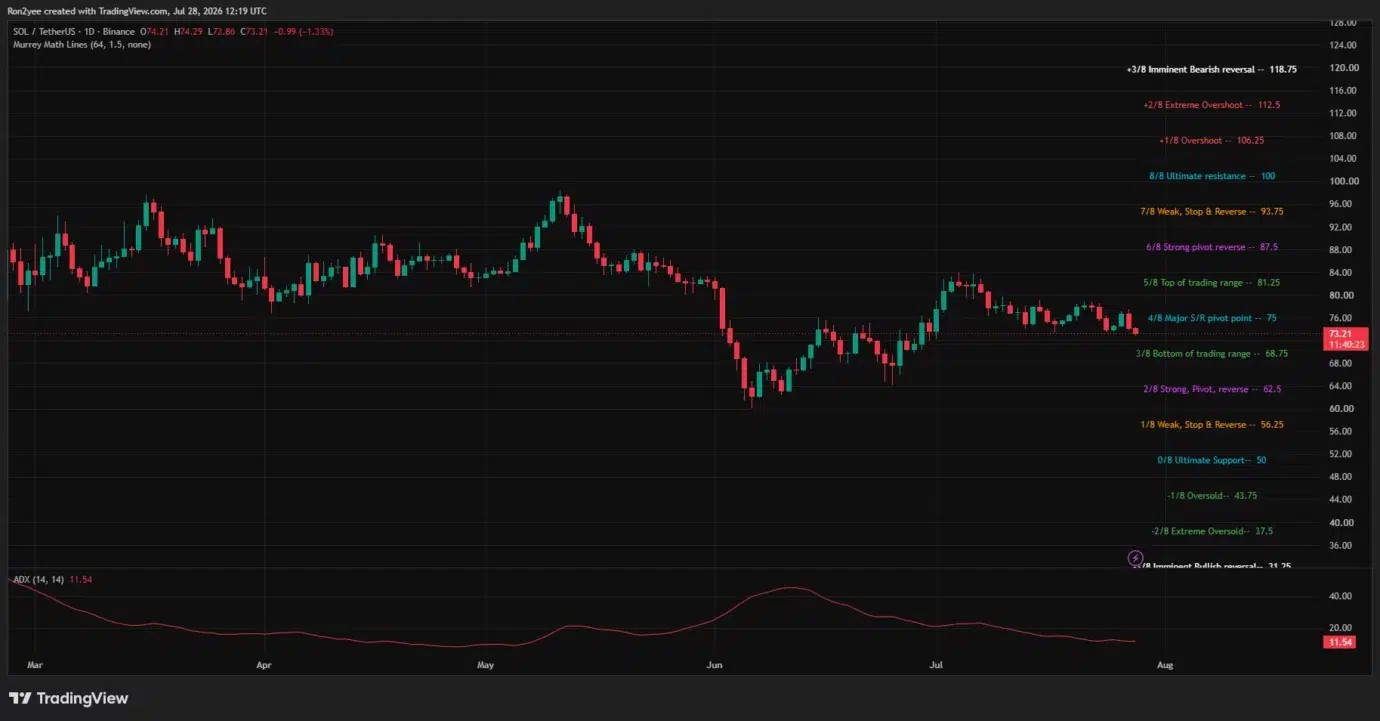
    The daily chart showed $SOL trading below the Murrey Math major support-and-resistance pivot at $75. Its July 28 candle recorded a low of $72.86, although buyers prevented a sustained fall below $73.

    Solana price daily chart — July 28 | Source: crypto.news

    $SOL’s decline also came as capital showed a preference for Ethereum. $ETH recently reclaimed $1,900, while $SOL remained trapped below its July resistance range.

    Crypto trader Daan Crypto Trades noted that the pair was beginning to lose its horizontal support area.

    “[Solana] needs to break this local consolidation before we can start looking at the range high again.”

    Daan added that Ethereum’s recent strength against Bitcoin had left Solana behind, making the $ETH ecosystem more attractive while $SOL remained weak.

    Long liquidations accelerated the sell-off

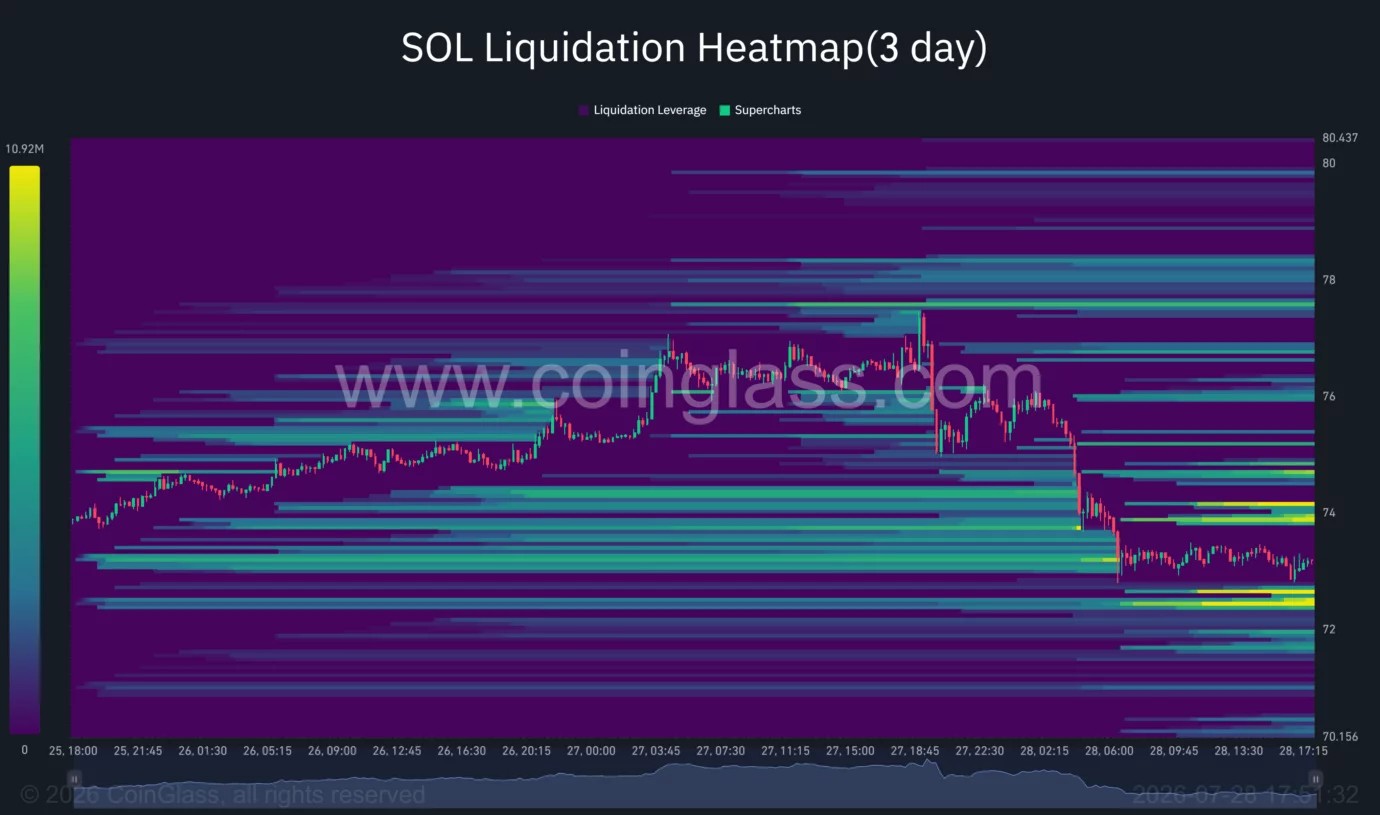
    The three-day CoinGlass liquidation heatmap shows that Solana’s slide cut through several leveraged trading zones between $75 and $73.

    $SOL first dropped sharply below $75 before falling through another band of liquidity around $73. The move likely forced leveraged long traders to close their positions, adding market sell orders to an already weak spot market.

    Solana liquidation heatmap | Source: CoinGlass

    The heatmap shows that the largest nearby concentrations now sit on both sides of the current price. A bright liquidity band has formed around $72.40–$72.70, while additional clusters are visible near $73.80–$74.20.

    This positioning could keep short-term price action unstable. A move below $73 may attract $SOL toward the lower liquidity pool, while an initial rebound could target the accumulated positions around $74.

    Further liquidation interest is visible near $75 and $76.50. Those levels could act as upside targets if buyers regain control, but they may also become resistance because traders caught in the decline could use a recovery to exit positions.

    The liquidation data support the view that derivatives positioning magnified the decline. However, the charts alone do not establish that institutional sell blocks caused the move.

    $SOL indicators point to weak momentum

    Solana remains inside a descending parallel channel that has guided its 4-hour price action since the early-July peak above $83. The channel has produced a sequence of lower highs, including rejections near $79 and $77.

    Solana price is trading within a descending parallel channel pattern on the 4-hour chart — July 28 | Source: crypto.news

    $SOL is now approaching the channel’s lower half. The lower boundary sits close to $70, making that level the next broader technical support if $73 fails.

    The 4-hour relative strength index has fallen to 35.57, below its signal average of 47.33. The reading shows that sellers control short-term momentum, although $SOL has not yet entered the conventional oversold zone below 30.

    Aroon readings also favor the downside, with the stronger line at 78.57% compared with 57.14% for the opposing measure. The indicator reflects the recency of price highs and lows rather than the size of a move, but its current configuration is consistent with $SOL’s recent lower low.

    On the daily chart, the average directional index stands at only 11.54. An ADX reading below 20 normally indicates a weak trend, suggesting $SOL is still consolidating rather than entering a confirmed directional breakdown.

    That weak reading leaves room for false moves around support. $SOL could briefly sweep liquidity below $73 before recovering, particularly if selling pressure in the derivatives market eases.

    Solana price levels to watch next

    The first level buyers need to recover is $74. A move above that area would allow $SOL to challenge the $75 pivot, which has changed from support into near-term resistance.

    A daily close above $75 would weaken the immediate bearish case. Bulls would then need to clear $77–$78 and break above the descending channel to reopen a path toward the July high around $83.

    Failure to reclaim $75 would leave $SOL exposed to another test of the $72.50 liquidation cluster. Below that area, the channel boundary near $70 becomes the next likely target.

    The daily Murrey Math chart places the bottom of the broader trading range at $68.75. That level may provide stronger support if a breakdown below $70 develops. A deeper correction could then extend toward the $62.50 pivot, although the current low ADX reading does not yet confirm such a move.

    Fed decision adds risk for US traders

    US investors are also awaiting the Federal Reserve’s next policy decision. Interest-rate expectations, movements in the dollar and Treasury yields can affect demand for high-risk assets such as $SOL.

    Treasury yields eased on July 28, while oil prices also fell as markets responded to renewed hopes for diplomacy in the Middle East. Brent traded below $87 and US crude near $81, reversing part of the inflation-driven pressure seen earlier in the week. The pullback reportedly followed a pause in attacks and renewed hopes for a US-Iran agreement.

    That means $SOL’s latest decline appears more closely linked to its technical breakdown and leveraged positioning than to a fresh rise in oil or Treasury yields. The Fed decision could still determine whether US liquidity conditions help $SOL recover $75 or push it toward lower support.

  • Singapore Regulator Tells Banks to Report Their “Cryptos”

    Singapore Regulator Tells Banks to Report Their “Cryptos”

    Singapore’s financial regulator wants banks to report their “cryptos,” but the instruction has nothing to do with disclosing Bitcoin, Ethereum or other digital-asset holdings.

    TL;DR

    • Banks must catalogue their cryptographic assets.
    • “Cryptos” does not mean cryptocurrencies.
    • Phased requirements arrive later in 2026.
    • Vulnerable systems will migrate by priority.
    • Crypto networks face similar security risks.

    In this case, “cryptos” refers to cryptographic assets: the encryption keys, digital certificates, signatures and algorithms protecting customer information, payment instructions and communication between financial institutions.

    The Monetary Authority of Singapore will issue formal supervisory expectations later in 2026, according to Channel News Asia. Banks will receive progressive deadlines for identifying their cryptography, ranking vulnerable systems and preparing replacements that can resist future quantum attacks.

    What Banks Will Need to Report

    MAS is not asking banks to publish their cryptocurrency portfolios. It wants each institution to maintain an internal inventory showing where cryptography is used across its operations.

    That could include mobile banking systems, payment authorization, customer databases, internal communications, cloud platforms and services supplied by external technology companies.

    Banks will also need to identify which systems rely on algorithms that powerful quantum computers may eventually be able to break. The most sensitive infrastructure can then be moved to the front of the migration queue.

    MAS first outlined this approach in its advisory on quantum-related cybersecurity risks, which encouraged financial institutions to map their cryptographic solutions, assess vulnerable assets and review their ability to adopt new security standards.

    The new supervisory expectations will turn that preparation into a more structured process with defined timelines.

    The Most Exposed Systems Will Move First

    Not every system carries the same risk. Infrastructure used to authorize payments or protect long-lived customer records will require more urgent attention than information that loses its value quickly.

    Banks must also account for encryption built into software, hardware and services operated by outside vendors. A financial institution may understand its own systems but still depend on a technology provider that cannot support newer algorithms.

    MAS expects institutions to develop the expertise and governance needed to manage those dependencies. That means assigning responsibility, coordinating with suppliers and planning for older infrastructure that cannot be upgraded easily.

    The regulator is aiming for Singapore’s financial institutions to become quantum-resilient before the end of the decade. MAS managing director Chia Der Jiun said experts estimate that quantum computers capable of breaking current encryption could emerge within five to 10 years, while a safe migration may itself take years.

    Why Quantum Computers Threaten Encryption

    Modern banking security depends on mathematical problems that conventional computers cannot solve within a practical amount of time. These calculations protect encryption keys and digital signatures from unauthorized access.

    A sufficiently powerful quantum computer could handle some of those problems far more efficiently, weakening widely used forms of public-key cryptography. Financial transactions, confidential communications and stored customer data could then become exposed.

    That capability does not exist at the scale needed today. The concern is that banks cannot wait for the threat to become practical before finding and replacing cryptography spread across thousands of systems.

    There is also a risk that attackers collect encrypted information now and attempt to unlock it years later. Data that must remain confidential for a long time may therefore require earlier protection.

    Singapore’s Quantum-Safe Migration Handbook describes the transition as a multi-year process involving system discovery, risk assessment, testing and gradual deployment.

    There Will Be No Single Quantum Upgrade

    Encryption is built into almost every layer of banking infrastructure, so replacing it through one large update would create its own operational and security risks.

    The transition will instead happen in phases. Banks must test how post-quantum algorithms affect processing speed, system compatibility and connections with other financial institutions before using them in live services.

    They will also need crypto-agility—the ability to replace algorithms and keys without rebuilding the systems around them. Institutions with rigid or outdated infrastructure may need to modernize those systems before adding quantum-resistant protection.

    The first post-quantum standards finalized by NIST provide algorithms for encryption and digital signatures, but adopting them across complex financial networks will take considerably longer than publishing the standards themselves.

    Why Crypto Networks Face the Same Problem

    The MAS requirements apply to financial institutions, but the underlying threat also matters to cryptocurrency networks. Blockchains depend on cryptographic signatures to prove ownership, authorize transactions and prevent funds from being moved without the correct private key.

    Parts of the crypto sector are already exploring possible responses. Bitcoin developers have discussed a multi-year migration away from quantum-vulnerable wallet signatures, while a BNB Chain post-quantum test reportedly reduced cross-region throughput by about 40%, showing that stronger protection can create significant performance costs.

    Banks and blockchains therefore face a similar trade-off. A new algorithm may offer stronger security, but it must still process transactions efficiently and work with existing wallets, applications and infrastructure.

    Singapore Has Already Tested the Technology

    Singapore’s preparation has moved beyond policy guidance. MAS and the Banque de France completed a cross-border post-quantum cryptography experiment using quantum-resistant algorithms to sign and encrypt communications over conventional internet infrastructure.

    The test showed that post-quantum protection can work across existing international communication channels. Wider deployment will still require banks to update certificates, key-exchange systems and technical standards shared with other institutions.

    MAS is expected to publish its detailed supervisory expectations later in 2026. The progressive timelines will cover cryptographic inventories, migration priorities and the governance needed to oversee the transition.

    For crypto readers, the headline may initially sound like Singapore is asking banks to disclose their digital-asset holdings. The real policy reaches further: the regulator is preparing the security behind digital finance for a threat that could eventually affect banks, payment networks and blockchains alike.

    Quantum computers cannot break modern financial encryption at scale today. Singapore is acting now because replacing that security safely may take most of the decade.

  • Franklin Templeton Joins Blackrock, Fidelity, Goldman Sachs in Backing CLARITY Act

    Franklin Templeton Joins Blackrock, Fidelity, Goldman Sachs in Backing CLARITY Act

    Franklin Templeton Adds to Wall Street’s CLARITY Act Support

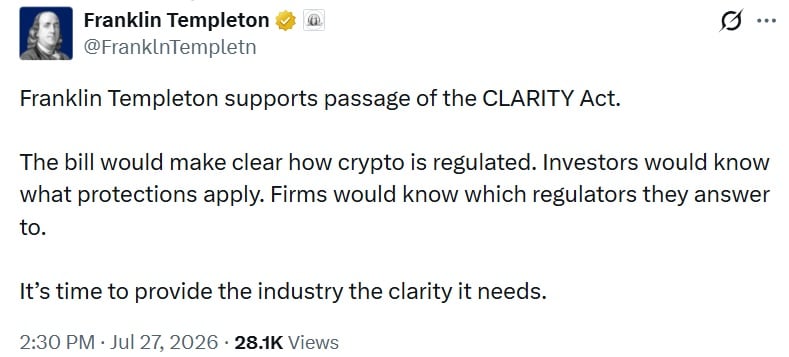
    Financial giant Franklin Templeton, a subsidiary of Franklin Resources Inc. (NYSE: BEN), announced its endorsement of the CLARITY Act on July 27 after reporting $1.79 trillion in assets under management as of June 30.

    The firm indicated that the CLARITY Act would establish clearer rules for digital assets, helping investors better understand the protections available to them while giving companies greater certainty over which federal regulators oversee their operations. Franklin Templeton added that the legislation would provide the regulatory clarity the crypto industry has long sought.

    Franklin Resources announced on July 6 that preliminary assets under management increased to $1.79 trillion at the end of June, up from $1.78 trillion a month earlier, driven by $9 billion in long-term net inflows, partially offset by market movements, distributions, and other factors.

    The endorsement places Franklin Templeton alongside the world’s largest asset manager, Blackrock Inc. (NYSE: BLK), investment giant Fidelity Investments, and global investment banking leader Goldman Sachs Group Inc. (NYSE: GS), all of which have publicly backed the CLARITY Act.

    Financial Giants Press Congress for Clearer Crypto Rules

    Blackrock Senior Managing Director and Global Head of Market Development Samara Cohen described the bill as an important step toward a digital asset framework that supports innovation while preserving transparency, resilient capital markets, and investor protections, expanding on Blackrock’s backing of the legislation.

    Fidelity Investments, which oversees approximately $7.1 trillion in assets, also urged senators to approve the measure, arguing that a consistent national regulatory framework would encourage responsible innovation while providing greater certainty for investors and market participants in its call to advance the Senate bill.

    Backing for the legislation also includes major Wall Street banks. Goldman Sachs CEO David Solomon endorsed the proposal, highlighting the banking industry’s growing interest in tokenization, digital asset custody, trading, and blockchain-based financial services, according to his public endorsement of the proposal.

    Charles Schwab Corp. (NYSE: SCHW), one of the nation’s largest brokerage firms, likewise characterized the measure as a catalyst for broader digital asset adoption by financial institutions and retail investors while outlining its vision for the industry’s future.

    Updated CLARITY Act Defines Federal Oversight

    Senate Republicans on July 22 unveiled updated CLARITY Act text reflecting merged work from the Senate Banking Committee and Senate Agriculture Committee as lawmakers pursued broader support.

    According to the bill’s official section-by-section summary, the proposal assigns responsibilities across the U.S. Securities and Exchange Commission (SEC) and the Commodity Futures Trading Commission (CFTC).

    The framework defines regulatory treatment for securities and digital commodities while establishing registration standards, customer protections, disclosure obligations, and preserved anti-fraud enforcement authority.

  • Grayscale: HYPE ETF Outpacing BTC, ETH, SOL, and XRP ETFs in Early Inflows

    Grayscale: HYPE ETF Outpacing BTC, ETH, SOL, and XRP ETFs in Early Inflows

    A new analysis from Grayscale indicates that the recently launched $HYPE spot exchange-traded fund (ETF) is attracting capital at a faster rate in its initial trading period than several prominent cryptocurrency ETFs did during comparable early stages. The finding, based on cumulative inflows relative to each fund’s market capitalization, positions the $HYPE ETF as an outlier in the current market.

    Comparing Early-Stage Inflows

    Grayscale’s report examined the inflow patterns of spot ETFs for Bitcoin ($BTC), Ethereum ($ETH), Solana ($SOL), and Ripple ($XRP) over their respective early trading windows. While $BTC ETFs demonstrated the most consistent and steady inflow trend, and $ETH ETFs experienced a notable mid-period surge, the $HYPE ETF’s initial capital accumulation stood out. $SOL and $XRP ETFs also recorded solid early inflows, but none matched the relative pace set by $HYPE.

    The analysis uses cumulative inflows relative to market capitalization as a key metric, offering a proportional view of investor demand. This approach accounts for differences in fund size and market depth, providing a more balanced comparison than raw inflow numbers alone.

    Why This Matters for Investors

    The data suggests that investor appetite for the $HYPE ETF is unusually strong in its formative stage. This could reflect a combination of factors, including market timing, the specific asset’s perceived potential, or broader trends in cryptocurrency ETF adoption. For market participants, the comparison offers a benchmark for gauging new ETF performance against established products.

    Implications for the ETF Market

    If the trend continues, it may signal shifting investor preferences toward newer digital asset funds. However, early-stage inflows do not guarantee long-term success, and the ETF’s performance will depend on sustained demand, market conditions, and the underlying asset’s fundamentals. Grayscale’s analysis provides a useful snapshot but should be viewed as one data point in a broader evaluation.

    Conclusion

    Grayscale’s comparison of early ETF inflows highlights the $HYPE fund’s strong initial performance relative to $BTC, $ETH, $SOL, and $XRP ETFs. While the data is promising for the $HYPE ETF, investors should consider it alongside other metrics and market developments. The report underscores the dynamic nature of the cryptocurrency ETF landscape and the importance of tracking relative performance over time.

    FAQs

    Q1: What is the $HYPE ETF?
    The $HYPE ETF is a spot exchange-traded fund that tracks the price of a specific cryptocurrency asset, allowing investors to gain exposure without directly holding the digital token.

    Q2: How does Grayscale measure early-stage inflows?
    Grayscale uses cumulative inflows relative to the ETF’s market capitalization over a defined early trading period, providing a proportional comparison across different funds.

    Q3: Does early inflow strength guarantee future performance?
    No. Early inflows indicate initial investor interest but do not predict long-term performance, which depends on market conditions, asset fundamentals, and sustained demand.

  • HTX Research Maps the RWA-DeFi Convergence as Tokenized Assets Surge Past $20 Billion

    HTX Research Maps the RWA-DeFi Convergence as Tokenized Assets Surge Past $20 Billion

    The infrastructure that once separated government bonds held in a custodian and liquidity pools on a blockchain is dissolving. A new research paper from $HTX Research, the analytical division of crypto exchange $HTX, traces the precise mechanism behind this shift. The report argues that the paths of real-world asset tokenization and decentralized finance are no longer parallel lanes—they are converging into one continuous financial loop. The analysis surfaces at a moment when tokenized RWAs have already crossed the $20 billion mark, according to industry trackers, and major financial institutions are actively settling real transactions on-chain.

    The $HTX paper, the original report, moves beyond the raw numbers. It examines the concrete flow mechanics that let tokenized treasury bills, private credit, or real estate become productive collateral in lending protocols, automated market makers, and yield aggregators. Instead of treating tokenization as a one-way bridge for capital import, the report frames the entire system as a feedback loop: assets from the off-chain world generate on-chain yield, which then attracts more capital to be tokenized, creating a flywheel that tightens the link between traditional finance and DeFi rails.

    That flywheel has recently gained speed. In a landmark week covered by our weekly tokenization roundup, exchange operator Bullish acquired Equiniti for $4.2 billion, Ondo Finance and JPMorgan executed the first live tokenized treasury settlement, and total on-chain RWAs pushed above $20 billion. These milestones moved tokenization from pilot experiments into actual market infrastructure. The $HTX research adds a structural layer to that narrative, mapping how DeFi protocols can absorb these tokenized instruments without breaking the composability that has defined decentralized lending and trading.

    How the Loop Works

    The report’s core insight is not simply that real assets can be tokenized, but that the resulting tokens can generate self-reinforcing liquidity. A tokenized T-bill fund, once minted on Ethereum or a rollup, can plug into a money market like Aave or a derivatives platform, where it earns an additional spread. That yield differential encourages more capital to leave low-yield traditional accounts and enter on-chain pools. The process mirrors the way institutional staking has been pulling capital into layer-1 ecosystems. Just as Nasdaq-listed firms are driving demand for SUI staking, institutional appetite for tokenized yield is reshaping DeFi liquidity profiles from the supply side.

    This tightening loop also changes the risk calculus for DeFi lenders. Handling collateral that carries off-chain credit risk and jurisdictional nuance requires more sophisticated oracle infrastructure and legal wrappers. $HTX Research points to the growing role of compliance layers and on-chain identity solutions that sit between the token and the protocol, creating a tiered access model that some purists may resist but that institutional participants demand. The tension between permissionless ideals and regulatory guardrails is not new—it has been a subtext in the legislative fights unfolding on Capitol Hill. Recent maneuvers by traditional banks to stall a sweeping crypto bill just days before a Senate vote underscore how high the stakes have become, as covered in our analysis of the legislative standoff.

    Developer Activity and the Infrastructure Race

    For the loop to hold at scale, the underlying blockchains must sustain high throughput, low transaction costs, and reliable developer tooling. The latest data on developer activity across the top blockchains shows Ethereum, BNB Chain, and Polygon leading, with Solana, Cosmos, and Arbitrum close behind. This sustained builder activity is essential because the RWA-DeFi convergence relies on far more than simple ERC-20 token minting. It demands specialized vault contracts, verifiable off-chain data feeds, and integrations with traditional settlement systems—software that must be battle-tested under the heightened scrutiny that comes with real-world financial exposure.

    Uncertainties remain around standardization. Different jurisdictions now treat tokenized assets under varying legal frameworks, and cross-chain interoperability for RWAs is still fragmented. The $HTX paper notes that while a unified financial loop is technically achievable, the path depends on whether common settlement standards and unified KYC/AML rails emerge rapidly enough to keep the flywheel turning without introducing systemic friction. A slowdown in regulatory clarity—or a messy enforcement action targeting a major protocol—could stall the feedback effect just as it is accelerating.

    For market participants, the report serves less as a prediction and more as a map of the pressure points. Traders watching on-chain volumes, protocol designers building for institutional liquidity, and compliance teams navigating rulemaking in multiple arenas all have a stake in how tightly the loop closes. The convergence looks structural rather than cyclical, but $HTX’s framework suggests that its tempo will be set by the practical integration of legal wrappers, not by raw transactional throughput alone. The next months will test whether the infrastructure and the policy environment can move in sync fast enough to match the velocity of the capital that is already searching for the shortest path between off-chain assets and on-chain yield.

  • Why Did the Shiba Inu (SHIB) Price Suddenly Spike? What Will Happen Next?

    Why Did the Shiba Inu (SHIB) Price Suddenly Spike? What Will Happen Next?

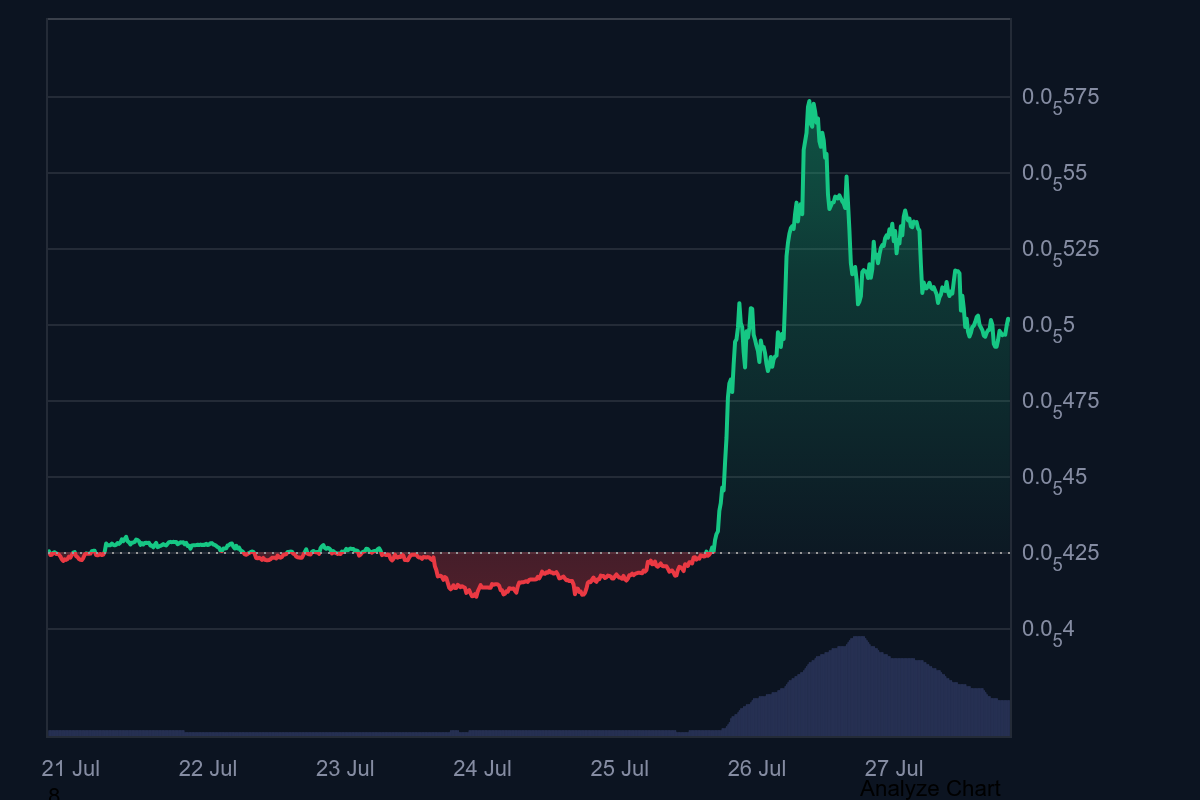
    Cryptocurrency analytics company Santiment has analyzed Shiba Inu ($SHIB), which has seen a significant increase in volatility recently. According to the company’s data, the price of $SHIB rose by 37 percent in two days, but quickly gave back some of its gains.

    Santiment reported that social media interest in Shiba Inu also increased significantly during the rally. $SHIB’s social dominance reached 0.084%, its highest level since April 2nd. However, the company noted that investor interest peaked during a period when price movement began to weaken.

    The chart shows the increase in $SHIB price.

    On-chain data also indicated that large investors may have viewed the rise as a selling opportunity. 52 whale transactions occurred in $SHIB in a single day, the highest daily level recorded since March 31st.

    Related News Attention: We’re Entering a Critical Week – Numerous Economic Developments and Altcoin Events Ahead – Here’s a Day-by-Day, Hour-by-Hour List

    According to Santiment, the increase in whale transactions suggests that large investors may have reduced their $SHIB positions by realizing profits as the price rose. In contrast, individual investors are believed to have entered the market later.

    The company stated that the surge in social media interest following the sharp rise indicates that small investors bought under the FOMO (Fear of Missing Out) effect as the price approached its peak. This may have provided whales with the necessary liquidity to reduce their positions.

    *This is not investment advice.