Tag: CRYPTOS FoxBusiness

  • Ethereum Foundation names pcaversaccio to board amid leadership changes

    Ethereum Foundation names pcaversaccio to board amid leadership changes

    The Ethereum Foundation (EF) has appointed longtime ecosystem contributor pcaversaccio (known as “pc”) to its board, expanding the group’s leadership as it continues to refine the governance of the organization behind the world’s second-largest blockchain.

    pc, a security researcher and co-founder of the emergency response initiative SEAL 911, joins the board for an initial one-year voluntary term. He has also served on the EF’s Silviculture Society, an advisory group that provides informal guidance on preserving the foundation’s core principles, including censorship resistance, open source development, privacy and security.

    The appointment brings the Ethereum Foundation’s board to four members: President Aya Miyaguchi, Ethereum co-founder Vitalik Buterin, Swiss legal counsel Patrick Storchenegger and pcaversaccio.

    The board is responsible for setting the EF’s strategic vision and ensuring management’s decisions remain aligned with the organization’s values, accordinfg to the Foundation. It also serves as a “security council” tasked with safeguarding the foundation’s mission and ensuring compliance with the laws of Switzerland, where it is currently based.

  • IOTA Integrates Pyth Pro

    IOTA Integrates Pyth Pro

    $IOTA has connected its L1 network to Pyth Pro, the new price feed infrastructure developed by Pyth, a decentralized oracle network providing financial market data for blockchain applications. The update gives developers access to more than 3 000 institutional-grade price feeds, lower latency, and faster data updates.

    Previously, $IOTA used Pythnet, Pyth’s original decentralized infrastructure that delivered price data through the Wormhole bridge. As part of a network-wide upgrade, Pyth is retiring Pythnet and moving all supported blockchains to Pyth Pro. The change is not exclusive to $IOTA and affects the entire Pyth ecosystem.

    Developers building on $IOTA can already migrate to the new service by subscribing to a Pyth Pro data plan and updating their integrations. The transition becomes mandatory on August 18. After that date, Pyth Core price feeds will stop working, and applications that have not migrated will lose access to market data.

    Image: Magnific

  • K3 Capital Opens Credit Vault for Galaxy

    K3 Capital Opens Credit Vault for Galaxy

    K3 Capital, an investment firm specializing in DeFi strategies, has launched an on-chain credit facility for Galaxy through Accountable’s blockchain verification platform infrastructure. The product is available on the Monad blockchain and has already attracted $30 million in committed capital. The companies plan to expand the facility to $100 million as new liquidity providers complete onboarding.

    The vault is denominated in the AUSD stablecoin. Investors deposit funds into the vault, K3 Capital manages liquidity, while Galaxy, a digital asset financial services company, borrows the capital. All movements of funds, loan status, and interest payments can be verified on-chain through Accountable’s verification system.

    The structure is designed for institutional investors. Each loan has a 90-day term with the option to roll it over, while up to 30% of deposited funds can be redeemed every month. The project also issues tokenized vault positions that can be used across other DeFi protocols on Monad, including for yield strategies and secondary lending markets.

    Image: Magnific

  • Bitcoin steadies above $64,000 as crypto looks to Fed interest-rate decision

    Bitcoin steadies above $64,000 as crypto looks to Fed interest-rate decision

    The crypto market was mixed before the Federal Reserve’s interest-rate decision later Wednesday. The CoinDesk 20 Index has added 0.41% since midnight UTC, with 10 members advancing and 10 declining.

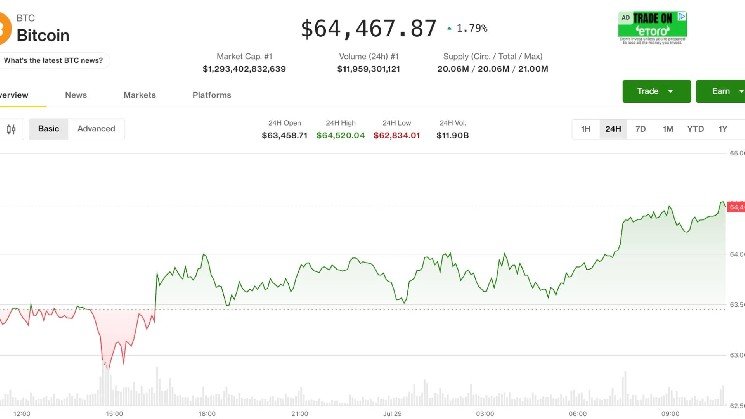
    Bitcoin $BTC$64,491.67, the largest cryptocurrency, added 0.75% to claw back some of Tuesday’s losses after a volatile 48 hours that saw it spike to $66,700 last week before crashing to $62,400 in the wake of the rout in South Korean stocks.

    Inflation running at 4.1% makes the case for the Fed to raise the fed funds target rate for the first time in three years. Balanced against that, a pause in Iran-U.S. hostilities has taken some of the heat out of oil prices and slightly trimmed the odds of an increase.

    Ether ($ETH) is down 0.13% on the day. S&P 500 and Nasdaq 100 index futures are both positive, while gold holds above $4,000 and silver gained 1.40%, suggesting markets are hedging rather than committing ahead of the announcement.

    Derivatives positioning

    • Steady positioning ahead of Fed meeting: The crypto taker long-short volume ratio is almost in a perfect balance ahead of the Fed meeting. Open interest (OI) has held steady near $113 billion over the past 24 hours while volume increased by 10% to $205 billion. Taken together, the numbers point to steady positioning but slightly higher churn.
    • Spot gains yet to lift futures participation: Both $BTC and $ETH’s spot prices have risen more than 1% in 24 hours, but the moves have yet to translate into increased participation in futures. $BTC’s OI remains steady near 750K $BTC. $ETH’s dropped for a fourth straight day to 14.14 million $ETH.
    • $UNI is an exception: Most of the top-20 tokens have seen OI hold steady or fall over 24 hours. $UNI is an exception, with OI up slightly to 68.53 million tokens, the most since July 13. This validates the 5% upswing in the token’s price in the wake of BlackRock’s decision to bring its tokenized Treasury fund to the decentralized exchange.
    • Mixed signals from OI-adjusted CVD: The 24-hour OI-adjusted CVD paints a mixed picture. It’s positive for tokens such as $ADA, TRX, $XRP, CC, $UNI and $ETH, a sign of more and more traders going long at market orders rather than passive limit orders. Other coins display the opposite dynamic.
    • Implied volatility stays near recent lows: Bitcoin and ether’s 30-day implied volatility indexes remain near recent lows, a sign that traders do not expect any near-term jitters. It also contradicts the unease in the analyst community over the fact that traders still assign a 35% probability of the Fed raising rates on Wednesday. This is unusual as markets typically reach a consensus on what the Fed will do before the decision.
    • Puts dominate $BTC options volume: In Deribit-listed options, $BTC puts at strikes $62,000, $60,000 and $54,000 dominate the 24-hour volume rankings. A put option offers insurance against price drops in the underlying asset. In $ETH’s case, calls are at the top of the list.

    Token talk

    • $XRP led altcoin gains on Wednesday, rising 1.72% to $1.086, with $ADA$0.1635 rising 1.48%. Both are continuing to recover from their July lows as the major cryptocurrencies consolidate.
    • Jupiter (JUP) was the standout 24-hour performer among DeFi coins, rising 5.79% as trading volume ticked up, extending a recovery that has now seen it rise in three of the past four days.
    • FET continued its retreat, falling 4.60% since midnight and 6.78% over 24 hours. The AI token is now down nearly 14% over the past week as the sector’s early-July momentum continues to unwind.
    • PUMP$0.001868 shed 5.14%, giving back the bulk of last week’s speculative gains as retail enthusiasm fades.
    • Monero (XMR) bucked the trend with a 1.82% gain to $347, quietly extending a run of outperformance from the privacy coin sector that has gone largely unnoticed amid the broader market turbulence.
  • Ethereum Wallet Count Crosses 200 Million: What It Signals for Adoption

    Ethereum Wallet Count Crosses 200 Million: What It Signals for Adoption

    The number of wallets holding Ethereum ($ETH) has surpassed 200 million, according to data reported by Cointelegraph. This milestone reflects a steady increase in user engagement with the Ethereum network, driven by decentralized finance (DeFi), non-fungible tokens (NFTs), and growing institutional interest.

    Network Growth in Context

    Ethereum’s wallet count has more than doubled since early 2021, when it first crossed 100 million wallets. The latest figure of 200 million includes both active and dormant addresses that hold a non-zero balance of $ETH. While not every wallet represents a unique individual — some users control multiple addresses — the metric is widely used as a proxy for overall network adoption.

    The growth comes despite periods of market volatility and shifting regulatory landscapes. Ethereum’s transition to proof-of-stake in September 2022, known as the Merge, improved energy efficiency and laid the groundwork for future scalability upgrades, which may have encouraged new users to enter the ecosystem.

    Implications for the Broader Crypto Market

    A wallet count of 200 million suggests that Ethereum’s user base is expanding beyond early adopters into a more mainstream audience. This is significant because Ethereum serves as the foundation for a large portion of the decentralized application (dApp) ecosystem, including lending protocols, decentralized exchanges, and $NFT marketplaces.

    Analysts note that wallet growth often correlates with increased transaction volume and network activity. However, it does not directly indicate price appreciation, as market sentiment and macroeconomic factors also play substantial roles. The milestone reinforces Ethereum’s position as the leading smart contract platform by user adoption, though competitors like Solana and Avalanche continue to attract users with lower fees and faster transaction times.

    What This Means for Everyday Users

    For retail investors and crypto enthusiasts, a larger wallet base can imply greater network security and liquidity. More participants generally lead to a more decentralized and resilient network. It also suggests that tools and services built on Ethereum — such as wallets, exchanges, and dApps — are becoming more accessible to non-technical users.

    However, users should remain aware of risks, including network congestion during peak usage and fluctuating gas fees. Layer-2 scaling solutions like Arbitrum and Optimism aim to mitigate these issues by processing transactions off the main chain while maintaining security.

    Conclusion

    The crossing of 200 million Ethereum wallets is a notable indicator of the network’s maturation and continued relevance in the cryptocurrency space. While the metric alone does not predict market direction, it underscores a growing base of users who are engaging with Ethereum’s ecosystem. As scalability improvements roll out and regulatory clarity evolves, the trend may accelerate, further cementing Ethereum’s role in the digital economy.

    FAQs

    Q1: Does 200 million wallets mean 200 million people use Ethereum?
    No. Many users control multiple wallets, so the number of unique individuals is likely lower. The figure represents addresses with a non-zero $ETH balance, not necessarily active users.

    Q2: How does this compare to Bitcoin’s wallet count?
    Bitcoin’s wallet count is estimated at around 50–60 million addresses with a non-zero balance. Ethereum’s higher count reflects its broader utility for smart contracts and dApps.

    Q3: Is this milestone bullish for $ETH price?
    Not directly. Wallet growth indicates adoption, but price is influenced by many factors including market sentiment, regulation, and macroeconomic conditions. It is a positive signal for network health, not a price guarantee.

  • Vitalik Introduces Diamond iO: A Breakthrough in Crypto Encryption Timescales

    Vitalik Introduces Diamond iO: A Breakthrough in Crypto Encryption Timescales

    Vitalik Buterin has pitched the Diamond indistinguishability obfuscation (iO), a novel cryptographic framework that promises to deliver blockchain privacy and trustless infrastructure in both crypto and Web3.

    Vitalik proposes new blockchain privacy technology

    In his latest blog, the Ethereum co-founder describes Diamond iO as a tool that would enable user interaction with encrypted software, but in such a manner that the program’s underlying logic, code, and keys remain secret. Diamond iO would run on Fully Homomorphic Encryption (FHE) inside a modified Attribute-Based Encryption (ABE) scheme.

    Unlike historical assumptions about iO, Buterin’s proposal could theoretically reduce the time it takes to run hidden program logic from a “universal-level” to a “planet-level” timescale. This would lay the groundwork for several privacy-preserving applications, including:

    1. On-chain voting where the program tallies votes and displays results without the need for a centralized tallying body.
    2. Private key use where applications can deploy private keys without risking their exposure.
    3. Trustless cryptographic infrastructure where developers can build secure software licensing protocols and decentralized, trustless Web3 services.
    4. Privacy-first blockchain and AI systems where artificial intelligence (AI) and smart contracts can process sensitive data with zero leakages.

    Current limitations and competition

    While Diamond iO is a viable proposition, it still requires extensive research and peer review before deployment. It also demands heavy computational input and tight circuit depth limits and will therefore require additional optimization studies.

    Nonetheless, the idea speaks to the ever-growing need for privacy preservation on-chain and beyond, for both individuals and corporate entities.

  • Altcoin Season Index Holds Steady at 52 as Market Waits for Clear Direction

    Altcoin Season Index Holds Steady at 52 as Market Waits for Clear Direction

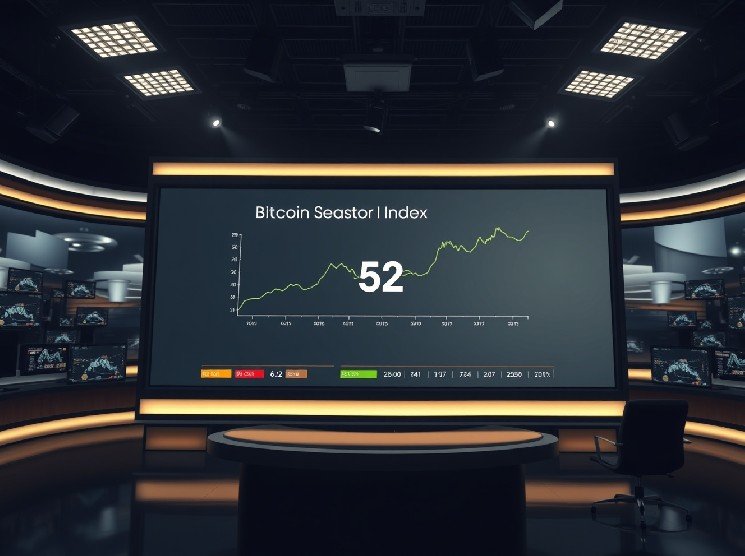
    The Altcoin Season Index, a widely followed gauge of cryptocurrency market sentiment, remained at 52 on Wednesday, unchanged from the previous day. The reading, calculated by CoinMarketCap, indicates a market that is neither firmly in Bitcoin season nor altcoin season, leaving traders in a neutral zone.

    How the Index Works

    The index compares the 90-day price performance of the top 100 cryptocurrencies by market capitalization, excluding stablecoins and wrapped tokens, against Bitcoin. When 75% or more of those coins outperform Bitcoin, the market is considered to be in altcoin season. Conversely, when fewer than 75% outperform, it signals Bitcoin season. The scale runs from 1 to 100, with higher readings pointing toward altcoin dominance.

    A reading of 52 means that roughly half of the top 100 coins have outperformed Bitcoin over the past three months, while the other half have lagged behind. This balance reflects a market that has not yet committed to a clear trend.

    What the Neutral Reading Means

    For investors, a neutral index reading often suggests a period of consolidation or indecision. Historically, sustained altcoin seasons have been associated with periods of high risk appetite and speculative interest, while Bitcoin seasons tend to occur during times of uncertainty or when Bitcoin itself is the primary focus of capital inflows.

    The current reading of 52, unchanged from the prior day, implies that the market is waiting for a catalyst. This could come from regulatory developments, macroeconomic data, or a significant price move in either Bitcoin or a major altcoin.

    Broader Market Context

    Bitcoin’s price has been relatively stable in recent weeks, trading in a narrow range. Altcoins have shown mixed performance, with some projects gaining on specific news while others have followed Bitcoin’s lead. The index’s lack of movement suggests that no single narrative has taken hold across the broader market.

    Traders and analysts often watch the Altcoin Season Index as a supplementary tool for assessing market sentiment. However, it is not a predictive indicator. A neutral reading does not guarantee that a shift is imminent, but it does highlight the current equilibrium between Bitcoin and altcoins.

    Conclusion

    The Altcoin Season Index at 52, unchanged from yesterday, reflects a cryptocurrency market in a holding pattern. With no clear leader emerging between Bitcoin and altcoins, the coming days may bring either a breakout or further consolidation. Investors should continue monitoring the index alongside other market data for a more complete picture.

    FAQs

    Q1: What is the Altcoin Season Index?
    The Altcoin Season Index is a metric from CoinMarketCap that measures whether the top 100 cryptocurrencies (excluding stablecoins and wrapped tokens) are outperforming Bitcoin over a 90-day period. A reading above 75 indicates altcoin season, while lower readings suggest Bitcoin season.

    Q2: Why did the index stay at 52?
    The index remained unchanged because the relative performance of the top 100 coins against Bitcoin did not shift significantly from the previous day. This indicates a balanced market with no strong trend in either direction.

    Q3: Is a reading of 52 bullish or bearish?
    A reading of 52 is neutral. It does not signal a strong bullish or bearish bias for either Bitcoin or altcoins. It suggests that the market is in a period of indecision, and traders should look for other signals to determine direction.


  • Zama’s Q2 update triggers 20% volume surge: But THIS warns of a correction

    Zama’s Q2 update triggers 20% volume surge: But THIS warns of a correction

    Zama [$ZAMA] is back on track after an explosive recovery in terms of trading volumes and network activity.

    The token’s prices increased by more than 10% over the past 24 hours following the release of the company’s Q2 report, which indicated further expansion of its ecosystem.

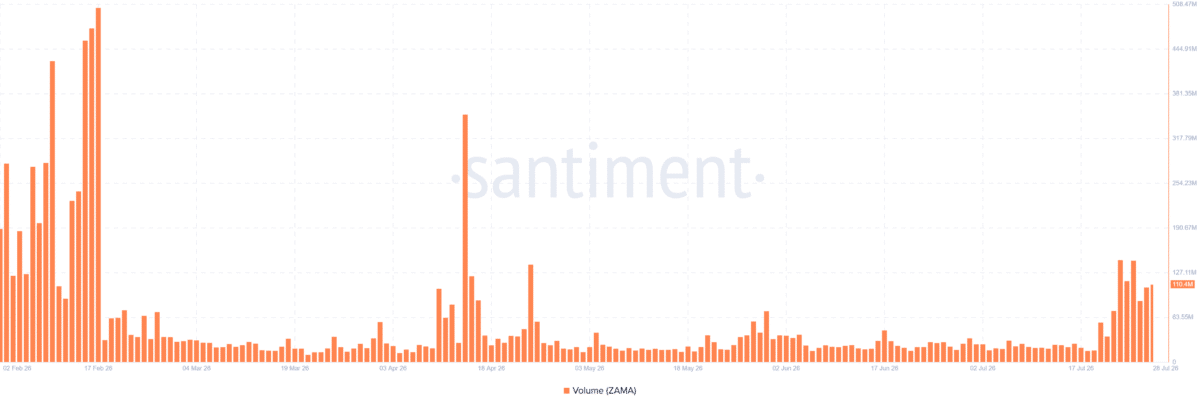
    The move was accompanied by a 20% increase in trading volume to $110.4 million, suggesting buyers backed the rally instead of chasing it on thin liquidity.

    For prospective investors, the question now is whether the latest surge has enough momentum to keep the bullish run going.

    Source: Santiment

    The Q2 update is already showing up on-chain

    Market response was not confined just to price changes.

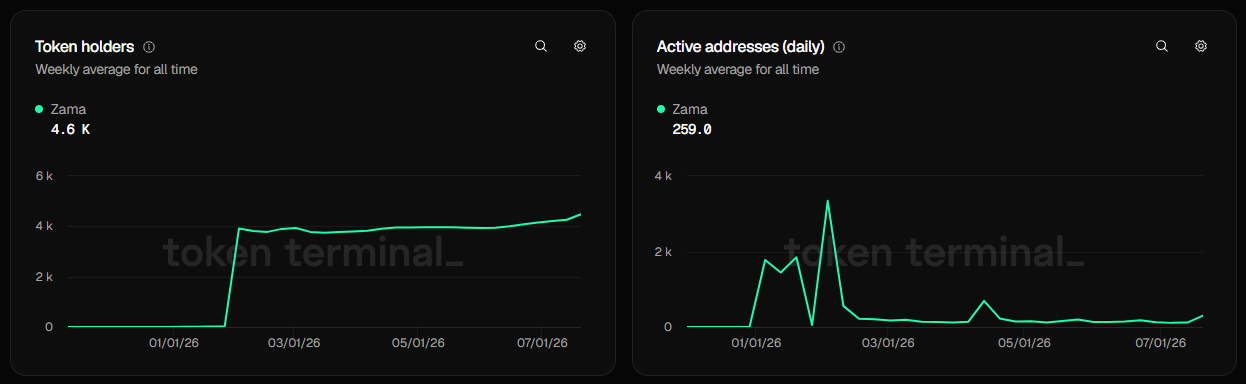
    Activity on the network increased soon after the report was published, with the number of active addresses doubling in the past 24 hours. The number of token holders has also recorded some recommendable gains of late.

    Source: Token Terminal

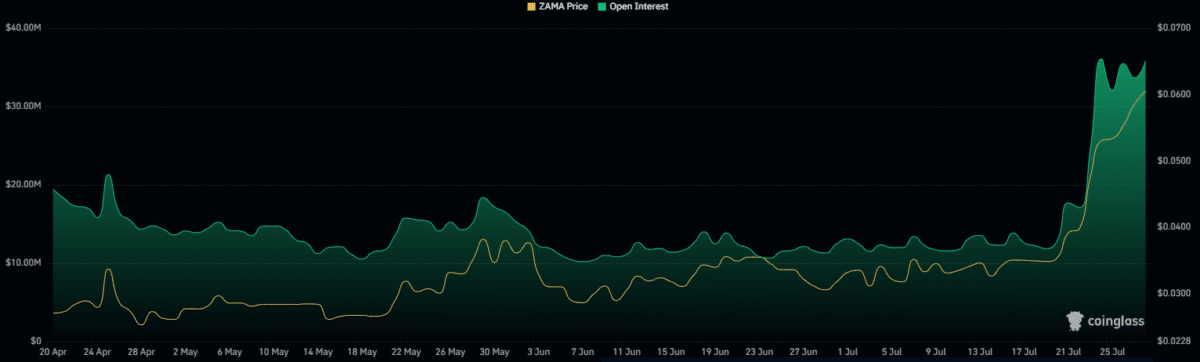
    On the other hand, Open Interest surged by double digits, implying that there is new money flowing into the derivatives market and not merely existing traders changing their positions.

    At press time, the cumulative leverage open positions were at an all-time high at $36.4 million after a sharp 24% daily surge.

    Source: CoinGlass

    All in all, the market shows improving market confidence following the latest ecosystem update, a development that could boost the current bullish momentum.

    Buyers remain in control

    The technical structure has also strengthened.

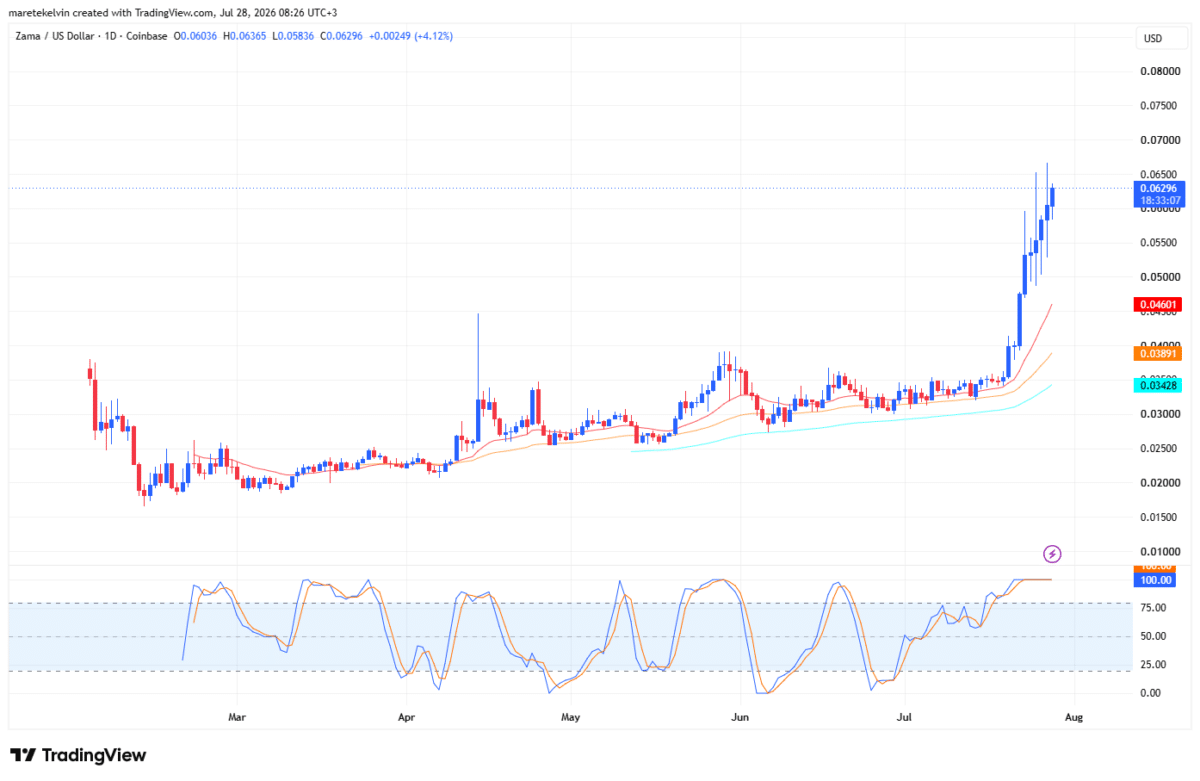
    $ZAMA continues to trade above its key Exponential Moving Averages (EMAs), preserving the bullish trend that has been building over the past 10 consecutive days.

    Holding above those dynamic support levels suggests buyers are still absorbing selling pressure despite the token’s recent advance.

    However, despite most on-chain metrics and structure standing by the market bulls, its Stochastic RSI sends some cautionary signals.

    On the daily chart, the token’s stochastic RSI is just bouncing from an oversold region (greater than 80), suggesting the token’s price action could be a short-term correction before extending its long-term bullish trend.

    Source: TradingView

    Can the rally extend?

    After the Q2 report, there has been higher network activity, increased active addresses, derivatives usage, and price action. All the metrics collectively point to a potential momentum continuation in the long run.

    But while $ZAMA stays above its key moving averages and participation is high, bulls should keep momentum on their side. A short-term correction cannot be sidelined either.


    Final Summary

    • $ZAMA gained by more than 10% after releasing its Q2 report, while trading volume climbed 20% to $110.4 million.
    • Active addresses doubled over the past 24 hours, and Open Interest posted double-digit gains, reinforcing the token’s bullish structure.
  • Ondo drops tokenized asset blockchain plans for private, high-speed trading network

    Ondo drops tokenized asset blockchain plans for private, high-speed trading network

    Tokenized asset specialist Ondo Finance ONDO$0.4037 has abandoned plans to build a conventional layer-1 blockchain, instead introducing a trading network it says is better suited for the next wave of onchain financial assets.

    Dubbed Ondo Network, the system marks a shift from the company’s February 2025 vision for Ondo Chain, a blockchain for institutional finance and tokenized real-world assets. After building its new perpetual futures platform, Ondo Perps, the firm said it concluded that a traditional blockchain wasn’t the best tool for handling the speed and privacy institutional trading requires.

    Ondo Perps is the first application using the network, with plans to offer tokenized assets as collateral for trading.

    The pivot comes as tokenization gathers momentum across Wall Street. Tokenization — the process of representing traditional assets such as stocks, bonds and funds as blockchain-based tokens — is gaining traction as firms look to modernize capital markets with faster settlement and around-the-clock trading. At the same time, perpetual futures, once largely confined to crypto markets, are expanding to traditional assets such as stocks and commodities like oil and gold.

    Beyond issuing tokenized assets

    Ondo has emerged as one of the sector’s largest issuers, with about $2.6 billion in tokenized U.S. Treasury products across OUSG and USDY and roughly $850 million in tokenized equities, according to rwa.xyz. The firm’s broker-dealer obtained last week FINRA approval to launch regulated markets and services for tokenized securities.

  • Crypto-Friendly States Are Winning, Draper Index Shows

    Crypto-Friendly States Are Winning, Draper Index Shows

    Crypto-friendly policies and startup incentives are helping reshape the U.S. innovation landscape, according to the latest Draper Innovation Index (DII).

    The index ranks states based on their ability to attract entrepreneurs, investment, and emerging technologies.

    The top performers and laggards

    The March 2026 update shows that states embracing digital assets and emerging technologies are gaining ground. Meanwhile, some traditional technology hubs are losing momentum.

    Texas climbed to fourth place in the DII US ranking, overtaking Wyoming, thanks in part to growth in overall venture capital investment, cryptocurrency and blockchain-related funding, and new business creation. Oklahoma also posted one of the biggest gains, rising to 15th place after strong growth in startup formation and crypto-related venture investment.

    Meanwhile, California dropped to 31st place and New York fell to 49th. According to the index, both states were hurt by weaker new business formation despite their large economies and established innovation ecosystems.

    New Hampshire ranked third, despite being 40th in GDP and 42nd in population size, highlighting the index’s argument that business-friendly policies can outweigh economic size. The state’s tax environment and startup-friendly policies have helped it attract entrepreneurs, according to BizWorld.

    Draper argued that innovation moves toward places with fewer barriers for founders.

    “When taxes get punishing, when regulations pile up, when policy stops rewarding risk… founders leave,” he said.

    The index also shows Canada falling from third to fifth place and other regions seeing declines linked to instability and capital flight.

    Cryptocurrency, blockchain adoption, and policies supporting business formation are becoming increasingly important factors in determining where the next generation of startups will emerge, according to Draper.