Tag: CRYPTOS FoxBusiness

  • U.S. regulator warns prediction markets against cutting corners in event contracts

    U.S. regulator warns prediction markets against cutting corners in event contracts

    The U.S. Commodity Futures Trading Commission, which has claimed a role as the leading regulator of prediction markets firms run by companies such as Kalshi, Coinbase, Polymarket and Crypto.com, issued an advisory on Friday reminding the businesses that they shouldn’t cut corners with far-ranging contract certifications meant to encompass a wide array of events.

    The agency said that “broad, template-style certifications should not be submitted,” marking the second time in recent months that the regulator has had to warn about overly generalized submissions.

    Many of the “designated contract markets” regulated by the CFTC “continue to self-certify event contracts” (in other words, prediction market contracts) as broad templates “without supplying the terms and conditions of each proposed permutation and a concise explanation and analysis with respect to the product’s terms and conditions, the underlying commodity, and the product’s compliance,” the agency said.

    The regulator said skirting the process can undermine its ability to work out whether the firm “has supplied all information, explanation and analysis required” and has “adequately evaluated the settlement methodology, data sources, and core-principles compliance of all permutations of the contract.”

  • Report: Kalshi Accuses Netflix of Defamation Over Trailer for New Prediction Markets Film

    Report: Kalshi Accuses Netflix of Defamation Over Trailer for New Prediction Markets Film

    Kalshi wants the trailer pulled and a public retraction issued before the film premieres Sunday, July 26. The company says the trailer uses a fabricated trade slip to suggest Kalshi allowed sports betting in Nevada in violation of a state court order, according to reports from The Hollywood Reporter and CNN, which obtained the cease and desist letter.

    The upcoming documentary tracks the rise of prediction markets, platforms where people trade contracts tied to real events. Netflix says more than $5.6 billion moved through Kalshi and Polymarket alone on the 2026 FIFA World Cup final. Reports state that CFTC Chairman Michael Selig, Kalshi CEO Tarek Mansour, and Polymarket CEO Shayne Coplan all appear in the film, which comes from producer Words + Pictures with Steve Yaccino as showrunner.

    The Disputed Scene

    The trailer, released earlier this week, shows a private gathering in Las Vegas during World Cup final weekend. It has been claimed that one guest in the trailer holds up a phone displaying what looks like a Kalshi trade slip and describes a $5,000 bet on Spain, which beat Argentina 1-0 in the July 19 final.

    Kalshi says the image tells a different story than the trailer implies. The receipt is dated May 16, 2025, more than a year before the events shown on screen. The phone display reads “crop,” which Kalshi says shows the person was viewing a saved image rather than an active trade. The company also says the slip does not match its interface and uses the phrase “bet slip,” language it claims has never appeared on its platform.

    Kalshi marketing head Brandon Beckhardt said the company flagged the issue to Netflix before the trailer went out. “We flagged the fake trade slip to Netflix. They said they’d pull the trailer. They haven’t,” Beckhardt said in a statement on X. He described the people in the scene as influencers rather than Kalshi traders.

    Beckhardt stated:

    “Netflix had a chance to make a genuinely interesting documentary about prediction markets. Instead, they made a sensationalized film built on fiction.”

    Kalshi has told Netflix it has barred sports event contracts in Nevada since May 4, 2026, and argues the trailer puts that legal position at risk during active litigation with the state.

    Netflix Pushes Back

    Netflix denies fabricating footage in a statement shared with The Hollywood Reporter. A Netflix spokesperson said the disputed trade was placed in May 2025, before any Nevada restrictions on Kalshi existed, and that the scene was filmed at a private Winible World Cup Watch Weekend event in Las Vegas. Winible, a platform tied to sports content creators, said the trade was placed outside Nevada and that tracking a position from any location is legal.

    Nevada’s Regulatory Fight

    The dispute sits inside a longer battle between Kalshi and the Nevada Gaming Control Board. A temporary restraining order arrived in March 2026, followed by a preliminary injunction and an amended order on May 18, requiring geofencing to block Nevada users from prohibited contracts.

    Kalshi recently reached a deal with Nevada to deploy a multi-source geofencing system through a provider such as Geocomply. The company has until August 12, 2026, to finish the rollout or face penalties of $120,000 per day.

    Gaming attorney Daniel Wallach pointed to a timing problem. He noted Kalshi told Netflix it has barred Nevada sports trading since early May, while court filings around the same period referenced trades that got through during the injunction period. Wallach said the overlap could weaken parts of Kalshi’s defamation claim, which depends on the trailer’s implication being entirely false.

    Why It Matters

    Prediction markets grew fast in 2025 and 2026 on the back of federal clarity for event contracts and high-profile moments like elections and the World Cup. Kalshi and Polymarket now lead the U.S. market, while state gaming regulators in Nevada, Michigan, Washington and Massachusetts have pushed back with lawsuits and restrictions.

    The unresolved question of CFTC authority over state gaming law now sits behind a documentary dispute with real legal weight. Kalshi cooperated with the film’s production, yet moved to block the trailer once it aired. As of July 25, the trailer was still circulating and Netflix had not confirmed any changes ahead of the Sunday premiere.

  • What Is the STABLE token for? A chain where fees speak USDT

    What Is the STABLE token for? A chain where fees speak USDT

    StableChain’s product is Tether’s dollar: gas in $USDT, transfers in $USDT, yield in $USDT. Its native token does none of that, and holders own governance and staking rights over a network whose every cash flow is denominated in someone else’s asset. This is crypto’s value-accrual question in its purest form yet, and it deserves a straight answer.

    Every blockchain token answers one question with its existence: why does this network need me? Bitcoin’s answer is total; the token is the point. Ethereum’s answer is functional: the token is the fuel and the bond. And the new generation of stablecoin chains has produced the strangest answer yet, embodied most cleanly by $STABLE, the native token of the Tether-ecosystem chain whose entire design philosophy is that users should never have to touch it.

    On StableChain, gas is paid in USDT0, the omnichain version of Tether’s dollar. Balances are $USDT. Simple transfers are exempt from fees entirely. The yield products pay in dollar terms. A user can onboard, transact, build, and exit without ever knowing $STABLE exists, and that is not an oversight; it is the pitch: a payments chain where the volatile native token has been engineered out of the user’s path completely, which leaves the token itself standing in an interesting place.

    $STABLE launched alongside the mainnet in December with two stated jobs, governance and staking, and a market price that implies belief in a third: that owning the token means owning something about the network’s future economics. This guide takes the question seriously from both directions: what the token actually does, mechanically, today, and what it would need to become for the belief to be right, because the gap between those two is where every dual-token chain’s story is decided.

    What the token actually does

    Start with the mechanical inventory, because it is short, real, and frequently misdescribed.

    Job one: security. StableChain is a proof-of-stake network, and its validators stake $STABLE as the bond that makes consensus honest; misbehavior risks the stake, and diligence earns rewards. This is the token’s hardest, least dismissible function: every proof-of-stake chain needs a bonding asset whose value is endogenous to the network, because a chain secured by staking someone else’s asset, $USDT, say, would let an attacker rent security from outside the system it attacks.

    The security budget, the total value staked and the rewards paid to maintain it, is denominated in $STABLE, funded today primarily through emissions, and it is the one place where the token is structurally irreplaceable. The dual-token design’s honest logic lives here: the payment medium should be stable and external, the security bond should be volatile and internal, and one asset cannot be both.

    Job two: governance. $STABLE carries voting rights in the network’s governance through the framework stewarded by the Stable Foundation, the independent body launched with the mainnet to run grants, ecosystem programs, and protocol votes. Tokenholder governance over a payments chain means influence over real parameters: fee policy for the non-exempt tiers, the scope of the gas-exempt allowlist, validator-set rules, upgrade schedules, treasury allocation. Governance rights are the token’s most commonly mocked function, crypto’s history is thick with governance tokens whose votes govern nothing consequential, and the mockery should be calibrated: on a chain with a patron as dominant as Tether’s ecosystem, the live question is not whether votes happen but how much of consequence is actually delegated to them, and the honest answer this early is: it is being determined, vote by vote, and the record so far is thin because the chain is young.

    And that is the complete mechanical list. $STABLE is not gas, not the settlement asset, not the unit of account for the chain’s products, not required to hold, send, or build. The inventory’s brevity is the design, and everything else about the token is a question about the future.

    The value question, stated honestly

    A token’s price is a claim on future usefulness, so state precisely what a $STABLE holder owns a claim on, and what they do not.

    They do not own the chain’s product. The product is $USDT mobility, and its economics flow elsewhere: the float income on the dollars flows to Tether, the fee revenue on non-exempt transactions accrues in $USDT terms, and the network’s growth, more users, more transfers, more integrations, grows the patron’s business directly, the mechanism this publication’s gasless-economics guide details. A million new users transacting entirely in the free tier generate, mechanically, zero fee demand for $STABLE, precisely because the design removed the token from their path.

    This is the sharpest version yet of the value-accrual gap that runs through crypto’s whole history, Ethereum’s L2s paying pennies to mainnet, XRPL’s agents settling in RLUSD, adoption compounding while the associated token watches, except that on those networks the gap emerged; here it was drafted, deliberately, as a feature.

    What holders do own is three claims, in ascending order of speculativeness.

    First, security demand: as the value settled on the chain grows, the security budget must grow with it; a chain moving billions cannot be secured by a token worth millions without inviting attack, so a successful StableChain structurally requires a valuable $STABLE, with validators and delegators buying and locking it to earn the staking yield. This is real, and it has a known weakness: security demand sets a floor proportional to what attackers could steal, not a valuation proportional to what users transact, and the two numbers can diverge by orders of magnitude.

    Second, governance premium: if the parameters tokenholders control become commercially consequential, which fee tiers exist, who gets allowlisted, how the treasury deploys, then influence over them is worth paying for, particularly to businesses building on the chain.

    Third, and decisive: the fee switch, the question of whether the network’s $USDT-denominated cash flows are ever routed to the token, through staking rewards paid from real fees instead of emissions, buy-and-burn mechanics, or revenue sharing. Every dual-token network eventually faces this fork, and the whole investment case compresses into it: a $STABLE whose staking yield is funded by growing $USDT fee revenue is equity-like, a claim on a payments business; a $STABLE whose yield is funded by its own emissions is a dilution machine wearing a yield costume, paying holders with their own money.

    Which fork this chain takes is not yet determined, is squarely within what governance and the Foundation will decide, and is, far more than any adoption metric, the number to watch.

    One structural detail deserves its own paragraph before the arithmetic: where $STABLE sits in the chain’s launch history, because the token’s distribution is part of its value question. The network arrived through a pre-deposit campaign that drew more than $2 billion from over 24,000 wallets before mainnet, a mechanism this publication’s stablechain coverage has examined as its own fundraising genre, and the token generation that followed allocated $STABLE across the founding ecosystem, investors from the $28 million seed round, the Foundation’s treasury, and the community programs the Foundation administers.

    The composition matters for both of the token’s jobs. For governance, initial concentration among ecosystem insiders means early votes measure the founding coalition’s intentions more than any community’s, and the decentralization of the holder base is itself one of the signals the grading framework below should track.

    For security, the same concentration cuts the other way, benignly: a validator set staked by aligned parties is resistant to hostile accumulation precisely because so much supply sits with the ecosystem, which is the standard early-chain trade: security through concentration now, credibility through distribution later. The unlock and emission schedules, as they publish, convert this from description to data: the float’s growth path determines how quickly the dilution ratio bites, and whose tokens are doing the diluting.

    The security-budget arithmetic, worked

    The token’s hardest function deserves its numbers worked in public, because security demand is the one claim $STABLE holders own unconditionally, and its arithmetic is both the case’s floor and its ceiling.

    A proof-of-stake chain’s security budget must answer one question: what does it cost to attack the network, and is that cost comfortably above what an attacker could gain? The attack cost is a function of the staked value, acquiring or corrupting a controlling share of stake, and the gain is a function of what the chain settles: double-spendable balances, censorable payments, extractable value in flight.

    For a payments chain aspiring to carry institutional $USDT settlement, the gains side scales with throughput and float parked on-chain, which is why the design community’s rule of thumb holds that staked value must grow roughly in line with the value the chain secures, and why a successful StableChain mechanically requires a substantially valuable $STABLE: billions settled daily cannot sit on security worth tens of millions without the mismatch itself becoming the vulnerability.

    That is the floor argument, and it is real. Its limits are equally arithmetic.

    First, security demand prices the bond, not the business: a chain can secure ten billion dollars of daily settlement with, say, low single-digit billions of staked value, generous by current industry ratios, and that number is a ceiling on security-driven token demand no matter how large the payment volumes above it grow. The token’s security case, in other words, scales with the square footage of the vault, not the traffic through the lobby.

    Second, the demand is circular at the margin: validators acquire $STABLE to earn staking rewards, and if the rewards are emissions, the demand is buying dilution, a loop that adds lock-up but not exogenous value, which is again why the fee-switch question dominates everything; real-fee rewards are the only input that breaks the circle.

    Third, the floor is contingent on decentralization actually mattering: a young chain whose validator set is effectively permissioned within a patron’s ecosystem is secured, in practice, by the patron’s reputation as much as by the bond, and the bond’s economic necessity, along with the token’s, grows only as that training-wheel arrangement is genuinely retired.

    The security argument for $STABLE is therefore best held precisely: it guarantees the token a job, sized to the vault; it does not guarantee the token a valuation, sized to the network; and the distance between those two is, once more, a decision waiting in governance, not a mechanism waiting in code.

    The comparisons that calibrate it

    Three adjacent cases put boundaries on how this can go, and each maps onto a live possibility for $STABLE.

    The cautionary case is the pure governance token: assets whose networks succeeded while the token’s claims never matured, votes over nothing binding, fees never routed, value asymptoting toward the governance premium alone, which history prices low. Crypto’s graveyard of DeFi governance tokens trading at fractions of their launch against thriving protocols shows the failure mode is not network failure; it is the network succeeding around the token.

    The constructive case is the modern fee-sharing turn: protocols that activated their fee switches, Maker’s burn against DAI revenues in its era, the newer generation of staking modules paying real revenue, and repriced accordingly. The mechanics exist, are well understood, and require only the governance will, which on a patron-dominated chain means the patron’s will: routing $USDT fees to $STABLE stakers is a decision to share the rail’s economics with tokenholders instead of concentrating them in the ecosystem, and patrons make that decision when tokenholder alignment is worth more to them than the revenue, typically as the validator set decentralizes and the chain’s credibility requires it.

    And the sobering case is the gas-token contrast: Ethereum’s $ETH, whatever its troubles, is bought by every user by necessity, a demand floor $STABLE’s design explicitly forgoes. The dual-token chain trades away that mandatory bid for a better product, stable fees, and the trade’s honesty should be admired even as its consequence is priced: on this architecture, nothing is automatic; every path from network success to token value runs through an explicit decision, by governance, by the Foundation, by the patron, to build the connection.

    $STABLE is, in that sense, the cleanest experiment yet run on crypto’s oldest question. The chain can succeed enormously; the token participates only if someone decides it should; and the entire due diligence of holding it reduces to a judgment about whether, when, and how generously that decision gets made.

    Watch the emission schedule against real fee revenue, watch the first governance votes that touch money, and watch for any fee-switch proposal in the Foundation’s pipeline, because on a chain that engineered the token out of the product, the only thing that can engineer it back in is a vote.

    A closing note on how this experiment will actually be graded, because the token’s design guarantees the verdict arrives as a series of documents, not a moment.

    The first grading event is every emissions disclosure: the schedule’s dollar value against the chain’s real $USDT fee revenue is the dilution ratio, and its trend is the single most information-dense number the token will ever print.

    The second is the first governance vote that moves money, a fee-tier change, a treasury deployment, an allowlist decision, because it will reveal whether tokenholder governance on a patron chain is a legislature or a suggestion box, and markets will reprice the governance premium accordingly within the week.

    The third is any fee-routing proposal, the fork this guide has argued everything reduces to, and its absence is also information: each quarter the network grows while staking yield remains emission-funded is a quarter of evidence about which fork the ecosystem intends.

    And the last is the slow one, validator-set composition, because the security argument matures only as the set opens beyond the founding ecosystem, converting the bond from ceremony into necessity.

    None of these events is a price target, and that is the point: $STABLE is a claim whose value will be legislated into existence, or not, by identifiable decisions on a public calendar, which makes it, whatever else it becomes, one of the most watchable experiments in token design now running. The chain’s users will never notice any of it, by design. The holders should notice nothing else.

    One comparison from outside crypto rounds out the calibration, because the dual-token structure has a traditional-finance cousin worth naming: the exchange operator. A stock exchange’s product is other people’s securities, its fees are denominated in ordinary money, and its own listed shares confer exactly what $STABLE confers, governance over the venue and a claim on whatever economics the operator chooses to route to shareholders.

    Nobody needs exchange shares to trade on the exchange, and the shares are valuable anyway, because the operator routes real fee revenue to them; the fee switch, permanently on, is the entire business model. The analogy clarifies both what $STABLE could become and what it is not yet: exchange operators are valuable because the routing decision was made at incorporation, in the corporate form itself, while a dual-token chain makes the same decision later, optionally, through governance, under a patron whose interests may prefer the revenue concentrated elsewhere.

    The distance between $STABLE today and the exchange-share model is exactly one decision wide, which is both the bull case’s simplicity and the bear case’s, and it returns the analysis to where the mechanical inventory left it: a token whose two real jobs are secure and decide, holding an option on a third job, collect, that only the second job can exercise.

    Frequently Asked Questions

    What is the $STABLE token in one sentence?

    $STABLE is the native governance and staking token of StableChain, the Tether-ecosystem Layer 1: validators stake it to secure the network, and holders vote with it on protocol matters, while all user-facing activity, gas, transfers, and settlement, runs in $USDT and USDT0, deliberately excluding the native token from the payment path.

    Why would a chain design its own token out of the user experience?

    Because volatile gas is a payments-product defect. Requiring users to hold a fluctuating native asset to move stable dollars adds friction, unpredictable costs, and onboarding failure, so stablechains denominate fees in the stablecoin itself and exempt simple transfers entirely. The dual-token structure separates roles: stable asset for payments, native token for the security bond and governance, each doing what the other cannot.

    If users never need it, where does demand for $STABLE come from?

    Three sources. Security demand: validators and delegators must acquire and lock $STABLE to earn staking rewards, and a chain settling large value structurally needs a large security budget. Governance demand: influence over commercially meaningful parameters, fee tiers, allowlists, treasury, is worth acquiring if those votes bind. And prospectively, fee routing: any future mechanism directing the chain’s $USDT-denominated revenues to stakers, the fee-switch question that dominates the token’s long-term case.

    What is a fee switch and why does it matter so much here?

    A fee switch routes a network’s real revenues to its tokenholders, through revenue-funded staking rewards, buybacks, or burns. It matters acutely for $STABLE because the chain’s cash flows are all denominated in $USDT: without routing, staking yield comes from $STABLE emissions, which is dilution recycled as yield; with routing, the token becomes a claim on an actual payments business. The decision sits with governance and the Foundation, and no commitment has been made either way.

    How does $STABLE’s situation compare to Ethereum’s $ETH?

    They occupy opposite ends of the design space. $ETH is mandatory: every Ethereum user buys it for gas, creating an automatic demand floor tied to usage, and it doubles as the staking bond. $STABLE forgoes the mandatory bid entirely for a better payments experience, keeping only the bond and governance roles. The trade means StableChain’s success does not automatically create $STABLE demand; every connection must be built by explicit decision.

    What are the main risks for $STABLE holders?

    The governance-token failure mode: the network thriving while the token’s claims never mature, with emissions diluting holders faster than security and governance demand grow. Concentration risk: a patron-dominated ecosystem may keep economically consequential decisions outside tokenholder reach. And the structural gap between security-budget demand, which scales with what attackers could steal, and the network’s transaction volume, which can be orders of magnitude larger without touching the token.

    What signals would show the token’s case strengthening?

    Real-fee staking yield: rewards funded by $USDT fee revenue rather than emissions. Binding votes on money: governance decisions that actually set fee policy, allowlists, or treasury deployment. A published emission schedule declining against growing fee revenue. And validator-set decentralization that increases the security bond’s importance. The inverse signals, emission-funded yield, ceremonial votes, widening dilution, mark the cautionary path.

    Is the dual-token model good or bad design?

    It is honest design with a hard consequence. Separating the payment asset from the security bond solves real problems: stable fees, spam-resistant security, and the world’s largest stablecoin gets a purpose-built rail from it. The consequence is that token value becomes a policy outcome rather than a mechanical one, decided by governance rather than usage. Holders are underwriting that policy process, which is a different investment than underwriting the network. This is educational information, not investment advice.

    Disclaimer: This article is for information and educational purposes only and does not constitute financial or investment advice. Token designs, governance frameworks, and reward mechanisms described here can change through protocol decisions. Nothing here is a recommendation to buy, sell, or hold any asset. Always do your own research. Information is accurate as of July 24, 2026.
  • Europe’s high regulatory bar could spark new crypto industry M&A wave

    Europe’s high regulatory bar could spark new crypto industry M&A wave

    “As it uses existing rules, it’s going to be much less like a standalone framework,” Lightstone said. “A crypto firm will be treated like any normal traditional financial institution,” adding that “it will still be hard to get FCA authorization.”

    For established banks and investment firms already operating under those rules, adapting to crypto may be relatively straightforward. For newer crypto businesses, however, the cost of building governance, capital and custody systems from scratch could prove considerably more burdensome.

    That challenge is particularly evident in the FCA’s proposed client asset regime, applying the Clients Asset Sourcebook (CASS) framework, which would require firms to segregate customer crypto assets from company funds under trust arrangements while introducing crypto-specific operational safeguards around private keys and reconciliations.

    “The CASS requirements are very onerous,” Lightstone said. “That could encourage those newcomers to merge [with], be acquired by, a traditional firm that’s already subject to CASS and has those controls in place.”

    Banking adoption

    The prospect of consolidation comes as banks themselves appear more willing to enter digital assets now that regulatory uncertainty is beginning to lift.

    “As of today, there is less than 20% of all the banks in Europe [that] offer today any type of crypto services, so it’s heavily underserved,” said Simon Schneider, CEO of Sygnum Europe.

  • Top 10 Blockchains by Developer Activity: Ethereum and BNB Chain Lead

    Top 10 Blockchains by Developer Activity: Ethereum and BNB Chain Lead

    Developer activity keeps serving as a key factor to indicate the health of the blockchain network. This data still reflects innovation, long-term sustainability, and community engagement. Based on the data from Santiment, Ethereum, $BNB Chain, and Polygon are the leading blockchains in terms of developer activity. The other prominent players include Arbitrum, Optimism, Solana, Cosmos, Avalanche, Harmony, and Cardano.

    Ethereum Continues to Dominate 30-Day Developer Activity

    Ethereum is the top name on the list of key blockchains in line with developer activity. Over the past thirty days, the blockchain has recorded 263.3K developer activity events with a 40.29% decline. Additionally, these events witnessed 1.1K contributors, expressing a 13.23% drop. In addition to this, $BNB Chain has become the 2nd top player, witnessing 121.8K developer activity events with a 40.72% decrease. At the same time, the respective events had 603 contributors, highlighting a 17.62% dip.

    Following that, Polygon has become the 3rd top blockchain ecosystem when it comes to developer activity over the past 30 days. In this respect, it saw 100.4K developer activity events, displaying a 40.85% plunge. Additionally, the 452 contributors of these events show a 16.14% decrease. Additionally, as the 4th top name on the list, Arbitrum accounted for 79K events with a 45.22% decline, while its 373 contributors expressed an 18.02% dip.

    Solana, Avalanche, Harmony, and Cardano Bottom List

    As per sanbase data, Optimism’s 78.4K monthly developer activity events indicated a 45.3% dip. Simultaneously, its 355 contributors signified an 18.01% drop. Then comes Solana with 77.4K developer activity events, showing a 32.14% decline. However, its 377 developer activity contributors show a 1.62% rise over the same period.

    According to Santiment, Avalanche is the 8th top blockchain when it comes to 30-day developer activity. It thus recorded 73.4K events with a 43.93% dip alongside 320 contributors, reflecting a 15.34% decrease. Additionally, Harmony’s 62.9K monthly developer activity events show a 39.45% dip, while its 287 contributors present a 10.87% drop. Concluding the list, Cardano’s 62.6K events and 295 contributors account for 34.58% and 11.41% dips.

  • Shiba Inu Netflow Exits Bullish Zone With 69 Billion SHIB but Price Says Otherwise

    Shiba Inu Netflow Exits Bullish Zone With 69 Billion SHIB but Price Says Otherwise

    Shiba Inu has recently flipped negative and its key exchange activity shows that demand is on pause and traders are increasingly selling again.

    Latest onchain data from crypto analytics platform CryptoQuant shows that the Shiba Inu exchange activity has retreated from its recent bullish position, flashing negative signals.

    Shiba Inu price explodes

    The data shows the Shiba Inu exchange netflow has increased to over 69 billion $SHIB as the amount of $SHIB currently available for sale across all supported exchanges has surged substantially.

    With the $SHIB exchange flow sitting at a net balance of 69,237,400,000 $SHIB, it implies that the amount of $SHIB tokens being sent to exchanges for sale over the last day is substantially higher than the amount of tokens removed from the exchanges for buying purposes.

    $SHIB reclaims $0.000004566 despite bearish netflow

    Despite the bearish trend in the Shiba Inu exchange activity, Shiba Inu has taken an unexpected turn with an explosive price move that has seen its price reclaim a previous high.

    Unlike previous market situations when bearish netflows are met with extreme price volatility, Shiba Inu has defied the trend this time, resisting the pressure from sellers.

    Although the $SHIB exchange activity shows that inflows are outpacing outflows, Shiba Inu has surged by over 10% over the last 24 hours, reclaiming its previous high of $0.000004566.

    Nonetheless, the unexpected divergence between the $SHIB price move and exchange netflow suggests that buyers are aggressively absorbing the additional supply entering exchanges.

  • Robinhood in talks with Crypto.com over prediction markets: WSJ

    Robinhood in talks with Crypto.com over prediction markets: WSJ

    The company behind the cryptocurrency and stock trading app, Robinhood, is reportedly discussing plans to expand its existing prediction markets offering with crypto exchange Crypto.com.

    According to a Friday Wall Street Journal report citing people familiar with the matter, Robinhood was in talks with Crypto.com to place yes-or-no event contracts supplied by the exchange. The trading company launched its prediction markets hub in March 2025, initially facilitated by Kalshi in order to comply with regulatory requirements from the US Commodity Futures Trading Commission (CFTC), and later using ForecastEx and Rotella.

    The reported move came just days after Bernstein analysts raised the firm’s price target on Robinhood (HOOD) stock to $160 from $130 per share, based on the company’s outlook for prediction markets and tokenized equities. They predicted Robinhood’s revenue using prediction markets could reach $1.7 billion by 2028.

    While Bernstein said in April that volumes in prediction markets could reach $1 trillion by 2030, many of the platforms face ongoing legal challenges in the United States between state and federal authorities. The CFTC has claimed to have “exclusive jurisdiction” over the companies’ event contracts, while gaming authorities in many states have filed lawsuits attempting to block or restrict their activities.

  • Sui traders eye range lows at $0.70 as oversold RSI signals potential buying zone

    Sui traders eye range lows at $0.70 as oversold RSI signals potential buying zone

    Sui [$SUI] faced a 5% price drawdown in the past 24 hours, with a 9.6% uptick in daily trading volume. This was worrisome as it suggested a short-term increase in selling pressure.

    The rest of the crypto market has faced losses over the past day, too. Bitcoin [BTC] and Ethereum [ETH] were down 1.05% and 1.14%, respectively. Compared to these market leaders, Sui was underperforming in the short-term.

    Why the Sui downturn is surprising

    Coinbase announced that $SUI can be staked directly on the exchange. Staking rewards would directly accumulate to the user’s account. It offered an easy, effortless way of earning rewards.

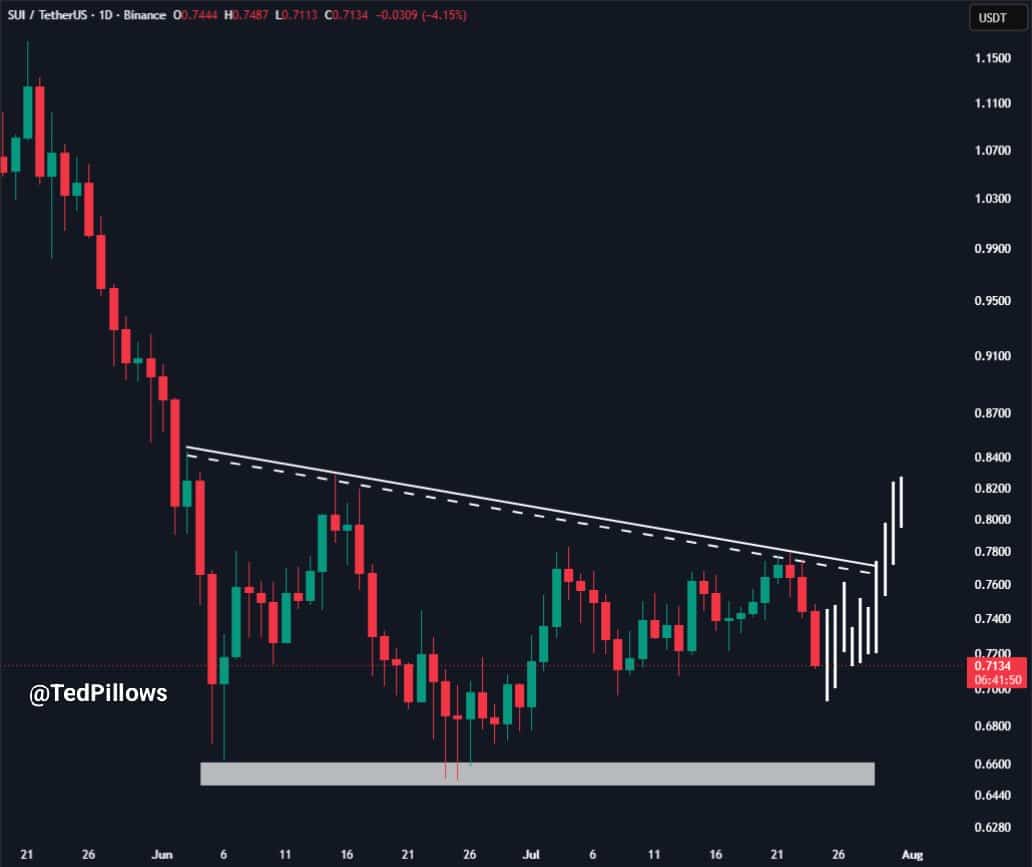
    Source: Ted on X

    Trader Ted noted that the bullish catalyst could help the altcoin break past the descending trendline resistance in place since early June. The token has defended the $0.66 support zone well so far.

    Some more consolidation followed by a bullish breakout was a viable scenario, the trader wrote.

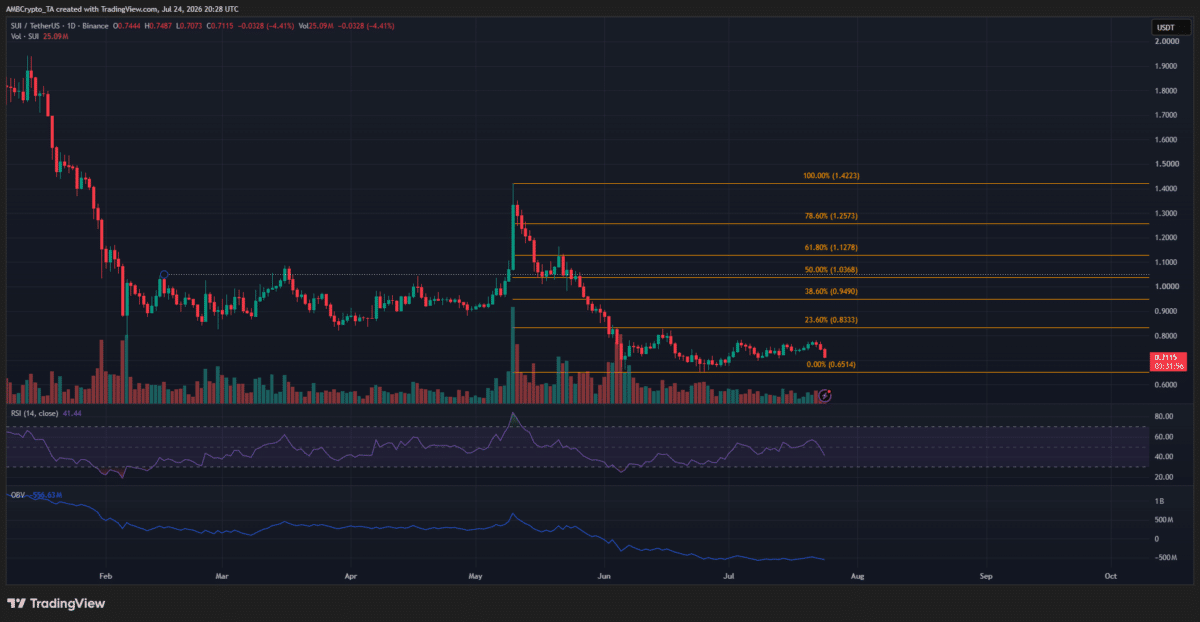
    Source: $SUI/$USDT on TradingView

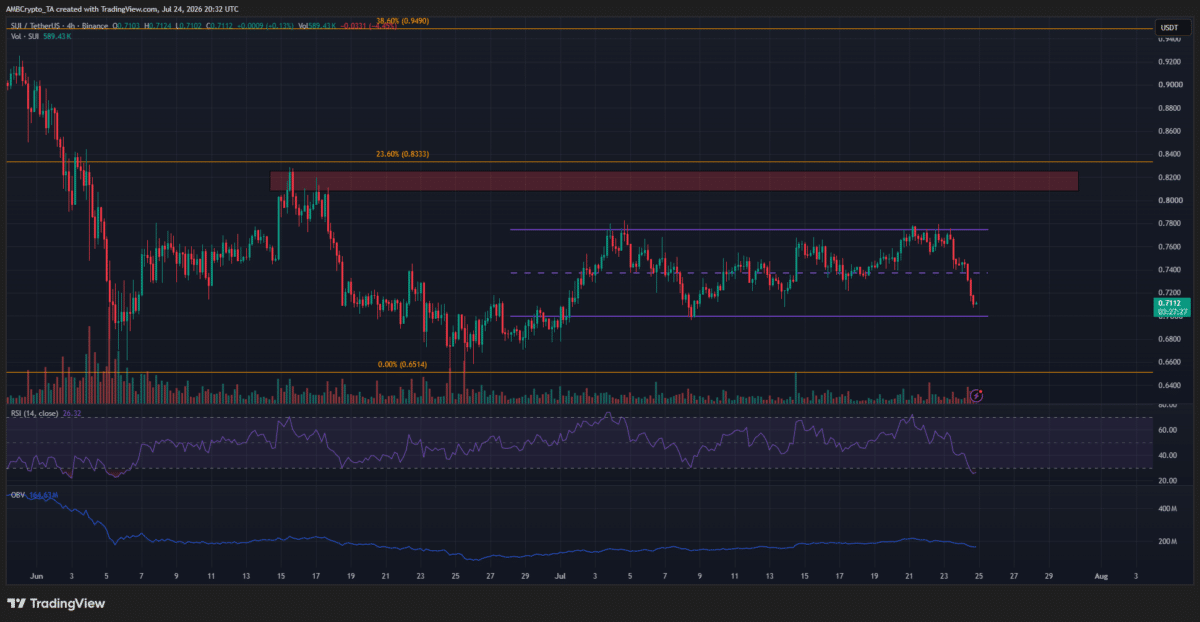
    The swing low at $0.65, made in June, marked the swing structure’s low. The RSI on the 1-day timeframe recently climbed above neutral 50, but the losses of the past three days sent the momentum indicator tumbling once more.

    The OBV was in a downtrend, although the selling pressure has eased in July.

    A pullback, in the form of a rally toward $1.12-$1.25, the Fibonacci golden pocket, was technically possible. However, it was far from playing out in reality.

    Traders’ call to action- Wait

    Source: $SUI/$USDT on TradingView

    In July, $SUI has been trading within the $0.70-$0.77 range. Traders can look to trade the token within this range. The RSI on the 4-hour chart was in oversold territory as the token approached the range lows.

    While this can be a buying opportunity, a breakout past the $0.82 local resistance zone would be a stronger buy signal for swing traders. Similarly, a breakdown below $0.65 would signal that the next impulse bearish price move was imminent.

    Final Summary

    • The Coinbase staking news has served as a sell-the-news type event.
    • The short-term range between $0.70-$0.77 might provide trading opportunities, but the $0.82 supply zone is also one to keep an eye on.
  • KULRTech moves $9.45mln in Bitcoin – Is a complete exit next?

    KULRTech moves $9.45mln in Bitcoin – Is a complete exit next?

    Since the October 2025 peak, Bitcoin has failed to sustain an uptrend, falling 48% from its $ATH. Amid this extended market weakness, long-term holders, especially institutions, have seen their losses skyrocket.

    The rising losses have pushed many of these firms to a breaking point, and they are not only capitulating but also walking away.

    KULRTech dumps $9 million in Bitcoin

    Treasuries that rushed to accumulate Bitcoin [$BTC] from late 2024 and 2025, fearing they would miss out, have found themselves operating at a loss.

    Others were pushed to capitulate to avoid more losses, and one such Bitcoin treasury company is KULRTech.

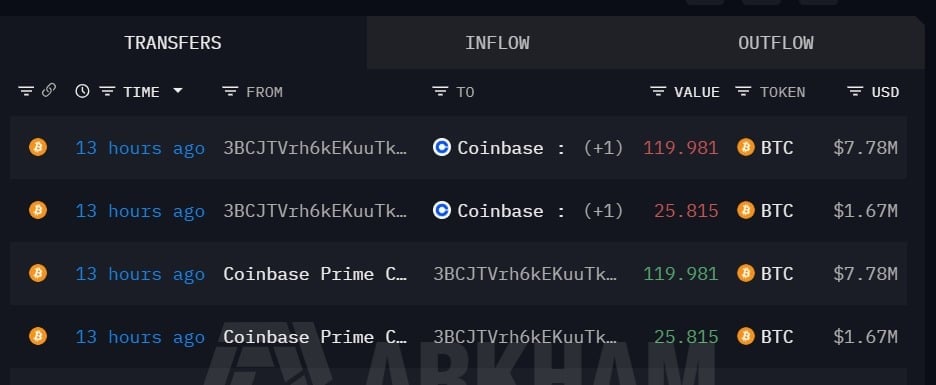
    KULRTech has been aggressively dumping its $BTC over the past months. According to Arkham data, KULRTech transferred 145.8 $BTC worth $9.45 million to Coinbase Prime.

    Source: Arkham

    After multiple transfers, its holdings of 1,021 $BTC worth $101 million now have only 100 $BTC worth $6.47 million left.

    In its selling spree, the company has mostly exited at a loss. AMBCrypto earlier reported that KULR Bitcoin holdings saw over $18 million in losses.

    Now with only 100 $BTC left, it seems the company is on the verge of completely exiting its position. Thus, if weakness continues, the company is likely to sell and exit the market entirely.

    Source: Yahoo Finance

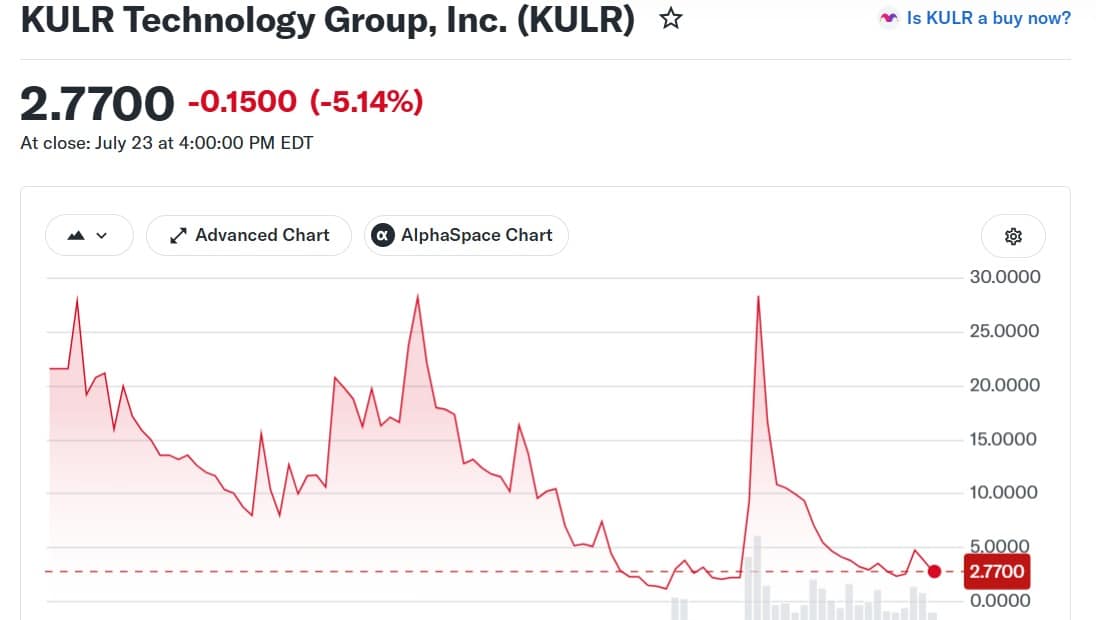
    Even more impactful for KULRTech, the company’s stock value was hit the hardest by extended Bitcoin poor performance.

    Yahoo Finance data showed that the company’s stock declined 78% from its $ATH of $43 recorded after it announced its $BTC investment. As of this writing, the firm’s stock value was around $2.7.

    Treasuries holdings value plunges $47 billion from 2025 peak

    KULR Technology Group, Inc is one of the many Bitcoin treasury companies operating at a loss. Also, it joins a long list of these firms aggressively selling.

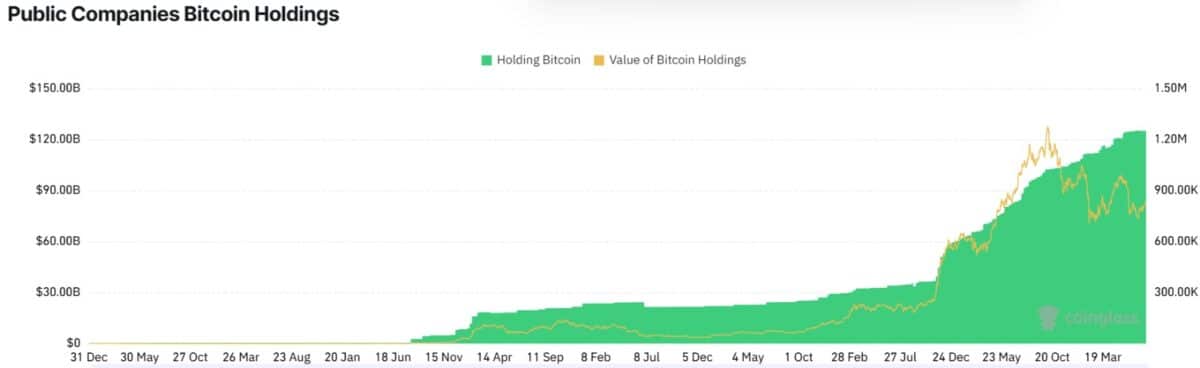
    Interestingly, while Treasury companies have increased their holdings in 2026, they have yet to reclaim peak value.

    Source: CoinGlass

    In 2025, Bitcoin treasury companies held 1.02 million $BTC worth approximately $128.5 billion at the peak. Now, these firms hold 1.25 million $BTC worth $81.5 billion, marking a $47 billion drop from the 2025 peak.

    Thus, although holdings have increased by 230k $BTC, the value remains extremely low, signaling rising losses. For example, Strategy is currently operating on $9 billion in losses.

    With these major investors holding at a loss and continually selling, the Bitcoin market still remains at extreme risk. Thus, fear from treasuries could drive continued market weakness, further reducing the capital that $BTC relied on significantly for the 2024-2025 rally.

    Final Summary

    • KULR Technology Group transferred 145.8 $BTC worth $9.45 million to Coinbase Prime, reducing total holdings to 100 Bitcoin.
    • Bitcoin treasuries have increased holdings by 230k $BTC since October 2025, but value dropped from $128 billion to $81 billion.
  • 382,000-Member Police Group Supports Revised Crypto CLARITY Act

    382,000-Member Police Group Supports Revised Crypto CLARITY Act

    Nation’s Largest Police Labor Group Reverses Course

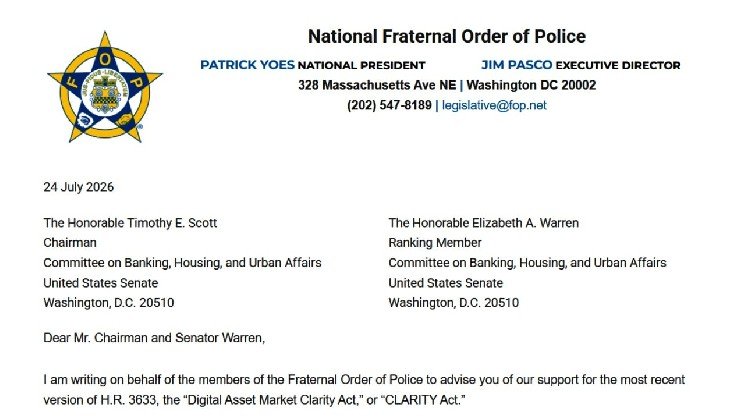
    The National Fraternal Order of Police (FOP) has endorsed the latest version of the Digital Asset Market Clarity Act after lawmakers revised provisions that had raised concerns about cryptocurrency-related prosecutions.

    Founded in 1915, the FOP describes itself as the largest law enforcement labor organization in the United States, representing more than 382,000 active and retired officers. Its size gives the group a prominent voice in federal debates affecting policing, criminal investigations, and officer resources.

    In a July 24 letter to Senate Banking Committee Chairman Tim Scott and ranking member Elizabeth Warren, FOP National President Patrick Yoes said the organization’s concerns had been “satisfactorily addressed.”

    The endorsement reverses the FOP’s earlier position. In its April opposition letter, the organization warned that language involving noncontrolling blockchain developers could restrict prosecutors pursuing financial crimes involving cryptocurrency.

    Revisions clarified that protections for certain noncontrolling software developers and decentralized technologies would not curtail investigations, prosecutions, or the application of established criminal statutes.

    Law Enforcement Positions Shift

    The FOP joins the National Organization of Black Law Enforcement Executives (NOBLE), which became the first major police organization to endorse the legislation. NOBLE said the bill would expand investigative capabilities while preserving established criminal authorities, marking an early law enforcement endorsement for the proposal.

    Major County Sheriffs of America stopped short of endorsing the bill but withdrew its opposition after further discussions. The group’s move to a neutral position suggested that revisions had eased some concerns.

    Opposition has not disappeared. A coalition representing more than 70,000 prosecutors, sheriffs, police chiefs, and other professionals previously called for changes to the CLARITY Act, arguing that broad exemptions could weaken oversight and investigative tools.

    Revised Bill Expands Enforcement Tools

    The revised bill would protect digital asset companies and stablecoin issuers from liability when they voluntarily delay suspicious transactions or act at law enforcement’s request. Temporary holds could give investigators time to prevent losses, trace stolen assets, and disrupt illicit transfers.

    The legislation also addresses crypto ATM fraud and applies Bank Secrecy Act obligations to covered digital commodity exchanges, brokers and dealers. An official section-by-section summary says those businesses would face anti-money laundering, customer identification, and due diligence requirements.

    Title IX would establish a grant program to strengthen state and local digital asset enforcement capabilities, create a law enforcement and national security training program, establish a digital asset cyber innovation center, and fund research into emerging technologies used in cryptocurrency-related crime. The provisions also include initiatives aimed at protecting older Americans from fraud and improving coordination among federal, state, and local agencies.

    Democrats Reject Latest Senate Draft

    U.S. Senator Cynthia Lummis (R-WY) released an updated CLARITY Act draft July 22 after Senate banking and agriculture lawmakers combined their market-structure proposals. The measure addresses securities oversight, commodities regulation, decentralized finance, illicit-finance controls, and federal ethics requirements involving digital assets.

    Seven Democratic senators rejected the Republican text, contending that the proposal still falls short of an acceptable bipartisan agreement. Their joint statement opposing the current draft identified unresolved concerns involving elected officials’ ethics, consumer protections, illicit finance, conflicts of interest, and market integrity.

    Although the seven lawmakers pledged to continue negotiations, Republicans are expected to need Democratic votes to reach the 60-vote threshold typically required to invoke cloture if the legislation faces a filibuster. The timing of a floor vote will depend on whether negotiators can resolve the remaining political and regulatory disputes.