The Solana Foundation launched Solana DvP, an open-source escrow program giving financial institutions a standardized API for delivery-versus-payment settlement, released under the MIT license with input from J.P. Morgan.
The tool compresses the multi-day clearinghouse-and-custodian process into a single atomic transaction where both the asset and payment settle together or neither does.
It builds on Solana’s growing institutional pull in tokenized assets.
The Solana Foundation is making a direct play for institutional finance, launching an open-source program designed to let banks settle trades on the network with the certainty they expect from traditional markets.
Announced Monday, the tool, called Solana DvP, is an open-source escrow program that gives financial institutions a standardized API for delivery-versus-payment settlement, the bedrock mechanism that ensures an asset and its payment change hands simultaneously.
Released under the permissive MIT license, it aims to bring that settlement guarantee to public blockchain infrastructure as a reusable standard rather than the bespoke smart contracts institutional trades have typically relied on.
The foundation said J.P. Morgan provided input on institutional settlement practices that shaped the design.
“Atomic settlement removes counterparty risk that is inherent in traditional finance,” said Catherine Gu, the foundation’s head of product for digital assets, adding that the program offers institutions a single open standard “with finality in seconds instead of days.”
Rhodel D’souza, J.P. Morgan’s head of markets digital assets, said a shared, open standard for atomic delivery-versus-payment is “exactly the kind of foundational infrastructure institutional market participants require.”
In conventional markets, delivery-versus-payment runs through a multi-day chain of clearinghouses, depositories and custodians that can tie up capital for a day or two. Solana DvP compresses that into a single atomic transaction, where both legs settle together or neither does. The program supports SPL Token and Token-2022, including extensions regulated issuers depend on like permanent delegate, pausable tokens and transfer hooks, and has undergone external security audits. The foundation said it plans to add privacy features so settlements can be kept confidential.
The launch builds on Solana’s growing pull among institutions chasing tokenized real-world assets.
BlackRock, the world’s largest asset manager, in August launched a tokenized money market fund for stablecoin reserves that records ownership on Solana alongside Ethereum, structured to qualify as a reserve asset under the GENIUS Act.
Kraken, meanwhile, has used Solana to offer tokenized U.S. stocks to overseas customers through its xStocks product. Solana has emerged as a leading venue for tokenized equities, and infrastructure like DvP is aimed at deepening that lead by giving regulated players a trusted way to settle on-chain.
Daily Debrief Newsletter
Start every day with the top news stories right now, plus original features, a podcast, videos and more.
ZachXBT says he fronted 349.7K USDC on March 6, 2025, and accepted a 5% loss on each order while posing as a client of a Chinese laundering syndicate.
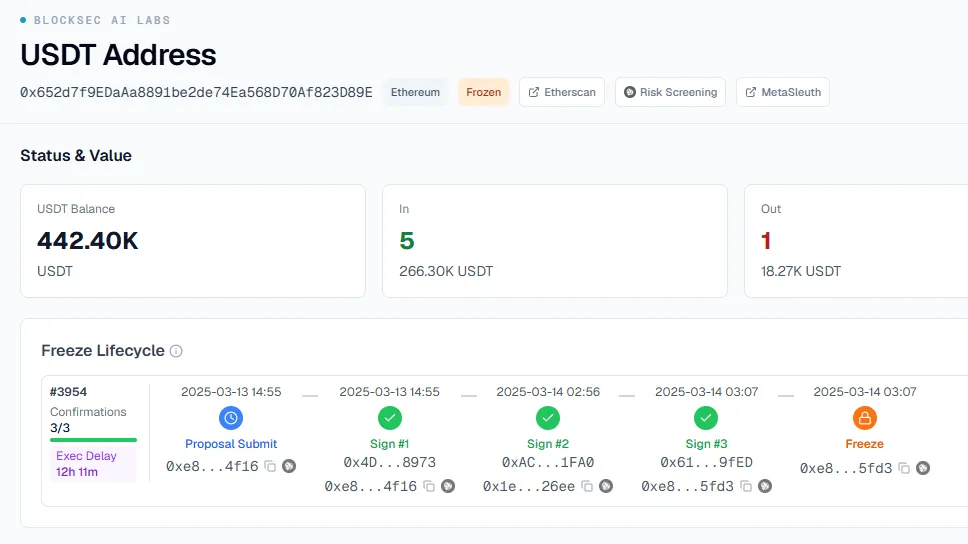
He says the operation exposed a $12M+ cluster of Bybit exploit funds, and that Tether later froze 442K USDT linked to it.
He says he has helped action $75M+ in freezes tied to North Korean incidents since 2022, and funds his work through grants and donations.
Most on-chain sleuths trace stolen crypto from the sidelines. The pseudonymous ZachXBT says he wired $349,700 of his own money to the people moving it.
“Posing as a client, I gathered intel that helped action freezes for the Feb 2025 Bybit exploit and attribute illicit activity onchain.” he wrote on X. ZachXBT explained the group was a Chinese gang working for North Korea.
That exploit he is referencing caused $1.5 billion in losses to the crypto exchange Bybit. The FBI attributed the incident to North Korean hackers it tracks as TraderTraitor. The alleged launderers, ZachXBT says, were not exactly hiding.
For those who don’t spend their days on “Crypto Twitter” tracking the everyday goings on of crypto hacks and exploits, ZachXBT is likely the best-known and most prolific on-chain investigator in the space. The mostly pseudonymous 20-something-year-old has spent years tracing stolen crypto and naming the people behind scams and hacks. His threads lean on public blockchain data that anyone can check, and he’s kept on with his investigations even after a former target sued and doxxed him in 2023.
1/ How I infiltrated a Chinese organized crime syndicate that has laundered $1B+ across multiple exploits for Lazarus Group.
Posing as a client, I gathered intel that helped action freezes for the Feb 2025 Bybit exploit and attribute illicit activity onchain. pic.twitter.com/jauRRt8875
“In Feb 2025, shortly after the $1.5B Bybit exploit attributed to the DPRK-linked group ‘TraderTraitor,’ I observed a pattern of 15+ accounts asking for help with orders directly tied to stolen funds in public groups on Telegram and Discord,” he wrote today in post on X.
He saw the same thing last week after the $387 million Bitget hack, which Bitget’s CEO and blockchain tracing firms Ellipic and Chainalysis have linked to North Korea.
His North Korea record is pretty relevant. On the day of the Bybit hack, he connected it to Lazarus Group using on-chain data, and the FBI backed that attribution days later. He also showed that wallets used to launder the Bybit funds were tied to earlier Lazarus attacks, including the Phemex and BingX hacks.
In 2024, his tracing of the theft of roughly 4,100 BTC from a Genesis creditor helped lead to arrests. Paradigm hired him as an incident response advisor in February 2025, with co-founder Matt Huang saying he had returned more than $350 million to victims of hacks and scams. ZachXBT says grants from foundations and donations from individuals are what let him take on riskier cases like this one.
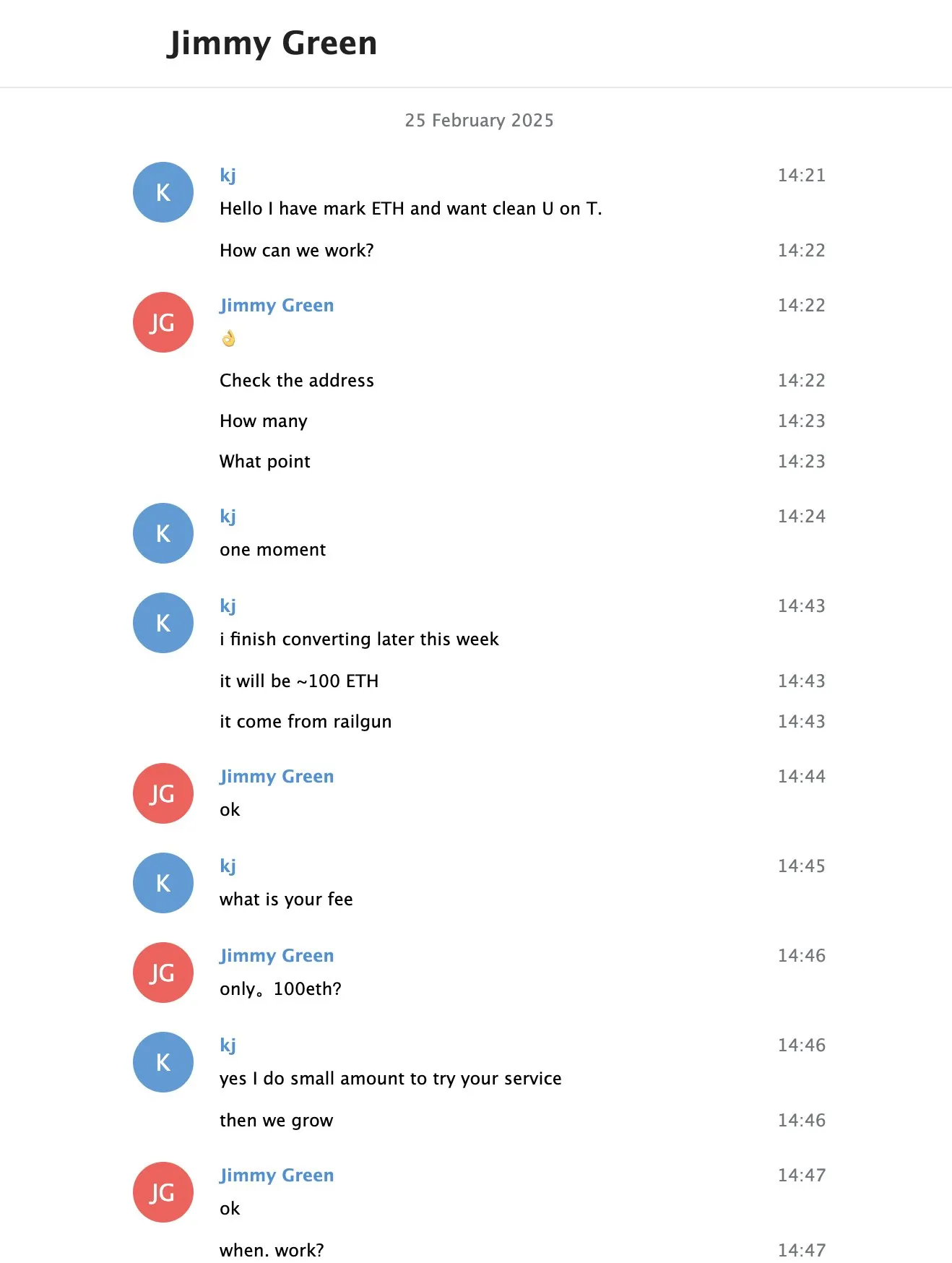
Back in 2025, ZachXBT started messaging the accounts complaining about Bybit-linked orders. One went by “Jimmy Green” on Telegram.
Screenshot of a conversation between ZachXBT and “Jimmy Green.” Image: ZachXBT
“On Mar 6, 2025, I funded a new address with 349.7K USDC on Ethereum in preparation to conduct several transactions with Jimmy Green,” he said. Jimmy gave him an address to send the USDC to, in exchange for USDT on Tron.
That address, ZachXBT wrote, had been funded with gas by a wallet that “is directly traceable to Bybit exploit funds and is labeled on the public Bybit exploit blacklist site.”
“I completed several additional transactions with him in order to build up trust,” he said. “After that, Jimmy began to talk about moving Bybit funds for DPRK in advance of it happening, along with basic details about their operation in [Hong Kong] and mainland China.”
BitcoinBTC · USD
$86,336+2.35%
Sep 29Oct 1Oct 3Oct 4Oct 6
$86.8k$85.6k$84.3k$83.0k
24h HighHigh$86,662
24h LowLow$85,010
VolVol$1.2B
Market projectionsOdds by Myriad
→
The proof, per ZachXBT, was that “one day prior he stated funds would be moved to Solana and the next day they were.”
Staying in the hunt cost money. “At this point, I realized I needed to continue losing 5% per order and gamble on capturing as much actionable intel as quickly as possible,” he wrote.
“For this case, I fronted $349.7K and lost 5% on each order, with no guarantee Jimmy wouldn’t disappear with the funds, and an unknown amount of personal risk from dealing with the syndicate,” he said.
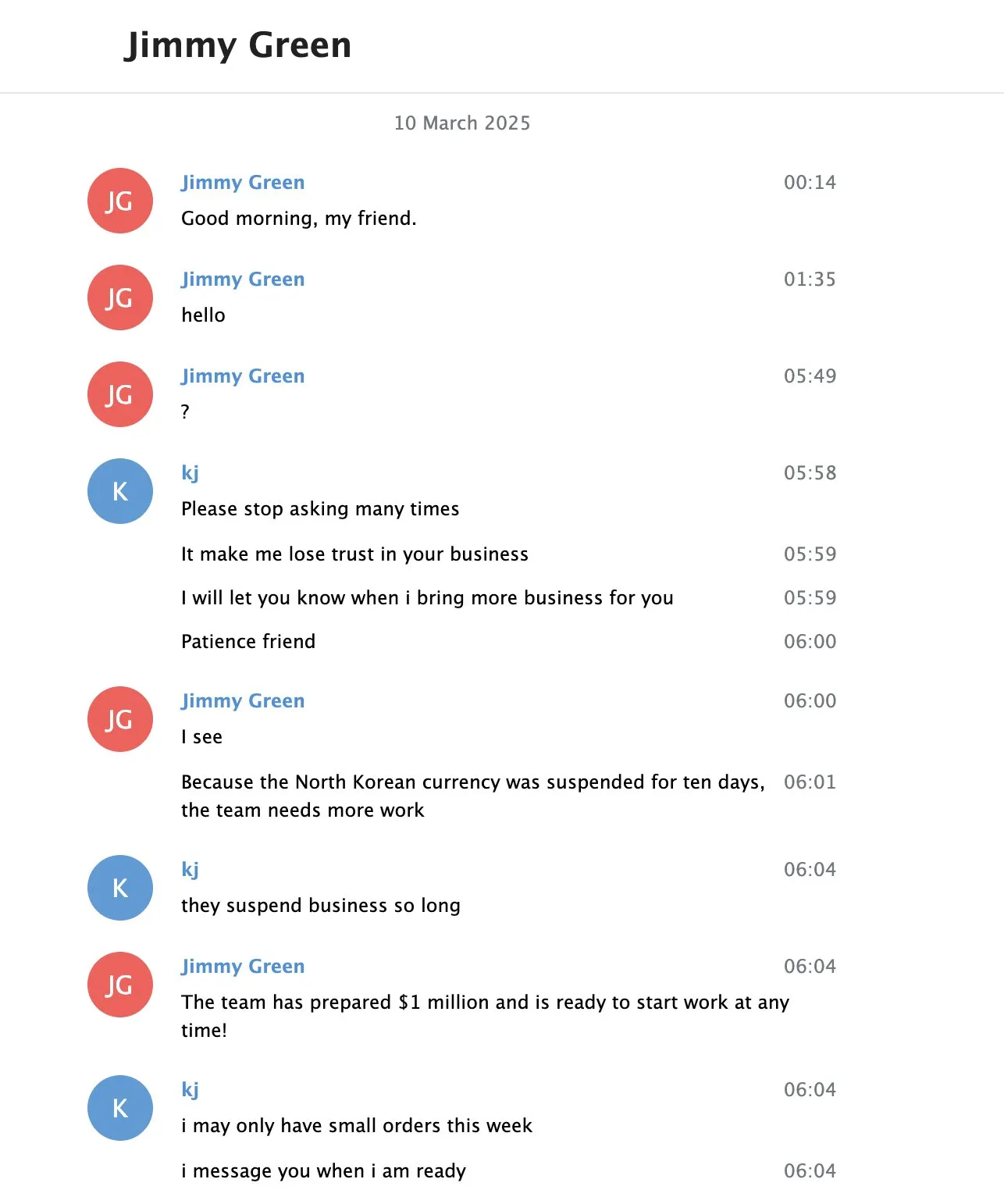
Jimmy was eager for more. On March 10, he kept pinging the fake persona until ZachXBT said, in character, it made him “lose trust in your business.” Jimmy’s answer was that “the team has prepared $1 million and is ready to start work at any time!”
Screenshot of a conversation between ZachXBT and “Jimmy Green.” Image: ZachXBT
In another chat, Jimmy explained the team’s setup: “We have different divisions of labor. We take the u and distribute it to different acceptors.” The “u” is apparently shorthand for USDT, the stablecoin issued by Tether.
The chats paid off on-chain. ZachXBT wrote that on March 12, 2025, he matched a screenshot Jimmy sent of himself bridging funds to an order created within minutes of the message, using amounts and timing on the Thorchain explorer, a public log of swaps on the decentralized protocol that moves coins directly across blockchains.
Jimmy then shared three Solana addresses. They exposed a cluster of more than $12 million in Bybit loot being swapped in real time, hopping from Bitcoin to Ether to Solana and finally to Tron. Tether later froze 442,000 USDT linked to the cluster.
Jimmy also dropped details ZachXBT could check. He said a team he knew had around $300K frozen in 2024, and ZachXBT found the freeze on-chain. The real figure was 332,000 USDC, stolen in the Poloniex exploit, the November 2023 hack that drained more than $100 million from the exchange and that researchers have tied to North Korea’s Lazarus Group.
Then came the Cambodia link. Jimmy also said he had laundered $3 million in fraud proceeds for a different client, and ZachXBT traced those funds to a hot wallet used by Huione Guarantee, a Telegram marketplace where criminals sold laundering services and stolen data.
Huione Guarantee is part of Huione Group, the Cambodian conglomerate the U.S. Treasury’s FinCEN targeted over alleged laundering of at least $4 billion. Telegram banned the marketplace in May 2025, and Chinese authorities arrested former Huione Group chairman Li Xiong after Cambodia deported him.
Not all of it was crime talk. “Throughout our conversations, Jimmy and I had a lot of small talk in between discussing laundering for DPRK,” ZachXBT said. “He talked about playing mahjong, hunting wild rabbits, food, his fat reducing meal, family life, and vacations at Disney.”
The sting is not a one-off. “Since 2022, I have helped action $75M+ in freezes related to DPRK incidents,” ZachXBT wrote. He said his findings went immediately to trusted private-sector investigators and to the law enforcement assigned to the case, and that sensitivity around the investigation kept him from publishing sooner.
Daily Debrief Newsletter
Start every day with the top news stories right now, plus original features, a podcast, videos and more.
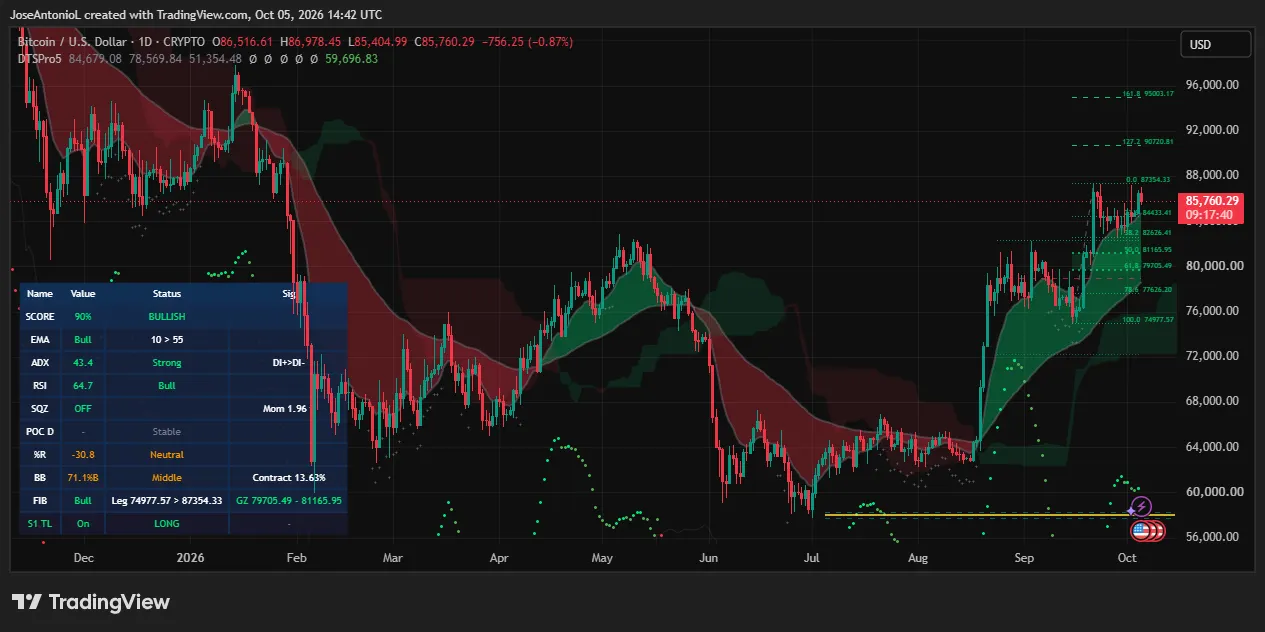
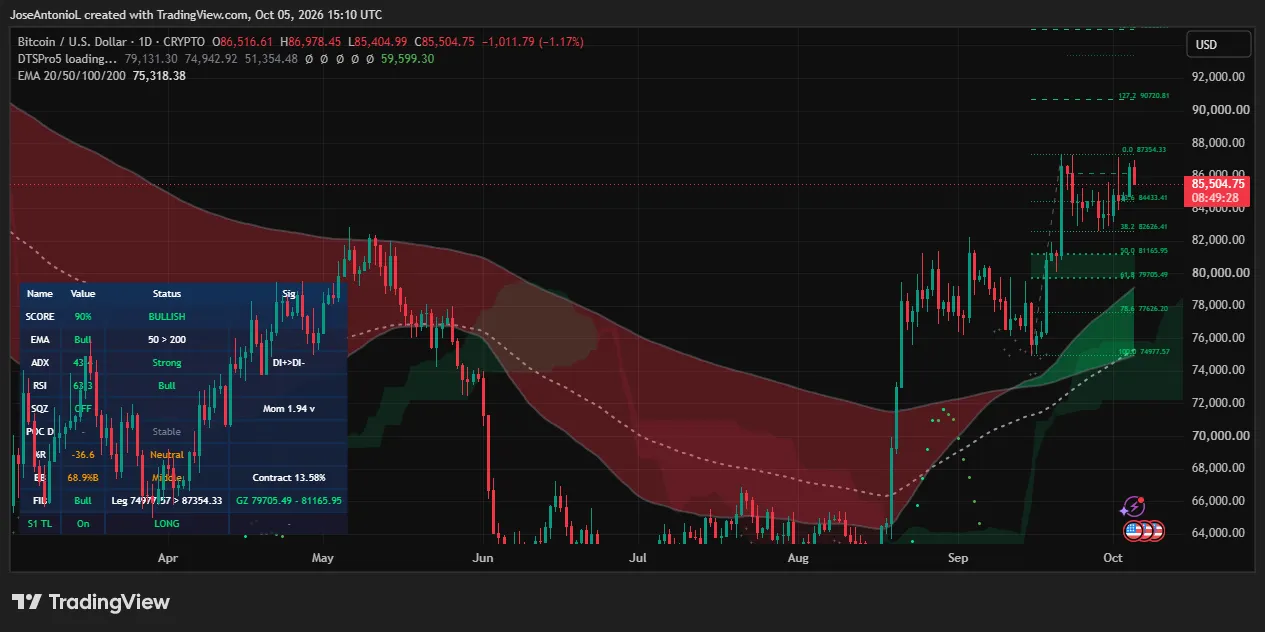
Bitcoin traded around $86,000 on Monday, roughly $1,200 below the $87,354 swing high that has capped the rally.
Macroeconomic winds have turned in Bitcoin’s favor, with potential future catalysts around the corner.
The daily chart has painted a decidedly bullish picture, with Bitcoin entering a second, stronger “golden cross.”
Bitcoin is starting the week on the front foot. It still can’t clear the ceiling, but investors have reason to be optimistic.
The top crypto asset traded around $86,100 on Monday morning, up 1.14% in 24 hours, with a market capitalization of $1.73 trillion. The entire crypto market is worth $2.94 trillion, up 1.36% on the day, and the Fear & Greed Index sits at 68, still in “greed” territory and stabilizing sentiment after a dip from “extreme greed” readings last month.
The spark was Friday’s jobs report, and it was ugly—for the economy, that is. U.S. employers added only 29,000 positions in September, according to the Bureau of Labor Statistics, roughly a third of what economists expected. The unemployment rate ticked up to 4.2%.
Revisions made it worse. July was revised from a gain of 21,000 to a loss of 10,000 jobs, and August was cut from 162,000 to 133,000. Annual wage growth cooled to 3.0%.
Bad news for workers, good news for risk assets. That’s the weird math of this cycle.
Bitcoin price data. Image: Tradingview
The Federal Reserve raised rates a quarter point to 3.75%-4.00% on September 16 in a unanimous vote. A week before Friday’s report, bond traders gave an October hike a 64% chance. After it, those odds fell to roughly 16%-22%, depending on the snapshot.
It is the mirror image of last month. On September 4, a blowout August report sent Bitcoin sliding more than 2% to near $79,300 as hike bets rose. Bitcoin now trades about 8% above that level.
Stocks cheered too. The S&P 500 closed Friday at 7,722.72, up 0.73%, while the Nasdaq gained 1.19% to 27,190.86 and the Dow added 0.49% to 51,176.96. Nvidia hit a fresh record high, and stock futures edged higher Sunday night.
Altcoins are mixed. Ethereum trades at $2,711, up 0.59%, and XRP is at $1.51, up 0.81%. Solana slipped 0.91% to $120.31. All the top 10 altcoins are in the green, but not a single one has moved more than 1%, except for Hyperliquid, which is up 3.68% on the day to $93.17 and 6% on the week.
ETF money is not fading either. U.S. spot bitcoin ETFs recorded $189.84 million in net inflows on the latest daily reading, with total net assets at $101.1 billion, according to Decrypt data.
Bitcoin price: Rejected at the door, but pushing up with force
The chart explains the hesitation. On the daily time frame, the $87,354 high remains the line to beat.
Momentum is strong. The Relative Strength Index, which scores recent gains against losses on a 0-100 scale where readings above 70 are considered overbought, sits at 64.7 which is hot but not extremely overbought. The Average Directional Index, which measures trend strength regardless of direction and reads above 25 as a strong trend, is at 43.4.
Exponential moving averages, or EMAs, track the average price over a set number of days while giving more weight to recent days. A golden cross happens when a faster EMA climbs above a slower one. The chart shows the 50-day EMA (the average price of the last 50 days) above the 200-day EMA, the classic version of a golden cross. This happened in mid-September as Bitcoin registered the second best performance in that month, ever.
But an even stronger sign has just appeared as the 100-day EMA has now also crossed above the 200 day. You can see it in the following chart. The 100-day EMA being the dotted white line.
Why is the 100/200 cross even more bullish? Because it’s harder to fake. A sharp two-month bounce can drag the 50-day EMA over the 200 day. To pull the slower 100-day EMA over the 200 day, the price of Bitcoin has to stay elevated for months, which means BTC has not just bounced from the sub-$60,000 levels of July but rebuilt its medium-term trend.
Together, the two crosses mean the short-term and medium-term averages both sit above the long-term one. Think of it as a second confirmation of the same story. The catch: EMAs lag, so a golden cross confirms a move that has already happened rather than predicting the next one.
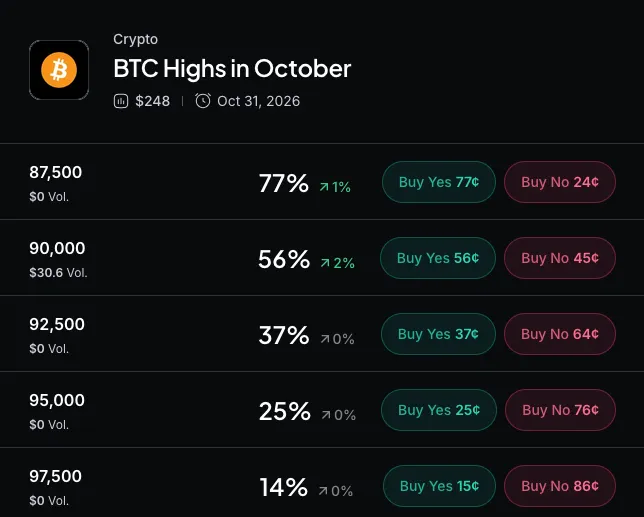
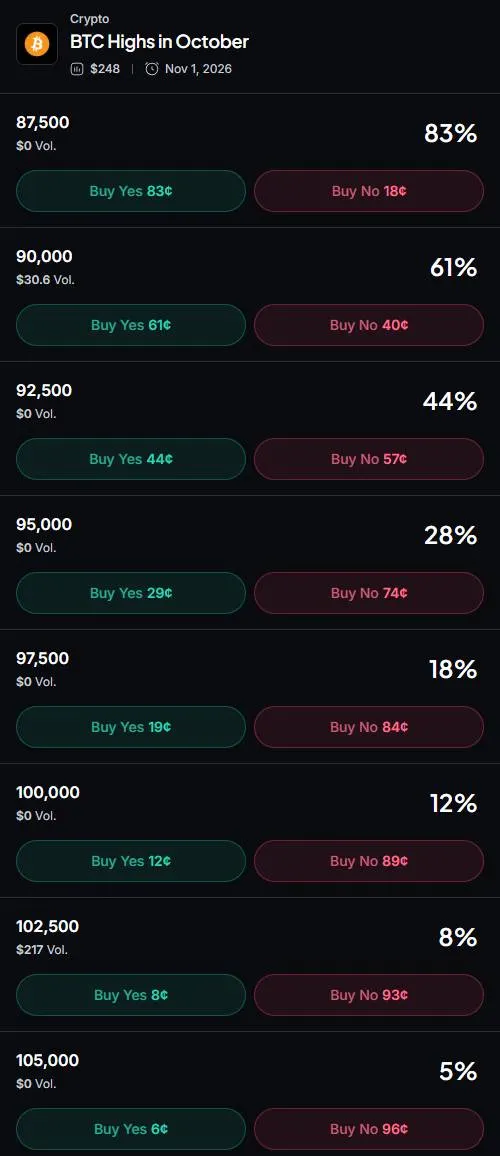
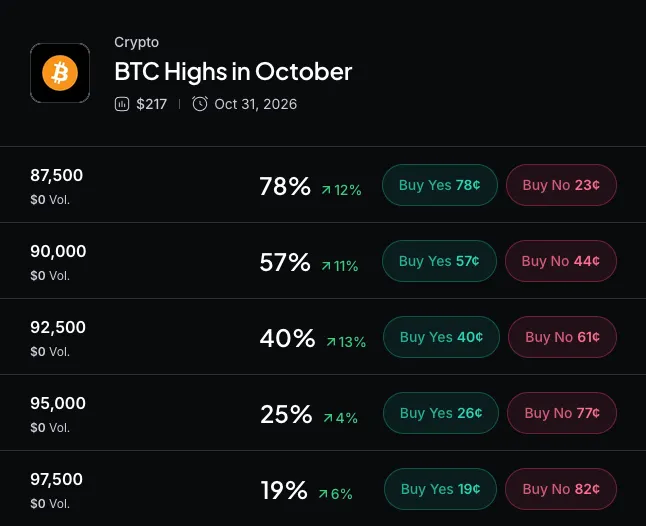
On Myriad, a prediction market built by Decrypt‘s parent company Dastan, traders are leaning bullish on a short-term push. In the October highs market, an $87,500 touch trades at 80%, $90,000 at 59%, $95,000 at 25%, and $100,000 at 12%.
As far as future catalysts, the week’s calendar is short but loaded. The Fed releases the minutes of its September meeting on Wednesday, October 7, at 2:00 p.m. ET, and the BLS publishes September CPI on October 14. The Fed’s next policy meeting runs October 27-28, with a press conference on October 28 at 2:30 p.m. ET.
Disclaimer
The views and opinions expressed by the author are for informational purposes only and do not constitute financial, investment, or other advice.
Daily Debrief Newsletter
Start every day with the top news stories right now, plus original features, a podcast, videos and more.
The CFTC published an advance notice outlining Regulation CTX and Regulation CAM, which would let crypto exchanges register as a new type of federally regulated “crypto asset market.”
Under the agency’s preliminary reading, merely offering leverage could bring even fully paid trades under CFTC oversight unless customers take actual delivery of their crypto.
The public has 60 days to comment. Exchanges that don’t offer leverage could keep operating under state licenses.
The CFTC wants to give crypto exchanges a federal home, and leverage is the key that unlocks the door.
The agency is moving forward with further rulemaking proposals following the collapse of the Clarity Act, the legislation that would have established the ground rules for most cryptocurrency activity in the United States but last month fell short. The CFTC on Monday published an advance notice of proposed rulemaking, an early step that seeks public input before formal rules are drafted.
Its proposal outlines two linked frameworks: Regulation Crypto Asset Transactions, or Regulation CTX, and Regulation Crypto Asset Markets, or Regulation CAM. The public will have 60 days to comment once the notice appears in the Federal Register.
The plan rests on a 2010 Dodd-Frank provision requiring retail commodity trades offered with leverage, margin, or financing to take place on a CFTC-registered exchange, as if they were futures.
Under Regulation CTX, the CFTC reads that rule broadly. Simply offering leverage, even through routine onboarding documents or terms of service, could pull fully paid trades under the agency’s watch, as long as the purchased crypto sits on the exchange’s internal books rather than in the customer’s own wallet.
Those trades escape federal oversight only through “actual delivery,” which the CFTC suggests could require customers to hold their private keys. On-chain trading protocols, which typically send tokens straight to users’ wallets, would usually clear that bar, the agency said.
BitcoinBTC · USD
$85,338+1.62%
Sep 29Oct 1Oct 2Oct 4Oct 6
$86.8k$85.6k$84.3k$83.0k
24h HighHigh$86,662
24h LowLow$85,010
VolVol$1.2B
Market projectionsOdds by Myriad
→
Regulation CAM would create a “crypto asset market” license, a tailored version of the designated contract market status held by futures exchanges. Trades would run through futures commission merchants, brokers subject to anti-money laundering rules, and leverage could come only from those brokers or banks they sponsor. Exchanges could also register as their own broker and clearinghouse.
The CFTC is weighing proof-of-reserves requirements and standards against listing tokens prone to manipulation. Exchanges that don’t offer leverage could keep operating under state money transmitter licenses.
CFTC Chairman Michael Selig said the rules are “designed to prevent, rather than only prosecute after the fact, fraudulent schemes such as FTX.”
The notice also repudiates the agency’s past approach, describing its Biden-era cases against Kraken, Ooki DAO, and Uniswap as “regulation by enforcement.”
The SEC approved Cboe’s request on October 2 to list six 3x funds from Volatility Shares tracking Bitcoin, Ethereum, gold, silver, crude oil and natural gas.
Each fund targets three times the daily performance of futures contracts on its asset, and the order sets no launch date.
The approval follows SEC warning letters on leverage above 2x in December 2025 and a March 2026 request to avoid 5x products.
The SEC approved a rule change on October 2 that lets the Cboe exchange list six funds built to deliver three times the daily price moves of Bitcoin, Ethereum, gold, silver, crude oil, and natural gas, per the agency’s order.
The funds come from Volatility Shares, the firm behind existing 2x Bitcoin and Ethereum products. Shares will trade on Cboe’s BZX Exchange like a regular stock.
An ETF, or exchange-traded fund, is a basket of assets you buy and sell through a brokerage app like a share. A leveraged one uses debt and other financial tools to amplify returns, and losses.
These funds aim for triple. If Bitcoin futures rise 2% in a day, the fund aims to gain 6%. If they fall 2%, it aims to lose 6%.
The funds mainly get that exposure through futures, which are contracts to buy or sell an asset at a set price on a later date.
But there’s a catch in the word “daily.” These funds reset every day, so the 3x promise applies to one day at a time. Over longer stretches, results can drift far from three times the asset’s move.
So, for example Bitcoin futures drop 10% on Monday, then rise 10% on Tuesday. The asset ends down 1%, while a 3x fund falls 30%, gains 30% and ends down 9%. If you have $100 worth of Bitcoin, a 30% drop takes off 30% of $100, which is $30, leaving you with $70 net. A 30% gain adds 30% of $70, which is $21. You’re at $91, overall 9% down after the movement.
BitcoinBTC · USD
$85,346+1.63%
Sep 29Oct 1Oct 2Oct 4Oct 6
$86.8k$85.6k$84.3k$83.0k
24h HighHigh$86,662
24h LowLow$85,010
VolVol$1.2B
Market projectionsOdds by Myriad
→
The SEC and FINRA have warned investors about exactly this. Their alert says returns over more than a day can differ significantly from the daily target.
Why the SEC had to vote
Cboe’s fast-track listing rules for commodity funds exclude products that chase a multiple of an asset’s return, so the exchange needed the SEC to approve these funds individually. Apart from the 3x target, the funds must meet all of Cboe’s other listing requirements.
The SEC leaned on existing guardrails. Brokers must act in a retail customer’s best interest under Regulation Best Interest, and FINRA, the brokerage industry’s self-regulator, requires tougher sales and margin (borrowing) rules for leveraged products.
Volatility Shares launched the first leveraged crypto ETF in the U.S. in 2023, tracking Bitcoin futures. Spot Bitcoin ETFs, which hold the coins directly, arrived in January 2024 after a decade of rejections.
Then the race for more leverage began. In October 2025, Defiance filed for 49 funds with 3x long and short exposure, and Volatility Shares filed for 5x products.
The SEC pushed back. In December 2025 it halted review of products above 2x exposure and sent warning letters to nine issuers, including ProShares. In March 2026, it asked issuers to avoid 5x products.
Volatility Shares kept shipping 2x funds anyway. In April 2026 it launched 2x funds on Cardano, Stellar, and Chainlink, adding to existing 2x products on Bitcoin, Ethereum, Solana, and XRP.
These aren’t the first 3x products. Earlier ones tied to silver, crude oil and natural gas, from other issuers, have since left the market, per the order. A 3x gold product from another issuer still trades.
The order sets no launch date. According to Cboe’s filing, the shares can’t trade until each fund’s registration statement takes effect.
Daily Debrief Newsletter
Start every day with the top news stories right now, plus original features, a podcast, videos and more.
Nine suspects, including two servicemen accused of leadership roles, were due before an investigating magistrate in northern Greece on Monday.
Police put the alleged proceeds at about $8 million from around 10,000 investors.
Entry started at €800, with so-called VIP investors asked for €5,000 on a promise their money would double.
Two Greek servicemen are among nine suspects accused of running a cryptocurrency pyramid scheme that took in about $8 million from roughly 10,000 investors, the Athens daily To Vima reported.
The nine were due to give statements to an investigating magistrate on Monday. Police have arrested 17 people over the alleged organization, which prosecutors say operated as a pyramid scheme and pushed investors into cryptocurrencies through a platform it controlled. None of the allegations has been tested in court, and the figures come from police sources rather than a charging document.
The recruiting vehicle, on the paper’s account, was a local civic group. A 44-year-old who led the Association of Artificial Intelligence Friends in Katerini was remanded in custody after the magistrate and prosecutor were unconvinced by his account. Six others from the first group of seven arrested were released under restrictive conditions with bail set between €15,000 and €20,000, according to the public broadcaster ERT.
The two military suspects come from Pieria and Larissa. Investigators believe the Larissa serviceman picked up the method from a contact he met while the pair were travelling overseas.
The offer followed a familiar shape. Investors were encouraged to put in from €800, while those designated VIP were asked for €5,000, with both tiers promised their money would double. In Katerini alone, investigators estimate the organization signed up 1,842 members and took in around €2 million.
The whole case began in July with two anonymous complaints, filed through gov.gr, the Greek government’s own digital services portal, to officers at the Katerini Sub-Directorate for Crime Investigation.
Daily Debrief Newsletter
Start every day with the top news stories right now, plus original features, a podcast, videos and more.
Morning Minute is a daily newsletter written by Tyler Warner. The analysis and opinions expressed are his own and do not necessarily reflect those of Decrypt. And check out our daily news show ‘FOMO HOUR’ covering all of the top stories and market action.
GM!
Today’s top news:
Crypto majors slightly green after weekend chop; BTC at $86.1k
Pump leads onchain protocols in revenue on the week with $17.9M
Polymarket CEO teases potential token announcement this week
Hyperliquid begins HYPE buybacks with USDC fees via AQAV2
Blast officially shuts down on Friday after holding $2B+ in TVL at peak
BitcoinBTC · USD
$85,649+2.71%
Sep 28Sep 30Oct 2Oct 4Oct 5
$86.8k$85.5k$84.2k$83.0k
24h HighHigh$86,949
24h LowLow$85,010
VolVol$1.5B
Market projectionsOdds by Myriad
→
📈 Uptober Off to a Green Start
Bitcoin rallied to $86,500 on Sunday, up 2.07% on the day and 8.57% over the past month. Ethereum sits at $2,720, up 11.05% in thirty days. Nearly everything in the top ten is green. October is living up to its nickname (“Uptober”) so far.
The ETFs were also green. Spot Bitcoin funds took in $31.7 million day and $102.7 million Thursday, so $134.4 million for the month. That’s a two-day streak after September closed with a $148.7 million outflow.
The alt board shows where even more action is. Pump.fun leads the way for notable alts up 26.2% and LayerZero was up 19.8%. Sky and Aave are both up double digits on the week. Those aren’t meme coins, they’re protocols that make money, and most of them run buyback programs. The SEC said eight days ago that buying back your own token doesn’t make it a security as long as the network works. Now it’s easier than ever for investors to buy into the revenue-generating protocols.
Where does this leave us? The gains are real and they’re spreading past Bitcoin. The quietest week for ETF flows in a month is the one where almost everything went up. So it’s more likely crypto-native funds driving this recent price action rather than institutions.
And today is a very interesting day, as the historic 4-year cycle pattern would bottom today based on the Oct 6, 2025 ATH and a 364-day top-to-bottom timeline (played out the past 2 cycles exactly). So if there are no massively negative events today and/or this week, the last remaining bears will be forced to capitulate. And the bull market will officially be on…
🌎 Macro Crypto and Markets
Crypto majors are mostly green up 1-2%; BTC +1% at $86.1k; ETH +1% at $2,720; SOL -1% at $121; HYPE +3% at $93; ZEC -1% at $1,320
Top alt movers include ADA (+11%), FET (+12%), ENA (+10%) and LIT (+8%)
Oil -1% at $90; Gold +0.6% at $4,190
Stock futures are slighlty red; DOW -0.14%, Nasdaq -0.2%
Community banks sued the OCC Fridayto stop it granting crypto firms national trust charters; the Independent Community Bankers of America calls the charters a side door into banking that skips FDIC insurance and capital rules, and wants Protego’s charter thrown out
Chainalysis blamed North Korea for the $387 million Bitget hackand used its own AI to trace the money; the funds left in 23 transfers over three hours onto Ethereum, XRP, Zcash and Tron, and the year’s North Korean total is now past $1 billion
OKX and the NYSE’s parent company told the SEC they’re launching a tokenized stock venuestarting with 63 NYSE-listed companies; their joint venture OKXICE filed Sunday under the SEC’s new framework
Corporate Treasuries & ETFs
The Bitcoin ETFssaw $32M in net inflows on Friday; the ETH ETFs saw $17M in outflows and Solana had $1.3M in inflows
Meme Coin Tracker
Meme leaders were green up 2-5%; DOGE +3%, SHIB +5%, PEPE +6%, PENGU +5%, TRUMP +2%, SPX +3%, BONK +5%
Robinhood chain leaders were red and continue their downturn; Pons -5% to $270M; AI -5% at $110M; Cashcat -2% at $159M; Boner +31% to $75M, Programmable +140% and SIMD +100x to $9M led top movers
Solana top movers Baton +90%, Human +240x, Higgs +250x, and Swordcat +240%
💰 Token, Airdrop & Protocol Tracker
🚚 What is happening in NFTs?
NFT leaders were slightly red; Punks even at 33 ETH, BAYC -4% at 5.95 ETH, Pudgy +1% at 3.02 ETH
Identity MD (+52%) and Quotrons (+21%) led top movers
Daily Debrief Newsletter
Start every day with the top news stories right now, plus original features, a podcast, videos and more.
Metaplanet sold 10,000 BTC and repurchased 11,000 during the third quarter, a net gain of 1,000 that brings its holdings to 44,000 BTC.
It sold more than the full principal of its bonds and borrowings, held the cash, and left the debts outstanding.
The sale produced a U.S. capital loss, against which it estimates a deferred tax asset of about $97 million.
Metaplanet sold 10,000 BTC and bought back 11,000 during the third quarter, the Tokyo-listed treasury companydisclosed, in a round trip staged to prove to credit rating agencies that it is both able and willing to turn its Bitcoin into cash.
The net effect was an increase of 1,000 BTC, taking the group’s holdings to 44,000 BTC as of September 30, per BitcoinTresauries.
“Rating agencies and credit investors ask one question of a Bitcoin company: can that Bitcoin be turned into cash to meet obligations, and will it be?” chief executive Simon Gerovichtweeted. “We answered by doing it.”
I have two important updates to share with you today as we continue to build Metaplanet into a global financial platform rooted in Bitcoin.
From the beginning, our strategy was never simply to accumulate Bitcoin. Our objective has been to build the leading Bitcoin financial… pic.twitter.com/SGgLSctFCs
The reasoning in the filing is that while Bitcoin is liquid, what matters to rating agencies and bond investors is not only whether an asset can be sold but whether the issuer will actually sell it when obligations fall due. Rather than assert that, Metaplanet decided to demonstrate it with a real transaction.
So it sold an amount of Bitcoin exceeding the entire outstanding principal of its bonds, borrowings and other interest-bearing liabilities, and held the proceeds in cash. The debts were not repaid and remain outstanding on their original terms. Its liabilities, net of cash and dollar stablecoins, stood at ¥122.4 billion at quarter end, against sale proceeds of ¥124.7 billion.
Metaplanet points in thefiling to “a previously published issuer credit rating of an overseas peer company” as the precedent, saying it showed that an issuer refusing or reluctant to sell its Bitcoin may find the asset given little weight in a credit assessment. It did not name the company. S&Passigned Strategy a B- issuer credit rating in October 2025, the first awarded to a Bitcoin treasury company, citing low dollar liquidity among its concerns and warning that a downturn could force sales at depressed prices.
Strategy has since moved further than that. Itapproved a Digital Credit Capital Framework in June permitting sales of up to $1.25 billion to fund its cash reserve, dividends and buybacks, and hadsold 6,948 BTC for about $432.5 million by August. The firm’s Chair, Michael Saylor, has recast his position as never being “a net seller” of Bitcoin rather than never selling. It has since resumed Bitcoin purchases, surpassing its previous record holdings late last month.
The intent differs, with Strategy selling Bitcoin to meet obligations, while Metaplanet sold to prove it could, held the cash, then bought back more than it had sold. It came at a cost, with Metaplanet selling at an average of ¥12.47 million per BTC and buying back at ¥13.63 million, roughly 9% higher, so the net 1,000 BTC cost ¥25.2 billion against repurchases priced near ¥13.6 million each.
BitcoinBTC · USD
$85,649+1.91%
Sep 28Sep 30Oct 2Oct 4Oct 5
$86.8k$85.5k$84.2k$83.0k
24h HighHigh$86,949
24h LowLow$85,010
VolVol$1.5B
Market projectionsOdds by Myriad
→
Because the coins sold had been bought above the sale price, the disposal produced a capital loss for U.S. purposes, and the company estimates a deferred tax asset of about $97 million at subsidiaries of its U.S. holding company. The figure is preliminary and unaudited, and may not be recognized at all. Since Metaplanet carries Bitcoin at fair value, the loss does not create a new accounting loss.
The company says it now intends to pursue a credit rating, and that its Bitcoin Income Generation business has booked revenue for eight consecutive quarters. Gerovichsaid the holdings make Metaplanet the second-largest listed Bitcoin treasury company in the world, and that the strategy “was never simply to accumulate Bitcoin.”
He also announced a Net Interest Income Strategy, which he said is “designed to create recurring income streams and lower our effective cost of capital.” It sits alongside a pending Superplanet transaction and the build-out of Metaplanet Securities, in what he described as a unified push toward a Bitcoin-based financial institution.
The quarter also marks a further slowdown in accumulation. Metaplanet added2,823 BTC in the second quarter, itself a cooling from earlier in the year; the third quarter’s net addition was roughly a third of that.
Daily Debrief Newsletter
Start every day with the top news stories right now, plus original features, a podcast, videos and more.
Near Intents recovered the full $3.8 million stolen in Thursday’s exploit, general manager Alex Shevchenko said Friday, and the team has ended its investigation.
The return came after Shevchenko publicly told the attacker “We have identified you, sir” and gave them 48 hours to return the funds.
An on-chain message that appears to come from the exploiter said “we were in the wrong” and urged others to use bug bounties.
Near Intents got its money back.
The cross-chain swap service said Friday that the roughly $3.8 million drained in an exploit on Thursday has been returned in full. The return came a day after the team publicly told the attacker it knew who they were.
“The funds from the $3.8M NEAR Intents hack were sent back in full,” Alex Shevchenko, general manager of Near Intents, wrote on X. “We are stopping the investigation.”
The turnaround was fast. On Thursday, Shevchenko posted Bitcoin, BNB/Ethereum and Solana addresses for returning the funds and addressed the attacker directly: “We have identified you, sir.”
He framed the return as a last chance at responsible disclosure, the practice of reporting a vulnerability to developers instead of exploiting it, and warned that the window would close after 48 hours.
An on-chain message attached to a transaction, which Shevchenko shared and which appears to come from the exploiter, struck a contrite tone. “We’ve returned all the funds, we were in the wrong,” it read. The message also thanked the Near team for being cordial during the process and urged others to use bug bounties.
BitcoinBTC · USD
$86,476+3.39%
Sep 28Sep 30Oct 2Oct 3Oct 5
$86.8k$85.5k$84.2k$83.0k
24h HighHigh$86,949
24h LowLow$85,098
VolVol$1.2B
Market projectionsOdds by Myriad
→
Near Intents had halted service Thursday after a bug in how its Omni deposit and withdrawal layer interacted with its main smart contract let an attacker siphon funds. The team had pledged to compensate users in full and reported the incident to law enforcement. Blockchain sleuth ZachXBT said the stolen funds were sent to KuCoin and bridged to Bitcoin.
Near Intents lets users swap tokens across 35 blockchains by stating what they want and letting market makers compete to fill the order. It has processed more than $30 billion in swaps, according to data from the service.
The exploit capped a turbulent week. Two days earlier, Near Intents blocked a $50 million swap attempt by the hacker behind the roughly $387.5 million Bitget breach, which Bitget and blockchain analytics firm Elliptic have pinned on North Korea. The hack also came days after Bitwise’s spot NEAR ETF began trading.
“Please use bug bounties instead of disrupting the services,” Shevchenko wrote.
Daily Debrief Newsletter
Start every day with the top news stories right now, plus original features, a podcast, videos and more.
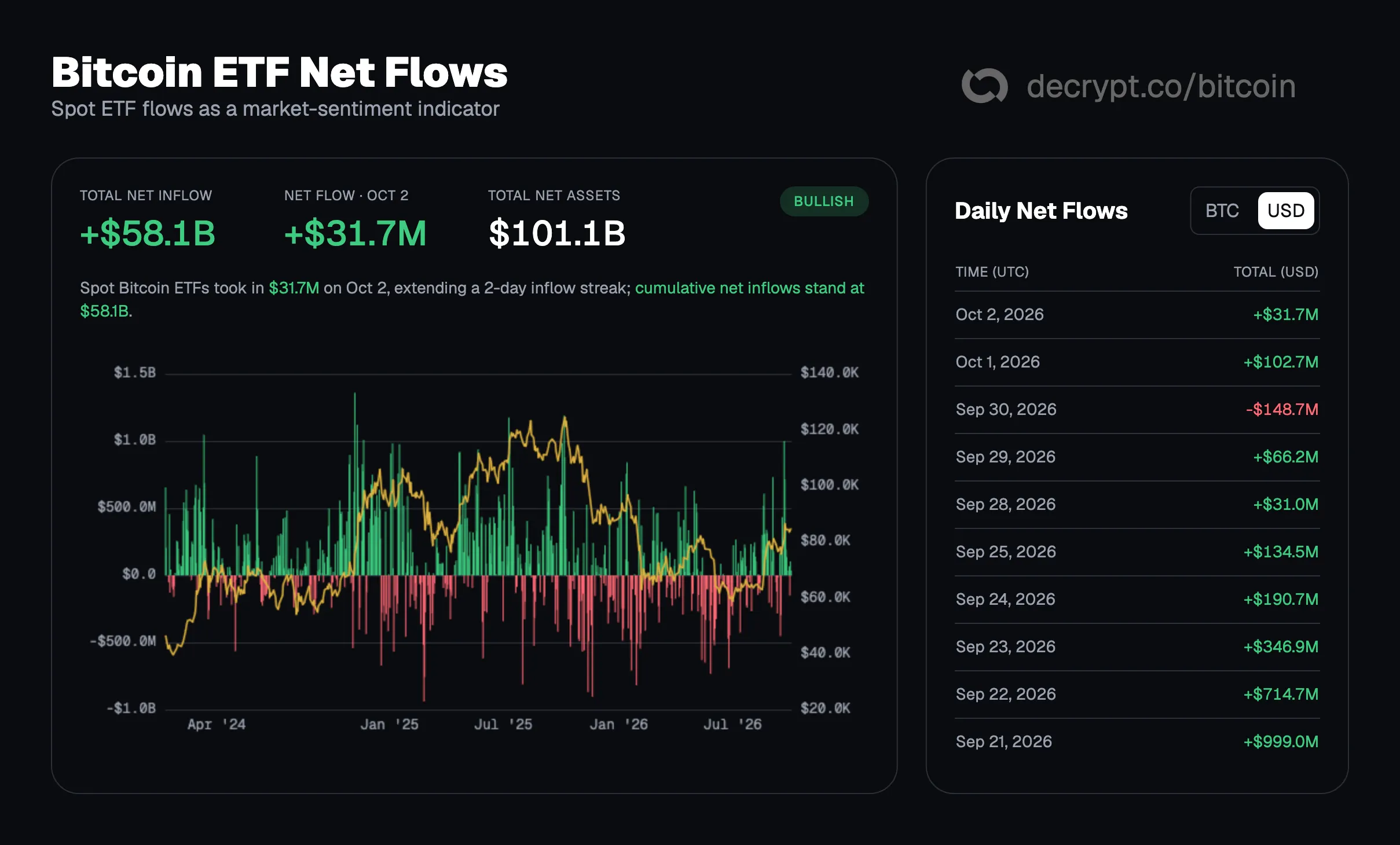
U.S. spot Bitcoin ETFs drew $102.7 million Thursday and $31.7 million Friday, opening October with $134.4 million in net inflows, per Decrypt’s tracker.
The inflows followed a $148.7 million outflow on Sept. 30, which ended a nine-session streak.
A soft jobs report cut October rate-hike odds, but Myriad traders still give a 93% chance Bitcoin won’t hit a new high this year.
Bitcoin ETFs are living up to the “Uptober” meme, so far at least.
U.S. spot Bitcoin ETFs drew $102.7 million on Thursday and another $31.7 million on Friday, according to Decrypt‘s Bitcoin ETF tracker. That’s $134.4 million in net inflows to start October.
The green start followed a red finish. The funds shed $148.7 million on Sept. 30, snapping a nine-session inflow streak that began Sept. 17. Even so, September was their second-best month since October 2025, with $2.65 billion in net inflows, according to SoSoValue data.
“Uptober” is crypto shorthand for October’s track record as one of Bitcoin’s strongest months. Over the past decade, the asset has averaged an 18% gain in October, Algoz’s Stephen Wundke told Decrypt. “Traders feel there is more upside currently than there is downside,” he said.
Friday’s jobs report added fuel. The U.S. economy added just 29,000 jobs in September, and unemployment rose to 4.2%, according to the Bureau of Labor Statistics. After the release, CME FedWatch odds of an October rate hike fell to 14% from 70% earlier in the week. A weaker labor market eases pressure on the Fed to keep raising rates, which tends to favor risk assets like Bitcoin.
Bitcoin briefly tested $87,173 on Friday, just shy of its September high of $87,354, before pulling back. It traded at around $85,000 on Sunday morning, up 0.5% over 24 hours, according to CoinGecko data.
BitcoinBTC · USD
$86,470+3.38%
Sep 28Sep 30Oct 2Oct 3Oct 5
$86.8k$85.5k$84.2k$83.0k
24h HighHigh$86,949
24h LowLow$85,098
VolVol$1.2B
Market projectionsOdds by Myriad
→
Cumulative net inflows since the funds launched stand at $58.1 billion, and total net assets sit at $101.1 billion, according to Decrypt‘s tracker.
Not everyone is sold on a breakout. Traders on Myriad, a prediction market owned by Decrypt‘s parent company Dastan, put the odds at 93% that Bitcoin won’t set a new all-time high in 2026.
Year-to-date ETF inflows also remain under $1 billion after heavy outflows earlier in the year. The next tests come soon: September’s CPI report lands Oct. 14, and the Fed meets Oct. 28.
Daily Debrief Newsletter
Start every day with the top news stories right now, plus original features, a podcast, videos and more.