Tag: Business – Decrypt

  • Tether, Anchorage Tap Deloitte for First USAT Stablecoin Reserve Report

    Tether, Anchorage Tap Deloitte for First USAT Stablecoin Reserve Report

    In brief

    • Deloitte penned USAT’s first attestation report on behalf of issuer Anchorage Digital.
    • The Big Four accounting firm began working for Circle in 2023.
    • Tether signaled last year that it’s pursuing a full, independent audit.

    Anchorage Digital tapped Deloitte for USAT’s first attention report, linking the Big Four accounting firm with Tether’s efforts to offer a regulated stablecoin in the U.S.

    The report showed that USAT’s reserves were valued in excess of the stablecoin’s circulating supply, totaling $17.6 million and $17.5 million, respectively, as of Jan. 31. That meant the token had a cushion of around $100,000 a few days after its debut last month.

    USAT’s reserves consist of cash and U.S. Treasuries, which are held at financial institutions based in the country, the report showed. It was prepared under a framework established by the world’s largest member association for certified professional accountants last year.

    In a blog post, Tether USAT noted that its token combines Tether’s ability to operate at a global scale with Anchorage’s “strong track record operating under a clear U.S. federal framework.” Anchorage became the first federally chartered digital asset bank in 2021.

    “Anchorage Digital Bank is establishing a clear standard of accountability and financial strength,” Tether CEO Paolo Ardoino said in a statement. “We intend to help define the next chapter of digital dollars in the United States.”

    Tether USAT is led by CEO Bo Hines, former executive director of the White House’s digital assets working group, who initially signed on as a strategic advisor to Tether in August.

    USAT’s debut followed the passage of the GENIUS Act last year, a framework for stablecoins requiring companies operating in the U.S. to abide by reserve requirements that don’t align with Tether’s $183 billion stablecoin, which is partially backed by Bitcoin and gold.

    Deloitte’s role in USAT’s attestation report highlights Tether’s bifurcated approach: building a wall of federal compliance around its U.S. stablecoin to win over institutional players who might remain wary of the company’s broader international business.

    Tether’s reserves have never undergone a full audit, and its flagship USDT stablecoin has previously faced scrutiny for its role in facilitating criminal activity. The company announced that it was relocating its headquarters to El Salvador in January of last year. 

    Months later, Ardoino told DL News that “none of the Big Four companies will audit us” because they are afraid of damage that it may cause to their reputations. Nonetheless, he said that securing a firm like Deloitte for a full, independent audit was a “top priority.”

    Decrypt has reached out to Tether for comment.

    The attestation report produced by Deloitte did not judge how Anchorage manages USAT’s reserves day-to-day, only that the money was there when a snapshot was taken. Additionally, Deloitte did not determine whether the stablecoin reserves “complied with federal, state or local laws or regulations.”

    Anchorage declined to comment to Decrypt.

    Circle, Tether’s biggest rival, appointed Deloitte as its independent auditor in its 2022 fiscal year. That means the Big Four accounting firm has been also producing attestation reports for USDC’s reserves since January 2023.

    Daily Debrief Newsletter

    Start every day with the top news stories right now, plus original features, a podcast, videos and more.


  • OpenAI Claims Safety ‘Red Lines’ in Pentagon Deal—But Users Aren’t Buying It

    OpenAI Claims Safety ‘Red Lines’ in Pentagon Deal—But Users Aren’t Buying It

    In brief

    • OpenAI signed an agreement with the Pentagon to deploy AI in classified environments.
    • The firm said it imposed “red lines,” but the contract allows “all lawful purposes,” a standard that ultimately depends on the government’s own interpretation.
    • The controversy sparked the QuitGPT movement and drove a surge in Claude downloads.

    OpenAI said this weekend that it reached an agreement with the Pentagon to deploy advanced AI systems in classified environments, marking a significant expansion of the company’s work with the U.S. military.

    The announcement came less than 24 hours after the Trump administration blacklisted Anthropic, designating the rival AI firm a “supply chain risk to national security” following a dispute over contract language related to surveillance and autonomous weapons.

    President Donald Trump also directed federal agencies to immediately cease using Anthropic’s technology, with Treasury Secretary Scott Bessent writing Monday on X that the agency “is terminating all use of Anthropic products, including the use of its Claude platform, within our department.”

    The timing of the AI announcements placed OpenAI’s deal under intense scrutiny. In a detailed blog post, the company outlined what it described as firm “red lines” and layered safeguards governing its Pentagon partnership.

    The agreement, as presented by OpenAI, raises broader questions about how AI systems will be governed in national security settings, and how the company’s stated restrictions will be interpreted and enforced in practice.

    When “lawful” isn’t enough

    OpenAI’s blog post opens with three commitments framed as non-negotiable: no use of its technology for mass domestic surveillance, to independently direct autonomous weapons systems, or for high-stakes automated decisions like social credit scoring.

    Then comes the actual contract language—which OpenAI notably calls “the relevant language,” not “the full agreement.”

    “The Department of War may use the AI system for all lawful purposes, consistent with applicable law, operational requirements, and well-established safety and oversight protocols,” OpenAI said.

    That is the exact phrase Anthropic said the government had been demanding throughout negotiations. The exact phrase that Anthropic refused to go along with. OpenAI signed it, yet argues its red lines remain fully intact.

    However, “lawful” in national security contexts isn’t a fixed boundary—it lives inside a patchwork of statutes, executive orders, internal directives, and often classified legal interpretations. When a contract grants “all lawful purposes,” the practical limit becomes the government’s current legal envelope, not an independent standard set by the vendor.

    A cluster of clauses

    The weapons provision reads that the AI system “will not be used to independently direct autonomous weapons in any case where law, regulation, or department policy requires human control.”

    The prohibition only applies where some other authority already requires human control—it borrows its teeth entirely from existing policy, specifically DoD Directive 3000.09. That directive requires autonomous systems to allow commanders to exercise “appropriate levels of human judgment over the use of force.”

    And “appropriate” is as subjective as can be.

    Human judgment is not human control. This distinction was not accidental. Defense scholars have noted that omitting “human-in-the-loop” language was deliberate, precisely to preserve operational flexibility.

    OpenAI’s strongest counterargument is its cloud-only deployment architecture—fully autonomous lethal decision loops would require edge deployment on battlefield devices, which this contract doesn’t permit. That’s a real technical constraint.

    But cloud-based AI can still perform target identification, pattern-of-life analysis, and mission planning. Those are kill-chain activities regardless of where the final trigger sits. The outcome for a target doesn’t differ based on which server the model runs on.

    The surveillance clause follows a similar pattern. OpenAI’s stated red line: no mass domestic surveillance. The contract language: The system “shall not be used for unconstrained monitoring of U.S. persons’ private information as consistent with these authorities”—then lists the Fourth Amendment, FISA, and Executive Order 12333.

    The word “unconstrained” implies a constrained version of mass surveillance would be permissible. And EO 12333 is the executive order the NSA has used to justify intercepting Americans’ communications when done outside U.S. borders.

    And this is where Anthropic’s concerns about wording throughout the negotiations becomes noticeable. Anthropic’s argument was that current law hasn’t caught up with what AI makes possible. The government can legally purchase vast amounts of aggregated commercial data about Americans without a warrant—and has already done so.

    OpenAI’s contract language, by anchoring its protections to existing legal frameworks, may not close the gap Anthropic was actually worried about.

    Altman responds

    On Saturday night, Altman held an AMA responding to thousands of questions about the deal. When asked what would cause OpenAI to walk away from a government partnership, he answered: “If we were asked to do something unconstitutional or illegal, we will walk away.”

    That framing places OpenAI’s limit at legality—not at an independent ethical judgment about what the company will or won’t enable if it happens to be legal, which is what Anthropic defends. Asked whether he worried about future disputes over what counts as “legal,” he acknowledged the risk: “If we have to take on that fight we will, but it clearly exposes us to some risk.”

    On why OpenAI reached a deal where Anthropic could not, Altman offered this: “Anthropic seemed more focused on specific prohibitions in the contract, rather than citing applicable laws, which we felt comfortable with. I’d clearly rather rely on technical safeguards if I only had to pick one. I think Anthropic may have wanted more operational control than we did.”

    That’s a substantive philosophical difference. Anthropic argued that because frontier models can be repurposed for intelligence and military workflows in ways that are hard to anticipate, the limits need to be explicit and binding in writing, even at the cost of the deal. OpenAI’s position is that technical architecture, embedded personnel, and existing law together constitute a stronger safeguard than contractual text alone.

    The public picked a side

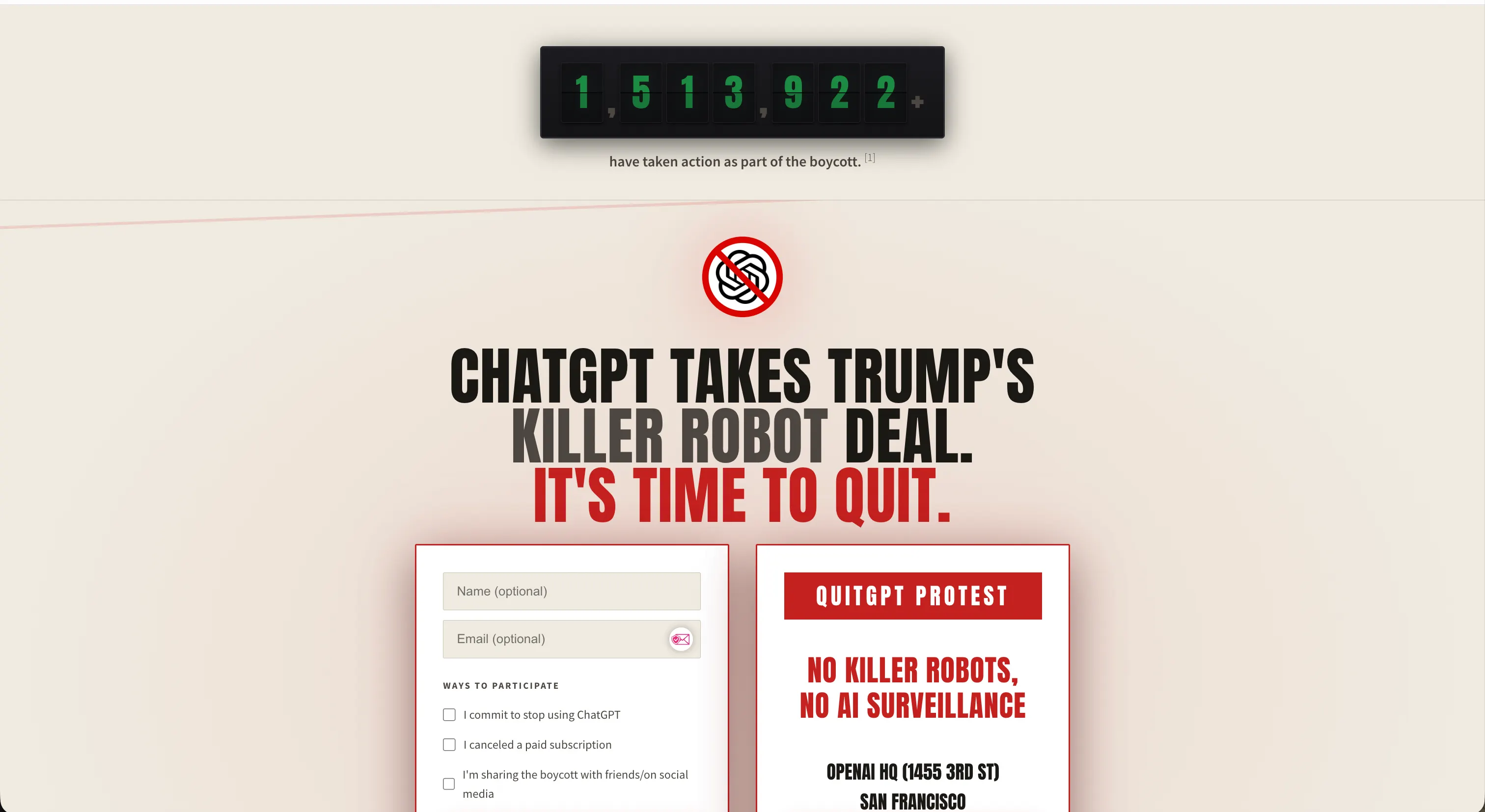
    The backlash was immediate. By Monday, the “QuitGPT” movement claimed that over 1.5 million people had taken action—canceling subscriptions, sharing boycott posts, or signing up at quitgpt.org.

    The campaign framed OpenAI’s move as prioritizing military contracts over user safety, accusing the company of agreeing to let the Pentagon use its technology for “any lawful purpose, including killer robots and mass surveillance.”

    OpenAI might contest that characterization. But the market moved regardless.

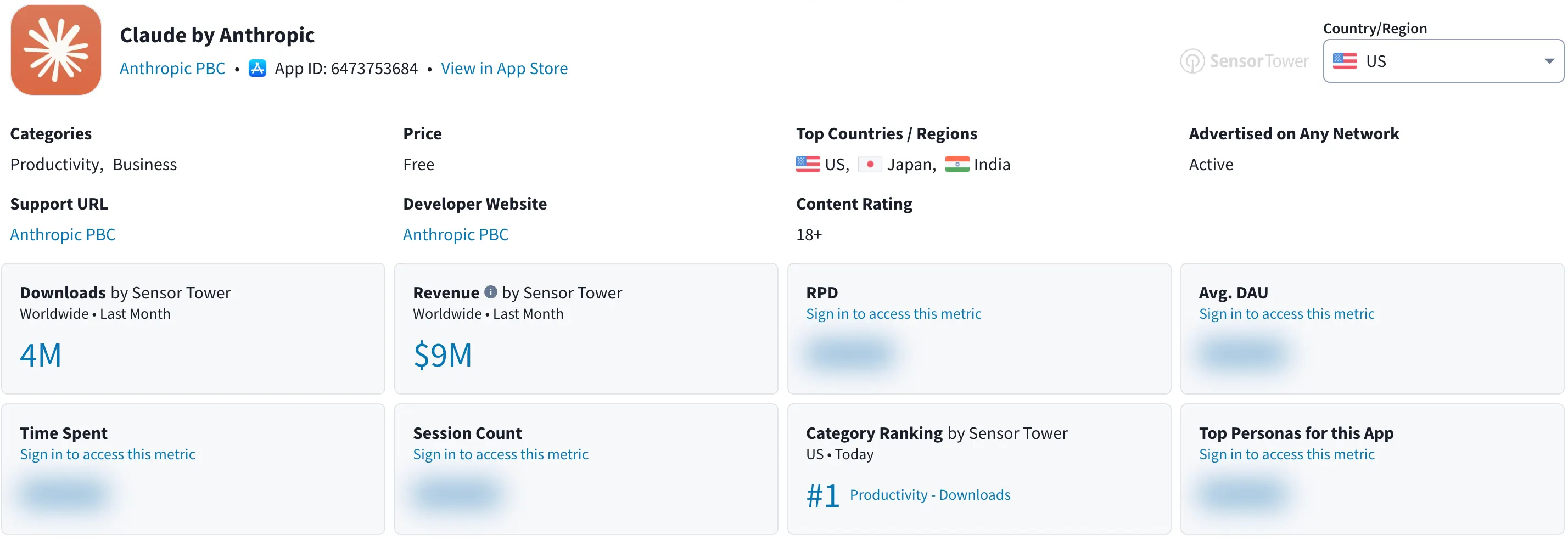
    Anthropic’s Claude surged past ChatGPT to become the most downloaded free app in the United States on Apple’s App Store, with the company telling Decrypt that it saw record daily signups over the weekend.

    Pop star Katy Perry shared a screenshot of Claude’s pricing page on X. Hundreds of users documented their subscription cancellations publicly on Reddit. Graffiti praising Anthropic appeared outside its San Francisco offices, while chalk attacks covered OpenAI’s sidewalks. Even hundreds of OpenAI’s own employees had previously signed an open letter supporting Anthropic’s refusal to accede to Pentagon demands.

    The QuitGPT framing is emotionally compelling, but not entirely precise. Anthropic itself has a partnership with Palantir and Amazon Web Services that grants U.S. intelligence agencies and defense departments access to Claude models, and has allegedly been used in military operations to overthrow the governments of Venezuela and Iran. The ethics of AI and national security contracting were never clean on either side.

    What the campaign captured, accurately, is that a large segment of users believed there was a meaningful difference between how the two companies drew their limits—and voted with their subscriptions.

    Whether that difference is as meaningful as it appears requires reading the contract carefully.

    Daily Debrief Newsletter

    Start every day with the top news stories right now, plus original features, a podcast, videos and more.
  • US Prosecutors Seek $327K Crypto Forfeiture Over Romance Scam

    US Prosecutors Seek $327K Crypto Forfeiture Over Romance Scam

    In brief

    • The Massachusetts District of the U.S. Attorney’s Office filed for the forfeiture of nearly $328K linked to a crypto romance scam.
    • The victim was tricked into sending funds to a user they communicated with via an online dating application.
    • U.S. prosecutors recently warned the public about the dangers of romance scams and their crypto ties.

    Prosecutors for the Massachusetts District of the U.S. Attorney’s Office are seeking the civil forfeiture of $327,829 in USDT as part of a money laundering scheme that victimized the user of an online dating app.

    An individual operating under the guise of “Linda Brown” communicated with the victim—a Massachusetts resident—for a few weeks beginning in November 2024 before offering a purported cryptocurrency investment opportunity to the individual.

    The victim then sent funds to wallets controlled by Brown, believing it was a legitimate investment vehicle, only to find out it was a scam when they attempted to withdraw their money later.

    The victim’s funds were then transferred between multiple wallets and later converted into USDT—the Tether-issued, dollar-backed stablecoin—from other cryptocurrencies, according to the complaint. 

    “It is a violation of federal law to conduct a financial transaction knowing that the transaction is designed to conceal the nature, location, source, ownership, or control of criminal proceeds,” the U.S. Attorney’s Office, District of Massachusetts wrote in a statement. 

    “A civil forfeiture action allows third-parties to assert claims to property,” it added, “which must be resolved before the property can be forfeited to the United States and returned to victims.” 

    At least a portion of the victim’s funds were traced to crypto wallets that were later seized in August 2025. Prior to forfeiture and return to the victim though, the “United States must prove, by a standard of preponderance of the evidence, that the property is subject to forfeiture,” the release indicates. 

    Though the crime happened in 2024, the forfeiture filing comes just a few weeks after U.S. prosecutors warned the public of romance scams tied to crypto as Valentine’s Day approached. 

    “Unlike traditional scams, which execute quickly, these schemes exploit both emotional and financial vulnerabilities,” an analyst told Decrypt at that time. “Scammers spend weeks or even months building your trust before introducing seemingly lucrative investment opportunities.”

    Last year, the U.S. Department of Justice filed to seize a record $225 million tied to similar crypto scams, which play on a victim’s confidence and trust. Such schemes are often called “pig butchering” scams, referring to the method of fattening up a swine before the slaughter.

    Daily Debrief Newsletter

    Start every day with the top news stories right now, plus original features, a podcast, videos and more.
  • Iran Conflict Not Major Concern For Bitcoin Mining Hashrate, Say Experts

    Iran Conflict Not Major Concern For Bitcoin Mining Hashrate, Say Experts

    In brief

    • Social media rumors argued that massive BTC dumps and hashrate collapse could follow the U.S.-Israel attacks on Iran.
    • Analysts and miners say Iran’s share of global Bitcoin mining is small and the impact limited.
    • War-driven volatility is tied more to price sentiment than supply network risk, they argued.

    The escalating conflict in Iran is unlikely to significantly disrupt the global Bitcoin mining network, industry analysts and operators said, countering circulating rumours on social media platforms suggesting a disastrous hit to hashrate and a flood of Bitcoin sell-offs.

    “I don’t think it’s of any major concern for Bitcoin,” Wolfie Zhao, head of research at TheMinerMag, told Decrypt, dismissing suggestions that conflict-related power outages in Iran would materially affect the network. While individual miners could see disruptions, the scale is not comparable to past global shocks like the 2021 crackdown on mining in China, Zhao added.

    The remarks come amid heightened speculation on social media platforms that the war could force the collapse of Iran’s mining industry, leading to billions of dollars in BTC dumped on markets and hundreds of thousands of rigs going offline.

    Bitcoin dipped and then rebounded over the weekend. But on X, posters warned that disruption to Iran’s power grid could lead to “2-5%” of the global Bitcoin hashrate being impacted, with one tweet on Saturday arguing that “If this regime falls: – Billions in BTC get dumped or lost forever – 5% of global hashrate disappears overnight – 427,000 rigs go dark Get ready for the supply shock.”

    According to data from CoinWarz, Bitcoin’s hashrate was around 986.1876 EH/s on February 28 in the immediate aftermath of the first U.S.-Israeli attacks, and rose to highs of 1.1361 ZH/s on March 1, before dipping to just under 1 ZH/s Tuesday morning.

    On Myriad, a prediction market owned by Decrypt’s parent company Dastan, users place an 51% chance on the Iranian regime falling by October—up almost 20% on the weekend.

    Crypto mining in Iran

    Although it was legalized in 2019, crypto mining in Iran has faced significant structural hurdles for years, including unstable power, high import costs and regulatory complexities that have limited growth.

    Ethan Vera, COO of Luxor Technology, said that even if Iranian mining activity were interrupted, there would be minimal impact on Bitcoin block times or network security. Estimates of Iran’s actual share of global hashrate vary, but most put it in the low single digits. Vera put it at below 1%.

    “If there is an interruption there will be no material impact to block times, and zero impact to the security of the Bitcoin network,” he said.

    He added he believed the industry there was made up of private enterprises mining small scale and legacy Chinese companies operating in the space.

    Iran has built a substantial crypto ecosystem that serves as an alternative financial channel outside the U.S. dollar system, a system that the country is largely locked out of due to international sanctions.

    “Iranian cryptocurrency activity is correlated to political events and conflict at home and abroad,” said Chainalysis in a report in January. It estimated that Iran’s broader crypto economy reached $7.78 billion in 2025, with a sizable portion of activity tied to state-linked entities.

    The conflict has prompted a spike in cryptoasset outflows from Iranian exchanges, with a report from blockchain analytics firm Elliptic finding that outgoing transaction volumes spiked by 700% within minutes of the first U.S.-Israeli attack.

    Daily Debrief Newsletter

    Start every day with the top news stories right now, plus original features, a podcast, videos and more.

  • Nasdaq Wants a Piece of the Prediction Market Biz Too

    Nasdaq Wants a Piece of the Prediction Market Biz Too

    In brief

    • Nasdaq files with the SEC to offer binary “Outcome Related Options” contracts.
    • The move puts Nasdaq in competition with Kalshi, Polymarket, and Crypto.com.
    • Wall Street giants like ICE, CME Group, and Cboe are also entering the space.

    Nasdaq Inc., the parent company of the second-largest stock exchange by market capitalization, wants to roll out its own prediction market offering.

    The company intends to offer options contracts for yes-or-no bets, which would be priced between 1 cent and $1, according to an SEC filing submitted early Monday morning.

    Nasdaq’s so-called Outcome Related Options would let traders take binary positions on whether a specified event happens. Binary options are a simplified version of more traditional option contracts that payout depending on the outcome of a yes-or-no proposition.

    If the requested rule change is approved, this will be Nasdaq’s first foray into the prediction market space—albeit under the regulation of the SEC rather than the Commodities Futures Trading Commission. The company’s would-be competitors, like Kalshi, Polymarket, and Crypto.com, are all regulated by the CFTC through Designated Contract Markets licenses.

    Prediction markets are effectively a form of derivative contracts that allow traders to wager on the outcome of virtually anything—from stock and crypto prices to sports, cultural, and political events. The industry has exploded over the last year, generating billions in trading volume on a weekly basis.

    There’s been ongoing discourse, though, about which federal regulator, the SEC or CFTC, has jurisdiction over prediction market platforms. In February, CFTC Chairman Michael Selig said “see you in court” in response to state attorneys general and gaming commissions who have argued that prediction markets encroach on their regulatory frameworks.

    But there’s also been some mention of the SEC having a role in overseeing prediction markets. SEC Chair Paul Atkins has suggested that some prediction markets could fall under the agency’s jurisdiction.

    “Prediction markets are exactly one thing where there’s overlapping jurisdiction potentially,” Atkins said at the time, in response to a question from Sen. Dave McCormick (R-PA). “That is a huge issue we’re focused on.”

    Other Wall Street giants have already gotten on the field.

    In October 2025, New York Stock Exchange owner Intercontinental Exchange invested up to $2 billion in Polymarket, bringing the company’s valuation to a whopping $9 billion. Although a press release said the investment would be worth “up to $2 billion,” a Polymarket spokesperson told Decrypt that it was accurate to call it a $2 billion investment.

    Derivatives exchange CME Group has teamed up with FanDuel for a prediction market offering. And Cboe, its competitor derivatives exchange operator, has taken a strategy similar to Nasdaq. Last month, the company began talks with brokers to offer yes-or-no contracts, unnamed sources told The Wall Street Journal.

    Daily Debrief Newsletter

    Start every day with the top news stories right now, plus original features, a podcast, videos and more.
  • Altcoins Outperform Bitcoin With Double-Digit Weekly Gains

    Altcoins Outperform Bitcoin With Double-Digit Weekly Gains

    In brief

    • Polkadot, Near, and Jupiter are among the altcoins that have clocked double-digit gains over the past week.
    • The altcoin rally follows Bitcoin’s 4.7% recovery from a $63,000 low triggered by the U.S.-led attack on Iran.
    • For this rally to transition into a sustained uptrend, experts cited a combination of renewed liquidity and the dissipation of uncertainty due to macro and geopolitical events.

    Altcoins including Near Protocol, Polkadot and Jupiter have posted double-digit gains over the past week, far outpacing Bitcoin as traders rotated into higher-beta assets following the leading crypto’s attempted recovery.

    Near Protocol jumped 19.4% over the past seven days, while Polkadot gained 16.5% and Jupiter climbed 15.8%, according to CoinGecko data.

    Bitcoin, by contrast, is roughly breakeven over the same period, hovering near $66,100 after recovering 4.7% from its February 28 low of $63,176—a drop triggered by escalating Middle East tensions following a U.S.-led attack on Iran.

    The divergence tests whether altcoins can sustain momentum without Bitcoin leading the way. The move reflects technical positioning rather than a fundamental shift in market structure, experts told Decrypt.

    The altcoin rally comes despite fearful sentiment lingering in the crypto ecosystem, with the Crypto Fear & Greed Index hovering around 10—territory signaling “extreme fear.”

    “When the Fear & Greed Index hits extreme lows like 10 or 11, it typically signals that the forced selling phase of a deleveraging event has reached exhaustion,” Lacie Zhang, research analyst at Bitget Wallet, told Decrypt. “Over the past week, as Bitcoin found tentative support near the $63,000–$64,000 range, high-beta altcoins began to bounce simply because they were oversold on a technical basis.”

    “This explosion isn’t a sign of returning confidence but rather a result of thin liquidity and the clearing of over-leveraged short positions,” Zhang added. “In an environment of extreme fear, even a small amount of bottom-fishing by brave dip-buyers can cause outsized percentage gains in alts.”

    The altcoin rally is also a result of “heavily positioned” bearish bets, Rachel Lin, CEO of SynFutures, told Decrypt. “When sentiment is depressed, even modest stabilization in Bitcoin can trigger short covering and rotation into higher beta assets,” she said. “This move appears more technical and liquidity-driven than a reflection of improving fundamentals.”

    Macro pressures

    Lin pointed to Bitcoin’s dip below $66,000 amid escalating Middle East tensions as evidence that crypto remains macro-sensitive. “While selling pressure has eased and dip buyers are active, we have not yet seen consistent safe-haven flows,” she added.

    The SynFutures CEO noted a divergence between retail sentiment and institutional capital allocation, citing “selective allocation into DeFi infrastructures” such as Morpho, which supports certain alt sectors more than the broader market.

    Lin said that for altcoins to sustain momentum, broader macro uncertainty needs to ease alongside improving liquidity conditions with renewed capital inflows—factors that could suggest a potential risk-on scenario and transition the ongoing rally into a sustained uptrend.

    Zhang cautioned that calling this the start of a sustained uptrend remains premature. “While Bitcoin showed resilience by rebounding to the $66,000 to $68,000 zone after the reports involving Iran, the market remains in a state of geopolitical paralysis,” she said. “We are currently seeing a relief rally fueled by short-covering and tactical rotation into beta assets that were hit hardest during the weekend drop.”

    She outlined three pillars needed for a sustained recovery: institutional stabilization, macro clarity, and technical confirmation. “We need to see a return to consistent net inflows in the Spot Bitcoin ETFs,” Zhang said. “The macro overhang must ease, specifically regarding the Fed’s interest rate trajectory and the potential for an energy-driven inflation spike due to Middle East tensions.”

    U.S. spot Bitcoin ETFs posted their first weekly inflow in six weeks, adding $787 million, according to SoSoValue data—further underscoring a long-standing risk-off behavior from crypto investors.

    Though altcoins have popped over the past week, their long-term performance remains deep in the negative. Users on prediction market Myriad, owned by Decrypt‘s parent company Dastan, reflect this pessimism, assigning a 6.4% chance to the likelihood of an “alt season” before April 2026 .

    Daily Debrief Newsletter

    Start every day with the top news stories right now, plus original features, a podcast, videos and more.
  • Morning Minute: Bitcoin Crashes, Rebounds as Iran War Begins

    Morning Minute: Bitcoin Crashes, Rebounds as Iran War Begins

    Morning Minute is a daily newsletter written by Tyler Warner. The analysis and opinions expressed are his own and do not necessarily reflect those of Decrypt. Subscribe to the Morning Minute on Substack.

    GM!

    Today’s top news:

    • Crypto majors dip then rebound amidst Iran War; BTC at $66k
    • HYPE wins the weekend, rallying 20%+ to $30 while HIP-3 sees record OI
    • Bitcoin ETFs saw $787M in net inflows last week
    • US declares Anthropic as supply chain risk after negotiations on how the US could use Claud fell through
    • Paradigm announced a new $1.5B fund focused on AI & Robotics

    🪖 Bitcoin Crashes, Rebounds During Early Hours of Iran War

    Bitcoin was the only large liquid asset that anyone could sell when the bombs started dropping. And it only dropped 3%.

    📌 What Happened

    Early Saturday, US and Israeli forces launched coordinated missile strikes on Iran targeting nuclear, missile, and naval infrastructure.

    President Trump confirmed “major combat operations” and urged Iranians to overthrow the regime.

    Iran retaliated with missiles targeting Israel, Qatar, the UAE, Bahrain, and US bases in Iraq. Israeli Defense Minister Israel Katz declared a nationwide state of emergency.

    Iranian state media later confirmed that Supreme Leader Ayatollah Ali Khamenei was killed in the strikes, along with 40 senior officials.

    Crypto markets absorbed it all in real time.

    BTC dropped from roughly $65,500 to $63,000 within hours. The total crypto market cap fell by $128B with $449M in longs liquidated.

    Then, as Iranian state media confirmed Khamenei’s death, BTC shot back to $68,196 in a major recovery rally.

    As of this morning, it’s back to $66,300.

    Meanwhile, Hyperliquid was the surprising crypto winner of the weekend. Its HIP-3 markets set a new record in open interest, and Hyperliquid was featured in Bloomberg as the primary marketplace for those looking to trade the war.

    The HYPE token rallied from $26 to $32 through weekend trading.

    🗣️ What They’re Saying

    “Bitcoin is the only large liquid asset trading 24/7, so it absorbed all the selling pressure that would normally spread across equities, bonds, and commodities. The real price discovery happens Monday when US equity markets and Bitcoin ETFs reopen.” – Hayden Hughes, Tokenize Capital

    “With a lot of the leverage already cleared out and exhausted sellers, there’s only so much impact macro events can have.” – Justin d’Anethan, Arctic Digital

    “Where price discovery happens when TradExchanges sleep.” – Arthur Hayes, responding to Hyperliquid’s weekend volume surge

    🧠 Why It Matters

    Fear and Greed was sitting at 14. ETF flows had flipped to net sellers in February.

    And then the biggest geopolitical shock in years hits on a Saturday.

    BTC dropped less than 4%. That was the signal.

    Heading into April 2024, when Iran first fired missiles at Israel, BTC dropped about 6%. Then over subsequent months it broke to new all-time highs. The June 2025 strike on Iranian nuclear sites pushed BTC below $100K briefly before it ripped.

    The pattern is consistent: war shocks trigger sell-offs, then the macro digestion reverses them. The question this time is whether the 50%-off ATHs and bear market make it different.

    Two things to monitor: the Strait of Hormuz and the ETF bid.

    If Iran’s IRGC retaliates by threatening the strait, through which about 20% of global oil passes daily, you get an inflation shock that would keep the Fed on hold indefinitely and crush risk assets broadly, crypto included. Goldman Sachs is already predicting Oil will hit $100/barrel if this war goes on for 4 weeks as Trump said it might on Sunday.

    On the other hand, if Khamenei’s death accelerates regime destabilization and traders read it as shortening the conflict, the relief bid continues.

    Monday’s ETF flows will be the first signal.

    The Hyperliquid story is the other one to watch longer term.

    Its HIP-3 open interest (where TradFi assets can be trading around the clock) hit an all-time high above $1.1B. Hyperliquid infrastructure is becoming the 24/7 layer for all asset classes, not just tokens.

    And it was the big winner of the weekend.

    Now we wait for what’s in store this week…

    🌎 Macro Crypto and Markets

    • Crypto majors fell and then rebounded on the initial Iran strike and have levelled off; BTC even at $66.3k; ETH -2% at $1,950; SOL -1% at $84
    • Morpho (+5%), NEAR (+5%) and JUP (+3%) led top movers
    • Oil is up 8% premarket this morning with the Straight of Hormuz closure
    • Gold (+3%) and Silver (+2%) are both rallying amist the war
    • HYPE rallied 13% over the weekend to $31 as Hyperliquid HIP-3 open interest set an all-time high above $1.1B and was featured in a Bloomberg headline about weekend markets
    • The Department of War labeled Anthropic a “supply chain risk” and directed federal agencies to stop using its AI tools after negoations to use Claude for the Iran war fell through
    • Iran’s crypto mining network is being monitored, as the regime operated between 2-5% of global Bitcoin hashrate using subsidized electricity
    • Trump Media is weighing spinning off Truth Social into a separate public entity called SpinCo, which would merge with Texas Ventures III
    • South Korea’s National Tax Service accidentally published unredacted Ledger seed phrases in a press release
    • Minnesota lawmakers are considering a full statewide ban on crypto ATMs via HF 3642, which would make it the first US state to do so.
    • Ripple introduced new funding routes for XRP Ledger development, including a new FinTech Builder Programme and university partnerships

    Corporate Treasuries & ETFs

    Meme Coin Tracker

    • Meme majors were mostly red; DOGE -2%, SHIB -3%, PEPE -2%, TRUMP -1%, PENGU -1%, SPX -4%, FARTCOIN -2%
    • WAR (+150%), Jellybean (+50%), PysopAnime (+30%) and HODL (+50%) led notable movers

    💰 Token, Airdrop & Protocol Tracker

    • One Polymarket trader banked $385K betting on a US-Israel Iran strike date every day since February 8, losing repeatedly until Saturday morning
    • Meanwhile, Kalshi caught heat for not resolving its Khamenei market, leading to several comments on the matter from founder Tarek Mansour
    • Crypto VC Paradigm announced a new $1.5B fund foducsed on AI, robotics and other frontier tech
    • Backpack exchange explained the legal engineering behind its token-to-equity program, stating that the conversion right won’t attach to the token itself, it’ll attach to a VIP program requiring one year of staking and active trading

    🚚 What is happening in NFTs?

    • NFT leaders were mostly flat over the weekend; Punks even at 29.9 ETH, Pudgy +1% at 4.5 ETH, BAYC -1% at 6 ETH; Hypurr’s -2% at 460 HYPE
    • CyberKongz (+36%) led top movers

    Daily Debrief Newsletter

    Start every day with the top news stories right now, plus original features, a podcast, videos and more.

  • What the Iran Conflict Means for Bitcoin’s Price

    What the Iran Conflict Means for Bitcoin’s Price

    In brief

    • Bitcoin has steadied after an initial weekend selloff tied to Middle East tensions, holding up better than U.S. equity-index futures.
    • Funding rates in Bitcoin futures have turned sharply negative, signaling crowded short positioning in derivatives markets.
    • Oil and gold have rallied on fears of supply disruption and inflation risk, underscoring a broader risk-off tone across global markets.

    Bitcoin has so far absorbed the latest escalation in the Middle East, following a spike in volatility in U.S. futures on Sunday, as traders continue to parse the impact on global energy markets.

    U.S.-led strikes on Iranian targets have prompted retaliatory missile and drone attacks, raising fears of a wider regional conflict after reports that Ayatollah Ali Khamenei’s 36-year rule as Iran’s supreme leader had ended. 

    Iran has warned of further retaliation, while shipping and aviation disruptions across the Gulf have sharpened concerns that the conflict could extend beyond a limited exchange.

    Bitcoin is down 0.4% on the day to $66,600 after reclaiming ground lost over the weekend, when its price fell to as low as $63,000. The asset is down roughly 2.8% on the week, according to CoinGecko data. 

    The decline was relatively smaller than losses implied by equity-index futures, which were down more than 1% across the Nasdaq, Dow, and S&P 500. Losses in equity-index futures suggests investors are marking down risk broadly in response to overnight macro and geopolitical developments ahead of the U.S. open.

    “Bitcoin’s initial sell-off was almost textbook; markets hate uncertainty more than bad news, and the moment the Iran conflict looked contained, the reflexive bid came back fast,” Ryan McMillin, chief investment officer at Merkle Tree Capital, told Decrypt.

    The expert pointed to a Fear and Greed index reading of 11, alongside Bitcoin futures funding rates swinging to -6%, indicating shorts are paying a significant premium to maintain a bearish bias in a situation not seen since Bitcoin traded at $16,000 back in 2022.

    “The market is mechanically paying you to be long; it’s time to get long, McMillin said.

    Echoing that sentiment, Pratik Kala, head of research at Apollo Crypto, told Decrypt Bitcoin’s price action suggested much of the initial shock had already been reflected. 

    “Bitcoin would’ve sold off by now if it had to—the tape through the event over the weekend was very positive. CME futures have also opened, and if Bitcoin were to dump or follow equities, it would have by now,” Kala said.

    Broader markets have focused on the potential for disruption around the Strait of Hormuz, the narrow shipping lane that carries roughly one-fifth of global oil supply.

    Oil prices have surged sharply on the Iran conflict, with Brent crude jumping roughly 8–10% toward $80 a barrel and U.S. WTI up about 7–8%. 

    “If oil stays elevated, there will be a risk to a higher inflation print, which is negative for risk assets—and Bitcoin,” Kala said. “However, I don’t expect that to be the base case.”

    Kala cited large oil supplies from OPEC countries that could seek to “plug the gap” and President Donald Trump doing “things in his power” to keep prices low, as “he knows that will turn the sentiment of Americans most.”

    Safe-haven gold, meanwhile, has leapt more than 2% to $5,388 per troy ounce. 

    “The ongoing Middle East conflict is set to further fuel gold’s tailwinds, likely triggering a knee-jerk price spike on rising safe haven demand.” Han Tan, chief market analyst at Bybit Learn, told Decrypt.

    “Still, seasoned market watchers would be well aware that geopolitical risk premiums are often faded out swiftly, once market and economic risks are digested and appear to be contained,” he added.

    Daily Debrief Newsletter

    Start every day with the top news stories right now, plus original features, a podcast, videos and more.
  • Hyperliquid’s Token Rises as Weekend Iran Shock Finds Few Open Markets

    Hyperliquid’s Token Rises as Weekend Iran Shock Finds Few Open Markets

    In brief

    • HYPE rose about 6% even as Iran headlines drove weekend volatility.
    • Hyperliquid absorbed early volume as price moves formed before traditional futures reopened.
    • Weekend shocks may turn always-on perps into a repeat venue for early risk pricing and fee growth, Decrypt was told.

    As tensions escalated over Iran-related headlines this weekend, Hyperliquid’s HYPE token rose about 6% as traders turned to the always-on decentralized perpetuals platform to express risk while many traditional markets were closed.

    Bitcoin and other risk assets fell as Iran-related tensions escalated, while oil and gold moved higher amid a broader risk-off shift. Volatility rose, and funding rates turned negative across crypto derivatives markets as traders adjusted positioning.

    Hyperliquid is a decentralized exchange that lets traders buy and sell perpetual futures contracts directly on-chain without using a centralized intermediary.

    Its native token, HYPE, fell to about $26.2 at the end of February, in line with the broader market pullback, before surging to roughly $32 as volatility picked up on Sunday.

    The token is up about 25% year to date, though it remains well below its September peak near $58, per CoinGecko data.

    Trading volume over the last 24 hours for the exchange reached a near one-month high on Saturday, rising to a peak of $200 million before dissipating as traders digested the risk premium to global energy markets.

    Always-on trading

    Hyperliquid was one of the few venues open and liquid as volatility picked up over the weekend, drawing trading activity at a time when equity futures and many centralized crypto platforms were either closed or operating with thinner books.

    “As a decentralized perpetuals platform, it was one of the few venues actually open and liquid when the Iran headlines hit, and in a weekend event where centralized venues are closed off to face thin liquidity,” Ryan McMillin, chief investment officer at Merkle Tree Capital, told Decrypt.

    Geopolitical shocks “make the case for non-custodial, always-on trading infrastructure,” McMillin added, noting how HYPE appears to sit “at an interesting intersection.”

    Hyperliquid’s token “benefits both from volume-driven fee revenue during chaos events and from any broader rotation away from centralised exchange risk,” he said. “It’s worth watching whether weekend crisis volume is becoming a structural tailwind rather than a one-off.”

    For HYPE, this ties geopolitical shocks directly to trading volume and fee activity, supporting the view that off-hours crises may become a repeat source of demand.

    First response

    Decentralized platforms like Hyperliquid’s are increasingly serving as “the first-response venue for geopolitical risk,” Dominick John, analyst at Kronos Research, told Decrypt.

    “Institutions leverage these always-on markets to anticipate moves in conventional venues, using on-chain perpetuals to hedge before broader markets open,” John explained, adding that such a function positions decentralized venues “for early risk pricing.”

    Weekend geopolitical shocks provide decentralized perpetuals exchanges “a structural edge” that captures “risk-driven flow while TradFi sleeps,” he added.

    While platforms like Hyperliquid could serve that purpose, most other perpetual decentralized exchanges, including its own HIP-3 markets, would still need to “achieve much deeper order book liquidity to onboard institutional traders,” Siwon Huh, researcher at Four Pillars, told Decrypt.

    On Hyperliquid, new markets require HYPE to be staked, and much of the platform’s fees go toward HYPE buybacks, meaning volatility and trading growth can directly increase demand for the token, which has also shown lower correlation to Bitcoin than many other altcoins, he explained.

    “For now, they appear to have already established themselves as highly useful exchanges at the retail level,” Huh said, adding that the weekend geopolitical shocks are likely to “capture demand from liquidity providers requiring hedging at a much larger scale.”

    Daily Debrief Newsletter

    Start every day with the top news stories right now, plus original features, a podcast, videos and more.
  • Banking Regulator Floats New Stablecoin Yield Rules—Do They Hurt Coinbase?

    Banking Regulator Floats New Stablecoin Yield Rules—Do They Hurt Coinbase?

    In brief

    • The OCC proposed rules that would restrict certain stablecoin rewards programs under the GENIUS Act.
    • The language could affect Coinbase’s USDC rewards arrangement with Circle, some industry experts said.
    • But the rules are changeable, and not final, and others believe they won’t outlaw top stablecoin rewards programs.

    A key Treasury Department bureau released preliminary rules this week detailing how it will implement the stablecoin-focused GENIUS Act—and industry experts are split about whether the proposal could impact America’s top stablecoin rewards program.

    On Thursday, the Office of the Comptroller of the Currency, the nation’s top banking regulator, released a massive, 376-page proposed rulemaking detailing how it intends to implement the GENIUS Act, which was signed into law by President Donald Trump last summer.

    Among the proposed rules—which are subject to a 60-day public comment period—are multiple sections prohibiting certain types of stablecoin rewards. The prohibitions appear to outlaw certain arrangements between stablecoin issuers and third parties in which the third parties pass yield onto stablecoin holders in connection with their “holding, use, or retention” of the tokens.

    That sounds not so far from the current arrangement between USDC issuer Circle and Coinbase. Both companies share revenue from the yield generated on USDC’s reserves, and Coinbase currently offers users roughly 4% yield, essentially a type of interest payment, on their USDC deposits.

    Multiple crypto policy leaders told Decrypt they think the OCC’s proposed language could impact Coinbase’s current USDC rewards program, but emphasized the complexity of the proposed rule and the possibility that it could be worked around.

    One of the policy leaders said Coinbase was likely always going to need to adjust its USDC rewards program at least somewhat after the implementation of the GENIUS Act. Coinbase did not immediately respond to Decrypt’s request for comment on this story.

    Last year, Coinbase reported $1.3 billion in stablecoin revenue. The company cited its USDC rewards program as its key growth driver in 2025.

    Some crypto executives have denounced the OCC’s proposed rulemaking, deeming it regressive.

    Scott Johnsson, a finance lawyer and crypto-focused venture capitalist, told Decrypt he thinks the language “most likely does” impact Coinbase’s USDC rewards program. But he also expects the rule will be challenged, and changed.

    But others have taken a different tune. Circle’s head of global policy, notably, commended the OCC on its proposed regulations—a sentiment echoed by Circle’s CEO, Jeremy Allaire.

    “This is all part of accelerating U.S. leadership in transforming the economic and financial system and rebuilding it natively on the internet,” Allaire said.

    Perhaps underscoring the possibility that Coinbase and Circle needn’t worry too much about the proposed rules, a banking industry source told Decrypt that the OCC’s announcement does not give them much comfort. The banking lobby has been pushing for months to restrict stablecoin rewards, which it worries could siphon customers away from traditional, low-yield bank accounts. 

    “It really doesn’t solve the problem,” the banking industry source said, alluding to potential loopholes in the OCC’s proposed restrictions. The source emphasized that rulemakings “can always be changed.”

    The banking industry would rather have restrictions on stablecoin yield permanently enshrined in law, the source said. For over a month, banking and crypto representatives have gone back and forth negotiating the issue of stablecoin yield, as part of negotiations on crypto’s stalled market structure bill. The meetings, led by the White House, were intended to arrive at a deal by this weekend—but a deal is unlikely to materialize so soon, Decrypt reported earlier Friday.

    “This doesn’t fix the debate,” Todd Phillips, a law professor at Georgia State focused on bank regulation, said of the OCC’s proposed rules. “This is not going to satisfy the two warring sides.”

    Daily Debrief Newsletter

    Start every day with the top news stories right now, plus original features, a podcast, videos and more.