Tag: Business – Decrypt

  • ‘The Worst Is Behind Us’: Bitcoin Market Conditions Mirror FTX Bottom, Analysts Say

    ‘The Worst Is Behind Us’: Bitcoin Market Conditions Mirror FTX Bottom, Analysts Say

    In brief

    • A bottom may be forming for Bitcoin amid its monthslong rout, K33 analysts said.
    • Technical indicators have paralleled the collapse of FTX, they wrote.
    • The market’s defensive posture is “atypical,” K33’s Vetle Lunde said.

    Bitcoin has come under significant pressure in recent months, but there are signs that a bottom may be forming for the digital asset despite a backdrop of geopolitical instability, according to analysts at crypto research and brokerage firm K33.

    As the U.S.-Israel war on Iran raged on for a fifth day, the analysts wrote in a Wednesday note that Bitcoin is showing signs of relative stability, leading them to determine that the most intense period of selling pressure has likely passed amid Bitcoin’s months-long swoon.

    “The worst is behind us; now we wait,” they wrote. “However, bottoming regimes in BTC have typically been slow, and patience has been a necessary virtue.”

    Bitcoin recently changed hands around $73,036, a more than 7% increase over the past day, according to CoinGecko. It remained 42% down from its all-time high of $126,000 in October.

    K33 Head of Research Vetle Lunde cited technical indicators including Bitcoin’s weekly relative strength index, or RSI, which fell to 26.84 last week, its lowest level since July 2022. The indicator serves as a gauge for Bitcoin’s momentum based on the speed and magnitude of price changes, mirroring oversold conditions that emerged during a series of blowups among crypto lenders that year.

    Those failures preceded the collapse of crypto exchange FTX, which marked the bottom for Bitcoin’s route in 2022. As Bitcoin has fallen in recent weeks, Velte noted that Bitcoin posted back-to-back days where trading volumes exceeded 95% of those on record. During bear markets, that has only happened once: when FTX filed for bankruptcy.

    Beyond that, Lunde pointed to derivatives, where market participants have been “willing to pay a chunky premium for bearish bets” to protect against further price drops in perpetual futures markets that maintain price alignment with Bitcoin through periodic payments.

    With regards to options, Lunde noted that so-called skews—which compare the cost of bearish “puts” versus bullish “calls”—jumped to levels only witnessed during the most catastrophic market collapses of 2022, including the fall of FTX and the Terra crash. Lunde described “extreme impulses of market stress” as an encouraging sign for bottoms to form.

    K33’s report acknowledged that no indicator is foolproof, but history suggested “an overwhelming concentration of bets in one direction for BTC tends to be followed by BTC moving in exactly the opposite direction.”

    Lunde echoed that sentiment in an interview with Decrypt, but he described the latest sell-off as relatively orderly compared to the chaos that rattled crypto prices years ago. Nonetheless, he viewed the defensive position in the crypto market as “atypical.”

    “It is something that, in the past, has been associated with global bottoms,” Lunde told Decrypt. “Bitcoin has a tendency to do the unexpected.”

    Daily Debrief Newsletter

    Start every day with the top news stories right now, plus original features, a podcast, videos and more.


  • Kraken Secures Access to Fed’s Core Payment Systems: WSJ

    Kraken Secures Access to Fed’s Core Payment Systems: WSJ

    In brief

    • Crypto exchange Kraken has secured approval for a Federal Reserve “master account,” giving it access to the Fed’s core payment systems.
    • A “master account” enables regulated depository institutions to maintain account balances at the central bank.
    • Kraken Financial’s account comes with some limitations, akin to the “skinny” master account proposed by the Fed’s board of governors last year.

    The banking unit of crypto exchange Kraken has secured approval for a Federal Reserve “master account,” giving it access to the Fed’s core payment systems.

    According to a report in the Wall Street Journal, Kraken Financial’s application is expected to be announced today by the Federal Reserve Bank of Kansas City, which oversaw its application, and Kraken’s parent company Payward.

    The approval “improves reliability and efficiency for moving fiat deposits in and out of digital-asset markets,” Arjun Sethi, co-chief executive of Kraken, told the WSJ.

    A Federal Reserve master account is an account at one of the twelve regional Federal Reserve banks that enables regulated depository institutions to maintain account balances at the central bank.

    Crypto bank Custodia, which has been engaged in its own long-running bid to secure a Fed master account, took to social media to congratulate Kraken on its success. In a tweet, the firm said that it is “continuing down a dual path of pursuing a Fed master account while expanding our collaborations with traditional banks in the tokenized deposit and stablecoin markets.”

    Kraken’s “skinny” master account

    According to the WSJ, Kraken Financial’s master account access has some limitations in its services, such as not offering payment of interest on reserves held at the central bank. This is similar to the “skinny” master account concept mooted by the Fed’s board of governors in October last year.

    At the time, Fed Governor Christopher J. Waller said that such an account “could be beneficial for those focused primarily on payments innovations,” noting that it could be tailored to the needs of “firms engaged in substantial payments activities that may not want or need all the bells and whistles of a master account, or access to the full suite of Federal Reserve financial services, to successfully innovate and provide services to their customers.”

    The move comes as crypto firms are increasingly making inroads on the traditional financial system. To date, companies including Circle, Ripple, Paxos, the Stripe-owned Bridge and Crypto.com have received conditional approval for national trust bank charters from the Office of the Comptroller of the Currency, enabling them to offer some bank-like services including federally regulated digital asset custody, staking, and trade settlement.

    Crypto exchange Coinbase and stablecoin issuer World Liberty Financial have also filed applications—the latter of which has raised the ire of House Democrats, who have warned of potential national security concerns over the firm’s links to the family of U.S. President Donald Trump.

    The wave of applications has also faced pushback from traditional banking lobbying groups, with the American Bankers Association writing to the OCC, urging it to slow the pace of crypto charter applications until Congress finalizes the rules they would operate under.

    Daily Debrief Newsletter

    Start every day with the top news stories right now, plus original features, a podcast, videos and more.
  • Morning Minute: CFTC Chair Says U.S. Perpetual Futures Are Coming

    Morning Minute: CFTC Chair Says U.S. Perpetual Futures Are Coming

    Morning Minute is a daily newsletter written by Tyler Warner. The analysis and opinions expressed are his own and do not necessarily reflect those of Decrypt. Subscribe to the Morning Minute on Substack.

    GM!

    Today’s top news:

    • Crypto majors surge 4-6% overnight; BTC at $71k
    • CFTC chair says perps are coming to the US within the next month
    • Trump accused the banks of undermining the Genius Act and stalling the Clarity Act
    • Trump’s American Bitcoin leans into BTC mining while major miners pivot to AI
    • Saylor’s STRC sets new daily record, trades enough to buy 1,016 BTC

    🏛️ CFTC Chair Says U.S. Perpetual Futures Are Coming

    The regulator who exiled perps from America just handed the keys back.

    But who stands to benefit the most?

    📌 What Happened

    CFTC Chairman Mike Selig, alongside SEC Chair Paul Atkins, said his agency is “working towards getting perpetual futures, true perpetual futures here in the U.S. within the next month or so.”

    Guidance is expected imminently along with a more formal rulemaking process.

    For those unfamiliar, perpetual futures are contracts with no expiration date that let traders hold leveraged crypto exposure indefinitely. And they have become the dominant instrument in global crypto derivatives.

    They represent over 90% of global crypto derivatives volume, despite being functionally banned for U.S. users since the prior administration.

    Selig said plainly: “The prior administration drove a lot of these firms and the liquidity offshore.” He’s trying to bring it back.

    🗣️ What They’re Saying

    Selig: “As regulators, we don’t want to be enforcing firms to rely on old tech and be stuck in the past. Many firms want to move onchain.”

    “Question: if the main purpose of hyperliquid is for US users to trade perpetual swaps without kyc and the US legalizes perpetual swaps is that good or bad?” – Goodalexander, on X

    🧠 Why It Matters

    So what does this mean for the onchain perps leader Hyperliquid?

    The bull case for HYPE: Regulatory legitimacy for perps is a rising tide.

    If the CFTC formally blesses perpetual futures as a product category, it validates the entire market. Institutional capital that has been sitting on the sidelines, unwilling to touch offshore or decentralized venues, now has a potential on-ramp.

    That demand doesn’t all flow to Coinbase or Kraken. Hyperliquid is the most liquid onchain perps venue on the planet, with all the open interest ($11b+) and all of the onchain action. And it’s getting major attention already for its 24/7 markets (especially useful in weekend war scenarios).

    For traders who want onchain, self-custodial, non-KYC’d access to perps, Hyperliquid is the primary option. And the CFTC can’t regulate Hyperliquid directly.

    The bear case for HYPE: Everything that made Hyperliquid valuable was the absence of legitimate U.S. alternatives.

    The moment Coinbase Advanced, Kraken, or a CME-affiliated venue lists BTC and ETH perps for U.S. institutional users with CFTC clearing, the narrative shifts and their advantage goes away.

    Institutional allocators don’t want to self-custody on a DeFi protocol. They want prime brokerage relationships, regulated counterparties, and audited infrastructure.

    Hyperliquid offers none of that.

    What the CFTC is likely to prescribe: conservative leverage caps, KYC/AML requirements, transparent funding rate methodology, and real-time surveillance. That’s not Hyperliquid’s product.

    Regulated U.S. perps could also tighten spreads on the most liquid pairs, potentially compressing Hyperliquid’s fee revenue on BTC and ETH, its highest-volume markets.

    So where does this leave us?

    Perps volume is likely to go up and to the right. Many believe it is truly a better product than the options product in TradFi.

    The question is who captures the majority of that increase and does it go onchain, offchain or both.

    My gut is both, and Hyperliquid continues to dominate onchain and other centralized providers like Coinbase likely win some as well.

    But Hyperliquid wins the most…

    🌎 Macro Crypto and Markets

    • Crypto majors are big green after huge overnight gains; BTC +4% at $71k; ETH +3% at $2,050; SOL +5% at $89.60; HYPE +1% at $32.60
    • KITE (+21%), SPX (+11%) and Aero (+11%) led top movers
    • Trump posted on Truth Social that banks are “threatening and undermining” the GENIUS Act and holding the CLARITY Act “hostage”
    • Iranian crypto exchanges logged $10.3M in outflows between February 28 and March 2 following the US-Israeli airstrikes
    • Saylor’s STRC closed above $100 with 1.82M shares sold, raising enough capital for Saylor to buy 1,016 Bitcoin (a new daily record)
    • Vitalik shared thoughts on Ethereum’s place in the world and what good is has caused, promising to focus future efforts into building a “sanctuary tech ecosystem”
    • Tether committed $6.4M to Swiss city Lugano continuing its bitcoin adoption partnership with the municipality that’s become a test case for city-level BTC integration
    • Bridge and Visa are expanding stablecoin-linked Visa card issuance globally, building on the Latin America pilot launched last April

    Corporate Treasuries & ETFs

    Meme Coin Tracker

    • Meme majors were mostly green; DOGE +3%, SHIB +4%, PEPE +4%, TRUMP -1%, PENGU +3%, SPX +11%, FARTCOIN +5%
    • memecoin (+69%) and USELESS (+17%) led notable movers
    • The Venice AI model was removed from OpenClaw’s highlighted provider list (VVV -8%)

    💰 Token, Airdrop & Protocol Tracker

    🚚 What is happening in NFTs?

    • NFT leaders were slightly green; Punks even at 29.9 ETH, Pudgy +1% at 4.5 ETH, BAYC +2% at 6 ETH; Hypurr’s even at 455 HYPE
    • New project The Nibbles saw 234 ETH in volume and opened at a 0.0364 ETH floor
    • The CryptoPunks app was updated to allow USDC purchases for the first time

    Daily Debrief Newsletter

    Start every day with the top news stories right now, plus original features, a podcast, videos and more.

  • X Warns Against Creator Payouts Over Undisclosed AI War Videos

    X Warns Against Creator Payouts Over Undisclosed AI War Videos

    In brief

    • X’s product head, Nikita Bier, said creators posting undisclosed AI-generated war videos will lose access to the platform’s revenue-sharing program for 90 days.
    • The policy targets AI-generated footage that could mislead users during wartime.
    • Researchers and governments have warned that deepfakes could spread propaganda and misinformation online.

    Elon Musk’s social media platform X said it will suspend creators from its revenue-sharing program if they post AI-generated videos depicting armed conflict without clearly disclosing that the footage was created using artificial intelligence.

    In a post on Tuesday, X’s head of product Nikita Bier said the company is revising its Creator Revenue Sharing policies to maintain authenticity on the platform’s timeline and “prevent manipulation of the program.”

    “During times of war, it is critical that people have access to authentic information on the ground,” Bier wrote. “With today’s AI technologies, it is trivial to create content that can mislead people.”

    Creators who violate the rule will lose access to the platform’s Creator Revenue Sharing program for 90 days, Bier wrote. Repeat violations will lead to permanent removal from the monetization program.

    The policy change comes as AI-generated videos claiming to show scenes of escalating violence in the Middle East following missile strikes by the U.S., Israel, and Iran last week.

    On Monday, an AI-generated clip on X showing an airstrike on the Burj Khalifa in Dubai was viewed over 8 million times; at the same time, another version of the clip was viewed over 42,000 times on Instagram.

    The United Nations has warned that deepfakes and AI-generated media threaten information integrity, particularly in conflict zones where fabricated images or videos can spread hate or misinformation at scale.

    This concern was realized during Russia’s invasion of Ukraine, a deepfake video circulated online appearing to show Ukrainian President Volodymyr Zelensky urging Ukrainian troops to surrender. Officials quickly debunked the video, and Zelensky later released a message rejecting the claim.

    According to Bier, enforcement will rely on several signals, including posts that receive a Community Note identifying the video as AI-generated, along with metadata or other indicators suggesting the footage was produced using generative AI tools.

    By tying enforcement to monetization, X’s policy focuses specifically on the financial incentives creators have to post fake videos that drive clicks and views.

    “We will continue to refine our policies and product to ensure X can be trusted during these critical moments,” Bier wrote.

    Daily Debrief Newsletter

    Start every day with the top news stories right now, plus original features, a podcast, videos and more.

  • Colombian Court Rejects Appeal for AI Writing, Then Gets Flagged By Its Own AI Detector

    Colombian Court Rejects Appeal for AI Writing, Then Gets Flagged By Its Own AI Detector

    In brief

    • Colombia’s Supreme Court rejected a cassation appeal after AI detectors flagged it as machine-generated.
    • Lawyers ran the ruling through the same tools and found it also appeared AI-written.
    • Experts and studies showed AI-detection software produced unreliable and inconsistent results.

    The Supreme Court of Colombia denied a cassation appeal, arguing that it was generated by AI. But the same tool the court used to determine the appeal’s purported AI origins said that its own ruling also received generative help.

    Is it a double standard by the court, or faulty tools at play?

    “Faced with a well-founded suspicion that the brief submitted by the attorney had not been drafted by the legal professional himself, the court submitted the text to the Winston AI tool,” the court argued. “Its analysis indicated that the document contained only 7% human content, evidencing a marked influence of automated writing and leading to the conclusion that it had been produced using artificial intelligence.”

    After running the analysis with other tools that provided similar results, the court ruled that “since the filing cannot be regarded as a duly submitted pleading, its dismissal as inadmissible is required.”

    But when the court’s ruling faced similar scrutiny from legal experts, it showed similar results.

    “I submitted the text of Auto AP760/2026 from the Supreme Court to the same Winston AI software cited in the ruling,” attorney Emmanuel Alessio Velasquez wrote on X on Tuesday. “The result: The document contains 93% AI-generated text.”

    “If the very ruling that condemns the use of artificial intelligence scores that percentage, the methodological fragility of using these detectors as argumentative support becomes self-evident,” he argued in a subsequent tweet.

    Within hours of the court posting a thread about the decision on X, lawyers began running their own tests. Velasquez’s post went viral in legal circles, accumulating tens of thousands of views.

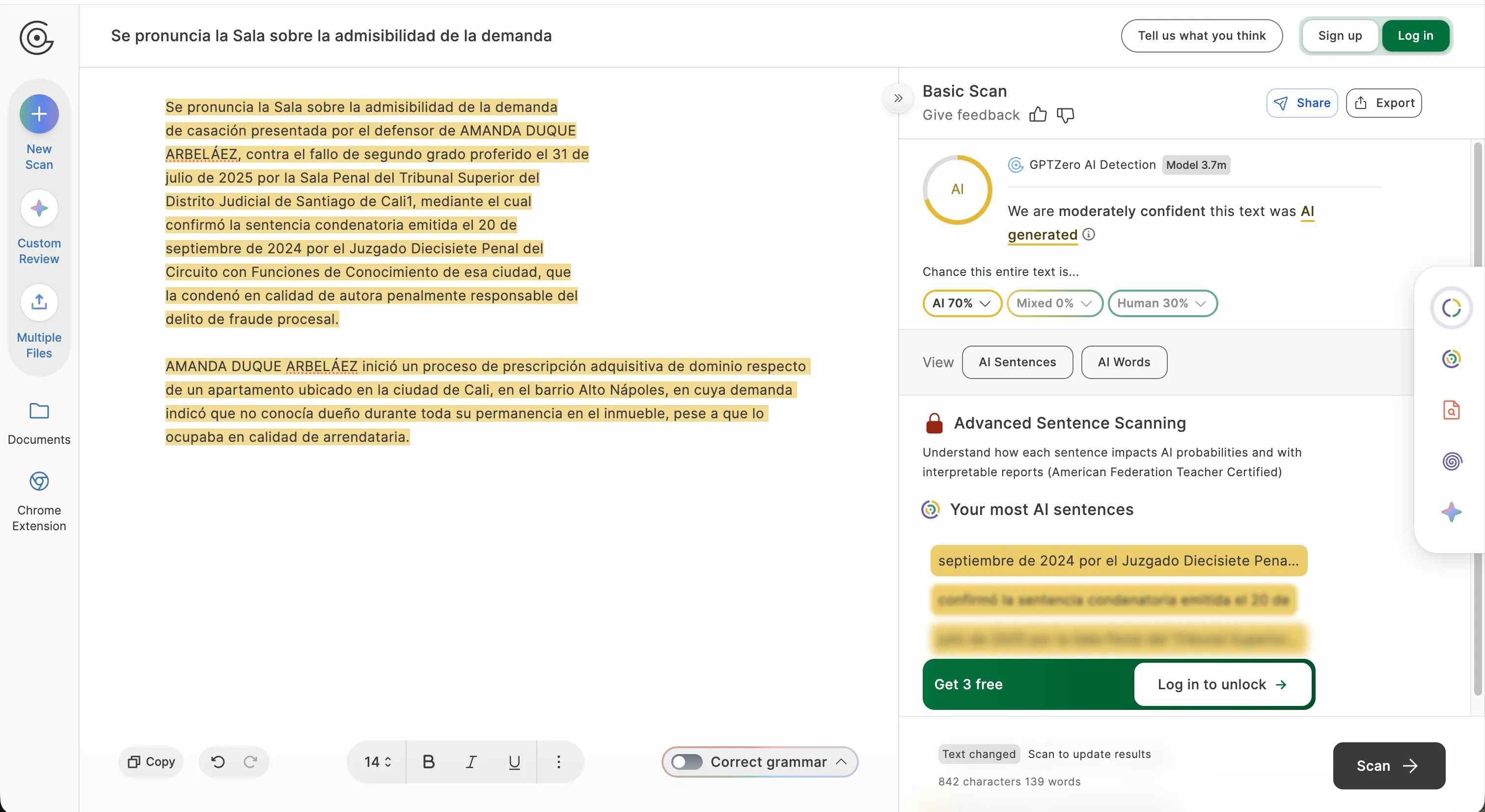
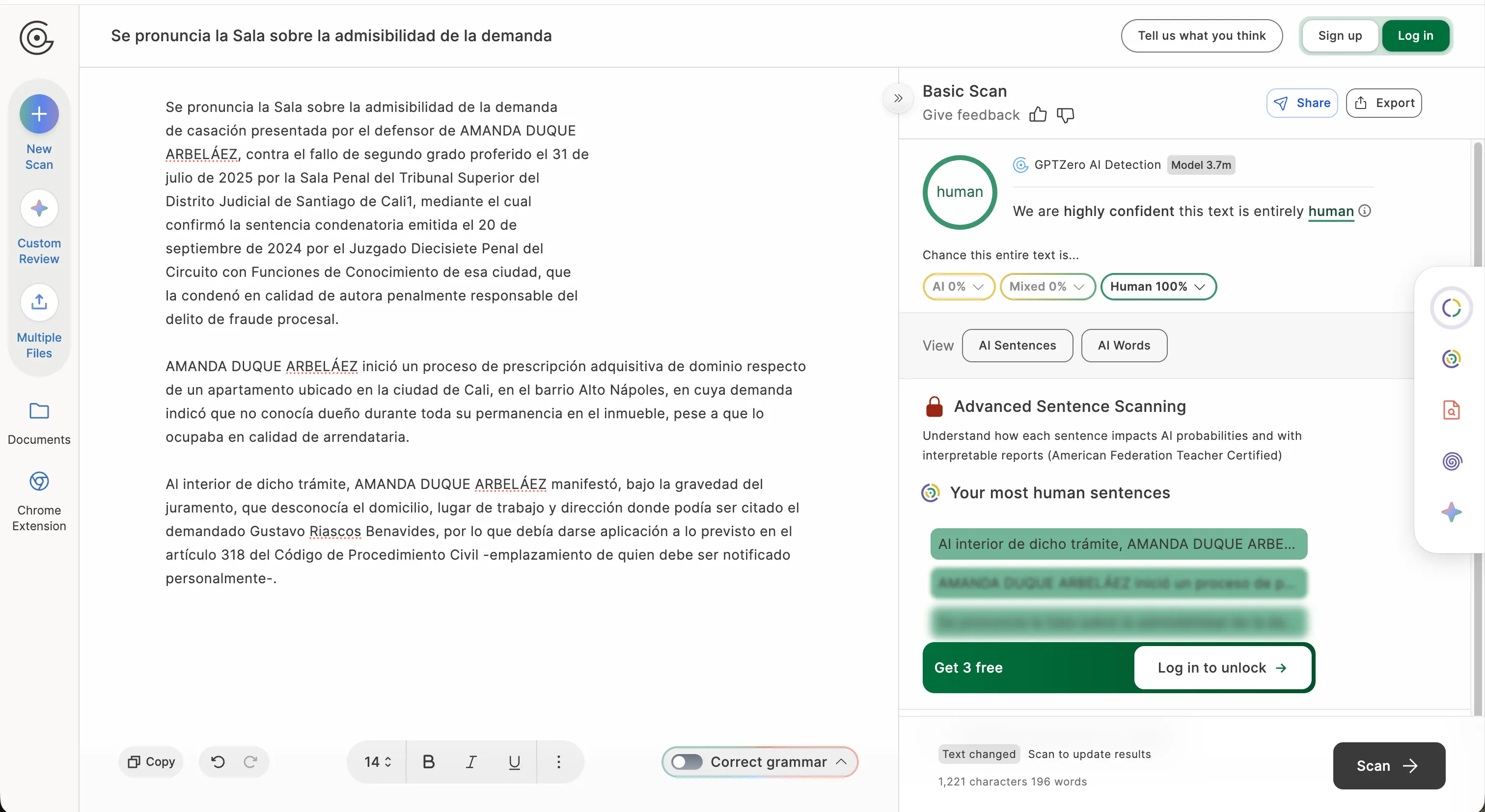
    We ran the test on the court’s verdict, as well, and things initially didn’t look great. When GPTZero scanned only the opening words of the court text, it returned a 100% AI result.

    When the same tool processed a longer version including the factual background section, it reversed course entirely: 100% human.

    The tool is simply not reliable enough to be trusted in court or in situations that would require a high degree of certainty.

    Colombian attorneys reacted quickly with their own experiments. Criminal defense lawyer and lecturer Andres F. Arango G, submitted a court filing from 2019, years before the large language models these tools were trained to detect even existed, and it came back claiming 95% AI generation.

    “These tools then invite you to ‘humanize’ the article through their paid services,” he wrote on X, noting an obvious commercial incentive baked into the detection business model.

    Nicolas Buelvas ran his 2020 undergraduate thesis on the principle of trust in criminal law. The result? 100% AI.

    Dario Cabrera Montealegre, another Colombian attorney, pointed out the hypocrisy of relying on technology to try to combat it.

    “The court is using AI to determine if there was AI,” he said. “Something contradictory from my practical point of view.”

    Beyond legal circles, further tech-savvy individuals pointed out the dangers of excessive reliance on AI flagging tools.

    “To date, there is no publicly accessible tool that can accurately define the percentage of AI use when drafting a text,” Carlos Alejandro Torres Pinedo argued. “What is worse: No one can publicly verify the source code behind these detection platforms. How can they be used to delegitimize someone’s right of access to justice?”

    The technical reasons for these failures are well-documented. AI detectors measure statistical patterns: sentence length, vocabulary predictability, and a quality that researchers call “burstiness,” which refers to the natural rhythm variation humans introduce in their writing.

    The problem is that formal legal prose, academic writing, and texts produced by people who write in a second language share many of those same statistical signatures.

    Studies on AI detection

    A 2023 study published in Patterns found that more than 61% of Test of English as a Foreign Language (TOEFL) essays by non-native English speakers were incorrectly flagged as AI-generated.

    A systematic review by Weber-Wulff that same year concluded no available tool is either precise or reliable. Turnitin acknowledged in June 2023 that its own detector produced higher false positive rates when the AI content level in a document fell below 20%.

    Even OpenAI had to take down its own AI detection tool following constant inaccuracies and an inability to do its actual job.

    Universities have been grappling with this for years. Vanderbilt disabled Turnitin’s AI detector in 2023 after estimating it would generate around 3,000 false positives annually.

    The University of Arizona dropped AI-detection features from its plagiarism software after a student lost 20% of a grade on a false positive. A 2024 case at UC Davis saw 17 linguistics students flagged, 15 of them non-native English speakers.

    The pattern is consistent. The tools penalize the people who write most formally, most repetitively, or most carefully, exactly the profile that lawyers, academics, and second-language speakers fit.

    The cultural fallout has bordered on absurdity. Across writing and journalism circles, people have started avoiding em dashes in their work, not because of any style guide, but because AI language models use them frequently and detection tools (and people) have taken notice.

    Writers are self-editing natural punctuation out of fear of algorithmic suspicion. Beyond the written world, artists have suffered the wrath of moderators and colleagues for making art pieces that look AI

    Colombia’s two rulings—AC739-2026, in which the Civil Chamber fined a lawyer for citing 10 nonexistent AI-generated precedents in February, and AP760-2026—are emerging as some of the region’s first judicial decisions directly confronting the misuse of generative AI in legal filings.

    Colombia’s judicial branch adopted formal guidelines in December 2024 that regulate how judges and court staff can use artificial intelligence.

    The rules allow AI to be used freely for administrative and support tasks, such as drafting emails, organizing agendas, translating documents, or summarizing texts, while permitting more sensitive uses, like legal research or drafting procedural documents, only with careful human review.

    The guidelines explicitly prohibit relying on AI to evaluate evidence, interpret the law, or make judicial decisions, emphasizing that human judges remain fully responsible for all rulings and must disclose when AI tools were used in preparing judicial materials.

    These guidelines, compiled in the “PCSJA24-12243” agreement, could be used to contest such a decision.

    The Supreme Court has not yet issued any additional statement in response to the backlash over its choice of detection tools. The ruling didn’t have em dashes, either.

    Daily Debrief Newsletter

    Start every day with the top news stories right now, plus original features, a podcast, videos and more.
  • ‘More Accurate, Less Cringe’: OpenAI Rolls Out GPT-5.3 Instant in ChatGPT

    ‘More Accurate, Less Cringe’: OpenAI Rolls Out GPT-5.3 Instant in ChatGPT

    In brief

    • OpenAI launched GPT-5.3 Instant, updating ChatGPT’s default model for smoother conversations.
    • The model reduces unnecessary refusals and improves factual accuracy, the company said.
    • GPT-5.2 Instant will be retired on June 3, after a three-month transition period.

    OpenAI on Tuesday announced the rollout of GPT-5.3 Instant, an update to ChatGPT’s default model aimed at making conversations feel less awkward and preachy, and “more directly” helpful.

    In a product post, OpenAI said the new version reduces overly cautious refusals, trims unnecessary disclaimers, and delivers more accurate answers. The changes reflect user complaints that earlier versions could sound stiff or overbearing in everyday interactions.

    “More accurate, less cringe,” OpenAI wrote on X. “We heard your feedback loud and clear.”

    Rather than introducing new capabilities, the update targets routine interactions.

    “Part of the day-to-day experience with ChatGPT comes down to interacting with the model,” an OpenAI spokesperson told Decrypt. “This update focuses on addressing common user feedback we’ve received, including reducing unnecessary refusals, cutting down on caveats, and making answers more direct and useful in everyday conversations.”

    OpenAI said earlier versions sometimes declined questions they could safely answer, or interrupted responses with lengthy explanations about safety limits.

    “GPT‑5.2 Instant eventually answers the question, but in an attempt to explain its safety boundaries, leads with a lengthy preamble about what it cannot help with,” OpenAI wrote. “GPT‑5.3 Instant, on the other hand, gets right into the response.”

    OpenAI reported improvements in factual reliability alongside the tone changes, claiming that internal evaluations showed hallucination rates dropped by nearly 30%.

    “On the higher-stakes evaluation, GPT‑5.3 Instant reduces hallucination rates by 26.8% when using the web and 19.7% when relying only on its internal knowledge, compared to prior models,” OpenAI said. “On the user-feedback evaluation, hallucinations decrease by 22.5% with web use and 9.6% without web access.”

    OpenAI did not explain what it defines as “cringe,” but noted that the new model includes stronger writing abilities, comparing GPT-5.2 and 5.3’s ability to write poetry.

    “5.4 sooner than you think,” the company said in a separate post, which drew swift mockery from users on X, suggesting that the tease was due to recent backlash against the firm for its deal with the Pentagon.

    GPT-5.3 Instant replaces the default ChatGPT model starting today, the company said, while GPT-5.2 Instant remains accessible under legacy options for paid subscribers during a transition period ending in early June.

    The update drew mixed reactions on social media. Some users praised the focus on more direct responses without unnecessary disclaimers, while others argued the real “cringe” at play was agreeing to a contract with the U.S. Department of Defense when rival Anthropic declined due to safety concerns.

    Others complained that GPT-5.3 would never match the sense of intimacy many associated with the now-depreciated GPT-4o, and called for the popular model’s return.

    Last summer, OpenAI faced a surge in backlash after the company abruptly replaced the popular GPT-4o with GPT-5, prompting complaints that the new model felt colder and less supportive. Users flooded forums with criticism, and some threatened to cancel subscriptions, leading OpenAI to restore GPT-4o for paid users.

    In January, OpenAI announced that GPT-4o and its variants would be officially retired as of February 13.

    “I think we’ve learned a lesson about what it means to upgrade a product for hundreds of millions of people in one day,” OpenAI CEO Sam Altman said at the time, calling the reversal a wake-up call and “a lesson in upgrading a product used by hundreds of millions of people” at once.

    Editor’s note: This story was updated after publication to include comments from OpenAI.

    Daily Debrief Newsletter

    Start every day with the top news stories right now, plus original features, a podcast, videos and more.
  • South Koreans Paid in Crypto for ‘Revenge’ Attacks Involving Human Waste, Say Police: Report

    South Koreans Paid in Crypto for ‘Revenge’ Attacks Involving Human Waste, Say Police: Report

    In brief

    • A local news report from South Korea points to a “private revenge” group which pays in crypto for individuals to vandalize property and intimidate individuals.
    • Some tactics include dropping defamatory leaflets and spreading food and human waste.
    • Individuals have been arrested but police are still searching for their superiors.

    Police in South Korea say people are using crypto to pay for intimidation tactics that include vandalizing front doors, leaving threatening messages, and spreading human waste, according to a local news report from Hankyoreh

    The so-called “private revenge” attacks were reportedly ordered through social messaging app Telegram, with alleged perpetrators paid between $337-$675 or 500,000-1,000,000 South Korean won worth of cryptocurrency—though different suspects in at least three cases spanning back to December claim they do not know who ultimately paid them.

    In the latest two events, which have occurred in the last week, individuals identified as “Mr. Lim” and “Mr. K” by the report were arrested and charged by South Korean police. The pair both vandalized the front door of residences and were accused of dropping defamatory leaflets, at least some of which contained the message “I will not leave you alone.”

    In Mr. Lim’s case, the man, identified to be in his 20s, also scattered food waste and was accused of spreading human waste on a nearby stairwell. The attacks occurred in the Suwon District of South Korea, outside Seoul.

    “Police believe that the individuals arrested this time committed the crimes under the direction of a private revenge organization operating on Telegram, and are tracking down their superiors,” the local report reads. 

    The recent cases are also under investigation regarding their potential connection to a December 7 vandalization, which also saw the dropping of defamatory leaflets and payments to three individuals via cryptocurrency.

    The crypto crime spree follows a recent Bitcoin dispute in South Korea that led to attempted murder charges. According to authorities in that case, an individual laced his business partner’s coffee with methomyl—a banned and toxic insecticide—after the colleague allegedly mismanaged his Bitcoin investments.

    The country has also seen regulators recently face scrutiny regarding their inability to find an internal system flaw in crypto exchange Bithumb, which led to the erroneous distribution of up to 2,000 BTC or $137 million to hundreds of customers, instead of 2,000 won ($1.35). All told, Bithumb credited users with $43 billion in Bitcoin, though it realized the mistake within minutes and clawed back most of those funds.

    Furthermore, it was recently discovered that police officers from Gangnam Police Station had lost access to $1.4 million worth of Bitcoin more than four years ago. Plus, the nation’s tax service (NTS) publicly shared the seed phrase for three crypto wallets that held $4.8 million worth of tokens at face value in a press release. 

    Daily Debrief Newsletter

    Start every day with the top news stories right now, plus original features, a podcast, videos and more.
  • Circle Stock Extends Double-Digit Gains Amid Broader Crypto Rally

    Circle Stock Extends Double-Digit Gains Amid Broader Crypto Rally

    In brief

    • Circle shares rose another 15% Monday, extending gains to roughly 60% since last week’s Q4 earnings.
    • Analysts point to short covering, accelerating USDC growth, and regulatory clarity under the GENIUS Act.
    • The rally comes as Bitcoin steadies near $68,000 amid the rising U.S.–Iran tensions.

    Stablecoin issuer Circle’s shares jumped another 15% Monday, extending gains to roughly 60% since last week’s fourth-quarter earnings release, as investors poured into stablecoin-linked equities while broader crypto markets held firm.

    The move follows the company’s announcement of 72% growth in its stablecoin USDC to $75.3 billion and 77% revenue growth to $770 million, despite a net loss tied to IPO-related compensation in the fourth quarter.

    CRCL is trading at $96, marking a 71% advance in its stock in just over a month, according to Google Finance data. It’s still down by more than 10% since its debut on the New York Stock Exchange back in June of last year.

    It comes as broader crypto markets digest geopolitical and regulatory crosscurrents, with Bitcoin hovering near $68,372, after recovering from a brief selloff triggered by a U.S.-led strike on Iran, per CoinGecko data.

    President Donald Trump said Monday on X the U.S. had launched “Operation Epic Fury,” calling it “one of the largest, most complex, most overwhelming military offensives the world has ever seen.”

    On Myriad, a prediction market owned by Decrypt’s parent company Dastan, users now see a 51% likelihood of a U.S.–Iran ceasefire happening before April 1.

    Oil and gold have risen on supply concerns, and for equity investors, attention has shifted to stablecoin fundamentals, positioning, and regulation.

    “Demand for stablecoins as well as the medium-to-long-term positive forecasts have made CRCL and stablecoin projects in general the real flavour of the month,” Sean Dawson, head of research at Derive, told Decrypt.

    “Regulatory momentum (Genius Act) as well as the obvious product market fit have made CRCL a relatively stable and reliable place to invest as the digital asset market has languished over the last several months,” he said.

    Last week, the Office of the Comptroller of the Currency released a proposal detailing how it intends to implement the stablecoin-focused GENIUS Act, which Trump signed into law last summer.

    The proposal would restrict certain stablecoin rewards programs, and multiple crypto policy leaders told Decrypt it could affect Coinbase’s USDC rewards structure, though the rule remains subject to a 60-day public comment period and is not final.

    At the same time, some analysts say the rally points to a shift in how investors view Circle, not as a token proxy, but as a payments infrastructure tied to artificial intelligence.

    “We’ve started a new era in the AI story,” Pav Hundal, lead analyst at Australian crypto exchange Swyftx, told Decrypt. “Investors are starting to pick winners and losers, and, rightly or wrongly, Circle is seen as a big winner in the AI narrative.”

    “USDC isn’t a crypto bet anymore, it’s a payments infrastructure and agentics bet,” he added. 

    He described a future where AI agents transact autonomously on behalf of users and businesses, “naturally route around high fees” and select the “cheapest settlement rails available,” with stablecoins already “positioned for that role.”

    On an earnings call last week, Circle CEO Jeremy Allaire tied the company’s future to artificial intelligence, saying it will “drive the greatest acceleration of economic activity we’ve ever seen in human history.”

    USDC’s year-to-date supply growth of +0.1% has outpaced Tether’s stablecoin USDT’s -2%, driven partly by increased usage on Polymarket, Peter Chung, head of research at Presto Labs, told Decrypt, highlighting “the importance of tying up with the right distribution channel.” 

    He noted that if the pending CLARITY Act ultimately forbids distributors from revenue sharing, “it could ironically benefit Circle by shielding its revenue base from competitive pressure.”

    Daily Debrief Newsletter

    Start every day with the top news stories right now, plus original features, a podcast, videos and more.

  • Four Headwinds Stalling Bitcoin’s $70K Breakout

    Four Headwinds Stalling Bitcoin’s $70K Breakout

    In brief

    • Bitcoin is trading around $67,000 after testing $70,000 Monday, while spot Bitcoin ETFs recorded over $9B in net outflows over the past four months.
    • The Middle East conflict has pushed oil prices higher, complicating the Fed’s March rate decision.
    • Experts say tariff uncertainty and the BLS jobs data revision could further curb risk appetite.

    Bitcoin’s consolidation has extended for weeks, with experts highlighting four key headwinds suppressing the leading crypto’s potential bottom formation and recovery, ranging from institutional outflows to geopolitical tensions and labor market uncertainty.

    The top crypto has increasingly behaved like a risk asset through late 2025 and early 2026, correcting sharply as investors’ risk-off behavior spikes amid rising macro and geopolitical uncertainties.

    Bitcoin is currently trading around $67,000, down 4% from Monday’s $70,000 retest after U.S. President Donald Trump’s comments on “large-scale operations” in Iran. The top crypto is up 1.1% over the past 24 hours and 6% over the past week, according to CoinGecko.

    Until crypto market headwinds clear, analysts expect extended consolidation or deeper corrections, testing whether Bitcoin’s four-year cycle remains intact or if structural damage is taking hold.

    Crypto market headwinds

    The most prominent headwind is persistent institutional selling. Spot Bitcoin ETFs have recorded over $9 billion in net outflows over the past four months, Andri Fauzan Adziima, research lead at Bitrue, told Decrypt. These outflows have “fueled fragile short-covering bounces rather than genuine fresh buying,” keeping Bitcoin “trapped in a high-equity-correlation, risk-off environment.”

    “Long-term holder selling has dropped 87% since early February, and whale wallets have absorbed roughly 270,000 BTC over the past month,” Shawn Young, chief analyst at MEXC Research, told Decrypt. “Historically, that combination of capitulation fading while large players accumulate has preceded stabilization, not further collapse.”

    “We’re not seeing aggressive buying from large players, and without that, rallies tend to fade quickly,” Georgii Verbitskii, founder of crypto investor app TYMIO, told Decrypt, echoing demand concerns. “Capital continues to rotate into other areas—gold, metals, selective equities—while Bitcoin remains relatively weak,” he said.

    Geopolitical tensions add another layer of pressure and complexity.

    Escalating conflict in the Middle East has driven oil prices higher, reigniting inflation concerns ahead of the Federal Reserve’s March 18 interest rate decision. Following recent U.S.-led attacks on Iran, crude prices spiked, adding to an already sticky inflation outlook.

    Users on prediction market Myriad, owned by Decrypt’s parent company Dastan, assign a 49% chance to a U.S.-Iran ceasefire before April, reflecting the uncertainty.

    Nick Ruck, director of LVRG Research, told Decrypt these geopolitical headwinds are “driving up oil prices and inflation risks” while combining with “potential renewed trade wars via tariffs” to curb risk appetite. However, the Middle East conflict has so far had “limited direct impact on crypto,” with  Bitcoin continuing to trade “more like a risk asset than a hedge,” Verbitskii said.

    President Trump’s recent imposition of 15% global tariffs—upheld through alternative legal statutes after a Supreme Court ruling—has injected fresh uncertainty into trade policy.

    The tariffs risk escalating into broader trade wars that could continue to keep global risk appetite suppressed.

    Ruck pointed to “potential renewed trade wars via tariffs” as a key variable, while Adziima noted that tariff uncertainty compounds the broader risk-off environment, keeping Bitcoin rangebound between $65,000 and $70,000.

    The final piece of the puzzle is the Bureau of Labor Statistics’ upcoming revision of January jobs data and whether it will show softer conditions than initially reported, potentially impacting investor behavior.

    “Softening labor market signals, including BLS revisions and rising unemployment forecasts,” as factors that could “pressure Trump’s standing ahead of the midterms” and further curb risk appetite, Ruck highlighted.

    While a meaningful reversal in ETF flows is essential for any sustained upside toward higher levels, experts added that Bitcoin’s recovery rally will be kept in check, leading to local tops and bottoms, until all these headwinds are cleared.

    Daily Debrief Newsletter

    Start every day with the top news stories right now, plus original features, a podcast, videos and more.

  • Scientists Turn Milk Protein Into a Biodegradable Plastic Alternative—Here’s How

    Scientists Turn Milk Protein Into a Biodegradable Plastic Alternative—Here’s How

    In brief

    • Scientists created a biodegradable packaging film from milk protein, starch, and volcanic clay.
    • The material reduces water vapor permeability by nearly 1,000x compared to similar biopolymer films.
    • It fully degrades in soil in about 13 weeks—far faster than petroleum-based plastics.

    The protein that keeps your yogurt thick and your cheese stretchy just got a new job: replacing plastic wrap.

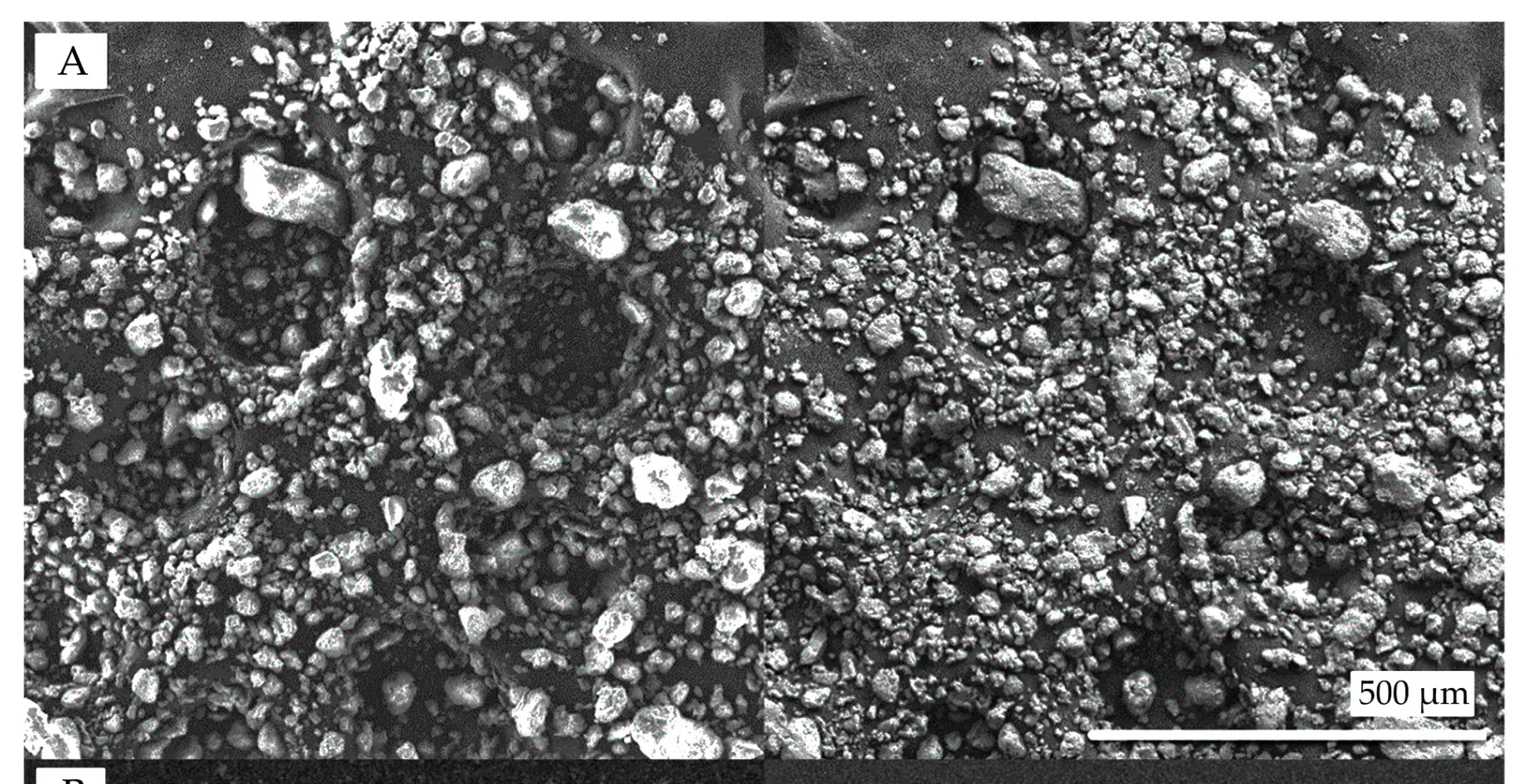
    Researchers from Colombia and Australia have published a study in Polymers detailing a biodegradable film made primarily from calcium caseinate—the same protein that makes up roughly 80% of cow’s milk—blended with starch, a dash of clay, and a synthetic binder to hold everything together. The result is a packaging film that degrades completely in soil in about 13 weeks, compared to conventional plastics that can take centuries.

    Casein—the milk protein—naturally forms dense molecular networks when dissolved and dried, giving films a decent baseline structure. But on its own, pure casein film contracts and becomes brittle after drying, like a piece of dried glue. The researchers found that glycerol, a common food-grade plasticizer, acts like a lubricant inside the polymer, keeping it flexible.

    Image: Polymers
    Image: Polymers

    They then blended in modified starch to bulk it up and PVA—a biodegradable polymer—to dramatically improve strength and compatibility between the other ingredients, and voilà.

    But the key of the concoction is bentonite: a volcanic clay mineral ground down to nanoscale particles and suspended in the mixture. When the film dries, those tiny clay platelets arrange themselves in flat, overlapping layers inside the material—like a wall of stacked cards running through the film.

    Water vapor trying to cross the packaging can’t go straight through anymore—it has to navigate a maze of these clay barriers, following a longer, winding path. That “tortuous diffusion” effect is why the film’s water vapor permeability dropped by nearly three orders of magnitude compared to conventional casein-starch films reported in the literature. That’s a thousand-fold reduction.

    The final film stretches more than double its original length before tearing. Comparable casein-starch films without PVA or bentonite are a lot more rigid. Such improvement in strength comes from bentonite’s silicate layers acting as internal reinforcement, distributing stress more evenly across the material when it’s being pulled or bent. Think of it less like a standard plastic bag and more like a fiber-reinforced composite—just made from food ingredients instead of carbon fibers.

    On the microbiology front, bacteria colonies on the film remained below the threshold set by ISO standards for non-sterile packaging applications. This means that these films don’t have explicit antimicrobial properties, but they don’t create a petri dish environment either. The researchers flagged this as a direction for future work, noting that incorporating silver nanoparticles or other active agents could push the film into genuinely antibacterial territory.

    Biodegradation was tracked by burying rectangular film samples in soil for nine days and weighing them daily. The most aggressive breakdown happened in the first 72 hours—the casein and starch begin absorbing moisture quickly, swelling and fragmenting. After that, degradation continued at a steadier pace.

    Extrapolating the curve puts full disintegration at around 13 weeks, which is longer than simpler casein-only films but significantly shorter than anything petroleum-based. That’s much shorter than the whole millenia it may take a plastic bag to go through the same process.

    Image: Polymers
    Image: Polymers

    The researchers used a solution casting method to produce the films, essentially pouring the liquid mixture into molds and letting it dry in an oven at 38°C (about 100°F). It’s low-tech enough to scale without exotic equipment, which matters for adoption in developing countries where plastic waste management infrastructure is often limited.

    There’s still work ahead. Thermal stability testing hasn’t been done, antimicrobial performance needs deeper validation, and the optical clarity drops slightly with bentonite added—though the researchers say the change is imperceptible to the naked eye.

    These aren’t dealbreakers. They’re the kind of engineering problems that get solved as the formulation moves from lab to pilot production. The core proof of concept—that you can build a functional, genuinely biodegradable food packaging film out of milk protein and volcanic clay—is sitting right there in the data.

    Daily Debrief Newsletter

    Start every day with the top news stories right now, plus original features, a podcast, videos and more.