Tag: Business – Decrypt

  • Russian Hacker Jailed for 81 Months Over $9M Ransomware Attacks

    Russian Hacker Jailed for 81 Months Over $9M Ransomware Attacks

    In brief

    • A U.S. court has sentenced Russian citizen Aleksei Volkov to 81 months in prison for his role in ransomware attacks causing over $9 million in actual losses.
    • Volkov operated as an “initial access broker,” finding vulnerabilities and selling unauthorized access to ransomware groups who then encrypted victims’ data.
    • The 26-year-old must pay $9.2 million in restitution to victims and forfeit equipment used in the crimes.

    A court in the Southern District of Indiana sentenced Russian citizen Aleksei Volkov, 26, to 81 months in prison Monday for assisting major cybercrime groups including the Yanluowang ransomware group in attacks that caused over $9 million in actual losses and over $24 million in intended losses across the United States.

    Volkov, of St. Petersburg, Russia, operated as an “initial access broker”—a specialist who gains unauthorized access to corporate networks and sells that access to other threat actors, according to court documents. His buyers used the access to deploy ransomware that encrypted victims’ data, then demanded cryptocurrency payments—”sometimes in the tens of millions of dollars”—in exchange for restoring access and not publishing stolen data on leak sites.

    On November 25, 2025, Volkov pleaded guilty to four counts from the Southern District of Indiana indictment—unlawful transfer of a means of identification, trafficking in access information, access device fraud, and aggravated identity theft—plus two counts from the Eastern District of Pennsylvania indictment for conspiracy to commit computer fraud and conspiracy to commit money laundering. Police in Rome, Italy, had arrested Volkov before his extradition to the United States.

    As part of his plea agreement, Volkov admitted that he and co-conspirators “demanded tens of millions of dollars in ransom and received millions,” with Volkov receiving a share of cryptocurrency ransom payments. The court ordered him to pay full restitution including almost $9.2 million to known victims and to forfeit equipment used in his crimes.

    Ransomware and crypto

    Ransomware, often leveraging cryptocurrency for payment, remains a challenge for the crypto space. Per Chainalysis’ 2026 Crypto Crime Report, on-chain ransomware payments totaled $820 million in 2025, down 8% year-on-year, while claimed attacks increased by 50% and the median ransom payment grew 368% year-over-year to nearly $60,000.

    In recent months, ransomware developers have turned to blockchain smart contracts as a distribution channel, including the DeadLock ransomware strain that leverages Polygon smart contracts for proxy server address rotation and distribution, and EtherHiding, which targets BNB Smart Chain and Ethereum smart contracts.

    Daily Debrief Newsletter

    Start every day with the top news stories right now, plus original features, a podcast, videos and more.
  • Tether Says It Will Be Audited By Big Four Accounting Firm—But Won’t Say Which One

    Tether Says It Will Be Audited By Big Four Accounting Firm—But Won’t Say Which One

    In brief

    • Tether says it will undergo its first full audit by a Big Four firm, but hasn’t disclosed which one.
    • The audit would verify reserves backing USDT, which the company claims total around $192 billion.
    • Completing the audit could help Tether comply with U.S. rules under the GENIUS Act.

    Tether, the world’s top stablecoin issuer, announced Tuesday it will soon make good on a yearslong promise to audit its sprawling stablecoin reserves—but won’t yet disclose which firm will actually do the job.

    Tether claims to hold some $192 billion in assets in reserve around the world to back the value of its dollar-pegged stablecoin, USDT. The majority of those reserves are purported to be held in U.S. Treasuries.

    But, ever since its founding in 2014, the company has refrained from undergoing an audit from a Big Four accounting firm to confirm the accuracy of its reserve claims. It has instead relied on attestations reviewed by an Italian accounting firm that has never directly examined Tether’s accounts and holdings.

    Today, the company announced it has signed a deal with a Big Four accounting firm to “complete its first full independent financial statement audit.” But Tether did not state which firm, and a Tether representative declined comment when reached by Decrypt.

    The Big Four accounting firms—Deloitte, PriceWaterhouseCoopers, Ernst & Young, and KPMG—are the world’s largest auditors, and are widely regarded as providing a certain standard of rigor and transparency when engaged by major corporations.

    Tether’s CEO, Paolo Ardoino, told Decrypt last year he planned on putting Tether through a Big Four audit, but that the process was taking time given the company’s size.

    The GENIUS Act, signed into law by President Donald Trump last summer, requires all foreign stablecoin issuers—theoretically including Tether, which is based in El Salvador—to undergo rigorous audits of its stablecoin reserves. Ardoino said last year he intends for USDT to comply with the law. A Big Four audit would go a long way to achieving that goal.

    Last fall, Tether launched an American offshoot with its own, U.S.-specific stablecoin, USAT. The token launched in January, and currently boasts a far smaller market capitalization than Tether’s flagship token: just $27 million, compared to USDT’s $184 billion.

    USAT’s far smaller reserves were successfully audited by Deloitte a month later.

    Editor’s note: This story was updated after publication to note that Tether declined comment.

    Daily Debrief Newsletter

    Start every day with the top news stories right now, plus original features, a podcast, videos and more.

  • Wall Street’s Crypto Ties Deepen as NYSE Taps Securitize for Tokenized Securities

    Wall Street’s Crypto Ties Deepen as NYSE Taps Securitize for Tokenized Securities

    In brief

    • The New York Stock Exchange said that it’s working with Securitize on developing systems that will allow tokenized securities to trade round-the-clock.
    • The companies are collaborating on standards that will shape tokenized securities on a platform affiliated with the largest stock exchange by market capitalization.
    • Securitize CEO Carlos Domingo has advocated for “native” securities, which embody the rights of traditional counterparts while existing solely on-chain.

    The New York Stock Exchange said Tuesday that it’s collaborating with Securitize, the BlackRock-backed tokenization specialist, on a program aimed at accelerating Wall Street’s shift toward trading infrastructure underpinned by digital assets.

    As part of the arrangement, the world’s largest stock exchange by market capitalization will work with Securitize on developing standards for tokens that represent real-world assets like stocks and bonds, as well as exchange-traded funds, according to a joint press release.

    Securitize is also slated to serve as the first digital transfer agent for NYSE’s Digital Trading Platform, the companies said. That will enable Securitize to create “blockchain-native securities” on the NYSE-affiliated platform, which is designed to facilitate round-the-clock trading.

    The collaboration comes as the latest sign that giants in traditional finance are growing serious about perceived opportunities with blockchain-based trading infrastructure. Last year, SEC Chair Paul Atkins unveiled Project Crypto, describing it as an agency-wide initiative to develop rules and regulations that “enable America’s financial markets to move on-chain.”

    Last week, Nasdaq gained approval from the watchdog for a pilot program involving tokenized securities. The system is expected to keep trading and settlement within traditional market rails through coordination with a subsidiary of Depository Trust & Clearing Corporation.

    As experimentation with tokenization intensified last year, Securitize CEO Carlos Domingo told Decrypt that the only way to truly represent securities on-chain is through “native” tokenization. That means a token representing a stock, for example, would carry the same rights as its traditional counterpart, including the ability to vote or receive dividends.

    Transfer agents typically record ownership of securities in “book-entry” form using centralized databases. Securitize uses a black-chain based system for that instead, including BlackRock’s $2 billion tokenized money-market fund BUIDL, which primarily exists on Ethereum.

    “We are proud to support NYSE in helping design the foundational transfer agent infrastructure,” Domingo said in a statement. “This is about building tokenization in a way that works within real market structure, with the protections, controls, and operational integrity.”

    Last month, World Liberty Financial, the DeFi project backed by U.S. President Donald Trump, tapped Securitize for issuing tokens tied to the development of a luxury Maldivian resort.

    In October, the firm backed by the world’s largest asset manager unveiled plans to list on the Nasdaq at a $1.25 billion valuation. Before the president was elected on a pro-crypto platform, BlackRock led a $47 million strategic funding round for Securitize in 2024

    Daily Debrief Newsletter

    Start every day with the top news stories right now, plus original features, a podcast, videos and more.

  • Mastercard, Western Union, Worldpay Building With New Solana Enterprise Platform

    Mastercard, Western Union, Worldpay Building With New Solana Enterprise Platform

    In brief

    • Solana launched an API-driven platform helping enterprises build financial products on its blockchain, with 20+ infrastructure partners integrated at launch.
    • Mastercard, Worldpay, and Western Union are early users, applying it to stablecoin settlement, merchant payments, and cross-border transfers.
    • The platform is live in a test version today, with a trading module and full availability coming later in 2026.

    The Solana Foundation on Tuesday unveiled a new developer platform aimed at making it easier for banks, payments companies, and other financial institutions to build products on its blockchain network, announcing partnerships with three major financial firms at launch.

    The Solana Developer Platform, or SDP, bundles together infrastructure from more than 20 technology partners into a single, API-driven interface designed to lower the technical barriers enterprises typically face when building on blockchain networks. The platform is structured around three core modules covering the issuance of digital assets, payment orchestration, and trading—though the trading module is not expected to go live until later this year.

    Mastercard, Western Union, and Worldpay have joined as early users of the platform, according to the announcement, each deploying it for distinct purposes.

    Mastercard is using SDP to enable stablecoin settlement on the Solana network, while Worldpay, the payments processing giant, is applying it to merchant payments and settlement. Western Union, whose core business has long been cross-border money transfers, is exploring how the platform can extend its existing capabilities onto the blockchain.

    “The next phase of digital asset innovation will be defined by practical use cases that integrate seamlessly with existing financial systems,” said Raj Dhamodharan, Mastercard’s executive VP of blockchain and digital assets, in a statement.

    “As an early user of Solana Developer Platform, we’re helping enable direct stablecoin settlement for customers on select blockchain networks—beginning with Solana—combining the speed and programmability of blockchain with the reliability, security and global reach of the Mastercard network,” he added.

    The platform draws on infrastructure partners across four categories: node infrastructure providers such as Alchemy and QuickNode, custody wallet solutions including Fireblocks and Coinbase, compliance tools from firms like Chainalysis and Elliptic, and payment ramp services. The platform launched in a sandbox environment built on Solana’s test network, with broader availability expected to follow.

    Daily Debrief Newsletter

    Start every day with the top news stories right now, plus original features, a podcast, videos and more.
  • Morning Minute: Saylor Gains Access to Another $44B to Buy Bitcoin

    Morning Minute: Saylor Gains Access to Another $44B to Buy Bitcoin

    Morning Minute is a daily newsletter written by Tyler Warner. The analysis and opinions expressed are his own and do not necessarily reflect those of Decrypt. And check out our new daily news show covering all of the top stories in 5 minutes or less, downloadable on Apple Pod or Spotify.

    GM!

    Today’s top news:

    • Crypto majors grind higher, SOL leads; BTC +1% at $71k
    • Saylor gets access to another $42B+ in MSTR and STRC ATM programs
    • Congressmen introduce bipartisan bill banning sports betting in pred markets
    • Polymarket introduces referral program and new fee structure
    • Elizabeth Warren comes after Mr. Beast’s new banking app and potential crypto tie in

    ₿ Strategy Unveils a $44B Equity Plan to Buy More Bitcoin

    Strategy said it can now issue $44 billion in additional equity to fund future Bitcoin purchases, split across $21 billion of common stock (MSTR), $21 billion of STRC, and $2.1 billion of STRK.

    The move is designed to keep feeding Strategy’s Bitcoin-buying machine, even as the pace of purchases briefly slowed.

    Notably, STRC accounts for nearly half of the total authorization. The company recently boosted STRC’s monthly dividend to 11.5%, leading to a spike in demand that helped fuel Saylor’s large buys earlier this month.

    Bitcoin did not react to the news, holding at $70,500 on the day.

    Key Details

    • Strategy can issue $44B in fresh equity.
    • The authorization includes $21B MSTR, $21B STRC, and $2.1B STRK.
    • STRC has enabled Strategy to raise more than $1.5B this month.

    🏛 Congress Moves to Ban Sports Bets on Prediction Markets

    The Wall Street Journal reported that lawmakers are preparing a bipartisan bill to ban sports betting on prediction market platforms.

    That would directly target one of the fastest-growing use cases for firms like Kalshi and Polymarket, both of which have pushed aggressively into sports-related markets.

    For context of how big this is, Kalshi’s weekly sports volume makes up 70-85% of its total handle and Polymarket’s sports volume is 35-40% of its total.

    And the timing is notable, with Kalshi fresh off the news of its latest $22B fundraise.

    State gaming regulators argue these products are sports betting and should be treated like gambling. The platforms argue they are federally regulated event contracts and belong under derivatives oversight instead.

    Congress now appears ready to test that question directly with legislation.

    Key Details

    • WSJ reported the bill would be bipartisan and would target sports bets on prediction markets, not the entire category.
    • Kalshi’s sports volume makes up 70-85% of its total volume across platforms.
    • The timing is notable because prediction markets have just had a major momentum streak, with large new partnerships, rising volumes, and fresh private-market funding.

    🕵️ Polymarket and Kalshi Make Series of Announcements

    It was a busy day for prediction markets, beyond the WSJ report of the new bipartisan bill.

    Polymarket previously hyped a big announcement coming Monday, and it delivered…a new referral program. They also bundled in a new fee structure, varying by market sector and probability with a peak fee of 1.8% (for crypto markets).

    Polymarket also updated its insider-trading rules and emphasized a “multi-layered monitoring system” for suspicious activity, while Kalshi has also been tightening controls as the sector faces more political and regulatory attention.

    Kalshi is banning athletes, coaches and politicians from betting on their own markets in an effort to prevent insider trading.

    And Polymarket recently said it is working with Palantir to build surveillance systems for sports-focused prediction markets.

    Key Details

    • Polymarket’s new referral program includes traders >$10k in volume and will include up to 30% rewards
    • Polymarket’s new fee structure varies by market type and peaks at 1.8%
    • Kalshi banned athletes, coaches and politicians from trading

    🏀 Coinbase Users Blast March Madness Push Notifications

    Coinbase users complained after receiving repeated March Madness push notifications encouraging them to make sports-related predictions. The backlash on X got large enough to become a trending topic, with multiple users arguing the notifications felt more like sports-gambling ads than a normal crypto exchange experience.

    Coinbase’s app homepage was prominently featuring March Madness promotion at the top of the screen, while some users said they were getting several notifications a day.

    Coinbase CEO Brian Armstrong replied that the criticism was “a fair point” and said more customization options would be added.

    Key Details

    • Users complained about receiving multiple push notifications per day.
    • Coinbase’s app homepage was also featuring a March Madness ad prominently.
    • Armstrong responded publicly and promised more customization options.

    🧒 Elizabeth Warren Presses MrBeast Over Crypto in a Teen Banking App

    Senator Elizabeth Warren is pressing Beast Industries over whether crypto could be pushed through Step, the teen-focused banking app tied to MrBeast.

    Warren sent a 12-page letter focused on Step’s previous crypto activity and raised concerns about how a large youth audience could be exposed if crypto features returned.

    Step had previously marketed itself as the first U.S. platform to let teens, with parental consent, buy digital assets such as Bitcoin, and later expanded that access to dozens of crypto assets and NFTs.

    Key Details

    • Warren’s letter is 12 pages long and focuses heavily on Step’s prior crypto activity.
    • Step previously let teens buy crypto with parental consent.
    • Beast Industries recently received a $200M investment from BitMine.

    🌎 Macro Crypto and Markets

    • Crypto majors are slightly green after yesterday’s major bounce; BTC +1% at $71k; ETH +2% at $2,165; SOL +3% at $92
    • APT (+12%), TAO (+11%), and ZRO (+8%) led top movers
    • Oil held steady at $90; Gold also flat at $4,410
    • Nasdaq partnered with institutional crypto infra firm Talos to connect crypto trading and risk tools with its Calypso platform, the same system banks and funds use to manage collateral and surveillance across stocks and bonds
    • Former Kalshi employees are raising $35M for a new prediction market venture fund, backed by both the Kalshi and Polymarket CEOs
    • ParaFi Capital raised $125M for a new venture fund focused on stablecoins, tokenization, and institutional on-chain finance

    Corporate Treasuries & ETFs

    Meme Coin Tracker

    • Meme majors were mixed; DOGE +2%, SHIB +1%, PEPE +1%, TRUMP flat, PENGU flat, SPX -1%, FARTCOIN -3%
    • 7 Wanderers (+75x), Punch (+50%), LOL (+40%) and testicle (+33%) led top movers

    💰 Token, Airdrop & Protocol Tracker

    • Polymarket introduced a new referral program with 30% rewards for direct referrals and 10% for indirect and hinted at eligibility for “all future rewards” along with a new fee structure for its markets
    • MoonPay released its OpenWallet Standard as open source, a unified protocol that lets AI agents handle keys, wallets, and transaction signing across all major blockchains
    • The Backpack Exchange token launched yesterday, opening at $400M FDV before falling to $200M; Mad Lads received a BP token airdrop
    • Balancer Labs is winding down six months after a November exploit drained $128M across six blockchains in 30 minutes from its V2 Vault contract

    🚚 What is happening in NFTs?

    • NFT leaders were mostly mixed; Punks -3% at 28.5 ETH, Pudgy +1% at 4.15 ETH, BAYC +4% at 5.35 ETH; Hypurr’s +1% at 405 HYPE
    • Normies (+60%) led notable movers
    • Pudgy World officially lau

    Daily Debrief Newsletter

    Start every day with the top news stories right now, plus original features, a podcast, videos and more.

  • Bittensor Leads AI Altcoin Surge as Short Squeeze, Conflicting Iran Talks Claims Fuel Volatility

    Bittensor Leads AI Altcoin Surge as Short Squeeze, Conflicting Iran Talks Claims Fuel Volatility

    In brief

    • Bittensor’s TAO led an AI altcoin surge as geopolitical tensions briefly eased following Trump’s announcement of a pause in planned strikes against Iran’s energy infrastructure.
    • Iran subsequently denied that talks had taken place, triggering a whipsaw in prices and liquidating roughly $670 million in leveraged crypto positions over 24 hours.
    • Conflicting Iran signals fuel risk aversion, testing Bitcoin’s store-of-value narrative, Decrypt was told.

    AI-focused altcoins led a market-wide rally Tuesday after U.S. President Donald Trump announced that he would “postpone” planned strikes on Iran’s energy infrastructure, triggering a cascade of short liquidations.

    Bittensor’s TAO token jumped 10.2%, while Artificial Superintelligence Alliance (FET) and Render (RENDER) gained 6.2% and 4.8%, respectively, over 24 hours. Aptos (APT), LayerZero (ZRO), and World Liberty Financial (WLFI) also posted significant moves as the total crypto market cap topped $2.5 trillion, according to CoinGecko data.

    The immediate catalyst was President Donald Trump’s announcement of a five-day pause on strikes against Iran’s power plants, along with claims of “productive conversations” between the U.S. and Iran. Trump’s statement sent oil prices tumbling over 13%, sparking a relief rally across risk assets.

    However, Iran’s foreign ministry said there was “no dialogue” between Tehran and Washington, a statement subsequently echoed by Iran parliament speaker Mohammad Bagher Ghalibaf. The remarks sparked a volatile environment that sent oil back over $100 a barrel and led to over $670 million in liquidations across the crypto market over a 24 hour period. Short positions accounted for $370 million—more than half of the total.

    That short squeeze propagated “hardest into higher-beta names where positioning was already most compressed,” Derek Lim, head of research at crypto market-making firm Caladan, told Decrypt.

    He also pointed to Nvidia CEO Jensen Huang’s GTC conference last week as a second catalyst. The convergence of the two events added tailwinds to the AI sector, he said.

    Despite the sharp gains, a broad-based altcoin rally remains unlikely, Decrypt previously reported. Instead, any “alt season” is expected to mature and be limited to a narrow sector of narrative- and fundamental-driven tokens.

    Looking ahead

    “Conflicting statements around the Iran war are increasing uncertainty, which fuels risk aversion,” Illia Otychenko, lead analyst at cryptocurrency exchange CEX.IO, told Decrypt. “That uncertainty is keeping oil prices elevated and lowering expectations for rate cuts.”

    For now, with both oil prices and Treasury yields rising, inflation remains a key concern, he said. That dynamic is “not that bad for Bitcoin due to its store-of-value narrative.”

    Still, Bitcoin continues to hold steady around $71,000 and is up 0.3% over the past 24 hours, according to CoinGecko data.

    Otychenko warned that the bigger risk would be if oil prices and Treasury yields start moving in different directions. “That would create a more complex macro backdrop that could test Bitcoin’s store-of-value narrative as it would put significant pressure on most assets except bonds and the U.S. dollar.”

    Users on prediction market Myriad, owned by Decrypt’s parent company Dastan, reflected the growing uncertainty, assigning only a 44% chance to a spring crypto rally.

    Daily Debrief Newsletter

    Start every day with the top news stories right now, plus original features, a podcast, videos and more.
  • MoonPay Launches Open-Source Wallet Standard for AI Agents

    MoonPay Launches Open-Source Wallet Standard for AI Agents

    In brief

    • MoonPay has introduced the Open Wallet Standard (OWS), an open-source framework for AI agents to manage funds across blockchains.
    • Contributors include PayPal, Ethereum Foundation, Solana Foundation, Ripple, OKX, Tron, and TON Foundation, among others.
    • The standard addresses wallet and key management fragmentation challenges while enhancing security for AI developers.

    Crypto payments infrastructure company MoonPay has launched an open-source wallet standard designed for AI agents to manage funds and execute transactions across multiple blockchains, addressing key infrastructure challenges that have limited AI-crypto integration.

    The Open Wallet Standard (OWS), announced Monday, was developed with contributions from PayPal, the Ethereum Foundation, the Solana Foundation, Ripple, OKX, Tron, TON Foundation, and Base, among other companies.

    “The agent economy has payment rails. It didn’t have a wallet standard. We built one, open-sourced it, and now the full stack exists,” said MoonPay co-founder and CEO Ivan Soto-Wright in a statement.

    The framework aims to solve fragmentation issues in wallet and key management that have complicated financial operations for autonomous AI systems, according to MoonPay, which is an investor in Decrypt’s sister company Myriad.

    OWS supports the x402 open payment protocol developed by Coinbase, along with Stripe and Tempo’s Machine Payments Protocol (MPP) for session-based micropayments. It also builds on MoonPay’s earlier collaboration with Ledger that enables hardware wallet signing for MoonPay Agents transactions.

    “On-chain payments originate from wallet addresses, and every chain represents them a bit differently,” said Mysten Labs co-founder and CTO Sam Blackshear in a statement, explaining that a “unified representation” streamlines processes and enables agents to focus on high-level tasks instead of details.

    According to MoonPay, OWS is designed in such a way that a wallet’s private key is never exposed to agents, the LLM context or parent applications when transacting.

    The launch comes as AI agents increasingly require sophisticated financial capabilities to operate autonomously, and forms part of a “deliberate shift” at MoonPay towards AI-native infrastructure.

    Agentic payments are a growing concern for crypto infrastructure developers, with Coinbase launching a wallet specifically for AI agents with built-in guardrails, Stripe-backed Tempo Network focusing on enabling AI agent payment capabilities, and Sam Altman’s World tapping Coinbase’s protocol to verify humans behind AI agents.

    Daily Debrief Newsletter

    Start every day with the top news stories right now, plus original features, a podcast, videos and more.

  • OKX Rolls Out Round the Clock Trading for Mag Seven Stocks Using Crypto Collateral

    OKX Rolls Out Round the Clock Trading for Mag Seven Stocks Using Crypto Collateral

    In brief

    • The contracts track major U.S. stocks and indices but do not grant ownership, functioning as synthetic exposure products.
    • Traders can post Bitcoin, Ethereum and yield-bearing crypto assets as collateral under a unified margin system.
    • The launch comes as exchanges race to offer real-world asset exposure to retail traders outside traditional brokerage systems.

    OKX has launched more than 20 equity perpetual swap contracts, offering users across Asia, the CIS region, Latin America, and Türkiye exposure to trade major global stocks around the clock using crypto as collateral.

    The launch includes the full “Magnificent 7”—Nvidia, Tesla, Apple, Alphabet, Microsoft, Amazon, and Meta, according to a statement shared with Decrypt.

    It also covers crypto-linked firms such as Strategy, Coinbase, Robinhood, and Circle, as well as technology stocks Palantir, Intel, Micron, and SanDisk, and the S&P 500 tracker SPY.

    The equity perp launch is framed as the first phase of a broader rollout, with OKX planning to expand its range of equity contracts and tokenized real-world asset exposure in the coming months.

    It’s OKX’s latest push into real-world assets, as crypto exchanges increasingly compete to offer traditional market exposure to retail investors who face hurdles accessing U.S. equities through conventional brokerages in many parts of the world.

    All contracts are denominated in USDT and offer up to 5x leverage, allowing traders to respond to earnings releases, macroeconomic developments, and market-moving events even when traditional equity markets are closed, the statement said.

    Unlike tokenized equities that represent actual shares, equity perpetual swaps are derivatives that track price movements without granting ownership, placing them closer to synthetic exposure products already offered by other exchanges.

    “I think these instruments will command a good following from momentum-driven retail investors,” Peter Chung, head of research at Presto Labs, told Decrypt. “Crypto exchanges are far more accessible venues for retail investors in many jurisdictions around the world.”

    “On traditional rails, these names are often beyond their reach due to various hurdles,” he added.

    Asked how the product differs from those offered at rival platforms, including Binance, an OKX spokesperson told Decrypt its offering is differentiated by its “unified trading account.”

    The spokesperson said the platform allows users to stake assets and use them as collateral for equity perpetual positions, with those assets continuing to generate yield while positions remain open.

    A unified trading account allows users to deploy a range of crypto assets, including Bitcoin, Ethereum, USDT, and staked holdings, as collateral across positions.

    “This is one step towards bringing a broader range of real-world assets into our platform,” the spokesperson said when asked about the choice of perpetual swaps over tokenized equities representing actual shares.

    “We will keep expanding our infrastructure to support exposure to global equities while allowing traders to use their crypto portfolios for this,” they said.

    The rollout follows OKX’s high-profile tie-up with Intercontinental Exchange, the New York Stock Exchange’s parent company, which invested in OKX earlier this month at a $25 billion valuation. 

    The deal is also expected to enable OKX users to trade tokenized stocks and derivatives listed on the NYSE starting in the second half of the year. 

    OKX’s native token, OKB, is trading at $85, up 0.3% in the last day, and down 11.7% in the last 7 days, according to CoinGecko data.

    Daily Debrief Newsletter

    Start every day with the top news stories right now, plus original features, a podcast, videos and more.
  • Balancer Labs Winds Down Months After $128M DeFi Exploit

    Balancer Labs Winds Down Months After $128M DeFi Exploit

    In brief

    • Balancer Labs is winding down after a $128 million exploit left the company facing legal exposure and no sustainable revenue.
    • The protocol will continue under a DAO, foundation, and service-provider structure, with staff potentially moving to a new operating entity.
    • Experts say the shutdown reflects deeper issues with older DeFi governance and token incentive models that are losing traction.

    Balancer Labs has decided to call it quits six months after its namesake protocol suffered a major security breach that founders say caused reputational damage and triggered a sell-off in the Balancer token.

    The protocol, created to build and manage a DeFi platform for token swaps and liquidity pools, was hit by an exploit in November last year, after an attacker drained $128 million across six blockchains in just 30 minutes from Balancer V2’s Vault contract.

    The “exploit created real and ongoing legal exposure,” co-founder Fernando Martinelli wrote in a statement on Monday,  adding that Balancer Labs was left without “any sources of revenue.” 

    “Maintaining a corporate entity that carries the liability of past security incidents, while the protocol itself needs to move forward unburdened, is not responsible stewardship,” Martinelli added.

    Balancer no longer needs a traditional company above it, and its DAO, Foundation, and service-provider structure should carry the protocol forward, with key staff set to move into a new operating arm if governance approves, he added.

    The hack worked by exploiting a small pricing error in Balancer’s older V2 stable pools, where the system inconsistently rounded numbers during swap calculations, according to an analysis by blockchain security firm BlockSec.

    “Beyond the immediate financial impact, the incident led to three lasting pressures: unrecovered funds, ongoing legal and operational exposure, and a significant erosion of user trust,” Brian Wong, senior audit engineer at BlockSec, told Decrypt

    Transitioning to a DAO governance model could help “isolate legal risk, reduce fixed operational overhead, and shift governance and accountability more directly to the community,” Wong added.

    “I believe Balancer still has a chance to turn things around and prove to token holders who stay that there can be product market fit and sustainability,” Martinelli said.

    Balancing act

    The wind-down points to both the longer-running weaknesses in Balancer’s token and governance model and the pressure the November hack put on the protocol’s ability to sustain itself, observers told Decrypt.

    Balancer’s decision “exposes structural failure” that points to how it has “capitulated to a broken model where emissions faded, governance weakened, value capture stayed shallow,” Dominick John, analyst at Zeus Research, told Decrypt.

    While streamlining its operations could be the right call, it comes as a “late-stage patch,” he said, adding that older DeFi models built around token rewards and incentive-driven growth are being “phased out.”

    The shutdown also appears to be Balancer’s way of finding “a quick way to escape legal risks” after the November 2025 hack, Ryan Yoon, senior analyst at Tiger Research, told Decrypt.

    It gives Balancer a way to use the DAO transition to drop veBAL, its escrow governance model, which Yoon suggested had become part of the protocol’s broader structural problems.

    The next test is whether Balancer’s smaller team can “actually fix governance,” Yoon said, by keeping governance aligned, security intact, and the treasury stable enough to carry the protocol forward, areas John said are “critical to keeping Balancer relevant.”

    Daily Debrief Newsletter

    Start every day with the top news stories right now, plus original features, a podcast, videos and more.

  • Australian Pension Fund Weighs Crypto Access Amid Market Volatility

    Australian Pension Fund Weighs Crypto Access Amid Market Volatility

    In brief

    • Hostplus CIO Sam Sicilia says the retirement fund is eyeing a potential launch as early as next financial year.
    • The fund is looking beyond Bitcoin at a wider range of digital assets, including tokenized exposure to areas like music rights.
    • It comes as AMP Super, the first Australian fund to back crypto, exited most of its Bitcoin futures position ahead of this year’s market decline.

    Crypto is inching closer to Australia’s retirement system, with one of the country’s largest super funds now actively exploring how to offer it to members.

    Australian industry superannuation fund Hostplus is exploring whether to open a path into Bitcoin and other digital assets for its members, according to a Bloomberg report.

    This move would put the $105 billion (A$150 billion) retirement giant among a small group of global pension funds willing to take on crypto exposure.

    “As soon as one super fund breaks ranks on crypto assets, I’d say there’s a high probability the rest follow,” Jason Titman, CEO of Australian crypto exchange Swyftx, told Decrypt. “Around a quarter of Australians want their super funds to offer digital assets, and that number is likely to increase when the market is regulated.”

    The fund’s CIO, Sam Sicilia, told Bloomberg the plan is focused on Choiceplus, a self-directed window that lets members manage a slice of their own retirement savings, currently about 1% of the fund’s total book. 

    “There’s certainly a demand from some of our members who write in and say, ‘Why can’t I have access to cryptocurrency?’” he said.

    A launch could come as early as next financial year, pending regulatory approval and internal product design work, Sicilia said. 

    Hostplus, which serves nearly two million members with an average age in the mid-to-late 30s, is still reviewing consumer protections and product design.

    Sicilia said the fund’s view of crypto has evolved considerably since an earlier assessment roughly a decade ago, and that the current review covers not just Bitcoin but a broader universe of digital assets, including potential tokenized exposure to areas such as music rights.

    Kraken Australia managing director Jonathon Miller told Decrypt the move, if implemented, is a “positive step forward for the sector.” 

    “We have come a long way in the last decade, and for many Australians, digital assets are increasingly viewed as a legitimate long-term investment; however, access to them, outside of SMSFs, has remained limited,” he said. 

    “Expanding availability through platforms like Choiceplus gives investors more flexibility in how they build and diversify their portfolios,” Miller said, adding that “more choice” and “easier access” would benefit “both consumers and the broader market”.

    Still, volatility remains a key barrier as AMP Super, one of the few funds to experiment with crypto, recently cut its Bitcoin futures exposure to around 0.02% after a sharp downturn wiped out roughly $700 billion from the market earlier this year. 

    “We’ve had essentially no exposure during most of the recent sell-off,” AMP Super head of portfolio design Stuart Eliot told Investment Magazine last month.

    The position dates back to May 2024, when AMP Super added Bitcoin futures via its dynamic allocation strategy.

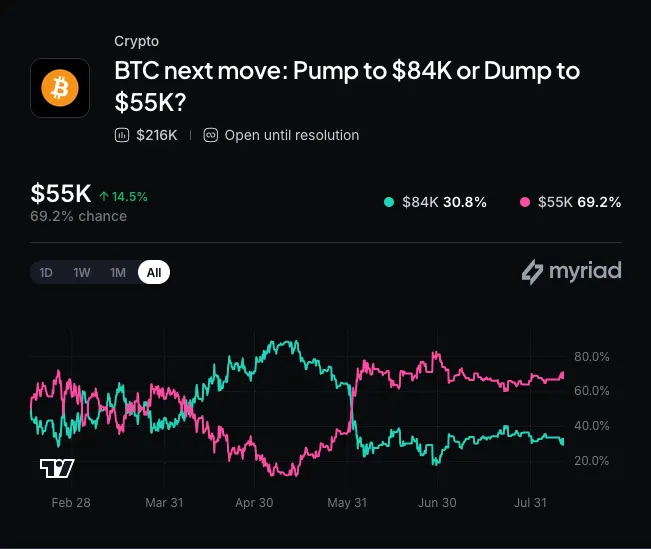
    On Myriad, a prediction market owned by Decrypt’s parent company Dastan, market sentiment leans toward upside, with users seeing a 50.7% likelihood of Bitcoin reaching $84,000 rather than falling to $55,000.

    The world’s largest crypto currently sits at $70,599, up 3.6% on the day, according to CoinGecko data.

    Daily Debrief Newsletter

    Start every day with the top news stories right now, plus original features, a podcast, videos and more.