Tag: Business – Decrypt

  • Cathie Wood’s Ark Invest Dumps Meta, Nvidia and Bitcoin ETF Shares in Major Tech Sell-Off

    Cathie Wood’s Ark Invest Dumps Meta, Nvidia and Bitcoin ETF Shares in Major Tech Sell-Off

    In brief

    • Ark Invest parted with nearly $41 million in META and $26 million in NVDA shares on Thursday.
    • Cathie Wood’s firm also dumped around $11 million worth of shares in its Bitcoin ETF.
    • The sales come amid a sustained market downturn as uncertainty in Iran shakes stocks and crypto.

    Ark Invest, the investment firm of notable tech investor Cathie Wood, shed millions of dollars’ worth of shares of major tech stocks on Thursday, significantly trimming positions in Nvidia and Meta while also diminishing its exposure to Bitcoin via its own Bitcoin ETF. 

    The firm’s Thursday activity saw it part with nearly $41 million worth of Meta (META) and more than $26 million in Nvidia (NVDA), both of which have fallen further since the opening bell on Friday, dropping 2.98% and 1.55%, respectively. 

    The prominent tech stocks have fared much worse over the last month, with META dropping more than 17% over that time to change hands around $531. The bulk of those losses—around 10%—have come in the last week as the social media platform lost a pair of social media addiction lawsuits that said it failed to protect young users. 

    Nvidia has held up better, but still dipped around 5% in the last month as uncertainty surrounds the conflict in Iran. The firm was also hit with a class action lawsuit over alleged crypto mining revenue gaps

    The actively managed ARK ETFs also saw considerable decreases in other popular tech stocks, like Google parent Alphabet (GOOG) and Advanced Micro Devices (AMD), which it sold around $2.5 million and $7.5 million worth of, respectively. The pair have not been spared in Friday trading, dropping 1% and 2.27% since trading began.

    Beyond the tech stocks, Ark Invest also divested from some crypto exposure on Thursday. The firm shed around $11 million worth of shares in its spot Bitcoin ETF (ARKB) and about $6.5 million in shares of crypto exchange Bullish. It also dumped nearly $5 million worth of Bitcoin proponent Jack Dorsey’s firm, Block (XYZ), which has a number of Bitcoin-centric products.

    Bitcoin, the leading cryptocurrency, has now fallen around 4.8% in the last 24 hours to change hands around $66,020, briefly touching its lowest price since March 2 below $66,000. Meanwhile, Bullish has fallen nearly 3.5% in the last 24 hours, and is now down nearly 44% in the last six months of trading as the entire crypto market slides. 

    Wood has been outspokenly optimistic about the future of Bitcoin, providing ambitious price forecasts—like $1.2 million per coin by 2030. But after Thursday’s sales, the firm only holds around $100 million in ARKB, enough to make it the 35th largest holding among actively managed ARK ETFs out of 96 total positions, according to data from Cathie’s Ark

    Earlier this year, Wood said that she was not concerned about a bubble in AI, instead pointing to precious metals and the run in gold as the real bubble. As of Friday, gold was down around 20% from its yearly high, recently changing hands around $4,483 per ounce.

    Daily Debrief Newsletter

    Start every day with the top news stories right now, plus original features, a podcast, videos and more.

  • Binance Australia Hit With $6.9M Fine After Investors Lose Millions on Derivatives

    Binance Australia Hit With $6.9M Fine After Investors Lose Millions on Derivatives

    In brief

    • A federal court ordered Binance Australia Derivatives to pay a $6.9 million USD penalty for allowing misclassified users to access high-risk products.
    • A total of 524 retail investors were incorrectly classified as wholesale clients between July 2022 and April 2023, resulting in about $6 million in trading losses
    • Binance admitted allowing clients unlimited attempts at a multiple-choice quiz to qualify as sophisticated investors.

    Australia’s Federal Court has ordered Oztures Trading Pty Ltd, trading as Binance Australia Derivatives, to pay an AUD $10 million (about $6.9 million USD) penalty after the exchange admitted to exposing 524 retail investors to high-risk crypto derivative products without required consumer protections.

    The misclassification occurred between July 2022 and April 2023, with Binance admitting to failures in client onboarding that allowed retail clients to make unlimited attempts at a multiple-choice quiz until they achieved a passing score to qualify as sophisticated investors, according to ASIC’s announcement.

    The misclassified client group incurred AUD $8.66 million (about $6 million) in trading losses and paid AUD $3.89 million ($2.67 million) in fees. Of the 524 misclassified clients, 460 were incorrectly classified as meeting the Sophisticated Investor Test, 33 as meeting the Individual Wealth Test, 26 as professional investors, 4 as Related Body Corporate, and 1 as meeting the Large Business Test.

    In one example, Binance assessed an individual as a professional investor based solely on their claim to be an “exempt public authority,” without adequate verification.

    “Binance failed to set up basic compliance checks and incorrectly approved hundreds of applications for complex, wholesale investor products,” ASIC Chair Joe Longo said, in a statement. “Binance’s shortcomings left more than 85% of their Australian customer base exposed to high-risk products they should have never been able to access, and without important consumer protections or rights, costing retail investors millions.”

    Justice Moshinsky also ordered Binance to contribute to ASIC’s costs, with the penalty coming on top of approximately AUD $13.1 million in compensation already paid to affected clients in 2023.

    “The issue was self-identified, reported to ASIC, and fully remediated in 2023, with approximately AUD 13 million compensated to affected users. Oztures ceased its derivatives business and voluntarily gave back its AFSL in 2023,” a Binance spokesperson told Decrypt. “Binance Australia is committed to offering users in Australia innovative, compliant, and trusted products, while helping advance the responsible growth of the country’s blockchain and digital asset ecosystem.”

    Editor’s note: This story was updated to include comment from Binance.

    Daily Debrief Newsletter

    Start every day with the top news stories right now, plus original features, a podcast, videos and more.

  • Bitcoin Dips Under $67K as Geopolitical Uncertainty, Treasury Yields Spook Traders

    Bitcoin Dips Under $67K as Geopolitical Uncertainty, Treasury Yields Spook Traders

    In brief

    • Bitcoin dropped under $67,000 as Middle East tensions and rising yields pressured risk assets.
    • Over $1.33 billion was liquidated this week, with heavy leveraged positions stacked between $70,000 to $75,000.
    • Experts expect choppy near-term action with potential relief rally contingent on easing macro pressures.

    Bitcoin and the broader crypto market continue to stack losses this week as March comes to a close, with experts anticipating rangebound price action and increased volatility in the near term.

    The leading crypto dropped to lows of $66,400 Friday, Bitcoin’s lowest level since March 9. It is currently trading at $66,633, down 3.9% in the past 24 hours and 5.6% on the week, according to CoinGecko data.

    Bitcoin’s drop this week is primarily driven by macroeconomic risk-off conditions resulting from the geopolitics, involving the Middle East war, Andri Fauzan Adziima, research lead at cryptocurrency exchange Bitrue, told Decrypt.

    The ripple effects of this war have raised oil prices, leading to fears of sticky inflation. Though Bitcoin continues to outperform gold and the U.S. stock market since the war began on February 28, it dropped over 6% from over $75,000 to below $70,000 as the U.S. Federal Reserve kept the interest rates steady last week.

    “Like all other macro assets, Bitcoin is trading to geopolitical headlines,” Thahbib Rahman, research analyst at crypto research platform Block Scholes, told Decrypt. “Trump’s uncertain tone yesterday around the likelihood of a ceasefire coincided with Bitcoin falling to $67,000.”

    In addition to geopolitical pressure, 10-year U.S. Treasury yields rose for four consecutive weeks in response to the confusing mixed messages around the U.S.-Iran war.

    The U.S. dollar index rose 0.57% this week to 100.148, continuing to weigh down on risk assets, including Bitcoin.

    Despite Bitcoin’s relatively tiny range, extending from $72,000 to $66,200, over $1.33 billion has been liquidated this week, CoinGlass data show. That reflects “heavy leveraged positions stacked above current levels, especially $70,000 to $72,000, and up to $73,000 to $75,000, with thinner liquidity on the downside, Adziima said.

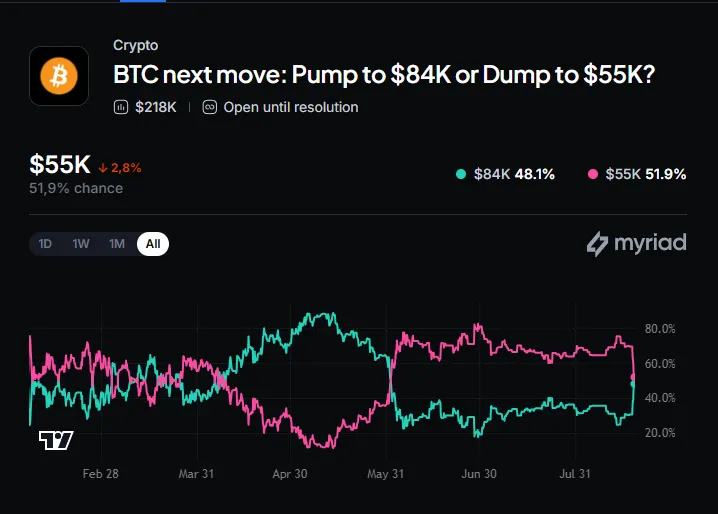
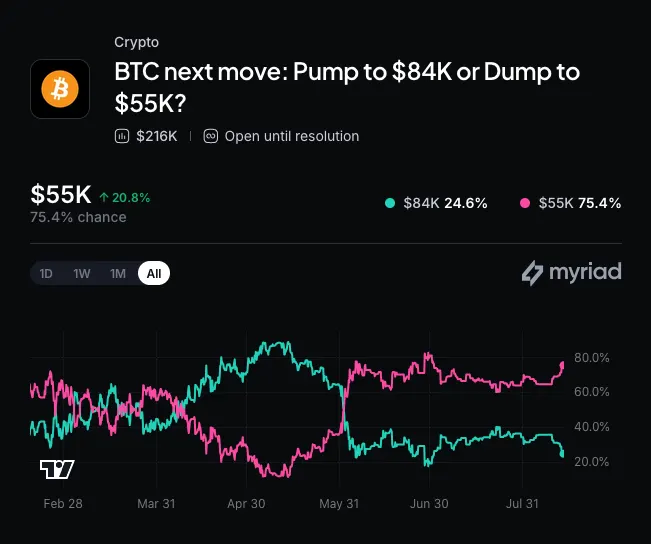
    Users of Myriad, a prediction market owned by Decrypt’s parent company Dastan, turned bearish on Bitcoin’s outlook, putting a 56% chance on its next move taking it to $55,000, up 10% on the day.

    Experts continue to expect heightened volatility and a potential choppy price action in the near term, with a potential relief rally in the mid-term, contingent on easing macro and geopolitical pressures.

    “Thin weekend volume raises odds of a quick liquidity sweep lower toward $67,000 to $68,000 support first,” Adziima explained.

    From a macro perspective, Myriad users assign a 66% chance that oil’s next move could see it rally to $120, underscoring the uncertain geopolitical landscape.

    Daily Debrief Newsletter

    Start every day with the top news stories right now, plus original features, a podcast, videos and more.
  • Morning Minute: Fannie Mae Accepts Crypto for Mortgages

    Morning Minute: Fannie Mae Accepts Crypto for Mortgages

    Morning Minute is a daily newsletter written by Tyler Warner. The analysis and opinions expressed are his own and do not necessarily reflect those of Decrypt. And check out our new daily news show covering all of the top stories in 5 minutes or less, downloadable on Apple Pod or Spotify.

    GM!

    Today’s top news:

    • Crypto majors fall hard overnight on escalating war+oil concerns; BTC -4% at $66.6k
    • Fannie Mae to accept crypto collateral for mortgages w/ help from Coinbase
    • Mara sold $1.1B in Bitcoin as it pivots to AI, still holds $2.75B worth
    • Tether selects KPMG for its first official audit
    • Strategy CEO reveals that retail investors prefer STRC over MSTR

    🌎 Bitcoin Falls Ahead of Iran War “Final Blow”

    BTC fell below $67,000 overnight after Axios reported the Pentagon is actively preparing plans for a “final blow” in Iran, including ground forces and a massive bombing campaign.

    Trump posted on Truth Social that he’s extending the military pause to 10 days, citing ongoing diplomatic talks that are “going very well,” which led to a brief rebound in prices before the deeper selloff overnight.

    Now the week closes with three convergent events in a 24-hour window: a $15B options expiry on Deribit Friday morning at 8am UTC, PCE inflation data, and the expiration of Trump’s original diplomatic window.

    It’s going to be a rocky Friday.

    Key Details:

    • Bitcoin dipped to $67K Friday morning, with ETH sub-$2k; Oil +3% to $97
    • Trump posted on Truth Social extending the strike pause to 10 days, citing an Iranian government request and talks “going very well”
    • $15B in BTC options expire Friday at 8am UTC on Deribit, along with PCE data

    🏠 Fannie Mae Just Accepted Crypto as Mortgage Collateral

    The $12 trillion US residential mortgage market just formally recognized Bitcoin as a legitimate asset.

    Coinbase and Better Home & Finance launched the first Fannie Mae-conforming mortgage that lets borrowers pledge BTC or USDC as down payment collateral instead of selling.

    The primary mortgage is a standard conforming loan with all of Fannie Mae’s usual protections. Where crypto comes in is via a separate, overcollateralized loan that covers the down payment. And it has no margin calls and no forced selling on price drops.

    Here’s an example of how it works: On a $500,000 home requiring a $100,000 down payment, the buyer can pledge $250,000 in BTC to Coinbase Prime custody, receive a $100,000 loan against that collateral, use it as the down payment on a conventional $400,000 Fannie Mae mortgage. Note that the interest rates are 0.5% to 1% higher than standard.

    The Bitcoin stays intact (no sale, no taxable event) and is returned once the loan is repaid or refinanced.

    Liquidation triggers only on a 60-day payment delinquency, same as any mortgage.

    Key Details:

    • Coinbase and Better launched the first Fannie Mae-conforming crypto-backed mortgage; borrowers pledge BTC or USDC as collateral for a separate down payment loan without selling their assets
    • The structure: two loans: a standard Fannie Mae primary mortgage plus a separate overcollateralized crypto-backed loan to fund the down payment; Fannie buys the primary loan just like any conforming mortgage
    • No margin calls: if BTC drops, mortgage terms are unchanged; liquidation only triggers on 60-day payment delinquency, same as conventional mortgages
    • Rates run 0.5-1.5% higher than a standard 30-year; cold wallets excluded; collateral must be held on a US-regulated exchange (Coinbase)
    • Better CEO Vishal Garg estimates the company missed “$40 billion more of consumer demand over the past few years” without this product; 41% of American families lack the cash for a down payment despite holding other assets

    ⛏️ MARA Sold $1.1B in Bitcoin

    Bitcoin miner turned AI infrastructure player MARA sold 15,133 BTC between March 4 and March 25 for approximately $1.1B.

    The company used those proceeds to buy back roughly $1B of its own convertible notes at a 9% discount, capturing approximately $88 million in value in the process.

    The concerns here from Bitcoin enthusiasts are twofold:

    • Mara has another $2.75B in Bitcoin (38,689 BTC), still the second-largest public corporate Bitcoin holder behind Strategy’s 762,099 BTC.
    • Many other miners have also pivoted to AI data centers and infra strategies over the last year – and they may become sellers as well

    Key Details:

    • MARA sold 15,133 BTC between March 4 and March 25 for ~$1.1B; proceeds used to retire ~$1B in convertible notes
    • BTC holdings drop from 53,822 to ~38,689 BTC; MARA remains the second-largest public corporate holder behind Strategy
    • MARA stock jumped 10% in premarket Thursday

    🔒 Crypto Got Its Green Light, Privacy Developers Did Not

    Coin Center says crypto privacy tool developers are in a “very bad state” despite the most pro-crypto administration in US history.

    The DOJ continues to actively prosecute Tornado Cash developer Roman Storm and the Samourai Wallet developers as unlicensed money transmitters, despite the Trump administration dropping enforcement actions against exchanges and rolling back Biden-era crypto policy across the board.

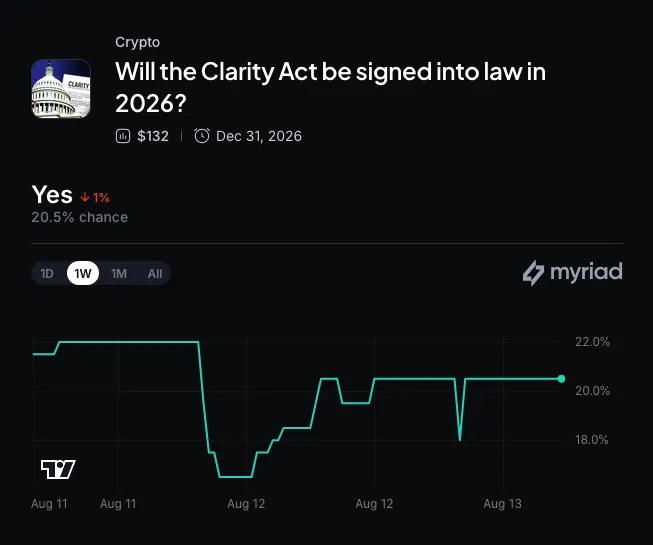
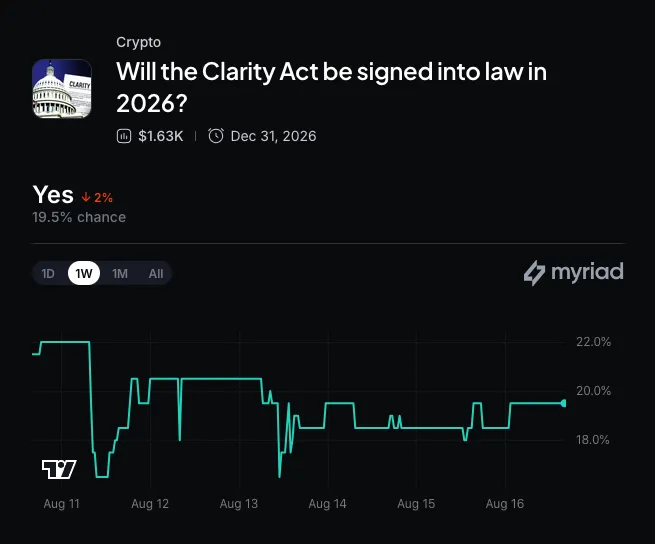
    The House version of the Clarity Act included explicit developer protections that would have prevented exactly this. The Senate let them die.

    If the Clarity Act passes without those developer shields, the message to anyone building privacy infrastructure in the US is clear: proceed at your own risk.

    Key Details:

    • Coin Center says crypto privacy developers are in a “very bad state” despite the most pro-crypto administration in US history
    • DOJ continues prosecuting Tornado Cash developer Roman Storm and Samourai Wallet developers as unlicensed money transmitters — cases that predate Trump but have not been dropped
    • Coin Center’s argument: treating software publication as financial crime creates chilling uncertainty for US open-source development and drives builders offshore

    ₿ Retail Is Choosing STRC Over MSTR

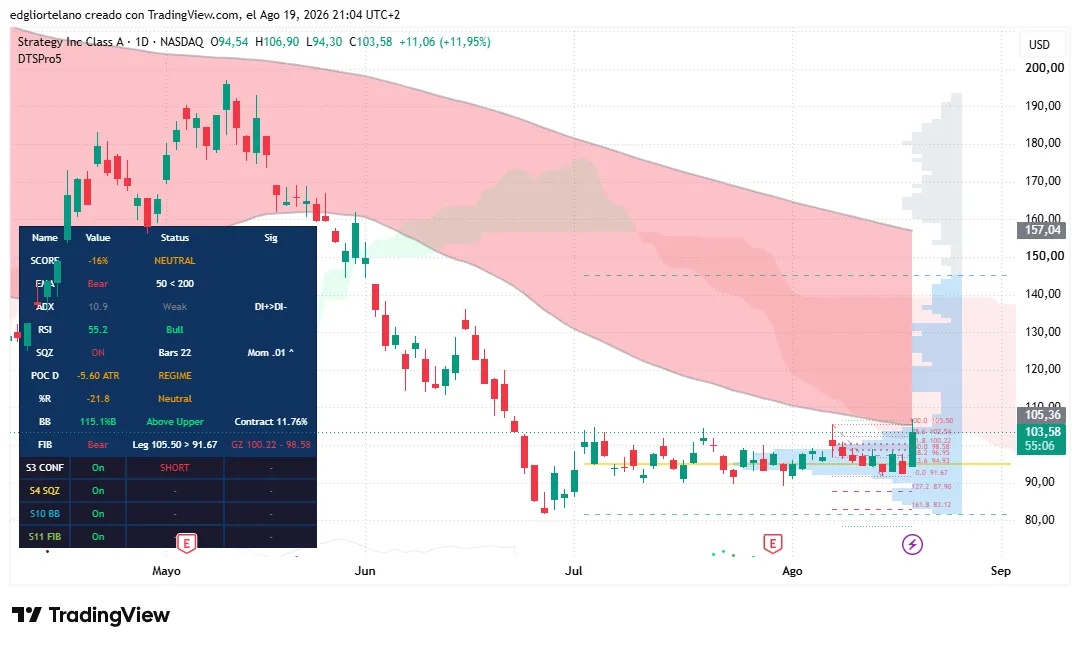
    Strategy’s CEO revealed Thursday that retail investors own 80% of STRC versus 40% of MSTR common stock.

    At a $5B market cap, that’s $4 billion of retail capital in the 11.5% annual dividend product engineered to trade near its $100 par value. Strategy has raised $1.5B via STRC just this month.

    The product is available on Robinhood, Kraken, and Webull, common platforms for retail investors. Benchmark-StoneX analyst Mark Palmer said this makes sense from a risk-adjusted lens because Institutions tend to prefer MSTR’s liquidity and asymmetric upside, while retail investors are accustomed to thinking about yield.

    STRC fits that mental model. And notably, the product is starting to show up on other Bitcoin treasury firms’ balance sheets as a reserve asset – so it’s not just a consumer product.

    Key Details:

      • Strategy CEO revealed 80% of STRC is owned by retail vs. 40% of MSTR; at $5B market cap, retail holds ~$4B in the dividend product
      • MSTR is down 56% over the past six months to $134; STRC holds near $100 par and pays 11.5% annually (~$0.9583/share monthly)
      • Strategy has raised $1.5B+ via STRC this month alone – its fastest issuance pace since the product’s $2.5B public debut last July

    🌎 Macro Crypto and Markets

    • Crypto majors are red again as war, energy concerns escalate; BTC -4% at $66.6k; ETH -4% at $1,990; SOL -5% at $83; HYPE -2% at $38.40
    • M (+4%), STABLE (+4%) and CC (+4%) led top movers
    • Oil +3% at $97; Gold -1% at $4,410
    • David Sacks stepped down as White House AI and crypto czar after hitting the 130-day limit for special government employees; he will stay involved as co-chair of the Science Council alongside Zuckerberg, Huang, and Andreessen
    • Tether named KPMG as the auditor for its first-ever full independent audit of USDT’s $184B in reserves; the company also engaged PwC to prep its internal systems for the processOKX said it won’t rush a US IPO, with CMO Haider Rafique telling the Digital Asset Summit “we will go public when we have confidence that we can give back shareholder value”

    Corporate Treasuries & ETFs

    Meme Coin Tracker

    • Meme majors were mostly red; DOGE -2%, SHIB -3%, PEPE -4%, TRUMP -4%, PENGU -5%, SPX -4%, FARTCOIN -3%
    • Either (+72%), Hachi (+50%) and Wojak (+20%) led top movers

    💰 Token, Airdrop & Protocol Tracker

    • X Money hired Benji Taylor as its new crypto-savvy design lead, former CPO at Aave Labs and design head at Coinbase’s Base
    • Ripple is rolling out AI-assisted red team security testing across the XRP Ledger

    🚚 What is happening in NFTs?

    • NFT leaders were mostly red; Punks -1% at 29 ETH, Pudgy -1% at 4.1 ETH, BAYC even at 5.25 ETH; Hypurr’s even at 409 HYPE
    • Pixel Pups (+35%) led notable movers

    Daily Debrief Newsletter

    Start every day with the top news stories right now, plus original features, a podcast, videos and more.

  • First Sora, Now Sexy Chat? OpenAI Cancels Erotic ChatGPT Mode

    First Sora, Now Sexy Chat? OpenAI Cancels Erotic ChatGPT Mode

    In brief

    • OpenAI has reportedly halted plans to release an adult mode in ChatGPT.
    • The move follows earlier promises to allow verified adults access to more content features.
    • The reported move comes the same week that OpenAI canceled its Sora text-to-video generator.

    OpenAI has shelved plans to launch its previously announced erotic chatbot, according to a report, apparently backing away from a controversial expansion of ChatGPT that would have allowed adult users to generate sexual content.

    The reversal, first reported by the Financial Times on Thursday, follows internal concerns about the societal impact of sexualized artificial intelligence. In January, members of OpenAI’s Expert Council on Well-Being and AI reportedly warned that erotic chat features could foster unhealthy emotional dependency among users, and risk turning the chatbot into what one member described as a “sexy suicide coach.”

    OpenAI declined Decrypt’s request to comment on the status of the erotic mode, and the firm has yet to post about its fate.

    The decision to cancel what was reportedly to be called “Citron mode” comes two days after OpenAI canceled its Sora text-to-video model, as the company moves to focus development on a unified AI platform rather than a collection of specialized tools.

    The move marks a departure from the direction outlined by CEO Sam Altman as recently as October. At the time, Altman said OpenAI planned to allow verified adults to access romantic and erotic content once a robust age-verification system was in place.

    Altman described the idea as part of a broader effort to treat adult users with greater autonomy while maintaining safeguards for minors. By December, however, the timeline was pushed to 2026 as the company continued to refine its age-estimation technology.

    While OpenAI may be getting out of the adult chatbot business before it ever really got into it, AI models do not necessarily need an “erotic mode” for users to form connections with them.

    When OpenAI deprecated GPT-4o last summer, users flooded social media with calls to restore the model after saying they had formed personal and emotional relationships with the chatbot, reflecting a broader debate around erotic chatbots and how people interact with AI.

    In June, research published by researchers at Waseda University in Tokyo said 75% of participants reported turning to AI systems for emotional advice.

    At the same time, AI developers are facing growing scrutiny as lawsuits test whether conversational AI systems are responsible for reinforcing delusional beliefs or harmful behavior among vulnerable users.

    Daily Debrief Newsletter

    Start every day with the top news stories right now, plus original features, a podcast, videos and more.
  • Trump Policy Has Crypto Privacy Developers in a ‘Very Bad State’, Says Coin Center

    Trump Policy Has Crypto Privacy Developers in a ‘Very Bad State’, Says Coin Center

    For over a year now, the White House has made strong efforts to court the crypto industry, rolling out permissive regulations that have turbocharged the sector’s integration with the U.S. economy.  

    But there’s one issue that still keeps some crypto industry leaders up at night, despite the Donald Trump administration’s many promises on the subject: protections for software developers. 

    Last year, the Trump Justice Department made multiple commitments to stop prosecuting the developers of crypto privacy software—the types of tools used to keep crypto transactions anonymous. And yet, months later, federal prosecutors sent two Bitcoin developers to prison for creating such software—and took another Ethereum developer to trial for creating similar tools. 

    The Ethereum developer, Roman Storm, was convicted on one charge and acquitted on two others. But earlier this month, the Trump DOJ filed to try him on those two charges again. 

    Those developments had crypto privacy advocates in a grim enough mood. But on Wednesday, a federal judge in Texas handed down a decision that some feel could bode even more poorly. The judge dismissed a lawsuit against the DOJ brought by a software developer, Michael Lewellen, who said he feared being prosecuted by the U.S. government for creating his own privacy tool. The judge ruled that because the Trump DOJ has said it doesn’t plan to prosecute crypto developers, the man had no standing to claim “a credible threat of prosecution.”

    The ruling has Peter Van Valkenburgh, executive director of the crypto advocacy group Coin Center, very worried. By making statements in support of software developers, but still going after some of them anyway, the Trump DOJ appears to have now stuck policy leaders like him between a rock and a hard place.

    “They can effectively go after developers when they want to go after them, and then claim to be pro-developer when they want to claim to be pro-developer,” Van Valkenburgh, who leads Washington’s longest running crypto policy think tank, told Decrypt. Coin Center was financially supporting Lewellen’s lawsuit.

    In yesterday’s ruling, Judge Reed O’Connor determined that the “core conduct” of the crypto developers thus far prosecuted by the Trump DOJ was money laundering—whereas, in yesterday’s case, plaintiff Michael Lewellen asserted he planned to run a proper, upstanding business. Because Lewellen had no intention to launder money, he should not fear an impending prosecution, O’Connor decided. 

    That particular conclusion particularly irked Van Valkenburgh, who maintains crypto developers—including those targeted by the Trump DOJ—should not be responsible for policing who ends up using their software. 

    “Michael wants to build good tools that can be used for privacy,” he said. “It is very plausible that those tools will be used for money laundering, and that then somebody will come and prosecute him.”

    Prosecutions against the developers of crypto privacy tools didn’t start under Trump. They trace back to the Joe Biden administration, which was roundly criticized by industry leaders for numerous crypto-skeptical policies. But while the current White House has taken a far friendlier tack towards digital assets, and even—theoretically—software developers, Van Valkenburgh worries the DOJ’s apparent lack of consistency on the issue might have put his priorities in a worse spot. 

    “Short term, pragmatically, maybe developers are a little safer now,” he said. “But that very same deprioritization is now making it harder for someone like Michael Llewellyn to get binding legal clarity.”

    “That’s a very bad state of the world right now,” Van Valkenburgh said.

    Daily Debrief Newsletter

    Start every day with the top news stories right now, plus original features, a podcast, videos and more.
  • Venture Firm Founder Offers Bounty to Help Recover $42 Million in Stolen Bitcoin, Crypto

    Venture Firm Founder Offers Bounty to Help Recover $42 Million in Stolen Bitcoin, Crypto

    In brief

    • Bo Shen, founder of Fenbushi Capital, is offering a 10-20% bounty to those who can help him recover a portion of $42 million that was stolen from him in 2022.
    • The theft was allegedly due to a compromised seed phrase, leading to the loss of around $38 million in stablecoins in addition to Bitcoin and Ethereum.
    • The venture founder believes new on-chain tooling and AI can help crack the case.

    Bo Shen, the founder of crypto venture firm Fenbushi, is offering a bounty of 10-20% to any individuals able to help him recover a portion of the $42 million in Bitcoin, Ethereum, and stablecoins stolen from his personal wallet in 2022. 

    The malicious actor made off with crypto assets now valued around $42 million, highlighted by $38 million in Circle’s dollar-backed stablecoin USDC, but also 1,607 Ethereum, nearly $720,000 in Tether’s stablecoin USDT, and 4.13 Bitcoin. 

    “Three years have passed. The investigation has never stopped,” said Shen in a post on X. “Our team has continued to gather critical evidence and leads. The flow of the stolen assets is becoming increasingly clear,” he added while making a public bounty offer. 

    “Any individual or organization that makes a substantive contribution to asset recovery—regardless of identity, background, or method—will receive 10%–20% of the total recovered amount, based on the level of contribution,” he added.

    About $1.2 million of the funds have been frozen to date thanks to help from notable on-chain analyst Taylor Monahan and pseudonymous sleuth ZachXBT. 

    Now, though, Shen thinks the advances in on-chain tooling and artificial intelligence (AI) can help do even more in the case. 

    “This is not just about recovering assets,” he said. “It is about opening a real case to the community, inviting collaboration, and seeing how far the tools of the AI era can push what was once impossible.” 

    The theft from Shen’s personal wallet took place in November 2022, allegedly as a result of a compromise of his seed phrase, the 12 or 24 word phrase that unlocks a wallet’s private key,  according to analysis by blockchain security firm SlowMist.

    Shortly after the theft, it was reported to local law enforcement, according to Shen, with the FBI and lawyers also involved. 

    Established in 2015, Shen’s Fenbushi Capital says it has more than $1.6 billion in assets under management. Its portfolio includes major crypto firms like exchange Bybit and stablecoin issuer Circle, alongside holdings of Ethereum and Zcash

    Daily Debrief Newsletter

    Start every day with the top news stories right now, plus original features, a podcast, videos and more.

  • Wikipedia Bans AI-Generated Text in Articles Under New Editing Policy

    Wikipedia Bans AI-Generated Text in Articles Under New Editing Policy

    In brief

    • Wikipedia now prohibits editors from using large language models to generate or rewrite article content.
    • The policy still allows limited AI-assisted copyediting if editors review the changes and no new content is introduced.
    • The rule reflects growing concerns about hallucinations, fabricated sources, and accuracy in AI-generated text.

    Wikipedia editors have moved to restrict how artificial intelligence can be used on the platform, in a recent policy update banning the use of large language models to write or rewrite articles.

    The new guideline reflects growing concern within the Wikipedia community that AI-generated text can conflict with the platform’s standards, particularly around verifiability and reliable sourcing.

    “Text generated by large language models often violates several of Wikipedia’s core content policies,” the policy update reads. “For this reason, the use of LLMs to generate or rewrite article content is prohibited, save for the exceptions given below.”

    The policy still allows limited use of AI tools, including suggesting basic copy edits to an editor’s own writing, provided the system does not introduce new information. However, editors are advised to review those suggestions carefully.

    While the new policy does not mention penalties for using AI-generated content, according to Wikipedia’s guidelines around disclosure, repeating misuse forms a “pattern of disruptive editing,” and may lead to a block or ban. Wikipedia does give editors a path to reinstate their accounts following an appeal process.

    “Blocks can be reversed with the agreement of the blocking admin, an override by other admins in the case that the block was clearly unjustifiable, or (in very rare cases) on appeal to the Arbitration Committee,” Wikipedia said.

    “The Wikimedia Foundation does not determine editorial policies and guidelines on Wikipedia; volunteer editors do,” a Wikimedia Foundation spokesperson told Decrypt. “Wikipedia’s strength has been and always will be its human-centered, volunteer-driven model.”

    According to Emily M. Bender, a professor of linguistics at the University of Washington, some uses of language models in editing tools may be reasonable, but drawing a clear boundary between editing and generating text can be difficult.

    “So one of the things that you can do with a language model is build a very good spell checker, for example,” Bender told Decrypt. “I think it’s reasonable to say it’s fine to run a spell checker over edits. And if you are doing the next level up, a grammar checker, that can also be fine.”

    Bender said the challenge comes when systems move beyond correcting grammar and begin altering or generating content, noting that large language models lack the kind of accountability that human contributors bring to collaborative knowledge projects.

    “Using large language models to produce synthetic text, it is a fundamental property of these systems that there is no accountability, no connection to what someone believes or stands behind,” she said. “When we speak, we speak based on what we believe and what we are accountable for, not based on some objective notion of truth. And that’s not there for large language models.”

    Bender said widespread use of AI-generated edits could also affect the site’s reputation.

    “If people are instead taking shortcuts and making something that looks like a Wikipedia edit or article and putting it there, then that degrades the overall value and reputation of the site,” she said.

    Joseph Reagle, associate professor of communication studies at Northeastern University, who studies Wikipedia’s culture and governance, said the community’s response reflects longstanding concerns about accuracy and sourcing.

    “Wikipedia is wary of AI generated prose,” Reagle told Decrypt. “They take the accurate characterizations of what reliable sources state about a topic seriously. AI has had serious limitations on that front, such as ‘hallucinated’ claims and fabricated sources.”

    Reagle said Wikipedia’s core policies also shape how editors view AI tools, noting that many large language models have been trained on Wikipedia content. In October, the Wikimedia Foundation said human visits to Wikipedia fell about 8% year over year as search engines and chatbots increasingly provide answers directly on their platforms, rather than sending users to the site.

    In January, the Wikimedia Foundation announced agreements with AI companies, including Microsoft, Google, Amazon, and Meta, allowing them to use Wikipedia material through its Enterprise product, a commercial service designed for large-scale reuse of its content.

    “While the use of Wikipedia content is permitted by Wikipedia’s licenses, there’s still some antipathy among Wikipedians about services that appropriate the content of communities and then place unwanted demands on those communities to deal with the consequent glut of AI slop,” Reagle said.

    Despite the prohibition on using LLMs, Wikipedia does permit AI tools to translate articles from other language editions into English, provided editors verify the original text. The policy also warns editors not to rely on writing style alone to identify AI-generated content and instead focus on whether the material complies with Wikipedia’s core policies and the contributor’s editing history.

    “Some editors may have similar writing styles to LLMs,” the update says. “More evidence than just stylistic or linguistic signs is needed to justify sanctions, and it is best to consider the text’s compliance with core content policies and recent edits by the editor in question.”

    Editor’s note: This article was updated after publication to include comment from the Wikipedia Foundation.

    Daily Debrief Newsletter

    Start every day with the top news stories right now, plus original features, a podcast, videos and more.
  • Retail Investors Growing Exposed to Bitcoin Giant Strategy’s STRC Over MSTR, Says CEO

    Retail Investors Growing Exposed to Bitcoin Giant Strategy’s STRC Over MSTR, Says CEO

    In brief

    • Strategy CEO Phong Le signaled that Strategy’s common stock is taking a backseat relative to its flagship preferred share among retail investors.
    • Benchmark-StoneX’s Mark Palmer said that makes sense, describing STRC as an investment that dovetails with individuals’ accustomed thinking.
    • On a notional basis, the value of common stock held by retail investors still outweighs allocations among individuals to the dividend-paying product.

    Strategy CEO Phong Le signaled on Thursday that retail investors are becoming increasingly interested in the Bitcoin-buying firm’s flagship preferred share relative to its common stock, highlighting who is exposed to the company’s shift in fundraising efforts.

    Although individuals currently hold approximately 40% of the company’s ordinary shares, Lee noted in a post on X that they presently make up around 80% of those invested in STRC. Strategy started pitching the shares alongside its $2.5 billion debut last year.

    At a market cap of $5 billion, Lee suggested that STRC’s popularity among retail investors indicates that they “prefer low-volatility, high-yield digital credit.” The assessment comes as Strategy’s common stock (MSTR) price has plunged 56% over the past six months to $134.

    Not long after STRC debuted in July, Strategy Executive Chairman and co-founder Michael Saylor said the product that currently pays 11.5% in dividends annually could be interesting for a “whole new class of people.” Those remarks focused on investors like retirees, yet the product has also started showing up on its Bitcoin-buying peers’ balance sheets.

    Platforms common among retail investors have expanded access to STRC, which trades on the Nasdaq, including Robinhood, Kraken, and Webull. At 80% of STRC’s market cap, Lee indicated that retail investors hold $4 billion worth of the dividend-paying product.

    On a notional basis, that’s still less than the value of common shares that Lee said retail investors hold. A 40% slice of Strategy’s $46.3 billion market cap is currently $18.5 billion.

    The notion that Strategy’s common stock is losing preference among retail investors makes sense when viewed through a risk-adjusted lens, according to Mark Palmer, an equity research analyst at investment banking firm Benchmark-StoneX.

    “The company’s common stock offers theoretically unbounded upside, but it is essentially a leveraged, non-yielding Bitcoin proxy and therefore better suited for sophisticated, risk-tolerant investors,” he told Decrypt. “STRC offers a predictable return through its high-yield, low-volatility, and significant Bitcoin overcollateralization that limits downside, and as such it maps better to how most retail investors are accustomed to thinking about income-generating assets.”

    Analysts at Benchmark, who have penciled in a year-end price target of $705 for Strategy, are among the Bitcoin-buying firm’s most bullish on Wall Street. Analysts at TD Cowen, for example, pared their price target to $500 from $440 earlier this year.

    The investment bank’s managing director of equity research, Lance Vitzana, recently told Decrypt that STRC’s uptick in issuance followed Strategy’s annual conference in Las Vegas last month. He noted that STRC was marketed aggressively during the two-day confab.

    So far this month, Strategy has raised more than $1.5 billion via the dividend-paying product, which is engineered to trade at near its $100 par value. That represents around 33% of the product’s market cap, including its multi-billion-dollar public offering.

    When the preferred share trades above that threshold, Strategy issues more shares to grow its Bitcoin stockpile. If the product lingers below, then the firm has indicated that it will hike the dividend in an effort to increase demand and lift STRC back towards its target.

    Even though institutional investors are allocating to STRC, Palmer said that group is unlikely to displace demand from individuals. That’s because institutions tend to prefer the relative liquidity of Strategy’s common equity and asymmetric risk-reward profile, he said.

    “In that sense, STRC is carving out a distinct investor base rather than competing directly with Strategy’s common stock,” Palmer added. “Importantly, this dynamic strengthens Strategy’s ability to raise capital for bitcoin accumulation, as STRC effectively expands the company’s addressable investor base.”

    Daily Debrief Newsletter

    Start every day with the top news stories right now, plus original features, a podcast, videos and more.

  • XRP Falls to 2-Week Low as Ripple Deploys AI to Boost Ledger Security

    XRP Falls to 2-Week Low as Ripple Deploys AI to Boost Ledger Security

    Ripple has unveiled a comprehensive AI-powered security overhaul for the XRP Ledger, deploying automated testing tools and establishing a dedicated red team that it said has already uncovered more than 10 bugs in the blockchain’s codebase.

    The company outlined its new strategy on Thursday, detailing how AI tools will be integrated across the XRP Ledger development lifecycle, including adversarial code scanning on every pull request and automated stress testing.

    The AI-assisted red team focuses on analyzing how features interact in real-world scenarios, particularly at boundaries where legacy code meets new functionality.

    Ripple said the next XRP Ledger software release will be dedicated entirely to bug fixes and improvements without introducing new features, signaling a shift toward prioritizing security over rapid feature deployment. The company also plans to require multiple independent security audits for significant protocol changes and is expanding its bug bounty program.

    “XRPL has proven its reliability over more than a decade of operation. Our responsibility now is to ensure the ledger continues to meet the demands of global payments, tokenized assets, and institutional-grade financial infrastructure,” the blog post reads. “We will evolve XRPL by systematically strengthening the foundation it is built on.”

    XRP was recently trading at $1.34, down 5% on the day amid a broader crypto market dip on Thursday. Stock prices are also tumbling amid uncertainty around the Iran conflict.

    At that price, XRP is at its lowest price in more than two weeks, per data from CoinGecko. XRP set a new all-time high price of $3.65 last July, but has fallen 63% since.

    Daily Debrief Newsletter

    Start every day with the top news stories right now, plus original features, a podcast, videos and more.