Payward, the parent company of crypto exchange Kraken, is buying Saldo Bank, an EU-licensed lender based in Lithuania, the Financial Times reported.
Co-CEO Arjun Sethi said customers will be able to borrow and lend against their assets without selling them, in an undisclosed deal expected to close in 2027.
The deal comes as a U.S. community bank lobby sues the federal bank regulator over the trust charters it has granted to crypto firms.
Payward, the parent company of crypto exchange Kraken, is buying Lithuania-based Saldo Bank as it expands into lending and card issuing, the Financial Timesreported on Wednesday.
Payward is the first digital asset company to buy a bank in Europe, according to the FT. Saldo received its EU banking license in 2021 and offers consumer and business loans as well as term deposits. The price was not disclosed.
“One of the biggest things that our customers have been asking us is ‘I would like to get products and services and offerings similar to what I get with another bank,’” Payward co-CEO Arjun Sethi told the FT.
Sethi said the plan is to bring cash, crypto, tokenized stocks and credit together in a single system, so customers can borrow and lend against their assets without selling them.
The Wyoming-based company, founded in 2011, applied in May for a national trust company charter from the U.S. Office of the Comptroller of the Currency, the federal bank regulator. Coinbase and Ripple are among the crypto firms that have received conditional approval for such charters, which let them hold customers’ assets and provide transaction services but not take deposits.
This month, the Independent Community Bankers of America sued the OCC, arguing that granting such charters to crypto firms exceeds the regulator’s authority. “Any non-fiduciary firm seeking the benefits of a federal bank charter should meet the same standards as community banks,” ICBA President and CEO Rebecca Romero Rainey said in a statement. An OCC spokesperson declined to comment.
The bank deal follows Payward’s $550 million acquisition of derivatives exchange Bitnomial in April and its $600 million purchase of Asian stablecoin payments firm Reap Technologies in May. Kraken filed confidentially for an IPO last November, but has since pushed the listing back to the second quarter of 2027 at the earliest, CoinDeskreported in September, citing people familiar with the matter.
The Saldo acquisition is subject to regulatory approvals and is expected to close in 2027.
Daily Debrief Newsletter
Start every day with the top news stories right now, plus original features, a podcast, videos and more.
A wallet holding 4,581.94 BTC sent its full balance, worth about $377 million, to five new addresses on Oct. 12 in a single transaction that paid a fee of 732 sats.
The coins arrived in March 2020, when they were worth roughly $40.5 million.
The address received 22 dust deposits since 2020, including 600 sats on Jan. 28, 2025 from a look-alike address matching its first three and last four characters.
A Bitcoin wallet that has held 4,581.94 BTC since March 2020 sent its entire balance to five new addresses on Oct. 12, moving about $377 million in a single transaction, according to blockchain data. The transfer confirmed in block 971,126 at about 18:37 UTC, with Bitcoin trading around $82,350.
Four of the receiving addresses got exactly 1,000 BTC each, and the fifth received 581.94 BTC. The transaction paid a fee of 732 satoshis, the hundred-millionth-of-a-bitcoin units known as sats, or about 60 cents. As of block 971,279 on Oct. 13, none of the five addresses has spent anything, and it is unclear who controls the wallet or where the coins are going.
The wallet received its coins on March 3, 2020, in a transaction that split a 5,081.95 BTC balance three ways, with 250 BTC going to each of two other addresses. At roughly $8,830 per Bitcoin, the 4,581.95 BTC that landed in the wallet was worth about $40.5 million. The value of the Bitcoin has nearly increased by 10X since then.
The wallet is an example of patience. The coins have sat through several market shocks since they arrived, starting with the COVID-19 crisis, which started shortly after the wallet got funded. During that time the stash went from about $40.5 million to about $17.6 million.
Tesla’s suspension of Bitcoin payments and China’s mining crackdown followed in May 2021, tanking the wallet from about $291 million at its April peak to $131 million by June. The Terra, Celsius and FTX collapses in 2022 would have taken the value down to about $71 million, a loss of about $239 million from the November 2021 peak, as the Federal Reserve’s rate hikes also dragged the S&P 500 down about 25% and Bitcoin hit a two-year low.
Trump’s tariff shock cut also crashed the markets. Bitcoin has since fallen 54% from a record $124,728 to $57,735 before recovering to its current price. The wallet’s value dropped from $571.5 million to about $265 million during that dip, but overall, hodling has resulted in almost 10X of net gains since day 1.
BitcoinBTC · USD
$81,989−1.23%
Oct 7Oct 9Oct 11Oct 12Oct 14
$84.2k$83.1k$81.9k$80.7k
24h HighHigh$84,025
24h LowLow$82,294
VolVol$1.3B
Market projectionsOdds by Myriad
→
The address has also collected dust, meaning transfers of a few hundred to a few thousand sats that cost almost nothing to send. Blockchain data shows 22 such deposits between August 2020 and May 2026, ranging from 546 to 6,953 sats, or less than $6 each at current prices. Sixteen arrived in batch transactions that paid out to between 87 and 610 addresses at once.
One deposit matches the pattern of address poisoning, in which an attacker generates an address that copies the first and last characters of a real one, hoping someone later copies it from a transaction history by mistake. On Jan. 28, 2025, an address beginning 18VpNbPc and ending pQ9x sent the wallet 600 sats, and it shares the first three and last four characters with the whale’s address.
The look-alike was funded in a Nov. 12, 2024 transaction that paid out to 1,401 outputs at once, and it was emptied after sending that one payment. Every other sender used a bc1 address, which looks nothing like the wallet’s legacy 18 address.
That said, this is not the first time dormant wallets move their coins. Back in July 2025, an entity moved 80,000 BTC that had sat for 14 years, worth $8.6 billion, the biggest daily movement of coins aged 10 years or more. Ten days later a Satoshi-era wallet sent 40,009 BTC, about $4.7 billion, to Galaxy, which later said it had executed a sale worth roughly $9 billion for a Satoshi-era client.
As of Oct. 13, the original address holds 23,288 sats in leftover dust, about $19, while the five receiving addresses hold the full 4,581.94 BTC.
Daily Debrief Newsletter
Start every day with the top news stories right now, plus original features, a podcast, videos and more.
Binance will discontinue Binance Pool, Pool Savings, Cloud Mining, Transaction Accelerator and related features at 07:00 UTC on Nov. 10.
Miners must point their hardware to another pool before the cutoff, and Pool Savings users must redeem their positions before the service ends.
The closure follows Binance’s July shutdown of its exchange NFT service and its June push into U.S. stocks and tokenized equities.
Binance will shut down its mining pool and several related services on Nov. 10, the exchange said in an announcement published Tuesday. The closure covers Binance Pool, Pool Savings, Cloud Mining, and Transaction Accelerator, along with Telegram hashrate alerts, email notifications, and the pool’s API.
“As part of our ongoing review of products and services, Binance will discontinue Binance Pool and related services on 2026-11-10,” Binance wrote. “All Binance Pool-related services will be discontinued. Binance Pool will begin disconnecting mining connections, and Binance Mining Pool Stratum URLs and mining endpoints will be disabled. Hashrate submissions and mining shares submitted after this time will no longer be accepted, processed, or credited.”
A mining pool combines the computing power of many miners and splits block rewards among them based on the work each one contributes. Cloud Mining let users buy hashrate, a slice of mining power, without owning any hardware, while Transaction Accelerator helped users push through Bitcoin transactions that were slow to confirm because of low fees or network congestion.
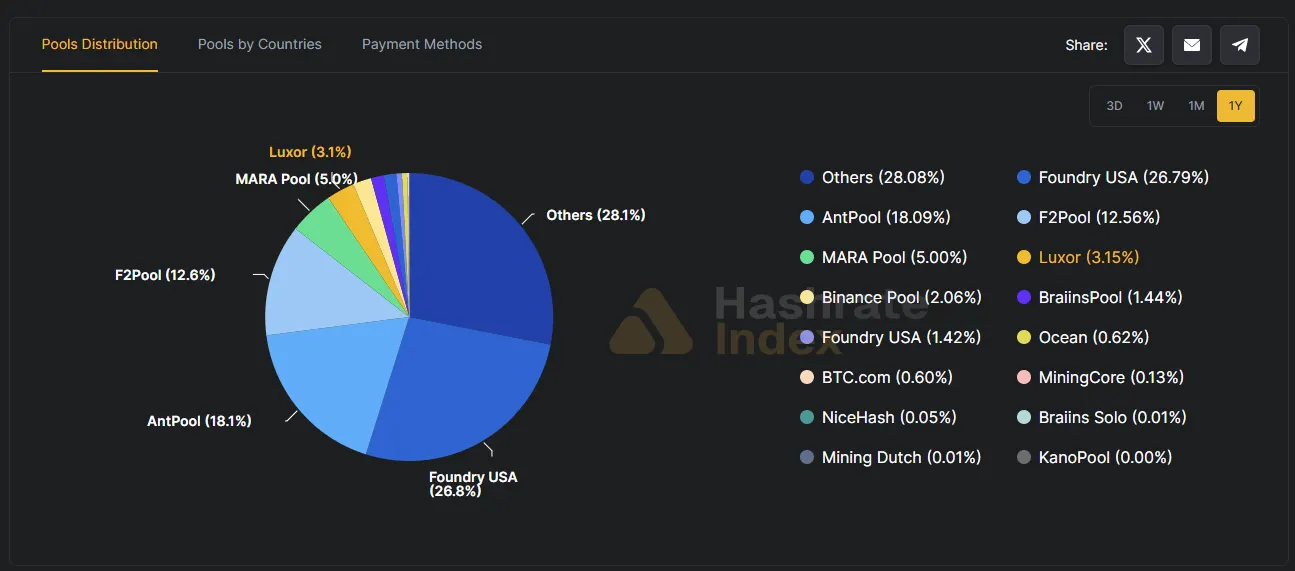
Binance pool launched in April 2020 and ranked ninth among Bitcoin pools at the end of 2025, with about 26 exahashes per second, or 2.3% of the network, according to Hashrate Index. One exahash per second equals a quintillion guesses every second at the puzzle that earns a block.
Image: Hashrate Index
The same report called Binance Pool the last pool still standing from the era when exchanges rushed into mining, with its relevance tied to Binance’s exchange and custody business rather than mining technology.
Seems like Binance, just as Satoshi Nakamoto, wants to move onto other things. The shutdown arrives as Binance expands into traditional finance. On June 1, the exchange opened access to more than 7,000 US stocks and ETFs for customers outside the United States, with zero commission and fractional purchases from $5, according to co-CEO Richard Teng. It also previewed bStocks, a coming feature that lets users mint tokenized versions of the shares they buy on the BNB blockchain.
Quantmap co-founder Ivan Patriki told Decrypt at the time that large exchanges are moving into equities because they no longer want to depend on crypto market cycles. Vytautas Mackonis, COO of RWA protocol ALCUM, told Decrypt the offering is more structurally complex than it appears, with Binance as the interface, Nest Trading as the broker-dealer, and Alpaca Securities as the custodian.
BitcoinBTC · USD
$81,952−1.27%
Oct 7Oct 9Oct 11Oct 12Oct 14
$84.2k$83.1k$81.9k$80.7k
24h HighHigh$84,025
24h LowLow$82,294
VolVol$1.3B
Market projectionsOdds by Myriad
→
Binance also closed its centralized NFT service on July 3, telling users to move their tokens to Binance Wallet, its self-custody wallet. Then-CEO Changpeng Zhao used the phrase “smooth sunsetting of old products” in 2023.
At 07:00 UTC on Nov. 10, Binance Pool will begin disconnecting miners and disable its Stratum URLs, the server addresses miners point their machines at to connect to the pool. Shares, the proofs of work that determine each miner’s payout, will stop being credited after that time, while those submitted earlier count toward final rewards. Binance said eligible outstanding rewards, balances and refunds will be processed afterward, subject to its product rules, account status and compliance checks.
Miners must point their hardware to another pool before the cutoff, and Pool Savings users need to unsubscribe or redeem their positions before the service ends. Binance said the pool will keep operating normally until the cutoff. Anyone expecting a final payout has until 23:59 UTC on Nov. 10 to finish any required identity verification. Binance Pool pages will stay viewable until 07:00 UTC on Nov. 24, after which they become permanently inaccessible.
Daily Debrief Newsletter
Start every day with the top news stories right now, plus original features, a podcast, videos and more.
Character.AI filed for voluntary Chapter 11 bankruptcy in Delaware on October 12 to sell itself under court supervision, and says the app will be wound down if no buyer keeps it running.
Disney is the opening bidder, offering $20 million for a non-exclusive perpetual license to some of the startup’s intellectual property, weeks after hiring its CEO as Disney’s first CTO.
The company pointed users attached to their AI companions toward mental health resources, just two weeks after launching two new chat models and a cheaper $4.99 subscription.
Character.AI, the app where millions of people spend hours chatting with AI versions of fictional heroes and made-up partners, has filed for bankruptcy.
The company announced Monday that it started a voluntary Chapter 11 process, a type of U.S. bankruptcy that lets a company keep operating while a judge supervises how its debts get paid or how its assets get sold. The case was filed in the U.S. Bankruptcy Court for the District of Delaware.
Character.AI isn’t trying to restructure its way back to health. It wants a court-supervised sale of all or substantially all of its assets, and if no bidder agrees to keep the service alive, the company said the platform “will be wound down”—corporate speak for switched off.
Disney Worldwide Services, a unit of the Walt Disney Company, signed on before the filing as the “stalking horse” bidder, according to Character.AI’s press release. In a bankruptcy auction, that is the opening offer that sets a floor every other buyer has to beat.
The media giant is offering $20 million for a non-exclusive, perpetual license to some of Character.AI’s intellectual property and certain legal claims, plus transition services run by former Character.AI employees it has already hired. Non-exclusive means Disney gets to use that tech forever, but so can whoever else ends up buying it, and other bidders can still top the offer.
The company expects the sale to close in late November or early December. Character Technologies Inc., the company’s legal name, estimated both its assets and its liabilities at $50 million to $100 million in its bankruptcy petition.
Three and a half years ago, Andreessen Horowitz led a $150 million funding round that valued Character.AI at $1 billion, with a16z partner Sarah Wang tweeting that “we are at the iPhone moment of AI.” Founded in 2021 by former Google engineers Noam Shazeer and Daniel De Freitas, the app lets anyone build a chatbot with a personality and share it with others.
BitcoinBTC · USD
$82,015−1.2%
Oct 7Oct 9Oct 11Oct 12Oct 14
$84.2k$83.1k$81.9k$80.7k
24h HighHigh$84,025
24h LowLow$82,294
VolVol$1.3B
Market projectionsOdds by Myriad
→
Google came calling in August 2024, rehiring both founders and part of the research team in a roughly $2.7 billion deal that also licensed Character.AI’s technology. Silicon Valley calls this kind of arrangement an acqui-hire, buying the talent without technically buying the company, and Character.AI later largely abandoned building its own large language models, the AI engines that generate the chatbots’ text.
Two months after the Google deal, Florida mother Megan Garcia sued Character.AI, its founders and Google, alleging that her 14-year-old son, Sewell Setzer III, died by suicide after becoming emotionally attached to a chatbot modeled on Game of Thrones character Daenerys Targaryen. More lawsuits from other families followed, and in September 2025 the Federal Trade Commission ordered Character.AI and six other tech companies to explain how they protect minors.
A month later, Character.AI banned users under 18 from open-ended chats with its characters, cutting off its core product for its youngest fans. In January, the company and Google agreed to settle lawsuits brought by families in Florida, Colorado, New York, and Texas.
In September 2025, Disney’s lawyers sent Character.AI a cease-and-desist letter, a formal legal demand to stop, over chatbots imitating Disney characters, and the startup took them down. This past September, Disney named Character.AI CEO Karandeep Anand its first-ever chief technology officer and said several of the startup’s engineers would join him.
Colin Adams, now Character.AI’s CEO, said the company spent the past year trying to sustain the business amid “significant legal, regulatory, and operational headwinds” before the board chose a court-supervised sale.
Besides the legal hurdles, the company was burning too much money without reporting enough revenue, reporting “an operating loss of approximately $8-9 million per month.”
Character AI also struggled to raise more capital, which ended up making the whole operation unsustainable. “Notwithstanding the progress that has been made with regulators and personal injury claimants and enhancements to platform safety, Character has faced challenges in obtaining new investment capital,” Character AI CEO Collin Adams said in a sworn statement.
On September 28, Character.AI launched two new models pitched as a big upgrade for roleplay (collaborative storytelling where the AI plays a character), and quick, text-message-style banter. It also rolled out a cheaper subscription called (c.ai) lite, priced at $4.99 a month or $2.49 a week.
Fourteen days later, the company was in bankruptcy court.
The app remains online for now, paid subscriptions stay active and billing is unchanged, according to the company, which also reminded users they can export their chats or delete their accounts.
Character.AI also linked to a support page for anyone struggling with the news, a tacit admission that for some users the app is not just entertainment. AI companions—chatbots designed to act as friends or partners that remember past conversations—can become a daily emotional anchor for people who talk to them for hours.
The page points users to Koko, a nonprofit offering free, anonymous mini-courses of five to 10 minutes on coping with stress and dark thoughts, and to a directory of free helplines staffed by real people. Its very first suggestion, however, is a conversation with a “supportive AI guide,” which is to say a chatbot to help people cope with losing their chatbots.
A February study of five AI companion communities, including Character.AI’s, found that users whose companions disappeared through model updates or platform shutdowns reported grief comparable to losing a person, and that platforms offered them no closure. OpenAI saw a version of this in February too, when it retired GPT-4o, a ChatGPT model many users found warmer than its successors, and users around the world publicly mourned it.
The bidding now plays out in Delaware’s bankruptcy court, with a sale targeted for late November or early December. If no buyer commits to keeping Character.AI running, the characters its users spent years building go offline with it.
Daily Debrief Newsletter
Start every day with the top news stories right now, plus original features, a podcast, videos and more.
Palantir CTO Shyam Sankar claimed on CBS that many AI researchers have started smoking to show how much they believe in AI.
Sankar provide any data, and used the segment to attack effective altruism as a doomsday cult.
The CDC says smoking causes about one in three U.S. cancer deaths, and Anthropic’s Dario Amodei says only actually curing cancer will earn public trust in AI.
Nothing says “I trust the future of medicine” quite like lighting a Marlboro and waiting for the chatbot to fix your lungs. That is the habit Palantir CTO Shyam Sankar says is spreading among AI researchers, who have supposedly started smoking cigarettes to prove how confident they are that AI will cure cancer.
“So many AI researchers have started smoking as a way of signaling to other researchers how much they believe in AI,” Sankar said in an interview on CBS News’ “Face the Nation” on Sunday. “I believe so much in AI that it’s going to cure cancer. So I’m showing you my chips are all in.”
He did not name a single researcher, cite a survey, or explain how he knows. The remark landed as an aside while host Margaret Brennan pressed him on why he was so focused on the topic.
He pointed to FTX founder Sam Bankman-Fried as the effective altruist most Americans know, calling the movement a “millenarian doomsday cult.” He also invoked Pascal’s idea of a god-shaped hole in every human heart, which he suggested some of these researchers are filling with a machine god called AGI.
The medical record is less enthusiastic than the thesis. The CDC says smoking causes roughly one in three cancer deaths in the United States, and cigarette smoke contains at least 69 chemicals known to cause cancer.
Smokers face about 25 times the lung cancer risk of non-smokers, according to the agency. Quitting lowers the risk of 12 types of cancer, and the added lung cancer risk drops by half 10 to 15 years after stopping.
The cancer pitch is not new in this industry. Anthropic CEO Dario Amodei said in August that promising AI will cure cancer has become “more a cliche than it is inspiring,” and that only actually curing it would earn the public’s trust.
2/2 Second, on the messaging around AI. I do not agree that my messaging has been disproportionately negative. In fact it has been about equally balanced between risks and benefits: I’ve written one major essay about each, and even in interviews where I discuss the risks, I…
That trust is thin. In the CBS poll Brennan cited, 50% of Americans said AI will create more problems than it solves, 29% said it will solve more than it creates, and 21% were unsure.
About 45% said they want the government to restrict AI’s use and development. Smoking to show faith in the technology does not obviously help that number, but it does help AI bros bond with each other. “When you’re smoking, you’re networking by accident,” Revamp AI cofounder Stephen Campbell told Business Insider last month.
The IMF’s Kristalina Georgieva recently warned that AI could hit 40% of jobs, and insiders expect a major AI incident within a year. Indirectly causing a lung cancer outbreak was probably not on their bingo card.
Palantir sells data-analysis software to governments and militaries. Most of its business relies on AI.
Daily Debrief Newsletter
Start every day with the top news stories right now, plus original features, a podcast, videos and more.
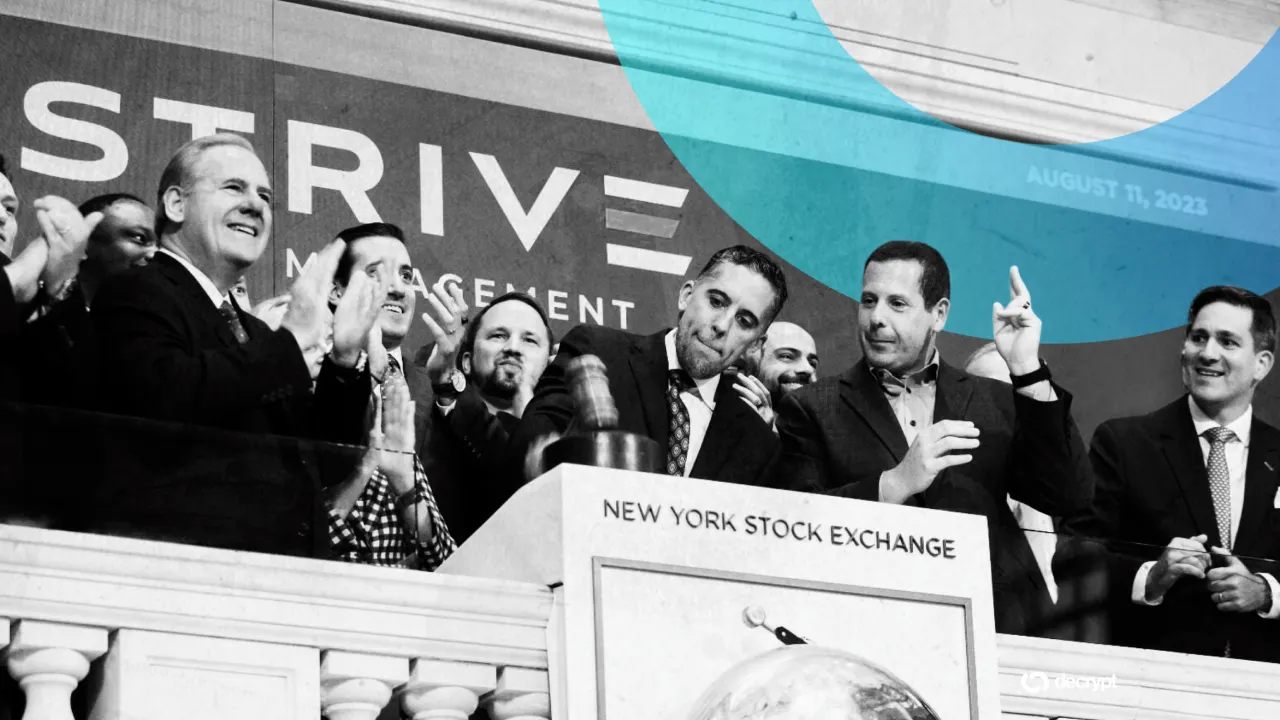
Strive bought 3,311 BTC worth roughly $280 million between Oct. 5 and Oct. 9 at an average price of about $84,500 per coin, its largest purchase since January, lifting holdings to 32,773 BTC.
The buy caps an aggressive run—following $169 million and $94.5 million purchases—for the firm, which trades as ASST and recently merged with Semler Scientific to grow its balance sheet.
It lands amid heavy treasury activity from Strategy, Solana’s DeFi Dev Corp. and Bitmine, as Strive bought into a dip well below Bitcoin’s recent highs.
Strive is piling into Bitcoin at its fastest clip of the year, scooping up another 3,311 BTC worth roughly $280 million in its biggest single purchase since January.
The Nasdaq-listed asset manager, which trades under the ticker ASST, disclosed in a filing Monday that it bought the Bitcoin between Oct. 5 and Oct. 9 at an average price of about $84,500 per coin, including fees. The buy lifts Strive’s total holdings to 32,773 BTC, worth roughly $2.73 billion at today’s prices, up from 29,462 BTC a week earlier.
The purchase caps a stretch of aggressive accumulation. Strive added $169 million in Bitcoin earlier this month in what was then its largest buy in four months, after pushing its stack past 27,000 BTC with a $94.5 million purchase in late September.
The latest tranche extends that momentum, and the timing is notable: the firm bought as Bitcoin slid through a rough week, picking up coins at an average price well below the token’s recent highs near $87,000.
Strive, led by CEO Matthew Cole, is among a wave of public companies that have adopted Bitcoin treasury strategies, raising capital to stockpile the asset and tie their share price to its performance.
BitcoinBTC · USD
$82,841−0.78%
Oct 7Oct 9Oct 11Oct 12Oct 14
$84.2k$83.1k$81.9k$80.7k
24h HighHigh$84,025
24h LowLow$82,919
VolVol$1.1B
Market projectionsOdds by Myriad
→
The model, pioneered by Michael Saylor’s Strategy, has drawn a crowded field, and Strive has moved aggressively since going public through its merger with Asset Entities, recently completing a tie-up with Semler Scientific to bulk up its balance sheet. Beyond its Bitcoin, the company also holds about 505,000 shares of Strategy’s STRC preferred stock, valued near $50 million, and roughly $310 million in cash.
The strategy carries the category’s familiar risk: Strive’s fortunes rise and fall with a notoriously volatile asset. Buying into a dip can pay off if Bitcoin rebounds, but the same exposure cuts the other way, and treasury firms have faced scrutiny over how much their stock premiums depend on continued accumulation.
Daily Debrief Newsletter
Start every day with the top news stories right now, plus original features, a podcast, videos and more.
AnyPS5 is an open-source, AI-powered project on GitHub that converts PS5 game executables into programs that run natively on PC.
Speculators believe that the tool will allow users to get higher performance out of PS5 games by using high-powered PCs.
Some gamers hope that the project will be able to run GTA VI on PC at launch, although Discord members warn there’s likely to be roadblocks.
Vibe coders are porting PlayStation 5 applications to Windows and Linux, leaving some users optimistic that the project will unlock better performance for PS5 games, and could even work for GTA 6 at launch.
AnyPS5 is an open-source, AI-powered project on GitHub that converts PS5 game executables into programs that run natively on PC, swapping Sony’s system libraries for its own version rather than emulating the console. A community-run tracker lists more than 180 PS5 titles that have been tried with the tool, but only a handful have been verified as playable.
An important distinction to make is that this is not an emulator and that games will be running natively on PC. As a result, some speculators believe that users will be able to get better performance from PS5 games by playing them on a high-powered PC.
“GTA 6 most likely will be able to run on your PC at launch, and [with] significantly higher frames than it would on your PS5,” pseudonymous gaming content creator Schlayerr said on TikTok. “We live in a crazy time.”
“Technically, this is feasible given the similarities between console and PC architectures, and AI can dramatically accelerate the reverse engineering work,” Theodore Agranat, Director of Web3 at Gunzilla Games, the game studio behind battle royale Off the Grid, told Decrypt. However, he remained skeptical over whether they “can deliver the quality, performance, and fidelity players expect from AAA games at scale.”
🚨 ANYPS5 SYSTEM LIBRARY SUPPORT JUST HIT 86%! 🤯🔥
Development has been FAST since Friday, and the library side is becoming the next phase to watch.
• 3,005 / 3,475 declared system functions implemented • Overall system library support is now 86.47% • libc: 99% •… pic.twitter.com/S1AekKNtOf
The latest project update claims that 100% of the PS5 GPU shaders have been ported while 88% of the system libraries have been ported. Discord community members believe the final 12% for system libraries is likely to take a long time, especially as new system libraries are continuously being discovered.
In the Discord showcase channel, some users have shown off rudimentary demos of PS5 games on PC. One community developer reported running GTA 5 at 27 frames per second, or FPS, in the performance graphics mode. Others have reported getting 4 FPS on Epic Mickey, 25 FPS on Phasmophobia, and 60 FPS on Vampire Survivors. It’s still a work in progress.
Still, in all of these examples, the games aren’t fully playable due to the incomplete system library port as well as game-specific bugs being encountered.
A potential roadblock in playing GTA 6 on PC at launch is a mandatory firmware update, Discord members say. This is because the AnyPS5 project would need to overhaul its converted files to the latest update in order to get GTA 6 running. As such, there is likely to be a delay before the game is available on PC via AnyPS5.
“Firmware updates could create hurdles, particularly around DRM, but likely wouldn’t invalidate the entire approach,” Agranat said.
A response to Sony’s disc ban?
AnyPS5 bans any form of piracy in its Discord server, meaning using the tool requires purchasing the game on the PlayStation Store. That said, there is nothing stopping an individual using AnyPS5 with a pirated copy of a video game.
Some PlayStation users have speculated that the movement is a response to Sony’s plan to discontinue physical game discs.
“The reason this all happened is because Sony discontinued discs,” pseudonymous gaming content creator The 1st Gamer said on TikTok. “They wanted to go digital, and they did, but just not on PS5.”
Sony announced in July that it plans to stop producing physical discs at the start of 2028. The decision was met with major community backlash, including a petition called “Don’t Kill the Disc” gaining over 385,000 signatures. Shawn Layden, a former PlayStation executive, called the move a “heavily spreadsheeted decision” and said it has damaged the company’s reputation.
In August, Sony argued in a California court that purchasing a digital game in the PlayStation Store does not equate to ownership of it. Sony claimed its Terms of Service and the Software Product License Agreement explain this and that users should understand it as a fact.
“Even without Sony stopping physical discs, this was bound to happen with AI accelerating dev,” Agrant said. “My hope is that projects like this push platform holders to offer the same flexibility themselves, but at a much higher standard,” he told Decrypt, hoping for a future where Sony rolls out games on PC as well as console. “That would be a genuine win-win.”
Daily Debrief Newsletter
Start every day with the top news stories right now, plus original features, a podcast, videos and more.
Trezor told partners their reseller authorization ends January 1, 2027, and that it will ship them no new stock, saying there is no evidence its devices were compromised.
Ledger’s Donjon team says wallets sold by Southeast Asian reseller CryptoBilis held an implant that captures recovery phrases from the screen and sends them over LTE.
Onchain investigator Specter traced more than $86 million in suspected thefts, a figure Ledger says it has not verified.
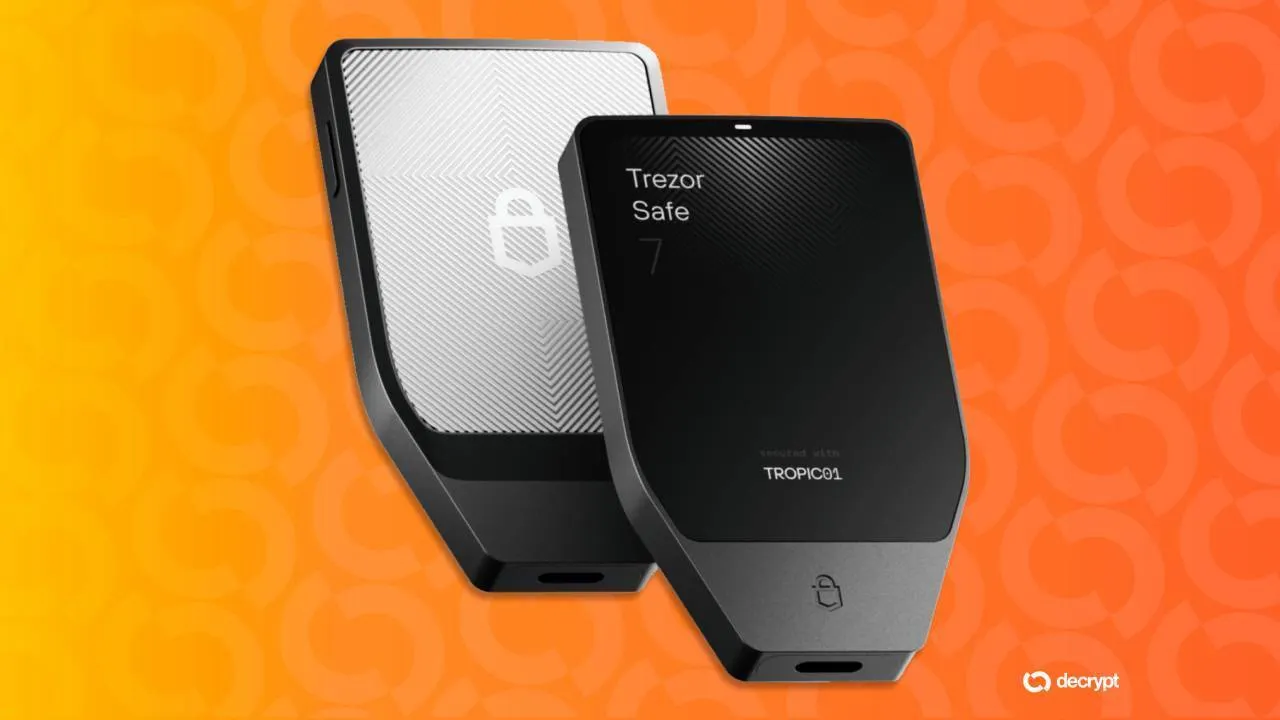
Trezor is cutting its network of authorized resellers, telling partners their authorization ends on January 1, 2027, days after rival hardware wallet manufacturer Ledger started an investigation that eventually confirmed a hidden spy implant in crypto wallets sold through a third-party store.
The company announced the move on X on Tuesday, saying “there is not a single piece of evidence” that Trezor devices have been compromised. It described the cut as a preventive step taken out of caution.
“Following recent supply-chain incidents, we decided to reduce the number of resellers so we can more effectively check those we work with,” Trezor wrote.
A hardware wallet is a small device that keeps the secret keys to your crypto offline, away from hackers. Setting one up produces a 24-word recovery phrase that works as a master password: whoever has those words can empty the wallet from anywhere in the world.
Ledger’s Donjon security team says wallets sold by CryptoBilis, a reseller in Southeast Asia, contained an unauthorized component that reads the screen and decodes the recovery phrase when it appears. The spy implant then sends the words out over LTE, the same mobile data network your phone uses, through an eSIM, a SIM card built into the hardware. Ledger says the implant does not alter the chip that stores the keys or the device’s operating system, so a tampered wallet looks and works normally.
Trezor CCO Danny Sanders shared the letter that the company sent to those providers that Trezor is ditching. “If you are receiving this letter, your authorization ends on 1 January 2027. On that date we will remove you from our list of authorized Trezor resellers,” the letter reads. “I am sorry. This decision says nothing about your effort or the way you represented us.”
BitcoinBTC · USD
$83,133−0.73%
Oct 7Oct 9Oct 10Oct 12Oct 14
$84.2k$83.1k$81.9k$80.7k
24h HighHigh$84,025
24h LowLow$82,919
VolVol$1.1B
Market projectionsOdds by Myriad
→
This is a precautionary measure to protect our supply chain and our customers,” he wrote. “If things change in the future we will review it.”
Affected resellers will get no new stock, but they can keep selling what they have through Black Friday and the holiday season. Sanders said the decision just reflects how many partners Trezor can vet closely itself.
Neither the post nor the letter says how many resellers are affected. Trezor says it reviewed each country on its own, weighing revenue and distribution against its own presence there, and that resellers who stay will face an updated legal framework and tighter rules on how devices are sourced, stored, and handled.
Trezor said on X earlier this week that CryptoBilis was already off its seller list and that it had received no reports of tampered Trezors from the retailer.
Hi, don’t open it. Forcing the casing open can damage the device, and if it’s a Safe 7, the built-in battery makes that genuinely risky. If something about your device worries you, reach out via https://t.co/wzwW038oLv, and we’ll take a look.
In May 2022, Trezor warned that counterfeit Model T wallets were being sold on a Russian marketplace by a seller that was not an authorized reseller. The devices had been opened, resealed, and fitted with replaced internal components, and Trezor said the recovery phrases they generated were predictable or predefined, meaning someone else could already know the words.
Trezor’s advice then was to buy only from its official shop or an authorized reseller. The second option is the network it is now shrinking.
In August, shipping partner ShipMonk exposed Trezor customer data after unauthorized access, and Trezor’s September update put the total at 80,689 customers. Trezor says its systems, devices, private keys, and wallet backups were not affected.
Ledger told anyone who bought from CryptoBilis in the past 90 days not to set up their device, and told those who already did to move their funds to a new seed phrase on a device bought from Ledger. Ledger and Trezor have each warned buyers against unauthorized sellers.
Daily Debrief Newsletter
Start every day with the top news stories right now, plus original features, a podcast, videos and more.
The Crypto Fear and Greed Index, a 0-to-100 sentiment gauge built from momentum, volatility, options positioning and social data, fell to 53 from an “extreme greed” reading of 82 on Aug. 26. It reads 56 today, a neutral score. What it boils down to is this: The August euphoria is gone, but traders aren’t panicking either.
Bitcoin ETFs are down a net $386.3 million in October, and outflows force funds to sell actual Bitcoin. Wednesday’s Consumer Price Index report, expected to show annual inflation rising to 3.6% from 3.4%, is the next test: a hotter print would boost rate-hike bets and likely pressure Bitcoin. The Federal Reserve meets Oct. 27-28.
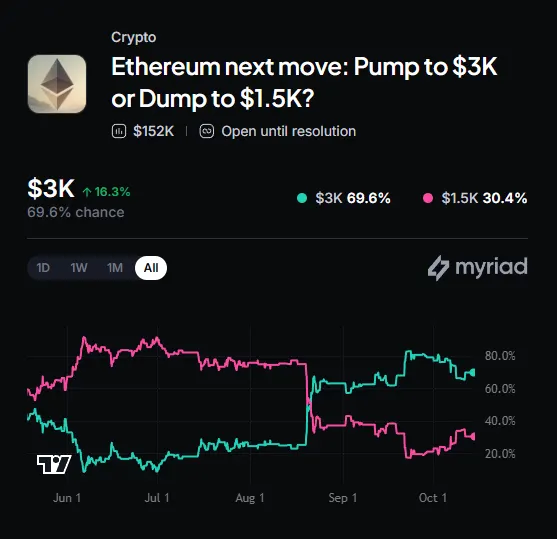
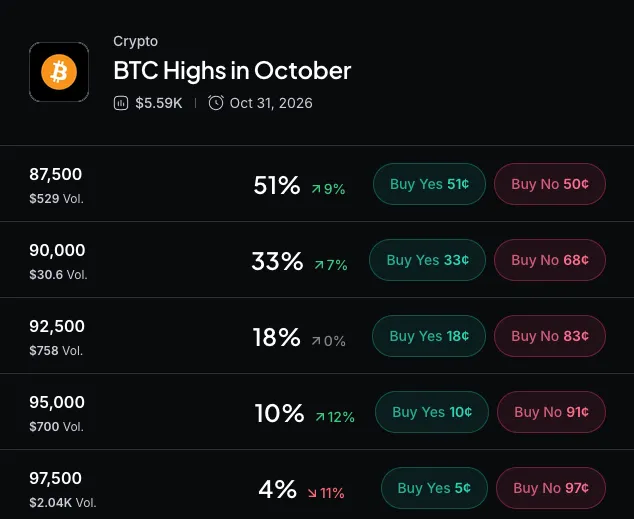
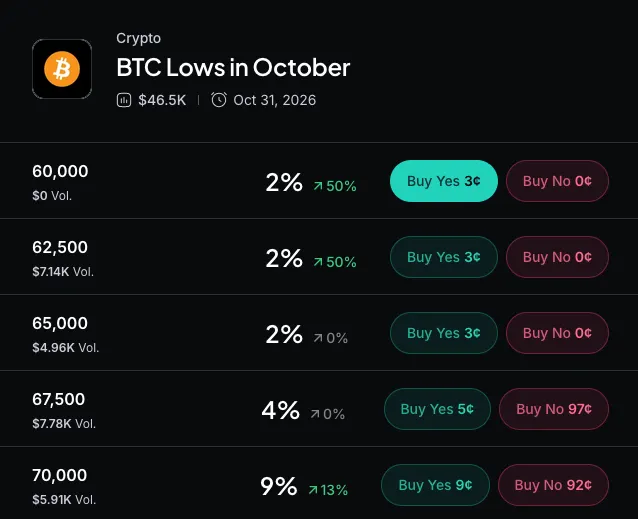
Traders on Myriad, a prediction market developed by Decrypt‘s parent company Dastan, give 54% odds that Bitcoin falls to $80,000 this month, down from 56% on Monday. The BTC highs in October market holds at 45% for $87,500. So, overall, sentiment has improved today, even if slightly.
Bitcoin price: Bulls defend the golden zone
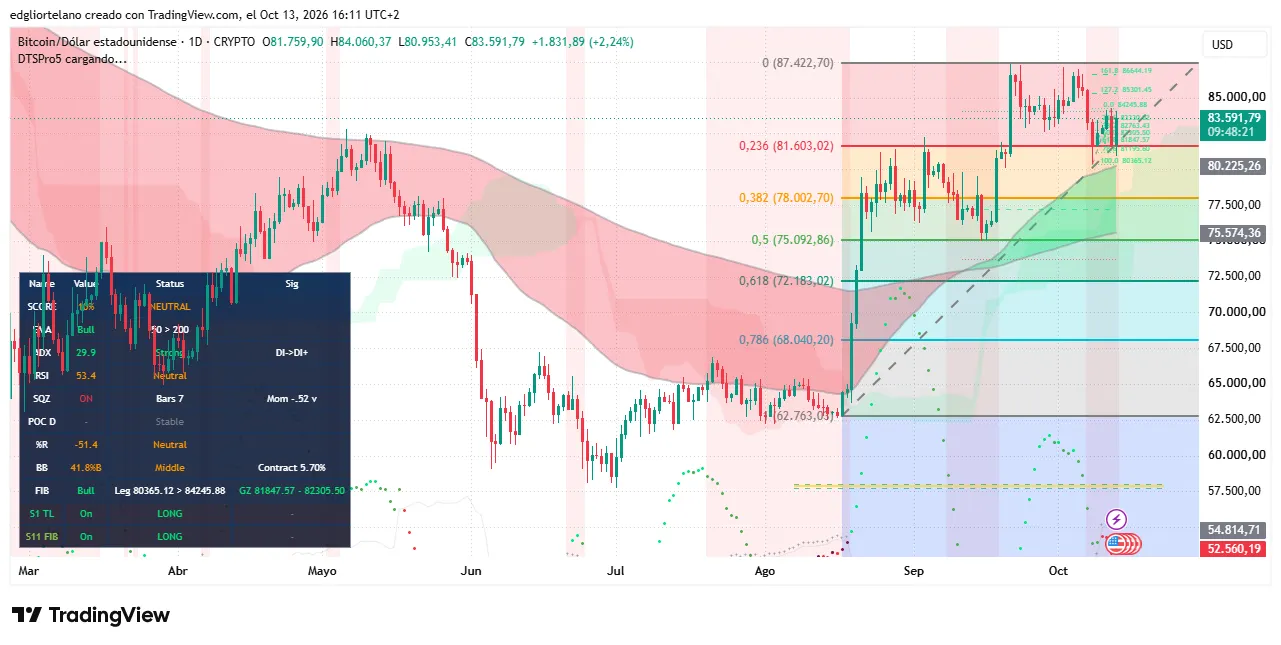
Today’s low stopped about $588 above $80,365.12, the swing low where the bounce began. That higher low is what traders want in an uptrend. Bitcoin also reclaimed the Fibonacci “golden zone” between $81,847.57 and $82,305.50, an area where pullbacks within uptrends often draw buyers.
Bitcoin price data. Image: Tradingview
The Average Directional Index, or ADX, measures trend strength, and readings above 25 confirm a trend. It reads 29.9 with buyers in control, but it was 42.8 on Oct. 7, so the uptrend is coasting rather than accelerating. The 50-day exponential moving average stayed above the 200-day, a golden cross traders read as an intact long-term uptrend.
The Relative Strength Index, a 0-to-100 momentum gauge, sits at 53.4, just above the 50 line that separates bullish from bearish momentum. The Squeeze Momentum Indicator has been on for seven sessions, meaning volatility is compressed like a coiled spring, and its -0.52 reading leans slightly bearish.
BitcoinBTC · USD
$83,131−0.74%
Oct 7Oct 9Oct 10Oct 12Oct 14
$84.2k$83.1k$81.9k$80.7k
24h HighHigh$84,025
24h LowLow$82,919
VolVol$1.1B
Market projectionsOdds by Myriad
→
A daily close above $84,245.88 would open $86,644.19, then the $87,422.70 high, about $77 shy of Myriad’s $87,500 line. Losing $81,603.02 would bring the daily trend band’s upper edge into play just above $80,000. A close below it would expose $77,500.
Until Wednesday’s CPI print, the active squeeze points to a market that is winding up rather than picking a direction. Oil and Iran headlines, Treasury yields, and daily ETF flows remain the short-term catalysts to track.
Disclaimer
The views and opinions expressed by the author are for informational purposes only and do not constitute financial, investment, or other advice.
Daily Debrief Newsletter
Start every day with the top news stories right now, plus original features, a podcast, videos and more.
DeFi Development Corp added about 22,070 SOL and SOL equivalents last week, lifting its treasury to roughly 2,586,282 tokens, up 12% since August 12.
Its CHAD perpetual preferred stock, which pays a 13% annual dividend on a $10 stated amount, hit record highs in the week ended October 9 and is approaching $10 after an IPO priced at $8.
DFDV common stock traded near $4.41 on Monday, giving the company a market value of about $144 million against roughly $287 million worth of SOL.
DeFi Development Corp, the Nasdaq-listed Solana piggy bank, added about 22,070 SOL—worth about $2,373,211—and “SOL equivalents” to its treasury last week, according to a press release published Monday.
That brings its stash to roughly 2,586,282 tokens, worth about $287 million with SOL near $111. Weekly buys keep shrinking, from 101,381 SOL in mid-September (around $11.4 million) to 47,706 ($5.8 million), then 26,202 ($3.1 million).
DFDV is a digital asset treasury company, a public firm that holds a cryptocurrency so stock investors can bet on it without opening a crypto account. It was a real estate software firm called Janover until April 2025, when it pivoted to Solana and copied Strategy’s Bitcoin playbook.
CHAD, the company’s perpetual preferred stock, hit all-time highs in the week ended October 9 and is approaching $10. Perpetual preferred shares never mature and get dividends before common stock; CHAD pays a variable 13% a year on its $10 stated amount, or $1.30 per share, declared each business day.
“CHAD reaching new highs and approaching $10.00 even as SOL pulled back is an encouraging sign that investors are recognizing its distinct income proposition,” said Dan Kang, Chief Strategy Officer. “For common shareholders, CHAD provides a funding source that can support accretive SOL per share growth without issuing additional common shares. For CHAD holders, it offers daily income supported by that growing, productive treasury,” he added.
That record sounds less dramatic once you know the shares priced their IPO at $8 in September, below their own stated amount. Last week DFDV even authorized buybacks for whenever CHAD trades under its $10 par value. Mission nearly accomplished.
BitcoinBTC · USD
$83,280−3.4%
Oct 6Oct 8Oct 10Oct 11Oct 13
$86.6k$84.6k$82.7k$80.7k
24h HighHigh$84,074
24h LowLow$81,018
VolVol$1.3B
Market projectionsOdds by Myriad
→
The price matters because DFDV funds its SOL purchases through a $300 million at-the-market program, which sells new CHAD shares gradually at market prices. The closer CHAD trades to $10, the more SOL each new share buys.
“Short-term volatility has not changed our conviction or our commitment to accumulating SOL,” CEO Joseph Onorati said in the release.
SOL fell about 9% over seven days, and nearly $1 billion in long positions, or bets that prices would rise, were liquidated in 24 hours. Liquidation is forced selling: when traders bet with borrowed money and prices fall far enough to wipe out their collateral, exchanges close the bet automatically, pushing prices lower still.
A 13% dividend looks generous, but CHAD is backed by a company whose main asset trades about 62% below its January 2025 peak of roughly $295. The release itself warns that staking rewards may not be enough to cover dividends.
DFDV’s common stock traded near $4.41 on Monday, a market value of about $140 million—roughly half the value of its SOL, though it also carries debt. When a treasury company trades below its crypto stash, selling shares to buy tokens stops making sense, one reason the sector is under pressure.
CHAD holders will keep collecting $0.00516 per share for each business day through October 30, and the next macro test arrives Wednesday with the U.S. September inflation report.
Daily Debrief Newsletter
Start every day with the top news stories right now, plus original features, a podcast, videos and more.