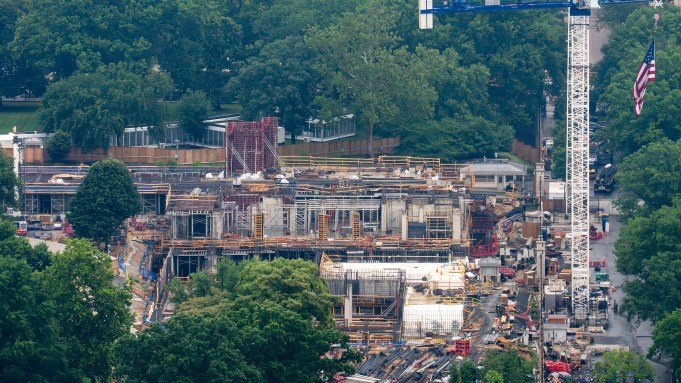
The Supreme Court ruled that construction could continue on Donald Trump‘s White House ballroom, sidelining lower court orders to halt the project.
Chief Justice John Roberts signed an order on Friday that stays a preliminary injunction issued by a district court judge in April. The stay will be in effect “pending further order of the undersigned or of the court,” per the document. There was no explanation for the court’s reasoning.
The Trump administration asked for a stay as it faced a lower-court deadline on Friday to halt construction.
In April, U.S. District Judge Richard Leon, an appointee of George W. Bush, ruled that construction of the ballroom required congressional approval. He made an exception for below-ground construction of a below ground bunker for national security needs, as well as other elements to protect the president.
The Trump administration appealed, and construction was allowed to continue until there was a ruling from the D.C. Circuit Court of Appeals. In a 2-1 decision earlier this month, the appellate court affirmed that the president needed congressional approval.
“Each President is a temporary tenant, not the owner, of the White House and its Executive Residence,” the judges wrote. “The President has no—and claims no—constitutionally assigned authority over that property, which is designed and maintained for the use of all Presidents, current and future, and for the American people.”
The ballroom is perhaps the most cherished of all projects Trump has taken around the White House complex and in Washington, D.C. He has defended the ballroom project as long overdue, given the limited space of other entertaining facilities in the complex. Lately, he has also taken to referring to the construction as a “military complex,” as the administration’s legal team has argued that the entire project is needed for purposes of national security.
But the plaintiffs in the case, the National Trust for Historic Preservation, have argued that the administration cannot bypass congressional input for a project of such magnitude — 90,000 square foot. And from a design standpoint, the trust said that the project will dwarf the main residence of the White House, at 55,000 square feet, while disrupting to symmetry of the structure and the surrounding buildings.
“The Constitution vests Congress with sole and preclusive authority over federal property,” the National Trust’s legal team wrote in a Supreme Court filing.
They argued that an injunction was needed because the Trump administration has tried to “outrun judicial review,” with an accelerated construction timeline and a 250-person crew working 20 hours a day and seven days a week on the project. Essentially, the National Trust contended, the Trump administration was making the case that the ballroom construction was so far along that they were “on the brink of a fait accompli.” They noted that the administration has said that the project would be substantially complete by November.
Without obtaining congressional approval, Trump ordered that the East Wing of the White House be torn down last fall. Also demolished was an east colonnade and a garden dedicated to Jacqueline Kennedy, as well as a movie theater.
Trump has said that the ballroom would be funded by private donations, with corporations like Comcast and Amazon among the donors covering the costs. The Washington Post reported in June that the entire project was estimated to cost $600 million, with more than half coming from taxpayers, per a contractor’s project estimate.
Leave a Reply