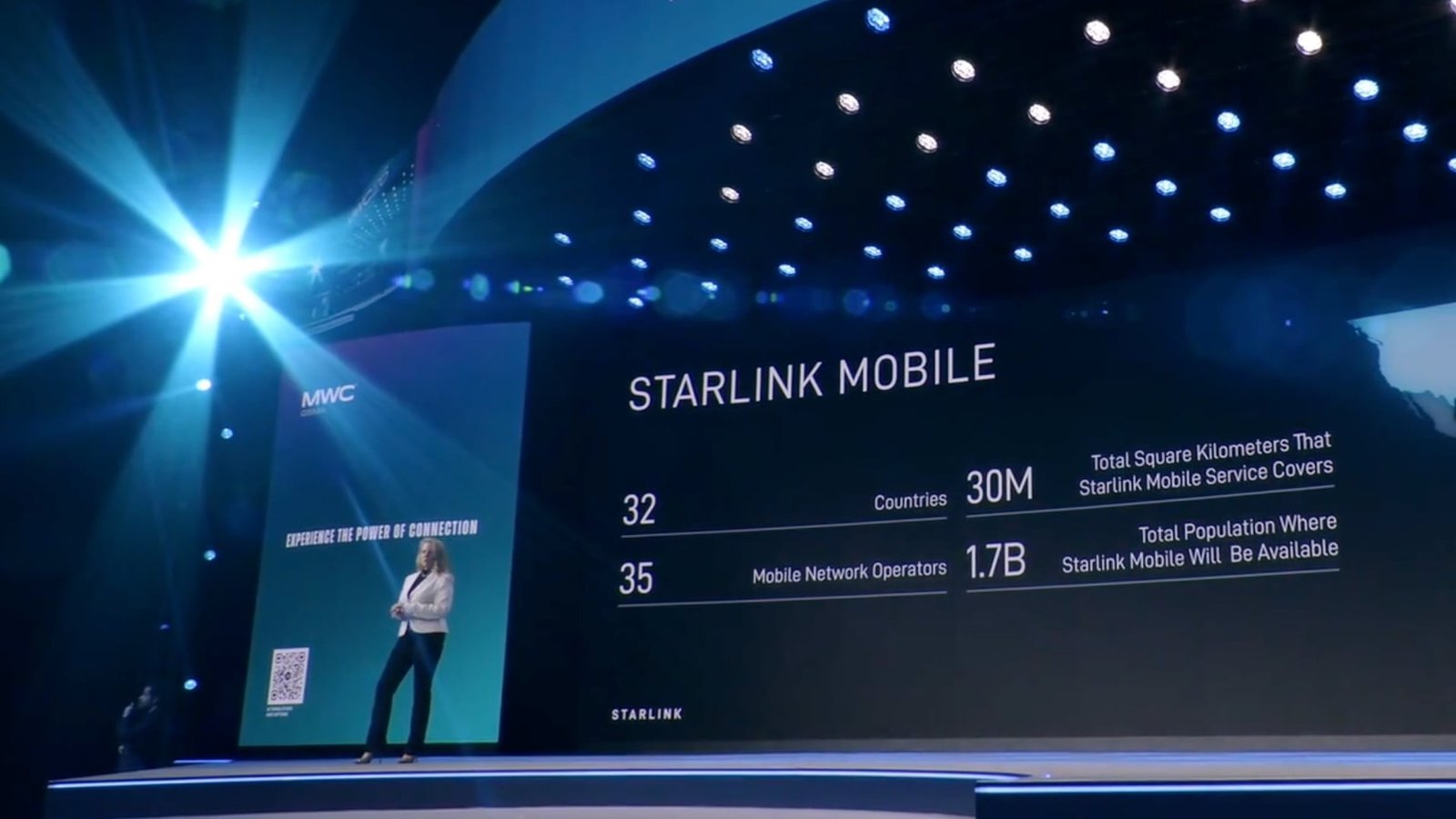
To become a major cellular carrier in the US, SpaceX must create robust, widespread cellular coverage to compete with AT&T, T-Mobile, and Verizon. One unconventional idea to help build out that network is to harness dish-focused Starlink installs nationwide, President Gwynne Shotwell said during an earnings call on Tuesday.
SpaceX will use traditional towers and next-generation satellites, enabling it to serve dense urban areas and remote places. But on the earnings call, Shotwell reiterated that the company will continue to incorporate small, cost-effective radio transmitters, called femtocells, to fill coverage gaps. That includes “smaller radios that we could put on already-installed Starlink” dishes in homes, businesses, and towers. “We will basically leverage the real estate for Starlink installs and other towers,” she said.
SpaceX plans to “turn on service” for the second-gen Starlink Mobile service, built for 5G speeds, in early 2028.
Shotwell and SpaceX CEO Elon Musk previously alluded to using existing Starlink dishes for the cellular network ambitions during a Q2 earnings call in August. “The Starlink antennas are located on the roofs of houses and businesses. So, they’ve got a clear view for providing connectivity directly to cell phones on the ground,” Musk said at the time.

(Credit: Douglas Sacha via Getty Images)
The approach makes us wonder whether SpaceX will try to recruit Starlink subscribers to help build out the cellular network, even though the dish-focused satellite internet system already has over 2 million customers in the US. Presumably, SpaceX would need to sell femtocell/Starlink Mobile equipment to willing customers. One interesting change we spotted is that the Android app for Starlink now includes a reference to “StarlinkCarrierService” in the code, although its purpose isn’t entirely clear.

(Credit: PCMag)
In the earnings call, Shotwell further noted: “The vast majority of mobile connectivity is actually Wi-Fi, right? I think it’s something between 85 and 93% is done through Wi-Fi. And keep in mind, Starlink broadband does a lot of Wi-Fi work as well.”
Still, the company’s plan to develop Starlink Mobile’s ground infrastructure has been relatively vague, including the costs. After Shotwell’s remarks, Musk said, “We probably should do a longer presentation on the game plan for Starlink connectivity, and why we think it’ll ultimately be a business that generates several hundred billions of dollars in revenue a year.”
“Veterans of the cellular industry look at the chess board of existing pieces and don’t see a solution,” Musk added in a tweet. “They don’t understand that SpaceX is developing entirely new pieces that fundamentally alter the strategic landscape.”
‘Not Very Well-Grounded in Research or Expertise’
Mike Dano, lead analyst at Speedtest.net’s parent Ookla, said it’s unlikely that every single Starlink subscriber in the US would be willing to place a transmitter on their roof for Starlink Mobile. “But that probably wouldn’t be necessary. After all, each of the big cellular providers in the US count around 60,000 to 80,000 total cell towers in their networks on a nationwide basis.”
However, Dano pointed out that SpaceX is bound to face regulatory questions concerning the Starlink Mobile equipment. “One would be the regulations involved in establishing a new cell site in support of the Starlink Mobile network. Cell siting rules can be very restrictive, and they can change on a county-by-county basis,” he says. “Another challenge would involve cell site organization: Ensuring that every Starlink Mobile S-band transmitter is in a suitable location, and that it would not cause interference, would require a significant amount of RF (radio frequency) planning and coordination.”
Other industry analysts remain skeptical of Starlink Mobile, which will face an uphill battle against AT&T, T-Mobile, and Verizon. Anshel Sag, an analyst at Moor Insights & Strategy, said SpaceX’s talk of using femtocells and Starlink dishes doesn’t appear to be a “viable plan for a real cellular network.”
“The problem is that femtocells and Wi-Fi have limited range, even outdoors. Realistically, no femtocell or Starlink Wi-Fi networks will add meaningful coverage beyond the property on which they sit. Especially when you consider where Starlink is in use today, it’s mostly rural areas with large properties,” Sag said.
“Additionally, what’s being missed here is that Starlink users would have to sacrifice their gateway bandwidth to host Starlink’s network if any users are in their proximity, degrading their broadband experience.” Instead, Sag expects SpaceX will need to spend a lot of money to “build or lease many cell sites in suburban and urban areas if they want to be competitive with the big three carriers.”
Recommended by Our Editors
“I think the fundamental problem is that SpaceX has promised that this Starlink Mobile service would be considerably cheaper to deploy than its competitors, and I believe that once all is said and done, incorporating the cost of building, launching, and maintaining satellites, the Starlink Mobile service may save 20-30% off the traditional costs of building and maintaining a cellular network. I’m just not sure whether SpaceX investors think that’s enough to pursue this,” he added.

(Credit: Cate Dingley/Bloomberg via Getty Images)
Jeff Moore at Wave7 Research, who previously worked at Sprint, also told PCMag: “My reaction is one of skepticism and that it raises a whole host of marketing personnel and legal questions… It sounds like the issue was not very well-grounded in research or expertise.”
Moore notes that the telecom industry has a long history of trying to develop more cost-effective ways to expand cellular connectivity, but these efforts failed to pan out because the economics don’t make sense when building a nationwide network. Although SpaceX could theoretically beam 5G from space and over its own towers and femtocells, the company will still face a host of other on-the-ground challenges. For example, Moore says most US consumers still sign up for wireless plans in stores. SpaceX will need to replicate its retail footprint as well, in addition to creating customer support for a nationwide network.
“Entering the game is very difficult; other companies, large and small, have all come to the same conclusion: It’s just easier to sign an MVNO agreement,” he said, alluding to SpaceX becoming a wireless reseller instead.
“Even companies of great scale, I’m thinking Comcast and Charter, these are companies that have the scale to do anything they want to, and yet they have made the conclusion to focus on their core competencies,” he added.
About Our Expert

Michael Kan
Principal Reporter
Experience
I’ve been a journalist for over 15 years. I got my start as a schools and cities reporter in Kansas City and joined PCMag in 2017, where I cover satellite internet services, cybersecurity, PC hardware, and more. I’m currently based in San Francisco, but previously spent over five years in China, covering the country’s technology sector.
Since 2020, I’ve covered the launch and explosive growth of SpaceX’s Starlink satellite internet service, writing 600+ stories on availability and feature launches, but also the regulatory battles over the expansion of satellite constellations, fights with rival providers like AST SpaceMobile and Amazon, and the effort to expand into satellite-based mobile service. I’ve combed through FCC filings for the latest news and driven to remote corners of California to test Starlink’s cellular service.
I also cover cyber threats, from ransomware gangs to the emergence of AI-based malware. In 2024 and 2025, the FTC forced Avast to pay consumers $16.5 million for secretly harvesting and selling their personal information to third-party clients, as revealed in my joint investigation with Motherboard.
I also cover the PC graphics card market. Pandemic-era shortages led me to camp out in front of a Best Buy to get an RTX 3000. I’m now following how the AI-driven memory shortage is impacting the entire consumer electronics market. I’m always eager to learn more, so please jump in the comments with feedback and send me tips.
Leave a Reply