The bill falls short, but vote shows cracks are starting to appear in Republican support for the US-Israel war on Iran.
Three Republican senators have joined Democrats in the United States Senate in voting to advance a bill to limit President Donald Trump’s ability to strike Iran without congressional approval.
While the bill ultimately fell short in a 50-49 tally on Wednesday, the vote showed that cracks in the support for the war are starting to show in Trump’s Republican Party.
Recommended Stories
list of 3 itemsend of list
It was the seventh such vote since the start of the war, and it received the highest level of support so far.
Democratic Senator John Fetterman – a pro-Israel hawk – sided with the Republican majority, single-handedly helping Trump’s party block the bill.
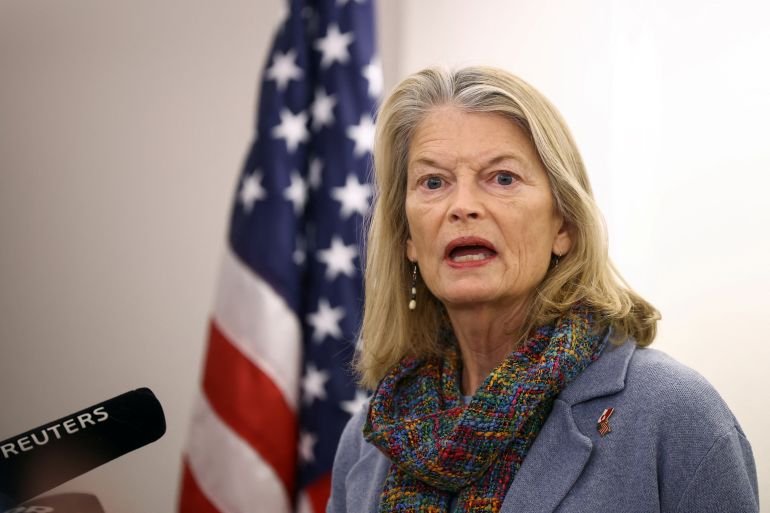
Republican Senator Lisa Murkowski broke ranks with her own party for the first time and voted in favour of the War Powers Resolution. Susan Collins – who is facing a tough re-election battle in Maine – voted for the resolution for the second time.
Rand Paul, a Kentucky libertarian who has consistently voted to curb the president’s war authorities, was the third to vote for the resolution.
Trump never sought congressional authorisation to go to attack Iran, although the US Constitution gives lawmakers the sole authority to declare war.
Since the start of the conflict, Democrats have repeatedly put forward bills under the War Powers Resolution of 1973 to limit Trump’s authority to order the US military into hostilities without authorisation from Congress.
The law was passed in the wake of the Vietnam War to curb what was seen at that time as executive overreach to take the US to war.
Senator Tim Kaine, one of the Democrats leading the efforts to advance the vote, underscored the “progress” in Wednesday’s vote.
“My colleagues and I have been forcing votes to stop the war against Iran – and we’re making progress,” Kaine wrote on X. “Today, our War Powers Resolution got 49 votes. My colleagues are hearing more and more from their constituents: end this costly and unnecessary war.”
Such bills are unlikely to pass in the Republican-controlled Senate and House of Representatives and would almost certainly be vetoed by Trump if they are approved. Still, the votes put pressure on Republicans to make their position on an increasingly unpopular war known on the record.
A Reuters/Ipsos poll released earlier this week suggested that two-thirds of US voters do not think Trump has clearly explained why the country has gone to war with Iran.
Trump has blocked the Strait of Hormuz in response to US and Israeli attacks, sending oil prices soaring.
Despite the ceasefire that came into effect last month, the Iranian blockade continues absent of a comprehensive deal to end the war. A US naval siege in Iran has worsened the energy crisis.
The average price of one gallon of petrol in the US has surpassed $4.50 ($1.18 per litre), up from less than $3 ($0.78 per litre) before the war. That spike has fuelled inflation overall in the US economy.
On Tuesday, before he departed for China, a reporter asked Trump whether the financial situation of Americans would factor into his negotiations to end the war with Iran.
“Not even a little bit,” Trump said. “The only thing that matters when I’m talking about Iran: They can’t have a nuclear weapon. I don’t think about Americans’ financial situation. I don’t think about anybody.”
Trump’s comments sparked criticism from his rivals, but US Vice President JD Vance said on Wednesday that there was a “misrepresentation” of the president’s remark.
“Of course, the president and I, and the entire team, we care about the American people’s financial situations,” he said.
Iran has repeatedly denied seeking a nuclear weapon, and Trump’s own intelligence chief, Tulsi Gabbard, told lawmakers last year that Tehran is not building one.
Leave a Reply