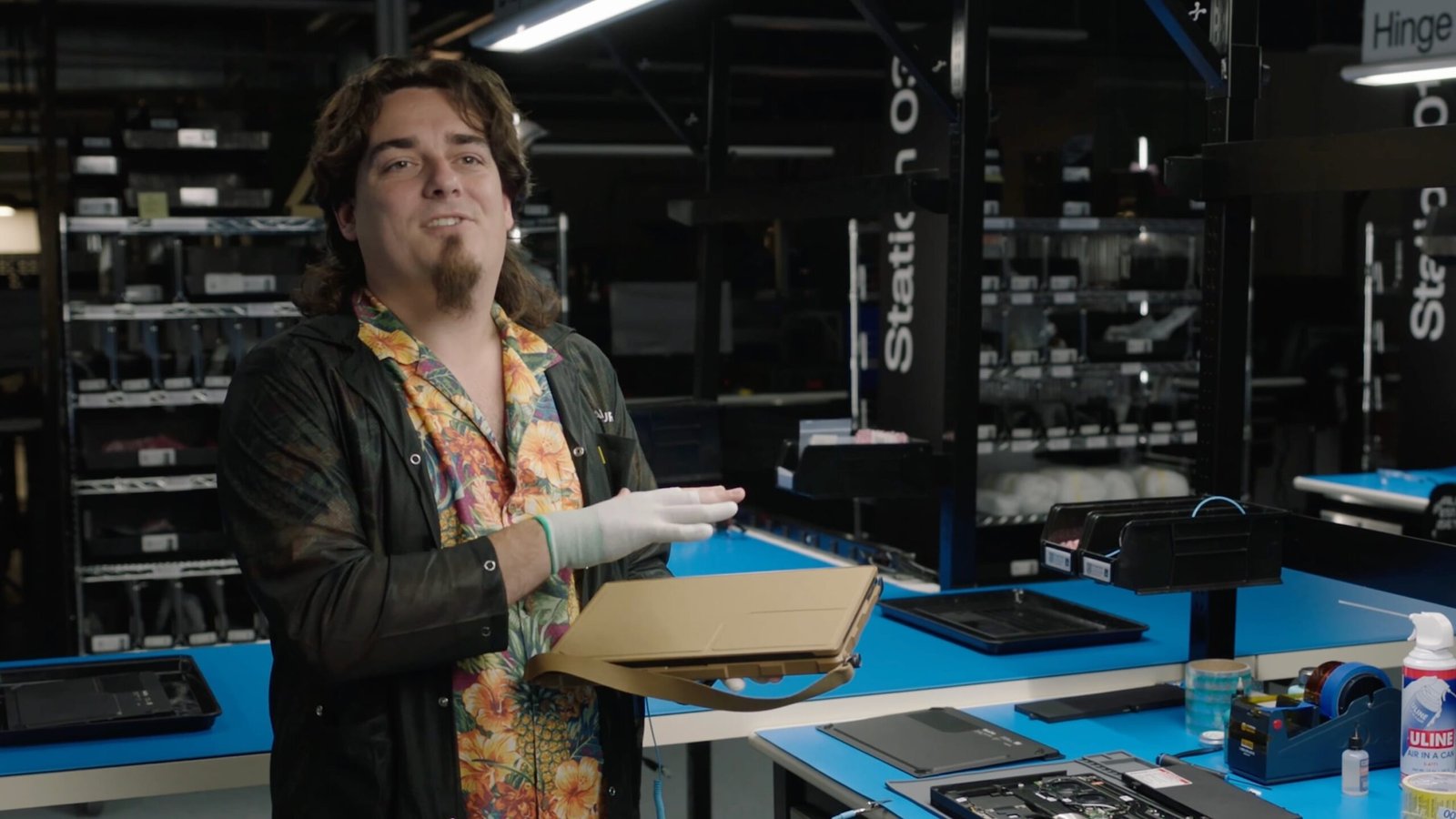
Oculus VR headset inventor Palmer Luckey is flirting with the idea of placing a Starlink-like antenna on future models of his company’s US-made laptops.
On Tuesday, Luckey’s military tech company, Anduril, announced the BlueChip product line, which will debut next year as US-assembled laptops running Qualcomm chips. In a video, Luckey brought up the idea of BlueChip laptops incorporating “phased array antennas,” which are used in satellite systems, including Starlink dishes, to transmit broadband signals.

(Credit: Anduril)
The laptop’s top shell “can easily integrate things like solar panels, other soft goods, other services insignias, even things like flat phased array antennas, directly into the laptop itself,” he said while touting the BlueChip laptop’s rugged and replaceable casing.
The BlueChip product line will initially target government and defense customers, as well as public safety users. Integrating satellite internet access into laptops could help them stand out and keep military users online in the field. Starlink itself has been in the news lately for its role in powering Ukraine’s wartime communications and drone strikes.
Dell and Apple have also filed patents focused on integrating a phased-array antenna into a laptop’s design. Dell’s 2024 patent proposes an antenna panel that flips out of the lid, allowing it to face the sky for a clear view. “The antenna portion is hingedly rotatable relative to the monitor portion,” the patent says.

(Credit: Dell)
Meanwhile, Apple’s 2023 patent proposes placing the antenna inside the laptop’s base. It “may be aligned with an aperture in a conductive housing wall,” and the signal beams can be adjusted based on the laptop lid’s positioning.
Recommended by Our Editors

(Credit: Apple)
That said, we’re not sure it’s practical to combine a laptop with a phased-array antenna in a single unit, as it might lead to overheating, quickly drain battery life, add weight, and increase costs. Still, SpaceX has increasingly developed ways to make its Starlink hardware thinner, lighter, and more power-efficient.
For now, SpaceX has been selling a portable Starlink Mini dish that works with third-party battery accessories. The company has also teased a second-gen model that could launch soon, and might come with its own official battery.
About Our Expert

Michael Kan
Principal Reporter
Experience
I’ve been a journalist for over 15 years. I got my start as a schools and cities reporter in Kansas City and joined PCMag in 2017, where I cover satellite internet services, cybersecurity, PC hardware, and more. I’m currently based in San Francisco, but previously spent over five years in China, covering the country’s technology sector.
Since 2020, I’ve covered the launch and explosive growth of SpaceX’s Starlink satellite internet service, writing 600+ stories on availability and feature launches, but also the regulatory battles over the expansion of satellite constellations, fights with rival providers like AST SpaceMobile and Amazon, and the effort to expand into satellite-based mobile service. I’ve combed through FCC filings for the latest news and driven to remote corners of California to test Starlink’s cellular service.
I also cover cyber threats, from ransomware gangs to the emergence of AI-based malware. In 2024 and 2025, the FTC forced Avast to pay consumers $16.5 million for secretly harvesting and selling their personal information to third-party clients, as revealed in my joint investigation with Motherboard.
I also cover the PC graphics card market. Pandemic-era shortages led me to camp out in front of a Best Buy to get an RTX 3000. I’m now following how the AI-driven memory shortage is impacting the entire consumer electronics market. I’m always eager to learn more, so please jump in the comments with feedback and send me tips.
Leave a Reply