$101 Million Worth of Crypto Transferred from US Government-Linked Wallets!
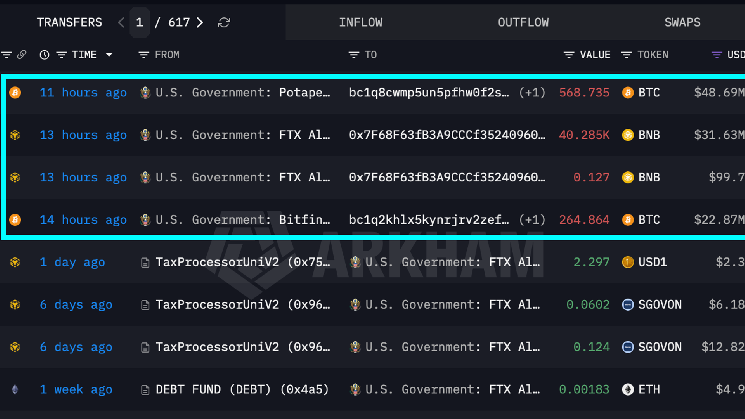
A noticeable surge in cryptocurrency wallets linked to the US government has been observed. According to the on-chain tracking platform Lookonchain, Bitcoin and $BNB totaling approximately $103 million were transferred from government-linked addresses.
At this point, the US government completed Bitcoin transfers exceeding $70 million last night and $BNB transfers this morning.
Bitcoin accounted for the largest portion of the transfers. A US-linked address sent 833.6 $BTC, worth approximately $71 million, to Coinbase Prime.
During the same process, approximately 40,285 $BNB, worth about $31.63 million, were also transferred. Unlike Bitcoin, $BNB was sent to an unknown address after multiple transfers.
The wallets still contain approximately $27.5 billion worth of cryptocurrencies.
Is a Bitcoin Sell Coming?
While the transfer to Coinbase Prime has raised questions about a possible sale in the market, current data does not indicate that such a sale occurred. Furthermore, the transfer alone does not mean the Bitcoins were sold. The platform offers asset management services to institutional investors, in addition to custody and transaction services. Therefore, to determine whether a sale took place, the subsequent movements of the $BTC in question need to be monitored.
What’s the Latest Situation with Bitcoin?
With these developments increasing selling pressure on Bitcoin, analysts are pointing to the $83,000 level.
Speaking to CoinDesk, Vikram Subburaj, CEO of the cryptocurrency exchange Giottus, stated that it is important for Bitcoin to remain above the $83,000 level. According to Subburaj, maintaining this level means that selling pressure is not yet strong enough to pull Bitcoin back down to the $76,000-$81,500 range. However, if Bitcoin remains permanently below the $82,000-$83,000 levels, it could increase downside risks. In such a scenario, Subburaj indicated that the price could fall to the $80,000-$81,500 range.
Alex Kuptsikevich, chief market analyst at FxPro, considers $84,000 a significant support level for Bitcoin. According to the analyst, a drop below this level could lead to increased selling pressure and pull the price down towards $80,000.
“I read the current move as evidence that the ETF bid that carried September has not yet returned strongly enough to offset renewed macro pressure. ETF inflows above roughly $300 million a session for several sessions (my threshold rather than a market one) would be an important signal that institutional demand is returning,” Oliver Carding, head of marketing at Tesseract Group, said in an email.
Martin Lee, head of content and data insights at DWF Labs, said large daily inflows matter more than extended inflow streaks that cumulatively bring in only a few hundred million dollars.
“Looking across the year, we’ve had 93 out of 190 (48%) trading days be negative while still seeing net $1.2B of inflows. Longer-term (week/month) size of flows is more important compared to daily, which is almost a coin flip this year, but definitely something worth monitoring to see how the situation progresses,” he said.
Meanwhile, other types of buyers are accumulating.
“Investors appear to be using periods of weakness to accumulate and dollar-cost average alongside institutional buyers,” Paul Howard, senior director at Wincent, said. “Many market participants are continuing to target Bitcoin at $100k+.” Stay alert!
Read more: For analysis of today’s activity in altcoins and derivatives, see Crypto Markets Today. For a comprehensive list of events this week, see CoinDesk’s Crypto Week Ahead.
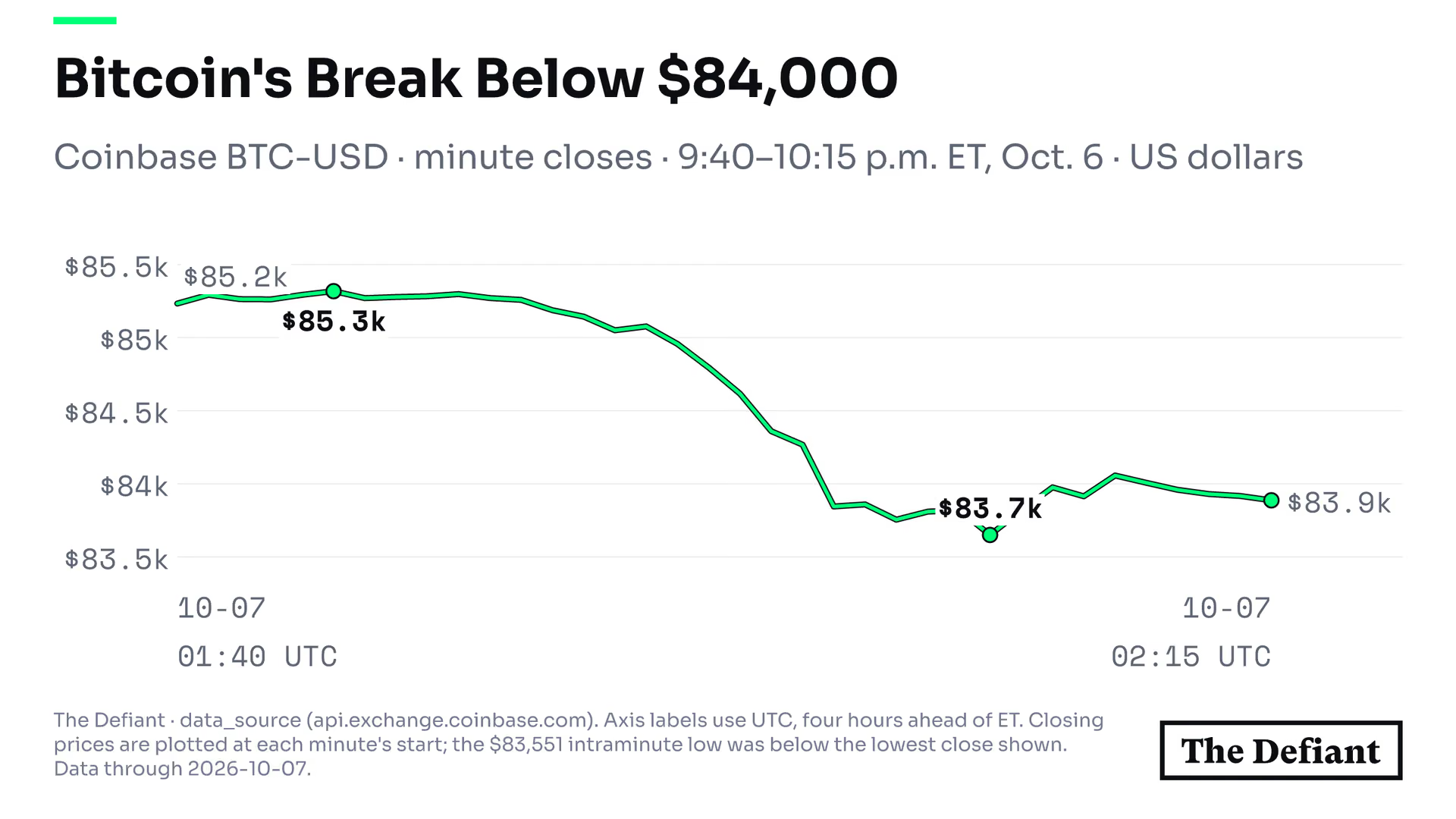
Coinbase’s 24-hour range was $83,551 to $86,698. Kraken’s spot feed also showed a 24-hour low of $83,555, confirming the break below $84,000 on a second venue.
The plunge put bitcoin near the bottom of its recent range. Coinbase’s seven completed UTC daily sessions, from Sept. 30 through Oct. 6, spanned $82,912 to $87,249.
Long Positions Bear the Brunt
Coinalyze’s bitcoin liquidation dashboard showed $83 million in long liquidations over 24 hours, compared with $8.4 million in shorts. Those figures cover bitcoin contracts tracked by the service, rather than the entire crypto market. Coinalyze also cautions that its Binance liquidation feed is incomplete.
An all-crypto long-liquidation total for the short burst of selling could not be independently confirmed.
Liquidations can amplify a decline by forcing bullish positions to close when their collateral falls below maintenance requirements. Hyperliquid’s rules, for example, call for market orders to close positions when that threshold is breached, adding sell orders when longs are liquidated. That mechanism does not identify the trigger for this sell-off.
Despite the liquidations, Coinalyze’s open-interest dashboard showed $27.9 billion in outstanding bitcoin derivatives, up about 1% over 24 hours.
Stacks Labs announced his appointment on Sept. 30, with interim CEO Alex Miller moving to an advisory role. The organization handles core protocol engineering, developer relations and ecosystem growth for the Bitcoin Layer 2.
The planned IP transfer builds on an existing funding relationship: Stacks Labs launched in October 2025 with support from the endowment.
Ali’s other priorities include a two-year roadmap spanning institutional-grade Bitcoin privacy and post-quantum technology, a simpler leadership structure, and a public holder update call within 30 days. He said he is meeting large holders one-on-one.
Bitcoin Bonds Already Require $STX
The staking system, whose upgrade vote The Defiant covered in July, already links Bitcoin participation to demand for $STX. Bonding requires an $STX position worth roughly 5% of the $BTC being bonded, according to Stacks Labs’ September recap.
In the Genesis Bond’s first 14 days following its Sept. 10 launch, participants bonded 230 $BTC alongside 3.57 million $STX and received 0.28 $BTC in rewards, Stacks Labs reported. Those rewards came from $BTC committed by Stacks miners through Proof of Transfer, the network’s consensus mechanism.
Self-custodial participants timelock $BTC on Bitcoin while retaining custody. The open pooled route instead uses sBTC on Stacks and relies on a decentralized signer set. The roughly 3% annual yield is a target, not a guarantee, according to the recap.
Stacks Labs says the next bonding period is expected to start around Oct. 10.
Wallets supposedly linked to the U.S. government moved more than $100 million in crypto on Tuesday, according to data from blockchain intelligence firm Arkham.
The government sent 833.599 $BTC, worth about $71.6 million at the time, to two addresses Arkham doesn’t label. Within hours, both addresses passed the coins on to addresses Arkham labels as Coinbase Prime deposit addresses.
A separate government-labeled wallet sent about 40,285 $BNB, worth $31.63 million, to another unlabeled address, 0x7F68F63fB3A9CCCf352409603421E0A574FbAD90. That address then sent all of it on to a second unlabeled address, 0x6fB3Fe7b7E78AbB84CE007cBC7412C850B15A579.
The $BTC came from a wallet Arkham labels as Potapenko/Turogin forfeited funds (568.7 $BTC) and from coins seized in the Bitfinex hack case (264.9 $BTC). The $BNB came from assets seized from Alameda Research.
The government still holds about $27.5 billion in crypto, all of it seized in enforcement actions. To date, it has not used taxpayer money to make new purchases.
Such transfers often spark fears of an impending sale, but that doesn’t appear to be the case here.
“A transfer is not the same as a sale. Under a March 2025 executive order, bitcoin forfeited to the government is meant to be held in a Strategic Bitcoin Reserve,” Jose Rosell, market commentator, said on X.
In a regulatory win, SpaceX has secured approval to launch and operate 15,000 next-gen satellites for Starlink Mobile, the company’s service to deliver satellite connectivity to phones.
On Tuesday, the Federal Communications Commission cleared the company’s request for the 15,000 satellite constellation after SpaceX originally filed the application back in Sept. 2025. In addition, the FCC issued a waiver so that SpaceX can offer wireless services through satellites without entering into a leasing agreement with a ground-based mobile operator.
The approval seems to create a regulatory path for SpaceX to turn Starlink Mobile into a competitor to AT&T, T-Mobile and Verizon, something that SpaceX executives have already been teasing. Currently, “version 1” of Starlink Mobile is exclusively available in the US through T-Mobile as T-Satellite —but it only uses around 650 satellites with data speeds estimated at 4Mbps.
In contrast, the upcoming 15,000 satellite constellation promises to deliver 5G speeds at 150Mbps per user, according to the company. Rather than using traditional cell towers, SpaceX envisions harnessing both satellites and smaller, cost effective ground-based femtocells to offer cellular coverage for phones, including in suburban areas and cities. That said, some in the telecom industry, including T-Mobile’s CFO, have been dismissive of the approach.
(Starlink)
Even so, the FCC went out of its way to say: “With this action, SpaceX’s planned deployments will reshape spectrum-based connectivity by improving competition, allowing more consumers more choices in more places to further the Commission’s goal to ‘connect everyone, everywhere to modern communications services.’” The FCC also supported the application’s waiver requests, noting the planned constellation promises to not only serve users in cellular dead zones, but also bring “increased competition in the provision of retail wireless services to American consumers.”
The FCC’s grant allows SpaceX to orbit the satellites from 335 kilometers to as low as 326 km (202 miles) from Earth — which appears to be a new low compared to the first-gen cellular-focused Starlink satellites. The lower orbit will likely help reduce latency.
(FCC)
To offer the 5G-like connectivity, the FCC authorization also lets the satellites use even more radio spectrum that SpaceX is acquiring from Boost Mobile’s parent EchoStar. This includes the 1695 to 1710, 2000 to 2020, 2180 to 2200, 1915 to 1920, and 1995 to 2000MHz bands in the US for the cellular connectivity. The company has also been cleared to use the satellites for cellular operations outside the US.
Recommended by Our Editors
That said, the FCC’s order says the company can only test using the EchoStar radio frequencies “until Step Two of the SpaceX-EchoStar transaction is consummated,” or when the deal is finally closed, which is scheduled for November 30th, 2027. By that time, the company projects to have begun launching the first “version 2” satellites for Starlink Mobile.
Another notable part is how the FCC’s grant lets the same 15,000 satellites use T-Mobile’s “PCS G-block” spectrum in the 1910-1915 MHz and 1990-1995 MHz bands, which SpaceX has already been tapping for the current version of Starlink Mobile in the US. This comes even though T-Mobile has been downplaying T-Satelite and floating the possibility of partnering with other satellite providers. Whether T-Mobile will continue to use Starlink Mobile remains a big question.
The Commission seems to have mainly cleared SpaceX’s proposal, despite opposition from rival satellite communication providers and environmental groups concerned about radio interference and light pollution. However, the FCC notes it deferred on other parts of SpaceX’s application, such as the company’s request to use the 2020 to 2025 MHz band, and another request to the use the 1429 to 2690 MHz range outside the US.
About Our Expert
Michael Kan
Principal Reporter
Experience
I’ve been a journalist for over 15 years. I got my start as a schools and cities reporter in Kansas City and joined PCMag in 2017, where I cover satellite internet services, cybersecurity, PC hardware, and more. I’m currently based in San Francisco, but previously spent over five years in China, covering the country’s technology sector.
Since 2020, I’ve covered the launch and explosive growth of SpaceX’s Starlink satellite internet service, writing 600+ stories on availability and feature launches, but also the regulatory battles over the expansion of satellite constellations, fights with rival providers like AST SpaceMobile and Amazon, and the effort to expand into satellite-based mobile service. I’ve combed through FCC filings for the latest news and driven to remote corners of California to test Starlink’s cellular service.
I also cover cyber threats, from ransomware gangs to the emergence of AI-based malware. In 2024 and 2025, the FTC forced Avast to pay consumers $16.5 million for secretly harvesting and selling their personal information to third-party clients, as revealed in my joint investigation with Motherboard.
I also cover the PC graphics card market. Pandemic-era shortages led me to camp out in front of a Best Buy to get an RTX 3000. I’m now following how the AI-driven memory shortage is impacting the entire consumer electronics market. I’m always eager to learn more, so please jump in the comments with feedback and send me tips.
Oil exports from the Gulf have resumed significantly in recent days, despite a surge in attacks on ships around the Strait of Hormuz, maritime experts and trackers say.
Gulf oil flows, excluding Iran, recovered to more than 81 percent of pre-war levels in September, while crude exports from the wider Middle East exceeded pre-war levels on 14 days during the month, maritime intelligence firm Kpler reported.
Recommended Stories
list of 3 itemsend of list
However, the recovery has come as attacks on tankers increase and shipping companies face higher freight, insurance and security costs.
On Tuesday, 12 crew members on a Panama-flagged tanker were injured in an attack by an unknown projectile while crossing the Strait of Hormuz, India’s Ministry of Foreign Affairs said in a statement.
Before the US-Israel war on Iran began on February 28, the Strait of Hormuz typically handled about 125 large commercial vessels a day and shipments through it accounted for about 20 percent of global crude and liquefied natural gas supplies.
In retaliation for US-Israeli attacks, Iran effectively closed the strait, while Washington has maintained a blockade on Iranian ports.
So, how are ships getting through the strait, and how long can producers maintain the increased flow through one of the world’s most important energy corridors while attacks and harassment of ships continue?
What do we know about the recent attacks on ships?
The security situation in the Strait of Hormuz has continued to deteriorate even as more oil moves out of the region.
At least seven incidents involving tankers have been reported in the past week, according to shipping intelligence service Marisks.
The Kuwaiti-flagged Very Large Crude Carrier (VLCC) MT Kazimah III caught fire after being struck on October 1 while travelling through the strait, causing a fire on board. Five staff were safely rescued following the incident.
On October 4, the Liberian-flagged Aframax tanker Lipsi was struck northeast of Oman’s Jazirat Umm al-Fayarin, damaging its engine room, with no casualties reported.
The United Kingdom Maritime Trade Operations (UKMTO) agency has reported at least one attack a day in the Strait of Hormuz or the Gulf of Aden, where Iran-backed Houthis are targeting Saudi-linked shipping, since October 2.
Threats continued on Monday, when a tanker entering the Hormuz strait near Oman was hailed by Iran’s Islamic Revolutionary Guard Corps (IRGC) and ordered to turn around or risk attack, according to UKMTO.
How much oil is getting through the Hormuz Strait?
Despite those attacks, oil exports from the region have risen dramatically.
According to provisional data from Kpler, the seven-day moving average for Middle East crude exports reached 18.3 million barrels per day (bpd) on September 30, compared with an average of about 18 million bpd during the 12 months before the war.
Vortexa separately estimated that the 14-day moving average for Middle East crude and condensate exports had reached 18.6 million bpd.
However, not all of that oil is actually being shipped through Hormuz.
Kpler estimates that about 40 percent of oil exports now bypass the strait, while much of the crude that does cross is transferred between tankers offshore.
Partly as a result of the increased oil exports, oil prices continue to fall, with Brent crude – the global benchmark – dropping 0.75 percent to $99.57 a barrel on Tuesday. US West Texas Intermediate crude also fell 1.2 percent to $88.37 a barrel, according to data from Oilprice.com.
US President Donald Trump has repeatedly taken credit for the apparent increase in oil flows, boasting that Washington controls the strait and that US forces were succeeding in protecting vessels passing through Hormuz.
Iran has disputed claims that oil flow through the key waterway has increased, saying the amount passing was “negligible” and that it still has effective control of the strait.
[Al Jazeera]
How are oil exports bypassing Hormuz?
The recovery of oil exports has been made possible largely by Saudi Arabia’s use of alternative export infrastructure and an increasingly complex system for moving crude around Hormuz.
“The increasing availability of crude oil from the Middle East is due to two factors: the effective use of the East-West pipeline by Saudi Arabia and ship-to-ship transfer around the Strait of Hormuz,” Tamas Varga, an analyst at PVM Oil Associates, told Al Jazeera.
Saudi’s East-West pipeline carries oil from fields in the east of the country to the Yanbu port on the Red Sea in the West.
Ship-to-ship transfers happen when smaller shuttle boats, which often turn off their transponders to make them hard to detect, physically transport oil through the Strait of Hormuz, before offloading their cargoes onto larger tankers waiting just beyond it.
Is this sustainable?
Varga said current flows could be maintained as long as those methods and routes remain secure.
Saudi’s East-West pipeline has already suffered temporary closures as a result of drone strikes, such as those launched by Iran-backed groups in Iraq in September.
“The flow will be sustainable unless attacks on ships and shipping lanes or on the pipeline resume, something that does not seem imminent at the moment but could happen at any time if geopolitical tensions flare up,” he said.
But maintaining those flows is also putting pressure on the shipping system.
“The shuttle system in the Gulf is doing wonders in getting oil out, but it requires plenty of ships,” Chris Beauchamp, chief market analyst at IG Group, told Al Jazeera.
That demand has pushed freight costs higher and reduced tanker availability elsewhere, while Asian buyers are increasingly having to source crude from further afield, he added.
“Previously a supply story, this is now one about the underlying mechanics of shipping,” Beauchamp said. “Ships don’t get built overnight.”
Varga said oil prices also remain comparatively high – currently hovering just less than $100 a barrel compared with around $72 before the war broke out – because of increased shipping and insurance costs.
Last week, members of the Group of Seven (G7) announced they would release up to 100 million barrels of strategic oil reserves, including diesel, in a bid to control prices. Further releases of crude and diesel from strategic reserves could also ease prices, but with global inventories already thin, another deterioration in Middle East security could quickly push them higher again.
“Only a sustainable and credible peace deal between the US and Iran and the subsequent permanent and unconditional reopening of the Strait of Hormuz would re-establish the pre-conflict status quo,” Varga said.
On Monday, Saudi Aramco CEO Amin Nasser warned that the effects of the disruption could last well beyond the reopening of Hormuz, even if it does happen.
Speaking at the Energy Intelligence conference in London, Nasser said nearly three billion barrels of oil supply had been lost since the conflict began at the end of February and that rebuilding depleted inventories while meeting demand could take as long as two years.
Letter from progressive US representatives brings attention to Israeli abuse and detention of Palestinian medical workers.
Published On 6 Oct 20266 Oct 2026
A group of six progressive Congress members in the United States have released a statement condemning Israel’s abuse of Palestinian healthcare workers, including the Gaza doctor Hussam Abu Safia, who has been held in Israeli detention since 2024.
The Tuesday statement draws attention to Israeli attacks on Palestinian medical workers, who have been targeted and detained during the country’s genocidal war on Gaza.
Recommended Stories
list of 3 itemsend of list
It was signed by Representatives Rashida Tlaib, Ilhan Omar, Jesus “Chuy” Garcia, Summer Lee, Pramila Jayapal and Delia Ramirez.
“Over the last three years, the Israeli government has systematically destroyed the health system in Palestine, murdering at least 1,700 Palestinian doctors, nurses, paramedics, and other healthcare workers and destroying dozens of hospitals,” the statement reads.
“It has arrested and arbitrarily detained hundreds of Palestinian healthcare workers, including at least 16 physicians who continue to be held in inhumane conditions.”
Among those detained is Abu Safia, who lawyers say was subjected to abuses such as torture, sleep deprivation and beatings during his detention.
Israeli soldiers arrested Abu Safia in December 2024, after he and other medical workers reportedly refused to evacuate from Kamal Adwan Hospital, where they worked.
No charges have been filed against Abu Safia, and he has not had a trial.
Israeli attacks on health infrastructure in Gaza, including the destruction of nearly all of the strip’s hospitals and medical centres, are one component of what rights groups have depicted as an effort to deprive Palestinians of essential services such as food, water and medical treatment.
Tuesday’s statement argues that such efforts are part of an “intentional policy designed to further occupation, apartheid, and genocide against the Palestinian people”.
That assessment is shared by a growing number of rights organisations, scholars and United Nations officials, who have denounced Israeli actions in the Palestinian strip.
Israeli officials have stated that they target hospitals and medical facilities as part of an effort to attack the Palestinian armed groups that allegedly use such facilities to carry out and coordinate operations.
Such claims have often failed to withstand scrutiny. Israel admitted that its soldiers killed a group of 15 emergency workers in southern Gaza in March 2025, after initially stating that the ambulance convoy had approached soldiers “suspiciously” and claiming, without evidence, that several of those killed were linked to Hamas.
A report by the group Forensic Architecture and Earshot found that Israeli soldiers fired more than 900 bullets as they opened fire on a clearly marked ambulance convoy and killed some of the medics “execution-style” before burying their bodies and their vehicles.
Hayden Panettiere’s ex-husband, Wladimir Klitschko, is asking for more answers about her missing belongings, with new claims that some of her jewelry may have ended up at a pawn shop.
The former professional boxer, who shares 11-year-old daughter Kaya with Panettiere, made the claim in new court documents as he continues his effort to be named guardian of Kaya’s estate.
According to the filing, acquired by TMZ, Klitschko believes “a non-family member previously connected to Hayden” sold some of her belongings to a pawn shop. He believes the items may include jewelry.
This is not a custory issue, Hayden gave Wladimir full custody when she was struggling with postpartum depression and addiction
The pawn shop has allegedly refused to provide specific information about the items unless law enforcement gets involved, according to the documents. Klitschko says he is concerned the belongings could be sold or transferred to someone else before they can be recovered.
He is now asking that his appointment as guardian include the authority to request and authorize a law enforcement investigation into the recovery of Panettiere’s property.
You may also like
Continue reading
Wladimir Klitschko wants to protect Hayden Panettiere’s estate for their daughter
Klitschko alleges that some jewelry and other personal belongings are missing
The new request builds on Klitschko’s earlier petition concerning the assets Panettiere left behind for their daughter.
Klitschko previously filed paperwork seeking to be appointed temporary guardian of Kaya’s estate, arguing that their daughter is the sole heir to Panettiere’s estate. It would give him the legal authority to protect the assets Kaya is expected to inherit.
Panettiere died without a will, according to the petition, meaning Kaya is set to inherit her mother’s estate, including her personal belongings and California property.
In that filing, he said federal agents had accessed Panettiere’s Los Angeles home as part of an ongoing investigation and removed property belonging to her estate.
He said he wanted the authority to help recover those belongings once investigators no longer needed them.
Klitschko also claimed Panettiere had hired a security company before her death because of concerns that someone had gained unauthorized access to her home.
After her death, he said the locks were changed, and storage units containing designer clothing and accessories were relocated as a precaution.
He further alleged that some of Panettiere’s jewelry and other personal belongings were missing or unaccounted for. He also claimed that emails belonging to the actress had been accessed and destroyed.
At the time, Klitschko did not identify the person he believed was behind the alleged unauthorized access or potential misappropriation of property.
Police were seen returning to the apartment complex where Hayden Panettiere was reportedly found unresponsive on August 17
The dispute over Panettiere’s belongings ultimately comes back to their daughter. He has argued that recovering the actress’ property is directly connected to protecting Kaya’s inheritance. His latest request would give him additional authority to seek law enforcement assistance if items belonging to Panettiere’s estate are believed to have been misappropriated.
The court has not yet ruled on Klitschko’s guardianship request.
Klitschko and Panettiere welcomed Kaya in 2014 and were previously engaged before splitting in 2018. Following their separation, Klitschko became Kaya’s primary custodial parent.
The surprising multi-million-dollar cost of executing killers is under the spotlight since the failed lethal injection of death row inmate Christa Pike drew global attention.
Murderer Pike survived two doses of the poisonous drug pentobarbital by the Tennessee Department of Correction on September 30 after languishing behind bars for over three decades.
Her case is estimated by an anti-death penalty group to have cost taxpayers over $3 million so far, with medical bills, legal challenges, her continued incarceration and investigation costs set to push that figure higher, reports The US Sun.
She was due to be executed for the 1995 murder of classmate Colleen Slemmer, but instead she is ‘conscious, speaking’ according to her legal team.
This facility in Texas shows the layout of an execution chamber (Getty)
They say faulty IV lines allowed the drug to leak into her tissue, causing both arms to become ‘swollen, burned and blistered’.
According to published Nashville hospital rates, the six days of intensive care Pike has received could already have produced a $26K bill, not including the costs of round-the-clock security and continuing legal fees.
Tennesseans for Alternatives to the Death Penalty executive director Stacy Rector told The US Sun, “I would guess her case has exceeded $3 million, before this botched execution attempt.
“I can’t even begin to guess what her hospital bill will be once this is all over – a hundred thousand plus?
“All is being paid by TN taxpayers.”
Pike was being held at the Nashville Debra K. Johnson Rehabilitation Center before she was moved to the Riverbend Maximum Security Institution for her failed execution.
The estimated bill for Pike’s execution was based on data collected by a Maryland study from 1978 to 1999 of 1,136 murder cases where the death penalty could have been imposed.
Tony Carruthers was given a temporary reprieve after Pike’s failed execution (Tennessee Department of Corrections)
Where prosecutors did not seek the death penalty the average bill was about $1.1 million.
In cases where the death penalty was sought but not imposed the bill rose to $1.8 million.
However, in cases where the death penalty was imposed costs were around $3 million, including the trial, the appeals process and incarceration.
An Ohio Legislative Service Commission study concluded in 2021 that death penalty cases cost up to five times more than non-capital cases – which could work out to between $1 million and $3 million per case.
In Indiana, costs were up to eight times higher for death row cases.
Christa Pike, pictured in 1995, could be heard snoring after the curtain to the execution chamber was drawn (WBIR10)
In Tennessee research by the state found taxpayers paid around 48% more where the death penalty is imposed when compared to life imprisonment.
Rector said, “I think the cost is a colossal waste of tax dollars spent pursuing death for a handful of people who are already incarcerated.”
She added, “Too many Tennesseans lack access to mental health care, and our Department of Children’s Services continues to struggle to serve children like Christa Pike, who have experienced terrible trauma and violence.”
Rector explained how taxpayers largely remain ignorant of how much money is being spent on death row and execution in their home states.
She said, “Our organization, TADP, continues to educate people about these costs, but too many Tennesseans don’t know how expensive it is.
“Our state has no centralized mechanism to track these costs so taxpayers are in the dark.”








![[Al Jazeera]](https://www.aljazeera.com/wp-content/uploads/2026/09/INTERACTIVE-MIDDLE-EAST-iran-hormuz-shipping-aug-27-2026-1787815800-1788488337.webp?w=770&resize=770%2C962&quality=80)