Blog

  • Turns Out the Oscars Didn’t Trash Its Red Carpet  After All

    Turns Out the Oscars Didn’t Trash Its Red Carpet After All

    The red carpet got a lot of attention at the Oscars this year — but it wasn’t just because of who was strolling on it.

    On March 16, the day after the 2026 ceremony, production assistant Paige Thalia posted a TikTok of herself arriving at the Dolby Theatre. As crews broke down the awards show setup, she had hopes of taking a piece of the carpet home to use as a rug in her apartment. The video follows her stumbling upon dumpsters with rolls and rolls of the Oscar red carpet inside and lugging one section back to her place as prized new decor (after a good vacuuming).

    The TikTok quickly went viral, racking up more than 6 million views, with hundreds of commenters expressing shock and horror that the Oscars carpet would be used for just a few hours and then be thrown away. Suddenly, the Academy found itself getting beaten up on social media as yet another grotesque example of Hollywood’s wasteful ways.

    As it turns out, though, there’s a bit more to the story.

    For starters, the dumpsters full of Oscar red carpet material were actually en route to being recycled, confirms Rob Thiess, co-director of the California Carpet Stewardship Program of CARE (the Carpet America Recovery Effort). Thiess tells THR that CARE has worked with Event Carpet Pros Inc., which supplies the Oscars carpet, for the past four years; from the Dolby, the carpet is transferred to the Los Angeles Fiber carpet recycling center in Vernon, where it is broken down into pellets. Theiss says these carpet pellets can be made into about 125 different products, including computer cases and car parts.

    The Academy adds that the Oscars carpet is itself made from recycled materials.

    Unfortunately, this sort of environmental mindfulness is not the norm. Hollywood puts on hundreds of events each year — premieres, galas and FYC events — and the majority of the time those red carpets are not recycled. More often than not, they end up in the trash, particularly those with customized designs, logos and cuts that make it tough to be reused.

    Courtesy of Circular Polymers

    “So many people still don’t know that carpet is recyclable,” says Theiss. CARE supports more than 179 public drop-off sites throughout California (which is drastically ahead of other states in this initiative) and collects 80 million to 90 million pounds of carpet per year, but most of that comes from residential sources. And so he is making a push to get Hollywood on board as well, having already locked up a deal to recycle the carpet at next year’s Super Bowl in L.A., on top of his work with the Oscars. But because entertainment events are so fragmented — with different studios, streamers, event planners and carpet companies involved with each one — it has been slow going to organize a carpet recycling system for the larger industry.

    “Quite frankly, it’s really low on the totem pole when it’s dollars and cents on the front side and making sure that production goes smoothly,” Theiss explains. “When it comes to breakdown, it’s just, ‘Get it out of here, on to the next,’ ” as he admits it’s “not a glamorous thing” to think about.

    Sheila Morovati, founder and CEO of environmental nonprofit Habits of Waste and a longtime advocate pushing to make Hollywood more sustainable, notes that carpets don’t necessarily need to be broken down into pellets to get re-purposed. She points out that carpets could easily be donated to schools or homeless shelters after their big moments. Or, perhaps more likely in the bottom line-driven entertainment industry, she suggests studio storage facilities — much like the storerooms used for costumes — where “red carpets can go and live and be clean and ready to be installed. And then they just roll it back up and bring it back into these warehouses so that the studio just holds onto it,” which would save on the cost of getting a new carpet for each event.

    Environmental Media Association CEO Debbie Levin also makes a case for increased use of rentals: “I don’t understand why renting a carpet would not be the way to go because then it’s being reused constantly. They’ve got every color in the world, and you really don’t need a logo on a carpet because [photographers and press] are not shooting that.” She adds, “There’s so much material that goes into a carpet, and not all of it is made from the greatest materials, so at least if you’re using it 50 times, you could feel better about it.”

    It would, of course, take extra thought and planning to make this happen, which may be a tough ask for a business focused more on the big on-camera backdrops than on how to properly dispose of the backdrop afterward. But, as Theiss notes, that disposal process is key, especially for carpet material that “doesn’t break down for 100 million years; it doesn’t produce methane gas, it can’t be collected and make power generation out of it. It’s just an unruly material that fills up our space.”

    He continues, “We’ve got to think about our future, our kids or grandchildren and what we’re leaving. We have how many capped landfills and how much material is in there that won’t break down? So [it’s about] really focusing on that and then taking those materials and turning them into new products.”

    This story appears in The Hollywood Reporter’s 2026 Sustainability Issue. Click here to read more.

  • X finally adds custom timelines

    Nikita Bier, X’s head of product, has announced the launch of custom timelines, which lets you curate what you see on your feed based on your topics of interest. He called the update “one of the biggest changes to X” and a ”huge undertaking” that took the team “many months” to develop. The feature lets you pin specific topics to your home tab, so you can switch from one to the other to see the latest discussions about your interests and hobbies.

    Bier said that X’s custom timelines is “powered by Grok’s understanding of every post with the algorithm’s personalization.” You have 75 topics to choose from, including food, art, photography, business, finance, movies and TV. As you’d expect, the personalization aspect of the feature works better if it’s a topic you already engage with regularly. X’s new feature is similar to Bluesky’s and Threads’ custom feeds, which also allow you to pin topic-based timelines to the home screens of the apps, and which their users have been enjoying since 2023 and 2024, respectively.

    At the moment, X’s custom timelines is still in its early access phase and is only available to Premium subscribers on iOS. It will be rolling out to Premium users on Android “very soon,” as well. Bier has also announced that X has released a tool to snooze topics on the For You tab. With the tool, you’ll be able to hide certain topics, such as politics or sports, for 24 hours from your feed. It’s now available for Premium users on iOS and the web.

  • Bitcoin tests $78,000 resistance as short-squeeze risks mount, altcoins rally

    Bitcoin tests $78,000 resistance as short-squeeze risks mount, altcoins rally

    The crypto market is on the brink of a major breakout with bitcoin trading at $78,000, the level it failed to breach on Friday and a price it has not topped since January.

    A break above this level would trigger upside momentum to $80,000 as $180 million worth of futures positions are due to be liquidated between $77,000 and $78,000, according to CoinGlass’ liquidation heatmap.

    However, there is also a $71 million long position that will be liquidated if the price fails to gain and descends back below $77,300, creating a defensive trading environment on both sides.

    The market is higher after U.S. President Donald Trump extended the ceasefire in Iran, saying that country’s government was “seriously fractured.”

    Nasdaq 100 futures and S&P 500 futures rose by 0.77% and 0.6%, respectively, since midnight UTC following the announcement, suggesting improving broader market sentiment.

    Derivatives positioning

    • $BTC‘s breakout to $78,000 caught the bears off guard, leading to $286 million in marketwide short liquidations on derivative exchanges. Longs, or bullish plays, suffered liquidations of just $132 million.
    • Still, overall crypto futures open interest (OI) has increased by over 4% to $126 billion in 24 hours. Notably, OI grew across the major tokens, including bitcoin and ether (ETH), outpacing spot price gains, indicating renewed capital inflows and rising demand for leverage.
    • Funding rates have flipped positive for most tokens, including $BTC, indicating a renewed bias for bullish bets. The 24-hour cumulative volume delta also paints the same picture.
    • M token stands out with annualized funding rates above 200%, signaling an overheated market crowded with bullish bets. Meanwhile, the HYPE and XML markets show a bias toward bearish short plays.
    • Broadly speaking, crypto futures activity suggests scope for further market gains. Also supporting the bull case are bitcoin and ether’s 30-day implied volatility indices, which remain under pressure, pointing to market calm.
    • On Deribit, bitcoin and ether risk reversals continue to print negative values across all time frames. That’s a sign of the richness of protective put options relative to calls.
    • Block flows featured investor bias for call ratio spreads, a strategy used by traders to profit from a moderately bullish, sideways or slightly rising market. Traders also chased bitcoin and ether straddles, a volatility strategy.

    Token talk

    • The altcoin market was also in a buoyant mood on Wednesday, with all major CoinDesk indexes posting gains of at least 1.5% since midnight UTC.
    • The CoinDesk MemeCoin Index (CDMEME) was the top performer, rising 3.4%, with one person turning $575 into more than $1 million on recently released token ASTEROID.
    • Popular memecoins TRUMP and DOGE added 6% and 3.8%, respectively, reflecting broader optimism across the sector.
    • There was also a boost in privacy coins DASH and XMR, both of which gained 6%-7% over the past 24 hours before tailing off slightly since midnight.
    • CoinDesk’s overnight rate (CDOR) for USDC rose to the highest level since 2024, hitting 15%. CDOR measures stablecoin lending & borrowing activity on the Aave platform, which spiked following the weekend’s $290 million exploit on KelpDAO. A high interest rate reflects high demand.
  • How Scriptation Broke Hollywood’s Addiction to Paper

    How Scriptation Broke Hollywood’s Addiction to Paper

    Call him the anti-paperboy.

    Steve Vitolo first came from Boston to Los Angeles as another writer with a dream, starting as an assistant when he began to notice a disturbing trend on set. “On this one show, we kept printing a revised script every single night for 100-plus people, 50 pages. So every single night, it was literally 5,000 sheets of paper that would then be obsolete by the next day,” he recalls, as he was tasked with the script delivery.

    That was more than a decade ago now, with each new line of dialogue or director’s note resulting in massive paper waste — and others around him also waking up to the problem, without much of a solution. Which led Vitolo, who would go on to write for shows including Black-ish and Hot in Cleveland, to ask, “Why are we writing scripts digitally and then printing it on paper? Who uses paper now? We’re all using computers.”

    And so Vitolo — already with a love of tech and background working on websites — co-created Scriptation (and now serves as its founder and CEO). The software allows actors, directors, writers and crews to take notes and mark up their scripts digitally while easily migrating those annotations over to revised versions. The app also enables people to add photos, voice memos and various other personalized features to their documents — appealing even to those who aren’t necessarily making a choice to be sustainable but are drawn in by the ease. It’s always been that two-pronged approach, looking to solve both productivity and environmental problems and reach beyond just the eco-conscious community.

    The company launched in 2016 and gained traction during the COVID shutdown, when people had a moment to learn a new technology. It took time, trying to convert an entire industry one by one — in what Vitolo describes as “this ground-up thing” — but word slowly spread, and today it has 25,000 active monthly users across more than 50 countries.

    From April 2023 to this April, Scriptation users have eliminated more than 120 million sheets of paper from production sets worldwide, according to Vitolo; last year’s total of 48 million sheets alone equates to more than 5,700 trees preserved, more than 5 million gallons of water conserved and 3.3 million pounds of CO2 emissions avoided. On a personal level, each Earth Month, beginning in 2024, Scriptation has sent users a Green Impact Report (à la Spotify Wrapped) to estimate their own personal water, waste and carbon savings.

    And new innovations are coming, as this spring Scriptation launches Playback, a feature that lets users listen to scripts read aloud in customizable voices (via AI). It comes at the request of executives who want to review scripts during their commute and saves them from reading on paper at home.

    Word-of-mouth and listening to industry feedback has been key to Scriptation’s Hollywood success, with Michael B. Jordan, Kathy Bates and the teams behind Hacks, Dexter and Saturday Night Live as effusive supporters.

    Hacks co-creator Lucia Aniello — who along with fellow showrunners Paul W. Downs and Jen Statsky has had a longtime commitment to sustainability on the show — says she learned about Scriptation through her assistant director and was drawn in both by the program’s organizational benefits and the fact that “I have always felt there was too much paper waste” on sets. “There will always be something lovely about having a physical script in your hand, but with the endless revisions needed, it just feels irresponsible to print them out for every iteration,” she adds. “Let’s save the trees for the first and last drafts, in my opinion!”

    Jennifer Phang, a director and member of the DGA’s Sustainable Future Committee, became aware of the software from a VFX supervisor on one of her sets and was impressed by the way “everyone was walking around with their iPads making notes; they looked so cool, everything was so clean and kept-together.” Though she acknowledges the additional step of having to make sure the iPad is charged every day, Phang has been using it on her projects — which include episodes of The Boys and The Flight Attendant for years and adds, “If you see all the paper distributed in any given production office, it can be a lot. You could be saving reams and reams and reams of paper by going paperless on a production.”

    Scriptation also has spread its gospel though the Hollywood guilds and various other industry organizations, putting on educational webinars and giving on-set presentations. Last year, the company launched a Brand Ambassador Program with 40 entertainment professionals and partnered with Green Rider, a U.K.-based movement pushing for sustainability on sets.

    The Green Rider campaign was co-founded by actor-writer Danusia Samal (The Great) and is an agreement — largely focused around travel, energy, waste (where Scriptation comes into play), food and storytelling — “that’s sent to production when the job is offered or as part of the deal process,” Samal explains. It’s not an official contract but more of an approach of using talents’ leverage to make sustainable changes on set. Olivia Colman, Benedict Cumberbatch, Bella Ramsey and House of the Dragon’s Emma D’Arcy are among the stars who have signed on, and the Green Rider is eying an expansion to the U.S. soon after discovering a way to more solidly lock in sustainable commitments.

    Despite the improvement over the past decade, though, it’s been a challenge to fully rid Hollywood of paper.

    “Anyone outside of [the industry] will be like, ‘Why are we still using paper scripts?’ But it is pretty common, and that is honestly our biggest competitor — paper,” Vitolo says. “It’s the way it’s been done, and the industry is a little slow to evolve. We’re [visiting] kids shows, and the kids have paper scripts; it’s like, ‘But they’re the ones on their phones all day!’ ”

    In 2022, Scriptation launched a pledge — with several major stars and directors on board — to get Hollywood paperless by 2030, and its founder is confident the industry can get there, though he sees some still using paper scripts “as a crutch” and resisting the push to learn a new technology.

    “If people are set in their ways and their workflows, you don’t want to say, ‘You have to do this,’ because that’s also bad. It’s like, ‘Here are all the reasons why you should do this,” and you just have to make them feel like that is the obvious choice,” Vitolo says of his approach. “It’s still a battle trying to get people away from their scripts that they hold on to dearly. But we’re working on it — and I’m not against shaming them.”

    This story appears in The Hollywood Reporter’s 2026 Sustainability Issue. Click here to read more.

  • The Secret to Rebuilding in L.A.’s Wildfire Era: “Home Hardening”

    The Secret to Rebuilding in L.A.’s Wildfire Era: “Home Hardening”

    The fires that destroyed his family’s Pacific Palisades home were still burning when Ross Greenberg and his wife made up their minds: They were going to rebuild.
     
    Yes, there were permitting challenges and headaches to soothe along the way, but quick decision-making and a year-plus-long hustle has placed them near the finish line on Iliff Street. “People are shocked when I tell them that we’re almost done,” the TV producer and co-founder of toy and board game IP company Perfect Game says on a recent afternoon over Zoom. “They can’t believe it. We’re getting a lot of, ‘What do you mean you’re almost done? How?’ We’ve worked really hard.”

    “Hard” being the operative word. The work — done in collaboration with Lannen Construction and architect Kevin Oreck — placed an emphasis on sustainability, particularly the notion of “home hardening.” It’s a strategy of retrofitting or building a home using fire-resistant materials and construction techniques designed to protect properties from embers, heat or direct flames.

    “I’m one of the first homeowners nearly complete, so we’ve been faced with so many first-mover problems, but we’ve been able to get it all done,” explains Greenberg of efforts that came after the Palisades and Eaton fires claimed nearly 7,000 homes in L.A. “I’ve basically had to become a mini expert on how to rebuild your home.”

    He credits Lannen Construction’s Lee Horvitz — a former CAA agent who left the industry in 2016 to work first in real estate and then in construction — as a “linchpin” in his rebuild and Oreck (“who we absolutely love”) for guiding them through the process. Greenberg rolls through the measures they took to protect it from future wildfires: no vents or eves; permanent dehumidifiers in the attic; a Class A clay tile roof; an indoor sprinkler system; concrete masonry unit wall; drought-resistant landscaping; stucco exterior with no wood; noncombustible exterior gates; solar and battery features; electric appliances; double-paned, tempered glass windows; underground power lines and more.

    Interior shots of the new home.

    Architect Kevin Oreck

    “I believe that home hardening is the next evolution of sustainability and green building, because a large portion of Los Angeles is in high fire zones,” says Greenberg, whose résumé also includes tenures at Beyond Productions and All3Media America. “In our neighborhood, we never thought in a million years that we were going to lose our house — never. But since it happened, it forces you to really have to consider whether or not a fire could come back. Is it going to try to burn us down again? You have to put in these mitigating efforts, but they work hand in hand with the sustainability efforts. The purpose is really to make sure that your house can withstand whatever’s thrown its way.”

    Greenberg likens it to making the home into a fortress without looking like one. “Our rebuild is beautiful and it looks like a normal house. You want to have all the comforts and conveniences of your last house. There are a just a few things that need to change,” says Greenberg, who is married to Danielle Amerian, an independent producer and writer who previously worked for Di Novi Pictures, Discovery Channel and John Goldwyn Productions.

    Greenberg and his wife purchased their home in 2021, and it had been a journey from the jump. “It was actually a hoarder house,” Greenberg notes. “A woman had lived there for 27 years and it was filled floor-to-ceiling with boxes. Her parents’ remains were in a USPS box in the living room. It was crazy.”

    And unhealthy. “Black mold, fungus, lead,” he added of the home’s dire state. “She really destroyed the place.” But Greenberg and his wife saw the potential and knew how difficult it was to find a prime spot in Pacific Palisades, so they went through with the purchase. They moved in May 2022 and immediately set about renovating and “ripping out all the bad stuff” inside the one-level, Spanish-style home built in the 1940s. They put in months of hard work and ended up loving it there.

    When the fires broke out on Jan. 7, 2025, Greenberg was in Brentwood while his wife was at home. He managed to make it home in time to grab a couple of suitcases — a shared one for him and his wife, and another for their two children — and flee to his in-laws’ home nearby.

    “We were glued to the TV all night,” Greenberg recalls. “I woke up the next day and turned on the news on NBC, and for a split second, I could see they were on my block.” He decided to race to his property and see what he could do as a last-ditch effort. He arrived to devastation. “As I got to our street, everything was on fire. House is completely gone. My car was in the driveway — gone. It was all rubble.”

    Greenberg evidently leaned on his professional experience as a veteran producer and problem-solver and leapt into action rather that crumbling under his emotions. His first call was to his insurance company, and the second was to Horvitz, someone he had known for more than two decades from working in entertainment. He remembers Horvitz reassuring him by saying, “We’re going to take care of you,” and suggesting a first order of business: Hire an architect before demand skyrockets. After a series of calls, Greenberg tapped Oreck, and they got started despite the uncertainty in the air.

    “We don’t know how long it’s going to take or how much money we will get from insurance or how it will all work out, but the decision was made,” he says, adding that they landed on it based on a variety of factors including their children’s school remaining safe nearby, having equity tied up in their home and wanting to stay in the Palisades. “We loved our house and didn’t really want to be anywhere else.”

    The rebuild, a Spanish colonial revival-style home with a courtyard and separate studio house, is nearly complete with final inspections on the calendar. Then come utilities and power, followed by moving trucks, hopefully this summer. “The motivation from the first day has been for our family. We have kids and we want to get them home,” he says. “Our house is in a visible spot, and we’ve had people ask us about the progress when they’ve driven by. It gives our neighbors hope, almost like, ‘You can do it, too.’”

    This story appears in The Hollywood Reporter’s 2026 Sustainability Issue. Click here to read more.

  • Prediction Market Giants Kalshi, Polymarket Eye Perpetual Futures Push: Report

    Prediction Market Giants Kalshi, Polymarket Eye Perpetual Futures Push: Report

    In brief

    • Kalshi plans to roll out crypto trading to users, a move expected to provide traders with access to perpetual futures, per a report.
    • Meanwhile, Polymarket announced that perpetual futures trading is coming to its platform, enabling users to speculate using leverage.
    • Polymarket and Kalshi can provide access to futures and options under the CFTC’s framework for Designated Contract Markets.

    Polymarket announced on Tuesday that users will soon be able to trade perpetual futures on its platform, while chief rival Kalshi reportedly eyes a similar push into the derivatives space.

    In an X post, Polymarket published a video indicating that users will be able to speculate on the price of various assets with at least 10x leverage, including real-world assets like gold and silver, stocks of companies like Nvidia and Coinbase, and digital assets like Bitcoin. 

    Not long before, The Information reported that Kalshi plans to support perpetual futures on its platform, a move that would give U.S. customers access to derivative contracts that don’t feature an expiration date and use a so-called funding rate to trade around the clock.

    For the prediction-market realm’s leading firms, an entry into the perpetual futures space would extend the platforms’ functionality beyond relatively basic bets on topics such as politics, finance, and sports—underscoring their respective efforts to expand their business models.

    Polymarket and Kalshi are already able to provide access to futures and options under the CFTC’s framework for so-called Designated Contract Markets. It is unclear whether Polymarket plans to introduce perpetual futures on its U.S.-facing platform, its international counterpart, or both.

    Decrypt has reached out to Kalshi and Polymarket for comment.

    The development comes as CME Group, the world’s leading derivatives marketplace, aligns itself with other players soliciting bets. Earlier this year, CME Group indicated that it would debut event contracts in collaboration with FanDuel, America’s leading online sportsbook.

    Recent interest in perpetual futures has been fueled by Hyperliquid, a decentralized exchange that facilitated $148 billion in derivatives volume last month, according to a Dune dashboard.

    In February, Hyperliquid said in an X post that it planned to support “outcome trading,” which would allow for the creation of prediction markets and option-like instruments on its platform. “There has been extensive user demand in both of these areas,” Hyperliquid said.

    Among crypto-native firms, dueling derivatives announcements have happened before. A week after crypto exchange Kraken debuted CME-based futures contracts for Bitcoin and Ethereum in the U.S. last July, Coinbase began offering similar contracts with five-year durations.

    On Tuesday, Coinbase found itself on the defensive amid its own prediction-market push alongside Gemini. The state of New York filed a pair of lawsuits against both firms, arguing that sports- and entertainment-related wagers were allowed in violation of local gambling laws.

    Daily Debrief Newsletter

    Start every day with the top news stories right now, plus original features, a podcast, videos and more.

  • Virginia redistricting election results: Key takeaways from Democrats’ win

    Virginia redistricting election results: Key takeaways from Democrats’ win

    Virginia voters have narrowly approved a referendum to redraw the state’s congressional map, with about 51.5 percent voting yes and 48.6 percent voting no, and 97 percent of ballots counted, according to The Associated Press news agency.

    The map redraws the boundaries of Virginia’s congressional districts, changes that can directly shape which party wins seats in the United States House of Representatives.

    With most votes counted, the result remained close, but Democratic-leaning areas helped push it through.

    The vote is part of a broader national fight over district lines – a battle that could decide who controls Congress.

    Republicans in Florida, for instance, are planning a special session of the state legislature next Tuesday where they are expected to seek to redraw their state’s political map – a move that could help them gain as many as five seats, potentially wiping out any Democratic gain in Virginia.

    Here are five key takeaways:

    Democrats gain a major advantage in the House race

    Currently, Virginia sends 11 members to the US House. At the moment, they comprise six Democrats and five Republicans.

    The new map changes how those seats are drawn. By reshaping district boundaries, it makes most areas more favourable to Democrats by clumping together voters who lean towards the party strategically, while splintering communities that typically vote Republican.

    • Eight districts would be safely Democratic
    • Two would be competitive but lean Democratic
    • Only one would be safely Republican.

    Because of this, Democrats could realistically win at least eight and possibly up to 10 of the 11 seats in the US house, instead of just six.

    This shift follows a high-stakes political battle, with total spending estimated at $100m.

    Democratic leaders, including Virginia Governor Abigail Spanberger, framed the new map as a direct response to efforts by US President Donald Trump and Republicans to redraw districts in their favour in other states.

    However, even with this win, “there’s no guarantee they’ll send a delegation dominated by Democrats to Washington,” Al Jazeera’s Rosiland Jordan said, reporting from Virginia.

    There are still six months until the midterm elections, and voter behaviour can shift. Even favourable maps can produce unexpected outcomes.

    Virginia is one part of a bigger battle

    Virginia is just one part of a bigger fight over who controls the US House.

    After the 2024 election, Trump pushed Republican-led states to redraw congressional maps before the usual timeline to improve their chances in the 2026 midterms.

    Republicans moved first in states like Texas, where new maps could give them up to five more seats.

    Democrats responded with their own moves. In California, voters approved a plan backed by Governor Gavin Newsom that allowed lawmakers to draw a new, more partisan map. This is expected to give Democrats up to five extra seats.

    The Virginia result fits into this bigger picture. If Democrats gain up to four seats there, it could help cancel out Republican gains in other states.

    But the fight is not over. More changes could still happen, including in Florida, where Governor Ron DeSantis is looking at redrawing the map.

    “Virginia just changed the trajectory of the 2026 midterms,” Democratic state House Speaker Don Scott said in a celebratory statement.

    “At a moment when Trump and his allies are trying to lock in power before voters have a say, Virginians stepped up and levelled the playing field for the entire country.”

    The measure has been approved by voters, but its future is still uncertain.

    The Supreme Court of Virginia is expected to review ongoing legal challenges that could affect whether the new map takes effect. While the court allowed the vote to go ahead, it said it would examine the case in full if the measure passed.

    The challenges focus on two key issues: Whether Democratic lawmakers followed the correct legal process when putting the proposal forward, and whether the wording on the ballot may have been misleading to voters.

    A narrow win

    Both parties were watching the vote closely.

    Democrats were happy to win, even if it was close. Republicans, meanwhile, were relieved it wasn’t a big loss.

    “Virginia Democrats can’t redraw reality,” said Republican Congressman Richard Hudson. “This close margin reinforces that Virginia is a purple state that shouldn’t be represented by a severe partisan gerrymander.”

    Gerrymandering is the process of redrawing electoral maps in ways that can benefit one party over another.

    Democrats said the tight result was partly down to voter confusion, which they blamed on Republican messaging. Democrats framed the effort as a response to Trump, promoting the plan with advertisements featuring former US President Barack Obama.

    Opponents pushed back by pointing to past comments from Obama and Spanberger, both of whom have previously criticised gerrymandering, using that to question the Democrats’ position.

    Gerrymandering is at the centre of the fight

    The vote highlights the growing importance of partisan map-drawing in US politics.

    Democrats say this balances Republican advantages elsewhere. Republicans call it a power grab in a competitive state.

    Either way, redistricting is now a key tool shaping election outcomes, not just reflecting them.

  • Flight to safety: How Maker’s Spark and USDC are winning the $10 billion Aave breakup

    Flight to safety: How Maker’s Spark and USDC are winning the $10 billion Aave breakup

    Over $10 billion has exited Aave after the Kelp DAO exploit, but the capital hasn’t all gone to one place.

    After the roughly $292 million exploit broke the cross-chain backing of rsETH, users have spread capital across safer, simpler venues rather than rotating into a direct replacement. Aave’s total value locked has fallen about 40%, according to DeFiLlama data, as impaired collateral triggered market freezes, stalled liquidations, and forced deleveraging, pushing users to withdraw or close positions.

    Some of that capital has moved into Maker-linked Spark, which has emerged as the clearest relative winner. Its TVL has risen around 10% as users rotate toward infrastructure backed by Sky’s $6.5 Billion stablecoin reserves, favoring tighter risk controls over open-ended lending markets exposed to complex collateral.

    Elsewhere, large liquid staking providers like Lido have held relatively steady. That stability suggests users are not abandoning ETH exposure, but stripping out layers of risk tied to restaking, rehypothecation and cross-chain bridges.

    A third pocket of inflows is showing up in real-world asset protocols such as Centrifuge and Spiko, which both offer exposure to tokenized assets like T-bills and bonds.

    At the same time, a significant share of funds has moved into stablecoins, particularly USDC, as users step out of risk and wait on the sidelines rather than immediately redeploying capital.

    Not all of Aave’s decline reflects capital rotation. Part of the drop comes from loans being repaid and positions unwound, mechanically shrinking TVL without a new destination.

    The result is a fragmented market response. Capital is flowing toward simplicity, controlled risk and even cash, suggesting that after Kelp, confidence in shared collateral layers has weakened rather than shifted elsewhere.

  • Giant Company Makes Big Claim! “Ethereum Could Surpass $100,000 Like Bitcoin (BTC)!” They Said, Revealing a Very Big Price Prediction for ETH!

    Giant Company Makes Big Claim! “Ethereum Could Surpass $100,000 Like Bitcoin (BTC)!” They Said, Revealing a Very Big Price Prediction for ETH!

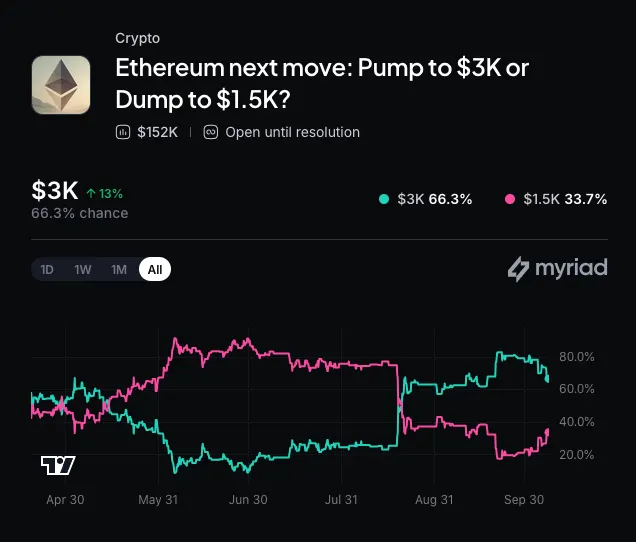
    While Bitcoin broke record after record in 2025, Ethereum only managed to surpass its 2021 all-time high once and couldn’t even break above $5,000.

    Ethereum has been underperforming compared to Bitcoin, and is currently 50% below its all-time high.

    However, according to a new report, Ethereum ($ETH) could also reach triple digits. A new report from Etherealize suggests that $ETH could reach $250,000, catching up with the monetary premium of gold and Bitcoin (BTC).

    A new report from Etherealize, a startup that received investment from Ethereum founder Vitalik Buterin, suggests that Ethereum could surpass $250,000 per $ETH if it catches up to the approximately $31 trillion monetary premium currently held by gold and Bitcoin. However, the report does not provide a target date for the price prediction.

    The report argues that $ETH is unique in the history of money because it is both a store of value and a productive asset.

    The latest price forecast is significantly lower than Etherealize’s previous target of $740,000 per $ETH, which was set in its initial public announcement last year.

    Etherealize co-founder Vivek Raman said, “Ethereum will be the cornerstone of the global financial system. One or two digital assets will prove themselves as a store of value. If one of them is Bitcoin, Ethereum will be another competing asset.”

    The report focuses on maintaining the value of gold and Bitcoin, while acknowledging that $ETH also has the potential to reach that value.

    Furthermore, unlike purely monetary assets such as Ethereum, gold, and Bitcoin, it also possesses real economic activity, such as a burgeoning DeFi, staking, and stablecoin economy.

    This makes Ethereum not only a value asset but also a more attractive investment option.

    $ETH is the first monetary asset to deliver returns without counterparty risk. Throughout human history, you’ve had to choose between holding onto money (stable, inefficient) or investing it in productive assets (risky, wealth-generating). These two categories were mutually exclusive. Ethereum eliminates that divide.”

    *This is not investment advice.