Blog

  • Did Epstein help Israel push for a security deal with Ivory Coast?

    Did Epstein help Israel push for a security deal with Ivory Coast?

    The latest tranche of documents released by the United States Department of Justice on the convicted sex offender and financier Jeffrey Epstein has caused an uproar and a slew of resignations by senior officials and businesspeople across the US and Europe.

    In Africa, the more than three million emails, photos, and videos released on January 23 are also causing some aftershocks as they reveal the extent of Epstein’s connections with prominent African figures, though appearing in the Epstein files does not automatically indicate a crime or wrongdoing.

    Recommended Stories

    list of 3 itemsend of list

    According to the documents, Epstein had ties with former South African President Jacob Zuma; Karim Wade, a politician and son of Senegal’s ex-president Abdoulaye Wade; and deceased Zimbabwean President Robert Mugabe.

    The new files also shed more light on Epstein’s connections to a relative of Ivory Coast President Alassane Ouattara, who appeared to connect the two men. This connection reportedly opened the door for a friend of Epstein’s, Israeli Prime Minister Ehud Barak, to propose a mass surveillance system to Ouattara that would work in the West African country. It is unclear if such a system is in place now.

    Epstein’s possible fixing role culminated in a formal 2014 security deal between the two countries, although the details of it are scant.

    The revelations, in general, underscore the range of Epstein’s influence on powerful figures across continents.

    Epstein, who was first convicted in 2008 on charges of sex trafficking, was found dead by suicide in his prison cell in 2019 while awaiting a trial on sex trafficking charges. His ex-girlfriend and co-conspirator, Ghislaine Maxwell, was convicted and sentenced in 2021.

    Here’s what we know about the Ivory Coast deal and his ties to Africa’s political elite:

    Ivory Coast
    A balloon bearing the image of President Alassane Ouattara floats above supporters during a campaign rally in Koumassi, Abidjan, Ivory Coast, before the 2025 election [File: Misper Apawu/AP]

    Israel and Ivory Coast: The context

    Discussions between Ouattara and Barak appeared to start in mid-2012, after the Ivorian president travelled to Jerusalem for talks with Israeli leaders, presumably in hopes of striking a security agreement. Ouattara met Barak, who was then the Israeli defence minister, and Prime Minister Benjamin Netanyahu.

    Five days before the trip, on June 12, 2012, exiled military officials linked to the Ivory Coast’s former president had attempted to overthrow Ouattara’s government.

    Ouattara’s predecessor, Laurent Gbagbo, had refused to hand over power to Ouattara, and a civil war that killed at least 3,000 people ensued. The fighting had only ended about a year before when UN and French forces intervened and arrested Gbagbo.

    Ouattara’s son, Dramane, and niece, Nina Keita, also met Epstein in New York on the same day, according to the Epstein files. It’s unclear what the parties discussed.

    Keita, a former model, was friends with Epstein and travelled regularly on his private jet, according to the documents. She appeared to have connected Epstein with her uncle, as well as other highly placed Ivorian politicians, according to the documents.

    The files showed that on September 12, three months after Epstein met Ouattara’s son, he again met Keita in New York.

    He met Barak immediately after in a private meeting at the Regency Hotel in New York, according to a schedule published in the files. It’s not known what was discussed.

    In November, Drop Site News reported that Epstein referred to a trip to the Ivory Coast, Angola and Senegal in a note to his assistant, but that there are no flight records to confirm the travels.

    What did Israel propose to Ouattara?

    A month after Ouattara’s travel to Jerusalem, an Israeli delegation visited Abidjan.

    At the meetings, Ouattara reportedly asked about Israeli defence systems to overhaul security in his country, according to reporting by Calcalist, an Israeli publication that covered the exchanges at the time.

    In late 2012, Ivorian Interior Minister Hamed Bakayoko travelled to Tel Aviv for a meeting with Barak, where they discussed a cybersecurity deal, Drop Site News found.

    Then, in spring 2013, Barak, who had now left office as defence minister, travelled to Abidjan himself to converse with Ouattara in what would be their second meeting.

    Barak presented an expensive security defence plan to the president, Calcalist reported. The $150m proposal encompassed border security, army training, and strategic military consulting, the publication said.

    Drop Site News, in an investigation in November, added that the proposal included a mobile and internet surveillance centre, as well as a video monitoring centre.

    The publication cited two sets of documents: an archive of leaked emails released by the Handala hacking group and hosted by nonprofit whistleblower site, Distributed Denial of Secrets, as well as earlier Epstein-linked documents released by the US House Oversight Committee in October 2025.

    Barak’s surveillance centre was to be developed by the French-Israeli private security company, MF-Group, which specialises in surveillance systems, and was to be located in Abidjan, Drop Site News reported.

    Email logs showed Epstein introduced Barak to Ouattara’s chief of staff later in September 2013, and planned a meeting in New York where the two men met.

    Although Ouattara was pleased with the plan, he ultimately did not sign the deal because of the price tag, Calcalist reported.

    Barak, in a response to Calcalist at the time, denied that he offered to build the Ivory Coast an intelligence apparatus. “The claims about establishing an intelligence apparatus and price offers are incorrect. These are private conversations, and the public has no interest in them,” he was quoted as saying.

    ouattara
    Ivory Coast’s President Ouattara being sworn in for another term at the Presidential Palace in Abidjan on December 8, 2025 [File: Sia Kambou/ Reuters]

    What was the final agreement?

    Although the plan appeared to be rejected, both countries continued to forge friendly ties.

    In June 2014, then-Israeli Foreign Minister Avigdor Liberman was welcomed in Abidjan on a state visit.

    Liberman had travelled to the country along with 50 Israeli businesspeople who were interested in investing in the Ivory Coast.

    In a news release at the time, the Ivorian government said two agreements were signed: “One concerning regular consultations between the two countries and the other on defence and internal security.”

    No details were provided. It is not known if Abidjan is using Israeli surveillance security systems.

    Nevertheless, the Israeli-Ivorian security relationship has continued, with the latter buying military vessels, aircraft, and armoured tanks from Israeli weapons companies.

    In 2016, a United Nations report found that Israeli firm Troya Tech Defence had sold weapons and night vision goggles to Ivory Coast in 2015, violating a UN arms embargo that was in place at the time.

    In 2018, an investigation into Israeli spyware Pegasus, developed by the NSO Group, revealed that the malware had targeted journalists’ phones in the Ivory Coast. Pegasus, believed to be used by governments, was found to be operating in 45 countries.

    In March 2023, privately owned Israel Shipyards, which builds naval vessels, delivered two offshore patrol vessels (OPVs) to Abidjan.

    Critics of President Ouattara say the Ivory Coast has slid further from democracy under his rule and point to incidents like the Pegasus scandal, among other issues.

    Former Israeli Prime Minister Ehud Barak gestures after delivering a statement in Tel Aviv, Israel June 26, 2019. [Corinna Kern/Reuters]
    Former Israeli Prime Minister Ehud Barak in 2019 [Corinna Kern/Reuters]

    Did Epstein and Barak strategise about other African countries?

    Barak also tried to leverage the Boko Haram crisis in Nigeria for a security deal, according to Drop Site News, citing the new documents.

    Epstein was aware of Barak’s business deals and advised him on doing business in Nigeria between 2013 and 2020, according to email exchanges.

    Both saw the escalating violence in the West African nation not as a humanitarian crisis, but as a business opportunity, the publication found.

    In June 2013, Barak attended a cybersecurity conference in Abuja, which organisers said privately was a pretext to meet Nigeria’s then-President Goodluck Jonathan.

    It came after Nigeria awarded Israeli firm, Elbit Systems, a controversial contract to surveil digital communications in the country. Public outrage caused Jonathan to consider cancelling the project, but the government never announced that it was withdrawn.

    Barak continued leveraging his access in Nigeria to promote Israeli products and services. In 2015, he facilitated the sale of Israeli biometric surveillance equipment to a private Christian university in Nigeria, Drop Site News found. The university, in a statement, denied the sale.

    In 2020, the World Bank selected Barak’s intelligence firm, Toka, and the Israeli National Cyber Directorate to advise Nigeria on designing its national cyber-infrastructure.

    Epstein, meanwhile, also facilitated high-level access for Sultan Ahmed bin Sulayem, ex-chairman of the Emirati firm DP World. In 2018, Epstein connected bin Sulayem with Jide Zeitlin, then-chair of Nigeria’s sovereign investment fund, for discussions on securing port ownerships in Lagos and Badagry.

    Bin Sulayem, last March, visited Nigeria and proposed that DP World establish industrial parks at Nigerian ports. The proposal has not been approved.

    Jacob Zuma
    Former South African President Jacob Zuma in 2025 [File: Rogan Ward/Reuters]

    Jacob Zuma

    The new files revealed that Epstein had some relations with former South African President Jacob Zuma, who led the country from 2009 until 2018.

    Epstein appeared to arrange a “small dinner” on behalf of Zuma in March 2010 at the Ritz Hotel in London.

    It’s unclear what the purpose of the dinner was, but emails released as part of the Epstein files seemed to show that a Russian model was invited. The model was told her presence would “add some real glamour to the occasion”, according to emails sent by Epstein’s planner, whose name was redacted in the files.

    In a different email, Epstein appeared to share that information with British politician Peter Mandelson, who is now under investigation for his links to Epstein. A host, whose name was redacted “is having dinner for zuma tomorrow night at the ritz„ i have invited a beautiful russina named (redacted) to attend,” he wrote.

    It’s unclear if Mandelson responded.

    After the dinner appeared to have taken place, one email sender whose name was redacted wrote to Epstein: “(Redacted name) was a delight last night and enchanted all those she met…By the way, Jacob Zuma was much more impressive and engaging than I thought he would be!”

    Karim Wade

    Politician and son of Senegal’s ex-President Abdoulaye Wade, Karim Wade’s name appeared 504 times in the released files.

    Wade, under his father, was a minister with an open-ended portfolio, and was so powerful that he was nicknamed “minister of heaven and earth”.

    His relationship with Epstein began in 2010, according to an investigation by the Organised Crime and Corruption Reporting Project (OCCRP), which cited the newly released files.

    In an email to an unnamed contact in November of that year, Epstein wrote: “the President of Senegal is sending his son to see me in paris,” the publication noted. Over the years, they planned trips in Africa along with Emirati businessman, bin Sulayem. They also discussed business ideas, the files showed.

    In 2015, after Wade was convicted on corruption charges by a new administration, records show Epstein approaching Norwegian leader of the Council of Europe, Thorborn Jagland, to ask about possibly filing an appeal at the European Court of Human Rights. Wade’s lawyers regularly updated Epstein on efforts to free him, according to OCCRP.

    Senegal pardoned Wade in 2016, after which he went into exile in Qatar. Keita, niece to Ivory Coast’s President Ouattara, who appeared to play some role in the efforts to free Wade, texted Epstein: “Thank you for everything you have done for him!!!!”

    Robert Mugabe

    The Epstein documents revealed that the sex trafficker planned to meet then-President Mugabe to propose a new currency for Zimbabwe amid that country’s hyperinflation crisis.

    In email exchanges back in 2015, Japanese financier Joi Ito recommended to Epstein that they both approach Mugabe to discuss the currency after the Zimbabwean dollar lost its value. It’s unclear if the meeting ever took place.

    Released along with the emails were FBI documents from 2017, which appeared to show unverified testimony from a “confidential source” who said Epstein was a wealth manager for Russian President Vladimir Putin, as well as Mugabe.


  • F1 driver Doohan says armed men confronted him in Miami after death threats

    F1 driver Doohan says armed men confronted him in Miami after death threats

    Australia’s Jack Doohan says he received death threats before he was dropped by F1 team Alpine, six races into last season.

    Jack Doohan says he received death threats and had to call police to resolve an encounter with armed men at about the time of last year’s Miami Grand Prix, just before he lost his Formula One drive with Alpine.

    The Australian driver said in the latest series of Netflix documentary Drive To Survive, released on Friday, that he had been threatened by email, describing the atmosphere around what proved to be his final race as “pretty heavy stuff”.

    Recommended Stories

    list of 4 itemsend of list

    Doohan made his debut for Alpine in the last race of 2024 and was dropped and replaced by Franco Colapinto after Miami, the sixth race of 2025. He is now a reserve driver for Haas.

    “I got serious death threats for this Grand Prix, saying they’re going to kill me here if I’m not out of the car,” Doohan said in the documentary. “I had six or seven emails saying if I’m still in the car by Miami, that I’ll be, you know, all my limbs will be cut off.”

    Doohan also described an incident where he saw three “armed men”, adding that “I had to call my police escort to come get it under control”.

    He did not specify how that incident was resolved, and did not identify anyone responsible.

    After Colapinto replaced him at Alpine in May, Doohan posted on social media that he and his family had been facing online abuse, and indicated at the time that fans from Colapinto’s home country of Argentina were responsible.

    The duo were the only two drivers in F1 last season not to score a point as Alpine finished last in the constructors’ standings.

  • Chris Hemsworth Says Moving Out of L.A. Was the ‘Greatest Decision’ Because ‘Nothing Was Shooting There’ and ‘You’d Come Home’ to Paparazzi

    Chris Hemsworth Says Moving Out of L.A. Was the ‘Greatest Decision’ Because ‘Nothing Was Shooting There’ and ‘You’d Come Home’ to Paparazzi

    Chris Hemsworth appeared on a recent episode of the “SmartLess” podcast while continuing to promote his latest movie, Amazon MGM’s “Crime 101,” and spoke honestly about his decision to move out of Los Angeles with his family during the height of his Marvel fame. Hemsworth and his wife, actor Elsa Pataky, were five years into their marriage when they decided to leave L.A. and relocate their family to Hemsworth’s home country of Australia.

    “It was right around the time my boys were born, and it was just, we kind of were set up in L.A. and not enjoying it, you know?” Hemsworth said. “Like nothing was shooting there. We were filming kind of everywhere else and then… you’d come home and paparazzi and all the sort of the trappings of, you know, living in that space.”

    Hemsworth said moving out of L.A. was the “greatest decision,” one that did not disrupt his professional career as an actor since he was also traveling elsewhere to shoot a lot of his projects.

    “You know, when you come back from work, you wanna go on a holiday? Like coming home for me is — it feels like a holiday,” Hemsworth said of living in Australia. “We have a big farm and horses and motorbikes and surf.”

    The actor’s exodus from Hollywood was years before the COVID pandemic, and Hollywood strikes even further reduced the amount of productions being shot in Los Angeles. As Variety reported last month, L.A. production days for film, TV and commercials fell 12.3% in the final quarter of 2025 compared to the previous one. That continued a downward trend that has persisted since 2022. For 2025 overall, production volume was about half what it was in 2019.

    Hemsworth made his Marvel debut as Thor in 2011, two years after his Hollywood debut as George Kirk in J.J. Abrams’ 2009 “Star Trek” reboot. He had three Marvel sequels (“The Avengers,” “Thor: The Dark World” and “Avengers: Age of Ultron”) under his belt when he decided to leave L.A. for Australia. He continued to act in major Hollywood productions like 2016’s “The Huntsman: Winter’s War” and “Ghostbusters.” Hemsowrth will be back as Thor at the end of this year with December’s “Avengers: Doomsday.”

    Listen to Hemsworth’s full interview on the “SmartLess” podcast in the video below.

  • Bruno Mars Makes a Leisure Suit of a Record With ‘The Romantic,’ Doubling Down on Silk Sonic’s Hermetically Sealed ’70s Revivalism: Album Review

    Bruno Mars Makes a Leisure Suit of a Record With ‘The Romantic,’ Doubling Down on Silk Sonic’s Hermetically Sealed ’70s Revivalism: Album Review

    When it rains reigning male pop superstars, it pours. The boys are back in town, and two of the three or four biggest guys in the recording business, Bruno Mars and Harry Styles, are coincidentally releasing albums on back-to-back weekends, as if teaming up to storm the barricades mostly held in recent years by pop’s girl bosses. So it’s interesting to see what these two alphas are bringing along as stylistic arsenals in their attempts to reassert some dominance, or at least parity. Coming next week is Styles’ intriguingly titled “Kiss All the Time. Disco, Occasionally,” and we’ll find out soon enough whether Harry means to use the D-word there literally or just figuratively.

    But for Mars’ first solo album in 10 years, “The Romantic,” it is as if disco never happened. It is a time machine back to the mid-1970s, just before dance music took over, with a heavy, heavy emphasis on retro-soul balladry. The album ends with a song called “Dance With Me,” but it’s a song dedicated to slow dancing, just like the surprisingly slow-simmering track that opens the album. When the pace does get upped a couple of times, it’s to bring us up to the tempo of the O’Jays, not to snap us back to the time of J. Cole. There’s not a moment on the whole nine-song collection that sounds like it was minted any more freshly than 1976. It’s already been well-established that the album’s first single (and one of its few bangers), “I Just Might,” reminds folks a little of Leo Sayer’s “You Make Me Feel Like Dancing,” which came out that year. So, truly, here, Mars is Bicentennial Man.

    Given how unhappy many people are with 2026, a trip headed exactly 50 years back into the past will be a welcome ride for a lot of hitchhikers. But will you ultimately find “The Romantic” compelling as anything much more than a mood ring… er, mood piece? The best predictor for that will be how much you loved or liked “An Evening With Silk Sonic,” the similarly throwback album Mars put out with Anderson .Paak four and a half years ago. (How time flies when you’re arresting it!) Paak has moved on, but Mars is remaining committed to the bit — really, really committed. It takes some nerve, after a full decade of not putting out a solo album, when that last solo record was a Grammy winner for album of the year (“24k Gold”), to return with something that is completely beholden to styles that went out of fashion before you were born. But it’s slightly less nervy if you think of it more in terms of sticking with the formula that last brought you an album-sized smash. This is “Silk Sonic II,” for most intents and purposes.

    I am part of the target audience for “The Romantic,” as an admitted nostalgist who thinks the 1970s was a golden era for just about everything but gas lines. But I’m also not part of the target audience, inasmuch as I don’t prefer the homages to past eras to be completely hermetically sealed, without even slight nods to what has transpired since, let alone an attempt to bring them a little bit into the future. I think “The Romantic” is actually better than “An Evening With Silk Sonic,” in several quantifiable ways, including its bold emphasis on ballads, where you really get to hear Mars test what he can do with those pipes, which is a lot. And there’s something even craftier about how well he, his extremely talented co-producer, D-Mile, and his band, the Hooligans, have replicated the exact feel of a great era in record-making. But, among these two albums, it does have the disadvantage of coming second. The album is great as a stunt, but, slightly refined or not, it’s the second time in a row doing what amounts to the same stunt. You can admire his ability to reverse-engineer the cool sounds of his forefathers, but that doesn’t mean you’re going to be moved by it.

    Especially when, once you get past admiring the encyclopedic knowledge of ’70s flourishes, you realize there’s not really much in the way of great songs here. Nearly everything sounds like a possible candidate for a followup single to “I Just Might,” but nothing jumps out as the pick. There’s actually a decent amount of sub-genre variation from song to song, but emotionally, it’s kind of a flat-line, with the most perfunctory lyrics you will hear on any album this year. There never seems to be even a remote possibility that Mars is telling us anything about his real life amid all the fill-in-the-blank cliches (“The fire don’t burn like it used to, girl”; “Let’s go to the moon a little later / Hope your wings get to fly”; “Turns out you don’t need a rocket ship, no / To find your own shooting star”). So, in the age of hyper-autobiographical pop, “The Romantic” feels weirdly and completely impersonal, unless you consider extreme pastiche a personality. It’s like a fun costume party where you never find out who actually attended. Although, to be fair, Curtis Mayfield is a hell of a mask, right?

    One thing that’s kind of interesting, though, is a Latin current that ebbs and flows through a few pieces of the record, starting with the album cover itself, which features hand-written lettering that is meant to remind oldsters of a golden age of Chicano rock. The first couple of tracks seem to be headed toward a concept album in that direction. “Risk It All” is the aforementioned kick-off that really does feel like a bit of a risk, not just because it starts off the album on a slow, pleading note with acoustic guitar plucking and some of Mars’ most supple vocals. There are horns through a lot of the record, but in this number, they’re played as mariachi horns. (It also has arguably the album’s most vapid lyrics — “I would swim across the sea just to show you / Sacrifice my life just to hold you,” et al. — but never mind those.) He ups the Latin quotient with the tenser rhythms and strings and congas of the second track, “Cha Cha Cha”; maybe the title is a giveaway. (On the non-Latin tip, it also interpolates Juvenile’s’s 2004 “Slow Motion,” a nice combo.) But these Latin flavors turn out not to be a constant through the rest of the album. They do return in one of the most up-tempo tracks, “Something Serious,” a fairly direct cop of “Oye Como Va,” which is fun until you start thinking about how the chorus is not that special and you’d rather be listening to “Oye Como Va.”

    After the third number, “I Just Might,” snaps you to attention with its booty-shake-or-go-home machismo, the fourth, “God Was Showing Off,” is when it really settles into the groove where Mars is most comfortable these days, bridging the gap between Motown and Philly soul. “Why You Wanna Fight?” almost sounds like a parody of some of these genres, with a backing chorus repeatedly and dramatically cooing whyyouwannafight as a single word, in-between the singer’s more extenuated phrases. “On My Soul” and “Nothing Left” bring in some welcome electric guitar licks. Most of the tracks that follow will make you think of the kind of vintage Top 40/AC soul where it’s summertime and the listenin’ is EZ.

    Overall, it’s an album that seems designed to be background music, which is not entirely meant as an insult; there’s an art to making music that can be put on at literally almost any party and suit the tastes of grandmas as well as kids, and serve that function for a couple of years or more. But if you were planning to foreground “The Romantic,” this one may have a more limited shelf life. As a leisure suit of a record, this is not really album-of-the-year material, like “24K Magic” was. It’s not even meant to be that kind of tour de force, to be fair, but it’s also probably not meant to be quite this in-one-ear-and-out-the-other. How can vocals be as bountifully impressive as Mars’ are here and still leave you thinking that there’s no lived experience in any of the songs?

    This really is a “romantic” album, but what’s missing is the sensation that the material has any tangible connection to actual love. Unless love for early Kool & the Gang counts.

  • Pokémon Winds and Waves are coming to Switch 2 in 2027

    The Pokémon leakers were right: the Gen 10 games are called Pokémon Wind and Pokémon Waves. The Pokémon Company confirmed the titles during a 30th anniversary stream on Pokémon Day. The games are set to hit Nintendo Switch 2 in 2027. (A Game Freak leak last October suggested Wind and Waves would be out this year with DLC to follow in 2027.)

    According to the Pokémon account on X, in Wind and Waves, “you’ll travel across beautiful windswept islands and a vast ocean with glittering waves that ebb and flow. You’ll also team up with Pokémon to overcome challenges and even the forces of nature!” They’ll be playable in 11 languages, including Brazilian Portuguese.

    A trailer for the two games revealed the three new starter Pokémon: Browt, Pombon and Gecqua. As suggested by their colors and environments they’re shown in, they are grass, fire and water types, respectively. Other Pokémon that were featured include Pikachu (sporting fetching beachwear) and Oddish. The trailer, which reveals a new region for the series, ends by taking us into the ocean to gawk at an number of water Pokémon.

    The Pokémon Presents stream on Friday included updates for many other games in the franchise, including the battle-focused Pokémon Champions (a modern spin on the likes of Pokémon Stadium). That will debut on Nintendo Switch in April before arriving on iOS and Android later this year. Cross-play will be available between the three platforms. It was also confirmed that Pokémon XD: Gale of Darkness will hit the GameCube library on Nintendo Switch Online + Expansion Pack on Switch 2 in March.

    Pokémon Day marks the 30th anniversary of the series’ debut with the 1996 release of Pocket Monsters Red and Pocket Monsters Green (later released as Pokémon Red and Pokémon Blue in the West) on Game Boy in Japan. The games were remade for GameBoy Advance in 2004 as Pokémon FireRed Version and Pokémon LeafGreen Version. Starting today, those are available on Switch and Switch 2 for $20 each. Meanwhile, Pokémon Pokopia, a cozy life sim spin-off, will hit Switch 2 on March 5.

  • Celebrate Pokémon’s 30th anniversary with this Game Boy-shaped music player

    Celebrate Pokémon’s 30th anniversary with this Game Boy-shaped music player

    Pokémon celebrates its 30th anniversary today, and as you’d expect, Nintendo and The Pokémon Company are cranking up the nostalgia in every possible way. In addition to re-releasing the Game Boy Advance remakes of Pokémon Red and Blue on Nintendo Switch Online, they’re also selling us a Game Boy-shaped portable Pokémon jukebox.

    Officially titled the Pokémon Game Music Collection, the little music player is palm-sized and can be loaded up with 45 different cartridges, each featuring a different melody or sound effect from the original games’ soundtrack. The device was announced by longtime series composer Junichi Masuda during today’s anniversary Pokémon Presents livestream, where he said that special care has gone into the audio sounding like it did on the Game Boy.

    Each cartridge also features a screenshot from the games, so when you slide it into the device’s display slot it looks like you’re playing as well as listening. Put one of these next to last year’s equally charming Lego Game Boy on a shelf and you’ve got two entirely non-playable replicas of the iconic handheld, which is sure to confuse and disappoint your guests in equal measure.

    The Pokémon Game Music Collection is available to buy from Pokémon Center starting today, but US pricing is yet to be confirmed.

  • New Day, New Ethereum Price Warning — But Why Is $1 Billion Still Betting Higher?

    New Day, New Ethereum Price Warning — But Why Is $1 Billion Still Betting Higher?

    Ethereum price is down about 1.4% over the past 24 hours, extending its broader weakness. At first glance, this looks like a routine pullback inside a consolidation phase. But this decline did not appear randomly. It came right after a warning signal flashed on the daily chart, suggesting the recent recovery may already be losing steam.

    What makes this moment unusual is the reaction from traders. Instead of reducing risk, leveraged long positions have surged past $1 billion. This creates a dangerous contradiction. The same conditions that are warning of a deeper drop are also attracting aggressive bullish bets. This disconnect could now decide Ethereum’s next major move.

    Bearish Divergence And Supply Cluster Are Now Pointing To The Same Risk

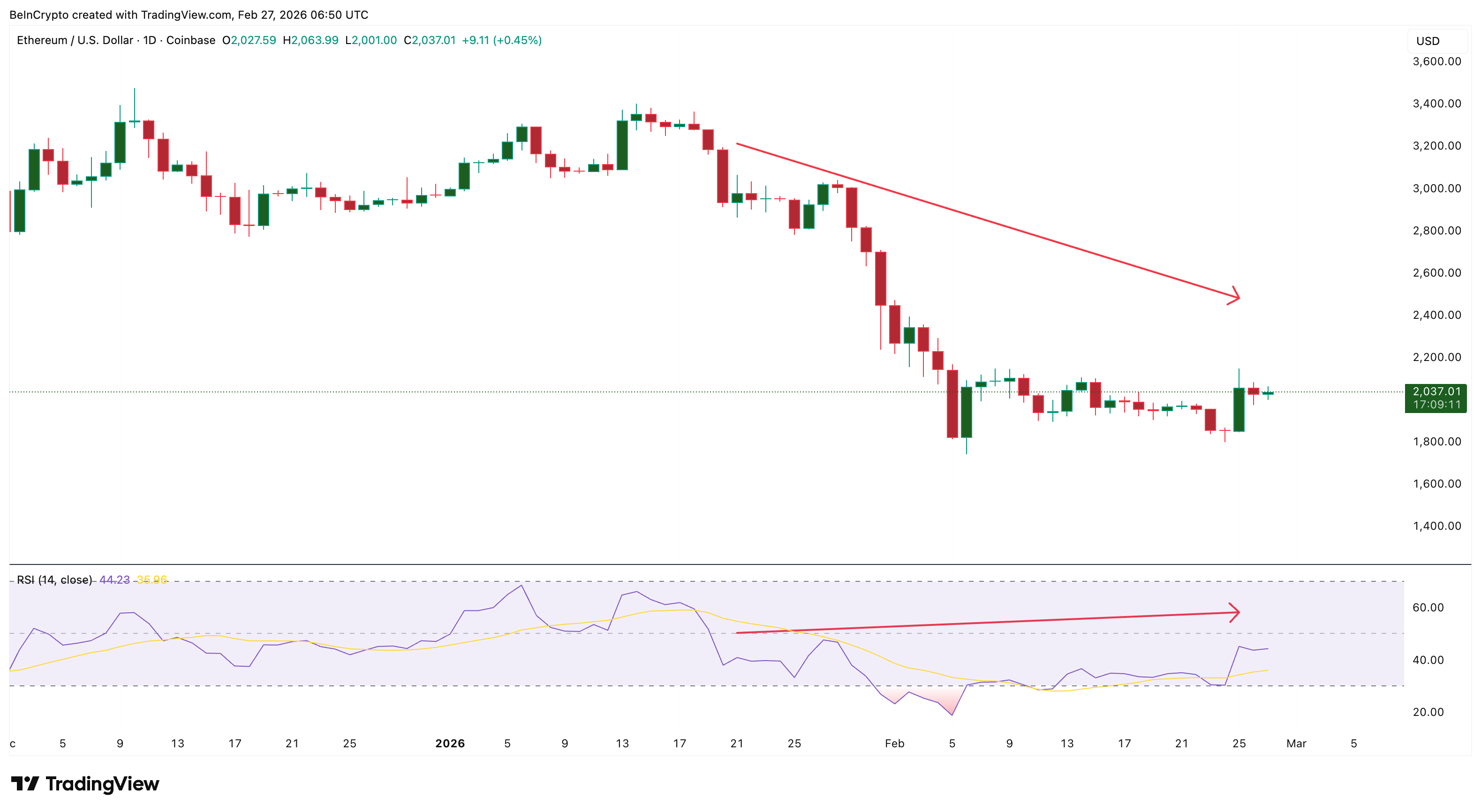
    The first warning sign appeared through a hidden bearish divergence on the daily chart. Between January 21 and February 25, the Ethereum price formed a lower high. This means the recent recovery was weaker than the previous rally, confirming the broader downtrend remains intact.

    At the same time, the Relative Strength Index (RSI), which measures momentum strength, formed a higher high. This creates a hidden bearish divergence. This pattern usually appears during downtrends and signals that the recovery is only temporary, with the larger decline likely to continue.

    Hidden Bearish Divergence

    Hidden Bearish Divergence: TradingView

    Want more token insights like this? Sign up for Editor Harsh Notariya’s Daily Crypto Newsletter here.

    This signal becomes more important because Ethereum is already down about 32% over the past 30 days. That confirms the broader structure remains bearish. Now, on-chain data shows where this pullback could accelerate.

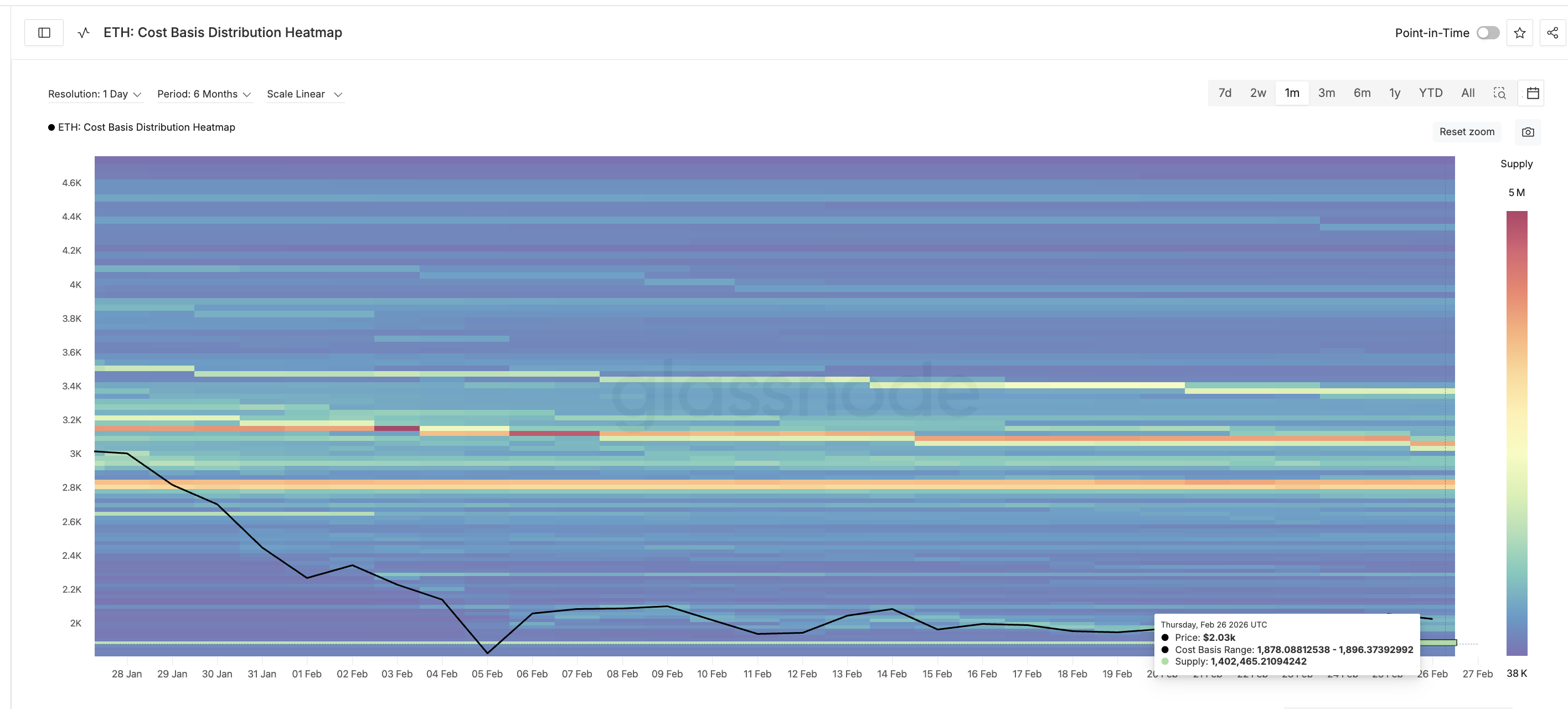
    The Ethereum cost basis heatmap reveals a major support cluster between $1,870 and $1,890. Around 1.40 million $ETH was accumulated in this range. This level is important because it represents the average buying zone for a large group of holders.

    These holders are still in profit at current prices. But if Ethereum falls into this zone while fear increases, many may sell to protect their gains. This could weaken support and allow the pullback to deepen.

    Cost Basis Cluster: Glassnode

    This makes the divergence warning more dangerous as a key support lies nearby.

    Whale Selling And $1 Billion Long Exposure Create A Dangerous Conflict

    At the same time, large holders are starting to show caution.

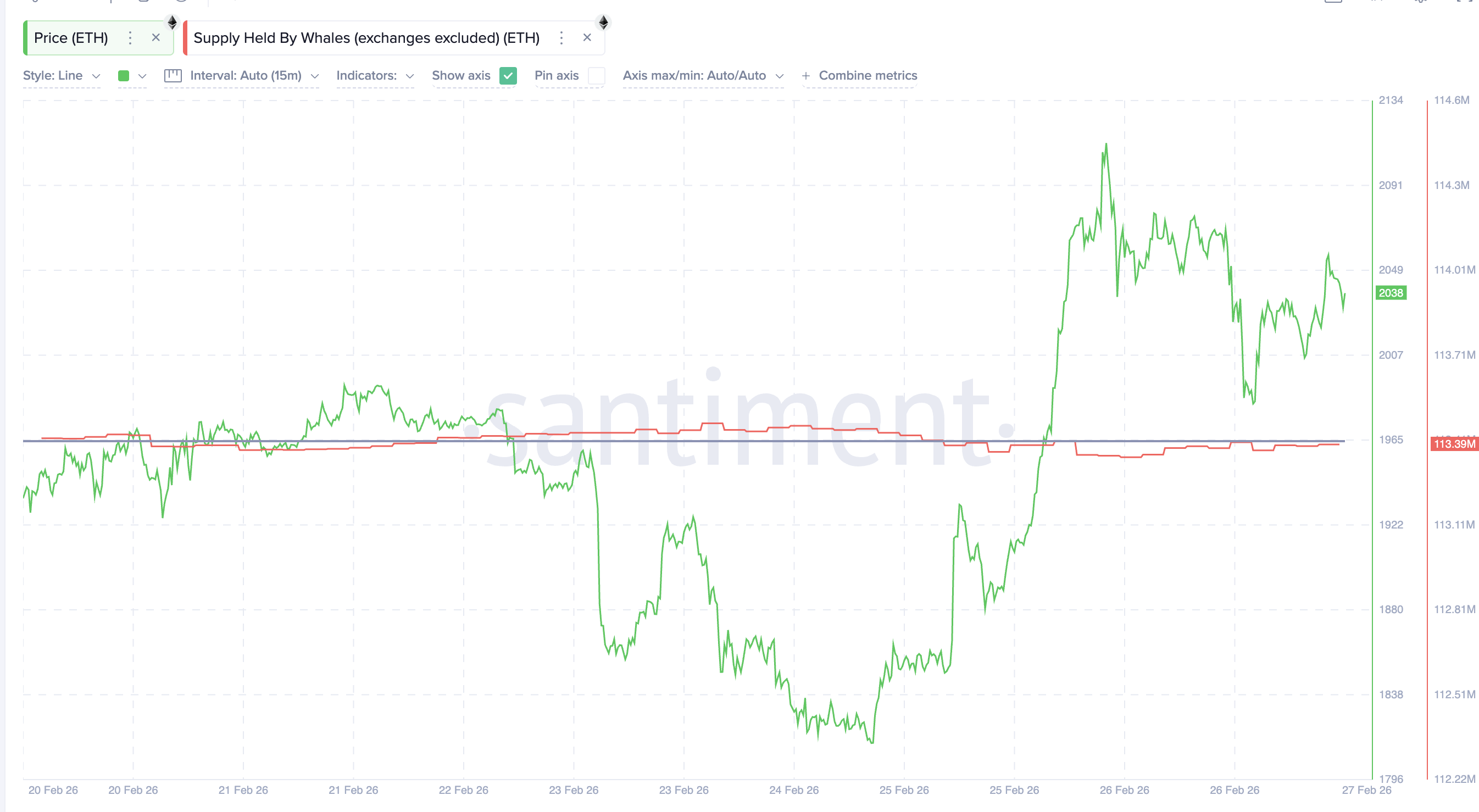
    Ethereum supply held by whales has dropped slightly from 113.41 million $ETH on February 25 to 113.39 million $ETH now. This is not a large drop, somewhere in the $40 million range, but it confirms that whales are no longer aggressively accumulating.

    This matters because whale activity often signals future price direction. When whales stop buying or begin selling, it weakens market confidence. But derivatives traders are reacting in the opposite way.

    <span class=$ETH Whales”>

    $ETH Whales: Santiment

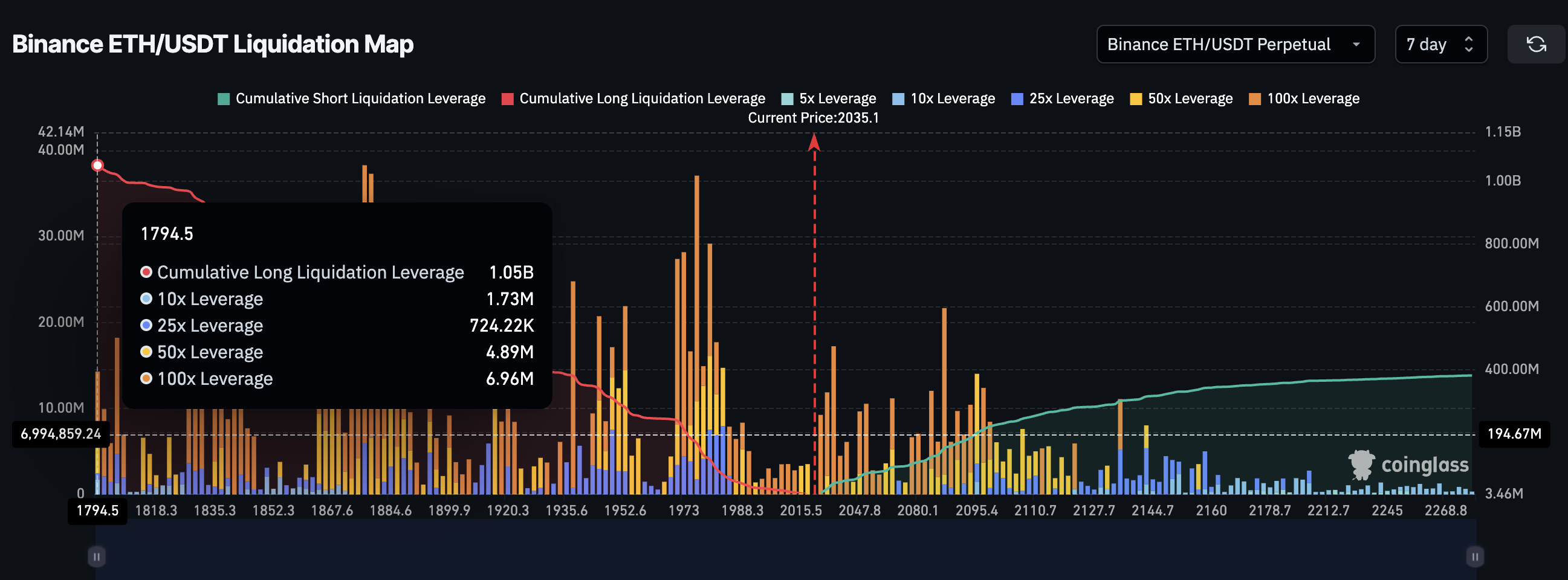
    Binance liquidation data shows cumulative long leverage has crossed $1 billion. Short leverage, in comparison, sits near $382 million. This means long exposure is nearly three times higher. Even more importantly, nearly $697 million of long leverage is concentrated near $1,870. Per the map, the risk starts developing if the $ETH price drops under $2,015.

    Liquidation Map

    Liquidation Map: Coinglass

    This level aligns almost perfectly with the cost basis cluster starting near $1,870. This creates a high-risk situation.

    If Ethereum falls into this zone, holders may begin selling while leveraged long positions are forced to close. These forced liquidations would push the price even lower and accelerate the correction. That risk could be the reason why whales have stepped back, for now.

    But despite these risks, traders are still betting on a breakout. The reason becomes clear in Ethereum’s price structure itself.

    Ethereum Price Structure Explains Both The $2,600 Hope And The Breakdown Risk

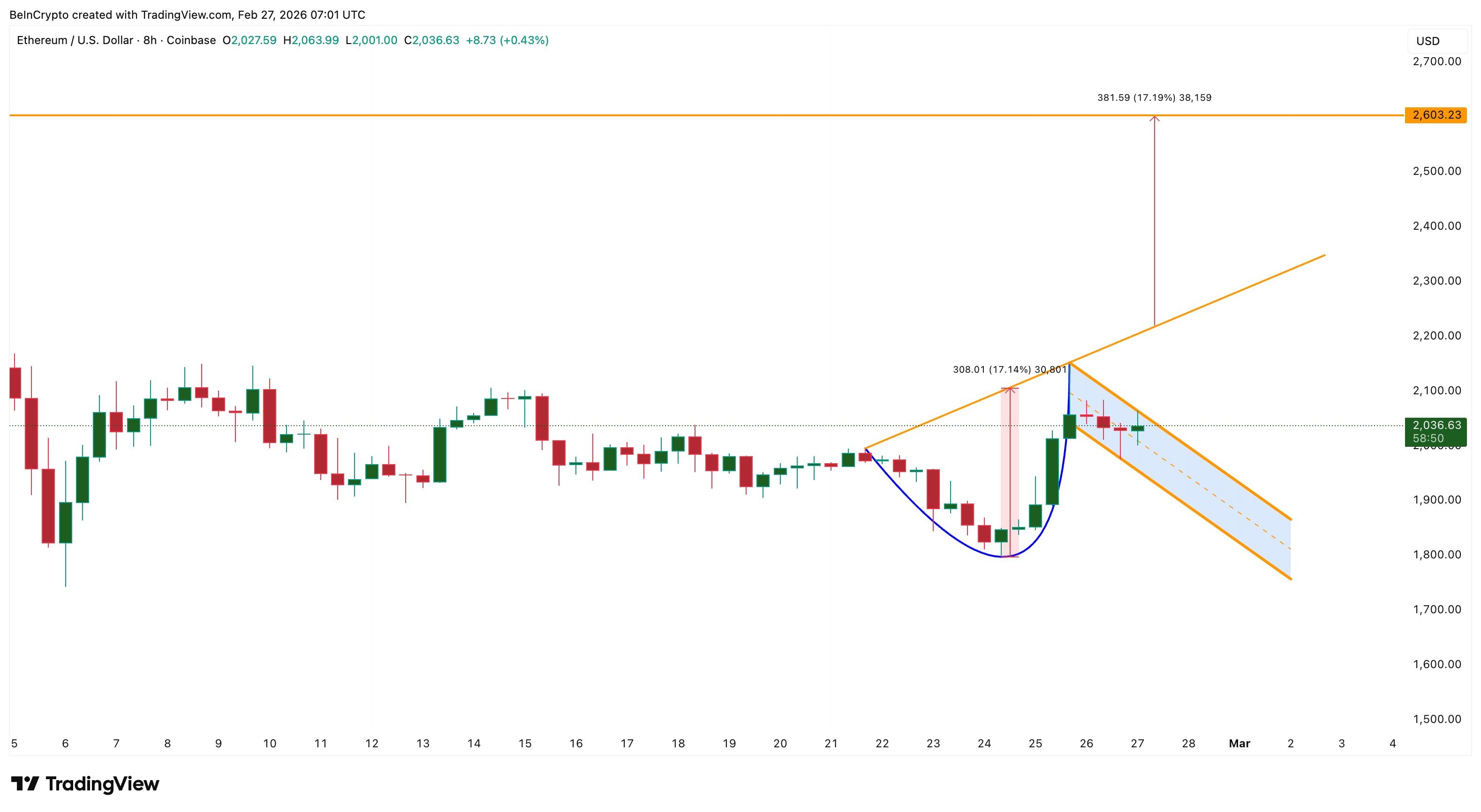
    Ethereum’s recent price structure is creating the optimism that derivatives traders are betting on. On the 8-hour chart, Ethereum is forming a cup and handle pattern. This is a bullish structure that often appears before upward breakouts.

    The handle is forming now as a consolidation phase, something that the traders might be considering as a lull before the breakout.

    The neckline of this pattern is sloping upward. An upward-sloping neckline strengthens breakout expectations, provided the price can break past key resistance levels. The critical ones are now revealed by the technical projections.

    <span class=$ETH Price Structure”>

    $ETH Price Structure: TradingView

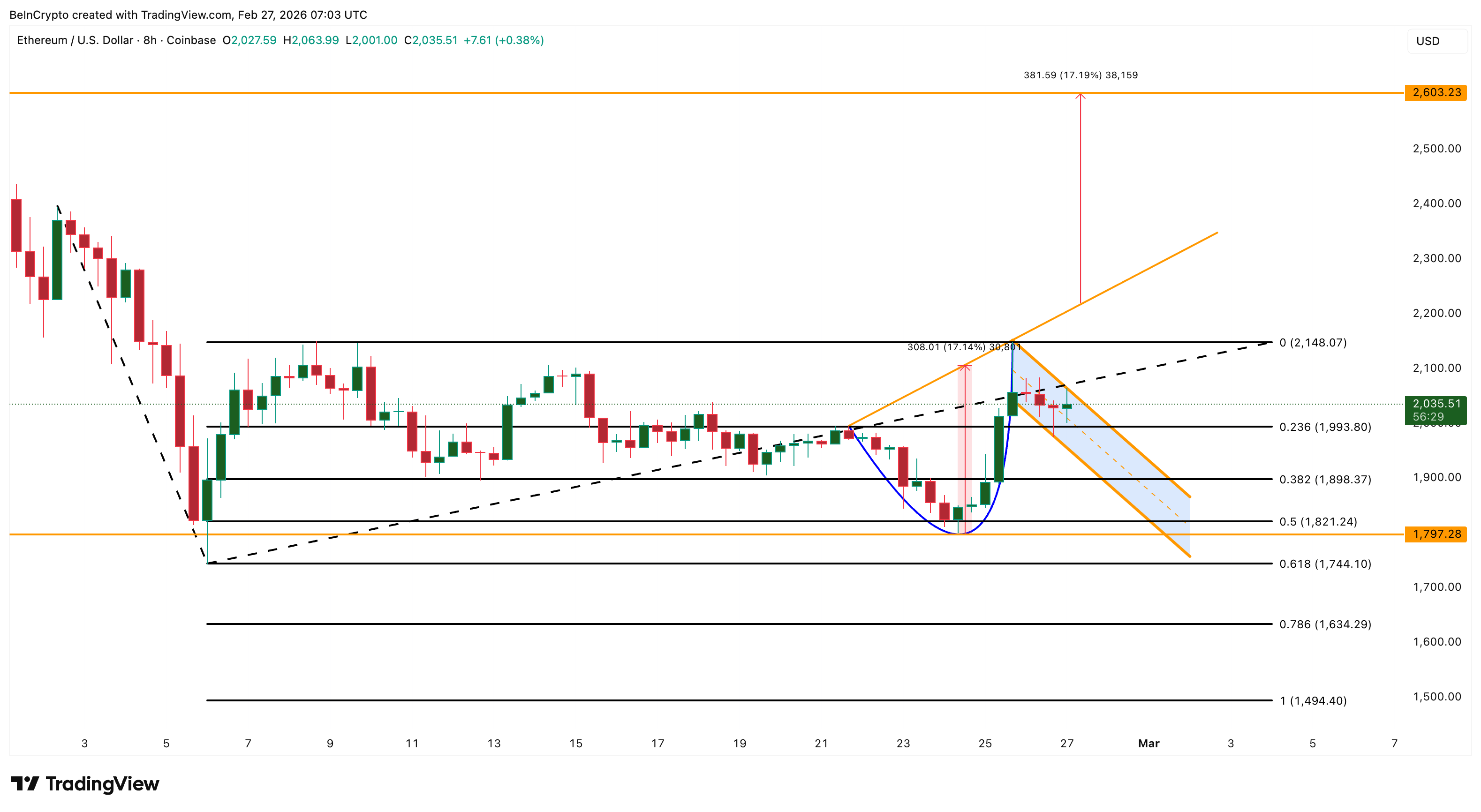
    If Ethereum breaks above $2,140, the pattern breakout hopes rise. While the neckline will still be at a distance, the hopes of a 17% rally toward $2,600 would surface. This upside potential possibly explains why traders continue opening long positions despite growing warning signs.

    But this optimism depends entirely on Ethereum holding its support levels. If Ethereum falls below $1,990, weakness begins increasing, although the pattern still survives.

    A drop below $1,890 would become much more serious. This level sits directly at the top of the cost basis cluster between $1,870 and $1,890. Losing this zone would weaken holder confidence and expose Ethereum to a deeper decline.

    Below $1,820, the bullish structure would begin failing. If Ethereum falls below $1,790, the cup and handle pattern would be invalidated completely. This would remove the bullish setup and could trigger large-scale long liquidations.

    Ethereum Price Analysis

    Ethereum Price Analysis: TradingView

    That is why the same price structure attracting $1 billion in bullish bets is also sitting directly above the most dangerous breakdown zone. Recovery is still possible. But Ethereum must break above $2,140 first. Until then, Ethereum remains stuck between breakout hope and breakdown risk.

    The post New Day, New Ethereum Price Warning — But Why Is $1 Billion Still Betting Higher? appeared first on BeInCrypto.

  • US Judge Rejects Binance’s Arbitration Request in Case Involving 7 Altcoins! Here Are the Details

    US Judge Rejects Binance’s Arbitration Request in Case Involving 7 Altcoins! Here Are the Details

    Binance received bad news from the US. A US judge rejected Binance’s arbitration request.

    District Judge Andrew Carter of the Southern District of New York ruled that Binance does not have the authority to compel U.S. users to arbitrate for damages arising from cryptocurrency purchases made on its platform before February 20, 2019.

    However, the judge ruled that the ongoing class action lawsuit would be heard publicly in federal court.

    Therefore, customers who accuse Binance of selling unregistered tokens will be able to pursue damages claims arising before February 20, 2019, in court.

    The judge, in his review, found that Binance unilaterally updated its Terms of Use in 2019, amending the terms to include a waiver of the right to arbitration and the right to class action, without notifying customers of this change.

    The ruling also stated that there was no evidence that Binance had announced the arbitration order or explained to customers where this order could be found in its terms of use.

    According to the judge, since the terms of use in 2017 did not include arbitration or class action waiver provisions, the changes made in 2019 cannot be applied retroactively to claims relating to periods prior to that date.

    The class-action lawsuit known as Williams v. Binance was filed by five US investors from California, Nevada, and Texas, alleging that Binance and its founder, CZ, illegally sold unregistered securities and failed to register as brokerage firms. The lawsuit was dismissed in 2022, but in 2024 the US Second Circuit Court of Appeals remanded it back to the lower court.

    In the retrial, Judge Carter rejected Binance’s request for arbitration, while Binance stated that the plaintiffs had voluntarily withdrawn claims arising after February 20, 2019, and that the company would continue to defend against the remaining claims.

    This decision allows users to file lawsuits for damages incurred before February 20, 2019, and for the case to be heard publicly. Altcoins named in the lawsuit include ELF, EOS, FUN, ICX, OMG, QSP, and TRX.

    *This is not investment advice.

  • Got a Public Amazon Wishlist? Upcoming Change Could Reveal Your Address

    Got a Public Amazon Wishlist? Upcoming Change Could Reveal Your Address

    Honest, Objective, Lab-Tested Reviews

    PCMag.com is a leading authority on technology, delivering lab-based, independent reviews of the latest
    products and services. Our expert industry analysis and practical solutions help you make better buying
    decisions and get more from technology.

  • ‘Jestermaxxing’ is bizarre new trend following on from people hitting their faces with hammers

    ‘Jestermaxxing’ is bizarre new trend following on from people hitting their faces with hammers

    Jestermaxxing is the latest term to make its way onto the internet, with the bizarre trend yet another that’s come about thanks to the manosphere.

    If you’re fortunate enough to not be aware of the strange culture which is affecting young men across the world, then buckle up, because I’m about to explain this bizarre trend as best as I can.

    Essentially, streamers online are attempting to influence young men into believing that violence against women is justified because women are ‘evil’, with their value as a human entirely dependent on their attractiveness, which is obviously nonsense, but some men are lapping it up because of their struggles with the opposite sex. The worrying trend is also explored in the hit Netflix series Adolescence.

    This sometimes involves coming up with strange new words, whether it’s ‘looksmaxxing’ which gives you terrible advice about looking your best, while ‘framemogging’ involves looking more muscular than another man.

    One thing those in incel culture aren’t too keen on is ‘jestermaxxing’, which essentially involves having fun and cracking jokes as a way of making yourself seem more entertaining, with some influencers in the manosphere warning against having fun at all costs.

    Jestermaxxing is the real key to romantic success (Getty Stock)

    Jestermaxxing is the real key to romantic success (Getty Stock)

    While it might be frowned upon in incel culture, jestermaxxing sounds alarmingly similar to my method with the opposite gender for most of my adult life, although obviously my devilish good looks also helped in landing me such a wonderful partner.

    Certainly, most sensible folks would argue that acting silly and making a woman laugh is far more likely to increase her attraction to you than admitting to hitting yourself in the face with a hammer, but that ridiculous tactic is seen as transformative by some of the main authorities in the manosphere.

    That’s exactly what popular streamer Clavicular has been recommending recently, with the young American applying Wolff’s Law in completely the wrong way, as he claims that controlled stress to his cheekbones is the best way of ‘looksmaxxing’ – yet another strange trend that this internet group seems to abide by.

    This is not going to make you better looking (Kick/Clavicular)

    This is not going to make you better looking (Kick/Clavicular)

    In a Kick video, he can be heard telling a bemused police officer: “Do you guys know about bone-smashing? It’s according to Wolff’s Law, so when you break down a bone it grows back stronger. So I’m trying to grow my cheekbones.”

    Naturally, if you want to have a successful and healthy relationship, you should probably do the exact opposite of what the likes of Andrew Tate and HSTikkyTokky are suggesting, given a significant percentage of their content revolves around hating women.

    However, a quick glance at Clavicular’s content seems to suggest that he’s shifted his focus in recent weeks, with the streamer more open to the idea of ‘jestermaxxing’ and actually enjoying his life. Good for him I say.