Blog

  • Jeff Probst Explains Why the Official ‘Survivor’ Podcast Is on Hiatus for Season 50

    Jeff Probst Explains Why the Official ‘Survivor’ Podcast Is on Hiatus for Season 50

    The official “Survivor” podcast is hitting pause for Season 50.

    “‘Survivor’ 50 was designed as a celebration, and it features one of the most exciting game designs we’ve ever done,” Probst said in a statement to Variety. “Because of that, we made a conscious decision not to immediately pull back the curtain while it was happening. We wanted fans to discover it on their own and experience it in real time. Then at the live finale, we’ll have the opportunity to reflect on all parts of the season together.”

    “On Fire With Jeff Probst” debuted at the start of Season 44 in 2023. Each week, directly after a new episode aired on CBS, a new episode would reveal Probst giving listeners a look behind the curtain at the making of “Survivor,” sharing his view as the executive producer, showrunner and host.

    Rick Devens joined Probst and producer Jay Wolff as co-host for Season 45; Dee Valladares co-hosted for 46; Charlie Davis joined for Season 47; Rachel LaMont took over for 48; and Jeremy Collins joined for 49.

    “Survivor” 50 premiered on Feb. 25 and averaged 5.06 million viewers over its three-hour debut — the biggest same-day audience for Season 45’s penultimate episode in December 2023. It became CBS’ best Wednesday night performance since the Season 42 finale of “Survivor” in 2022.

    The milestone “Survivor” is a huge one for CBS and Probst, as they introduce new twists, fan voting and celebrity twists. During the premiere, a Billie Eilish idol was revealed; a Jimmy Fallon twist and integration of Zac Brown and Mr. Beast will come later in the season — but the game won’t change, Probst promises.

    “I think it’s a legitimate concern when you start adding layers like celebrities, that they can overshadow the game and take it off course,” he told Variety. “Our job was to make sure that we stayed true to what we’re doing on ‘Survivor,’ which is exploring this continuous social experiment. And now we’re adding another layer.”

  • FCC approves the merger of cable giants Cox and Charter

    FCC approves the merger of cable giants Cox and Charter

    The Federal Communications Commission has given the go ahead for two of the US’ biggest cable providers, Charter Communications and Cox Communications, to merge. Charter announced its intention to acquire Cox for $34.5 billion in May 2025, with specific plans to inherit Cox’s managed IT, commercial fiber and cloud businesses, while folding the company’s residential cable service into a subsidiary.

    “By approving this deal, the FCC ensures big wins for Americans,” FCC Chairman Brendan Carr said in a statement. “This deal means that jobs are coming back to America that had been shipped overseas. It means that modern, high-speed networks will get built out in more communities across rural America. And it means that customers will get access to lower priced plans. On top of this, the deal enshrines protections against DEI discrimination.”

    The FCC claims that Charter plans to invest “billions” to upgrade its network following the closure of the deal, leading to “faster broadband and lower prices.” The company’s “Rural Construction Initiative” will also extend those improvements to rural states lacking in consistent internet service, a project the FCC was heavily invested in during the Biden administration, but has been pulling back from since President Donald Trump appointed Carr. The FCC also claims Charter will onshore jobs currently handled off-shore by Cox employees and commit to “new safeguards to protect against DEI discrimination,” which essentially amounts to hiring, recruiting and promoting employees based on “skills, qualifications, and experience.”

    While Carr’s FCC paints a rosy picture of Charter’s acquisition, history has provided multiple examples of mergers having the opposite effect on jobs and pricing. For example, redundancies created when T-Mobile merged with Sprint in 2020 led to a wave of layoffs at the carrier. And funnily enough in 2018, not long after Charter’s merger with Time Warner Cable was approved by the FCC, the company raised prices on its Spectrum service by over $91 a year.

    The FCC’s obsession with diversity, equity and inclusion as part of the deal is stranger, if only because it appears to fall outside of the commission’s purpose of maintaining fair competition in the telecommunications industry. It does fit with other mergers the FCC has approved under Carr, however. Skydance’s acquisition of Paramount was approved in 2025 under the condition it wouldn’t establish any DEI programs.

  • Trump orders federal agencies to drop Anthropic services amid Pentagon feud

    Trump orders federal agencies to drop Anthropic services amid Pentagon feud

    President Donald Trump has ordered all US government agencies to stop using Claude and other Anthropic services, escalating an already volatile feud between the Department of Defense and company over AI safeguards. Taking to Truth Social on Friday afternoon, the president said there would be a six-month phase out period for federal agencies, including the Defense Department, to migrate off of Anthropic’s products.

    “The Leftwing nut jobs at Anthropic have made a DISASTROUS MISTAKE trying to STRONG-ARM the Department of War, and force them to obey their Terms of Service instead of our Constitution,” the president wrote. “Anthropic better get their act together, and be helpful during this phase out period, or I will use the Full Power of the Presidency to make them comply, with major civil and criminal consequences to follow.”

    Before today, US Defense Secretary Pete Hegseth had threatened to label Anthropic a “supply chain risk” if it did not agree to withdraw safeguards that insist Claude not be used for mass surveillance against Americans or in fully autonomous weapons. In a post on X published after President Trump’s statement, Hegseth said he was “directing the Department of War to designate Anthropic a Supply-Chain Risk to National Security. Effective immediately, no contractor, supplier, or partner that does business with the United States military may conduct any commercial activity with Anthropic.”

    Anthropic did not immediately respond to Engadget’s comment request. Earlier in the day, a spokesperson for the company said the contract Anthropic received after CEO Dario Amodei outlined Anthropic’s position made “virtually no progress” on preventing the outlined misuses.

    “New language framed as a compromise was paired with legalese that would allow those safeguards to be disregarded at will. Despite DOW’s recent public statements, these narrow safeguards have been the crux of our negotiations for months,” the spokesperson said. “We remain ready to continue talks and committed to operational continuity for the Department and America’s warfighters.”

    Advocacy groups like the Center for Democracy and Technology (CDT) quickly came out against the president’s threats. “This action sets a dangerous precedent. It chills private companies’ ability to engage frankly with the government about appropriate uses of their technology, which is especially important in national security settings that so often have reduced public visibility,” said CDT President and CEO Alexandra Givens, in a statement shared with Engadget. “These threats undermine the integrity of the innovation ecosystem, distort market incentives and normalize an expansive view of executive power that should worry Americans all across the political spectrum.”

    For now, it appears the AI industry is united behind Anthropic. On Friday, hundreds of Google and OpenAI employees signed an open letter urging their companies to stand in “solidarity” with the lab. According to an internal memo seen by Axios, OpenAI CEO Sam Altman said the ChatGPT maker would draw the same red line as Anthropic.

    In a blog post published late on Friday, Anthropic vowed to “challenge any supply chain risk designation in court,” and assured its customers that only work related to the Defense Department would be affected. The company’s full statement is available here, an excerpt is below:

    Designating Anthropic as a supply chain risk would be an unprecedented action—one historically reserved for US adversaries, never before publicly applied to an American company. We are deeply saddened by these developments. As the first frontier AI company to deploy models in the US government’s classified networks, Anthropic has supported American warfighters since June 2024 and has every intention of continuing to do so.

    We believe this designation would both be legally unsound and set a dangerous precedent for any American company that negotiates with the government.

    No amount of intimidation or punishment from the Department of War will change our position on mass domestic surveillance or fully autonomous weapons. We will challenge any supply chain risk designation in court.

    Update, February 27, 9PM ET: This story was updated twice after publish. First at 6PM ET to include a link to and quotes from Hegseth about the designation of Anthropic as a supply chain risk. Later, a quote from Anthropic was added, along with a link to the company’s blog post on the subject.

  • Ethereum Outlines 2026 Glamsterdam Hardfork, ETH Still Below $2K

    Ethereum Outlines 2026 Glamsterdam Hardfork, ETH Still Below $2K

    • Vitalik Buterin has outlined Ethereum upgrades linked to its upcoming Glamsterdam hardfork.

    • The developments generally aim to increase scalability, security and user experience on the blockchain.

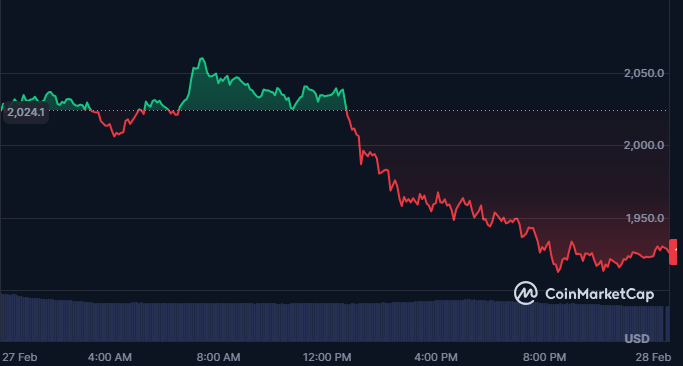
    • ETH has fallen below $2K following wider market events.

    Ethereum creator and co-founder Vitalik Buterin has outlined 8 Ethereum Improvement Proposals (EIPs) that comprise the upcoming Glamsterdam hardfork scheduled for the first half of 2026.

    Ethereum: 2026 Glamsterdam hardfork

    The proposals follow Ethereum’s three-track roadmap enshrined in its 2025 “predictable engineering delivery model” and comprising:

    • Scalability.
    • Improved user experience.
    • Heightened security, censorship-resistance, and quantum-resistance.

    More specifically, block building will now take place directly on Ethereum rather than external relays. This increases decentralization and transaction verification time for validators.

    Additionally, the upgrade will pave the way for parallel block verification, effectively increasing the network’s transaction processing speed. Users will also enjoy a 78.6% reduction in gas fees for both simple and complex smart contracts, and the ability to run nodes at a lower bandwidth.

    Developers, on the other hand, would be financially incentivized to write leaner code on the network’s database, aka “The State.” They would also experience fewer memory-related errors during code compilation and fewer smart contract security risks.

    Source: CoinMarketCap

  • Sen Warren leads Democrat probe into Binance in latest scrutiny of Trump crypto ties

    A group of Senators have written a letter to Attorney General Pam Bondi and Treasury Secretary Scott Bessent requesting that Binance’s compliance to its 2023 settlement be reviewed.

    The lawmakers are requesting for proof that an impartial investigation will be carried out given Binance’s ties to the Trump family and the Trump administration’s pro-crypto attitude.

    Will Binance be investigated?

    A group of 11 Democratic senators, led by Senator Elizabeth Warren sent a formal letter to Attorney General Pam Bondi and Treasury Secretary Scott Bessent, demanding a “thorough and impartial” investigation into Binance.

    The senators’ major concern is whether or not Binance is sticking to the rules of its massive 2023 settlement.

    Back then, the exchange paid over $4 billion and admitted to failing to stop money laundering. As part of that deal, Binance agreed to let U.S. officials watch over its operations.

    However, the senators now say that new reports suggest the exchange has resumed its old ways. They also claim that as much as $1.7 billion in digital assets moved through Binance to Iranian entities, including groups linked to terrorism like the Houthis and the Islamic Revolutionary Guard Corps.

    CEO Richard Teng and the company’s legal representatives at Withers Bergman denied a recent Wall Street Journal (WSJ) article that alleged that the exchange fired staff for flagging $1 billion in Iranian-linked transactions, calling it “defamatory” and “categorically false.”

    See also South Korea approves $23.3B extra budget to counter US tariff risks

    The company’s lawyers also argued in a letter to the WSJ editorial board that the newspaper ignored detailed corrections provided by the company before the story was published.

    Binance stated that between January 2024 and January 2026, it reduced its direct exposure to major Iranian cryptocurrency exchanges by more than 97.3%.

    The company noted that while anyone can try to send money to an address on public blockchains, their job is to monitor and stop those funds. They claim they are doing this better than any of their global peers.

    Binance also stated that it has invested hundreds of millions of dollars into its compliance systems. Its compliance team now includes over 1,500 people, which is roughly 25% of its entire global workforce.

    Senator Richard Blumenthal also opened an inquiry into Binance through the Senate’s Permanent Subcommittee on Investigations. He is specifically looking for records regarding two Hong Kong-based entities that were reportedly used to funnel money toward Iran.

    Why are lawmakers worried about Trump’s ties to Binance?

    Democratic lawmakers are worried that the Trump administration might not be tough enough on Binance for several reasons.

    First, is the pardon of Changpeng Zhao, the founder of Binance. In October 2025, President Trump granted a “full and unconditional pardon” to Zhao, who had served four months in prison for failing to stop money laundering. Trump described the prosecution of Zhao as a “war on cryptocurrency” by the previous administration.

    See also Breaking: Signature Bank kicks crypto clients to the curb

    His decision was criticized by Senator Warren, who argued that the pardon sends a message that crypto executives can break the law if they have the right political connections.

    Second, reports indicate that Binance has been a key supporter of “World Liberty Financial,” a crypto venture backed by President Trump and his sons. The exchange has also reportedly encouraged its 275 million users to use the $USD1 stablecoin.

    There are even reports that an Emirati fund used $USD1 to make a $2 billion investment in Binance itself, an arrangement that could earn the Trump family millions in interest every year.

    Because of these close ties, the senators are asking Attorney General Bondi and Secretary Bessent to prove that any investigation will be fair. They have given the DOJ and Treasury until March 13, 2026, to explain what steps they are taking to review Binance’s conduct.


  • All of ‘The Beauty’ Cast & Characters: Ashton Kutcher, Evan Peters, Bella Hadid and More in Ryan Murphy’s Body Horror Series

    The FX show, adapted by Murphy and longtime collaborator Matt Hodgson from the comic book, explores the extremes people will go to achieve perfection — with a star-studded cast.

    [This story contains major spoilers from The Beauty.]

    “One shot makes you hot,” reads the tagline of The Beauty, FX’s new dark comedy series laced in body horror.

    In what The Hollywood Reporter’s chief TV critic Daniel Feinberg calls an “occasionally provocative blend of Nip/Tuck and various American Horror Story iterations,” Ryan Murphy’s The Beauty — written and co-created by Matt Hodgson — centers on a mysterious drug that promises unimaginable physical attractiveness. Also sexually transmissible, “The Beauty” can transform its users into what society deems perfection, though not without the risk of devastating side effects. The show asks: How much are you willing to sacrifice for eternal youth?

    A star-studded cast joins the ride, including Murphy regulars Evan Peters and Jeremy Pope, alongside first-time Murphy-verse additions like Ashton Kutcher, plus a slate of notable guest stars.

    First premiering with a three episode launch on Wednesday, Jan. 21 (at 9 p.m. ET on FX), the remaining episodes roll out weekly across the 11-episode season, with two episodes released in each of the final two weeks. Since each episode brings more familiar faces into the show, The Hollywood Reporter is keeping track of all of the stars appearing in The Beauty with explainers on the characters they play.

    This list originally posted Jan. 21 and will be updated weekly as new characters are revealed. Check back for spoilers!

  • FBI hazmat team descends on homemade science lab at luxury California house

    FBI hazmat team descends on homemade science lab at luxury California house

    A homemade science lab in a rented luxury home near the Great Park in Irvine has sparked a heavy, multiday response from an FBI hazardous materials team and other federal and local agencies.

    The landlord of the home in Altair, a guard-gated community of multimillion-dollar homes, called Irvine police on Monday afternoon, Feb. 23 to alert them to suspicious items, according to the Irvine Police Department. The home is on Cartwheel near Iluna.

    Officers arrived and summoned the Orange County Fire Authority, and the investigation later was turned over to the FBI.

    Irvine Police on Thursday issued a statement saying the situation began “after a juvenile at the residence mixed unknown chemicals.” Investigators were analyzing the substances, police said.

    A tented area could be seen outside the house on Thursday, along with multiple unmarked trucks, trailers, Irvine Police Department vehicles and OCFA SUVs.

    No nearby residents were evacuated as of mid-afternoon, when multiple black trash bags and brown cardboard boxes sat on the curb in front of the house.

    The surrounding neighborhood is quiet and serene, with large houses separated from the street by manicured lawns. The community is across the street from Portola High School.

    A spokeswoman in the FBI’s Los Angeles field office said the bureau’s Evidence Response Team and Hazardous Evidence Response Team responded to the residence at the request of the OCFA.

    “The FBI continues to work this matter jointly with the Irvine Police Department, the Orange County Fire Authority and the Orange County Sheriff’s Department,” FBI spokeswoman Lourdes Arocho said. “There is no known threat to public safety.”

    She declined to comment further.

    Still, some concerned Altair homeowners were eager to learn what the items were.

    Neighbors told KCBS Channel 2 that the National Guard arrived outside of the home on Monday afternoon, and that some were seen wearing shirts that said “Weapons of Mass Destruction Civil Support Team.” Images from the scene showed a massive presence of federal and local law enforcement officers.

    Longtime Irvine residents can remember a separate, unrelated hazmat case in a different Irvine neighborhood 26 years ago, when law enforcement authorities removed 27 canisters packed with plastic explosives and other hazardous materials from the home of a doctor in Woodbridge.

    After health inspectors cleared the house of Dr. Larry Ford, 250 residents of 52 nearby homes were allowed to return home, ending a four-day evacuation.

    Ford, 49 at the time, shot himself to death on March 2, 2000, a day after police searched his house.

    City News Service contributed to this report.


  • Anthropic Refuses to Remove AI Safeguards Despite Pentagon Pressure

    Anthropic Refuses to Remove AI Safeguards Despite Pentagon Pressure

    Honest, Objective, Lab-Tested Reviews

    PCMag.com is a leading authority on technology, delivering lab-based, independent reviews of the latest
    products and services. Our expert industry analysis and practical solutions help you make better buying
    decisions and get more from technology.

  • Amazon, Nvidia Flood OpenAI With Cash as ChatGPT Maker’s Valuation Hits $730 Billion

    Amazon, Nvidia Flood OpenAI With Cash as ChatGPT Maker’s Valuation Hits $730 Billion

    In brief

    • OpenAI announced $110 million in new investment at a $730 billion pre-money valuation.
    • Amazon, Nvidia, and SoftBank invested in the firm, with Amazon and Nvidia also agreeing to strategic partnerships.
    • Microsoft and OpenAI said the addition of new investors and partnerships doesn’t change their deal at all.

    OpenAI has announced $110 billion in new investment at a $730 billion pre-money valuation, securing $30 billion each from Nvidia and SoftBank, with Amazon adding $50 billion to the pot. The ChatGPT maker has also revealed broader strategic alliances with Amazon and Nvidia.

    ChatGPT now has over 900 million weekly active users and 50 million consumer subscribers, OpenAI said in a Friday blog post. The firm added that its Codex AI coding tool has seen its weekly user base more than triple to 1.6 million since the start of the year, suggesting a strong growth area as more people use AI for coding purposes.

    The Amazon partnership focuses on accelerating AI adoption for enterprises and startups, while the expanded Nvidia collaboration includes dedicated inference and training capacity on next-gen hardware systems.

    “We’re pushing the frontier across infrastructure, research, and products to make AI more capable, reliable, and broadly useful,” said OpenAI CEO Sam Altman, in a statement.

    “SoftBank, Nvidia, and Amazon are long-term partners who share our ambition to turn real scientific progress into systems that deliver meaningful benefits for people at global scale,” he added. “Building AI that works for everyone will require deep collaboration across the stack, and we’re excited to do this together.”

    OpenAI said that additional investors are expected in the round, with only the three backers and $110 million investment announced so far on Friday. The raise also boosts the OpenAI Foundation’s stake in the company to over $180 billion, expanding its philanthropic capacity in areas like health and AI resilience.

    “Artificial intelligence is the most consequential technology of our time, and OpenAI is at the forefront,” said Nvidia founder and CEO Jensen Huang, in a statement. “We have been privileged to partner with OpenAI since its earliest days, as it delivered one breakthrough after another. Together, we will continue to push the frontier—building the infrastructure for the age of AI and scaling its benefits to serve industries and societies worldwide.”

    In a separate joint statement, OpenAI and Microsoft said that the addition of new investors doesn’t impact their existing relationship.

    “Microsoft and OpenAI continue to work closely across research, engineering, and product development, building on years of deep collaboration and shared success,” they wrote. “Microsoft maintains its exclusive license and access to intellectual property across OpenAI models and products. Collaborations like the partnership between OpenAI and Amazon were always contemplated under our agreements and Microsoft is excited to see what they build together.”

    Daily Debrief Newsletter

    Start every day with the top news stories right now, plus original features, a podcast, videos and more.

  • Minnesota Weighs Total Ban on Bitcoin and Crypto ATMs

    Minnesota Weighs Total Ban on Bitcoin and Crypto ATMs

    In brief

    • Lawmakers in Minnesota are considering a total ban on crypto ATMs.
    • The state passed a regulatory framework for the machines in 2024.
    • Countries like New Zealand have recently imposed sweeping bans.

    Lawmakers in Minnesota are considering a total ban on crypto ATMs, with legislation introduced earlier this week in response to a growing number of scams against the elderly.

    Introduced on Monday by Rep. Erin Koegel, who serves as co-chair of the state’s House Finance and Policy Committee, HF 3642 would effectively ban all physical machines in Minnesota that allow users to purchase cryptocurrencies using cash.

    The legislation marks renewed efforts to address risks associated with crypto ATMs, following a state framework passed in 2024 that imposed a $2,000 daily transaction limit for new customers, refund requirements, and a licensing framework for operators.

    Although several states have implemented pauses or strict local bans on crypto ATMs, the measure in Minnesota would likely be the first of its kind in the nation. It would mirror sweeping bans taken up in multiple countries, such as one last year in New Zealand.

    Law enforcement officials testified during a hearing on Thursday that older Minnesotans are continuing to lose tens of thousands dollars from scammers, who direct victims to send them crypto under false pretenses, often while impersonating the government or tech support.

    At the hearing, a local detective recalled how one resident feared she would become homeless after sending Bitcoin to a scammer 10 times within six months. The official said she was losing 50% of her monthly income until she was found at a gas station appearing confused one day, and she required government assistance “due to her dire circumstances.”

    There are around 430 crypto ATMs in Minnesota, which are clustered mostly around the state’s most populous city, Minneapolis, according to Coin ATM Radar. Across the country last year, victims reported $333 million in losses tied to crypto ATMs, according to the FBI.

    CoinFlip General Counsel Larry Lipka said at the hearing that the ATM operator is aware of the prevalence of scams using its machine, but scammers have multiple tools at their disposal.

    In a letter submitted to the committee, the police chief of one city in Minnesota wrote that “law enforcement has an extremely limited ability to recover funds once transferred,” representing one of several challenges from a public safety perspective.

    Rep. Keith Allen noted during the hearing that millions of dollars have likely been siphoned from rural communities that “could have been doing a lot of good.”

    As lawmakers in Minnesota weigh a total ban on crypto ATMs, state prosecutors in other areas are advocating for restrictions against associated companies, including Bitcoin Depot.

    Earlier this week, the largest operator of Bitcoin ATMs in North America signaled that it would begin requiring customers to provide personal identification each time they make a transaction. The move presented a voluntary effort to refine its compliance procedures.

    That decision followed a lawsuit brought by Massachusetts Attorney General Andrea Campbell earlier this month, which alleged that Bitcoin Depot knowingly facilitated crypto scams while “removing safeguards against fraud and misleading investors in order to line their own pockets.”

    Bitcoin Depot has pushed back against the assertion, according to ICIJ, with a spokesperson asserting recently that the firm is built around compliance and consumer protection. The company continues to work with law enforcement to combat illicit activity, they added.

    Daily Debrief Newsletter

    Start every day with the top news stories right now, plus original features, a podcast, videos and more.