Blog

  • Mike Myers to Receive Honorary Canadian Screen Award

    Mike Myers to Receive Honorary Canadian Screen Award

    Mike Myers is set to receive a special award at the upcoming Canadian Screen Awards in May.

    The Canadian comedian and Hollywood star, known for classic roles like Wayne Campbell, Austin Powers, Dr. Evil and Shrek, will pick up the Icon Award, the Academy of Canadian Cinema & Television said on Wednesday.

    Myers, who’s a U.S. citizen, in April 2025 appeared alongside Canadian Prime Minister Mark Carney in a TV ad (pictured above) where he wore a jersey that read “Never 51,” in response to U.S. president Donald Trump’s 51st state taunts against Canada. Myers, a Saturday Night Live alum, also returned to the NBC sketch comedy series to wear a “Canada is not for sale” T-shirt.

    Other special prize winners include the Gordon Sinclair Award for Broadcast Journalism going to popular Canadian sportscaster Hazel Mae, the Changemaker Award being presented to maxine bailey, executive director of Norman Jewison’s Canadian Film Centre, and the indie movie Mile End Kicks, directed by Chandler Levack, receiving the Sustainable Production Award.

    The honorary awards will be handed out at the Canadian Screen Awards, which includes a gala live ceremony on May 31. The Academy, which organizes the national film and TV awards, this year struck a deal to see a consortium of Canadian broadcasters partner to simultaneously broadcast the final prize-giving for the 2026 Canadian Screen Awards from Toronto.

    Actor and comedian Andrew Phung will host the CSAs’ 14th edition this year. Nominations for the Canadian awards show will be unveiled on March 25.

  • X Warns Against Creator Payouts Over Undisclosed AI War Videos

    X Warns Against Creator Payouts Over Undisclosed AI War Videos

    In brief

    • X’s product head, Nikita Bier, said creators posting undisclosed AI-generated war videos will lose access to the platform’s revenue-sharing program for 90 days.
    • The policy targets AI-generated footage that could mislead users during wartime.
    • Researchers and governments have warned that deepfakes could spread propaganda and misinformation online.

    Elon Musk’s social media platform X said it will suspend creators from its revenue-sharing program if they post AI-generated videos depicting armed conflict without clearly disclosing that the footage was created using artificial intelligence.

    In a post on Tuesday, X’s head of product Nikita Bier said the company is revising its Creator Revenue Sharing policies to maintain authenticity on the platform’s timeline and “prevent manipulation of the program.”

    “During times of war, it is critical that people have access to authentic information on the ground,” Bier wrote. “With today’s AI technologies, it is trivial to create content that can mislead people.”

    Creators who violate the rule will lose access to the platform’s Creator Revenue Sharing program for 90 days, Bier wrote. Repeat violations will lead to permanent removal from the monetization program.

    The policy change comes as AI-generated videos claiming to show scenes of escalating violence in the Middle East following missile strikes by the U.S., Israel, and Iran last week.

    On Monday, an AI-generated clip on X showing an airstrike on the Burj Khalifa in Dubai was viewed over 8 million times; at the same time, another version of the clip was viewed over 42,000 times on Instagram.

    The United Nations has warned that deepfakes and AI-generated media threaten information integrity, particularly in conflict zones where fabricated images or videos can spread hate or misinformation at scale.

    This concern was realized during Russia’s invasion of Ukraine, a deepfake video circulated online appearing to show Ukrainian President Volodymyr Zelensky urging Ukrainian troops to surrender. Officials quickly debunked the video, and Zelensky later released a message rejecting the claim.

    According to Bier, enforcement will rely on several signals, including posts that receive a Community Note identifying the video as AI-generated, along with metadata or other indicators suggesting the footage was produced using generative AI tools.

    By tying enforcement to monetization, X’s policy focuses specifically on the financial incentives creators have to post fake videos that drive clicks and views.

    “We will continue to refine our policies and product to ensure X can be trusted during these critical moments,” Bier wrote.

    Daily Debrief Newsletter

    Start every day with the top news stories right now, plus original features, a podcast, videos and more.


  • Colombian Court Rejects Appeal for AI Writing, Then Gets Flagged By Its Own AI Detector

    Colombian Court Rejects Appeal for AI Writing, Then Gets Flagged By Its Own AI Detector

    In brief

    • Colombia’s Supreme Court rejected a cassation appeal after AI detectors flagged it as machine-generated.
    • Lawyers ran the ruling through the same tools and found it also appeared AI-written.
    • Experts and studies showed AI-detection software produced unreliable and inconsistent results.

    The Supreme Court of Colombia denied a cassation appeal, arguing that it was generated by AI. But the same tool the court used to determine the appeal’s purported AI origins said that its own ruling also received generative help.

    Is it a double standard by the court, or faulty tools at play?

    “Faced with a well-founded suspicion that the brief submitted by the attorney had not been drafted by the legal professional himself, the court submitted the text to the Winston AI tool,” the court argued. “Its analysis indicated that the document contained only 7% human content, evidencing a marked influence of automated writing and leading to the conclusion that it had been produced using artificial intelligence.”

    After running the analysis with other tools that provided similar results, the court ruled that “since the filing cannot be regarded as a duly submitted pleading, its dismissal as inadmissible is required.”

    But when the court’s ruling faced similar scrutiny from legal experts, it showed similar results.

    “I submitted the text of Auto AP760/2026 from the Supreme Court to the same Winston AI software cited in the ruling,” attorney Emmanuel Alessio Velasquez wrote on X on Tuesday. “The result: The document contains 93% AI-generated text.”

    “If the very ruling that condemns the use of artificial intelligence scores that percentage, the methodological fragility of using these detectors as argumentative support becomes self-evident,” he argued in a subsequent tweet.

    Within hours of the court posting a thread about the decision on X, lawyers began running their own tests. Velasquez’s post went viral in legal circles, accumulating tens of thousands of views.

    We ran the test on the court’s verdict, as well, and things initially didn’t look great. When GPTZero scanned only the opening words of the court text, it returned a 100% AI result.

    When the same tool processed a longer version including the factual background section, it reversed course entirely: 100% human.

    The tool is simply not reliable enough to be trusted in court or in situations that would require a high degree of certainty.

    Colombian attorneys reacted quickly with their own experiments. Criminal defense lawyer and lecturer Andres F. Arango G, submitted a court filing from 2019, years before the large language models these tools were trained to detect even existed, and it came back claiming 95% AI generation.

    “These tools then invite you to ‘humanize’ the article through their paid services,” he wrote on X, noting an obvious commercial incentive baked into the detection business model.

    Nicolas Buelvas ran his 2020 undergraduate thesis on the principle of trust in criminal law. The result? 100% AI.

    Dario Cabrera Montealegre, another Colombian attorney, pointed out the hypocrisy of relying on technology to try to combat it.

    “The court is using AI to determine if there was AI,” he said. “Something contradictory from my practical point of view.”

    Beyond legal circles, further tech-savvy individuals pointed out the dangers of excessive reliance on AI flagging tools.

    “To date, there is no publicly accessible tool that can accurately define the percentage of AI use when drafting a text,” Carlos Alejandro Torres Pinedo argued. “What is worse: No one can publicly verify the source code behind these detection platforms. How can they be used to delegitimize someone’s right of access to justice?”

    The technical reasons for these failures are well-documented. AI detectors measure statistical patterns: sentence length, vocabulary predictability, and a quality that researchers call “burstiness,” which refers to the natural rhythm variation humans introduce in their writing.

    The problem is that formal legal prose, academic writing, and texts produced by people who write in a second language share many of those same statistical signatures.

    Studies on AI detection

    A 2023 study published in Patterns found that more than 61% of Test of English as a Foreign Language (TOEFL) essays by non-native English speakers were incorrectly flagged as AI-generated.

    A systematic review by Weber-Wulff that same year concluded no available tool is either precise or reliable. Turnitin acknowledged in June 2023 that its own detector produced higher false positive rates when the AI content level in a document fell below 20%.

    Even OpenAI had to take down its own AI detection tool following constant inaccuracies and an inability to do its actual job.

    Universities have been grappling with this for years. Vanderbilt disabled Turnitin’s AI detector in 2023 after estimating it would generate around 3,000 false positives annually.

    The University of Arizona dropped AI-detection features from its plagiarism software after a student lost 20% of a grade on a false positive. A 2024 case at UC Davis saw 17 linguistics students flagged, 15 of them non-native English speakers.

    The pattern is consistent. The tools penalize the people who write most formally, most repetitively, or most carefully, exactly the profile that lawyers, academics, and second-language speakers fit.

    The cultural fallout has bordered on absurdity. Across writing and journalism circles, people have started avoiding em dashes in their work, not because of any style guide, but because AI language models use them frequently and detection tools (and people) have taken notice.

    Writers are self-editing natural punctuation out of fear of algorithmic suspicion. Beyond the written world, artists have suffered the wrath of moderators and colleagues for making art pieces that look AI

    Colombia’s two rulings—AC739-2026, in which the Civil Chamber fined a lawyer for citing 10 nonexistent AI-generated precedents in February, and AP760-2026—are emerging as some of the region’s first judicial decisions directly confronting the misuse of generative AI in legal filings.

    Colombia’s judicial branch adopted formal guidelines in December 2024 that regulate how judges and court staff can use artificial intelligence.

    The rules allow AI to be used freely for administrative and support tasks, such as drafting emails, organizing agendas, translating documents, or summarizing texts, while permitting more sensitive uses, like legal research or drafting procedural documents, only with careful human review.

    The guidelines explicitly prohibit relying on AI to evaluate evidence, interpret the law, or make judicial decisions, emphasizing that human judges remain fully responsible for all rulings and must disclose when AI tools were used in preparing judicial materials.

    These guidelines, compiled in the “PCSJA24-12243” agreement, could be used to contest such a decision.

    The Supreme Court has not yet issued any additional statement in response to the backlash over its choice of detection tools. The ruling didn’t have em dashes, either.

    Daily Debrief Newsletter

    Start every day with the top news stories right now, plus original features, a podcast, videos and more.

  • ‘More Accurate, Less Cringe’: OpenAI Rolls Out GPT-5.3 Instant in ChatGPT

    ‘More Accurate, Less Cringe’: OpenAI Rolls Out GPT-5.3 Instant in ChatGPT

    In brief

    • OpenAI launched GPT-5.3 Instant, updating ChatGPT’s default model for smoother conversations.
    • The model reduces unnecessary refusals and improves factual accuracy, the company said.
    • GPT-5.2 Instant will be retired on June 3, after a three-month transition period.

    OpenAI on Tuesday announced the rollout of GPT-5.3 Instant, an update to ChatGPT’s default model aimed at making conversations feel less awkward and preachy, and “more directly” helpful.

    In a product post, OpenAI said the new version reduces overly cautious refusals, trims unnecessary disclaimers, and delivers more accurate answers. The changes reflect user complaints that earlier versions could sound stiff or overbearing in everyday interactions.

    “More accurate, less cringe,” OpenAI wrote on X. “We heard your feedback loud and clear.”

    Rather than introducing new capabilities, the update targets routine interactions.

    “Part of the day-to-day experience with ChatGPT comes down to interacting with the model,” an OpenAI spokesperson told Decrypt. “This update focuses on addressing common user feedback we’ve received, including reducing unnecessary refusals, cutting down on caveats, and making answers more direct and useful in everyday conversations.”

    OpenAI said earlier versions sometimes declined questions they could safely answer, or interrupted responses with lengthy explanations about safety limits.

    “GPT‑5.2 Instant eventually answers the question, but in an attempt to explain its safety boundaries, leads with a lengthy preamble about what it cannot help with,” OpenAI wrote. “GPT‑5.3 Instant, on the other hand, gets right into the response.”

    OpenAI reported improvements in factual reliability alongside the tone changes, claiming that internal evaluations showed hallucination rates dropped by nearly 30%.

    “On the higher-stakes evaluation, GPT‑5.3 Instant reduces hallucination rates by 26.8% when using the web and 19.7% when relying only on its internal knowledge, compared to prior models,” OpenAI said. “On the user-feedback evaluation, hallucinations decrease by 22.5% with web use and 9.6% without web access.”

    OpenAI did not explain what it defines as “cringe,” but noted that the new model includes stronger writing abilities, comparing GPT-5.2 and 5.3’s ability to write poetry.

    “5.4 sooner than you think,” the company said in a separate post, which drew swift mockery from users on X, suggesting that the tease was due to recent backlash against the firm for its deal with the Pentagon.

    GPT-5.3 Instant replaces the default ChatGPT model starting today, the company said, while GPT-5.2 Instant remains accessible under legacy options for paid subscribers during a transition period ending in early June.

    The update drew mixed reactions on social media. Some users praised the focus on more direct responses without unnecessary disclaimers, while others argued the real “cringe” at play was agreeing to a contract with the U.S. Department of Defense when rival Anthropic declined due to safety concerns.

    Others complained that GPT-5.3 would never match the sense of intimacy many associated with the now-depreciated GPT-4o, and called for the popular model’s return.

    Last summer, OpenAI faced a surge in backlash after the company abruptly replaced the popular GPT-4o with GPT-5, prompting complaints that the new model felt colder and less supportive. Users flooded forums with criticism, and some threatened to cancel subscriptions, leading OpenAI to restore GPT-4o for paid users.

    In January, OpenAI announced that GPT-4o and its variants would be officially retired as of February 13.

    “I think we’ve learned a lesson about what it means to upgrade a product for hundreds of millions of people in one day,” OpenAI CEO Sam Altman said at the time, calling the reversal a wake-up call and “a lesson in upgrading a product used by hundreds of millions of people” at once.

    Editor’s note: This story was updated after publication to include comments from OpenAI.

    Daily Debrief Newsletter

    Start every day with the top news stories right now, plus original features, a podcast, videos and more.

  • South Koreans Paid in Crypto for ‘Revenge’ Attacks Involving Human Waste, Say Police: Report

    South Koreans Paid in Crypto for ‘Revenge’ Attacks Involving Human Waste, Say Police: Report

    In brief

    • A local news report from South Korea points to a “private revenge” group which pays in crypto for individuals to vandalize property and intimidate individuals.
    • Some tactics include dropping defamatory leaflets and spreading food and human waste.
    • Individuals have been arrested but police are still searching for their superiors.

    Police in South Korea say people are using crypto to pay for intimidation tactics that include vandalizing front doors, leaving threatening messages, and spreading human waste, according to a local news report from Hankyoreh

    The so-called “private revenge” attacks were reportedly ordered through social messaging app Telegram, with alleged perpetrators paid between $337-$675 or 500,000-1,000,000 South Korean won worth of cryptocurrency—though different suspects in at least three cases spanning back to December claim they do not know who ultimately paid them.

    In the latest two events, which have occurred in the last week, individuals identified as “Mr. Lim” and “Mr. K” by the report were arrested and charged by South Korean police. The pair both vandalized the front door of residences and were accused of dropping defamatory leaflets, at least some of which contained the message “I will not leave you alone.”

    In Mr. Lim’s case, the man, identified to be in his 20s, also scattered food waste and was accused of spreading human waste on a nearby stairwell. The attacks occurred in the Suwon District of South Korea, outside Seoul.

    “Police believe that the individuals arrested this time committed the crimes under the direction of a private revenge organization operating on Telegram, and are tracking down their superiors,” the local report reads. 

    The recent cases are also under investigation regarding their potential connection to a December 7 vandalization, which also saw the dropping of defamatory leaflets and payments to three individuals via cryptocurrency.

    The crypto crime spree follows a recent Bitcoin dispute in South Korea that led to attempted murder charges. According to authorities in that case, an individual laced his business partner’s coffee with methomyl—a banned and toxic insecticide—after the colleague allegedly mismanaged his Bitcoin investments.

    The country has also seen regulators recently face scrutiny regarding their inability to find an internal system flaw in crypto exchange Bithumb, which led to the erroneous distribution of up to 2,000 BTC or $137 million to hundreds of customers, instead of 2,000 won ($1.35). All told, Bithumb credited users with $43 billion in Bitcoin, though it realized the mistake within minutes and clawed back most of those funds.

    Furthermore, it was recently discovered that police officers from Gangnam Police Station had lost access to $1.4 million worth of Bitcoin more than four years ago. Plus, the nation’s tax service (NTS) publicly shared the seed phrase for three crypto wallets that held $4.8 million worth of tokens at face value in a press release. 

    Daily Debrief Newsletter

    Start every day with the top news stories right now, plus original features, a podcast, videos and more.

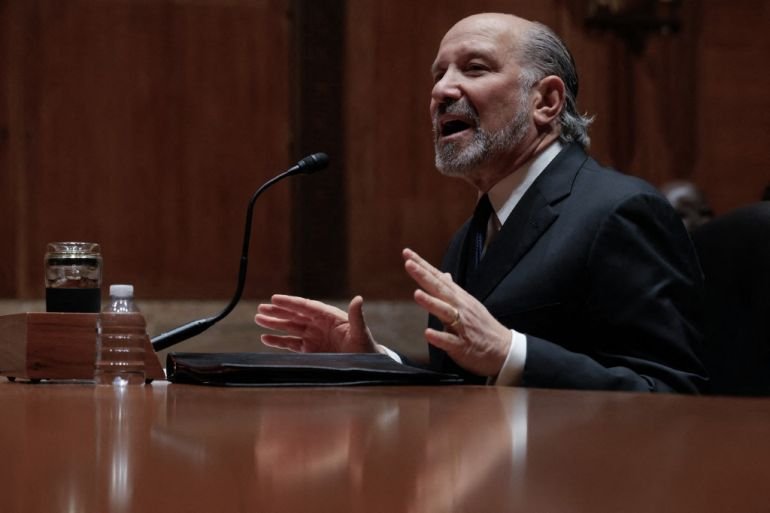
  • US Commerce Secretary Lutnick to testify before Congress about Epstein ties

    US Commerce Secretary Lutnick to testify before Congress about Epstein ties

    Lutnick’s relationship with the late financier and sex offender has come under scrutiny after files revealed closer ties than previously known.

    US Secretary of Commerce Howard Lutnick has agreed to give testimony to lawmakers about his ties to Jeffrey Epstein, the head of a committee investigating the late sex offender has said.

    Lutnick, who lived next door to Epstein in New York for more than a decade, “proactively agreed” to provide a transcribed interview to the House Committee on Oversight and Government Reform, panel chair James Comer said on Tuesday.

    Recommended Stories

    list of 4 itemsend of list

    “I commend his demonstrated commitment to transparency and appreciate his willingness to engage with the Committee. I look forward to his testimony,” Comer, a Kentucky Republican, said on X.

    Axios, which first reported the commerce secretary’s intention to testify, quoted Lutnick as saying he had done nothing wrong and he wished to “set the record straight”.

    Lutnick’s relationship with Epstein, who died in 2019 while awaiting sex trafficking charges, has come under mounting scrutiny after he appeared to misrepresent the extent of his associations with the notorious financier.

    In a podcast interview last year, Lutnick said he decided to “never be in the room” with Epstein again following an uncomfortable encounter at the sex offender’s Manhattan penthouse in 2005.

    But files released by the Justice Department earlier this year showed that Lutnick met and communicated with Epstein for years after the reported 2005 encounter, and the commerce secretary later acknowledged that he visited the financier’s private island of Little Saint James in 2012.

    Comer said on Tuesday that he had also sent letters to seven individuals seeking written testimony about their knowledge of Epstein’s crimes, including Microsoft cofounder Bill Gates, private equity investor Leon Black, and top Goldman Sachs lawyer Kathryn Ruemmler.

    Gates, Black and Ruemmler have repeatedly denied wrongdoing in connection with Epstein, or having knowledge of his abuse of women and girls.

    The committee’s requests for testimony come after former US President Bill Clinton and his wife, ex-Secretary of State Hillary Clinton, appeared before lawmakers last week to answer questions about their ties to Epstein.

    Bill Clinton told the committee he did nothing wrong and “saw nothing that ever gave me pause” while interacting with Epstein.

    Hillary Clinton told lawmakers she had no recollection of encountering Epstein and that she never “flew on his plane or visited his island home or offices”.

  • Russia, China raise diplomatic voices against US-Israeli attacks on Iran

    Russia, China raise diplomatic voices against US-Israeli attacks on Iran

    China’s foreign minister tells Israel to end attacks; Russian FM Lavrov says no sign Tehran seeking nuclear bomb.

    Russia and China have criticised the US and Israeli attacks on Iran, with Moscow saying it had seen no evidence that Tehran was developing nuclear weapons, and Beijing demanding an immediate halt to the joint attacks.

    Chinese Minister of Foreign Affairs Wang ⁠Yi told his Israeli counterpart, Gideon Saar, on Tuesday that the attack on Iran came as negotiations between Washington and Tehran had “made significant progress, including addressing Israel’s security concerns”, China’s Foreign Ministry said in a statement.

    Recommended Stories

    list of 4 itemsend of list

    “Regrettably, this process has been interrupted by military action. China opposes any military strikes launched by Israel and the US against Iran,” Wang told the Israeli foreign minister during a phone call, according to the ministry.

    “China calls for an immediate cessation of military operations to prevent the further escalation and loss of control of the conflict,” Wang said.

    “Force cannot truly solve problems; instead, it will bring new problems and serious long-term consequences,” he added.

    According to the Chinese Foreign Ministry, Saar agreed to a request from Wang to take “concrete measures to ensure the safety of Chinese personnel and institutions” in Iran.

    The call on Tuesday with Israel and Beijing’s apparent efforts to stabilise the spiralling regional situation followed calls Wang made on Monday to discuss the conflict with the foreign ⁠ministers of Iran, Oman and France.

    ‘US doesn’t attack those who have nuclear bombs’

    Russian Foreign Minister Sergey Lavrov also criticised the US and Israel on Tuesday, saying their war on Iran could lead to the very outcome they claimed they wanted to prevent: nuclear proliferation.

    Lavrov told a news conference that the logical consequence of the US and Israel’s actions could be that “forces will emerge in Iran… in favour of doing exactly what the Americans want to avoid – acquiring a nuclear bomb”.

    “Because the US doesn’t attack those who have nuclear bombs,” Lavrov said.

    Lavrov also said that Arab countries could now join the race to acquire nuclear weapons, given the experience of recent days and “the nuclear proliferation problem will begin to spiral ⁠out of control”.

    Israel is widely seen as the Middle East region’s only nuclear-armed state, which it neither confirms nor denies.

    “The seemingly paradoxical declared noble goal of starting a war to prevent the proliferation of nuclear weapons could stimulate completely opposite trends,” he said.

    Lavrov, who said that Moscow had still seen no evidence that Iran was developing ⁠nuclear weapons, spoke with his Iranian counterpart, ⁠Abbas Araghchi, on Tuesday, and said that Russia stood ready to help find a diplomatic solution to the conflict, while rejecting the US and Israel’s use of “unprovoked military aggression” in the region.

    As the US and Israel launched their first strikes on Iran on Saturday, Russia’s Foreign Ministry accused the close allies of carrying out a “premeditated and unprovoked act of armed aggression against a sovereign and independent UN member state”.

    The two countries had hidden their true intention of regime change in Tehran “under the cover” of negotiations to normalise relations with Iran, the ministry said.

    The US and Israel were “swiftly pushing the region toward a humanitarian, economic, and potentially even radiological disaster”, the ministry warned.

    “Responsibility for the negative consequences of this manmade crisis, including an unpredictable chain reaction and spiralling violence, lies entirely with them,” the statement added.

    Russia has faced its own accusations of aggression against a sovereign state after it launched a full-scale invasion of Ukraine, a war now in its fifth year.

  • Why Mayor Karen Bass Showed Up for Cinespace Studios’ Ribbon-Cutting and What It Means for Hollywood

    Why Mayor Karen Bass Showed Up for Cinespace Studios’ Ribbon-Cutting and What It Means for Hollywood

    Los Angeles Mayor Karen Bass doesn’t show up for the grand openings of many local businesses. But early Monday morning she trekked all the way out to the northwestern edge of the city, more than 25 miles from City Hall, to attend the ribbon-cutting ceremonies for Cinespace’s new studio complex in Woodland Hills. If there was any doubt as to why she made the effort, she cleared that up when she stepped behind the podium on Stage 1 and greeted the press and other assembled guests with her signature toothy grin.

    “When we invest in the [entertainment] industry, the industry invests in Los Angeles, and I think it’s important that we always educate Angelenos to all of the ways the industry impacts our economy, all of the ancillary businesses, and all of the economic growth that happens when industry stays here and films here,” said Bass, who also attended the opening of East End Studios’ new Mission Campus in L.A.’s Arts District back in January.

    Built inside the shell of the former headquarters and manufacturing facility for Catalina Yachts, the new 180,000-square-foot Cinespace campus boasts six 18,000-square-foot soundstages with 30-foot clearances, along with 72,000 square feet of production offices and support space. The complex’s first tenant, the thriller “Nightwatching,” starring Mila Kunis, has been shooting on Stages 2 and 3 since early February, and on Monday, the production had also commandeered one of the lunch rooms to rehearse a stunt sequence.

    Speaking to Variety following the ribbon-cutting, Cinespace Studios co-CEO Eoin Egan explained that when the company – which also has production campuses in Chicago, Toronto, Atlanta, Wilmington, North Carolina and Germany – began looking for a site in Los Angeles around 2022, it wanted a place where they could establish a turnkey “one-stop shop,” where “we don’t have parking down the street.”

    Los Angeles Mayor Karen Bass, center, with Cinespace co-CEO Eoin Egan at the March 2 opening of Cinespace Studios Los Angeles in Woodland Hills

    Egan got all that and more. Cinespace Studios Los Angeles is located in a bustling retail district on one of the Valley’s major thoroughfares, Victory Boulevard. Across the street is a mini-mall with tenants that include a deli, a liquor store, a nail salon, a chiropractor and a foot and body massage business. Directly behind the studio is a Home Depot, which “productions are in and out of all the time for everything from gaffer’s tape to toilet paper to lumber,” said Egan, who also noted that crew members regularly patronize the nearby B.J.’s Restaurant & Brewhouse location.

    The San Fernando Valley may not be where Hollywood’s cool kids hang out, but despite the confusing constellation of names given to various sections (North Hollywood, Sherman Oaks, Encino, Northridge, etc.), most of it is part of the City of Los Angeles. More importantly, a wealth of talent makes its home on this side of “the hill” (aka, the Santa Monica Mountains), particularly the below-the-line variety.

    “Heads of department tend to live here in the West Valley and in [nearby] Studio City, so we’re seeing those synergies and it’s already been an added value,” said Egan.       

    The surrounding neighborhood is no stranger to production. Another one of the day’s speakers, L.A. City Councilman Bob Blumenfield, pointed out that Cinespace Studios Los Angeles sits on land that was once part of Warner Ranch, where numerous Westerns were shot back in the ‘30s and ‘40s. More recently, the suburban developments that replaced it in the 1950s onward have served as locations for projects ranging from “Curb Your Enthusiasm” to various Paul Thomas Anderson movies, including 2021’s “Licorice Pizza.” The facilities are also about two miles northwest of the former site of the RKO Encino Ranch – sold in 1954 and redeveloped, primarily as the Encino Village subdivision of mid-century modern tract homes – where downtown Bedford Falls was constructed for 1946’s “It’s a Wonderful Life.”

    But building a studio complex is a risky proposition. When Cinespace embarked on the project, the industry was in the midst of a post-pandemic, peak-streaming production boom. Since then, there’s been a major contraction, exacerbated by dual WGA and SAG-AFTRA strikes in 2023, followed by renegotiated IATSE and Teamster contracts in 2024 that spurred more projects to shoot outside the U.S.

    That lent added urgency to the lobbying efforts mounted by Cinespace and other industry players in support of California’s Film and Television Tax Credit Program 4.0, which Gov. Gavin Newsom signed into law in July 2025. It raised the annual cap on the incentive from $330 million to $750 million and bumped the base tax credit from 20%-25% on qualified expenditures to 35%-40%. It also made it fully refundable for the first time, enabling companies to get cash back from California if their credit exceeds their state tax burden. The initial results were positive: As of January 2026, 119 projects (39 television and 80 feature film) had been approved under the revised program, which are estimated to produce 25,000 crew hires and $4.1 billion in economic activity.

    Bass also did her part, issuing an executive directive in May 2025 dubbed “Reel Change: Supporting Local Film and Television Production,” ordering city departments to take a proactive film-friendly approach to production and make iconic locations like Griffith Observatory and the Central Library more accessible and affordable for filming.

    Despite these improvements, success is far from assured. According to the Los Angeles County Economic Development Corporation’s 2026 Annual Economic Forecast released last month, sound stage occupancy hovered above 93% between 2016 and 2021, but by 2024 it had dipped to 63%. Meanwhile, sound stage square footage grew by 53% between 2020 and 2025.  

    But California Film Commission executive director Colleen Bell struck a positive note when she spoke to Variety on Monday.

    “When a project is accepted into [California’s incentive] program, they have 180 days to start principal photography, so you’re not going to see an instant spike,” said Bell, who also addressed the crowd at the event. “There’s a gradual increase of production taking place, so stages will start to fill up slowly, but it’s happening.”

  • Harry Styles Defies Expectations With the Slow-Burning but Satisfying ‘Kiss All the Time. Disco, Occasionally.’: Album Review

    Harry Styles Defies Expectations With the Slow-Burning but Satisfying ‘Kiss All the Time. Disco, Occasionally.’: Album Review

    Superstars don’t stay relevant by doing what people expect, or even what their fans necessarily want. Crowd-pleasing is a fast track to becoming a nostalgia act, where an artist is trapped in a loop of playing to type (i.e. the hits and only the hits) year after year. It’s not a bad life — Paul McCartney, the Rolling Stones, Elton John and countless others are making millions playing their decades-old hits to adoring, affluent, increasingly older crowds, with new songs being an indulgence for them and a bathroom break for the fans.

    But staying culturally relevant is a totally different game, one that requires a constant element of surprise, or at least the unexpected — a sense that the artist knows exactly what they’re doing, even if they’re not obvious about it. That combination of engagement and elusiveness, of knowing how much to say and how much to hold back, creates a tantalizing sense of mystery that keeps people curious, not only wanting more but wanting to know more.

    That elusiveness is a big part of what keeps us engaged with the Beyoncés, Arianas, Lanas, Taylors and Kendricks of the world — not knowing what’s coming next, the anticipation of getting something unexpected and exciting, because what’s more exciting than getting something awesome that you didn’t even know you wanted? Of course, countless artists have tried to lead their audience into places the fans knew they didn’t want to go, and faceplanted accordingly. But the risk is also a big part of the reward — even if it can lead to some ambivalent reactions to one’s dancing ability.

    Without putting Harry Styles in the same league as some of the above innovators, he has shown an unusually strong self-awareness in terms of his career, his audience and simply keeping people interested. After six years with One Direction, one of the biggest boy bands in history, his 2017 self-titled solo debut sounded like absolutely nothing he’d done before — not to mention nothing else on the charts — and gave him a clean slate from which he could go anywhere, yet “Fine Line” two years later found him shifting into the upbeat pop that fans probably expected from his debut. And although 2022’s “Harry’s House” continued in that musical vein, it arrived surprisingly quickly after the pandemic-delayed “Fine Line” tour, and basically made for a multi-year — and multimillion-dollar-spinning — extended album cycle.

    So what’s the move with the fascinatingly punctuated “Kiss All the Time. Disco, Occasionally.,” which comes out on Friday? Not what the title, or Styles’ stated inspirations from Berlin nightclubs, would lead people to expect, because there’s very little here that anyone would consider disco (albeit with one glorious exception we’ll get to in a moment).

    There are a lot of upbeat songs, big drums, heavy bass and loud electronic noises to go with Styles’ alternately cheery or melancholy melodies, but the beats on this album tend to pound rather than groove; even the upbeat and promisingly titled “Ready Steady Go” stomps more than it swings. Throughout most of the album, there’s a sense of restraint, of holding back — even the songs with the heaviest beats would be almost impossible to dance to. There are lots of electronics, few guitars, and one song, “Coming Up Roses,” is a lovely ballad with Styles accompanied only by a piano and orchestra.

    But in line with the sense of mystery and elusiveness mentioned above, it’s an album that reveals itself gradually, and there’s plenty for fans to grab onto. The shimmering pop songs “Taste Back” and “The Waiting Game” have the album’s sweetest melodies; “Pop” is driven by a Daft Punk-esque arpeggiated synthesizer hook; the closing “Carla’s Song” is the kind of track that could be an exuberant, set-closing, confetti-dropping finale in a more concert-friendly arrangement. Oddly, the memorably titled “Season 2 Weight Loss” is one of the least memorable songs.

    Even more oddly, the one true banger — “Dance No More” — is the outlier in the batch. With a funky groove, ‘80s synthesizer stabs, party noises and a put-your-hands-in-the-air-wooo! chorus of “DJs don’t dance no more!,” it has a loose, fun, carefree vibe found nowhere else on the album. It’s a prime early candidate for Song of the Summer 2026 — and, perfectly on brand for this album, it’s sequenced way toward the end, the tenth of 12 songs (maybe to manage expectations?), and is followed by the slow, acoustic-guitar-led ballad “Paint by Numbers,” squelching the party vibe just as it was getting a late start.  

    Initially, fans may greet this album with confusion or hesitant enthusiasm, because it may not be what they were dreaming of or expecting. But do we really want the same birthday present every year? “Kiss All the Time. Disco, Occasionally.” is actually the opposite of its opponent in pop’s 2026 heated rivalry: the new Bruno Mars album, which delivers — immediately, and on a silver platter — exactly what a majority of his fans presumably wanted. Styles could have done that easily — you can almost feel him not doing it, with the restrained vibe of many of the songs on this album — but artistically, he might be trying to play a longer game with songs that take some time to sink in.

    However, his concerts are a different story — a musical group hug, filled with hits and sparkle and laughs and unselfconscious joyful dancing, and many of his songs often take on a different life onstage, where the heat and grit of a live band let them loosen up and swing. That will probably happen with a lot of the tracks here too — witness (in the unlikely event that anyone reading this hasn’t already) his performance of “Aperture” at the Brit Awards last weekend, which saw the low-key song transformed into an anthem.

    So even if a lot of the songs on “Kiss All the Time. Disco, Occasionally.” are a bit on the chill side, they almost definitely won’t be when he hits the stage. We’ll get to find out on Friday, when a one-off concert in England will be livestreamed in advance of the tour starting in earnest in May.

  • States Move to Restrict Access to HIV Medications and Care: What to Know

    States Move to Restrict Access to HIV Medications and Care: What to Know

    A pharmacist examining boxes of medication on a shelf.Share on Pinterest
    Many states are limiting access to HIV medications through ADAP programs as federal funding has remained largely flat despite rising costs. Luis Alvarez/Getty Images
    • States are limiting or considering limits on programs that help people access HIV medications.
    • Reductions include lowering income eligibility thresholds, restricting drug coverage, and tightening enrollment rules.
    • Federal funding for HIV programs has remained largely flat for years, contributing to state budget shortfalls and is a key driver behind state-level restrictions.

    Several states are cutting or considering reductions to programs that help people access HIV medications as federal funding has failed to keep pace with rising costs, according to a new report.

    The February 2026 ADAP Watch report from the National Association of State and Territorial AIDS Directors (NASTAD), which tracks the fiscal health of state AIDS Drug Assistance Programs (ADAPs), warns that federal funding has “remained relatively unchanged over the last decade,” even as enrollment and healthcare costs have increased.

    At least 18 states have already implemented cost-containment measures, and several others are weighing similar steps as budget shortfalls grow.

    Several states have lowered income eligibility thresholds for their ADAPs or reduced the scope of covered medications, the report noted.

    Florida, for example, recently reduced ADAP eligibility from 400% to 130% of the federal poverty level — a change estimated to affect more than 12,000 clients and leave many without direct access to antiretroviral medications or insurance premium assistance.

    As part of its cost-containment strategy, the state has also dropped coverage of Biktarvy, a commonly prescribed single-tablet HIV regimen, and restricted coverage of Descovy to patients with specific clinical needs.

    Other states have also tightened their rules. Pennsylvania lowered its eligibility from 500% to 350% of the federal poverty level, affecting roughly 1,600 clients.

    Kansas has dropped its premium-assistance eligibility from 400% to 250%, while Delaware and Rhode Island have also reduced eligibility caps.

    Some states have tightened recertification requirements or reduced formularies, including Arizona, Michigan, and Nevada, while several — such as Alaska and Oklahoma — have reinstated stricter six-month recertification policies.

    In total, more than 20 states have adopted restrictions or are considering measures to reduce program spending.

    The report points to flat federal funding for the Ryan White HIV/AIDS Program as a key factor behind states’ cost-containment measures.

    Although enrollment and medication costs have increased, federal appropriations have not kept pace, leaving states to shoulder more of the financial burden.

    Those pressures follow broader federal funding reductions in HIV programs in recent years, including cuts to research and prevention initiatives.

    In a press release, Carl Baloney, Jr., President and CEO of AIDS United, recently noted that sustained federal investment is essential to maintaining treatment access.

    “Ending the HIV epidemic in the United States requires major investment from our federal government in HIV prevention, treatment, and support services in every state, county, and city in the country,” Baloney said.

    “These investments prevent transmission, keep communities safe, save money over time by avoiding more expensive care later, and save lives. Each HIV infection prevented saves an estimated half-million dollars in lifetime treatment costs. Cutting public health infrastructure now is cutting our future,” Baloney continued.

    ADAPs provide access to antiretroviral therapy and insurance assistance for low- and middle-income people living with HIV.

    Consistent treatment enables people to achieve viral suppression, protecting their health and preventing transmission of the virus to others.

    Reductions in eligibility, formulary changes, or limits on insurance assistance could disrupt medication access for some patients.

    When treatment is interrupted, HIV can begin replicating again, weakening the immune system and increasing the risk of serious illness.

    Interruptions may also increase the risk of drug resistance, potentially limiting future treatment options and making it harder to maintain current rates of viral suppression nationwide.