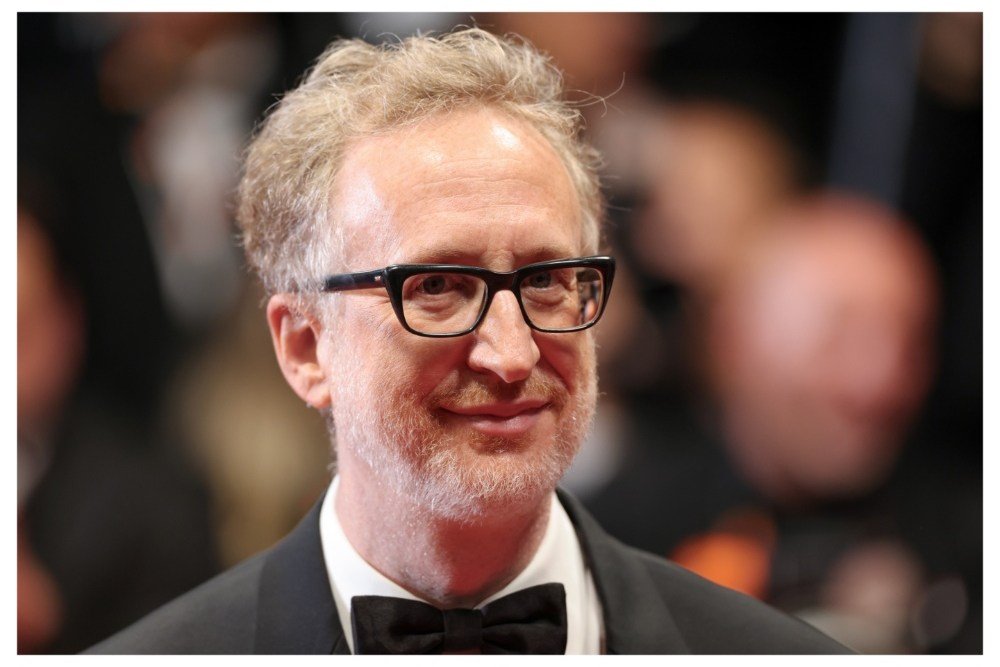
The Locarno Film Festival will honor James Gray with a lifetime career award at this year’s edition, where the U.S. auteur’s most recent work, “Paper Tiger,” will screen.
Gray will receive the Pardo alla Carriera award on Aug. 9 and will present “Paper Tiger” — which launched in May from Cannes — at the fest’s Piazza Grande outdoor venue. Set in 1986, the film follows two brothers, Irwin (Miles Teller) and Gary Pearl (Adam Driver). Irwin becomes entangled with the Russian mob after embarking on a get-rich-quick scheme to clean up the Gowanus Canal, and his former cop brother, Gary, is the only one who can get him out of trouble. “Paper Tiger” will have its North American premiere as the opening night film of the 64th New York Film Festival on Sept. 25.
Two other titles directed by Gray, “We Own the Night” (2007) and “Two Lovers” (2008), will also screen at Locarno as part of the tribute.
“Since winning the Silver Lion at Venice for ‘Little Odessa’ (1994) at age 25, James Gray has forged a singular career rooted, with piercing realism, in his upbringing in New York’s Russian-Jewish community,” the fest said in a statement, citing Gray’s “The Yards” (2000), “We Own the Night” (2007), “Two Lovers” (2008) and “The Immigrant” (2013), which cemented Gray’s standing “as one of American cinema’s most artistically distinctive voices — a filmmaker as concerned with criminal underworlds, rendered with exacting detail, as with meticulous family portraiture, often situated within the Brighton Beach of his youth and shaped by a dialogue with classic American and European auteur cinema.”
The Locarno statement continued: “As he has established himself at the top tier of filmmakers in the United States, Gray’s explorations of the often elusive promise of the American dream have, over the past decade, expanded into more varied thematic terrain — colonial exploration, space travel, racial prejudice — that reshaped the popular understanding of his work while remaining distinctively his own: ‘The Lost City of Z’ (2016) with Charlie Hunnam and Robert Pattinson, ‘Ad Astra’ (2019) with Brad Pitt and ‘Armageddon Time’ (2022) with Anthony Hopkins.”
Locarno artistic director Giona A. Nazzaro added, “James Gray is the last great novelist of American cinema. His films form a rich body of work that echoes the Jewish diaspora, film noir and Russian as well as North American literature.” He called Gray “a filmmaker with a humanist sensibility and profound cinephile knowledge” who “has experimented with genres such as science fiction and adventure while retaining his own artistic identity and voice.”
Previous winners of the Locarno Pardo alla Carriera Award include Francesco Rosi, Bruno Ganz, Claudia Cardinale, Johnnie To, Harry Belafonte, Jane Birkin, Costa-Gavras, Tsai Ming-liang, Shah Rukh Khan and Jackie Chan.
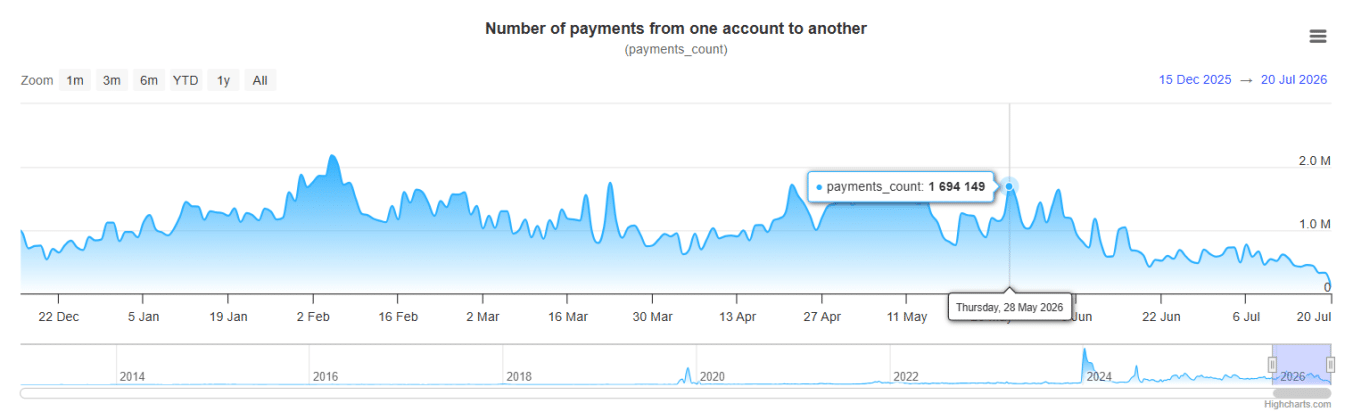
The number of daily payments on the $XRP Ledger (XRPL) has now crashed 80% from the May 2026 highs of over 1.69 million.
This comes amid the ongoing market-wide downtrend that has dealt a blow to investor sentiment. Notably, since hitting the $3.6 peak in July 2025, $XRP has collapsed more than 70%, currently trading for $1.08. As a result, bearish sentiments recently hit extreme levels.
$XRP Payment Volume Slumps 80%
Data from $XRP Scan, a leading XRPL explorer, confirms that these bearish sentiments have now begun impacting on-chain activity.
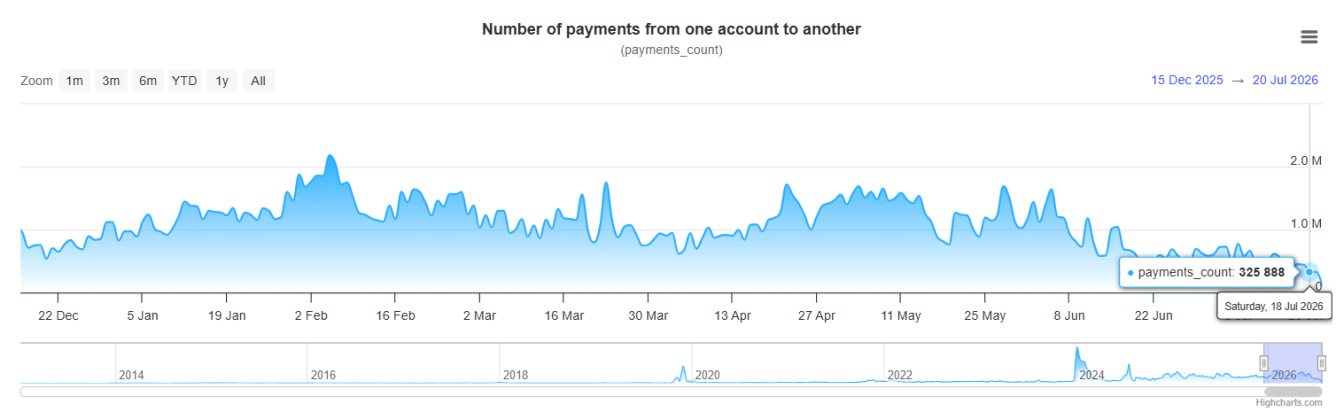
Specifically, the number of payments from one account to another on the $XRP Ledger dropped to a low of 325,888 on Saturday, July 18. This represents the lowest reading recorded on the network since the crash to 28,760 on Oct. 2, 2025, which occurred as a result of an unprecedented event.
$XRP Ledger Payment Crash
After that October 2025 crash, the number of XRPL payments remained above 500,000 every day until late June, when they dropped to around 400,000. Now, this figure has reduced further to a 9-month low of 325,888, indicating that payment activity has continued to decline.
Following the drop to 325,888 on Saturday, payment volume recovered slightly to 327,497 the next day, but this marked a drop below the 400,000 mark.
Importantly, the 325,888 figure represents an 80.7% crash from the recent highs of around 1.694 million daily payments recorded on May 28, 2026. Moreover, it also marks an 85% decline from the yearly peak of 2.188 million payments from February 2026.
The May 2026 High
Slowdown in Overall $XRP On-chain Activity
Meanwhile, further data confirms an overall slowdown in XRPL on-chain activitybesides the crash in the number of daily payments, as prices continue to hit lows around the $1 psychological mark.
For instance, the number of active users on the XRPL, when considering source tags and destination tags, dropped to a low of 123,986 on Sunday, coinciding with the crash in payment volume.
In addition, the number of transactions executed on the network also slumped to 1.129 million that day. This represented a 78% crash from the yearly peak of 5.172 million transactions executed on April 6, 2026.
$XRP Seeing Bearish Price Action
As earlier mentioned, this overall slowdown in network activity has been largely due to the broader market downturn that has led to increased selling pressure surrounding $XRP.
After recovering to $2.41 on Jan. 6, 2026, $XRP witnessed one of its steepest declines over the next few weeks, crashing to a low of $1.11 in early February before rebounding above $1.40. The asset maintained this level until early June, when it lost the support area from $1.1 to $1.4.
Now, $XRP changes hands below $1.1, down nearly 41% this year despite seeing a 4.85% gain in July 2026 so far. $XRP must hold above the $1 level to hedge against any steeper declines from here, which could push prices down to the $0.7 to $0.8 range.
London-based Chilean-Indian director Shalini Adnani’s debut feature “Our Share of Sand,” about a 12-year-old girl named Maya who returns to rural India to reconnect with her estranged father, is among standout entries in the upcoming Venice Film Festival Critics’ Week.
The section, dedicated to first works from around the world, also comprises two titles from Colombia: the fiction-documentary hybrid “The End of Times,” a political piece co-directed by Bibiana Rojas Gómez and Juan David Cárdenas that uses artificial intelligence and explores colonialism and capitalism in Colombian history, and Sebastián Múnera’s drama “Meteorite,” about plans to build an amusement park on the grounds of the former estate of drug lord Pablo Escobar.
Italy also features prominently in the lineup, with Paris-based Tommaso Usberti’s “Before the War,” about a young man named Guido raised within a Northern Italian racist milieu who falls in love with a Kosovar immigrant named Sonia, ensconced in a competition slot.
Also from Italy is the section’s out-of-competition opener, existential noir “Giaffa the Great” directed by Marco Santi, while the closer — also out-of competition — is Italian rap musical “Rider,” co-directed by Roan Johnson and the local music producer known as Dade (Davide Pavanello). “Rider” follows a young food delivery driver who delivers a huge sushi order to a luxurious villa on the outskirts of Milan and is invited to stay for the evening.
The seven features competing in Venice Critics’ Week are all by first-time directors and all world premieres.
Rounding off the section’s competition are Tunisian dystopian drama “The H@llow Man” by Kamel Laaridhi, set in 2059 Tunisia where a biochip regulates memory and suppresses emotion; Chinese drama “Zoom In, Zoom Out,” by Dong Jie, about a young video game designer who embarks on a journey to seek his missing roommate Gao following a clue hidden in an online game; and Brazilian drama “London,” by Victor Di Marco and Márcio Picoli, about a dilemma faced by a disabled young adult.
“Whilst the industry at large is grappling with its crises, these works are proof that cinema never stopped asserting its own cruciality,” said Venice Critics’ Week general delegate Beatrice Fiorentino in a statement. “This cinema is fierce and independent, daring and vibrant, resolute in its reminder that our collective imagination can, and indeed must, continue to be rewritten.”
All Venice Critics’ Week competition entries will compete alongside titles in the official selection for the fest’s Lion of the Future prize, which is worth $100,000.
The 83rd edition of Venice Film Festival will run Sept. 2-12, with its official selection lineup being announced on Thursday. See all the Venice Critics’ Week titles below.
COMPETITION
“The End of Times,” Bibiana Rojas Gómez, Juan David Cárdenas (Colombia)
“The H@llow Man,” Kamel Laaridhi (Tunisia)
“London,” Victor Di Marco, Márcio Picoli (Brazil)
“Meteorite,” Sebastián Múnera (Colombia)
“Our Share of Sand,” Shalini Adnani (India, United Kingdom, Greece)
“Prima Della Guerra,” Tommaso Usberti (France, Italy)
“Zoom In, Zoom Out,” Dong Jie (China)
OUT OF COMPETITION
“Il Grande Giaffa,” Marco Santi (Italy) — Opening Film
“Rider,” Roan Johnson, Davide Pavanello (Italy) — Closing Film
Bitcoin price has slipped below $64,000 as renewed US-Iran tensions, volatile oil prices, and a technology-sector sell-off tied to China’s Kimi K3 launch drove investors away from risk assets.
According to data from crypto.news, Bitcoin ($BTC) price fell nearly 2% to $63,785 on Monday before recovering toward $64,000, still down about 1% over the past 24 hours. The Crypto Fear & Greed Index remained in “Fear” territory at 29, while Ether, XRP, BNB, and Dogecoin also posted slight daily losses.
Middle East risks intensified after a projectile set a vessel ablaze in the Strait of Hormuz, forcing its crew to abandon ship before a tugboat rescued them. US strikes also killed one person in Tabriz, while Tehran condemned attacks on the unfinished Darkhovin nuclear facility.
CENTCOM separately reported that a US service member died during the controlled detonation of an unexploded Iranian drone in northern Iraq.
The attacks initially drove crude oil higher as traders assessed the threat to Middle Eastern production and shipping. Brent briefly exceeded $85 per barrel before falling toward $82 after Iran’s Foreign Ministry confirmed that international mediators had submitted proposals to reduce tensions.
Tehran also left the door open to negotiations with Washington if talks served Iran’s national interests. The diplomatic opening reduced immediate supply fears, although attacks on vessels, Iranian cities, and nuclear infrastructure kept the risk of another oil-price surge in place.
Technology stocks added another source of pressure after Beijing-based Moonshot AI released Kimi K3, a 2.8 trillion-parameter model designed for coding and agent-based tasks. Moonshot’s internal tests placed Kimi K3 ahead of several Western rivals in frontend coding, although those performance claims await independent confirmation when the model weights become available.
The launch intensified concerns that cheaper Chinese models could disrupt US artificial intelligence companies and their semiconductor suppliers. Bitcoin has traded closely with technology-heavy equity indices during recent risk-off sessions, leaving the cryptocurrency exposed as investors reduced positions across speculative markets.
US equity funds recorded $4.8 billion in withdrawals during the week ended July 15, according to LSEG Lipper data cited by Reuters. The Philadelphia Semiconductor Index lost 8.48% during the same period, while growth funds suffered $7.18 billion in net redemptions.
Bitcoin price must reclaim $65,000 to confirm a sustained recovery
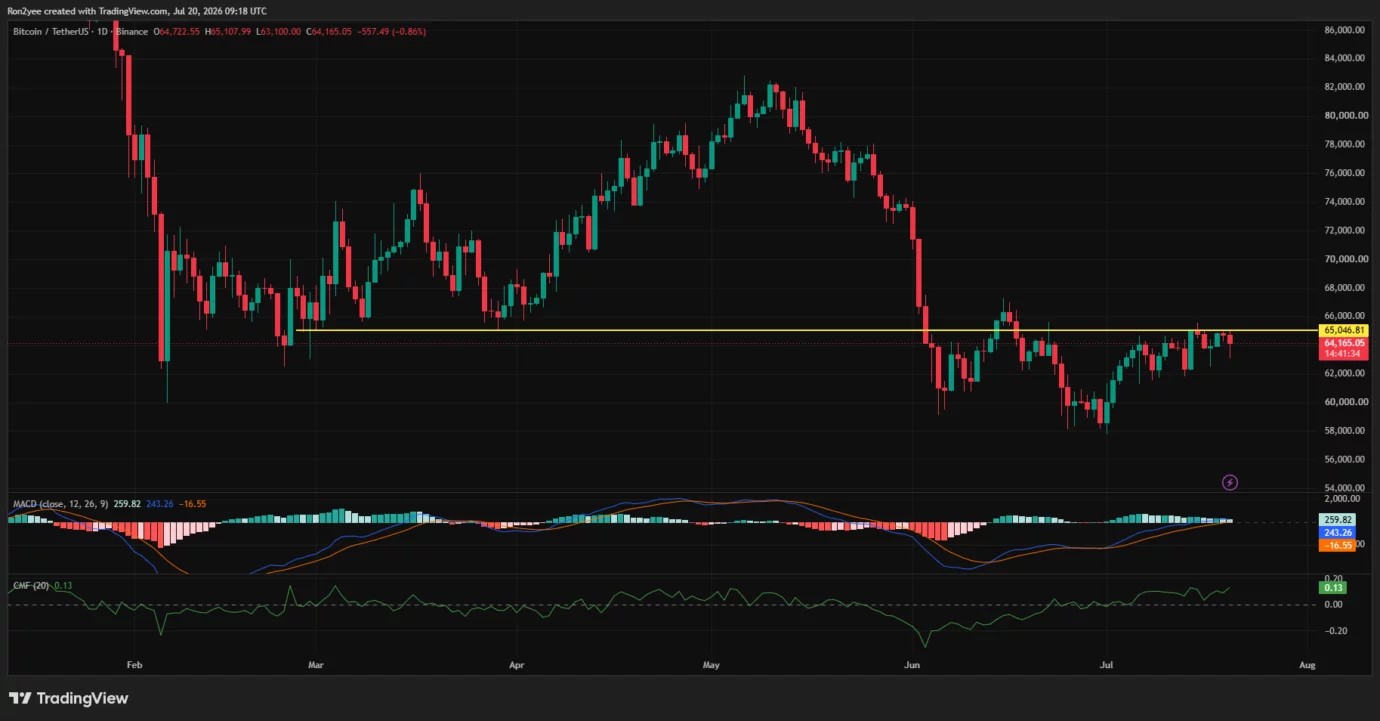
Bitcoin’s daily chart shows repeated failures around $65,047, a former support level that has turned into resistance. Buyers have tested the barrier several times since early July, but each attempt has ended without a daily close above it.
Bitcoin price daily chart — July 20 | Source: crypto.news
A decisive close over $65,047 would restore the recovery structure and expose the June swing high near $67,000. Until then, Bitcoin remains inside the range between roughly $60,000 and $65,000 that has controlled price action for most of July.
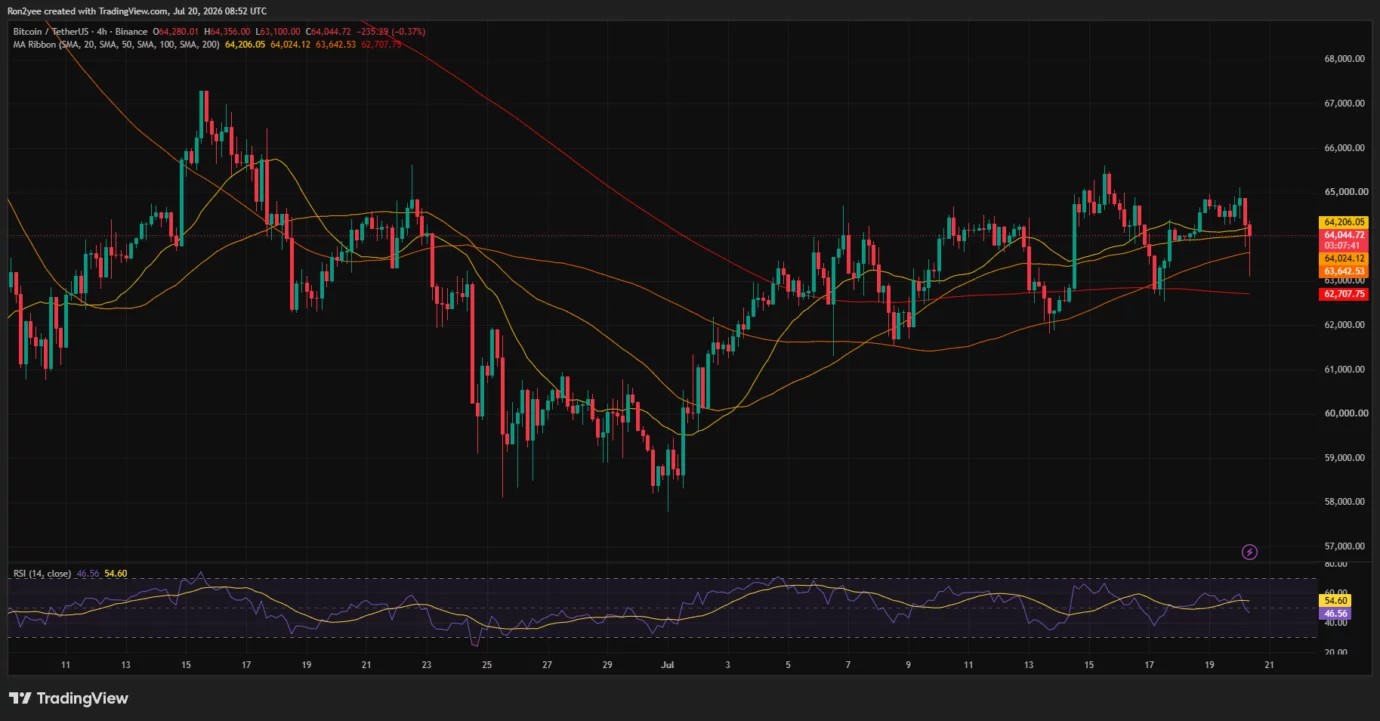
On the 4-hour chart, $BTC has fallen below its 20-period simple moving average at $64,206 but remains close to the 50-period average at $64,024. The 100-period SMA at $63,642 offers the next support, followed by the 200-period SMA near $62,708.
Bitcoin price 4-hour chart — July 20 | Source: crypto.news
4-hour relative strength has dropped to 46.56, below its moving average of 54.60. The reading shows that sellers have regained control of short-term momentum, though $BTC has not yet entered oversold territory.
Daily momentum presents a mixed picture. The MACD histogram has slipped below zero to -16.55 as the MACD and signal lines converge, raising the risk of a bearish crossover. However, the Chaikin Money Flow reading remains positive at 0.13, which shows that capital has not left the market at the same pace as the price decline.
According to trader Daan Crypto Trades, Bitcoin is still attempting to close above its weekly 200-period moving average, but a stronger advance is needed to challenge the weekly 200-period exponential moving average.
“Until then, we’re just caught in this $60K choppy price range.”
Spot Bitcoin ETFs have provided limited relief after more than eight weeks of heavy withdrawals, SoSoValue data shows. US-listed funds posted a second consecutive week of net inflows, while BlackRock’s IBIT helped drive a $132 million inflow on Friday despite a $4.2 million withdrawal from Fidelity’s fund. The improvement remains too small to establish aggressive institutional accumulation.
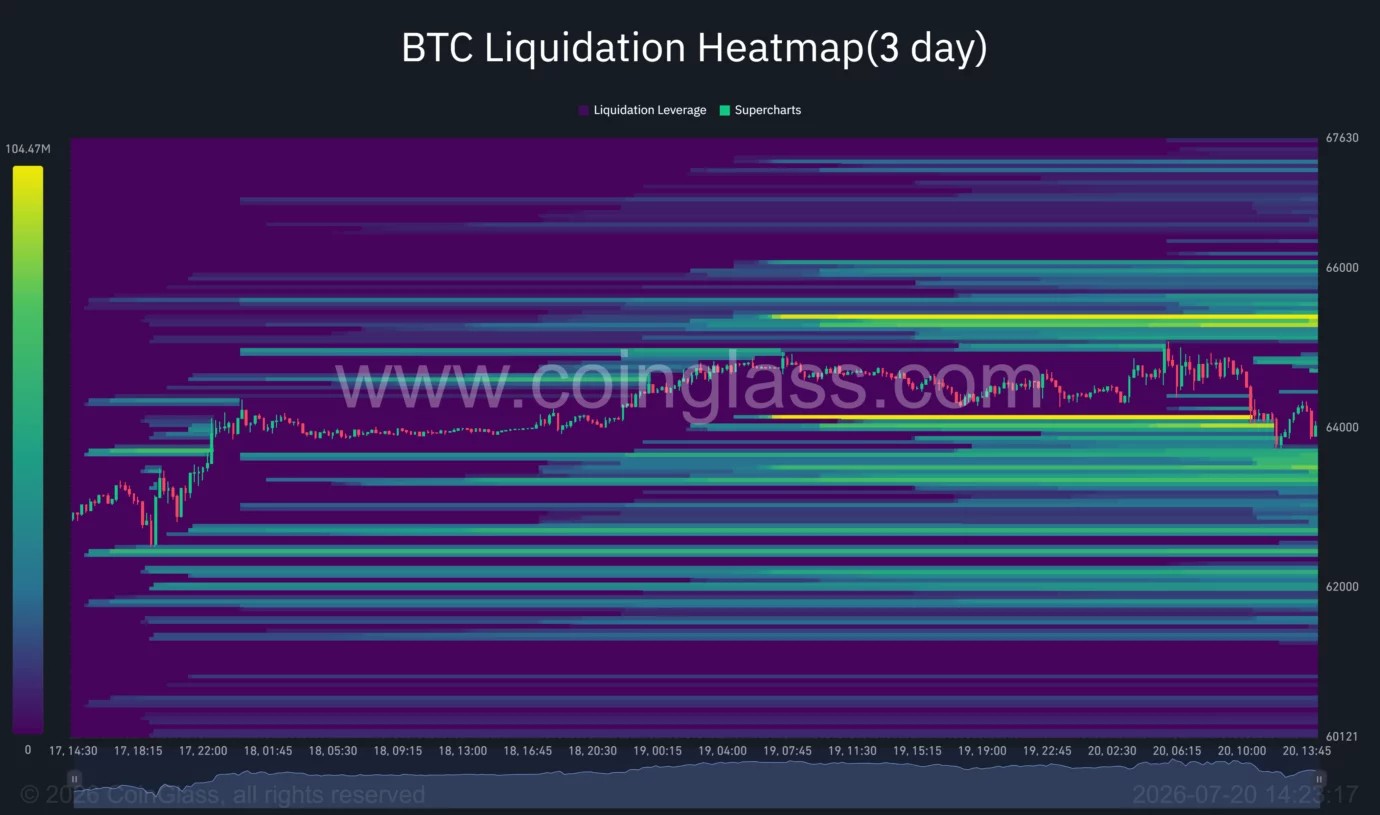
The three-day liquidation heatmap places the largest overhead liquidity concentration around $65,200 to $65,500. A move into that band could force leveraged short positions to close and help $BTC challenge the daily resistance near $65,047.
Bitcoin liquidation heatmap | Source: CoinGlass
Below the market, liquidation pools sit between $63,300 and $63,600, with another concentration around $62,500 to $62,800. Price frequently moves toward dense leverage zones, making either cluster a potential target if volatility expands.
Loss of $62,700 would expose Bitcoin to another capitulation leg
Bitcoin’s recovery thesis would weaken if sellers force a 4-hour close below the 100-period SMA at $63,642. A subsequent break under the 200-period SMA at $62,708 would expose $60,000, followed by the late-June low near $58,000.
Analyst Ardi warned that the current bear-market decline has not produced the severe capitulation seen before previous cycle bottoms. In his view, either months of range-bound trading must exhaust sellers or a deeper liquidation event must clear the remaining leverage.
I don’t necessarily think $BTC needs to bottom in Q4 this year.
But if the bottom comes sooner, we need a larger capitulation to front-run it.
Every prior cycle low was preceded by a brutal capitulation.
The kind of flush that pushed the average holder underwater, cleared the…
— Ardi (@ArdiNSC) July 19, 2026
Oil remains the main external risk. Failed US-Iran negotiations or renewed threats to regional energy routes could send crude higher again, revive inflation fears, and reinforce the Federal Reserve’s higher-for-longer policy stance.
For bulls, a daily close above $65,047 would invalidate the immediate bearish setup and open the path toward $67,000. Without that breakout, Bitcoin remains vulnerable to another sweep of leveraged positions below $63,600.
Hyperliquid said its HIP-4 upgrade, which introduced “outcome trading” to the decentralized exchange, will support permissionless deployment of the contracts in a future enhancement.
Once live, anyone will be able to offer a prediction market on the platform, subject to templates approved by validators, Hyperliquid said on Telegram on Sunday. In the meantime, they remain under the authority of validators.
Prediction markets, a sector dominated by Polymarket and Kalshi, allow participants to bet on event outcomes and have evolved into a multibillion-dollar sector of the blockchain industry. Users take positions on events from central bank interest-rate decisions to who performs at the Super Bowl halftime show.
The growing popularity of the platforms — the FIFA World Cup, which wrapped up Sunday with Spain winning its third title, drew more than $50 billion in bets — has attracted centralized trading platforms like Coinbase and Robinhood into the sector to offer customers a one-stop shop for predictions markets alongside more conventional financial trading.
US President Donald Trump said the latest strikes on Iran, now in their ninth consecutive night, were carried out ‘in honour’ of American military personnel killed in Jordan and Iraq. The latest casualty figures bring the total number of US service members killed since the war began to 17, with more than 420 others wounded.
Ben Shapiro posted an 18-minute review of Christopher Nolan’s “The Odyssey” to his YouTube channel on Saturday, in which he called the Greek epic a “masterpiece” despite the conservative outrage about the film’s cast and historical accuracy.
“Nolan is unparalleled. He’s the best director working today, without a doubt. He just creates iconic movie after iconic movie,” Shapiro said. He also had lots of praise for star Matt Damon, adding, “I think he’s great in nearly everything. He sort of disappears into the part in a way that he doesn’t in a lot of other movies. He’s great as Odysseus.”
He likewise gushed about several other members of the supporting cast: “Robert Pattinson as Antinous is an excellent antagonist. He’s sleazy and gross. Tom Holland as Telemachus is excellent, well cast. Anne Hathaway does a great job as Penelope.”
Shapiro also fired back at those who complained about Lupita Nyong’o playing Helen of Troy.
“So, I know a lot of people were like, ‘Oh my god, Lupita Nyong’o is supposed to look like Diane Kruger.’ I don’t know. Diane Krueger doesn’t look very Greek. She’s German,” Shapiro said. “Lupita Nyong’o is a beautiful woman. But here’s the thing, actually, in the script, Nolan goes out of his way to explain that the war wasn’t really launched over Helen being gorgeous.”
The political commentator did, however, take issue with Elliot Page’s casting as Sinon. He called Page’s role an “absolute puzzler” before pointing out that he is “about 5’2 and 105 pounds soaking wet and has the voice of a woman. It doesn’t work.”
Despite outrage from right-wing voices like Elon Musk, Nolan recently told The Telegraph that he’s unbothered by the noise. He explained that online backlash “comes with the territory” when making a blockbuster.
“Remember, I spent 10 years of my life dealing with Batman,” Nolan explained. “When I came on ‘Begins,’ writers and artists had been working on this beloved character for almost 65 years, and a lot of freighted thoughts were out there about what he represents. And what I learnt over my time on that trilogy is you can’t worry about any of that at all. What you have to do is honor the original text by interpreting it in the strongest way you personally can.”
AZ-COM Maruwa Holdings, a major Japanese logistics company, plans to adopt the JPYC stablecoin to make payments to around 2,300 business partners, in what is expected to be the first large-scale corporate use of the yen-denominated JPYC stablecoin in Japan.
According to a report from Nikkei, the stablecoin will be used to pay fees and compensation to individual contractors who handle transportation, including truck drivers, while the use of the stablecoin will allow faster and more frequent payments, as it does not charge transfer fees.
AZ-COM Maruwa is also considering a partnership with JPYC and an investment of over 1 billion Japanese yen ($6.2 million).
AZ-COM Maruwa is a mid-sized Japanese logistics company in Japan and counts Amazon Japan among its major customers.
“We will continue to advance the integration of logistics and commercial payment flows with JPYC,” said Noritaka Okabe, founder and CEO of JPYC Inc.
We have seen the future of who’s moving up in the list of artists contending to have the most No. 1 albums ever, and its name is Future. The rapper debuted on top of the Billboard 200 with “The Real Me,” landing his 12th No. 1 on the chart. That means he’s now in fifth place, by himself, in the ranking of all-time chart-topping album artists.
“The Real Me” debuted with 131,000 equivalent album units to easily slip in ahead of Olivia Rodrigo’s “You Look Pretty Sad for a Girl So in Love,” which moved another 96,000 units to hold on at No. 2 in its fifth week on the chart.
Previously, on the list of artists with the most No. 1 albums, Future had been tied with Eminem, with 11. With this 12th No. 1, he leaves Eminem behind to hold fifth place all by himself. The four artists ahead of him on that esteemed list are the Beatles (with 19 No. 1s), Drake and Taylor Swift (tied for second with 15 each) and Jay-Z (with 14).
Two albums besides Future’s debuted in the top 10. The Rolling Stones‘ “Foreign Tongues” bowed at No. 7 with 53,000 equivalent album units. That’s roughly in the same ballpark as a recent album by the Stones’ contemporary, Paul McCartney, which debuted with 63,000 in June.
The remaining top 10 entry was the soundtrack for television’s “Heated Rivalry,” which premiered in the No. 9 slot with 41,000 units. Billboard reported that this marked the first time a TV soundtrack had bowed in the top 10 in more than a decade — specifically, since the “Empire” soundtrack did it in 2015. (One other TV soundtrack, “Hazbin Hotel,” the companion album for an animated show, did reach the top 10 last year, but only after debuting at No. 70.)
Future’s figures for “The Real Me,” broken down, show streaming numbers far outstripping sales, which is typical for hip-hop. The album sold only 13,000 copies, but had 120.29 million on-demand streams, which translated into 118,000 SEA units.
Of course, the Stones’ numbers skewed the opposite way, with 48,500 albums sold, augmented by 4.48 million on-demand streams, amounting to 4,000 SEA units.
Curiously, the “Heated Rivalry” numbers came down entirely to sales, with 41,000 copies sold on CD and vinyl and 41,000 units altogether. That’s because the score album already came out digitally back in January, but it never accrued enough units on streaming alone to impact the chart prior to the July physical release.
Looking at the top 10, one big name is MIA: Madonna’s “Confessions II” has dropped out, after debuting last week at No. 1. Its chart position in week 2 isn’t yet known, as Luminate and Billboard only release the list of the top 10 albums on Sunday, so news of exactly where “Confessions II” came in in its sophomore session will have to wait till Monday.
The rest of the top 10 is rounded out by Morgan Wallen’s “I’m the Problem” at No. 3, Ella Langley at No. 4, Noah Kahan at No. 5, Drake at No. 6, Michael Jackson’s “Thriller” at No. 8 and Wallen’s “One Thing at a Time” at No. 10.
Strike founder and Twenty One Capital CEO Jack Mallers has made a forceful argument that Bitcoin’s long-term value lies not in attracting speculative capital, but in its potential to replace traditional savings and function as a reliable form of money. His comments, posted on X, directly challenge a recent critique from former Facebook executive Chamath Palihapitiya, who described Bitcoin’s current weakness as a structural issue tied to shifting liquidity and the rise of competing sectors.
Responding to Structural Concerns
Palihapitiya had argued that Bitcoin is facing a structural headwind as liquidity moves toward prediction markets, equities, and artificial intelligence (AI) ventures. He also suggested that Bitcoin mining power could earn 10 to 20 times more if redirected to AI computing. Mallers rejected this framing, stating that the new money flowing into prediction markets, meme coins, and AI was never sustainable demand for Bitcoin in the first place.
In his own words, Mallers wrote: “$BTC is not successful because it attracts speculative capital. It succeeds by replacing savings and becoming money.” This distinction is central to his thesis: Bitcoin’s ultimate value proposition is not as a high-risk asset for traders, but as a stable, decentralized store of value for long-term holders.
The Protocol’s Adaptive Design
Mallers also emphasized that Bitcoin’s creator, Satoshi Nakamoto, designed the protocol to adapt automatically even if power conditions change. He pointed to the network’s difficulty adjustment mechanism, which recalibrates when the hash rate shifts, ensuring that Bitcoin continues to produce blocks regardless of external market conditions. “We need $BTC much more than $BTC needs us,” Mallers added, suggesting that the network will remain operational long after speculative manias and tech bubbles fade.
Implications for Investors and the Market
This perspective carries weight for both retail and institutional investors. If Mallers is correct, Bitcoin’s current price volatility may be a feature of its speculative phase, not a flaw in its fundamental design. The argument positions Bitcoin not as a competitor to AI or prediction markets, but as a parallel system for preserving wealth outside of traditional financial and technological cycles.
For miners, the debate raises strategic questions. While some may consider pivoting to AI computing for higher short-term returns, Mallers’ view suggests that Bitcoin mining remains a critical and resilient component of the network’s security, with long-term value that may outweigh immediate profit opportunities.
Conclusion
Jack Mallers’ remarks offer a counterpoint to growing skepticism about Bitcoin’s role in a rapidly evolving digital economy. By framing Bitcoin as a monetary system rather than a speculative asset, he invites a reassessment of what constitutes success for the cryptocurrency. Whether the market agrees remains to be seen, but the debate underscores a fundamental divide in how Bitcoin’s future is understood.
FAQs
Q1: What did Jack Mallers say about Bitcoin’s success? Mallers argued that Bitcoin will succeed by replacing savings and becoming money, not by attracting speculative capital. He believes its value is in its role as a stable store of value, not as a high-risk investment.
Q2: How did Chamath Palihapitiya criticize Bitcoin? Palihapitiya described Bitcoin’s weakness as a structural issue, noting that liquidity is moving to prediction markets and equities, and that mining power could be more profitable if redirected to AI computing.
Q3: What is the Bitcoin difficulty adjustment mechanism? The difficulty adjustment is a built-in feature of the Bitcoin protocol that automatically recalibrates the mining difficulty when the network’s hash rate changes. This ensures that blocks are produced at a consistent rate, even if the total computing power on the network fluctuates.