$NEAR Protocol is building momentum after a governance proposal introduced a new long-term vision for the network’s token economy.
According to the $NEAR founder Illia Polosukhin, there are plans to establish the Sovereign Fund, which will be financed using 30 million $NEAR tokens.
The proposal arrives as $NEAR records its fourth consecutive day of gains, with buyers returning to both the spot and derivatives markets.
$NEAR whales are adding exposure
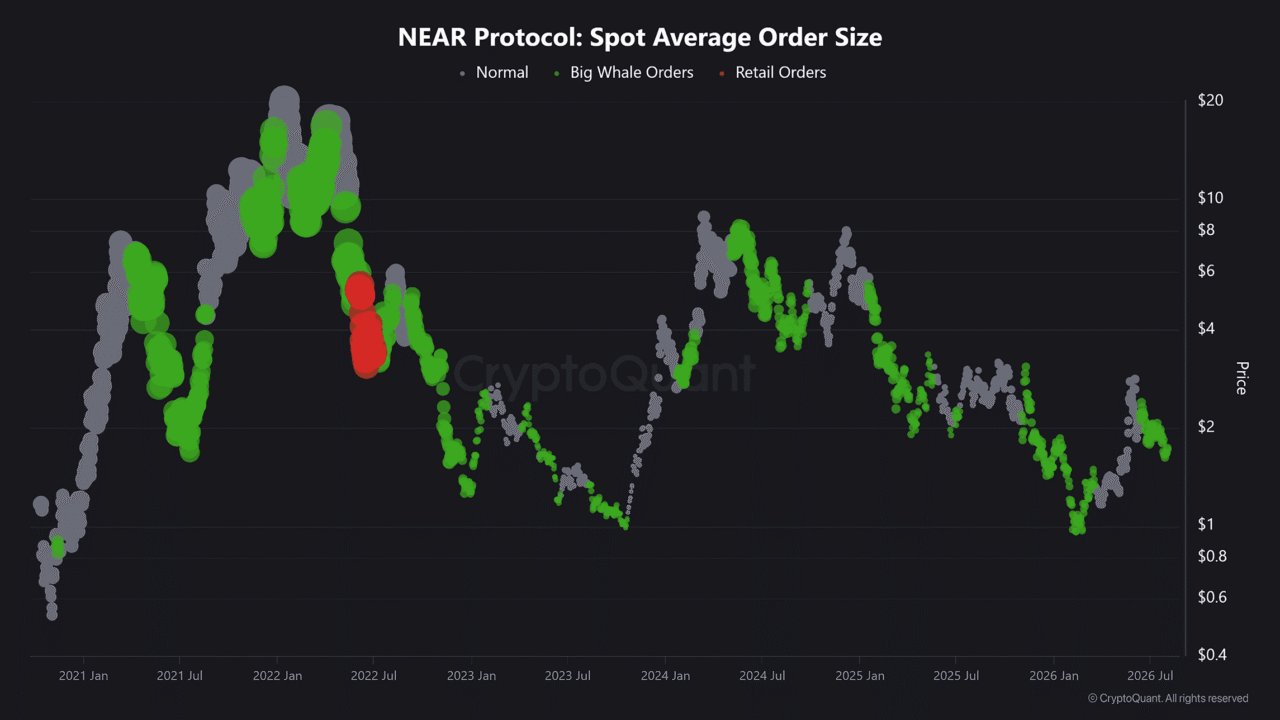
According to the recent Average Order Size data, Near Protocol’s large holders have become increasingly active during the latest rally.
The data indicates that a significant surge in the number of whale orders at the current trading prices, suggesting that institutional-sized investors are positioning alongside the improving market sentiment rather than locking in profits.
Source: CryptoQuant
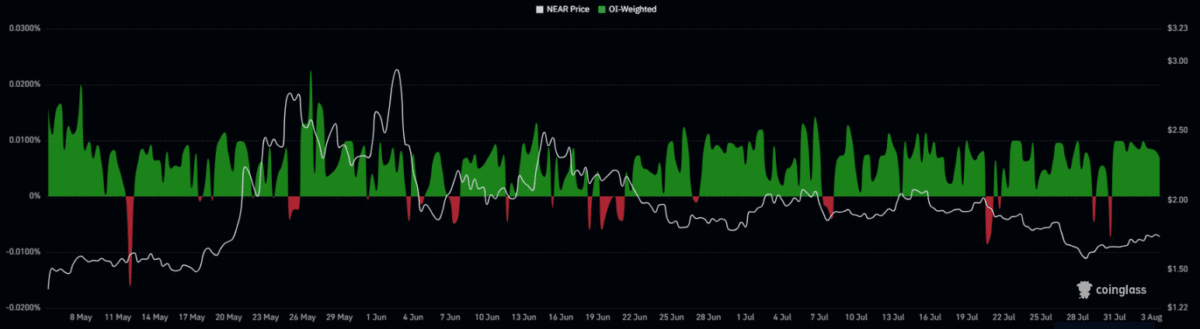
The derivatives market sparks the same signals. $NEAR’s Funding Rates have remained above 0% for several weeks, indicating long traders continue paying a premium to keep bullish positions open.
The persistent positive funding generally reflects an increased market confidence that higher prices are still expected, particularly when accompanied by steady spot accumulation.
All in all, both metrics point to strengthening conviction behind the current move.
Source: CoinGlass
Is a breakout on the cards?
The long-term technical setup continues to favor buyers.
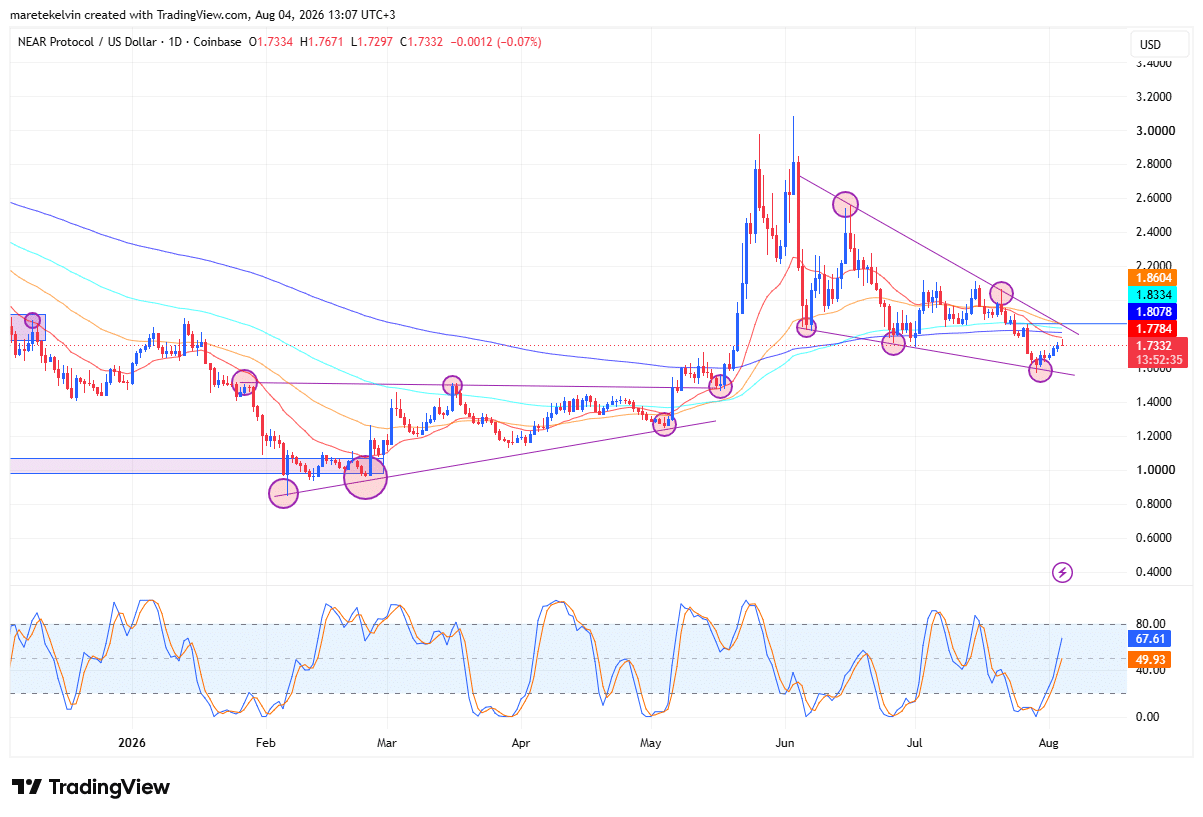
$NEAR has spent months consolidating inside a bullish pennant, a pattern that has repeatedly produced rebounds from support before another attempt at the upper boundary.
The latest rejection came near $1.60, where buyers successfully defended the pennant support. Since then, the token has posted a week of steady gains, preserving its higher-low structure and reinforcing bullish momentum.
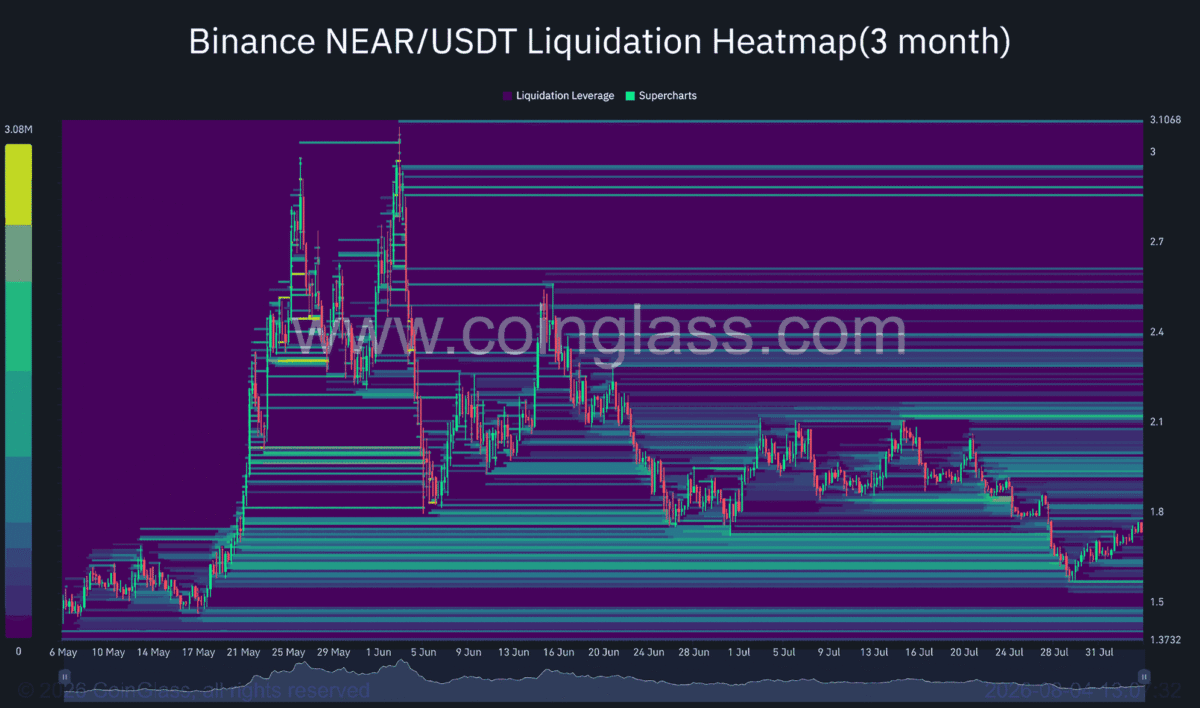
If the current trend continues, attention shifts to the next major liquidity zone. A liquidity cluster exceeding $1 million sits around $1.85, making it the next significant area where sellers could emerge.
Source: TradingView
As it stands, the combination of whale accumulation, persistently positive Funding Rates, and the proposed Sovereign Fund has improved market sentiment.
If buyers defend the pennant support, they could drive $NEAR toward $1.85 before it faces its next major resistance.
Source: CoinGlass
Final Summary
$NEAR extends its rally as a proposed 30 million token Sovereign Fund boosts sentiment.
Whale orders surge, and positive Funding Rates put the $1.85 liquidity zone on buyer radar.
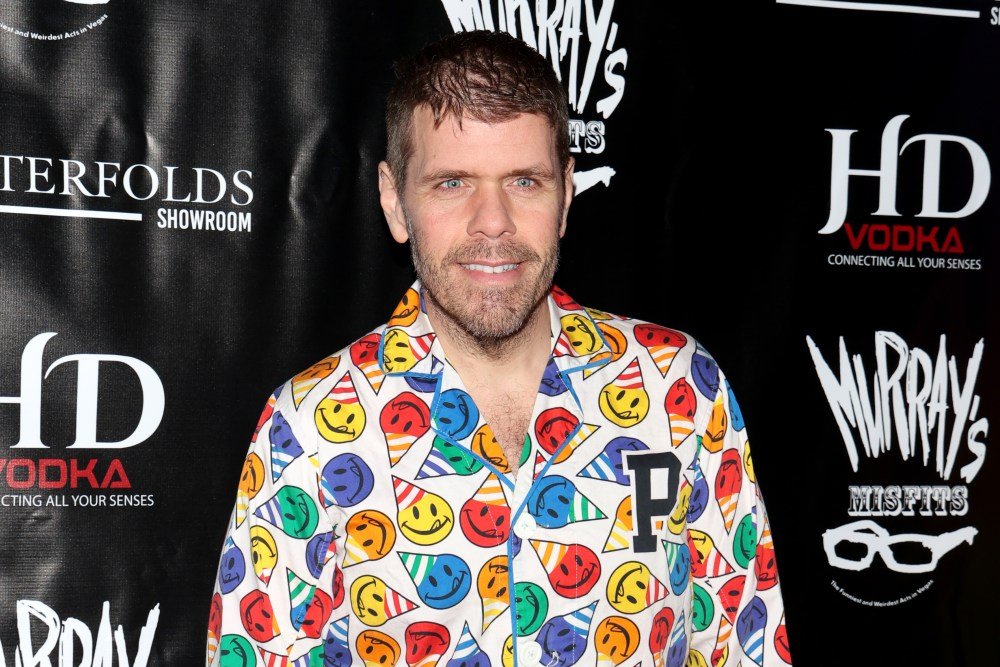
Local police were dispatched to the Miami home of Hollywood gossip journalist Perez Hilton after receiving reports about a disturbing livestream during which Hilton, covered in blood, appeared to be cutting himself, Variety has confirmed.
The Miami-Dade County Sheriff’s Office received multiple calls about Hilton’s livestream on Tuesday night and sent deputies to respond. Once on scene, officers spoke with several of Hilton’s family members. Authorities confirmed that Hilton was alone in his home during the time of the live stream. Deputies have since been ordered to “tactically disengage,” but continue to keep an eye on the situation.
The Miami-Dade County Sheriff’s Office also confirmed that Hilton was safely transported from his home to a local hospital, where he is receiving medical attention.
“In many incidents involving a person experiencing a mental health crisis or actively harming themselves, deputies prioritize de-escalation by creating time, distance, and opportunities for communication,” the Miami-Dade Sheriff’s Office said in a statement. “Unless there is an immediate threat to others, slowing the situation and utilizing crisis intervention techniques can reduce the likelihood of a suicide-by-cop encounter and minimize the risk of injury to the individual, deputies, and the public.”
Reps for Hilton did not immediately respond to Variety’s request for comment.
Hilton launched his career in the early 2000s, operating a popular celebrity gossip blog that offered a biting, unfiltered look at some of Hollywood’s most unsavory moments. In a 2012 sit-down with The New York Times, Hilton said that he was no longer aligned with his provocative reporting.
“What’s important for me is not being liked, but it is that people think I am no longer toxic to the world,” he said. Hilton later added, “I’m aware of the fact there are going to be a lot of people with lingering resentment and a lot of skeptics.”
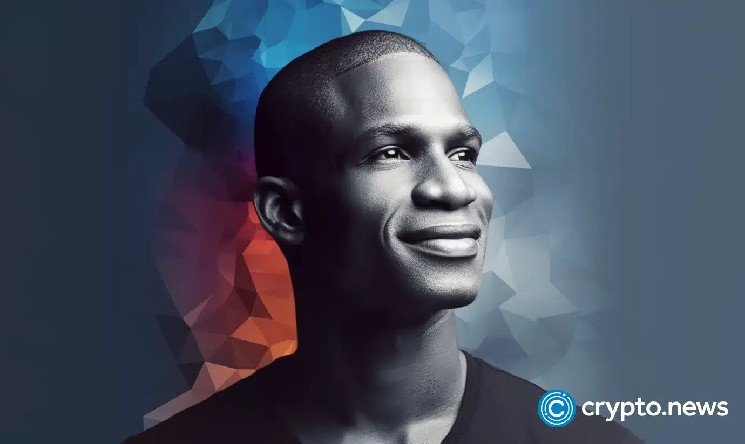
BitMEX cofounder Arthur Hayes published a new essay, “Situationship,” on Aug. 4, 2026, arguing that the artificial intelligence (AI) infrastructure boom could end as a credit crisis rather than a dot com style equity collapse.
Hayes framed data centers as leveraged real estate containing computing equipment that can lose economic value as newer chips become more efficient.
Hayes said an eventual slowdown in data center construction could expose weak borrowers and financiers, prompting government intervention and broader monetary easing. He believes the resulting liquidity could support a renewed Bitcoin bull market. However, the scenario remains his personal forecast, not a confirmed crisis or an official policy outlook.
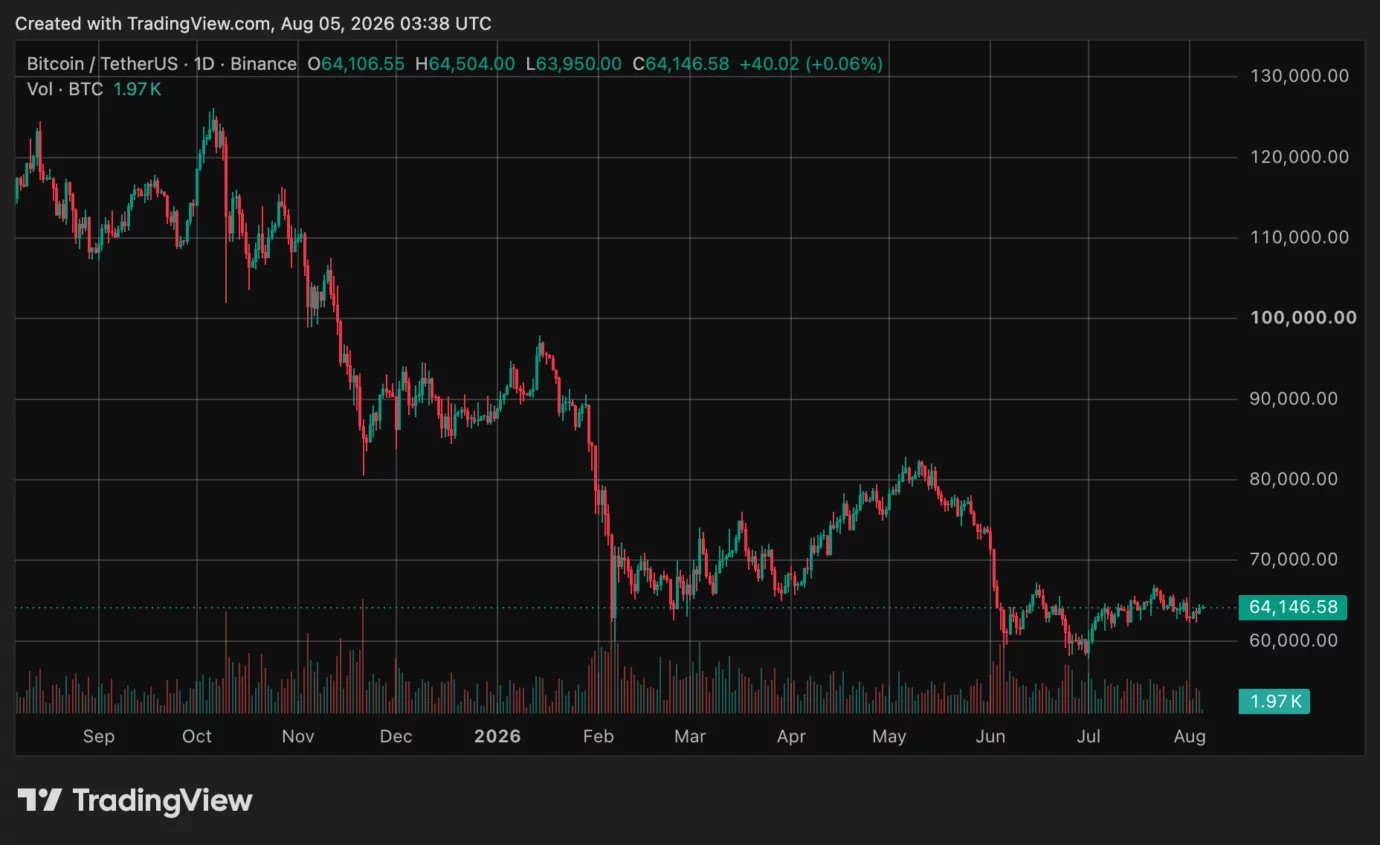
Bitcoin traded around $64,150 early on Aug. 5. No evidence reviewed for this report linked the immediate price move to Hayes’s essay. Hayes also acknowledged that he cannot identify the borrower that might trigger a crisis or determine Bitcoin’s precise bottom.
Bitcoin ($BTC) price chart, source: crypto.news
Arthur Hayes says AI spending is a real estate credit trade
Hayes’s central argument is that investors are treating AI capital expenditure as if every dollar supports a high margin technology business. He views much of the spending differently. Data center land, buildings, power connections and cooling systems resemble property development, while processors can become less valuable when newer equipment delivers more computing power at a lower cost.
“Situationship” is my $BTC bull porn essay on how the AI bubble will burst, and why the money printer will go hyper brrrr and take us back to a rip roaring bull market.
“The question of internal framing is the key variable that determines whether AI is a bubble. But before we… pic.twitter.com/ix5SGiAcuv
— Arthur Hayes (@CryptoHayes) August 5, 2026
This distinction leads to his comparison with the global financial crisis. Hayes described the AI boom as a “credit story like 2008 and not an earnings story like 2000.” In his scenario, banks, insurers, private credit funds and infrastructure investors continue financing construction after profitable demand begins slowing.
Losses would then emerge when weaker projects cannot generate enough cash to meet debt, lease or interest obligations. Financial stress could spread to lenders and investors holding AI infrastructure exposure, even if leading technology companies remain profitable.
Hayes expects announced AI capital spending growth to begin slowing during the second half of 2027 and become clearer in 2028. He also expects markets to eventually reward companies that reduce construction plans. Those dates are forecasts. No company filing reviewed for this report confirms that an industrywide contraction has begun.
His Bitcoin case follows from the expected policy response. Hayes argues that U.S. authorities would protect strategically important AI companies and their lenders because computing capacity has become part of the country’s economic competition with China.
He discussed a possible Bitcoin trading range between $60,000 and $70,000, with downside near $50,000, before an eventual rise toward $1 million. Those levels are not guaranteed targets and depend on monetary policy, credit creation and investor demand developing as Hayes expects.
The essay extends an earlier argument. As crypto.news previously reported, Hayes warned that major technology listings, including possible OpenAI, Anthropic and SpaceX offerings, could absorb liquidity that might otherwise enter crypto markets.
In related coverage, crypto.news examined the expanding bond and credit exposure behind AI infrastructure. That analysis noted that financial risks could spread beyond technology shares if data center construction relies more heavily on debt and private financing.
Official filings show AI spending is still accelerating
The latest company results do not show an AI capital spending collapse. Alphabet reported $44.9 billion of capital expenditure during the second quarter. About 60% of its technical infrastructure investment went toward servers, while 40% went toward data centers and networking equipment.
Alphabet raised its 2026 capital spending guidance to between $195 billion and $205 billion, up from its previous range of $180 billion to $190 billion. The company attributed the increase to faster capacity delivery required to meet demand.
Google Cloud revenue rose 82% from the previous year to $24.8 billion. Cloud operating income reached $8.8 billion, while backlog increased to $514 billion. Alphabet said it expects capital expenditure to increase again in 2027.
Microsoft also reported continued expansion. Its quarterly capital expenditure reached $41 billion, with roughly two thirds directed to CPUs and GPUs. Microsoft Cloud revenue increased 27% to $59.3 billion, while commercial remaining performance obligations reached $678 billion.
The company said it expects capital expenditure to grow during fiscal 2027. Microsoft also expects more than $50 billion of spending in its next quarter, although part of that figure reflects a change in how some data center leases will be classified.
Amazon reported a similar mix of rising investment and stronger cloud income. AWS revenue increased 37% to $42.2 billion in the second quarter, its fastest growth in 18 quarters. AWS operating income reached $16.6 billion.
However, Amazon’s trailing twelve month free cash flow moved to an outflow of $7.6 billion. The company attributed the change mainly to a $66.1 billion increase in property and equipment purchases, largely connected to AI investment.
These results cut both ways for Hayes’s thesis. Strong cloud growth and large customer backlogs weaken the argument that demand is already failing. At the same time, lower free cash flow, rising depreciation and growing contractual obligations show how the buildout can pressure finances even while revenue expands.
Heavy spending alone does not create a credit crisis. Such a crisis would require weaker cash generation, refinancing problems, defaults or impaired infrastructure assets across several companies and lenders.
U.S. financing exposure is growing, but 2008 is unproven
Regulatory filings support Hayes’s narrower claim that AI infrastructure increasingly involves leases, guarantees, joint ventures and outside capital.
Alphabet disclosed $85.2 billion of future payments for leases, mainly connected to data centers, that had not started as of June 30. These leases are scheduled to begin between 2026 and 2031, with contract terms reaching as long as 26 years.
Alphabet also reported $811 billion of purchase commitments and other contractual obligations. Most relate to technical infrastructure, inventory, energy agreements and other long term contracts. The company had $98.2 billion of long term debt and issued more than $51 billion of fixed rate notes during the first half of 2026.
Microsoft disclosed $62.9 billion of finance lease liabilities as of March 31. It also reported another $196.6 billion of leases, mainly for data centers, that had not yet commenced.
Meta reported approximately $182.88 billion of uncommenced lease obligations and $237.67 billion of noncancelable contractual commitments as of March 31. The company entered another $24 billion of infrastructure contracts during April.
Private financing is also becoming more visible in U.S. data center projects. Meta and BlackRock announced a venture for a one gigawatt campus in El Paso, Texas. Meta described the project as representing more than $10 billion of investment.
An earlier Meta venture with Blue Owl Capital covered an estimated $27 billion data center campus in Louisiana. Blue Owl funds received an 80% interest, while Meta retained 20%. Part of the outside funding came through debt sold privately to PIMCO and other bond investors.
Meta agreed to lease the Louisiana facilities and provided a capped residual value guarantee under certain conditions. Such arrangements show how data center exposure can be distributed among technology companies, insfrastructure funds, landlords and debt investors.
They do not prove that a 2008 style chain of insolvencies has started. Alphabet, Microsoft, Amazon and Meta remain profitable businesses with large operating cash flows and growing customer commitments. The reviewed filings did not report widespread defaults on AI infrastructure debt or an official government rescue program.
The 2008 comparison therefore remains a stress scenario rather than a present diagnosis. Mortgage losses became systemic because weak lending, securitization, leverage and opaque counterparty exposure spread through major financial institutions.
An AI infrastructure downturn could follow a different route involving unused capacity, falling rental values, obsolete equipment, tenant concentration and long power commitments. Whether those risks become systemic will depend on utilization, refinancing conditions and where losses ultimately settle.
Bitcoin’s outcome depends on policy, liquidity and timing
The Federal Reserve held its federal funds target range at 3.5% to 3.75% on July 29. The decision passed by a 9 to 3 vote. The central bank did not announce an AI rescue facility, emergency lending program or new asset purchase plan.
The Fed has conducted reserve management purchases of Treasury bills to maintain ample banking system reserves. Its July monetary policy report said Treasury bill purchases since early January totaled nearly $250 billion, including about $160 billion of reserve management purchases.
Those operations are not officially described as quantitative easing or an AI bailout. The Fed says they are intended to maintain an adequate level of reserves and support control over short term interest rates.
Hayes interprets balance sheet growth and stable policy rates as supportive for bank credit and future market liquidity. That interpretation remains open to debate because reserve management can expand the Fed’s assets without representing the broad crisis response assumed in his forecast.
Bitcoin could benefit if a future downturn produces rate cuts, emergency lending or larger asset purchases. However, the first stage of a credit shock could hurt Bitcoin as investors sell liquid assets, meet margin calls and reduce leverage.
As crypto.news reported in its examination of Bitcoin’s changing market cycle, Federal Reserve policy and global liquidity now compete with the halving cycle as major drivers of crypto prices.
The next evidence will come from company guidance and credit markets rather than from Hayes’s essay. Investors can watch 2027 spending plans, cloud backlog conversion, data center occupancy, lease commitments, private credit spreads and any defaults tied to AI infrastructure.
The Fed’s next scheduled meeting will take place on Sept. 15 and Sept. 16. Unless company demand weakens or financing stress begins appearing, Hayes’s argument remains a forward looking Bitcoin thesis built around a credit crisis that has not occurred.
FAQs
Is the AI bubble already bursting?
The latest filings do not show an industrywide contraction. Alphabet raised its spending guidance, Microsoft expects continued capital expenditure growth and AWS reported accelerating revenue. Financial pressure is visible in free cash flow and contractual commitments, but those conditions do not constitute a credit bust.
Why does Hayes compare AI with 2008 instead of 2000?
Hayes believes the main vulnerability lies in debt, leases and infrastructure financing rather than technology companies earning little or no revenue. The comparison depends on credit losses spreading through financial intermediaries, which has not been established.
Would an AI crash automatically raise Bitcoin’s price?
No. Bitcoin could decline during an initial liquidation period. A later recovery would depend on the scale, speed and form of monetary support, along with continuing demand for Bitcoin. Central bank easing would not guarantee any particular price.
What would weaken Hayes’s thesis?
Sustained cloud revenue, strong data center utilization, profitable AI services and stable credit performance would weaken the argument. The thesis would also lose force if companies fund construction without creating stressed borrowers or concentrated lender losses.
Ripple Expands Its Institutional Tokenization Infrastructure
Ripple President Monica Long outlined the company’s broader strategy on Aug. 4 after Ripple announced strategic investments in Zilo and Licuido to expand institutional capital markets infrastructure connected to the $XRP Ledger. She described a rapid transition from bank pilots toward production-grade activity and positioned Ripple’s digital asset stack across the full tokenized asset lifecycle.
“In the last year, we’ve seen the veritable light switch flip – from bank pilots to production, from issuing tokenized assets like money market funds and liquidity funds to using them! Institutional capital markets are moving in one direction — onchain 24/7,” Long stated on X, adding:
“At Ripple, our goal remains to provide the full stack of digital asset infrastructure – allowing institutional participants to take advantage of the entire lifecycle of a tokenized asset on the $XRP Ledger.”
Those investments in ZILO and Licuido add fund tokenization and institutional liquidity infrastructure to Ripple’s broader capital markets strategy, supporting fund issuance, trading, and settlement on the $XRP Ledger.
Ripple’s Mint platform complements that strategy. Launched on July 23, it provides financial institutions with a unified interface to access, mint, redeem, and manage Ripple USD, or $RLUSD, while issuing and transferring the stablecoin across fiat and blockchain settlement systems.
Institutional issuers can also use Ripple’s tokenization platform to create securities, stablecoins, fund units, bonds, commodities, and other real-world asset (RWA) tokens. Its infrastructure combines issuance, redemption, compliance screening, transfer restrictions, audit trails, freeze controls, clawbacks, and multichain distribution.
Tokenized Funds Move Into Trading, Lending, and Yield
A partnership among DBS, Franklin Templeton, and Ripple shows how tokenized assets can support continuous portfolio management after issuance. The arrangement allows eligible DBS clients to trade $RLUSD for Franklin Templeton’s tokenized money market fund within minutes while retaining access to yield.
DBS also plans to explore accepting these tokenized fund units as collateral through bank repurchase agreements or third-party lending platforms. That structure would let institutional investors move between a stable settlement asset and an income-producing instrument throughout the day.
Real-world asset tokens can represent bonds, funds, commodities, and property on blockchain networks, opening those assets to faster transfers and around-the-clock settlement.
Credit Infrastructure Could Extend the XRPL Stack
The proposed XRPL Lending Protocol would add standardized institutional lending to the network’s tokenization infrastructure. The design keeps underwriting and compliance decisions offchain while managing servicing, repayments, interest, and defaults onchain for treasuries, stablecoins, commodities, money market funds, and private credit.
Separate XRPL infrastructure is connecting $XRP and $RLUSD liquidity with tokenized U.S. Treasury products offering regulated, reserve-backed yield. A Doppler Finance and Openeden partnership plans to integrate Openeden’s TBILL token and yield-bearing USDO stablecoin into an XRPL-native protocol using audited reserves, regulated custody, and compliance controls.
The Bank for International Settlements (BIS) identified tokenization as a potential source of faster, programmable payments and more efficient financial intermediation. The organization’s 2026 assessment also called for trusted settlement instruments, coordinated oversight, and stronger safeguards, while warning that current stablecoin structures present financial-integrity and monetary risks.
Ripple’s next expansion point rests with validator decisions on the proposed lending standards, which would determine whether tokenized XRPL assets can support protocol-level institutional borrowing.
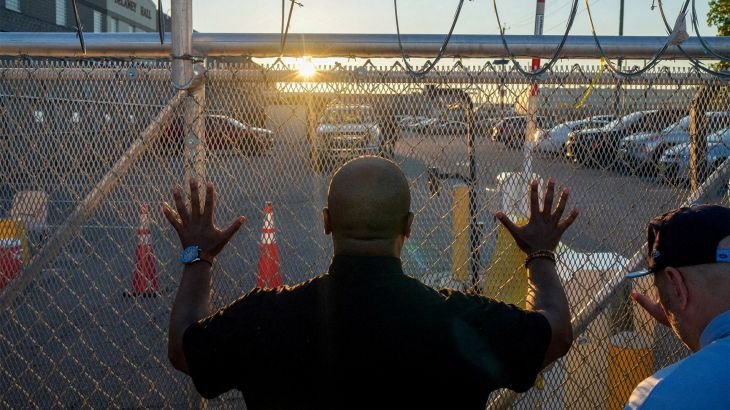
Anger is growing after a 41-year-old Salvadoran man named Edwin Lopez-Cornejo died after he suffered a medical emergency while detained at ICE’s Delaney Hall in Newark, New Jersey.
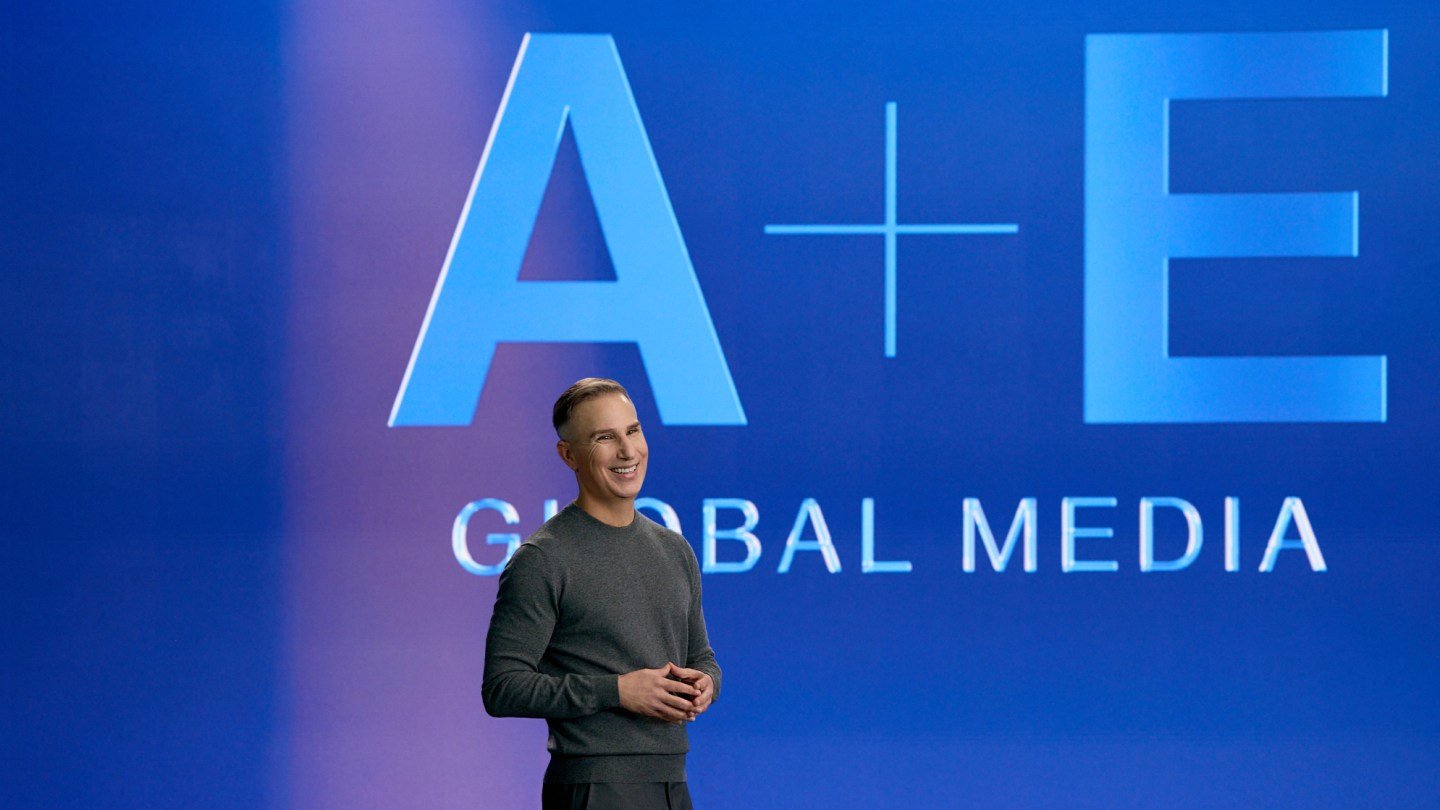
The Walt Disney Co. has sold its 50 percent equity stake in A+E Global Media to Hearst for $1.2 billion in cash, ending the joint venture that was first created in 1984.
The deal will see Hearst take full control of the media company formerly known as A+E Networks, which owns brands like A&E, History and Lifetime, including cable TV channels, content studios, and streaming offerings. A+E has also invested in companies like Vice, Propagate Content, Atlas Obscura and Philo TV.
A+E will become a part of Hearst’s entertainment group upon closing later this year.
“We thank our Disney colleagues for decades of successful partnership,” said Steven R. Swartz, president and CEO of Hearst. “We look forward to supporting Paul Buccieri and A+E Global Media’s leadership team as they continue to make must-see programs and innovate around the great HISTORY, Lifetime and A&E brands.”
Paul Buccieri has led A+E since 2018.
“In a media environment defined by fragmentation, A+E Global Media’s advantage is the strength and versatility of our brands, our strong partnerships and our vast library of owned assets,” added Buccieri, president and chairman of A+E Global Media. “As we continue extending our storytelling globally across all platforms with IP that travels to every screen and form-factor, we believe we are well suited for whatever opportunities may come next. I also want to express my deepest thanks to Hearst, The Walt Disney Company and to our board members — both recent and past — for their guidance and support over the years.”
The company was founded in 1984 (the Arts & Entertainment Network was its original cable brand), with Hearst and ABC each owning a slice alongside other investors. NBC obtained a minority stake in 1993. The company expanded with an acquisition of Lifetime Networks in 2009. Lifetime was also a JV of Disney and Hearst.
Disney and Hearst had been equal partners in A+E since 2012, when they bought out NBCUniversal’s minority stake. The company had begun to explore its options a year ago, hiring Wells Fargo to market it. Since then, of course, Comcast spun out its cable channels into Versant while Warner Bros. Discovery has inked a deal to sell itself to Paramount Skydance.
Paramount reported mixed second-quarter earnings Tuesday as its takeover of Warner Bros. Discovery remains in limbo.
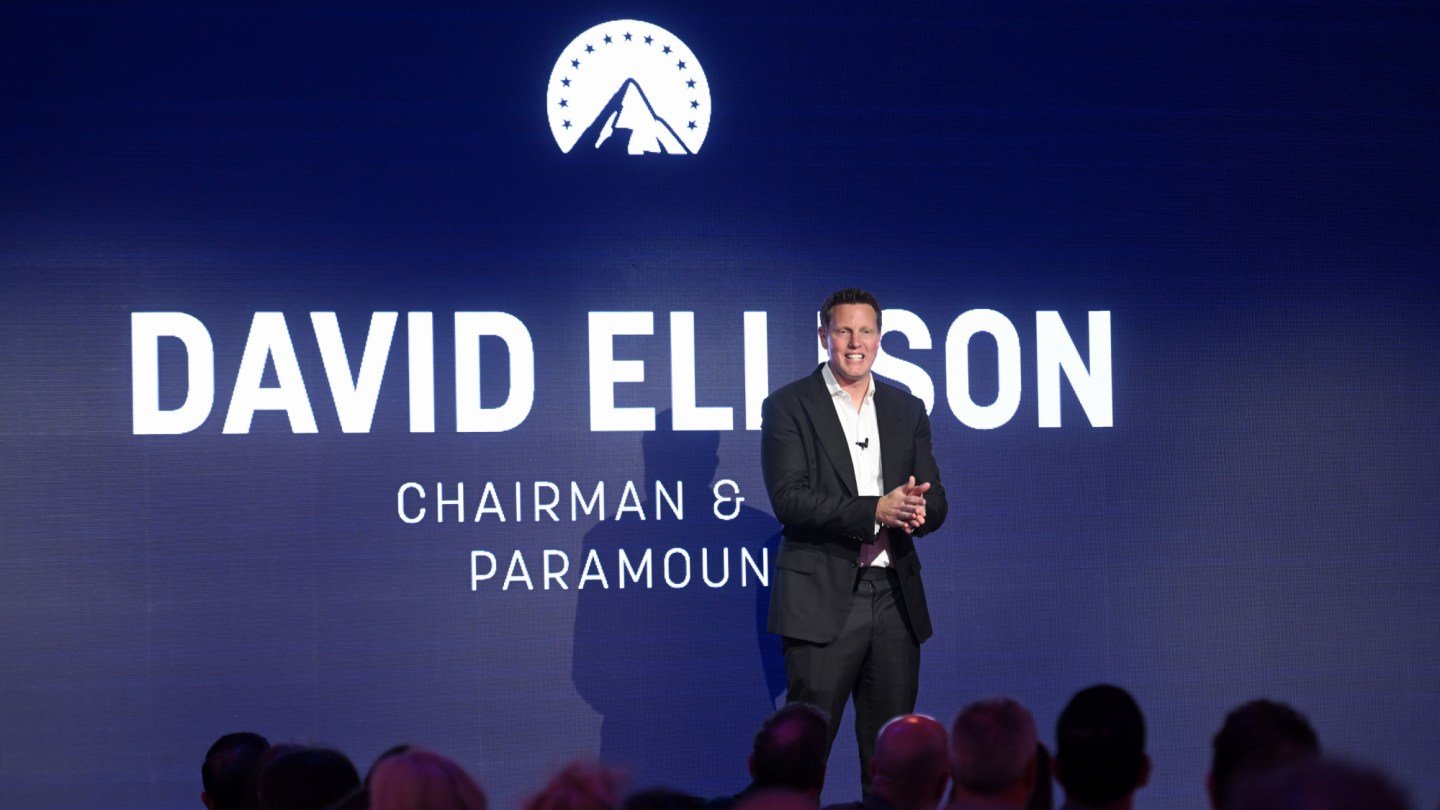
Still, CEO David Ellison sought to reassure shareholders in the letter saying, “We continue to prepare for our proposed combination with Warner Bros. Discovery, while staying focused on executing our standalone strategy and delivering strong results.”
The company reported revenues of $6.9 billion, up 1 percent from its predecessor company a year ago, while net earnings fell to $41 million, or four cents per share after $57 million, or eight cents a share, a year ago.
Paramount’s TV media segment, which includes CBS and its cable networks, continued to fall, dropping 9 percent year-over-year to $3.1 billion, while direct-to-consumer revenue rose 9 percent to $2.5 billion. Studio revenue rose 16 percent to $1.3 billion, thanks to content licensing deals and TV production arm as well as the success of Scary Movie.
Revenue at Paramount+ rose 16 percent to $2.1 billion, as the company said Q2 was its best quarter for retention ever on Paramount+ thanks to Dutton Ranch, UFC and the FIFA World Cup. The streaming services added 2 million new subscribers to hit 81.6 million worldwide, up 6 percent year over year.
Paramount is raising its full-year outlook range to $3.8 billion to $3.9 billion in adjusted EBITDA and now expects free cash flow conversion of at least 10 percent. The company added that it had seen “double-digit growth in commitments” across the company after its Upfronts presentation, but did release further specifics.
“We continue to make progress on our transformation at Paramount, and we now expect to deliver over $2.7 billion of run-rate efficiencies by the end of 2026 versus $2.5 billion previously, and continue to expect $3 billion-plus in efficiencies from the Skydance-Paramount combination,” the letter continues.
Paramount won the bidding war for Warner Bros. Discovery in February with its $111 billion offer, after Netflix declined to raise its offer. But the merger is currently on pause, as Paramount has since been hit with several lawsuits, including from 12 state attorneys general who claim the acquisition will kill competition in the film and television industries. The company has agreed to delay the billion takeover of Warner Bros. Discovery until June 1, 2027, or until the antitrust lawsuits brought by state attorneys general are resolved. Ellison has told staff he remains “highly confident” in the completion of the merger.
But just after earnings were released Tuesday, the judge overseeing the states’ lawsuit scheduled the trial to start in March, rather than November as the studio had requested. Starting Oct. 1, Paramount will have to pay a ticking fee of roughly $7 million per day to Warners shareholders until the deal closes.
The earnings also come the same day that an op-ed from Ellison appeared in The New York Times, in which the executive argued that his political leanings and proposed takeover of CNN are the root cause of the lawsuits filed by a dozen state attorneys general and the Writers Guild of America.
“I believe this fight is not really about market share … I believe a plainer worry sits beneath the briefs and the news releases: the news. The issue is whether I can be trusted as a steward of Warner’s CNN. There has been speculation about my politics, my loyalties, my intentions,” Ellison wrote. “Unfortunately, I can’t give anyone a view into my heart and mind, but I can share this: I have regularly voted for candidates of both parties; I hold some views that would be called conservative and others that would be called liberal, just like most Americans; and when it comes to our news operations, I do not aspire to lead these companies to bend their newsrooms to my views. I believe that news should be based on facts and truth.”
All players know that once you max out your skills in the game, one of the best ways to open the threshold for more record-breaking sessions is to upgrade your hardware. More refresh rates and faster response times create space to make you a better gamer and improve the picture and graphics of your game time, too.
Although upgrading your setup is expensive, especially when it comes to hardware outside your rig. Monitors are the kind of equipment that can make or break your experience, but they often demand a premium. Take this $600 monitor from Samsung, for example: it’s a 27-inch gorgeous OLED screen that makes gaming gorgeous and feel ultra-smooth. But wait—what’s that? Amazon has it for a massive 33% off right now, slashing $200 off the $599.99 list price.
The Odyssey G6 Gaming Monitor kicks off with 27 inches of dazzling QD-OLED screen space that delivers Pantone-validated color for the most vibrant on-screen picture. It reaches up to 400 nits of brightness with a million-to-one contrast ratio, thanks to HDR10 technology. Between color and contrast, rest assured that visuals will be lifelike yet discernible (and you won’t get picked off by a bad agent hiding in the shadows).
Speaking of action, the Odyssey OLED G6’s lightning-fast 240Hz refresh rate will ensure you won’t miss a single frame of it. The monitor also uses variable refresh rates that adjust on the fly based on the game you’re playing and uses AMD FreeSync Premium to prevent screen tearing and lag almost entirely. Between that and the 0.03ms response time, there’s plenty of overhead to build up your own reaction time to blistering speeds.
You aren’t limited to using this monitor for just gaming, too. If you moonlight as a player and spend the day as a remote professional, the Odyssey G6 is 54% less glossy than anti-reflective film, which makes it ideal for office spaces with ambient lighting, and it employs Samsung’s own OLED safeguard system to prevent burn-in and keep temperatures low to preserve longevity. The cherry on top is its height-adjustable stand, which lets you personalize it to your desk space.
Recommended by Our Editors
Gaming monitors aren’t cheap, especially this Odyssey G6 on a regular day. But for 33% off on Amazon right now, it’s a solid steal for players looking to up their game. But if you’re looking for something different, check out our experts’ picks for the best gaming monitors for 2026!
Paramount Skydance said second-quarter profit fell, even as the company was boosted by its streaming media and studios operations, while its large TV division shed ad dollars and subscribers. David Ellison, the company’s CEO, vowed that its deal to acquire Warner Bros. Discovery would close, despite legal setbacks that have slowed the transaction.
“While there is still significant work to be done, our confidence in the opportunity continues to grow, and we’re excited for the future of this company powered by storytelling and accelerated by technology,” Ellison said in a letter to shareholders Tuesday.
Paramount said net earnings fell to $41 million, or four cents per share, in the second quarter, compared with $57 million, or eight cents a share, in the year-earlier period. Revenue rose 1% to $6.91 billion, compared with nearly $6.85 billion a year earlier.
In the company’s TV operations, the largest part of its business, revenue fell 9%, to $3.12 billion, compared with $3.45 billion a year earlier. Ad revenue fell 14%, due in part to difficult comparisons with 2025 that involved more NCAA advertising. Distribution fees fell 6%, due in large part to erosion of linear subscriptions.
Revenue from streaming operations rose 9% to $2.5 billion, with revenue from Paramount+ rising 16%. The service added 2 million subscribers in the second quarter, ahead of expectations. The company cited FIFA World Cup telecasts in certain Latin American nations as as UFC broadcasts in the U.S., and said Paramount+ had its “lowest churn quarter” since launch.
Revenue from the company’s studios rose 16% year-over-year to $1.3 billion, owing in part to films such as “Scary Movie” and programming for third parties from its TV production operations.
Paramount said its upfront sales process had ended, and it had secured “double-digit growth in commitments across the company,” without offering further details about volume or pricing.
The company projected revenue in the third quarter would grow between 4% to 7%, increasing to $6.95 billion and $7.15 billion, with more growth from studios and streaming and “moderating declines” from TV. Subscribers to Paramount+ are seen as “flattish.”
Despite a recent legal setback that will delay the closing of its deal for Warner, Ellison said he remained optimistic it would eventually close. “We remain confident the transaction will be completed, creating a stronger, more competitive media company,” he said, describing the combined entity as a smaller player when compared with “tech giants such as Netflix, Amazon, Apple, and others.”
The judge overseeing a lawsuit from a coalition of 12 states looking to block Paramount‘s $111 billion takeover of Warner Bros. Discovery has scheduled a trial to start in March.
The decision marks a blow for the studio, which pushed to start the trial in November. Starting on Oct. 1, Paramount will have to pay a ticking fee of roughly $7 million per day to Warners shareholders until the deal closes. It’ll likely be on the hook for upwards of $1.5 billion, accounting for the time it takes for the court to issue a ruling on the antitrust trial.
Last week, Paramount urged the court to start the trial in November while the states proposed to set it for April.
The trial will last 12 days, beginning on March 2 and ending on March 19. It will run from 8:30 am to 1:30 pm. The final pretrial conference will be held in February, with both sides completing briefing by the beginning of April.
Paramount’s legal team is led by Beth Wilkinson, who successfully defended Microsoft’s bid to acquire Activision Blizzard after the FTC sued. She joined last month a deep bench of lawyers for Paramount that includes Jeffrey Kessler and Paul Clement.
Facing lawsuits from the states, the Writers Guild of America and Paramount shareholders looking to stop the deal, Paramount’s bid to acquire the legacy studio is in limbo. In a New York Times op-ed, Ellison stressed that the merger has been politicized, with the states primarily looking to stop him from owning CNN.
“I believe this fight is not really about market share … I believe a plainer worry sits beneath the briefs and the news releases: the news. The issue is whether I can be trusted as a steward of Warner’s CNN. There has been speculation about my politics, my loyalties, my intentions,” Ellison wrote. “Unfortunately, I can’t give anyone a view into my heart and mind, but I can share this: I have regularly voted for candidates of both parties; I hold some views that would be called conservative and others that would be called liberal, just like most Americans; and when it comes to our news operations, I do not aspire to lead these companies to bend their newsrooms to my views. I believe that news should be based on facts and truth.”