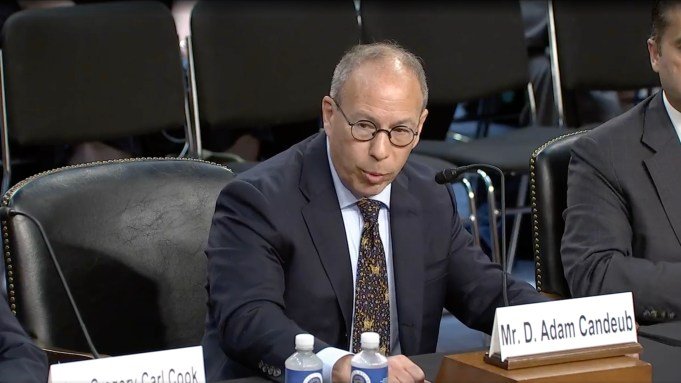
The FCC‘s general counsel Adam Candeub faced pointed questions as the agency has delved into network content, with one Republican senator, John Kennedy, warning him that the agency was “getting into the foothills of violating the First Amendment.”
Candeub was recently nominated by Donald Trump to lead the Justice Department’s Antitrust Division, a role at requires confirmation by the Senate. He appeared at a Senate Judiciary confirmation hearing on Wednesday.
FCC Chairman Brendan Carr, who was appointed by Trump, has undertaken multiple investigations of the networks, over issues ranging from diversity, equity and inclusion practices to the way that 60 Minutes edited an interview with Kamala Harris.
The agency also is investigating The View and whether it is bound by the Equal Time Rule, and ordered ABC to submit its eight broadcast licenses for early renewal. The network claims that the actions are regulatory retaliation for Trump’s dislike of network programming, including ABC News content and Jimmy Kimmel. The FCC has not yet issued a decision.
Kennedy, senator from Louisiana, asked Candeub, “All right, explain to me like you’re talking to a 10th grader. What business it is of the FCC if a television network criticizes a political figure?”
Candeub responded, “Senator, as general counsel of the Federal Communications Commission, I don’t think it would be appropriate for me to venture into that issue.”
Kennedy replied, “I do. Explain the law to me. … I mean, this stuff scares me. I don’t like some of the stuff that is said on television, but what business is it of the FCC? Educate me.”
Candeub started to go into the history of FCC oversight, referring to the 1927 and the 1934 Communications Act, before Kennedy interrupted.
“Well, we have’t given the FCC the right to regulate freedom of speech, have we?”
Candeub answered, “You have required the FCC to regulate broadcasters pursuant to the public interest.”
Kennedy replied, “And who decides what the public interest is?”
Candeub answered, “It is the judgment of the FCC following precedent and following the law.”
Kennedy continued, concluded by telling Candeub, “All I’m saying is ya’ll be careful. You are getting into the foothills of violating the First Amendment.”
“Understood, sir,” Candeub replied.
Carr has claimed that he has the authority to delve into content because stations are required to serve in the public interest. But the sole Democrat on the commission, Anna Gomez, has said that he’s using a vague standard to punish broadcasters for disfavored speech, even though the First Amendment still protects programming.
Some Democrats on the Judiciary Committee also focused on the FCC’s investigations. Sen. Peter Welch (D-VT) pressed Candeub on the FCC probe of 60 Minutes,.
“What would be the basis of opening that investigation?” Welch asked.
“As general counsel of the Federal Communications Commission, my job is not to make policy. My job is simply to advise the chairman and the commission,” he said, declining to go further in his comment and citing attorney-client privilege.
Sen. Cory Booker (D-NJ), the top Democrat on the Senate Judiciary antitrust subcommittee, said that he would not support Candeub’s nomination.
Booker pointed to what he said was the politicization of the Antitrust Division. He cited its approval of the Paramount-Warner Bros. Discovery merger without any conditions as an example of how the division has lost its independence from Trump’s desires. He cited a report that the division cleared the merger even though career staffers had issued a recommendation, and “they were going to recommend blocking the merger.”
Booker then asked Candeub to show his independence by answering the question, “Did Joe Biden win the 2020 presidential election, yes or no?”
Candeub, like other nominees asked the question, answered that the “United States Congress certified Joe Biden.” Booker accused Candeub of “showing cowardice.”
The hearing comes as state attorney generals have played a bigger role in challenging proposed mergers. California Attorney General Rob Bonta and others have sued to block not just Paramount-WBD but Nexstar’s proposed merger with Tegna.
Sen. Mike Lee (R-UT), the chair of the antitrust subcommittee, asked Candeub “to what extent state attorney generals should play in antirust enforcement.”
Candeub replied, “If confirmed, I hope to work with state attorney generals to have a coherent and consistent antitrust enforcement.”
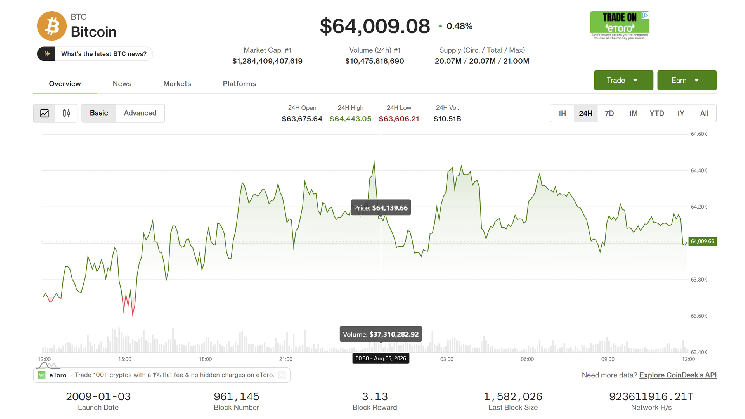
Bitcoin $BTC$64,032.87 was little changed, adding 0.16% since midnight UTC to trade near $64,000, even as global equities hit new highs, fueled by optimism over AI and progress toward reopening the Strait of Hormuz, which pushed oil prices lower.
MSCI’s All Country World Index rose 0.4% toward another record close, its Asia Pacific benchmark gained 2.2%, and Australian shares hit a new peak after the S&P 500 and Dow Jones Industrial Average closed at all-time highs Tuesday.
The broader CoinDesk 20 (CD20) is unchanged since midnight, with 11 components rising and nine declining.
The divergence points to crypto-specific weakness. U.S. spot bitcoin ETFs recorded $5.4 billion of net outflows in the first half of the year as capital rotated into AI-linked assets.
“Institutional and retail interest in crypto as an investment has cooled as AI absorbs a disproportionate share of capital and attention; most sectors, not just crypto, have underperformed AI over the past year,” DWF Labs wrote in a report.
Today’s direction may find a catalyst in U.S. employment figures and ISM services PMI due later.
Circle (CRCL) shares rose about 10% in premarket trading Wednesday after the stablecoin issuer reported second-quarter earnings that topped profit expectations, even as revenue came in slightly below Wall Street forecasts.
The company posted adjusted earnings of 18 cents a share, beating analysts’ consensus estimate of 16 cents, while revenue and reserve income rose 7% from a year earlier to $701 million, missing expectations of $712 million. Net income from continuing operations reached $48 million, topping analysts’ estimates of $43 million, while adjusted EBITDA climbed 8% to $143 million.
$USDC, Circle’s dollar-backed stablecoin, continued to expand. Circulation reached $73.3 billion at the end of June, up 19% from a year earlier, but down from its 2026 peak of nearly $80 billion. Onchain transaction volume surged 151% to $14.8 trillion during the quarter.
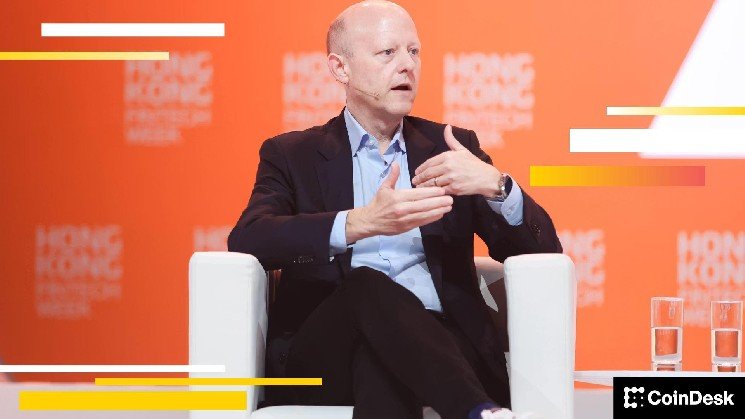
“Our quarterly financial results reflect the current rate environment and a crypto market that has slowed,” CEO Jeremy Allaire said in a statement. “But the institutions using $USDC today, like BlackRock, BNY and Standard Chartered aren’t piloting, they are expanding.”
The earnings also offered the clearest update yet on Arc, Circle’s blockchain network scheduled to launch its public mainnet on Sept. 16.
There’s an old saying that “every coin has two sides.” It applies perfectly to the multimillion-dollar hack of the hardware wallet Coldcard that began on July 30 and is still in progress.
On one hand, the hack raised questions about the safety of taking direct custody of coins in hardware wallets as a long-term holding strategy, a technique that became popular following the collapse of the FTX exchange in 2022.
On the other hand — and this is the bright side — it spurred the shuffling and reshuffling of coins to exchanges and multiple wallets alike by holders.
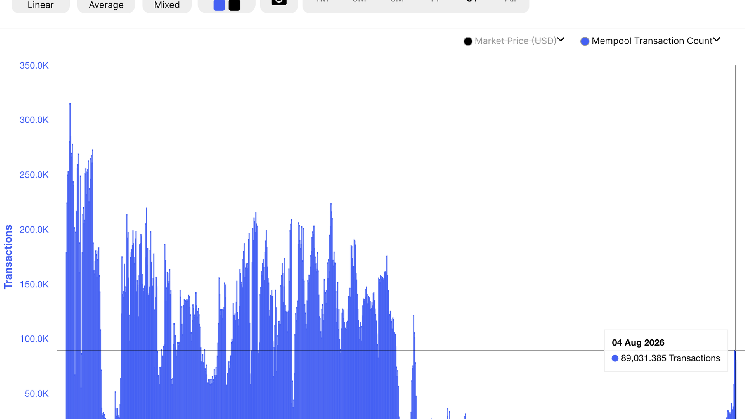
This bright side is evident from key data, starting with the number of transactions sitting in Bitcoin’s memory pool awaiting confirmation from miners. That count has spiked since late July, reaching 89,031 on Tuesday, the most since February 2025, according to data from Blockchain.com (check the Daily Signal).
Other metrics reveal the same picture. According to>
Increasing network activity is often said to support valuations for the network’s native coin, bitcoin BTC$64,032.44. So far, the token has neither rallied nor dropped significantly and remains boxed in the recent range of $62,000–$65,000.
Analysts continue to point to the fate of the Clarity Act as the immediate catalyst while citing longer-duration government bond yields as a more macro and longer-lasting one.
“CLARITY is still the immediate policy binary. The Senate has a three-day window before its August 10 recess, while the implied probability of passage by year end has fallen to 23% from around 75% in mid-May. A push to attach prediction-market restrictions adds another process risk,” analysts at Marex said.
Meanwhile, Bitfinex said the bullish macro case for bitcoin could collapse if the real or inflation-adjusted yield on the U.S. 10-year Treasury note tops 2.5%.
“The 10-year real yield has not stayed above 2.5% since before Bitcoin existed, so there is no price history above that line. It is now at 2.41%, nine basis points below,” the exchange said.
Stay alert!
Read more: For analysis of today’s activity in altcoins and derivatives, see Crypto Markets Today . For a comprehensive list of events this week, see CoinDesk’s “Crypto Week Ahead.”
Built as a 64-bit environment, Visual Studio Professional 2026 supports development across .NET, C++, Blazor, and .NET MAUI for cross-platform mobile and desktop projects. It’s currently available for $29.97 (MSRP $499.99).
IntelliCode-powered AI analyzes code context to deliver ranked completion suggestions and assist with refactoring, reducing bugs and boilerplate along the way. CodeLens surfaces commit history, test status, and code references directly in the editor without requiring a context switch.
Live Share enables real-time collaborative editing and debugging without requiring teammates to clone repos or configure matching environments. The IDE also integrates natively with Azure, GitHub, and DevOps workflows, and supports hot reload across .NET and C++ projects so code changes apply instantly during runtime.
This is a single-user lifetime license redeemable on one supported device. The code must be redeemed within 30 days of purchase.
Prices subject to change. PCMag editors select and review products independently. If you buy through StackSocial affiliate links, we may earn commissions, which help support our testing.
About Our Expert
StackCommerce Team (Sponsored)
Experience
Products featured in these stories are selected by our partners at StackCommerce. If you buy something through links on our site, PCMag may earn an affiliate commission.
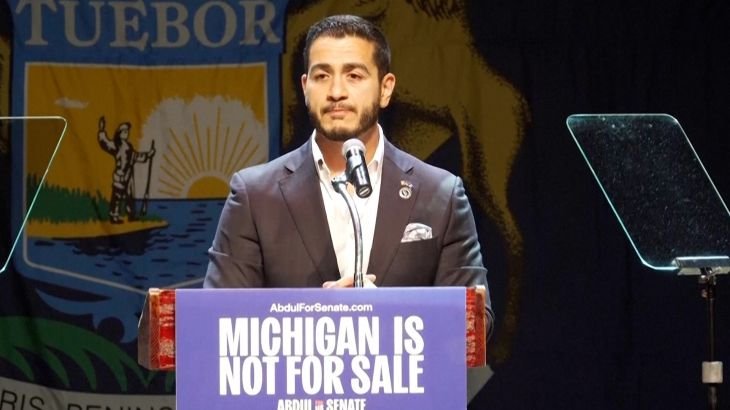
Michigan democratic senate primary candidate Abdul El-Sayed says the government is meant to be ‘for the people’ as he and Haley Stevens remain neck and neck with votes still being counted.
The date is much closer to the timeline sought by state attorneys general and the Writers Guild America, who sued to block the transaction, rather than a trial start this fall favored by Paramount.
U.S. District Judge Araceli Martínez-Olguín, based in Oakland, wrote that the trial will take place from March 2 to March 19 of next year.
Paramount had sought a November trial start; the state AGs and the WGA proposed April.
The judge wrote that the trial will run from 8:30 a.m. to 1:30 p.m., with two 15 minute breaks. The trial will be dark on March 8 and March 15.
A Paramount spokesperson said in a statement, “We respect the court’s decision and continue to believe a trial on the merits is the best and most direct way for us to prove what we’ve said from the start – this transaction is lawful, pro-competitive, and raises no antitrust concerns. The lawsuit against us has no basis in fact, economics or antitrust law. We will continue to vigorously defend the transaction and remain committed to closing as soon as possible so its benefits for the creative community and consumers can be realized.”
California Attorney General Rob Bonta, who is leading 11 other state AGs in challenging the merger, did not comment.
The date of the trial is hugely important for Paramount, which will be on the hook to pay Warner Bros. Discovery $7 million for every day that the transaction doesn’t close after September 30. That was Paramount’s deal sweetener as it competed with Netflix for the legacy studio and other assets.
The merger itself has an expiration date of June 4 of next year, and Paramount agreed to a $7 billion termination fee if the transaction did not close due to regulatory issues. The judge has not given any timeline as to when she would make a decision after the trial.
A month ago, it looked as if Paramount may be on its way to closing the transaction this summer, as it racked up regulatory approvals around the world. But Bonta and the other states filed an antirust lawsuit to block the transaction on July 13 and then won a temporary restraining order to put the merger close on hold for at least four weeks. Paramount then moved to go directly to trial, arguing for the earlier date, albeit even a November trial would cost them tens of millions in ticking fees.
Among other things, in a filing last week, Paramount warned that a trial next spring would require them to refile merger materials with the Justice Department, which has already cleared the transaction, because a waiting period expires on Feb. 19.
“A trial after that date would require the parties to re-do regulatory work that has already been completed,” the company’s legal team said in its filing last week. “This burden is not limited to the United States but will also be applicable in other jurisdictions where pre-closing regulatory review and clearance has been obtained. Redoing work that has already been done to the satisfaction of government agencies around the world serves nobody’s interests.”
The state AGs and the WGA, however, wrote that they needed extensive discovery. They pointed to the collection of materials on “the definition of the relevant product and geographic markets, the nature and scope of harm in those markets, whether expansion by other firms will prevent harm in those markets, and whether the merger will produce verifiable, merger-specific efficiencies sufficient to outweigh harm in those markets.”
The company said that that the later date would leave the creative community in a period of uncertainty, as Paramount plans to boost production to 30 films per year.
The judge set an initial case management conference for Aug. 19, with a joint case management statement due on Aug. 13.
A few years ago German writer-director Felix Randau (Iceman) got what sounded like an interesting proposal from France: to direct episodes of a miniseries about Felix Kersten, the former massage therapist of Nazi SS leader Heinrich Himmler.
“When I got back to Berlin and read their concept, I really liked it,” he recalls. “But there was this one special sentence in it that said, ‘If Steven Spielberg had known about Felix Kersten, he would have shot a film about Felix Kersten and not about Oskar Schindler.’ I knew that Steven Spielberg struggled for, I don’t know, about 10 years before he started shooting Schindler’s List, and he’s a smart guy who has a lot of assistance. So I became suspicious and started my own research, going to the archives and reading a lot of books and stuff.”
In the process, he realized that Kersten’s legacy is much less clear-cut. “I figured out that the story the French guys wanted to shoot was a hero story, a superhero story,” Randau tells THR. “But I felt you simply cannot do it.” He soon started focusing his work energy elsewhere.
The result is his new film, I Is Another (Ich Ist ein Anderer), which world premieres on Friday, Aug. 7 in the Piazza Grande program of the 79th edition of the Locarno Film Festival in Switzerland. Set in 1952, the film sees a journalist ambush Kersten and his wife on a train because she has doubts about the heroic narrative that he has been presenting about himself — one that might even get him the Nobel Peace Prize. What starts as a normal interview quickly turns into a psychological cat-and-mouse game. Is Kersten a hero or an impostor? Or could he maybe be both?
“Every story has three sides,” Randau says in a director’s note. “Yours. Mine. And the truth…”
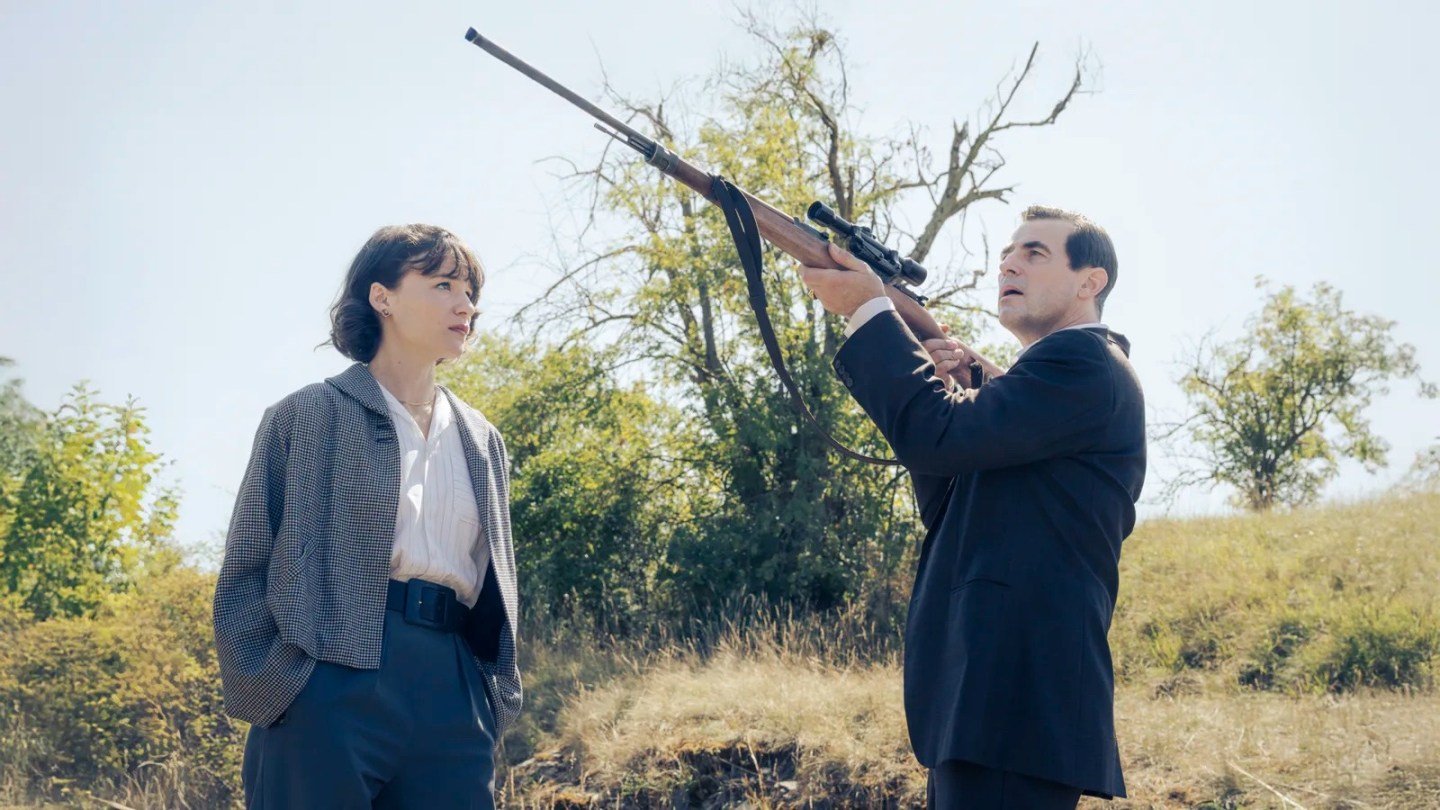
To explore all these complex themes, I Is Another features a cast of big European names, led by Danish star Claes Bang (The Square, Bad Sisters, Home) as Felix Kersten, Austria’s Valerie Pachner (The Stories, Fantastic Beasts: The Secrets of Dumbledore, Four Minus Three) as journalist Hedda, fellow Austrian Susanne Wuest (Sound of Falling) as Kersten’s wife Irmgard, German actor Timocin Ziegler as Hedda’s husband Winfried, and Germany’s Martin Müller as Himmler.
Felix Randau, courtesy of Felix Randau
The film, whose cinematographer was Sebastian Thaler, was edited by Joana Scrinzi. Beta Cinema is handling international sales.
For writer-director Randau, I Is Another is much more than a post-war film — and much more timely. “Of course, it’s a period movie, but it has a lot to do with our present time,” he tells THR. “It’s about truth and the question: what is truth? Nowadays, there are no more fundamental agreements about anything, so truth has become quite a flexible thing. And that’s very dangerous, as we all can see. So, I Is Another is a movie about that.”
Indeed, the themes of truth and image that the movie explores seem tailor-made for the social media age. “If Felix Kersten was alive today, he would be deep into all this social media shit, I’m pretty sure,” Randau acknowledges.
But he highlights the ambiguities and shades of gray that he sees in Kersten that the writer-director wanted to also showcase in I Is Another. “He was a narcissist. He was an opportunist,” says Randau. “But I think he also was a hero somehow because he saved some lives. Not thousands, as he said, but he saved some lives. And I think he saved lives not for good reasons. He wanted to save his own ass, I think.”
Where in the film’s facts turn to fiction doesn’t really matter much, according to the filmmaker, because much of how people feel about Kersten depends on whether they focus on his autobiography or facts and stories told by others. “All the scenes with Himmler and Kersten are from Kersten’s autobiography,” Randau explains. “So they are, I think, all fake, but it is his truth. All the other stuff, the journalist and the train ride and stuff like that, is invented. It’s fiction. But somehow it’s also true.”
Director Felix Randau and stars Claes Bang and Valerie Pachner during the shoot for ‘I Is Another,’ courtesy of Anke Neugebauer/ostlicht/Wega
Of course, to bring the story of Kersten and the themes that I Is Another explores to life, Randau needed a strong cast. “I’m really proud of our casting,” he tells THR. “They all were great and added so much.”
Randau reached out to Bang first to cast him as Kersten. The Danish star had never heard about the massage therapist. “I did not know about any of this until Felix brought it to me, and it’s quite interesting because it seems to be a story that everybody’s quite fascinated by when you retell it,” the star tells THR in a Zoom chat during a break from filming the Netflix series Assassin’s Creed. “It’s a story that’s really gone under the radar, even if it’s a quite crazy one.”
The team may have spent quite a few years getting the financing for the movie together, but the actor remained up for it throughout. “Ever since he brought it to me, I’ve been really into it and really wanted to do it,” Bang recalls. “I really felt strongly about this. So I stayed with it, and we managed to make it last summer. We had to do it quite fast because there wasn’t a massive budget. I think we had 24 shooting days altogether, which is a stretch for something like this. Everybody really put in a massive effort. Everybody was so devoted to it, and that is something that I will carry with me.”
How did he think about Kersten and what was key for portraying the character? “It’s really hard to find out what is actually the truth here,” Bang observes. “But what’s interesting is that if this guy hadn’t been so preoccupied with his legacy, then we would have had no story to tell. It’s only because it seems that after the war, he was not quite content with the credit he was given for what he had done, and therefore he started perhaps exaggerating.”
For the Danish star, Kersten’s story is about the human need for validation: “Ultimately, Kersten wants the Nobel Peace Prize because that would validate him. That whole thing of not being able to just trust yourself and knowing that you have done your bit seems weird and wild.”
Claes Bang as Felix Kersten and Martin Müller as Heinrich Himmler in ‘I Is Another,’ courtesy of Anke Neugebauer/ostlicht/Wega
Courtesy of Anke Neugebauer/Ostlicht Filmproduktion/Wega Filmproduktion
The fact that a prominent world leader has been desperately hoping (some might say whining) for a Nobel Peace Prize is not lost on Bang. “Obviously, we have Trump at the moment who is seeking the exact same validation. I mean, he also so desperately wants the Nobel Peace Prize. I know that the parallel is too much. But actually it’s more about … when can we just trust ourselves and know in our hearts ‘I have done my bit.’ Why can’t we just find our inner peace?”
Adds Bang: “What intrigued me, and that’s probably also something that I can really relate to and recognize in myself because I really very often wonder, ‘Why do I need that bloody validation from everywhere else? Why do I need the reviews to say that I’m great? Why do I need people to come up to me and say, Wow, that was a great movie.’ Why isn’t it just enough for me just to be whatever I am?”
In case you wonder: Bang and his director on I Is Another weren’t at all concerned with him trying to look like the real-life Kersten, which he doesn’t — at all. “That is not the story we’re trying to tell here. We’re trying to tell a story of the journey of a soul,” the star emphasizes. “This is not the wax museum of Madame Tussauds. So that was never important.”
Pachner was game for the role of the journalist immediately. “I loved the title, and the film’s themes were something I felt I could really connect with,” she tells THR. “It’s this idea of what you tell yourself and others about yourself, and how that can be very far from the truth. And what is the truth? Felix Randau also plays with our own idea of what’s true and right. And there is this autobiography that Felix Kersten wrote and how people took it as fact just because he wrote it. So, yes, the film is set after the Second World War, but with talk about fake news, it also feels very modern.”
Valerie Pachner as journalist Hedda and Claes Bang as Felix Kersten in ‘I Is Another’
Courtesy of Anke Neugebauer/Ostlicht Filmproduktion/Wega Filmproduktion
She adds that the character of Hedda is more complex than she may appear. “I was really happy to explore that because it felt so rich,” says Pachner. “It’s not this young journalist who is just this good girl who wants to get to the bad guy. She has her own very twisted and dark story. I’m so happy when I get to play a woman where not everyone says, ‘Oh, she’s so nice.’”
In fact, Pachner enjoyed teasing that her character isn’t sure who she is or wants to project to be either, very much like Kersten. “As Hedda, I didn’t know who I was,” she shares. “Is me another? Who is I? Or maybe I just want to be different. And I think she really wants to be. That struggle tells us that maybe she and Kersten are not that different.”
Pachner had never met any of the other cast members, but she felt a natural chemistry with them once shooting got underway. “We all enjoyed doing the scenes with the four of us, the two couples,” she says. “It just flowed. These weird relationships were kind of there, and there was such a rich history behind Hedda’s relationship with her husband. The Kerstens play these weird mind games with the younger people. I enjoyed working with all of them so much. They’re all really, really great actors.”
Wuest was also fascinated by the themes explored by the film, and couldn’t help but notice parallels to our current moment. “I feel that the timing of the film is so spot on for so many reasons,” she says. “First of all, it’s all about the image you create of yourself, and how manipulative that is. It’s like on social media where it’s not only about the ego; it’s about selling something all the time. And the film is about the questions of who do we want to be and how do we want to be perceived from the outside. That has become more important than creating a community, which I think is very toxic. I think it is a dead end.”
Director Felix Randau and stars Claes Bang and Valerie Pachner during the shoot for ‘I Is Another,’ courtesy of Anke Neugebauer/ostlicht/Wega
She adds that the movie also ties in with a troubling political trend that’s been on the rise throughout the world: “The second thing is the rise of all the right-wing radical politicians and ideologies again, which I think go hand-in-hand with this me, me, me culture. The film tells a story about that and perspective. You have at least three, if not four or five, different perspectives. You have the perspective of Felix Kersten. You have the perspective of the journalist who’s trying to get to him. You have the perspective of his wife. You have the perspective of the poor journalist’s husband. And then you have the perspective of the audience who also has a take on it. Plus, then you have the perspective of the person who tells the story, which is the director. So there are a lot of layers.”
Wuest concludes that I Is Another is much more timely than audiences may at first expect: “We live in very strange times, and I think the film covers and mirrors that.”
As mentioned before, the Kerstens of I Is Another look nothing like the real-life couple, and Wuest lauds director Randau for “allowing different ideas to happen.” Such as when they were trying out different looks for Irmgard.
Says Wuest: “I was putting on makeup, and we were discussing what she could look like. I thought her prime was in the 1930s, maybe in the 1940s even. And people tend not to change hairstyles every decade. We keep the hairstyles we grow up with. And because this story is being told by Felix Karsten, we get to see his memory and his idea of everything. So, Felix Karsten and his wife don’t see each other the way they really look, but more like this Hollywood couple. I really love that the film twists these things and ideas.”
The tech giant and the entertainment giant have inked what they are calling a “first-of-its-kind” content sharing deal, which will allow TikTok videos from Disney fans to live on both of their streaming platforms.
The deal bears a striking similarity to last year’s short-lived announcement with OpenAI to fold videos from Sora into Disney+… but without the whole AI-generated angle. Creators who opt-in to the program will gain access to Disney assets (think photos and videos featuring Disney characters and IP). A “thoughtfully curated” selection of videos will live on both TikTok and in Verts on Disney+.
The companies also say that they “will enable best-in-class creators to unlock special rewards and provide them with increased visibility, access to exclusive events and career development pathways,” making it a two-way street of engagement. The partnership will launch in the U.S. in the next couple months, with plans to eventually bring it to other markets.
“The best storytellers are fans first,” said Asad Ayaz, chief marketing and brand officer for Disney. “That has always been true at Disney, and today, fans are celebrating our stories in entirely new ways. This collaboration creates a new bridge between the stories we tell and the creativity they inspire, giving creators a bigger stage to share what they’ve made, and audiences more to discover on Disney+ every day.”
“Creators are at the heart of everything we do at TikTok. Their creativity extends the life of films and shows into conversations that fans discover and share,” added Dawn Yang, global head of entertainment for TikTok. “Together with Disney, we’re bringing the authentic creator expression of the TikTok community to Disney+, inviting audiences to experience the shared creativity that makes fandom so powerful.”
The deal will inevitably turbocharge Disney’s Verts offering, with the company teasing the possibility of creator content there when it launched in March. Vertical video has become a top priority for streamers, recognizing that consumers who watch videos on their phones are just not likely to turn it sideways in most use cases. Peacock, HBO Max, and Netflix have all also rolled out enhanced vertical video offerings in recent months.
But the Disney-TikTok tie-up also recognizes the role that creators are playing in fandom, with fand of characters and IP, be it Marvel Star Wars or Moana, often turning to social video platforms to dissect, discuss and celebrate those characters and worlds.
The U.K. Advertising Standards Authority has ruled that outdoor poster ads for “Lee Cronin’s The Mummy” breached its code by presenting an image that gave “a realistic impression of a dead child,” while clearing companion TV and streaming spots for the same campaign.
The ASA investigated four issues stemming from several complaints about ads for the Warner Bros Entertainment U.K. Ltd. cinema release, seen in April this year. The regulator upheld one complaint and rejected the other three in a ruling published Aug. 5.
“The ASA received 30 complaints, many of whom believed the ads were distressing for children and adults,” the ASA said.
Posters on the London Underground and at outdoor sites showed a close-up of a mummified female figure with grey, ashen skin, cracked lips and one eye swollen shut, wrapped in material resembling a shroud and inscribed with hieroglyphic-style symbols.
The ASA said the figure’s features gave “a realistic impression of a dead child” and that the material wrapped around her added to that impression. Because the posters ran in untargeted locations, including on the London Underground and at a site visible from a children’s nursery, the regulator concluded the imagery was likely to distress young children who saw it. It ruled the posters unsuitable for outdoor display in that form, finding them in breach of CAP Code rules 1.3 and 4.2.
Warner Bros. had argued the poster’s neutral expression, open eye and absence of a sarcophagus or restraints were deliberate choices meant to reduce distress, and noted the studio’s outdoor buying policy of keeping horror titles at least 100 metres from schools – a standard that does not extend to nurseries.
The ASA ordered that the poster ads “must not appear in the form complained of” and directed Warner Bros. to keep future marketing likely to frighten young children away from places where they would see it.
The ruling cited BCAP Code rules 1.2, 4.1, 4.10, 5.1 and 32.3, and CAP Code (Edition 12) rules 1.3, 4.1 and 4.2.
The ASA rejected a separate complaint that the posters trivialized child loss or ongoing global conflicts, finding that text identifying the image as promotion for a film provided sufficient context, even if some viewers found it distasteful.
The campaign also included a TV ad and a matching Prime Video ad depicting a family receiving a call about a daughter who had gone missing eight years earlier, with the father questioning what she was doing in a 3000-year-old sarcophagus. On-screen text read, “Some Things Are Meant to Stay Buried.” Both ran with a post-7:30 p.m. scheduling restriction cleared by Clearcast.
The ASA found the TV and streaming ads were unlikely to cause serious distress and that their scheduling restrictions were sufficient to limit exposure to young children, rejecting complaints that they should have been kept off air later or targeted more precisely on Prime Video. It also noted Clearcast’s data showing an average children’s index of 31 across the TV placements – well below the industry baseline of 100 that represents typical child viewership, indicating the actual child audience was low. No further action was required for the TV and streaming ads.
“Lee Cronin’s The Mummy” released in the U.K. on April 17 and grossed $2.9 million.