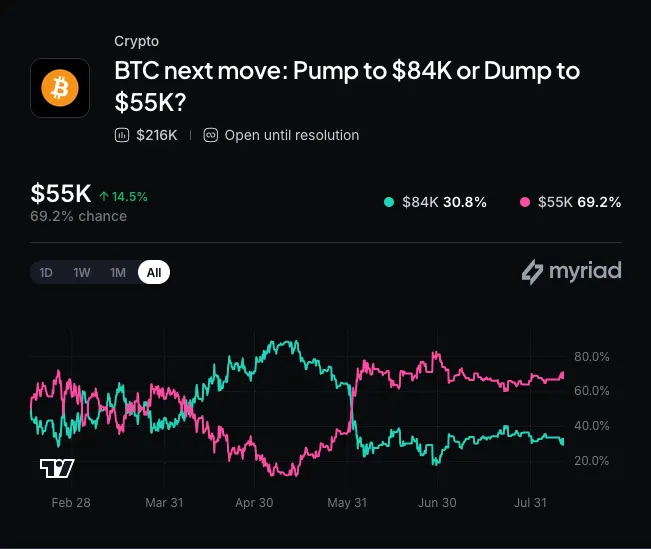
Bitcoin has fallen by 1.4% in the last 24 hours, dropping to around $62,000. This has also affected altcoins, with other major altcoins like Ethereum and XRP also showing a decline.
According to CoinMarketCap data, Velvet (VELVET) was the top-performing altcoin in the last 24 hours with a 38% gain. It was followed by Ether.fi (ETHFI), Cosmos (ATOM), and MemeCore (M).
In contrast, altcoins such as Venice Token (VVV), LayerZero (ZRO), and Lighter (LIT) were among the biggest losers.
While the altcoin market experienced both rises and falls, whale activity continued.
According to Lookonchain, a cryptocurrency analysis platform, a whale with the address 0x117f traded in the altcoin $ASTER. Specifically, the whale opened a 4x long position of 7.2 million $ASTER ($4.33 million) and staked 4.02 million $ASTER ($2.42 million) for four years.
Another whale, with the address 19pFLW, bought another 300 Bitcoin (worth $19.03 million) approximately five hours ago, increasing his Bitcoin holdings to 1,120 (worth $70.43 million).
According to Lookonchain’s report, another whale traded in the altcoin $HYPE. This whale, who had previously sold $HYPE, this time sold 923,743 $HYPE (worth $53.02 million). Initially holding 2.93 million $HYPE (worth $163.37 million), this whale had sold 1.03 million $HYPE (worth $57.44 million) approximately two weeks ago. With this latest sale, they still hold 969,595 $HYPE (worth $55.5 million).
Finally, Lookonchain reported that address 0x66f8, known as the largest on-chain BTC bear, closed its $136 million short position, making a profit of $1.65 million. Following this profit-taking, this whale moved into a long position in Bitcoin with 40x leverage.
Not everyone wants to climb aboard the Hogwarts Express, it transpires.
Top TV director Ally Pankiw has posted on Instagram a screenshot from a text exchange with a rep in which she scoffed at the notion that she would consider enrolling with HBO’s forthcoming series adaptation of J.K. Rowling‘s “Harry Potter” novels.
The reason? Rowling’s views on trans persons’ rights, which many have alleged are transphobic.
The Canadian filmmaker, who’s helmed multiple episodes of “Black Mirror” and “The Great,” and was a writer on “Schitt’s Creek,” commented on the post, “It simply is this easy to say no to funding transphobia!,” adding, “Also this was for directing, not acting… obviously lol.”
In the screenshot of the text messages, a representative for Pankiw (who is repped by talent agency WME), asks: “I have an instinct on the answer but I feel compelled to ask ‘Harry Potter? Hard no?’”
Pankiw shoots back, “Absolutely f—ing not! Lol.” And she adds, politely, “But thank you for asking.”
The representative responds, “Of course 🙂 I assumed as much (And agree).”
Another leading TV director, Kate Herron, whose credits include Marvel Studios’ “Loki” and Netflix’s “Sex Education,” shared that she had a similar experience.
Commenting on Pankiw’s Instagram post, preceded by three hearts, the British filmmaker says, “Yeah thank you exactly! Respect and love to you Ally. They’ve asked me twice and I’ve had to explain my answer is never gonna change from a no.”
That said, the roll call of actors joining the show grows ever longer. This week Nicholas Hoult signed on to play Gilderoy Lockhart.
Other cast members include John Lithgow, who plays Hogwarts headmaster Dumbledore, Janet McTeer, who is Professor McGonagall, Paapa Essiedu plays Snape, Bel Powley is Aunt Petunia, and Nick Frost has been cast as Rubeus Hagrid.
Powley, for her part, recently spoke of her disagreement with Rowling’s views on trans rights. “I strongly disagree with J.K. Rowling’s views on gender,” Powley told The Telegraph. “I think that the trans community deserve safety and dignity and respect and total acceptance.”
The series is due to debut on Dec. 25 on HBO and HBO Max, with the first season adapting the first book in the novel series, “Harry Potter and the Philosopher’s Stone.” The show has already been renewed for a second season, which will be based on “Harry Potter and the Chamber of Secrets.”
Variety reached out to reps for Rowling, who declined to comment, Pankiw and Herron, as well as HBO.
Bank Leumi, Israel’s largest bank, will offer cryptocurrency trading to customers from early 2027 becoming the first Israeli bank to announce such a service.
Customers of Leumi and its mobile banking unit, Pepper, will be able to buy, hold and sell bitcoin BTC$62,880.24, ether ETH$1,875.38 and solana (SOL) through a section of the Leumi Trade app, according to a Friday announcement.
Galaxy Digital (GLXY) will provide trading and services through GalaxyOne Institutional, its platform for banks and asset managers. Leumi has also signed an agreement to use Galaxy’s custody infrastructure, formerly known as GK8, to support the offering.
The tie-up gives Galaxy a banking partner in Israel and places Leumi among a growing group of financial institutions bringing crypto access inside customer platforms. By embedding trading within its capital-markets app, the bank is betting that clients will favor a regulated banking interface over standalone crypto exchanges.
Maya Ravia, Leumi’s head of strategy, described digital assets as an increasingly integral part of the global financial system. Galaxy Israel CEO Lior Lamesh said early movers among banks would help define finance’s shift toward open, programmable infrastructure.
The companies did not disclose commercial terms, fees or customer eligibility requirements. CoinDesk has reached out to Bank Leumi for further comments.
Strategy (MSTR) has pushed back against MSCI’s proposed methodology for identifying “non-operating companies,” which could result in the largest bitcoin treasury company being removed from the index provider’s global equity indexes.
Strategy said on X, “Digital assets are assets. Index providers should measure markets, not decide which assets companies are allowed to own,” Strategy said. “MSCI’s proposal puts it out of step with regulators, markets, and its own customers. Bitcoin doesn’t need MSCI. Neither does Strategy.”
The latest consultation replaces an earlier proposal focused specifically on companies with significant digital asset holdings. Applying the new financial-ratio screen using May 2026 data would have resulted in the removal of Strategy, Metaplanet and uranium holder Yellow Cake from the MSCI ACWI IMI.
The response follows Strategy’s formal objection in December 2025 to MSCI’s previous proposal, which would have excluded companies whose digital assets represented at least 50% of total assets.
Strategy argued at the time that it is an operating company, not an investment fund or passive bitcoin vehicle, pointing to its software business, active treasury operations and bitcoin-backed credit instruments. It described the 50% threshold as arbitrary and urged MSCI to maintain neutral index standards.
MSTR is lower by 4.3% on Friday as bitcoin dips to $62,600.
Phoebe Bridgers tends to stand out in a crowd, and not just because of her celebrity or natural star quality, but because of the hair; other women around L.A. may go for the platinum blonde look, but not quite that platinum. So it was fairly easy to pick her out for the entirety of the 10 minutes or so she spent skating with her fans Tuesday night at the Moonlight Rollerway in Glendale, California. But she was easy to spot, in this instance, from head to toe, as she was the only skater on the floor in brightly strobing light-up skates… an equipment option that the Moonlight was not able to offer any of the couple hundred fans who joined her. At this very action-packed listening party for her. The beaming Bridgers had earned the right to wear skates that special; this was not her first rodeo, clearly, when it came to making dozens of laps around a rink and outpacing a crowd.
As one fan commented on Reddit after the YouTube-sponsored event: “She was skating right with everyone, and if you could match her speed then you could say hello, but she is FAST so it may have been a bit difficult.”
Of all the albums that could be previewed with an evening out at an old-school roller rink, “Lost Weekend,” the singer’s long-awaited third solo album, would not jump out as the most obvious candidate… even if Bridgers is hell on wheels, as it turns out. The 16-track record has as many hushed passages as you’d expect from a Bridgers album, and it does not sound at all designed to inspire extended bouts of cardiovascular activity. And Bridgers did use the word “weird” in characterizing the juxtaposition when she spoke about her reasons for hosting the event there in a brief Q&A she did with fans at the event after the skating wound down. Yet, for her, it was an aspiration being realized.
“I’ve had this idea forever” she said to the crowd of about 200 sitting on the rink’s floor. “I always thought it would be cool to do like a Grouper Moonlight night… You always kind of skate to ABBA or something. I thought it would be interesting to listen to sad and slow songs and skate.”
Phoebe Bridgers skates at the Moonlight Rollerway in Glendale, California during a YouTube release party for ‘Lost Weekend.’
@linusandhiscamera
She’s had the same impulse at amusement parks, she pointed out. “I always thought about that at Six Flags,” she said saying that, while waiting in line for rides, she’d wished she could take the typical revved-up theme-park soundtrack and “catapult it somewhere” and replace it with music that was “30 bpm or something.” To her mind, slowcore and Tatsu might be the perfect fit.
Anyway, Bridgers’ promotional campaign for “Lost Weekend” has been unusual enough that a rollerskating listening party almost — almost — doesn’t stand out as that unusual. ,The singer-songwriter first began teasing “Lost Weekend” a few months ago with a series of pop-up gigs in small towns and middle American cities, places like Roswell, New Mexico, before the album was announced or even widely known to be in production. WIth the moment of release finally at hand, her team booked planetariums across the country and even in Europe for Spotify-sponsored listening parties where fans could experience the album for the first time this week with trippy visuals, if sore necks — a way of getting “Lost” in space, sort of. (And no phones allowed, as with virtually every pre-release event for the record.)
Another fairy unusual element of the promo campaign: no interviews. She hasn’t done a single one for “Lost Weekend,” so the roughly six minutes she spent answering fan questions at the Moonlight Rollerway may have constituted as much talking about the record as she plans to do, at least right away. Bridgers didn’t exactly talk anyone’s ear off in her quick, friendly response to the fan queries, but the answers still offered glimpses of insight as to where she’s coming from with this album and its attendant cycle of events and touring.
One of the first hands that went up from the crowd was to ask whether she’d been inspired by any other artistic media while making the record. “Well, there’s a movie called ‘Lost Weekend’ that’s about alcoholics’ kind of fugue state,” she said, referencing the harrowing 1945 Billy Wilder drama that some of her younger fans might not know. “That probably goes well (with the album), unfortunately.” She hesitated while trying to think of another example, then did come up with a musical reference point. “Do you guys know ‘The Lemon of Pink’ by the Books?” (Not everyone did — the Books are not exactly a household name — but some murmured their assent for the 2003 album, which has a strong following as a seminal indie-oughts cult record.)
Phoebe Bridgers does a Q&A with fans at the Moonlight Rollerway in Glendale, California during a YouTube release party for ‘Lost Weekend.’
@linusandhiscamera
Someone else wondered: Why the small-town pop-up tour? And what was her takeaway from what seemed like it might be an experiment? “I just wanted everything with this album to feel like it’s happening in real life,” she explained. “Like, I didn’t live through a time where I didn’t find out about something on the internet. Even cool pop-up shows and stuff, it was all kind of phone-based. So I just liked the idea of plastering a small town (with flyers)… It was so fun.” Her answer to the second part of the question: “The biggest takeaway was like, yeah, the internet’s not real. It’s all a fake,” she said, to laughter.
Another question: How did she decide it was time to come back? — the unspoken assumption being that six years between albums counts as a lot, even if there was a monumental Boygenius album and tour in between that came to feel like a very viable separate career.
“I mean, I didn’t love all parts of being away,” she said, with a chuckle, noting that while she knew she needed to pull away for a bit, it wasn’t necessarily a plan to wait this long. “I kept booking studio time and then putting it off… and booking studio time and putting it off, and putting it off… I really wanted to be making something,” she allowed, but the album was not yet ready to take shape. “So I just started going in and then taking six months off and then going (back). So this album took forever. Which is great!,” she added, harboring no regrets about leaving anyone in suspense.
After those and a few other questions, it was time for her to sign the big stack of posters commemorating the event. Prior to the Q&A, meanwhile, Bridgers premiered a rough cut of the second video for the album, for the song “I Can’t Wait,” which she said was nearly done, except for some drone footage that was shot during this very event that will be folded in.
Phoebe Bridgers signs posters for fans at the Moonlight Rollerway in Glendale, California during a YouTube release party for ‘Lost Weekend.’
@linusandhiscamera
There was a no-phones policy, but there were also no NDAs, so fans freely shared their experiences on Reddit and other forums after the event… including their impressions about Phoebe Bridgers being as good at skating as at music.
“I ate shit 3 times out there and got a sore ass today,” wrote one fan. “It was even more embarrassing because she was shredding around the rink.”
Others spoke of approaching Bo Burnham or Bridgers’ mother, Jamie Bridgers, for off-rink convos. But when it came to meeting the star attraction, some found her intimidating, despite her best efforts to be a fairly unassuming skatergrl. Some agonized afterward about not having found the right words when they made it to the front of the signing line. One spoke of becoming tongue-tied, but “I was towards the end of the line and it had been almost 2 hours at that point. She probably did appreciate our efficiency lol!!” Another wrote, “I just said ‘Yo this album fucking rips,’ and she laughed and said thanks.” One person who admitted being unable to do anything but blurt out their name said that as they left the signing table, Bridgers politely called out, “It was nice to meet you.”
Phoebe Bridgers skates at the Moonlight Rollerway in Glendale, California during a YouTube release party for ‘Lost Weekend.’
@linusandhiscamera
What will she do for an encore? That’s obvious: do sold-out two- and three-nighters at the nation’s biggest arenas, like the three-night stand she has upcoming at the Intuit Dome Oct. 30-31 and Nov. 1. Between now and then, there is much parsing of the 16-track album’s rich content to be done, with millions of words of formal and informal think-pieces to come. (Read Variety‘s own take on the album here.)
While fans who didn’t make it to the Moonlight Rollerway may have a lingering case of FOMO, it may still be possible to replicate the feel that Bridgers was going for, as she’s longed to marry slow sounds with frenetic action. You could go to Magic Mountain and do X2 while listening to “Lost Weekend” on earbuds; we can now be certain the author would approve.
The Moonlight Rollerway in Glendale, California during a YouTube release party for Phoebe Bridgers’ ‘Lost Weekend.’
The Bitcoin Red Team is using Chinese AI models to search Bitcoin projects for security flaws.
Calle said developers have confirmed numerous critical and high-severity vulnerabilities.
They warned that unmaintained projects should not be trusted.
The Bitcoin Red Team is using Chinese AI models to search nearly the entire Bitcoin open-source ecosystem for security flaws, according to pseudonymous developer and Red Team lead Calle.
The volunteer group combines AI tools with human review to examine wallets, Lightning applications, software libraries, and other Bitcoin projects. Researchers privately report credible findings to developers so the flaws can be fixed before details are released.
“We’re experiencing a massive collision between decades of human open source slop against 2 weeks of Kimi K3,” Calle wrote Thursday on X. “Everything is broken, Bitcoin is burning.”
Kimi K3 is an AI model from Chinese startup Moonshot AI that developers can download and run on their own systems. It can analyze large codebases and complete lengthy software tasks with little supervision.
The Bitcoin Red Team has also used Chinese developer Z.ai’s GLM 5.2, as well as models from OpenAI and Anthropic. American models, though, come with limitations, and developers frequently run up against restrictions imposed by OpenAI and Anthropic when doing security research. “Red team rugged by OpenAI cyber again,” Calle posted earlier this week. “Don’t like asking for permission. Loading up Kiimi K3.”
Nevertheless, the developer noted that the team is making progress, even if slow and painful.
“We’ve basically completed a basic scan of virtually the entirety of Bitcoin open source,” Calle wrote. “The low hanging fruit is done.”
In August, the group reported filing 4,962 findings across 390 projects, including 85 rated critical and 635 rated high severity. Calle said developers had confirmed “a ton of real critical and high vulnerabilities,” though the group has not named the affected projects or released technical details.
“Response speed is very different across projects and shows how healthy each project is,” they wrote. “I recommend acting fast these days.”
Lightning software, which supports faster and cheaper Bitcoin payments, was particularly difficult to review because of its complexity, Calle said, calling it “more broken than the average.”
“Those projects that started AI audits months ago are in a completely different position than those who didn’t,” he wrote. “Projects need their own AI audit pipeline going into the future.”
Calle also warned against relying on unmaintained projects and said AI has made it more stressful for developers to keep their software secure.
The Bitcoin Red Team is not alone. Last month, Hugging Face used China’s GLM 5.2 to investigate a breach after OpenAI models hacked into its systems and U.S. commercial models refused to analyze the attack logs.
Despite saying Bitcoin is “burning,” Calle argued that the audits are making its software stronger.
“Bitcoin is the obvious first target, but the rest of the world will follow shortly,” Calle wrote. “Sometimes old things need to burn so new things can grow on healthy soil.”
Daily Debrief Newsletter
Start every day with the top news stories right now, plus original features, a podcast, videos and more.
Anne Kelly, a former official at the U.S. Securities and Exchange Commission (SEC), has stated that the agency does not need to wait for the passage of the CLARITY Act to begin rulemaking for digital assets. In a post on X, Kelly emphasized that the SEC can initiate rulemaking proactively, and if the CLARITY Act is later enacted, its provisions can be incorporated through additional rule proposals.
Understanding the CLARITY Act and Its Timeline
The CLARITY Act, which aims to clarify the regulatory status of digital assets, has been a topic of debate in Congress. However, even if the bill were to pass immediately, it would still take several months for the SEC and the Commodity Futures Trading Commission (CFTC) to draft detailed implementation rules. Kelly’s remarks highlight a pragmatic approach: rather than waiting for legislative action, regulators can begin the process now, ensuring a smoother transition once the law is finalized.
Implications for the Crypto Industry
For the cryptocurrency industry, this signals a potential acceleration in regulatory clarity. Market participants have long sought clear guidelines on how digital assets are classified and regulated. By starting rulemaking earlier, the SEC could provide much-needed direction, reducing uncertainty for businesses and investors. Kelly’s perspective underscores that Congress and regulators are partners in this effort, not adversaries, and that collaboration can lead to more effective oversight.
Why This Matters
The timeline for crypto regulation has been a point of contention, with industry advocates pushing for faster action and regulators emphasizing the need for thorough deliberation. Kelly’s comments suggest that a proactive approach could bridge this gap, allowing the SEC to address key issues while Congress continues its work. For stakeholders, this could mean earlier clarity on compliance requirements, potentially fostering innovation while ensuring investor protection.
Conclusion
As the debate over crypto regulation continues, the possibility of the SEC moving forward with rulemaking independent of the CLARITY Act offers a constructive path forward. While the legislative process is essential, regulators have the tools to begin shaping the framework now. This development could mark a significant step toward a more defined regulatory environment for digital assets in the United States.
FAQs
Q1: What is the CLARITY Act? The CLARITY Act is a proposed U.S. law designed to clarify the regulatory status of digital assets, determining which are securities and which are commodities, and assigning oversight to the SEC or CFTC accordingly.
Q2: Can the SEC really start rulemaking before the CLARITY Act passes? Yes, according to former SEC official Anne Kelly. The SEC has existing authority to propose rules for digital assets, and any later legislative changes can be incorporated through additional rulemaking.
Q3: How long would implementation take after the CLARITY Act passes? Even if passed immediately, it would likely take several months for the SEC and CFTC to draft and finalize detailed rules, given the complexity of the subject and the need for public comment periods.
Troye Sivan has kicked off a new era with the release of his new single “She’s the Best” along with a music video co-starring Nicole Kidman.
In the clip, directed by Gordon Von Steiner, Sivan holds the spotlight at a club filled with drag queens, including Sasha Colby. Kidman, a fellow Aussie, sips a drink while watching Sivan perform his sultry track, joining forces with the singer while he’s in drag by the end of the video.
Steiner previously collaborated with Sivan on the music videos for his singles “Rush,” “Got Me Started” and “One of Your Girls,” which were featured on his 2023 album “Something to Give Each Other.”
Sivan is currently gearing up for the release of his fourth studio album “She’s the Best,” out October 9. The title track is written by Sivan alongside George Daniel, Jack Antonoff, Leland and Kaeyln Behr, with production by Sivan, Daniel and Antonoff as well as Styalz Fuego.
“‘She’s the Best’ is a painting that captures my life in all of its moods and colours,” says Sivan of the album in a statement. “It explores the high-octane highs of the last few years, and the solitude and longing that sat underneath. It’s chaotic, layered, organic, troubled and alive. It feels like the truest and most creative version of myself I’ve ever shared. At some point along the way I realised – the only constant in my life keeping me somewhat sane has not been the work, or the men, but the feminine. Thank god for them.”
Figure Technology Solutions reported $4.26 billion in Consumer Loan Marketplace volume for the second quarter on Aug. 13, up 132% from a year earlier and 47% from the first quarter.
The Nasdaq-listed blockchain lending company also reported net income of $87.4 million, up 192%, while net revenue more than doubled to $225.6 million.
The results mark Figure’s strongest quarter since becoming a public company and show a growing share of activity moving through its capital-light marketplace model. Figure Connect accounted for $2.77 billion, or 65%, of total consumer loan marketplace volume, compared with $767 million a year earlier.
Figure Connect now handles 65% of marketplace volume
Figure Connect volume rose 262% year over year in Q2. The marketplace, launched in June 2024, connects third-party loan sellers and buyers using Figure’s blockchain-based infrastructure. Figure defines Connect volume as consumer loans originated by third-party sellers through the marketplace.
That distinction matters when interpreting the headline $4.3 billion figure. Consumer Loan Marketplace volume also includes HELOC, debt-service coverage ratio and personal loan originations through Figure’s loan origination system. It should not be read as $4.3 billion of blockchain trades alone.
The shift toward third-party activity supports Figure’s push for a business requiring less balance-sheet capital. Ecosystem and technology fees rose to $72.9 million from $28.1 million, while gain on loan sales increased to $57.6 million from $36.3 million. Figure Connect itself represented nearly two-thirds of marketplace volume.
Figure also added 102 origination partners during the quarter, taking its active network to 489 across mortgage banks, depositories, servicers and fintech companies. Operations and processing costs fell to roughly 67 basis points of marketplace volume from 79 basis points one year earlier.
Figure profit grows faster than revenue
Net revenue rose 113% year over year to $225.6 million, while net income increased from $30 million to $87.4 million. The net income margin expanded from 28.3% to 38.8%. Operating income also rose to $77.7 million from $27.7 million, showing the profit increase was not solely the result of below-the-line accounting items.
Adjusted EBITDA reached $119.4 million, up 126%, while adjusted EBITDA margin expanded to 54.6% from 47.2%. Figure’s presentation sets a medium-term adjusted EBITDA margin target of 60% for 2026 through 2028. The 60% figure is a management target, not a guaranteed outcome.
The balance sheet also expanded. Cash and cash equivalents, excluding restricted cash, reached $1.4 billion at June 30, up $239.4 million from year-end. Loans held for sale increased 47.7% to $597 million.
Blockchain lending products expand beyond home equity
Figure’s growth is increasingly coming from products outside its original home-equity business. Small and medium-sized business loan volume grew 57% from the first quarter, while third-party borrowing on its Democratized Prime onchain lending marketplace reached about $170 million as of Aug. 6, roughly 23 times its year-end level.
Its regulated digital asset business also continued to scale. YLDS in circulation stood at $556 million at June 30, compared with $328 million at the end of 2025. Figure’s SEC-registered yield-bearing YLDS token expanded beyond Provenance to Sui, adding another route for the company’s tokenized financial products.
Figure is also expanding its underlying loan inventory. As crypto.news reported, the company agreed to acquire real-estate lender Kiavi for $717 million, a transaction expected to add residential transition and DSCR loans to Figure’s marketplaces. Figure said Thursday the acquisition remains on track to close during the second half of 2026.
Figure closed a $600 million offering of 8.5% senior notes due 2031 on July 14, with proceeds intended in part to fund the Kiavi transaction. The acquisition still depends on closing conditions and required regulatory approvals.
Q3 guidance points to another volume increase
Figure expects Consumer Loan Marketplace volume of $4.8 billion to $5.2 billion in the third quarter. At the midpoint, the company’s investor presentation says that would represent roughly 102% growth from a year earlier. The guidance is forward-looking and depends on lending demand, funding markets and other operating assumptions.
CEO Michael Tannenbaum said weekly loan applications had exceeded $1 billion by July and said the pending Kiavi acquisition “will significantly grow our platform into adjacent asset classes.” The latter remains a company expectation until the acquisition closes and integration begins.
Investors responded positively to the earnings session. FIGR closed Aug. 13 at $31.88, up 3.94%, after trading between $29.50 and $33.77 during the day.
The next milestones are Figure’s weekly operating updates, Q3 marketplace performance and completion of the Kiavi acquisition. The Aug. 13 filing furnished the quarterly earnings release to the SEC.