Blog

  • ‘Shame and Money’ Director on Sundance-Winning Drama About a Kosovo Family in Free Fall: ‘It’s a Look Into the Past and a Warning to the Future’

    ‘Shame and Money’ Director on Sundance-Winning Drama About a Kosovo Family in Free Fall: ‘It’s a Look Into the Past and a Warning to the Future’

    Sundance Grand Jury Prize winner Visar Morina returns to the Sarajevo Film Festival — the scene of a previous triumph — with the biting social drama “Shame and Money,” which won the top prize in Park City earlier this year and is playing in the festival’s main competition.

    The director’s third feature wowed audiences at Sundance, where Variety’s chief film critic Guy Lodge praised the “stoic, slowly lacerating look at economic desperation and exploitation in contemporary Europe” as a “keenly observed, sharp-edged portrait of a Kosovo family divided by class.”

    Morina’s previous film, “Exile,” which also premiered in Park City, won the Sarajevo Film Festival in 2020. That film, about a Kosovan immigrant grappling with paranoia after a string of menacing events, was loosely inspired by the director’s own experience. Born in Kosovo, Morina emigrated with his family to Germany in the 1990s, before the war that would ultimately lead to the country’s independence. 

    “Shame and Money” follows Shaban (Astrit Kabashi) and Hatixhe (Flonja Kodheli), a couple in their forties living with their extended family in rural Kosovo, where they eke out a modest living on their farm. When a family dispute leads to a terrible act of betrayal, their livelihood is suddenly lost. 

    Along with Shaban’s mother and the couple’s young daughters, they are forced to move to Pristina, where the pressure to provide weighs heavily on both husband and wife. Piecing together odd jobs, they do their best to find a way in the hyper-capitalist Kosovan capital, until the relentless struggle of daily life pushes Shaban to the breaking point.

    Though deeply rooted in the sociopolitical realities of Kosovo, a country that’s largely failed to make good on the promises of the post-war order, Morina sees “Shame and Money” as a parable of modern-day Europe. Across the continent, he notes, the rising cost of living, housing shortages, stagnant wages and a growing rift between the haves and have-nots has spurred widespread pessimism about the direction in which society seems to be heading. 

    “We are actually coming to a point in Germany where it feels like we are going straight to a situation like this in Kosovo,” Morina says. “It’s a look into the past and a warning to the future.”

    The film provides a bleak portrait of Kosovo, a war-scarred country whose social fabric is fraying at the seams: a society where, as Shaban is reminded by his brother-in-law, Alban (Alban Ukaj), a nouveau riche businessman who reluctantly agrees to take in the struggling family, “Everything has its place. And every person, too.”

    For the husband and wife duo, that means a succession of low-skilled, low-wage jobs as they scrap to make ends meet. The rigid taxonomy of contemporary urban life couldn’t be more apparent: When Shaban is offered a job as a night watchman at a gated community rising on the city’s outskirts, he explains to Hatixhe that it is a job “to keep out poor people like us.” 

    Gradually, Shaban becomes a ghost of himself, in what comes to feel like a natural outcome in a society where a man’s value can be calculated down to the very last cent. “‘When you’re broke, even your mom doesn’t love you,’” Morina recalls a Kosovan man once telling him. “There is nothing I associate more strongly with the film than this phrase.”

    “Shame and Money” is written by Morina and Doruntina Basha. It’s produced by Vicky Bane and Schuldenberg Films in co-production with Eagle Eye Films, Vertigo Ljubljana, On Film Production, List Production and Quetzalcoatl. World sales are being handled by The Yellow Affair and Espoo.

    In both of his most recent features, Morina has been preoccupied with the lives of outsiders — those who, either because of immigration (“Exile”) or class status (“Shame and Money”), are shunted to the periphery of society. Increasingly, it seems those dividing lines have become chasms.

    At a time when the world (briefly) christened its first trillionaire and the ruling classes build underground bunkers or dream of blasting off into outer space, “Shame and Money” provides a stark warning about the direction in which things are trending — both for our societies and ourselves.

    “I really believe that people can only take shit to a certain extent. At some point, they go crazy,” says Morina. “There is this German word sozialer Frieden — social harmony. And I think at some point, there is a point of no return.”

    The Sarajevo Film Festival runs Aug. 14 – 21.

  • Humanity eyes $0.33 as whale wallets grow – H rally at risk IF…

    Humanity eyes $0.33 as whale wallets grow – H rally at risk IF…

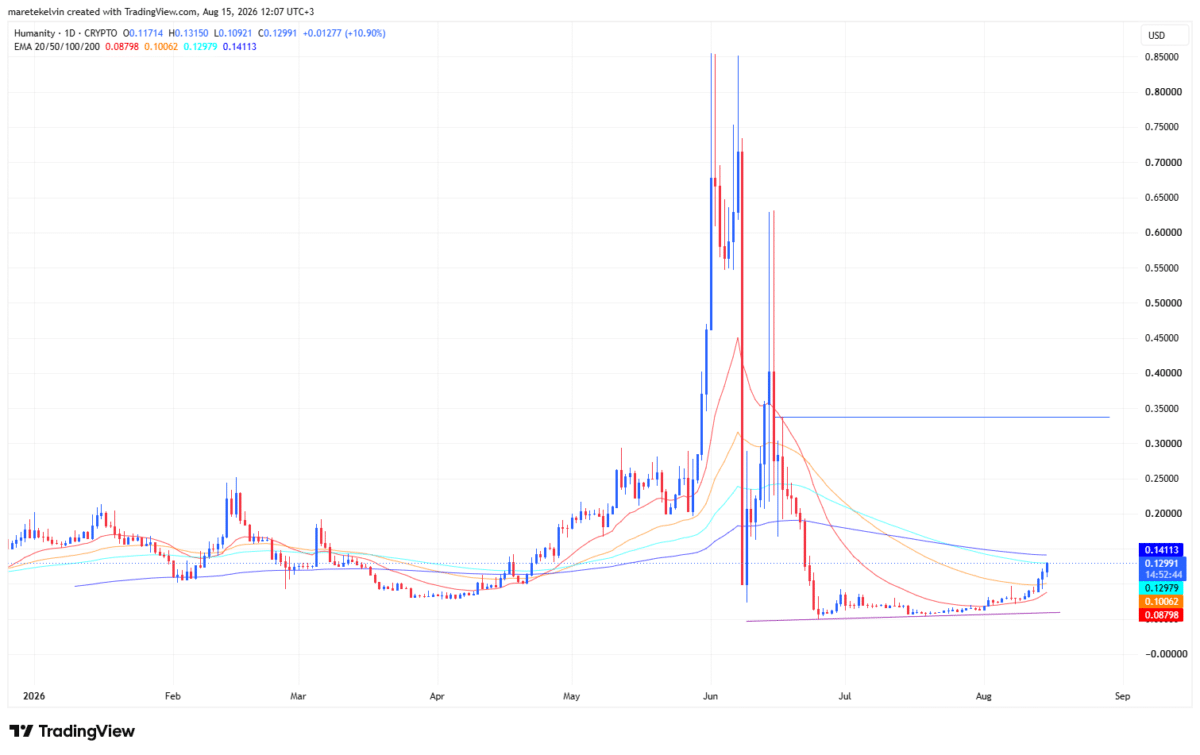
    Humanity [H] extended its weekly rally and moved above the 20-day and 50-day Exponential Moving Averages (EMAs).

    The technical improvement arrived as capital rotated toward altcoins. More large-holder wallets and bullish derivatives positioning supported H’s recovery. Could this momentum push Humanity toward the next resistance at $0.33?

    Can Humanity hold above its EMAs?

    Humanity advanced during the past week and traded above its 20-day and 50-day EMAs. This move suggested that buyers had gained momentum across the short and medium terms.

    Holding above both EMAs could help bulls extend the rally toward $0.33.

    However, losing these levels would weaken the bullish structure and increase the possibility of a deeper correction.

    Source: TradingView

    Are Humanity whales accumulating H?

    Notably, Humanity’s large-holder activity offered another bullish signal.

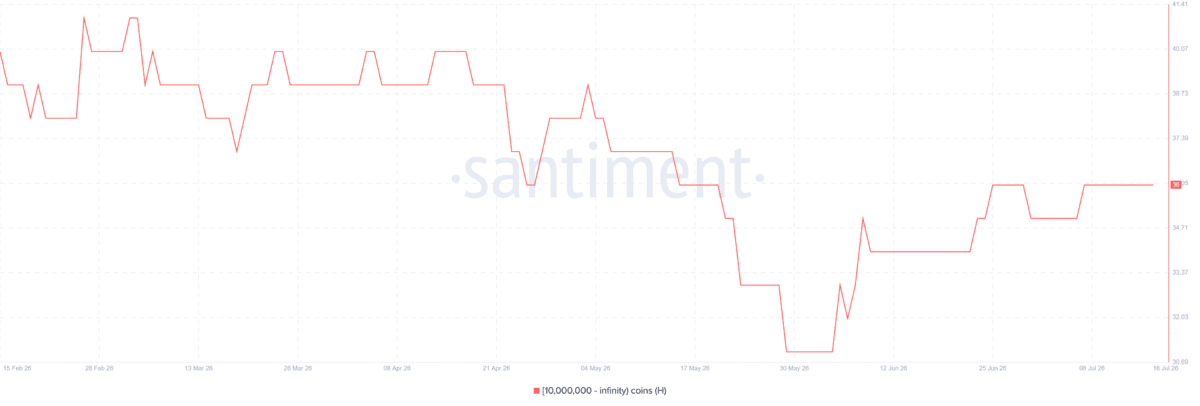
    The number of wallets holding over 10 million H reached 39, its highest level in several months. This increase suggested more wallets had entered that holding bracket. However, the metric alone could not confirm fresh whale purchases.

    Even so, continued growth in large-holder wallets could support H’s attempt to reach $0.33.

    Source: Santiment

    What does H’s 7% volatility mean?

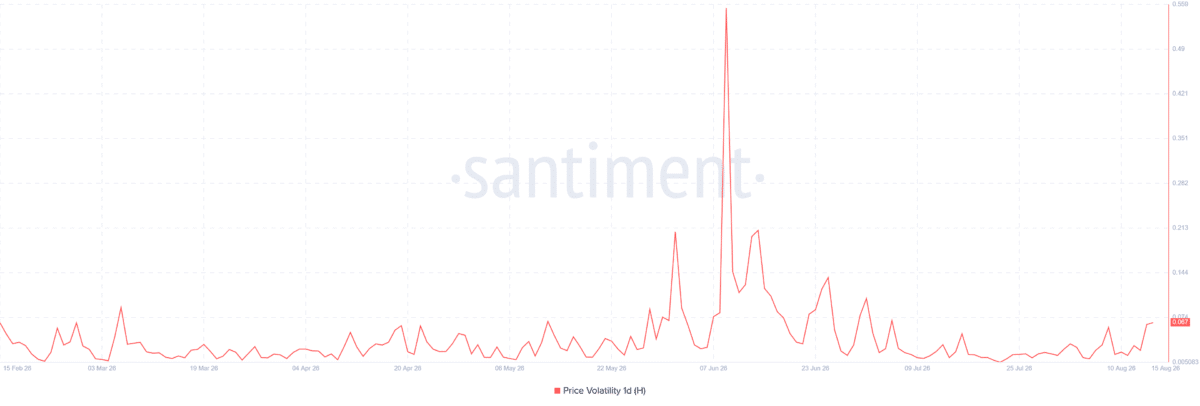
    At the same time, H’s Price Volatility climbed to approximately 7%, reaching its highest recent level. This increase indicated that H had begun experiencing wider price movements as its bullish trend continued.

    Elevated Price Volatility could amplify the rally if buying pressure holds. It could also accelerate losses during a sudden reversal.

    Therefore, the same metric supporting a faster move toward $0.33 also increased H’s pullback risk.

    Source: Santiment

    Are Humanity traders too bullish?

    On top of that, derivatives positioning remained strongly tilted toward buyers.

    Long positions represented approximately 66% of H’s tracked positioning, showing that traders expected further upside. This bullish positioning supported the continuation scenario.

    However, it also left leveraged longs exposed if momentum weakened. A price reversal could trigger Long Liquidations and deepen any resulting pullback.

    Source: Coinalyze

    Can Humanity reach $0.33?

    Humanity’s bullish structure rested on its EMAs, rising large-holder wallets, and strong long positioning.

    If buyers maintain control, H could extend its weekly advance and challenge the $0.33 resistance. For now, both EMAs remain the key support levels below H’s price.

    A sustained move above $0.33 could strengthen the bullish case. Losing EMA support may invalidate the near-term setup.


    Final Summary

    • Humanity traded above its 20-day and 50-day EMAs, strengthening its short-term bullish structure.
    • Wallets holding over 10 million H reached 39, their highest count in several months.
  • Ranveer Singh, Kalyani Priyadarshan’s ‘Pralay,’ Produced by Ananya Birla and Hansal Mehta, Directed by Jai Mehta, Starts Filming

    Ranveer Singh, Kalyani Priyadarshan’s ‘Pralay,’ Produced by Ananya Birla and Hansal Mehta, Directed by Jai Mehta, Starts Filming

    Ranveer Singh‘s “Pralay,” an end-of-the-world action thriller, has begun filming in Mumbai.

    The film is produced by Ananya Birla’s Birla Studios, Hansal Mehta and Sahil Saigal’s True Story Films and Singh’s Maa Kasam Films.

    Singh, who headlines the project, also serves as a producer on the film, which is directed by Jai Mehta. One of the top stars of Bollywood, Singh takes on a physically demanding role for “Pralay.” This is his next project after the “Dhurandhar” (2025) and “Dhurandhar – The Revenge” (2026) duology, which are among the highest-grossing Indian films of all time.

    The cast also includes Kalyani Priyadarshan, who broke out with “Lokah Chapter One: Chandra” (2025), in a pivotal role. Jai Mehta previously co-directed SonyLIV series “Scam 1992: The Harshad Mehta Story” (2020) with Hansal Mehta, and directed JioHotstar series “Lootere” (2024).

    “Pralay” is an original story centered on survival as the world faces catastrophe, set against the backdrop of Mumbai, where the production is now shooting. The production is filming at live locations across the Mumbai region, an approach the makers say brings added scale, texture and realism to the story. The crew includes talent from India and abroad.

    Birla Studios said the project reflects Birla’s interest in working with some of the leading current names in Indian cinema. True Story Films, run by Hansal Mehta and Sahil Saigal, said the film fits the banner’s focus on unconventional storytelling.

     “It’s the kind of film that India hasn’t made yet, the kind of film that India hasn’t seen before,” Hansal Mehta had told Variety while unveiling the True Story Films slate.

    “Pralay” moved into production after several months of technically intensive pre-production.

  • ‘RuPaul’s Drag Race,’ ‘All Stars’ and ‘Untucked’ Renewed for New Seasons at MTV and Paramount+

    ‘RuPaul’s Drag Race,’ ‘All Stars’ and ‘Untucked’ Renewed for New Seasons at MTV and Paramount+

    Shantay you stay!

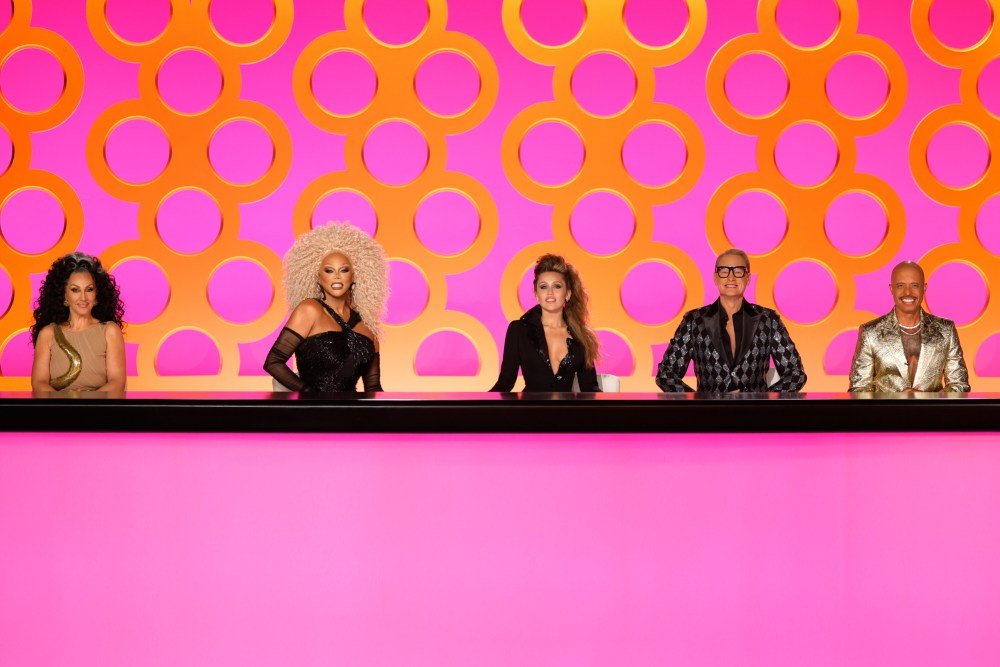
    “RuPaul’s Drag Race,” “All Stars” and “Untucked” have all been renewed for new seasons at MTV and Paramount+.

    The franchise’s main show, “RuPaul’s Drag Race” will return to MTV for its 19th season. This follows a successful season 18 which delivered double-digit growth over the previous season and set a new franchise premiere viewership record. The series was up 19% on P18-49 rating (0.564 vs. 0.472) and up 7% in P18-49 share (2.43 vs. 2.27). Season 18 of “Drag Race” ranked among the Top 3 cable series in 2026 to date in the key demo.

    Season 18 featured iconic guest judges including Cardi B, Teyana Taylor, Benny Blanco and more. Myki Meeks took home the crown.

    “RuPaul’s Drag Race: Untucked,” the aftershow, will also return for season 18.

    The show’s production company, World of Wonder said, “Nearly twenty years later, what began as a dream has become an extraordinary global movement. We owe endless thanks to our partners at MTV and Paramount+, along with every queen, judge, crew member, and fan who has built ‘RuPaul’s Drag Race.’ Drag brings people together in powerful ways –  and we are honored to keep celebrating new voices and sharing iconic moments with the world.”

    Paramount+ has also renewed “RuPaul’s Drag Race All Stars” for season 12 following the return of its Tournament of All Stars format, which brought together returning queens to compete for a coveted spot in the “Drag Race Hall of Fame.” Crystal Methyd earned the title during the latest season. The season also featured the franchise’s first all-disco Lip Sync Smackdown for the Crown and welcomed guest judges Kate Hudson, La Toya Jackson, Reneé Rapp and others to the panel. ‘RuPaul’s Drag Race All Stars: Untucked’ will also return for season 9.

    As Emmy voting gets underway, the show landed 11 nominations, including an outstanding host for a reality or reality competition program nod for RuPaul. The nomination was historic and was a record-extending 11th consecutive nomination.

  • ‘Monsters, Inc.’ Themed Land Will Open at Disney World in 2027

    ‘Monsters, Inc.’ Themed Land Will Open at Disney World in 2027

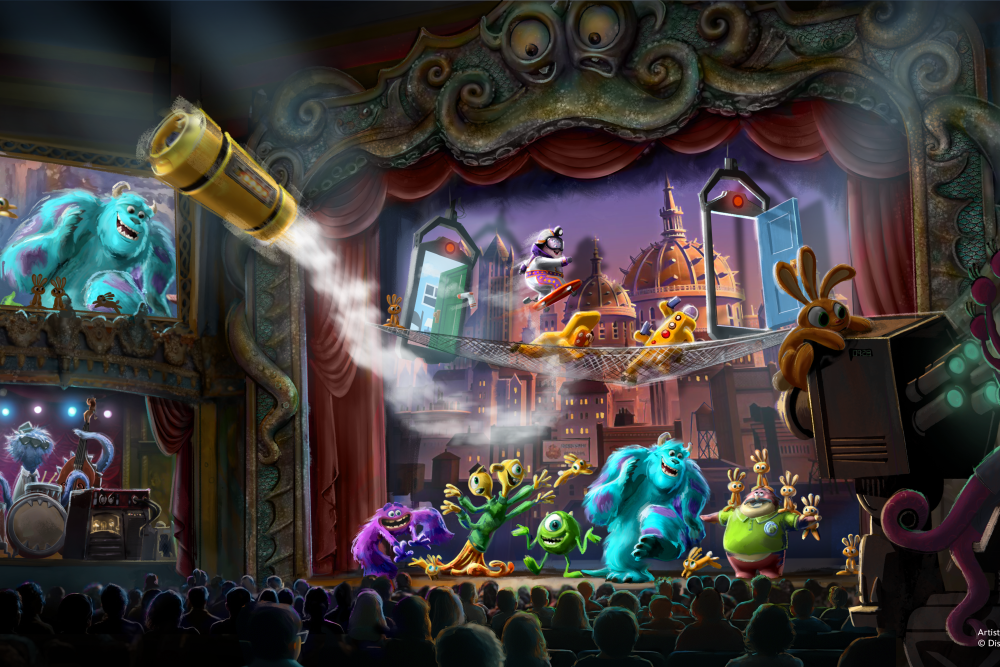
    THe’Monsters, Inc.’ themed land, Monstropolis is set to open at Disney’s Hollywood Studios at Disney World in 2027.

    The news was announced Saturday at D23. Vice President Creative, Walt Disney World Portfolio at Walt Disney Imagineering, Michael Hundgen told Variety, “We’re so excited to bring Monstropolis to life for fans.”

    Currently under construction, Monstropolis will transport visitors into the world of Sulley and Mike.

    According to Disney, guests will have the chance to explore the city, meet its citizens, taste unique cuisine, and step into the everyday world of monsters in a totally new way. For the first time, two worlds—once separated—are coming face to face, not through screams, but through laughter.

    Hundgen explained, “’Monsters, Inc’ is right up there in terms of iconic locations. The moment you saw it, you thought, ‘I want to go to a world where monsters live and work and play.’ And so, to get to do that at the scale that we’re doing it at is phenomenal. Not only is it about the breadth of the land, but also about creating some of these iconic locations that we’ve seen in the films throughout the years that we’re now getting to realize.’”

    A central element of Monstropolis is its theatrical experience, which Hundgen emphasized as an important addition to the land. “We knew the door coaster was the cornerstone of the experience,” he said. “It feels like just giving them a coaster would shortchange the experience. So, we embarked on this idea of a theater experience that would really orient our guests to Monsters. We’re inviting folks into this land for the first time, and the monsters are a little skittish around that, so they’re kind of feeling us out. For so long they’ve been sometimes as afraid of us as we are of them, and so this idea that we’re all working in harmony together is new to them.”

    Hundgen explained that it wouldn’t be a typical theater experience. Collaborating with Pixar and Industrial Light & Magic, the team has developed high-definition panels combined with physical characters. In addition to humor and heart, the show will feature a new original song written exclusively for the park by composer Randy Newman.“It’s the first time Randy has ever written something exclusively for a Disney theme park,” Hundgen revealed, calling the song a perfect complement to the high-thrill rollercoaster that will be located nearby.

    Disney’s first-ever suspended rollercoaster ride will be a major highlight of the land. “It’s a showstopper,” Hundgen declared. “It’s the first hanging coaster we’ve ever done at Disney anywhere in the world. That opening scene will take you straight into the laugh floor, and guests will be placed into contraptions that Mike has created to harness both laughs and screams. The idea is that if you combine those two things—well, screams are powerful, but laughs are even more powerful.”

    The ride will take guests 40 feet high in four seconds, he teases. “When you think about show-stopping moments in our canon, that is going to be up there as one of the biggest and best that we’ve ever seen.”

    The rollercoaster will take guests 40 feet high in just four seconds. “When you think about show-stopping moments in our canon, this will rank as one of the biggest and best,” Hundgen teased. He credited the Imagineering team and their research and development efforts for pushing the boundaries of innovation. “Some of the techniques we’re using in the theater itself come from our partnerships with R&D and ILM,” he said. “More importantly, it’s about using technology to support the story we’re telling. What can we do to deepen the emotional connection guests have with these characters while using tech to enable that?”

    Hundgen also noted the use of innovative techniques in both the theater and coaster experience. “We’re drawing inspiration from immersive theater and optical illusions that make you feel like things are actually there—paired with physical elements that truly are there,” he explained. “You’ll see plenty of that in the theater experience, as well as a few tricks in the coaster that combine old-school illusions with new tech, all infused with the humor and heart of these characters.”

    In addition to the theatrical experience and the rollercoaster, Monstropolis will feature merchandise locations and new restaurants—Disney staples. Among them will be Archie’s Scare Pig Pizza, inspired by the mascot from “Monsters University,” and Harryhausen’s, the sushi restaurant featured in the first film where Mike and Celia went on their date.

    “We’re reimagining Harryhausen’s as a brand-new space,” Hundgen shared. “The menu will be wildly fun. Imagine sushi dishes inspired by the monster world: sushi rolls, tempura satays, all with iconic names that feel straight out of the film.” Guests can also look forward to an animatronic octopus sushi chef. “We’re going to have a full-on animatronic sushi octopus figure, cooking up sushi and playing host,” he confirmed.

    Monstropolis is scheduled to open in 2027, with restaurants, merchandise experiences, and the theater show debuting alongside the new land. Hundgen expressed excitement about the ambitious project. “Monsters, being one of the first out the gate, will really raise the bar. It’s an incredible project team—passionate and dedicated—and they’ve worked through some pretty gnarly challenges. This will be a fantastic addition to Hollywood Studios and Walt Disney World as a whole. It’s going to be quite the destination.”

  • Apple Turns to Alibaba to Help Build AI Model for China

    Apple Turns to Alibaba to Help Build AI Model for China

    In brief

    • Apple trained a large language model for China with support from Alibaba, Reuters reported.
    • The deal could make Apple the first foreign company allowed to operate its own proprietary AI model in China.
    • Apple Intelligence is expected to reach Chinese iPhones through an iOS update in the coming months.

    Apple trained its own AI model for China with Alibaba’s help as it races to bring Apple Intelligence to Chinese customers, Reuters reported.

    Citing three people familiar with the matter, Reuters said the Cyberspace Administration of China registered Apple’s generative AI service last month, clearing a key regulatory hurdle that has kept OpenAI’s ChatGPT and Anthropic’s Claude unavailable in China.

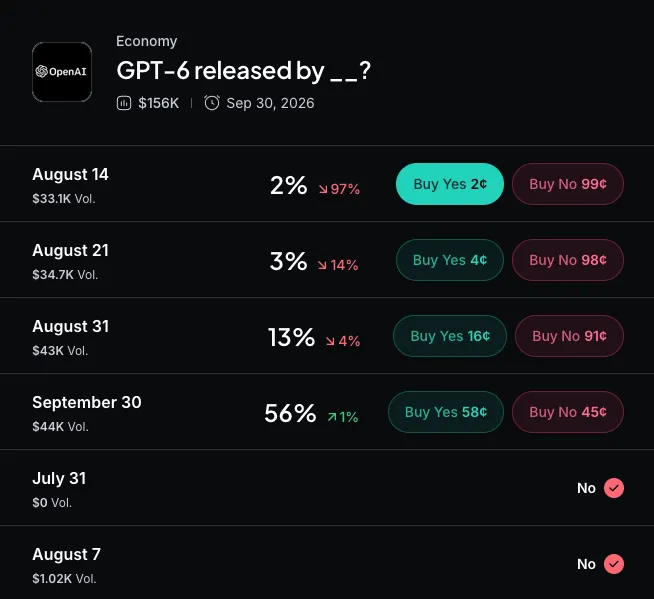
    Myriad: When will OpenAI release GPT-6? Click to make your prediction.
    Myriad: When will OpenAI release GPT-6? Click to make your prediction.

    Alibaba Chairman Joe Tsai confirmed the companies’ arrangement in February 2025.

    “They talked to a number of companies in China,” Tsai reportedly said at the time. “In the end they chose to do business with us.”

    According to Reuters, Apple plans to pair its model with Alibaba’s Qwen and technology from Baidu. It remains unclear what role each system will play; however, Apple Intelligence, the company’s branded artificial intelligence initiative, is expected to reach Chinese iPhones through an iOS update “in the coming months.”

    The news comes after a difficult year for Apple’s AI business.

    In January, the company said its next-generation Foundation Models would use Google’s Gemini, instead of a proprietary design, following delays and a weak reception for Apple Intelligence.

    In May, Apple agreed to pay $250 million to settle claims that it misled iPhone buyers about AI features that were unavailable at launch. The delay has left Apple trailing Chinese rivals such as Huawei, which already sells phones with AI features.

    In June, the company unveiled Siri AI, a rebuilt assistant that can hold conversations, analyze images, and use personal context. Apple said the assistant would enter beta later this year but remain unavailable in China while it worked through regulatory requirements.

    Daily Debrief Newsletter

    Start every day with the top news stories right now, plus original features, a podcast, videos and more.

  • CLARITY Act Odds Decline as SEC and CFTC Build Interim Fixes

    CLARITY Act Odds Decline as SEC and CFTC Build Interim Fixes

    Congress and the regulators are no longer moving on the same timeline. The CLARITY Act, the U.S. crypto market structure bill meant to settle long-running questions over digital asset issuance and trading, now looks less likely to pass in 2026. Galaxy Research’s latest read, the original report, points to fading legislative momentum and a shift toward faster agency action.

    The banking sector’s resistance to sweeping market structure changes has already been visible in the Senate, where major crypto legislation faced a last-minute lobbying fight. That friction is now part of the broader backdrop for the CLARITY Act. As the calendar tightens, the practical question for exchanges, issuers, and compliance teams is not whether Congress will act, but which agency will fill the gap first.

    Agency action is accelerating

    The SEC and CFTC have responded to the uncertainty by pushing administrative measures: rulemaking, interpretive guidance, and regulatory exemptions. Galaxy says the goal is to clarify how digital assets should be issued, traded, and supervised while the legislative path remains blocked. A staff interpretation or an exemption can be more useful in the near term than a bill that may never get a floor vote.

    That speed has real value. A token project waiting on registration guidance or a trading platform trying to understand which regulator has jurisdiction can make operational decisions off an agency action far sooner than off a stalled congressional process. For institutional buyers and token issuers, the difference between a statute and an agency exemption is not academic. A statute binds the agency and survives a leadership change. An exemption is only as durable as the current line of thinking at the commission.

    The urgency is especially visible in tokenized real-world assets, where issuance and settlement structures are already scaling. Recent tokenization activity shows that market participants are not waiting for Washington to settle every definition before expanding products.

    Temporary clarity has a hard ceiling

    Galaxy’s caution is straightforward: administrative fixes lack legal durability. Rulemaking and guidance can be revised or reversed by a future administration, and they cannot replace a long-term framework established by Congress. That creates a different kind of uncertainty. Firms can build against an SEC staff position only to have a new chair unwind it after a political transition.

    The result is a two-tier regulatory reality. Congress may still deliver a durable statute, but for now the industry is operating on guidance that is faster to arrive and easier to reverse. That is not a stable foundation for capital-intensive infrastructure decisions.

    For legal and compliance leaders, the shift also changes the type of risk they have to manage. A legislative process carries one set of lobbying and timing risks. An administrative process carries another: the possibility that a guidance document disappears with a new administration, or that a court reads a rule more narrowly than staff intended. That distinction is now a planning cost, not a theoretical concern.

    Meanwhile, builder activity continues to concentrate in a few dominant ecosystems regardless of the legal noise. Developer activity this week remains clustered among major Layer 1 and Layer 2 networks, but the rules for the assets built on those chains still depend on whatever the agencies do next.

  • ‘The Pitt,’ ‘Hacks’ and ‘Beef’ Among Astra TV Awards Winners

    ‘The Pitt,’ ‘Hacks’ and ‘Beef’ Among Astra TV Awards Winners

    “Hacks,” “The Pitt” and “Beef” were the big winners of the 2026 Astra TV Awards.

    “The Pitt” took home the most trophies of the night with six. Those include for best drama series, streaming drama ensemble, actor in a drama series for Noah Wyle, supporting actor in a drama series for Patrick Ball, supporting actress in a drama series for Sepideh Moafi and guest actress in a drama series for Tal Anderson.

    “Hacks” won several comedy awards, including best comedy series, actress in a comedy series for Jean Smart, supporting actress in a comedy series for Hannah Einbinder and directing in a comedy series for Lucia Aniello’s work on the final episode. “Shrinking” took home awards for best streaming comedy ensemble, actor in a comedy series for Jason Segel, supporting actor in a comedy series for Harrison Ford and guest actor in a comedy series for Michael J. Fox.

    “Beef” dominated the limited series and TV movie categories, earning five awards, including for best limited series, actor in a limited series for Oscar Isaac and supporting actor in a limited series for Charles Melton. Lee Sung Jin also won for directing the episode “Oh, The Comfort, The Inexpressible Comfort.”

    Elsewhere, Keri Russell won actress in a drama series for her work in “The Diplomat,” Macaulay Culkin won guest actor in a drama series for “Fallout,” Vince Gilligan won writing in a drama series for “Pluribus” (specifically, the episode “We Is Us”), Christina Ricci won guest actress in a comedy series for “Wednesday” and “The Comeback” won for writing in a comedy series, with Lisa Kudrow and Michael Patrick King being recognized for the episode “Valerie Does It All.”

    In the nonfiction and variety programming categories, “The Late Show with Stephen Colbert” won for talk or variety series, “The Muppet Show” won for stand-up or variety special, “John Candy: I Like Me” won for documentary TV movie and “Lost Women of Alaska” won for docuseries or nonfiction series.

    “Tonight’s winners represent the extraordinary range of talent and storytelling that continues to make television such a powerful medium,” Astra Awards EVP Matt Weis said in a statement. “From established icons to exciting new voices, we’re proud to celebrate the artists and creative teams whose work has entertained, surprised and connected with audiences over the past year.”

    The Astra Awards are voted on by the Hollywood Creative Alliance, honoring the best achievements in television from the past year. As previously announced, Troy Kotsur, William H. Macy, Cedric the Entertainer, Jason Ritter, Shawn Hatosy and Natalie Alyn Lind were all recognized with special achievement awards.

  • Ethereum and Solana may become scarcer – THESE Grayscale projections say…

    Ethereum and Solana may become scarcer – THESE Grayscale projections say…

    Ethereum [$ETH] was trading at $1,876.89 at press time, following a slight increase over the previous day but a 2.16% decline over the previous week. Meanwhile, Solana was trading at $75.16 at press time, following a slight increase over the previous week and a slight decline over the previous day.

    These contradictory price movements imply that there is no clear bullish or bearish momentum dominating the cryptocurrency market, which is extremely erratic.

    In fact, there were no clear indications of bulls or bears on the RSI for either $ETH or $SOL as well.

    Grayscale paints a concerning picture for $ETH and $SOL

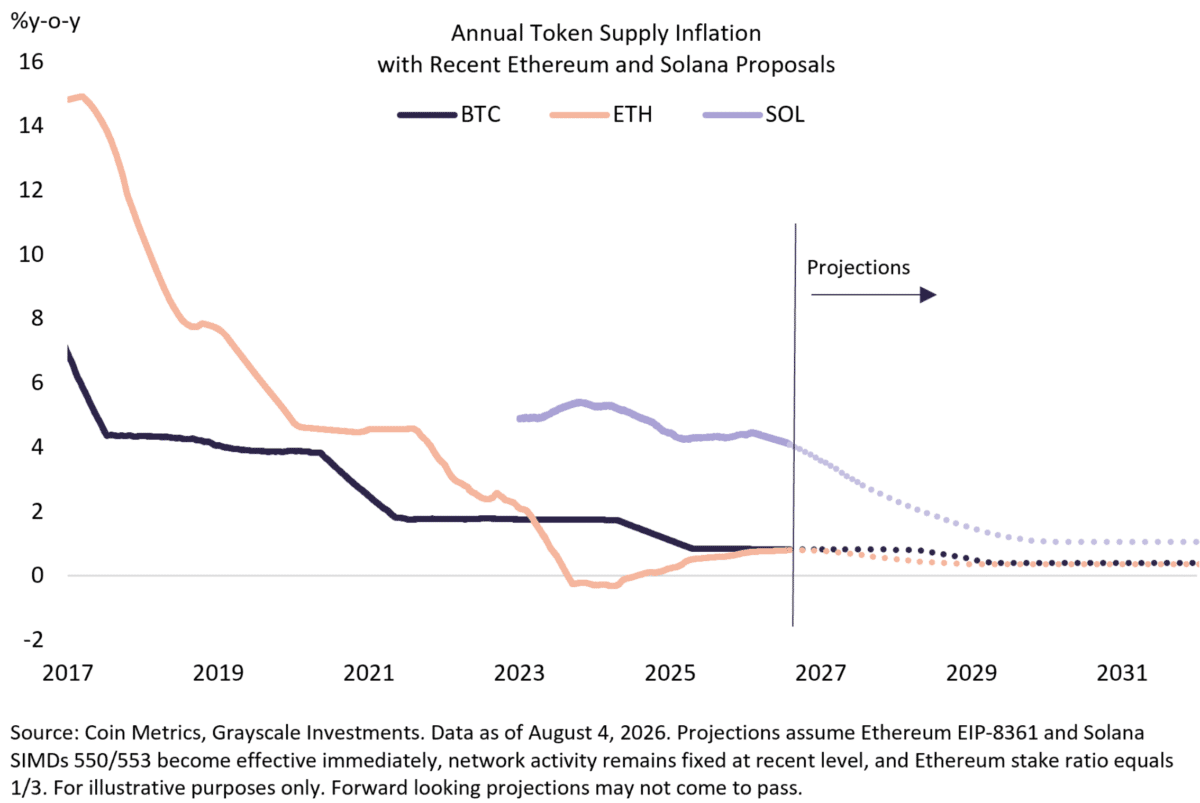
    At the same time, Zach Pandl, Head of Research at Grayscale, presented his analysis indicating that Ethereum and Solana may become more scarce assets due to their respective networks’ consideration of lowering the annual production of new tokens.

    Source: Grayscale

    Currently, issuing new $ETH and $SOL, which expands the total supply, helps to fund staking rewards on Ethereum and Solana.

    This inflation would be decreased by the suggested modifications. Comparable to lowering the production of a commodity, the value of the current tokens may rise if demand remains constant or rises and fewer new tokens are introduced to the market.

    According to Pandl, by 2031, the annual supply growth of $ETH and $SOL may drop to about 0.4% and 1.1%, respectively, bringing them closer to Bitcoin’s supply growth and below gold’s estimated 1.8% annual supply growth.

    What about stakers?

    For stakers, there is a trade-off, though. People who stake their tokens will get fewer tokens as rewards if there are fewer new $ETH and $SOL created.

    After a decrease in inflation, for instance, a staker who earns 5 $SOL might only receive 3 $SOL. Yet, the value of those three $SOL might still surpass the value of the initial five $SOL if the decreased supply makes $SOL more scarce and its price increases noticeably.

    Therefore, while stakers must weigh the potential for higher token prices against the possibility of lower token rewards, unstaked holders may directly profit from increased scarcity.

    s up for debate and do not guarantee changes.

    This was consistent with an earlier report from AMBCrypto that stated that Solana’s ecosystem provides more than just trading and DeFi, which is why it is drawing in more users and money.


    Final Summary

    • Both Ethereum’s and Solana’s price actions are not that strong, with RSI supporting this narrative.
    • Garyscale suggests that Ethereum and Solana may become more scarce assets due to their respective networks’ consideration.
  • Binance Ends Transactions With 16 Platforms, Warns of Wallet Reviews

    Binance Ends Transactions With 16 Platforms, Warns of Wallet Reviews

    Binance Sets Three Deadlines for Transaction Restrictions

    Transactions involving 16 crypto-asset service providers will no longer be processed through Binance under restrictions announced Aug. 14. The exchange instructed users not to send funds to, receive assets from, or otherwise engage directly or indirectly with the named entities after their respective effective dates.

    Restrictions took effect Aug. 7 for Shelbit, operated by Shelbit General Trading LLC, and Aban Tether Exchange. Binance applied a second deadline on Aug. 13 to A7 Nigeria, A7 Africa and Pilotfinance Ltd., followed by an Aug. 23 cutoff covering 11 more platforms, including HTX, EXMO, Rapira, Aifory Pro, ABCeX, and WhiteBird.

    The remaining Aug. 23 entities are Noonecrypto Inc., Tradex, Monease Ltd., Bitpapa and Exnode, including Exnode Pay. Binance cautioned:

    “Any transactions attempted on or after these dates, may be held and subject to a compliance review. Restrictions may be applied to the impacted wallet(s) while the review is ongoing and such activity may also constitute a breach of Binance Terms of Use.”

    Sanctions Target Iranian and Russian Crypto Networks

    U.S. authorities imposed sanctions on Shelbit and Aban Tether through an Office of Foreign Assets Control (OFAC) action on Aug. 7. The Treasury Department alleged that Shelbit addresses exchanged more than $3 million with Islamic Revolutionary Guard Corps addresses, while Aban Tether processed transactions involving previously designated Iranian exchanges.

    Earlier enforcement against Nobitex, Wallex, Bitpin and Ramzinex increased screening requirements surrounding Iranian exchange exposure. The June 2 sanctions action involving four Iranian platforms covered businesses that OFAC later identified among Aban Tether’s transaction counterparties, connecting the August restrictions to a broader campaign targeting Iran-linked digital asset flows.

    U.K. authorities separately targeted cryptocurrency exchanges and the Kremlin-backed A7 network through 18 sanctions designations announced May 26. Officials alleged that A7 supported sanctions evasion, military procurement and oil-related payments, while the network claimed it moved more than $90 billion during the previous year.

    The U.K. package included several entities appearing on Binance’s list, such as EXMO Exchange Ltd., Rapira Group LLC, Sooty Ltd., Bitpapa, Nueva Cryptologia and Huobi Global. The sanctions also reached exchanges and payment providers associated with Russia-facing settlement routes, stablecoin infrastructure and cross-border liquidity channels.

    A7 Expands Alternative Payments as Compliance Pressure Rises

    A7 has promoted alternative cross-border settlement systems as Western governments tighten access to established financial channels. A7 says it serves more than 10,000 trade partners and intermediates nearly one-fifth of Russia’s international settlements market. Its A7A5 ruble-backed stablecoin has reportedly surpassed $100 billion in aggregate transaction volume.

    Binance has expanded compliance operations while responding to scrutiny over transactions involving restricted parties. The company previously reported a 96.8% decline in sanctions-related transaction exposure between January 2024 and July 2025. Its compliance operation includes more than 1,500 workers, representing about 25% of its global workforce.

    Users remain responsible for confirming the destination, network, and counterparty before initiating an irreversible blockchain transfer. A small test transaction can expose address or network errors, although it would not eliminate the compliance risks associated with transferring assets to a restricted platform or wallet connected to one.

    Centralized exchanges retain custody over customer assets and can delay, review, or prevent withdrawals under applicable rules. A self-custodial wallet gives its owner control of the private keys, but it does not remove sanctions obligations or protect users who transact with restricted counterparties. Binance’s final group of platform restrictions takes effect Aug. 23.