Blog

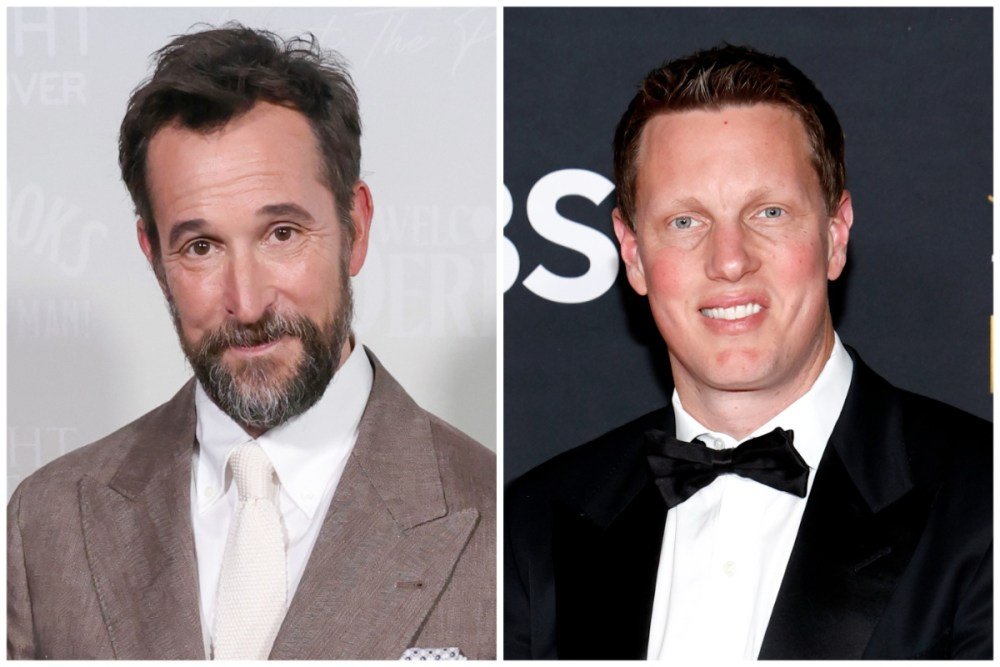
  • Noah Wyle Hopes David Ellison’s Threat to Move Paramount Out of California is ‘Saber Rattling’: ‘You’re Going to Take Hollywood Out of Hollywood’ 

    Noah Wyle Hopes David Ellison’s Threat to Move Paramount Out of California is ‘Saber Rattling’: ‘You’re Going to Take Hollywood Out of Hollywood’ 

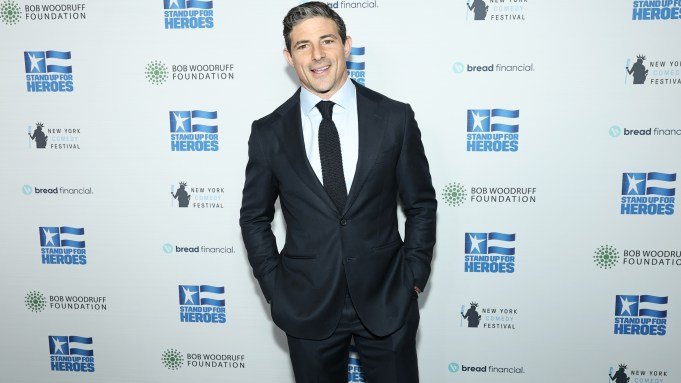
    Noah Wyle is hoping David Ellison isn’t serious about moving Paramount out of California.

    “I hope this is saber rattling because I can’t think of anything that would less engender you to the population of this industry than to say you’re going to take Hollywood out of Hollywood,” the “Pitt” star told me Sunday at the HBO Max Emmy Nominee Celebration in Los Angeles. “But I’m an Angeleno, so I have a vested interest in that one.”

    Variety confirmed on Aug. 11 that Ellison is prepared to start moving Paramount out of California as soon as October unless the Paramount-Warner Bros. Discovery merger is resolved through a settlement with the state’s attorney general, Rob Bonta. Twelve states have filed an antitrust case to block the merger.

    Paramount hasn’t yet decided where its new home might be; the company is considering destinations including Georgia, Texas and Tennessee.

    In March, Wyle spoke at a hearing organized by California Sen. Adam Schiff, held at City Hall in Burbank, in support of tax incentives to bring film and TV production back to the state. “I was asked to participate in today’s hearing to tell a success story,” Wyle said, according to the Associated Press. “I’m happy to report we’ll commence shooting season three this summer, and that a rising tide has indeed lifted all boats.”

    “The Pitt” shoots on the Warner Bros. lot in Burbank. Wyle said the first season of the HBO series created 600 production jobs and brought $125 million to the state economy.

    At the Emmy Nominee Celebration, Wyle said he couldn’t predict what would happen with the merger.

    “One article that says this, one article says that, one rumor leads you to believe one thing,” he said. “They haven’t painted the place yet, so who knows.”

  • ‘The End of Tom Six’ Review: The Director of the ‘Human Centipede’ Films Has Multiple Sclerosis and Is Sharing the Horror. This Confessional Doc Is His Witty Self-Defense

    ‘The End of Tom Six’ Review: The Director of the ‘Human Centipede’ Films Has Multiple Sclerosis and Is Sharing the Horror. This Confessional Doc Is His Witty Self-Defense

    Yesterday’s punk, grunge, and rebel-outsider upstarts have an uncanny way of evolving into today’s elder statesmen of respectable infamy. (Hello, John Waters, Patti Smith, John Lydon, Henry Rollins, and Robin Byrd.) But it’s doubtful that Tom Six will ever be in the mix of latter-day prestige. His desire to stand apart from it is too great.

    In case he’s not on your radar, Tom Six is the Dutch director of the “Human Centipede” trilogy, a series of horror films so grotesque that the idea of sitting through them would be a deal-breaker for 97 percent of moviegoers. Six was after the other three percent: the kind who feed off shock and transgression, and who recognize that a horror movie that makes hardened veterans of the genre feel like they have to watch parts of it peeking between their fingers is either a movie that has gone too far…or one that’s the definition of what true horror is. The “Human Centipede” films — especially “The Human Centipede 2 (Full Sequence),” a hellacious “Götterdämmerung” of torture porn — were both.

    Released in 2009, 2011, and 2015 (and watched mostly on VOD), the “Human Centipede” films carved out an extreme niche on the edge of global movie culture. Yet they also found a perverse mainstream foothold, becoming a cheeky meme (sorry! pun intended) referenced on “South Park,” “The Simpsons,” “Saturday Night Live,” “Unbreakable Kimmy Schmidt,” “Deadpool 2,” “Beavis and Butt-Head,” and the Childish Gambino video for “Bonfire.” Tom Mix wasn’t aiming for respectability; he was going as far as possible in the opposite direction. But he was courting notoriety and fame, and he did it by working in the carny-barker freak-show tradition of exploitation-world self-marketers like Herschell Gordon Lewis, Russ Meyer, Ted V. Mikels, and (of course) John Waters. These were filmmakers who specialized in selling a vibe of on-the-fringe danger, creating an underground mystique that was part of what made them successful. (By the time Waters was done peddling “Pink Flamingos” on the midnight-movie circuit, he had made a fortune, which became the basis of his trash-art empire.)

    “The End of Tom Six” is about how Tom Six made and sold his films in the same spirit. But it’s also about how his dark dream came crashing down. The movie, which premieres this weekend on YouTube, is a DIY schlock- umentary that’s also a real documentary, one that captures how Six’s life became his own private horror film, after he was diagnosed with multiple sclerosis.

    He first learned that he had the condition 14 years ago, and for a long time he was able to manage its symptoms comfortably (and in secret). But MS is incurable and progressive. For the last six years, Six has lived as a recluse in Amsterdam, lying in bed and going out twice a day for decaf coffee (the regular brew is too hard on his shattered nerves). “The End of Tom Six” is a self-styled confessional memoir in which Six fuses his life and career and illness into a kind of parable. He’s asking: Is there room anymore for movies like his, that stray over the line? And if not, what does that mean?

    Shot in black-and-white, “The End of Tom Six” opens with noirish images of an Amsterdam canal, lined with street lanterns that look right out of the London of “Dr. Jekyll and Mr. Hyde.” The images are accompanied by a doomy romantic Hollywood/classical score, and then, in old-fashioned letters, the words “The End” appear (with the added words “…of Tom Six”). So this will be the story of the end of Tom Six’s life. But it’s really the story of how he made his movies, and sold his image, and is still doing it, to the point that you may wonder at moments if his battle with MS is actually an Andy Kaufman stunt. (I don’t think it is; but one wouldn’t put it past him.)

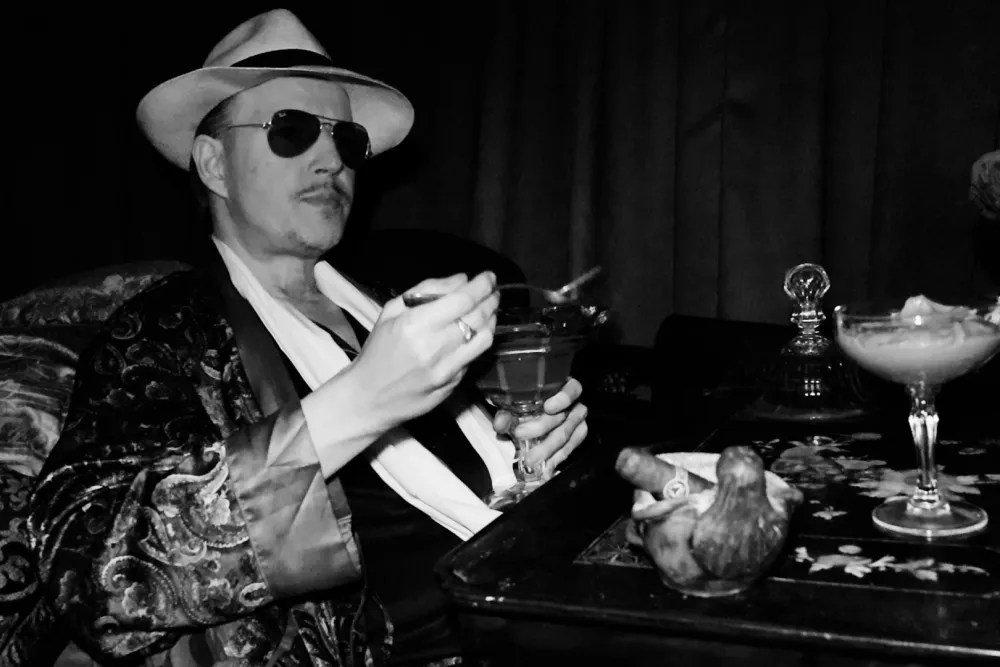
    The film moves inside Six’s home, where he’s lying in a paisley silk bathrobe on an antique Chinese opium bed, wearing a dandified mustache and Panama hat and dark aviator shades, smoking a Havana cigar, looking like Hunter Thompson’s hip Euro brother crossed with Michael O’Donoghue crossed with a svelte version of Rainer Werner Fassbinder. Mix is surrounded by a small crew and entourage: his paramour, Marci (Maartje Willems), who beams and insinuates like Morticia Addams; the film’s megaphone-wielding director, also played by Six; the camera man, boom operator, and butler, all played by the dwarf actor Edwin Alofs; a uniformed Nazi (Servaes Nelissen) who’s on hand to gloweringly comb the proceedings for trigger warnings and ideas worthy of censorship; and a first assistant director (Demian Kurosa) who looks like a circus tattooed man and talks with a post-operative vocoder.

    Six keeps cutting between himself and this kitsch gallery of jokers, tossing in B-movie “All About Eve” exchanges (“Alcohol is killing you slowly, baby.” “That’s okay, I’m not in a hurry”), which keeps the tone light. It also purges the movie of self-pity and helps to break up what is basically an amusing and irascibly witty Tom Six monologue of self-justification. Is “The End of Tom Six” for fans only? No question. But I count myself among the three percent who watched “The Human Centipede 2” and found it to contain a hint of the awesome within its awfulness, the same way I felt when I read the Marquis de Sade’s “The 120 Days of Sodom.” These are not works you recommend to people. But they’re works that, in their sick way, might be said to expand one’s vision of human evil.

    I was interested, after 15 years, to discover what sort of dude Tom Six is, and to hear him explain to his audience why he made these movies, and about how it shaped his experience (“To this day, I get marriage proposals and death threats”), and to listen to his diary of debilitating illness. “The End of Tom Six” is not a work of true-life body horror. Six describes his symptoms, and drug regimen (Oxycodone for the chronic pain), with tough understatement. At one point, though, he does admit, “I’m a fucking living X-ray. I’ve got massive brain fog from all the medications. My thoughts are like scrambled eggs.”

    What he wants to talk about is the movie he made after the “Human Centipede” trilogy. It’s called “The Onania Club,” and it’s the story of a group of chic women in Los Angeles (Chloë Sevigny is one of the stars) who get aroused by the misery and suffering of others. It is, as Six describes it, a story about the opposite of empathy. But in that sense, it’s about the loss of empathy, and maybe the end of it.

    Tom Six made “The Onania Club” in 2019, and though he had struggled to find a distributor for “The Human Centipede” and its sequels, he eventually did. With those films having crossed over into the pop consciousness, he figured he’d have no problem nailing down a distributor for a movie less grotesque and more serious. But no distributor would touch it. What he kept hearing was “The marketplace has changed.” In other words, no one wanted to deal with the controversy that might rear its head in an increasingly censorious environment. Six claims that the stress of all this exacerbated his illness. The way he portrays it, his health disaster was the crucifixion a clampdown society helped to reinforce. We’ll have to take his word on that. But while I haven’t seen “The Onania Club” (it remains unreleased), and therefore can’t comment on it, I will say this much. “The End of Tom Six,” an underground-cinephile-on-acid curio, is worth seeing for the question it raises: Do we want the arena of cinema to be a place where anything can happen, or do we want it to be a safe space?
  • Crypto Investors Move Beyond Market Cap Rankings to Usage and Value Capture

    Crypto Investors Move Beyond Market Cap Rankings to Usage and Value Capture

    A token’s position in a market-cap table has long been treated as a rough proxy for relevance. That shortcut is losing favor. Industry executives say investors are beginning to judge crypto assets by usage, economics, and value capture rather than where they sit in a market-cap ranking, according to the original report from CoinDesk.

    The distinction matters because market capitalization can be a badly distorted indicator. It is simply circulating or fully diluted supply multiplied by price. Low-float launches, locked allocations, airdrop vesting schedules, and meme-style supply mechanics can push a token high in the rankings without anything close to corresponding user demand or fee generation. When executives describe a shift back to fundamentals, they are describing an attempt to strip out those optical effects.

    Usage metrics now show up more often in investment memos: active developers, transaction counts, fee revenue, staking participation, and whether tokenholders actually capture network income. Developer activity, for instance, remains one of the cleaner signals that a chain is still building regardless of its rank, as tracked in this week’s developer activity rankings.

    For retail traders, rank remains a discovery shortcut. For institutions and long-horizon funds, it is increasingly treated as a screen rather than a conclusion. The difference in time horizon explains much of the divergence: a trader can profit from a re-rating based on supply mechanics, but an allocator that holds through unlocks and volatility needs a more durable reason to own the asset.

    What Rank Hides

    Market-cap tables reward size even when size is an artifact. A token launched with a tiny float can look more valuable than a widely distributed network with consistent volume. That dynamic has historically pushed speculative assets ahead of protocols generating steady fees. Investors who anchor on rank are therefore measuring the market’s supply story as much as its demand story.

    The practical consequence is that liquidation risk and unlock schedules matter more than the headline number suggests. A high market cap can coexist with thin liquidity, making exits sharper and short-term price moves more extreme. Fundamentals-based evaluation tries to answer a different question: would this network still produce activity if the speculative bid cooled?

    What Fundamentals Now Include

    Value capture is becoming the operative phrase. That means fee share, buybacks, burns, staking rewards, and the relationship between network activity and tokenholder returns. Sui’s institutional staking and Paga integration is one example of demand-side news moving a token on the basis of actual usage rather than supply optics. The question is whether those integrations persist and convert into recurring fees.

    Tokenization provides an even sharper test. When on-chain assets represent off-chain collateral, the market can compare usage against settlement activity and total value locked. The on-chain RWA market crossing $20 billion, as tracked in the weekly tokenization roundup, gives investors a less speculative layer to evaluate. It is harder to dismiss a token as rank-driven when real-world assets are being settled on-chain.

    The Measurement Problem

    Fundamentals in crypto are not standardized. Active addresses can be farmed. Transaction counts can be inflated by bots. Revenue can be subsidized by emissions, which effectively transfers value from holders rather than creating it. Even fee generation varies by accounting method, especially when validators and tokenholders have different claims

  • Bitcoin’s U.S. demand flashes a 90-day warning – What it means for BTC

    Bitcoin’s U.S. demand flashes a 90-day warning – What it means for BTC

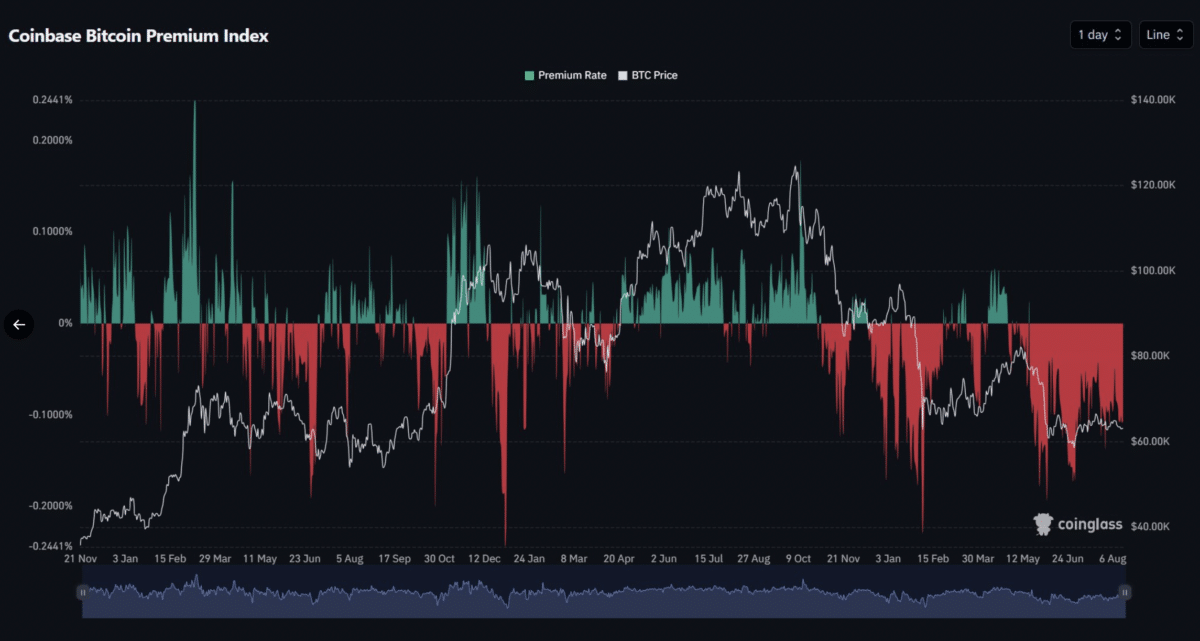
    The Coinbase Bitcoin Premium Index has stayed negative for ninety days as Bitcoin’s [$BTC] price continues its struggle to break above the $70,000 price level last observed in May.

    To put things in perspective, the Coinbase Bitcoin Premium Index calculates the price difference between Bitcoin on Coinbase and Binance and provides an estimate of buying or selling pressure from the U.S. market. A negative reading indicates that Bitcoin is trading at a lower price on Coinbase than Binance.

    At press time, the index stood at ‑0.1066% according to Coinglass. However, what’s raising eyebrows is not the reading itself but the premium, which has stayed negative for three months.

    Source: Coinglass

    Here, the overall pattern points to sustained spot weakness on the U.S. side, which was further supported by a previous report from AMBCrypto. However, it does not necessarily portend a bear market or institutional withdrawal from Bitcoin.

    Is price action denoting something else?

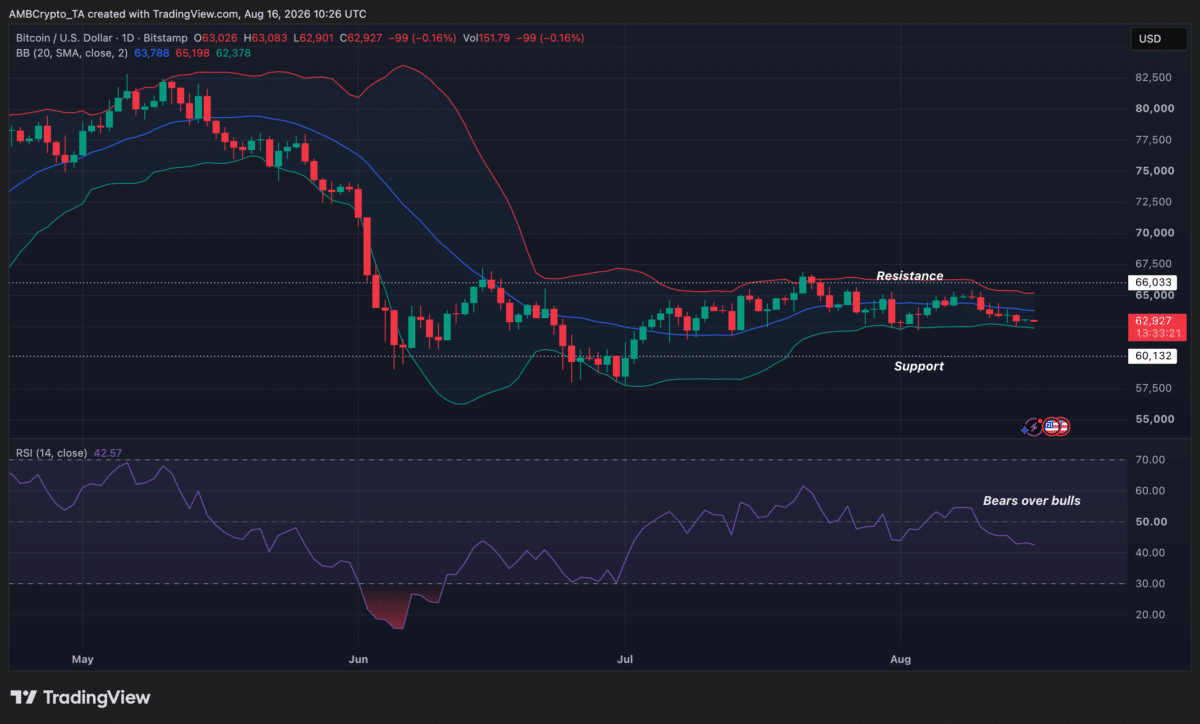
    This occurred as the price of Bitcoin dropped from about $79K in May to $62,923.64 at the time of writing. Since the RSI remained largely below the neutral level during that time, it too echoed the bearish sentiment.

    Source: Trading View

    Additionally, Bollinger Bands further supported the volatility that had prevented the price from hitting a high bullish threshold. In fact, despite whale wallets having bought 54,000 more Bitcoin since mid-June, the price action hasn’t changed.

    Are bulls losing steam?

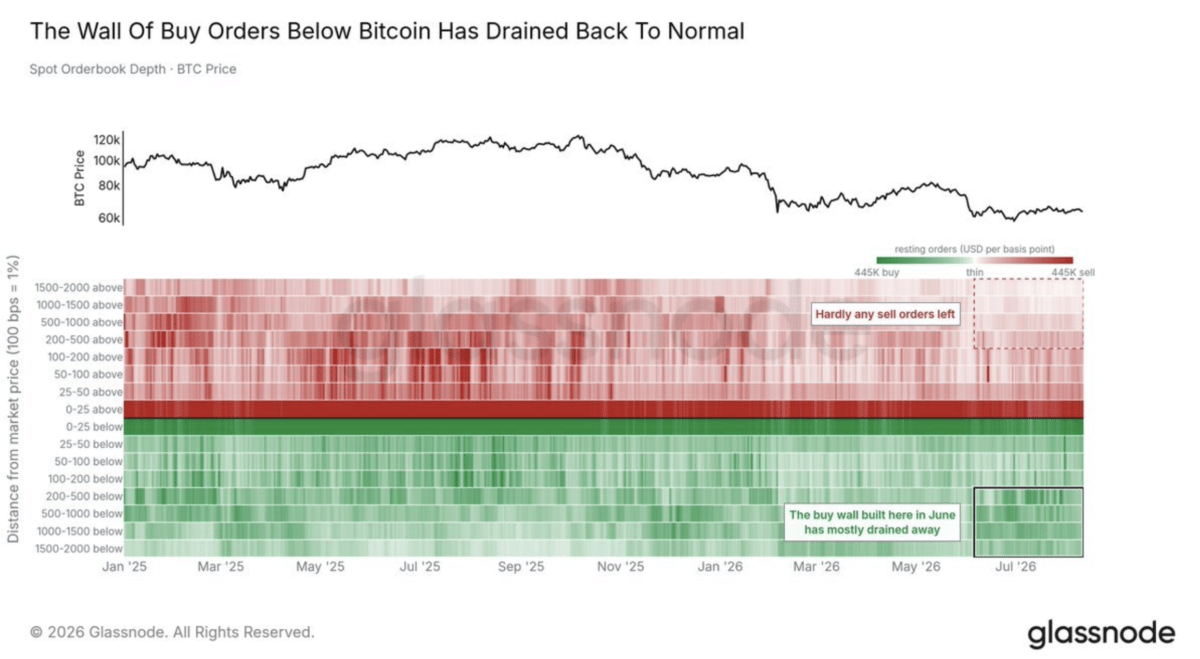
    Adding to the pressure, Glassnode also analyzed that the buy-side support below the current price of Bitcoin is eroding. A significant concentration of buy orders below the market existed earlier, especially in June.

    Source: Glassnode

    This created a solid “floor” because buyers were prepared to intervene and absorb selling pressure if Bitcoin dropped toward those levels. Now, with many of those bids removed, filled, or shifted lower, there are fewer orders directly beneath the price.

    With less buy‑side support to cushion declines, the market’s liquidity buffer has weakened. This in turn means that if sellers become more aggressive, Bitcoin may move lower more readily.

    All in all, though these metrics do not necessarily mean that Bitcoin will crash, they do suggest that the downside may have grown more susceptible.


    Final Summary

    • $BTC’s Coinbase Premium Index sat at around 0.1066% lower than the equivalent Binance price.
    • The price action, RSI, and Bollinger Bands all confirmed that bears were here to stay for some time.
  • SafePal reveals security breach affecting 39,798 users as phishing risks mount

    SafePal reveals security breach affecting 39,798 users as phishing risks mount

    SafePal on Sunday said a security incident exposed order information belonging to about 39,798 customers, with the orders placed between March 2nd and April 11th of this year.

    Speaking via a blog post announcement, SafePal said:

    “This incident did not involve your seed phrase, private keys, wallet password, or other wallet credentials, bank account information, payment card numbers, or government-issued identification numbers. SafePal never requests, collects, processes or stores such information from customers.”

    Under certain conditions, that weakness made it possible for an unauthorized person to view another customer’s order information. SafePal says the issue has since been fixed, and the company has added more security controls to the affected system.

    SafePal warns affected customers that scammers may use stolen order details to make phishing attempts look legitimate

    Email notifications were already sent out to customers whose data could be at risk from the cyber attack. Customers can still determine whether or not they should take any further actions by themselves rather than depending only on the information from the email notification.

    SafePal mentions different ways in which the scammers could make use of the leaked information. The victims can receive misleading calls on the support service, phishing emails, messages in the text form, written mail, offers of fake refunds, misleading update requests for the software and firmware, misleading messages from the support staff or web links directing to phishing websites that appear to be authentic.

    The company has also warned that the stolen order records could eventually be posted or circulated on public online forums.

    “Treat any unexpected contact or hardware delivery referencing your SafePal purchase as suspect, whether it arrives by phone, in the post, or in person. “

    According to SafePal, there is no need for the customers to transfer their cryptocurrency to other wallets solely because of their order data exposure. This happens only when the recovery phrase or the private key has been provided on a dodgy website or via email, text, phone call, or letter. In case the wallet credentials have been compromised in some way, then SafePal recommends that the wallet is considered unsafe.

    SafePal hires an independent security firm and limits personal order data retention to 90 days after fixing the flaw

    SafePal says the access-control weakness has already been repaired, while additional security measures have been added to the order system involved in the incident. The company is also hiring an independent cybersecurity firm to confirm that the fix works as intended. That outside firm will go beyond checking the original problem and will carry out a wider review of SafePal’s order-processing systems for any other security weaknesses.

    SafePal has also shortened the amount of time customer personal information is kept inside the relevant order-processing system. The new retention period is 90 days, unless applicable laws require certain information to remain on file for a longer period.

    According to SafePal, they have already identified who exactly had their data accessed and have communicated directly with those individuals to give them more details.

    Also, other companies that cooperate with SafePal with regard to the shipment and delivery of orders were also involved in the investigation. SafePal asked these external partners to check their own system for the presence of the security vulnerability, and not only in the SafePal order environment.

  • Former ABC News Field Producer’s Wrongful Termination Lawsuit Accuses Matt Gutman Of Making Inappropriate Sexualized Comments

    Former ABC News Field Producer’s Wrongful Termination Lawsuit Accuses Matt Gutman Of Making Inappropriate Sexualized Comments

    A former ABC News field producer filed a wrongful termination lawsuit against the network, including allegations that her former colleague Matt Gutman, now chief correspondent with CBS News, made inappropriate sexualized remarks when they worked together.

    Samira Said filed the lawsuit in Los Angeles Superior Court on Friday. The lawsuit names as defendants ABC, The Walt Disney Co., Gutman and David Herndon, who had worked as Los Angeles bureau chief. Among other things, she claimed wrongful termination, discrimination, hostile work environment harassment and retaliation for engaging in protected activity.

    Said claimed that she was terminated after being denied accommodations for mental health issues. She was being treated by a psychiatrist, including for depression, and her provider advised her to reduce her workload to protect her health.

    Her lawsuit made a number of claims of adverse employment actions. Said alleged that in one incident during her employment, she was placed on a male-only team that included Gutman, an on-air correspondent, and two crew members.

    According to the complaint, “While the team waited in a public queue during the assignment, Gutman initiated a discussion rating a female correspondent’s appearance and reducing her professional standing to a numerical score based on her physical attributes. The male crew joined in, continuing to assess the woman’s body and looks in Said’s presence. The men attempted to draw Said into the conversation by soliciting her views. Said declined and stated the conversation was inappropriate.”

    In another incident, per the lawsuit, she and Gutman were at a press day related to a film release, and they disagreed on whether the team should leave the work site. According to the lawsuit,
    “In front of multiple coworkers, Gutman responded by making a sexualized insinuation that Said must have an after-hours date in the city and that this is why she did not want to relocate. The remark, made audibly to others, demeaned Said and reduced her professional judgment to a sexualized stereotype.”

    CBS News and ABC News have not commented on the litigation.

    Gutman joined CBS News earlier this year, after a long tenure at ABC, where he served as chief national correspondent.

    According to the lawsuit, after experiencing Covid and covering the mass shooting in Uvalde, Texas, Said was approved for medical leave for two weeks in August, 2022, but “fearing that her employment would be terminated if she remained out too long, Said felt compelled to rush her medical leave and to communicate an expedited return.”

    For the rest of the year, her psychiatrist continued to certify the medical necessity of her leave on a recurring basis, and the following January cleared her to return to work subject to reasonable accommodations “designed to enable her to perform the essential functions of the position while protecting against re-exposure to trauma triggers,” per the lawsuit.

    Said claimed that HR personnel presented her with an “ultimatum to either return to work without any accommodations, or not to return at all.” Said eventually withdrew her accommodation requests because she was “effectively deterred from doing so” by the defendants “prior course of conduct.”

    The lawsuit claimed that she was demoted to weekend desk shifts and, although she was told the assignment was temporary until a replacement was hired, no person was.

    In early 2025, Said was assigned to cover the Los Angeles wildfires and additional weather events, according to the suit, and while in the field sustained a bone contusion when a piece of heavy equipment struck her foot. A Disney physician examined her and determined that she was not required to take leave, per the suit.

    The lawsuit claimed that ABC News Vice President Katie DenDaas met with her and emphasized that she was one of the news division’s best performers, but she was terminated some days later, on March 5, 2025.

    The lawsuit seeks unspecified damages, attorneys fees and costs and declaratory relief.

  • Alex Cooper Departing Talent Agency UTA

    Alex Cooper Departing Talent Agency UTA

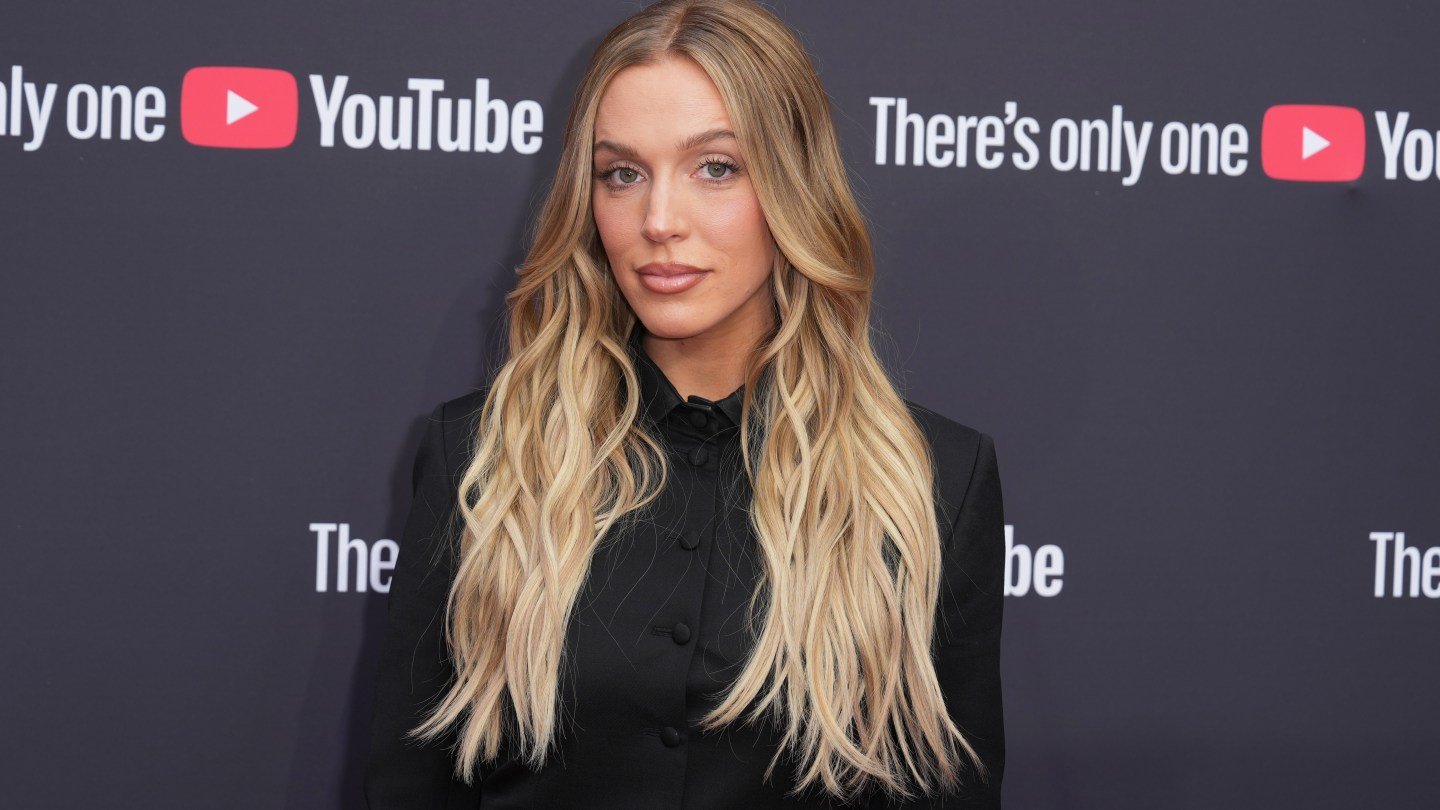
    Alex Cooper is leaving talent agency UTA, amid a busy week for the Call Her Daddy creator, according to sources familiar with the matter. 

    A source says Cooper is in conversations with other agencies, but nothing is yet signed. 

    The news comes after Cooper announced an investment on Aug. 12 from WTSL, the Silver Lake-backed firm led by Patrick Whitesell, that valued her Unwell media company at $500 million. The plan is to use the investment to grow the company, which includes a slate of podcasts, as well as live events and a film and TV production arm including through acquisition. 

    However, amid the planned expansion, a report in Bloomberg last week also said that Cooper’s branded beverage line, Unwell Beverage Co, is shutting down later this year. Cooper has also faced a number of negative headlines after Bloomberg and Vanity Fair both reported claims about staff turnover and uneasiness among the staff, particularly due to the behavior of Matt Kaplan, Cooper’s husband and the company’s co-founder, who is said to have yelled at and berated staff members.

    Cooper remains one of the most popular podcast hosts thanks to the success of Call Her Daddy, but is now looking to leverage that into more with an expansion of her empire outside of podcasting, which may have prompted the move. A source familiar with the matter says Cooper’s team has spent the past several months planning out its future growth strategy, including representation, related to the funding.

    UTA declined to comment on reports of Cooper departing. UTA’s Oren Rosenbaum negotiated a $125 million deal with SiriusXM in 2024 for Cooper and the agency also repped Cooper as she launched the Unwell podcast network in 2023.

    The talent agency represents a number of top creators, including MrBeast, Charli D’Amelio and Alix Earle, who formerly worked with Cooper but left her network, causing speculation about a rift or possible feud between the two creators. That has been raised as a possible reason for the departure, but Earle and Cooper have both been at UTA for more than a year.

  • Stray Kids Score Their Biggest Sales Week as ‘This & That’ Debuts Atop Albums Chart

    Stray Kids Score Their Biggest Sales Week as ‘This & That’ Debuts Atop Albums Chart

    Stray Kids have scored their biggest sales week yet as their latest, “This & That,” becomes their ninth No. 1 on the Billboard 200.

    The group bows atop the chart with 369,000 equivalent album units, with traditional album sales accounting for 357,000 of that sum. The latest feat extends their record for most No. 1s among groups this century, tying them with the Rolling Stones for second-most No. 1s in the chart’s history among groups, only behind the Beatles with 19 No. 1s. Additionally, “This & That” has the sixth-largest week for an album in 2026 and second-largest by traditional album sales behind the debut of BTS’ “Arirang” in March with 532,000.

    Stray Kids previously earned their first No. 1 on the Billboard 200 with “Oddinary” in 2022. Two years later, they became the first act to debut their first six entries at the top spot following the release of “Hop.”

    Elsewhere, Ariana Grande‘s “Petal” drops from No. 1 to 2 in its second week, earning 82,000 equivalent album units. Olivia Rodrigo’s “You Seem Pretty Sad for a Girl So in Love” holds steady at No. 3, followed by Ella Langley’s “Dandelion” at No. 4 and Morgan Wallen’s “I’m the Problem,” which dips from No. 2 to 5.

    Rounding out the rest of the top 10 are Noah Kahan’s “The Great Divide,” followed by the debut of Pooh Shiesty’s “All Eyes on Shiest” at No. 7. Karol G’s latest album, “No Me Arrepiento de Sentir Tanto,” bows at No. 8, while Drake’s “Iceman” slides from No. 6 to 9. Role Model’s latest album, “Chuck Timely & the Hourglass,” bows at No. 10 with 38,500 equivalent album units.

  • Alex Cooper Leaves UTA After Tough Period of Media Scrutiny

    Alex Cooper Leaves UTA After Tough Period of Media Scrutiny

    Alex Cooper seems intent on unraveling some of the current relationships that have helped underpin her production company, Unwell.

    The star podcaster and media entrepreneur has left hertalent agency, UTA, according to three people familiar with the matter, as she focuses on a larger suite of business operations beyond the podcast for which she is best known, and is frustrated in part by its continuing relationships with Alix Earle and Dave Portnoy, two prominent influencers and podcasters who have feuded with her. UTA had been pressed to part ways with Earle, according to one of these people. Last week, Cooper shut down a beverage venture, Unwell Beverage Co., which was launched last year with Nestle SA as a partner, according to a report from Bloomberg.

    A representative for Unwell confirmed the company ended its relationship with UTA on July 27.

    UTA has helped Cooper build and scale her presence over the years, and has helped broker deals that had her host interviews for Peacock during NBCUniversal’s coverage of the 2024 Paris Olympics. A person familiar with Unwell says the company has in recent months focused on ways to expand across podcasts, TV and film, live events and its creative agency work, among other operations, following a substantial investment from Patrick Whitesell, co-founder of WME and former executive chairman of successor company Endeavor. Unwell also plans to offer services to traditional media and advertising organizations. As the company devised its strategy, this person says, it believed a rethink of traditional talent representation was warranted.  

    In recent months, Unwell has unveiled a reality-competition series, “Unwell Winter Games,” that brings together 16 contestants at “a luxury chalet in Park City, Utah” to compete in a series of “mental and physical challenges over four days and named veteran marketing executive Joanne Bradford as the company’s president. Unwell serves as the producer on “Icebreaker,” a series that has been greenlit by Netflix and will adapt the novel by Hannah Grace.

    UTA declined to make executives available for comment. She is said to be in discussions about working with CAA, according to one of the people familiar with the matter.

    Whitesell’s WTSL, an investment firm focused on media, entertainment and sports he launched after exiting Endeavor and WME last year, has invested an undisclosed sum in Unwell that values the business at $500 million, according to information released August 12 by Unwell. Cooper and her husband, Matt Kaplan, who self-funded the company targeting Gen Z women audiences, retain a majority ownership stake. Formed in 2023, Unwell says it has been profitable from day one and sees the WTSL investment as growth capital. The entrepreneur believes the work Unwell does with brands could be worth as much as the podcasting business by next year.

    Unwell said that in addition to the funding, WTSL would bring “deep strategic expertise, industry relationships and a proven track record of supporting some of the most innovative companies and storytellers in media,” including Peyton Manning’s Omaha Productions.

    Whitesell’s funding followed a pair of recent exposés alleging behind-the-scenes chaos at Unwell. According to a Vanity Fair story in June, one Unwell freelancer alleged that Kaplan “creates the most toxic work environment that I’ve ever seen”; anonymous sources also said Kaplan had questioned employees about their sex lives and commented on their physical appearance. In April, Bloomberg reported that Kaplan “has earned a reputation for frequently yelling at staff members” and said Unwell’s employees were “looking for the exit.”

    Cooper, in an interview at Cannes Lions this June with the Wall Street Journal, was asked about the allegations. “I will just kind of leave it at ‘Don’t believe everything that you read on the internet’ — but I think everyone knows that at this point,” she said. Cooper also said, “I think that we have done a really incredible job at Unwell, and I think if you walk the halls, there are so many people that are so happy to work at this company. … I think, unfortunately, being a woman in this industry is extremely difficult because you’re held to a completely different standard. Whether it’s a smear campaign being created for someone’s narrative, whatever it be.”

    Earle, a podcaster and influencer, gained some her greatest fame while hosting the podcast “Hot Mess,” which was produced by Unwell. Still, Cooper stayed with UTA for a year after the pair ended their relationship. Dave Portnoy, the founder of Barstool Sports, alleged in a memoir that Cooper and her former co-host, Sofia Franklyn, planned to say they were harassed in order to get out of a previous contract with Barstool, which helped launch “Call Her Daddy.”

    Todd Spangler contributed to this story.

  • Ariana Grande Brings Out ‘Wicked’ Co-Star Cynthia Erivo for ‘Happy Days’ and ‘For Good’ at Eternal Sunshine London Show

    Ariana Grande Brings Out ‘Wicked’ Co-Star Cynthia Erivo for ‘Happy Days’ and ‘For Good’ at Eternal Sunshine London Show

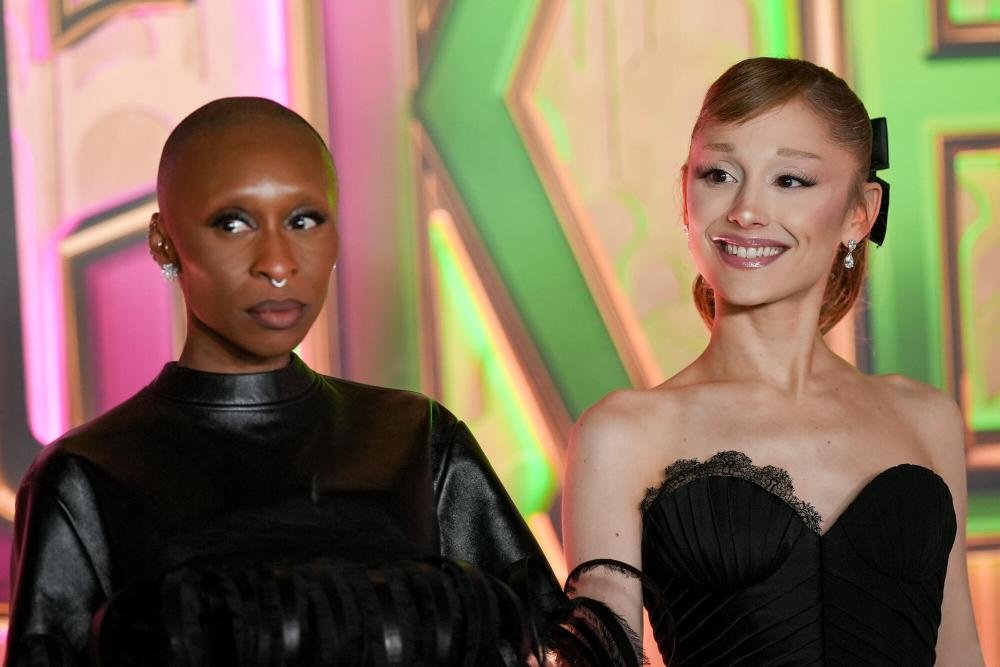
    Ariana Grande brought out Cynthia Erivo to perform at her Aug. 16 Eternal Sunshine stop at London’s O2.

    The “Wicked” stars sang “For Good” and “Happy Days” on the second night in the U.K. for Grande’s tour.

    Grande is currently on her Eternal Sunshine Tour, which shares a title with her seventh studio album. The tour is scheduled to conclude with 10 dates at London’s O2 Arena, ending on Sept. 1.

    Following the conclusion of the tour, Grande will be taking a step back from public appearances. “She looks forward to finishing the tour and ending it on a high note, both healthily and happily, and then taking a much-deserved break from public-facing work and appearances, which has led to endless, ongoing public scrutiny,” Grande’s rep told People in early August.

    Upon news of her break, it was also revealed that Grande dropped out of the West End revival of Stephen Sondheim’s “Sunday in the Park With George,” in which she was set to star alongside another “Wicked” alum, Jonathan Bailey.

    The “public scrutiny” has reached a fever pitch in recent years as Grande has been on a hectic run of promotion. Her physical appearance has been put under a microscope online. Her eighth studio album, “Petal,” was released on July 31. The music video for the title track, released concurrently, stirred up additional concerns about her physical appearance.

    Grande and Erivo starred in Jon M. Chu’s “Wicked” and its sequel “Wicked: For Good” as Glinda and Elphaba, respectively. After release of the first film, they both received Oscar nominations for their roles.