Blog

  • South Korea’s Budget Office Proposes 5-Year Crypto Loss Carryforward and Higher Tax Threshold Ahead of 2025 Rollout

    South Korea’s Budget Office Proposes 5-Year Crypto Loss Carryforward and Higher Tax Threshold Ahead of 2025 Rollout

    South Korea’s National Assembly Budget Office has recommended allowing virtual asset investors to carry forward trading losses for up to five years and raising the current tax exemption threshold of 2.5 million won (approximately $1,800), according to a report by Edaily. The proposals come as the country prepares to implement full-scale taxation on cryptocurrency gains starting January 2025.

    Key Proposals in the Tax Study

    The study, commissioned by the National Assembly Budget Office, outlines several measures aimed at addressing the practical challenges of taxing virtual assets. Among the most notable recommendations are:

    • Introducing a five-year carryforward for capital losses from virtual asset transfers, allowing investors to offset future gains against past losses.
    • Raising the minimum taxable threshold from the current 2.5 million won, which has been criticized as too low given the volatile nature of crypto markets.
    • Establishing more detailed tax standards for staking, lending, airdrops, and hard forks, which currently lack clear classification.
    • Introducing tax incentives to encourage trading on domestic South Korean exchanges, in an effort to prevent capital flight to overseas platforms.

    Background and Context

    South Korea has delayed its crypto tax regime multiple times, originally planned for 2022, due to market instability and industry pushback. The current framework, set to take effect in January 2025, would impose a 20% tax on annual gains exceeding 2.5 million won from virtual asset transactions. This threshold is significantly lower than the 5 million won exemption applied to stocks and other financial investments, a discrepancy that has drawn criticism from investors and lawmakers alike.

    The National Assembly Budget Office’s report acknowledges these concerns, noting that the low threshold could disproportionately affect smaller investors and discourage participation in the legitimate crypto market. The proposal to raise the exemption and introduce loss carryforwards aligns with international practices, such as those in the United States and Germany, where losses can be used to offset gains over multiple years.

    Implications for Investors and the Market

    If adopted, these recommendations would provide significant relief to South Korean crypto investors. The five-year loss carryforward would be particularly valuable in a market known for extreme price swings, allowing investors to recover losses against future profits. Raising the tax threshold would also reduce the compliance burden for casual traders, who may otherwise face taxes on relatively small gains.

    The proposed tax incentives for domestic exchanges are aimed at retaining trading volume within South Korea, where platforms like Upbit and Bithumb dominate. Without such measures, there is concern that traders might shift to overseas exchanges with more favorable tax treatment, reducing the effectiveness of the domestic tax regime and potentially undermining consumer protections.

    What’s Next

    The recommendations are not binding, but they carry weight as they come from the National Assembly Budget Office, which provides analysis to lawmakers. The final shape of the crypto tax rules will depend on legislative action in the coming months. With the January 2025 deadline approaching, stakeholders are closely watching whether the government will incorporate these proposals into the final framework.

    For now, investors and exchanges are advised to prepare for the upcoming tax regime while monitoring potential adjustments. The outcome will likely influence not only South Korea’s crypto market but also serve as a reference for other countries grappling with how to tax digital assets fairly and effectively.

    FAQs

    Q1: When will South Korea’s crypto tax take effect?
    The tax is scheduled to begin in January 2025, after multiple delays. The National Assembly Budget Office’s proposals, if adopted, could modify the rules before implementation.

    Q2: What is the current tax exemption threshold for crypto gains in South Korea?
    The current threshold is 2.5 million won (about $1,800) in annual gains. The Budget Office has recommended raising this threshold, though no new figure has been specified.

    Q3: How would a five-year loss carryforward work?
    Investors could deduct losses from virtual asset transfers against gains in the same year, and any unused losses could be carried forward to offset gains for up to five years, reducing overall tax liability over time.

    Related Reading

    • Upbit Adds NEXO to USDT Trading Pairs: What Traders Should Know
    • Nomura’s Laser Digital Registers as Crypto Business Operator in Japan
    • Upbit, Bithumb, and Coinone Place MANTRA (OM) on Delisting Watchlist: What Investors Should Know
    • Upbit and Bithumb Extend ZIL Delisting Review: What Traders Should Know
    • South Korea Moves to Empower FIU to Crack Down on Unregistered Crypto Firms

  • White House Derides Rosie O’Donnell As A “Nasty Woman” After She Skewers Trump During Jimmy Kimmel Guest Host Gig

    White House Derides Rosie O’Donnell As A “Nasty Woman” After She Skewers Trump During Jimmy Kimmel Guest Host Gig

    Rosie O’Donnell’s stint filling in for ABC late-night host Jimmy Kimmel has not gone unnoticed by the Trump White House.

    On Friday, they issued a statement about the president’s longtime nemesis. “Rosie O’Donnell is a nasty woman and a total slob whose brain has been completely destroyed by Trump Derangement Syndrome,” said White House spokesman Davis Ingle.

    O’Donnell finished up her week on Thursday with a parody of Danny Boy, including lines like this: Drop that Big Mac that we all know you are holding, because my dear, I worry for you so. Poor Donny boy, your polls, your polls are falling, your reflecting pool is green as Mountain Dew. Your wig’s a mess, your ballroom is appalling, and with Iran, you bit off more than you can chew.

    She then urged him to resign and “make this country great again.”

    On Wednesday, O’Donnell made a joke about Trump aide Natalie Harp: “You got to realize it’s time to hang up your wig and let Natalie tuck you in.” One of the bigger stories of the week has been the White House’s nuclear-level response to Democratic Sen. Jon Ossoff, who in a recent broadside against Trump said, “He wants to build his ballroom and travel with Natalie on their apparently defenseless flying palace gifted by the emir of Qatar.”

    The O’Donnell-Trump feud goes way, way back, so the White House response, first reported by Entertainment Weekly, is not a huge surprise. Also of note: Her guest host stint came just as ABC was taking on the Trump administration over its attacks on Kimmel, The View and ABC News reporting. The network filed a First Amendment lawsuit against the FCC on Tuesday, claiming that the agency’s early review of its broadcast licenses is a Trump administration retaliation over its content.

  • Bitcoin, Stocks and Gold Rip Higher While Bond Market Fear Festers

    Bitcoin, Stocks and Gold Rip Higher While Bond Market Fear Festers

    The session offered some breathing room after a bruising stretch in which rising long-term Treasury yields repeatedly hammered stocks lower. The Nasdaq Composite climbed 104.12 points, the NYSE Composite gained 194.68 points, the Dow Jones Industrial Average ripped 517.84 points higher, and the S&P 500 tacked on 32.83 points during Friday’s trading session.

    Even with that bounce, the real pressure point remained the bond market. Long-term Treasury yields had climbed toward multi-year highs as investors wrestled with sticky inflation, relentless government borrowing, and the swelling interest bill attached to federal debt. Higher yields bite because they raise financing costs for households and companies, while simultaneously making future corporate profits worth less in today’s dollars.

    Treasury Relief Fails to Kill the Fear

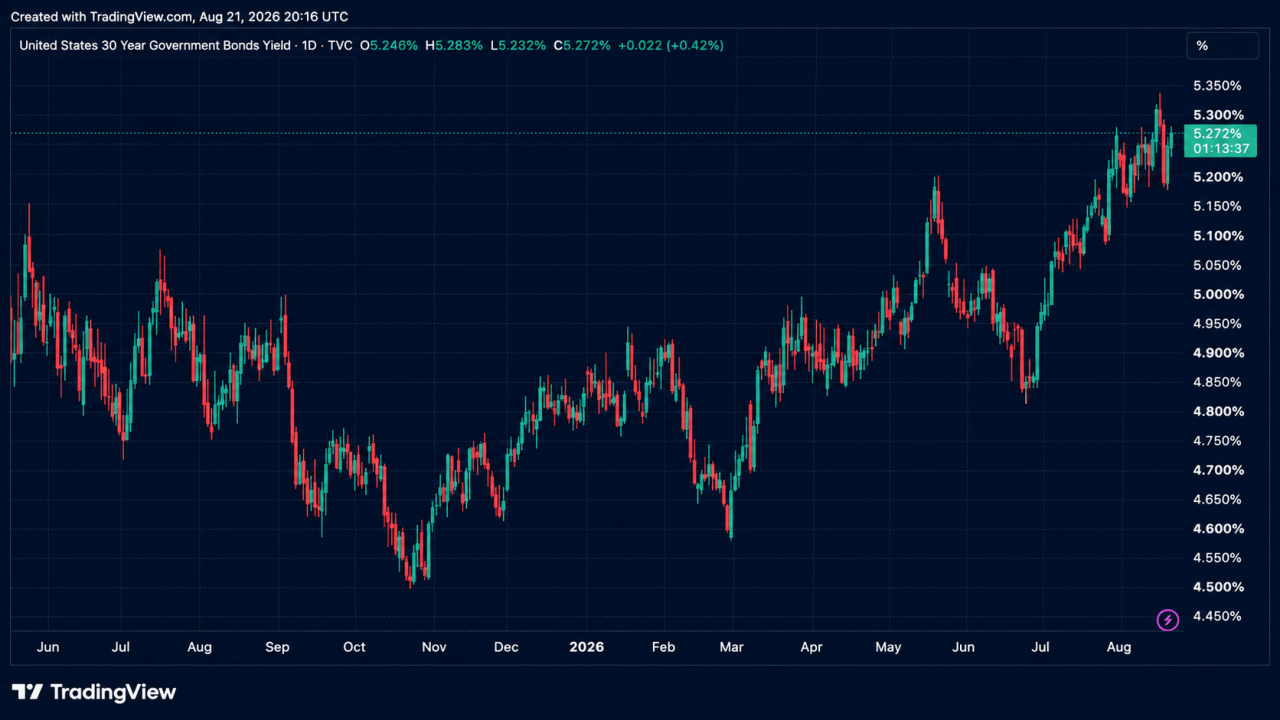
    Treasury Secretary Scott Bessent’s plan to expand purchases of outstanding longer-dated government bonds initially took some heat out of markets during the week. Those buybacks can lift bond prices and, in turn, push yields lower. But the relief proved thin because investors stayed locked on the forces driving yields higher, including massive deficits and oil-driven inflation risks tied to tensions involving Iran and the Strait of Hormuz. The U.S. 30-year Treasury bond yield stands at 5.273%.

    United States 30-Year Government Bond Yield via Tradingview on Aug. 21, 2026.

    That pressure explains why Friday’s gains hardly erased the week’s nerves. Financial stocks powered parts of the advance, while Ross Stores climbed after delivering stronger-than-expected quarterly results. Crypto-linked shares, including Coinbase, also caught a bid from bitcoin’s explosive move higher. Technology stocks, however, remained hostage to the bond market because high-growth companies get hit particularly hard when long-term yields climb.

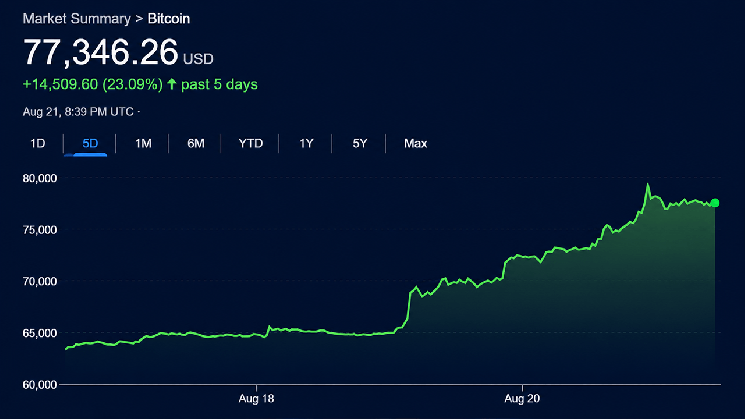
    Bitcoin delivered the sharpest contrast with the guarded mood in equities. Bitstamp $BTC/USD data over a four-hour timeframe shows the cryptocurrency ripping from a marked low near $62,653 to an intraday high near $79,461 before settling around $77,000. The run marked one of bitcoin’s strongest weeks since March 2023 and put the market’s swelling derivatives activity squarely under the microscope.

    Bitcoin Rally Lights Up the Derivatives Market

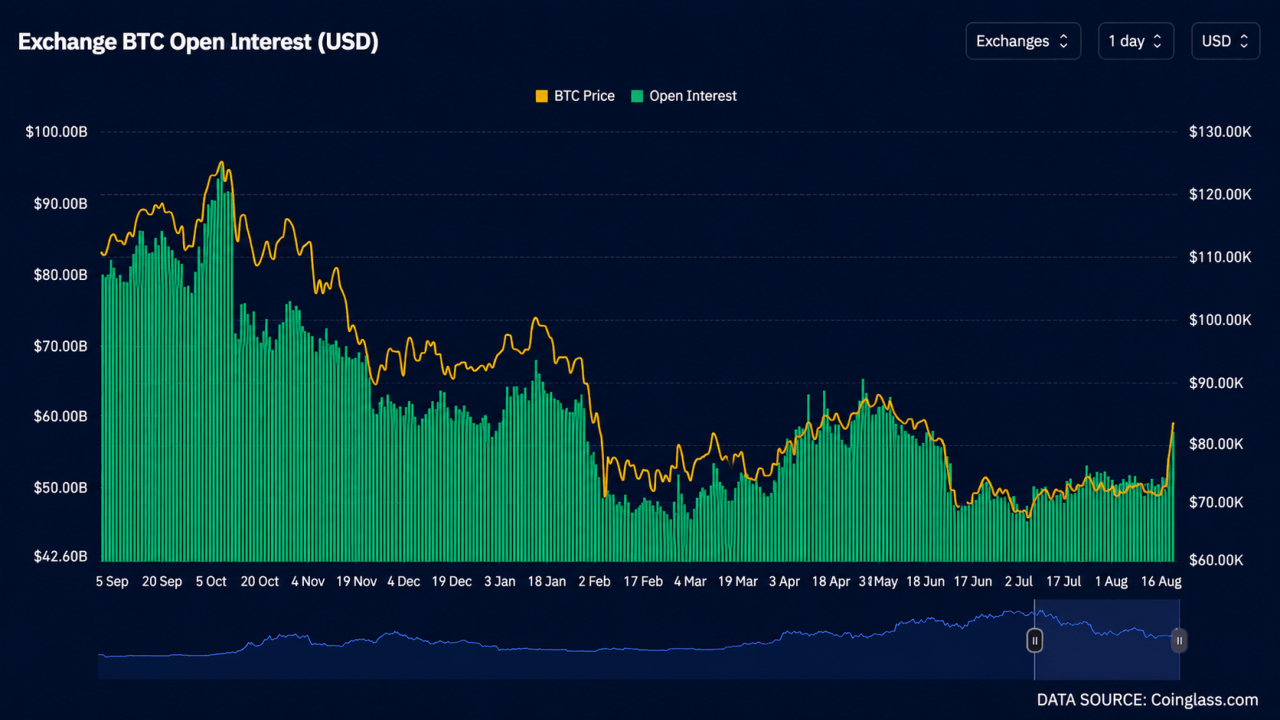
    Bitcoin futures open interest, the value of outstanding futures contracts, climbed sharply alongside the price. Exchange stats collected from coinglass.com show Binance carrying about $10.92 billion in bitcoin open interest and CME with $9.45 billion. CME’s open interest jumped 11.34% over 24 hours, while Binance’s rose 4.64%, showing that activity accelerated across both major venues.

    Bitcoin futures open interest (OI), according to stats collected from Coinglass.com on Aug. 21, 2026.

    Open interest is not automatically a bullish or bearish signal. While it reveals how much money is tied up in open positions, it cannot tell whether traders are positioned for gains or declines. Here, the increase followed a blistering price advance that triggered massive liquidations of leveraged short positions, or bets that bitcoin would fall. That kind of short squeeze can turbocharge a rally.

    The broader futures picture looked messier beneath the headline increase. Bybit, Gate, Kucoin, and Hyperliquid each recorded declines in open interest over the last 24 hours, while BingX logged a large percentage increase from a smaller base. That split shows the rally was not simply a leverage stampede across every venue. Instead, participation appeared concentrated in the biggest markets and in specific corners of the derivatives complex.

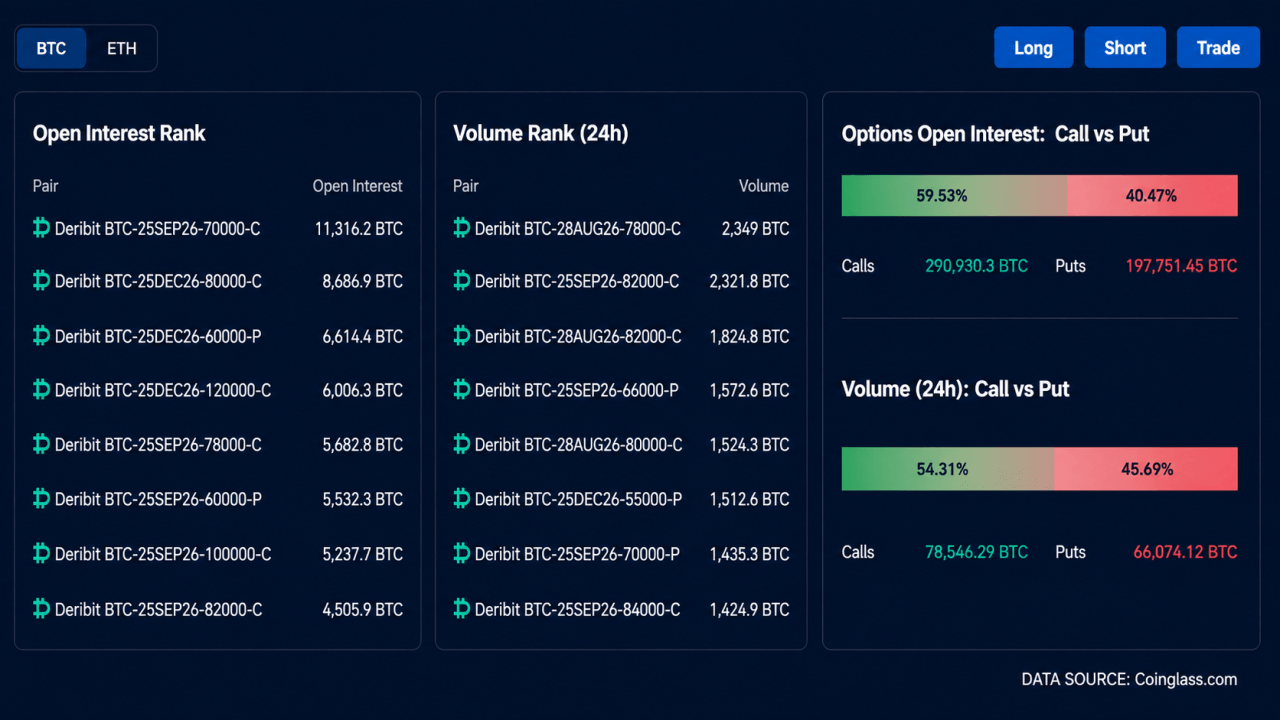
    Bitcoin options calls and puts on Deribit, according to stats collected from Coinglass.com on Aug. 21, 2026.

    On the other side of the derivatives map, options data showed a moderately bullish positioning tilt. Calls, which generally benefit when bitcoin climbs, represented 59.53% of bitcoin options open interest heading into the weekend, compared with 40.47% for puts. Calls also accounted for 54.31% of 24-hour options volume. The largest listed open-interest positions included December 2026 calls at $80,000 and $120,000, along with September calls at $70,000, $78,000, $82,000 and $100,000. Six figures is still firmly on the radar.

    Options Traders Chase Upside but Keep Protection

    Those positions should not be mistaken for clean-cut price targets. Investors routinely buy calls for upside exposure while buying puts to protect a portfolio against a reversal. The appearance of large put positions at $60,000 and $66,000 shows that downside insurance remains important right now, even while traders loaded up on upside exposure.

    The options market’s “max pain” measure, specifically from Deribit, also highlighted the gulf between bitcoin’s Friday price and several near-term strike concentrations. Max pain is the price where outstanding options would, theoretically, inflict the greatest aggregate losses on option buyers at expiration. Deribit’s data puts the Aug. 22 level near $74,000, followed by roughly $69,000 on Aug. 23 and $66,000 around Aug. 28.

    Institutional demand supplied another major piece of the advance. U.S. spot bitcoin exchange-traded funds (ETFs) are on track for more than $1 billion in weekly inflows, their strongest pace since January. These funds give investors $BTC exposure through a traditional brokerage account, making it easier for institutions and individuals to participate without directly holding or managing the cryptocurrency.

    Gold and Silver Catch the Same Bid

    Bitcoin was hardly the only asset reacting to the shift in yields and the dollar. The precious metal gold traded at $4,617.50 per ounce on Friday at Wall Street’s close, up 2.15% on the day, while silver traded at $69.52, gaining 1.92%. Platinum climbed 2.85%, and palladium added 1.29%, according to spot-price data.

    Gold and silver pay no interest, so they become relatively more attractive when yields retreat or when investors fear inflation and currency risks will eat into fixed-income returns. A weaker dollar also makes dollar-priced metals cheaper for buyers holding other currencies. The metals rally, therefore, captured both the temporary cooling in bond-market stress and the deeper anxiety surrounding debt, inflation, and geopolitical risk.

    The next test is whether yields stay contained after the Treasury’s intervention and whether Federal Reserve boss Kevin Warsh delivers clearer signals at the Jackson Hole symposium. Investors will also track oil prices, developments around Iran and the Strait of Hormuz, bitcoin ETF flows, and whether the leading crypto asset can defend its gains without another aggressive build-up in leveraged futures positions.

  • Supreme Court Order Allows Construction To Continue On Donald Trump’s White House Ballroom

    Supreme Court Order Allows Construction To Continue On Donald Trump’s White House Ballroom

    The Supreme Court ruled that construction could continue on Donald Trump‘s White House ballroom, sidelining lower court orders to halt the project.

    Chief Justice John Roberts signed an order on Friday that stays a preliminary injunction issued by a district court judge in April. The stay will be in effect “pending further order of the undersigned or of the court,” per the document. There was no explanation for the court’s reasoning.

    The Trump administration asked for a stay as it faced a lower-court deadline on Friday to halt construction.

    In April, U.S. District Judge Richard Leon, an appointee of George W. Bush, ruled that construction of the ballroom required congressional approval. He made an exception for below-ground construction of a below ground bunker for national security needs, as well as other elements to protect the president.

    The Trump administration appealed, and construction was allowed to continue until there was a ruling from the D.C. Circuit Court of Appeals. In a 2-1 decision earlier this month, the appellate court affirmed that the president needed congressional approval.

    “Each President is a temporary tenant, not the owner, of the White House and its Executive Residence,” the judges wrote. “The President has no—and claims no—constitutionally assigned authority over that property, which is designed and maintained for the use of all Presidents, current and future, and for the American people.”

    The ballroom is perhaps the most cherished of all projects Trump has taken around the White House complex and in Washington, D.C. He has defended the ballroom project as long overdue, given the limited space of other entertaining facilities in the complex. Lately, he has also taken to referring to the construction as a “military complex,” as the administration’s legal team has argued that the entire project is needed for purposes of national security.

    But the plaintiffs in the case, the National Trust for Historic Preservation, have argued that the administration cannot bypass congressional input for a project of such magnitude — 90,000 square foot. And from a design standpoint, the trust said that the project will dwarf the main residence of the White House, at 55,000 square feet, while disrupting to symmetry of the structure and the surrounding buildings.

    “The Constitution vests Congress with sole and preclusive authority over federal property,” the National Trust’s legal team wrote in a Supreme Court filing.

    They argued that an injunction was needed because the Trump administration has tried to “outrun judicial review,” with an accelerated construction timeline and a 250-person crew working 20 hours a day and seven days a week on the project. Essentially, the National Trust contended, the Trump administration was making the case that the ballroom construction was so far along that they were “on the brink of a fait accompli.” They noted that the administration has said that the project would be substantially complete by November.

    Without obtaining congressional approval, Trump ordered that the East Wing of the White House be torn down last fall. Also demolished was an east colonnade and a garden dedicated to Jacqueline Kennedy, as well as a movie theater.

    Trump has said that the ballroom would be funded by private donations, with corporations like Comcast and Amazon among the donors covering the costs. The Washington Post reported in June that the entire project was estimated to cost $600 million, with more than half coming from taxpayers, per a contractor’s project estimate.

  • Pentagon Fires Editor Of Stars And Stripes After He Gave An Interview To CBS News And Called Potential Censorship A “Red Line”

    Pentagon Fires Editor Of Stars And Stripes After He Gave An Interview To CBS News And Called Potential Censorship A “Red Line”

    The editor in chief of Stars And Stripes, the publication that covers the U.S. military and is partially funded by the U.S. government, said that he was was being fired following an interview he gave to CBS News Sunday Morning in which he talked of censorship being a “red line” for him.

    Erik Slavin told the network on Friday that he was “being fired for stating in a CBS interview that censorship of news for service members would constitute a red line. The Pentagon‘s public affairs office has charged me with insubordination.”

    “I stand by the principle that Stars and Stripes must remain editorially independent, as required by law and by the department’s own policies,” he said.

    Also getting termination notices was publisher Max Lederer, who recently announced his retirement, and reporter Lara Korte, who also sat for the CBS News interview, which aired on Sunday Morning, per the network.

    Korte posted on X, “Today, I was informed that the Department of Defense is firing me for insubordination after I told a CBS reporter that I work for Stars and Stripes – not the Pentagon, not any administration, and not any policy maker.”

    A Pentagon official confirmed the separation notices, but the department declined to comment.

    Published continuously since World War II, Stars and Stripes gets about half of its funding from the Pentagon and the remainder from advertising and subscriptions. It is set up to maintain its editorial independence from the military and government.

    On Friday, Navy Capt. Bill Urban wrote in a notice posted on the Stars and Stripes website that he was the new military deputy to the publisher. He wrote that in meeting with the Office of the Secretary of War, he received “multiple assurances” that they were committed to “the editorial independence of Stripes.”

    He wrote to staffers, “There are no external editorial curbs on our journalists searching out and reporting significant stories. Carry on and ignore the noise. Stay professional and committed to the highest journalistic standards.” He pointed to recent Stars and Stripes reports on the conditions of the USS Lincoln, and noted that there “was plenty of time between the initial report and the subsequent reporting for OSW to shut us down on the subject if they were not committed to our editorial independence.”

    He also called for a bigger push into digital and social media. He wrote, “My vision for the future of Stars and Stripes is simple: More eyeballs on our content and more impact on our service members while maintaining the highest standard of professional journalism with the credibility that comes with editorial independence.”

    The CBS Sunday Morning report detailed concerns that Pentagon was chipping away at the independence of the publication, including the rescinding of a federal regulation that Stars and Stripes operate “without news management or censorship.” The ombudsman, Jacqueline Smith, was fired in the spring, and she told the network she worried that “the endgame is turning Stars and Stripes into a public affairs propaganda machine.”

    Mark Schoeff Jr., president of the National Press Club, said in a statement, “In firing the editor of Stars and Stripes, Pentagon leadership is making clear their view that the newsroom should exist not as an independent outlet whose reporting serves to benefit U.S. troops, but as a mouthpiece to parrot Pentagon talking points.”

    He added, “Our service members deserve news and information they can trust, not narratives that are shaped solely by their own employer.”

    Will Creeley, legal director of the Foundation for Individual Rights and Expression, called the firings “an ugly, un-American attack on our free press.”

    “America’s brave servicemembers swore an oath to defend the Constitution. They deserve the free and independent press our Founders fought for 250 years ago, not Pravda-style propaganda.”

  • Icelandic Producer Hlín Jóhannsdóttir Sets ‘Just a Kid’ With Alief Ahead of Haugesund and Reunites with ‘Driving Mum’ Team (EXCLUSIVE)

    Icelandic Producer Hlín Jóhannsdóttir Sets ‘Just a Kid’ With Alief Ahead of Haugesund and Reunites with ‘Driving Mum’ Team (EXCLUSIVE)

    Veteran Icelandic producer Hlín Jóhannsdóttir of Ursus Parvus, behind titles from some Iceland’s most renowned filmmakers including Fridrik Thor Fridriksson, Dagur Kári and Rúnar Rúnarsson, has signed with French-U.K. sales outfit Alief on the coming-of-age “Just a Kid” (“Bara barn”) by up-and-coming writer-director Vala Ómarsdóttir.

    To be pitched at New Nordic Films’ Works in Progress in Haugesund, Aug. 27, the project fits into Jóhannsdóttir’s roster of debut features by talented female directors, next to “Quake” by Tinna Hrafnsdóttir, which Alief sold to more than 20 territories including Juno Films in the U.S.

    Hlín Jóhannsdóttir, Hilmar Oddsson, Þröstur Leó Gunnarsson and Hera Hilmar

    Credit: Ursus Parvus

    Besides Alief, which chipped in an Minimum Guarantee, a strong partner on the project is Estonian producer Marianne Ostrat of Alexandra Film, producer of Sundance winner and Estonian Oscar entry ”Smoke Sauna Sisterhood,” co-produced by Ursus Parvus.

    In “Just a Kid,” the story turns on 16-year old Julia (Birgitta Marín Thorsdottir) who’s moved from Norway to Iceland and struggles to balance caring for her younger sister with fitting in at a new school. Drawn to charismatic Salka (Hafrún Arna Levy from “When the Light Breaks In”) and the school newspaper, she begins to find her voice. But when a traumatic drunken night resurfaces, Júlía must confront shame, family responsibilities and the courage to tell her own story, reads the logline.

    Speaking with Variety, the versatile filmmaker and performer Ómarsdóttir said the idea for the pic developed when she was pregnant with her second daughter. “I remember thinking about this bond we have, knowing that at some point when [my kids] get older they will not need me as much as they do now. I am very interested in this mother-daughter bond, especially concerning the teenage years,” said the helmer. 

    After researching “what it feels like being a teenager today,” Ómarsdóttir said she drew from the rehearsal-driven sessions with her young cast “to continue the research, understand, and tell the story from their point of view.” “The whole experience was a long and exciting journey where I learned and discovered so many things. Both in visual storytelling and in human nature regarding the need to connect with someone and the need to set boundaries,” she said.

    Alief partner Miguel Govea who boarded the pic at development stage said “the story and setting drew us in. Once we saw the rehearsals, and proof of concept, we knew Hlin [Hrafnsdóttir] and Vala [Ómarsdóttir] had concocted some magic.”

    Boiling down the story and audience appeal he added: “Just a Kid” is a tender story of teen-angst and sexual awakening with a handsome cast that will resonate with discerning audiences.”

    “Just a Kid” received funding from the Icelandic Film Centre, Icelandic tax rebates, RÚV, Saga Film, Studio Syrland, Nordisk Film & TV Fond, and Estonian tax rebates. Max will handle the theatrical release in Iceland.

    “Driving Mum” Team

    In Haugesund, Jóhannsdóttir will also pitch at the Nordic Co-Production Market another project very close to her heart: “At The End of the Road,” which reunites her with the core team of the Tallinn Grand Prix winner “Driving Mum:” writer/director Hilmar Oddsson, prominent actor (“Noi the Albino,” “Solitude”) and Hera Hilmar (“Mortal Engines,” “Life in a Fishbowl”).

    In it, Leó, a renowned geriatrician specialized in Alzheimer’s disease, develops an unconventional friendship with Ásdís, a psychiatrist who’s returned to Iceland to care for her ailing grandmother. When Ásdís discovers that Leó himself is developing Alzheimer’s, both are forced to confront buried secrets.
    Jóhannsdóttir said she contributed to the development process with Oddsson and Gunnarsson as all have personal experiences about Alzheimer’s. “Sitting together, the three of us, and discussing the script was among the most rewarding experiences of my career as a creative producer,” she told Variety, underlining that the tone will remain darkly humorous. “I think a lot of people familiar with the disease will relate to the tragi-comedic side of Alzheimer’s.”

    “At the End of the Road” will “hopefully be both funny and dramatic, poetic, dreamlike, and realistic all at once,” said Oddsson in a statement.

    In Haugesund, Jóhannsdóttir will be looking for co-producers, co-financiers, sales and distribution.
    Commenting on the fact that “Just and Kid” and “At the End of the Road” are the only Icelandic projects selected for the popular the Norwegian Intl. Film Festival’s New Nordic Films showcase (Aug. 25-28)  at Haugesund, the seasoned producer, who sat on the board of the Icelandic Producers Association for several years, said “things are very difficult in Iceland, funding-wise.” 

    Citing the important Aug. 29 Icelandic referendum on whether to resume EU membership talks, she said: “our small nation is split, but it is really important for us producers that people at least to say ‘yes’ to the negotiations.”

  • ‘Good People’ Review: Milcho Manchevski’s Haunting Documentary Revisits the Kočani Nightclub Fire Through Survivors’ Eyes

    ‘Good People’ Review: Milcho Manchevski’s Haunting Documentary Revisits the Kočani Nightclub Fire Through Survivors’ Eyes

    On March 16, 2025, a fire broke out at the Pulse nightclub in the small North Macedonian town of Kočani, injuring hundreds and killing 63 people due to burn damage, smoke inhalation and other physical traumas sustained while attendees scrambled to flee through the venue’s sole exit. The club had only one fire extinguisher and its ceiling was made of highly flammable material, while the venue’s 250-person capacity was exceeded by double the amount of people, most of them between the ages of 16 and 25. 

    Making its world premiere in Sarajevo’s documentary competition, Milcho Manchevski’s “Good People” leaves the broader political context to the journalists. Arriving a little over thirty years since his auspicious debut, the muscular war drama “After the Rain,” nabbed Venice’s Golden Lion, this strikingly austere and undecorated film, which Manchevski self-funded, doesn’t cover the vast institutional failures that precipitated the incident and increased its casualties. Instead, it assembles over 20 first-hand accounts by victims and witnesses, bringing to life the tragedy’s harrowing timeline through testimonies entirely. The result is a haunting portrait of social collapse whose power is premised on the words and faces of survivors. 

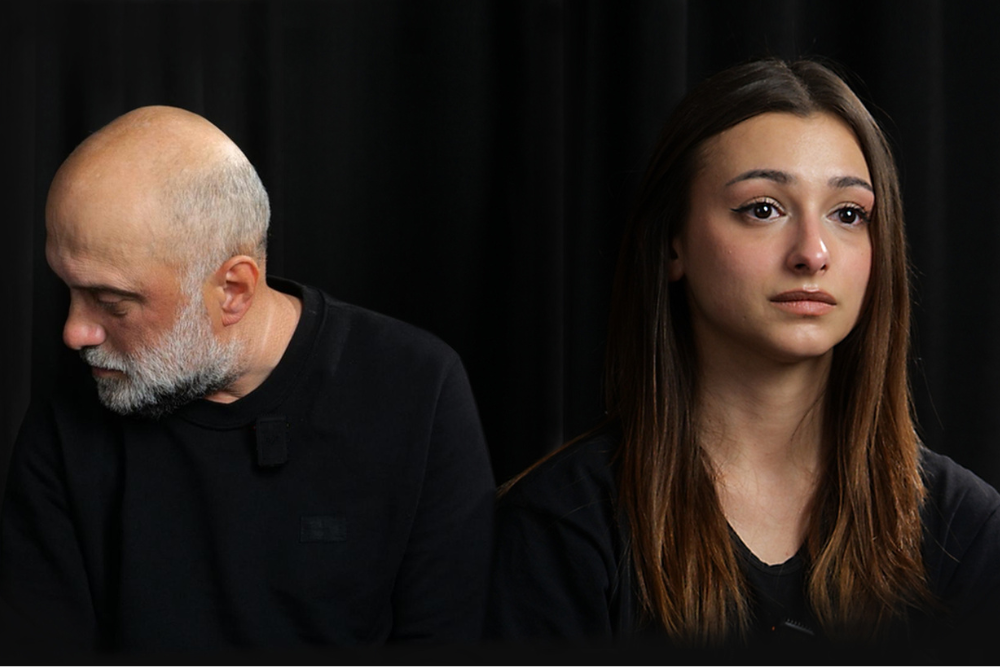
    Bookended by drone shots of the Macedonian countryside and a somber cello refrain by Novogradska, this 86-minute doc is otherwise composed of scoreless interviews with subjects seated in front of black curtains and captured in medium range. (Two brief exceptions include silent, phone-recorded footage of, first, the spark on the ceiling prior to the full break-out, and, second, an outside view of the club obscured by plumes of smoke.) The simplicity of the setup simplicity pays respect to the memory of the fallen, refusing to sensationalize the events or cater to morbid curiosity — principles that have dictated a long tradition of documentary filmmaking that privileges oral testimony, like Claude Lanzmann’s “Shoah” and Chantal Akerman’s “Tell Me.” 

    But unlike those long take-heavy films, “Good People” cuts frequently between its subjects, a chorus-like effect that is sometimes choppy as editor Mishko Chunikhin flits between longer memories and observations as short as a few words. The doc starts out by describing the club’s downward spiral, with survivors — some of whose burn marks you can observe on their necks and hands — sharing eerily similar experiences. The beginning of the fire was widely mistaken as a special effect put on by the pop group performing at the time, and the flames spread quicker than clubbers could realize what was happening.

    “My eyes were seeing so many things that my brain couldn’t process,” says one of the more eloquent speakers, a young woman with shell-shocked eyes and flat-ironed hair who lost all of her friends in the incident. Proceeding chronologically through the night, the speakers recall navigating the chaos of people rushing toward the exit; and how this fatal stampede, along with asphyxiating conditions, knocked people unconscious, creating a “carpet of dead kids” under which more people were trapped and sometimes killed by suffocation, all while “burning alive.”

    Frequent fades to black and plain intertitles, displaying pithy phrases drawn from the interviews (like “that’s it” and “like helpless animals”), allow for moments of silence, encouraging the subjects’ words to soak in. These pauses also give the documentary an air of mournful respect, making its pace more deliberate than the standard talking heads-doc that might be mistaken as a stylistic counterpart. 

    The second half introduces some parents of survivors and interviews with a handful of locals and early escapees who (re-)entered the club to help pull out injured bodies. The doc’s tagline — “when good people burn in hell” — comes off more than a bit crude, but the descriptions of people running out of the club burned and naked, their clothes and shoes torn off in the push to escape; or victims with bodies hot to the touch, their skin melting and ripping off the bone as rescuers pull them out from beneath piles of corpses, certainly justifies the metaphor. Against expectation, the film eschews neat narratives about survival and heroism. Ethics and normal human behavior are subsumed by “pure animal instinct” and “kicking, clawing, and biting.”

    If this doesn’t seem like a gracious revelation, there’s a point to the deep horror that Manchevski draws out here. As one subject explains, she feels “indignity” to have been violated so deeply by what she endured and witnessed. “Good People” may not explore the structural inadequacies that allowed this catastrophe to happen, but it does remind us of the ease with which our modern world can slide back into medieval times — and the responsibility we have to prevent it. 

  • ‘The Marching Band’ Review: Brothers From Opposite Worlds Are United by Music in a Finely Tuned French Crowdpleaser

    ‘The Marching Band’ Review: Brothers From Opposite Worlds Are United by Music in a Finely Tuned French Crowdpleaser

    “The Marching Band” blasts through more story in its first 12 minutes than many films now manage in two hours. In those first 720 seconds we meet Thibaut (Benjamin Lavernhe), a well-heeled classical music conductor in Paris, who discovers that he will need to find a blood marrow transplant as he has leukemia; he learns that his sister is not a match, as he was adopted; he then discovers a biological brother, Jimmy (Pierre Lottin), who was not adopted and still lives in a disadvantaged working-class community in the north of France; he asks his new-found brother to help him, and Jimmy accepts.

    That concision is evident in an almost brutally economical edit and in sharp, precise writing which provides narrative elements and deftly sketches character before moving busily on. Just as a marching band keeps time with its feet, so “The Marching Band” strides on, hitting the requisite notes and paying attention to the melody, sure, but especially making sure to hold the beat and keep the show on the road. This attention to rhythm helps director Emmanuel Courcol‘s film to stay true as it navigates some rather rocky terrain, for it is at once a mismatched buddy movie, a socially conscious crowdpleaser in the vein of, say, “The Full Monty,” and a sophisticated psychological drama à la française.

    That the film mostly pulls this off is testament to its formal precision and to a central pairing of actors, in Lavernhe and Lottin, who manage to find subtlety where broad strokes would seem to be called for. More than two years after its Cannes premiere, “The Marching Band” opens theatrically in the U.S. this week through Greenwich Entertainment.

    Once the film has dispatched its initial premise — the leukemia storyline is essentially a MacGuffin, and soon disappears for a sizable stretch — it can get down to the business of developing a bond between the characters, and establishing its (gentle) social critique. Jimmy, who works as a cook in a canteen, has a musical gift, which throws into sharp relief the different chances both men have been given in life. A scene in which this terse, withdrawn young man is revealed to have perfect pitch is typical of “The Marching Band’s” best qualities in its appealing first hour or so: Thibaut asks his brother to identify the sounds of a honking car or a barking dog, and Jimmy shyly names the correct chords. That pertness should be unbearable, but the scene is written in a minor key and performed by both actors to match, favouring eye contact and murmurs; the sheer brevity prevents it from becoming gloopy or crass.

    The casting of Lavernhe and Lottin is particularly inspired, as the two performers bring an affect to these characters that mimics the story’s dynamic. Lavernhe, credited as “Benjamin Lavernhe de la Comédie-Française,” comes from a background in classical theatre, and performs his role with worldly elegance; Lottin, meanwhile, is a veteran of the popular comedy franchise “Les Tuche”, centering on a working-class family from the north of France. These sensibilities come together in the film’s tight dialogue, as when the two men meet and Thibaut introduces himself: “My name is Thibaut Desormeaux, and two weeks ago I learned I have leukemia…” Jimmy: “Ah, shit.” Thibaut: “Yes.”

    Lottin is particularly intelligent in articulating Jimmy’s shame at his lack of means and achievement, inflected with pride and a lightly worn resentment that comes out in bursts of passive-aggressive joshing; meanwhile, Lavernhe deftly portrays the well-meaning and likable Thibaut as, conversely, insufficiently ashamed of his good fortune, at least early on: This smooth Parisian bobo does not even perceive how he flaunts his wealth and education.

    In parallel, “The Marching Band” depicts a working-class community struggling with poverty and unemployment, for whom the musical collective — in which Jimmy plays the trombone, alongside his on-off girlfriend Sabrina (Sarah Suco) — has become a lifeline. Thibaut becomes involved, but will he be able to save the band from ruin? Here, the film closely mirrors the 1996 British comedy “Brassed Off,” making it a dead cert that we’ll eventually get a barn-burning finale showing the federating power of music in adversity.

    Revealing how that comes about would enter spoiler territory, but saying that it happens at all is germane, as it shows that the film finally falls victim to formula. In these pre-ordained moments — a surfeit of montages, an artificial falling-out between the brothers, the occasional dip into the saccharine — “The Marching Band” becomes a touch pleased with itself. The formula works (and the film has the domestic box-office receipts to prove it), but it detracts somewhat from the project’s smarts elsewhere.

    In a well-presented technical package, plaudits should go to editor Guerric Catala for a cut that attempts to shun sentiment, and to Christel Birot for costumes that smartly outline both character and class differences via the means of double denim or a freshly pressed felted overshirt. The music department, as well as Courcol’s lively directing and writing, must be commended for scenes of the brass ensemble playing and rehearsing, in a constantly dynamic interaction with dialogue. The zippy soundtrack, much like the film itself, veers between surprisingly choice cuts (the aching “I Remember Clifford” by Lee Morgan) and rabble-rousing crowdpleasers (Dalida, or the overture from “Aida”). Ravel’s “Bolero,” which repeats the same phrase over and over again but with tonal differences each time, also features.

  • Solana is undergoing a four-phase update to double block production speed! Here are the details

    Solana is undergoing a four-phase update to double block production speed! Here are the details

    The Solana network is preparing to roll out a comprehensive upgrade plan aimed at increasing block production speed. According to information reported by BeInCrypto, the network aims to reduce its current 400-millisecond block production interval to 200 milliseconds. Following the completion of the four-phase upgrade, Solana is planned to produce a new block approximately every 0.2 seconds.

    This change is considered a significant step towards increasing Solana’s transaction capacity and overall network performance. Shortening block production time can lead to faster transaction processing and an improved user experience on the network. Faster block production, especially during periods of high transaction volume, can help the network meet demand.

    The first phase of the upgrade is planned to be activated with epoch number 1020. In the Solana network, epochs represent periods covering a specific number of slots, playing a crucial role in protocol updates and changes to network parameters.

    All four planned changes have already been integrated into the Agave validator software developed by Anza, the client for the Solana network. Instead of being rolled out all at once, the updates will be implemented gradually. This will allow developers to monitor the impact of each phase on the network before moving on to the next change.

    Following the successful implementation of all stages, Solana’s block production time will be reduced from 400 milliseconds to 200 milliseconds. This means the network’s current speed will be approximately doubled.

    The update, implemented in line with Solana’s scalability and high processing capacity goals, aims to improve the network’s performance while enhancing its decentralization and security features. Developers are opting for a phased approach to the upgrade, allowing for controlled handling of potential technical issues.

    *This is not investment advice.

  • DOJ Charges Five Iran-Based Hackers in HBO Breach Involving $6M Bitcoin Demand

    DOJ Charges Five Iran-Based Hackers in HBO Breach Involving $6M Bitcoin Demand

    The U.S. Department of Justice has expanded its case against members of the Iran-based Mabna Institute, adding charges against eight individuals and linking five of them to the 2017 hack of HBO that included a ransom demand of roughly $6 million in Bitcoin. The new indictments bring the total number of defendants in the broader cyber-espionage case to 17.

    Details of the HBO Hack and Indictment

    According to the DOJ, Behzad Mesri was previously indicted separately for allegedly hacking HBO’s systems, stealing internal data, and demanding a Bitcoin ransom of about $6 million. The latest charges allege that five of the newly charged defendants directly participated in that operation alongside Mesri. The Mabna Institute is accused of conducting cyberattacks against U.S. and international universities, companies, and government agencies on behalf of Iran’s Islamic Revolutionary Guard Corps (IRGC) and other entities.

    Broader Context of Iranian Cyber Operations

    The Mabna Institute has been linked to a series of intrusions dating back to at least 2013, targeting over 300 universities in the U.S. and abroad. The group’s activities have been characterized by U.S. officials as systematic theft of intellectual property and sensitive data. The new charges underscore the ongoing threat posed by state-sponsored hacking groups and the increasing use of cryptocurrency in ransom demands.

    Implications for Cybersecurity and Crypto Regulation

    This case highlights the intersection of cybercrime and digital currencies, as Bitcoin’s pseudonymous nature has made it a preferred payment method for ransomware attacks. The DOJ’s actions signal a continued effort to hold state-sponsored hackers accountable, even when they operate from jurisdictions with limited extradition treaties. For businesses and institutions, the case serves as a reminder of the persistent risks of cyber intrusion and the importance of robust security measures.

    Conclusion

    The expanded indictments against the Mabna Institute members mark a significant step in U.S. efforts to combat state-sponsored cybercrime. By linking the HBO hack to a broader campaign of intrusions, the DOJ is reinforcing its commitment to pursuing justice across borders. As the legal proceedings unfold, the case is likely to draw further attention to the challenges of prosecuting international cybercriminals and the role of cryptocurrency in modern extortion schemes.

    FAQs

    Q1: What is the Mabna Institute?
    The Mabna Institute is an Iran-based group accused by U.S. authorities of conducting cyberattacks on behalf of Iran’s Islamic Revolutionary Guard Corps (IRGC). It has been linked to intrusions targeting universities, companies, and government agencies worldwide.

    Q2: What was the HBO hack about?
    In 2017, hackers breached HBO’s systems, stole internal data, and demanded a ransom of approximately $6 million in Bitcoin. The DOJ alleges that Behzad Mesri and five other newly charged defendants were involved in this operation.

    Q3: How many people have been charged in connection with the Mabna Institute?
    With the latest charges, a total of 17 individuals have been indicted in connection with the Mabna Institute’s alleged hacking activities. The new charges add eight defendants, five of whom are linked to the HBO hack.