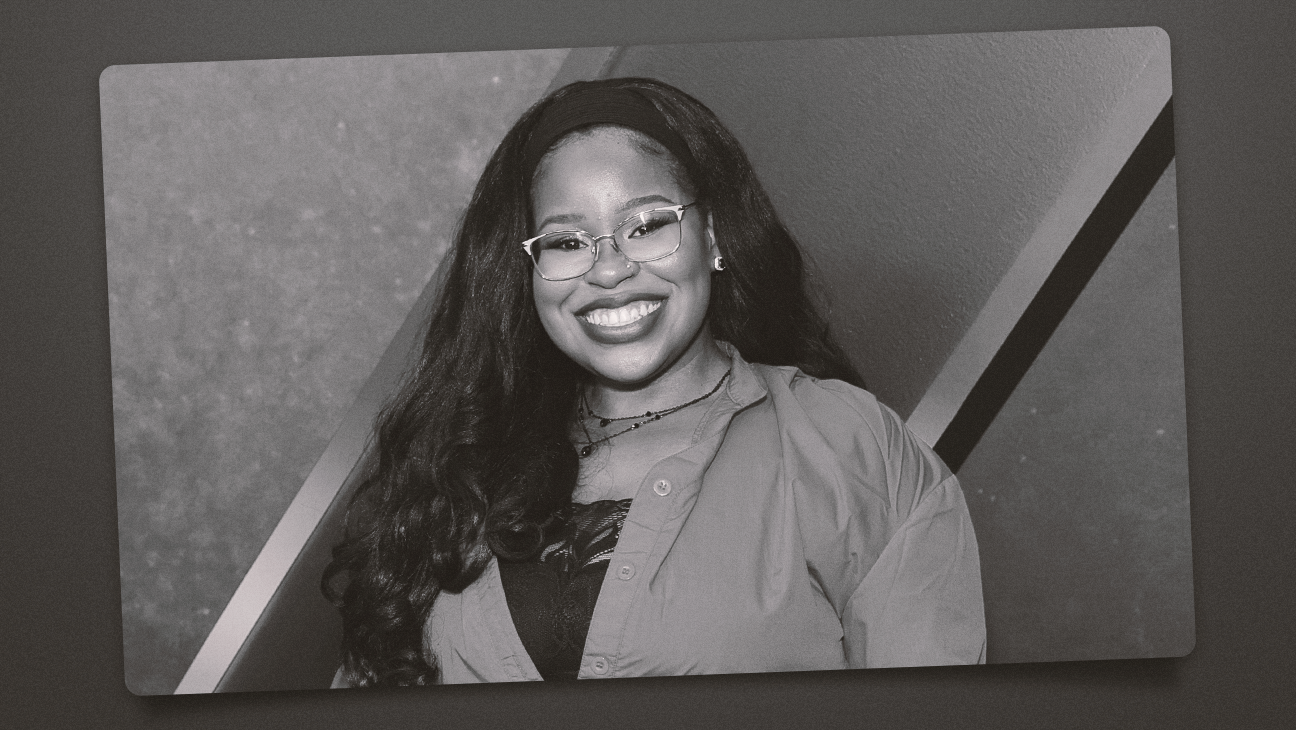
Carla Jeffery, best known for her role as Bree in Disney‘s Zombies franchise, died on Tuesday. She was 33.
Alexanders Talent Management announced her death, writing in a statement shared on her Instagram, “It is with profound sadness that we share the passing of our beloved Carla Jeffery, who passed away on September 1, 2026, at just 33 years old.”
“Carla joined the Alexanders Talent Management family at the age of 12. For more than 20 years, we had the privilege of watching her grow into a beautiful, vibrant and incredibly talented woman whose radiant smile could light up any room,” her team’s statement continued. “As Bree in Disney’s hit Zombies franchise, Carla shared her joy, humor and bright spirit with audiences around the world.
Jeffery’s cause of death wasn’t immediately available.
Born on July 10, 1993, in Houston, Jeffery began her career as a child actor, appearing in Phat Girlz, iCarly, Miss Guided, Southland, Curb Your Enthusiasm, Men of a Certain Age, Good Luck Charlie and Shake It Up.
Her most notable role was in Disney’s Zombies franchise, where she plays Bree, a bubbly cheerleader at Seabrook High and the loyal best friend to the main character, Addison (Meg Donnelly). Jeffery starred in Zombies (2018), Zombies 2 (2020), Zombies 3 (2022) and voiced the character in 2024’s Zombies: The Re-Animated Series.
Jeffery’s other on-screen credits included Scream Queens, American Vandal, Uncle Buck, Girl on the Edge, Teacher of the Year, Puzzled and Spider-Man.
Her management company concluded, “Carla was more than a client; she was family. Our hearts are with Carla’s family and loved ones during this devastating time. We respectfully ask that their privacy be honored as they grieve this unimaginable loss. Rest beautifully, Carla. Your light will never be forgotten.”
Milo Manheim, who starred alongside Jeffery in the Zombies films, paid tribute on his Instagram Story, writing, “Love you Carlaboo. The sweetest, kindest, most loving person.” He also shared a clip of her iCarly dancing scene, adding, “I pray you would want this brought back real quick. I fuckin love you. Thank you for spreading so much joy.”
Could Hollywood entice younger audiences by having a little faith?
A surprising new Future of Faith study from The Center for Scholars & Storytellers (CSS) at UCLA suggests that both Gen Z and Gen Alpha crave realistic and complex depictions of religion and spirituality in their entertainment that go beyond stereotypes. The group surveyed over 2,000 people, ages 14-24, and a majority cited a sensitivity to how their beliefs were portrayed on-screen.
Among the interesting data points:
Only around 40% felt that “people who hold beliefs or worldviews like theirs were accurately represented in the media.”
70% of “religious respondents said the way their religion or spirituality is portrayed in the media affects how others treat them.”
“More than 97% of religious respondents and 80% of nonreligious respondents said a piece of media had spiritually moved, inspired or comforted them.”
Asks from young audiences to storytellers include: both existing on-screen and being in the rooms where decisions are made; showing the ordinary side of religion vs. only the most extreme elements; showing internal group diversity; and having spiritual characters be complex and not just token.
Respondents weren’t shy in suggesting they thought Hollywood could do a better job with well-rounded depictions of faith and spirituality that didn’t veer into stereotype.
“We heard from young people that they wanted to see grappling with faith,” says CSS founder and CEO Yalda T. Uhls, Ph.D., in an interview with Variety about the findings. “They’re at this age when they leave home, they no longer have the structure of adults saying, ‘You go to church, go to this.’ They’re around all these other people, and a lot of them do question their faith and they try to do it safely. But that’s one of the things they complained about: there’s a lot of performative religion and policing from their faith groups online. They want to be able to have honest discussions.”
Uhls, the senior author of the study, is a professor in UCLA’s psychology department, and previously worked for nearly two decades as a senior executive at studios like MGM and Sony. Her background makes her confident that developing spirituality-forward storylines could help the entertainment industry engage with younger audiences. Given the turnout at the Aug. 5 CSS event The Future of Faith, where the findings were presented, Hollywood is listening.
“It’s a big opportunity,” she says of spirituality-forward content. “At our event, we had execs from Netflix, Amazon, NBC, Lionsgate. We were talking about that. They’re all exploring it. Lionsgate has several movies around this. They see purely religious movies make a lot of money with that very specific audience, but I think there’s opportunity to integrate it into different divisions — not just the faith division.”
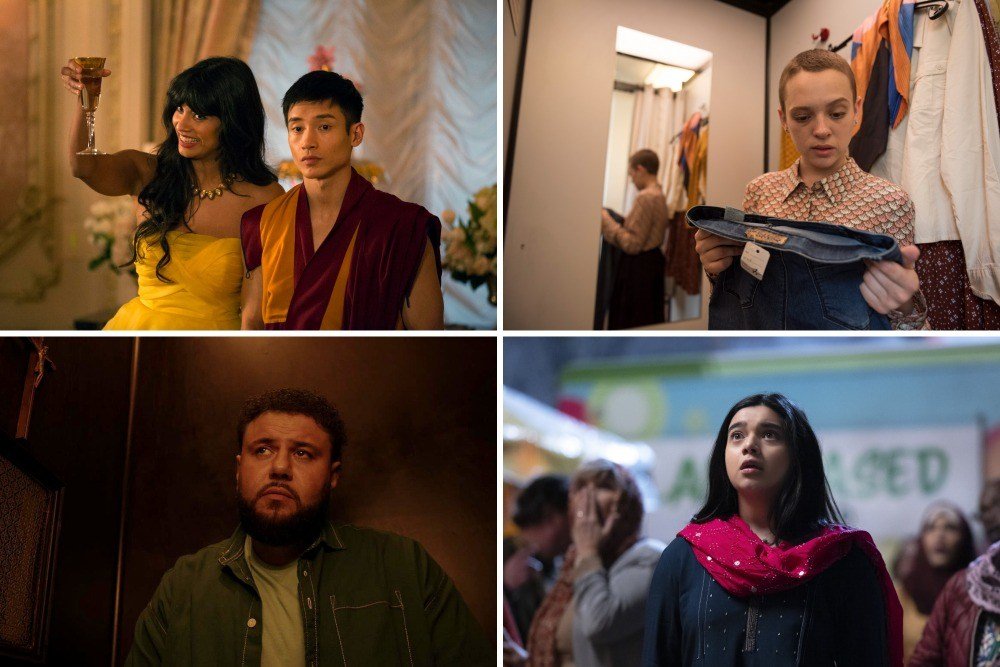
Uhls says respondents cited numerous series and films they believed were positive examples of what they were looking for, including films like “Wake Up Dead Man: A Knives Out Mystery,” “Over the Moon” and “Bend It Like Beckham,” as well as series like “Mo,” “The Good Place,” “Ms. Marvel” and “Avatar: The Last Airbender.”
Yet the story also doesn’t have to depict the religious elements reverentially for it to be seen as impactful. Uhls points to the Netflix series “Unorthodox,” about a woman who leaves her Orthodox Jewish community to start life over, as a prime example.
“I remember when ‘Unorthodox’ came out, there was a big backlash from the Orthodox community,” she says. “But I bet younger people are really thinking deeply about these questions as you’re figuring out who you are.”
That sentiment was carried by the keynote speaker of the Future of Faith event, Dustin Lance Black, the Oscar-winning screenwriter of “Milk.” He spoke about adapting “Under the Banner of Heaven,” a true crime account of murder in the fundamentalist Mormon community, and how the story impacted him due to his real-life faith.
“He used to be a Mormon, and he was queer,” Uhls says. “And so he felt lost. He left the faith, but he went through a very long period questioning it. He still is very spiritual. He said he went back to the Bible and read it and felt like, ‘Wow, there’s stuff in here that I can relate to,’ but it wasn’t reflected in the religious structure of the Mormon faith. So I do think you’ll turn off some people with that, but you will find a lot of young people grateful. I think the young people today, because they have so much information, they want things to be really real. They don’t want to see these glossy lives or fake hypocritical stories that don’t reflect the messiness of real life.”
In recent years, several high-profile directors have tackled projects which lean into discussions about faith. When speaking to Variety in 2024, Lee Daniels said his exorcism-meets-family-drama feature “The Deliverance” was deeply inspired by belief.
“This dysfunctional family finds a higher power, and in this time that we’re in, I think that is what we need to find, whether it’s Buddha, whether it’s Allah, whether it’s Jesus, whether it’s yourself,” he said in the interview. “How do you love yourself more? Because tomorrow isn’t promised and we don’t know what’s happening out here, and it’s dark. I think this is trying to scare you to your Higher Power. I don’t know whether I succeeded, but that’s what I was trying to do.”
And there’s been several high-profile films in recent years which have put a spotlight on wrestling with questions of faith, from 2024’s “Conclave” and “Heretic” to last year’s “Wake Up Dead Man” and “The Testament of Ann Lee.” The trend won’t stop, as it seems that Greta Gerwig’s next film, an adaptation of “Narnia: The Magician’s Nephew,” won’t shy away from author C.S. Lewis’ Christian themes. And these titles don’t even include wholly faith-based projects, like “The Chosen” series and films like “I Can Only Imagine 2.”
Ultimately, Uhls says she’s happy to shine a light on the desire young people have to engage with content that takes spirituality seriously.
“People are very, very interested in Hollywood listening to them,” she says. “There’s nobody, as far as I know, in any studio that is in charge of getting it right. There are people in charge of the creative teams developing the faith content, but they rely on the individual creator to do the homework, and maybe the exec. When I was an executive, nobody talked to me about any of this advocacy. So I didn’t know anything about it until a long time after I left the business.”
TapTools has abandoned a community $NFT sale intended to help bring its Cardano analytics platform back online after users reacted angrily to its return, with every participant refunded in full.
The backlash quickly reached Charles Hoskinson, who responded by sharing a South Park parody of BP’s repeated “we’re sorry” apology.
TapTools Pulls Sale After Community Backlash
TapTools shut down in June after four years of operating in the Cardano ecosystem. In its announcement then, the team said two co-founders, including its CTO and COO, had left earlier in the year, while its replacement CTO later decided to leave as well.
The company also cited infrastructure, development, and support costs as reasons it could not responsibly continue without a sustainable path forward. But that changed on September 2, when TapTools posted “We’re back” and said thousands of users had reached out after the shutdown asking how they could help. The team described the return as “Phase One” and said it wanted to try to bring the platform back.
The reaction was immediate and largely hostile. One X user, Sssebi, wrote that they were initially happy to see TapTools return but became disappointed after visiting the website and finding a limited $NFT sale of 777 pieces at 777 $ADA each, “the price of 2 copies of GTA6,” as a community member put it. Another, Matt Scheff, described the new $NFT mint as “dumb and extractive” and urged users not to buy it, while Gero Wallet called the move “either a scam or a scam.”
TapTools later acknowledged the problem. “We got this one wrong,” the team wrote, saying it had believed the sale could give the community a way to support an attempt at bringing the platform back. Instead, it said it had “misread the moment, the sentiment, and how it would be received.”
Some time after the apology, Hoskinson responded by quote-tweeting it with nothing but a link to a South Park clip parodying former BP CEO Tony Hayward repeatedly saying “we’re sorry” after the Gulf oil spill, a well-worn reference for hollow corporate apologies. He did not add a written comment, leaving the clip itself to carry the message.
Cardano’s Wider Frustration Adds Pressure
TapTools’ original shutdown landed when Cardano was going through a rough stretch, with EMURGO stepping down from the network’s governance group to focus on helping users affected by the SecondFi exploit, a planned Singapore summit getting called off, and Hoskinson himself warning of a possible “wave of failures” among the ecosystem’s DeFi projects.
Even so, large $ADA holders were adding to their positions while smaller wallets kept selling, a split some read at the time as one of the healthier setups the token had shown all year.
For TapTools, the immediate issue is no longer the sale, with the team withdrawing it and refunding participants. The harder part is rebuilding trust with users.
Long past his sexually explicit enfant terrible mumblecore origins, writer-director Joe Swanberg continues his ongoing experiments in honoring the romantic comedy’s conventional satisfactions while expanding its sexual parameters with “The Sun Never Sets.” Wendy (Dakota Fanning) has been dating sedate single dad Jack (Swanberg regular Jake Johnson) for two years. When he decides they should take a break so that Wendy can see other people and make absolutely sure she’s happy in their relationship, a love triangle is sparked. Both bizarre and boring, it’s definitely a signature Swanberg product: performance-driven, sexually (at least putatively) adventurous, full of craft beer.
In drone shots scored to generic indie-pop, Wendy (Dakota Fanning) drives into town, looking vaguely wistful under opening credits — so far, so romcom. But she’s not on the right heterosexual track to marriage and children, which particularly rankles after bestie Lindsay (Debby Ryan) announces she’s pregnant. With two kids and an ex-wife, Jack has no desire for more children or another marriage, but senses that Wendy might come to resent him for denying her both. So, he proposes she take six months off for her to see what else is out there; very reluctantly, she accepts.
Jack’s unnamed best friend (Lamorne Morris, popping in for a “New Girl” cameo reunion with his old castmate via Zoom) tells him the plan is half-baked, but Jack is unconcerned because he’s in Anchorage rather than his former base of New York City: “It’s a bunch of sweaty guys who smell like salmon. I’m not worried about it.” Mistake! Wendy immediately runs into old flame Chuck (Cory Michael Smith), who literally just got back to town the day before and, no longer a bad boy, begins by proposing marriage and seven children. The man who won’t change anything versus the man who’ll immediately change everything — descriptions that first apply to one character, then another, as Jack becomes desperate to win Wendy back while Chuck’s immature cracks emerge, leaving the lead with two theoretically equally red-flag choices at all times.
Scenery and single salmon joke aside, “Sun” doesn’t particularly show off its novel setting, unfolding in interiors proving Anchorage can be just as generic as any other American city: one of Swanberg’s beloved craft beer bars, a dive bar on trivia night, an art gallery for local painters, spacious suburban kitchens, less tony apartment complexes. Within these confines the main characters register as aliens; Wendy and Jack aren’t just flustered but people who seem to have never been inculcated with a rudimentary sense of social propriety. For example, Wendy is on a bar date she didn’t want to go on when she runs into Chuck, immediately sending the other guy packing; her decision is mirrored later when Jack also splits with his date Sara (Karley Sciortino) in a different bar after running into Wendy. Here, Sara finally raises her voice to express bafflement: “Is this a bit?”
The otherwise strangely becalmed register might make more sense if the protagonists were conceived as unflappable sociopaths, but the film’s theoretical naturalism heightens the inadvertent strangeness of watching people put other through so many stress positions while keeping their voices and mannerisms calm and level. That disjuncture could work if the film were stylized in some way to indicate that we’re operating in a realm of heightened emotional logic, rather than the familiar world of naturalism.
But despite shooting on 35mm, Swanberg continues to pursue a visually inconspicuous style that’s complementarily but counterproductively in line with the performance style. This is a film about difficult people in self-made traps — not unlike the willfully abrasive performers in the work of one of Swanberg’s admitted inspirations, Maurice Pialat, who understood the dramatic importance of externalized volatility to drive his emotionally bruising scenarios. Here, everyone both behind and in front of the camera seems a little too concerned with remaining likable and smooth on the surface. Like its protagonists, “The Sun Don’t Shine” wants to, but can’t, have it all.
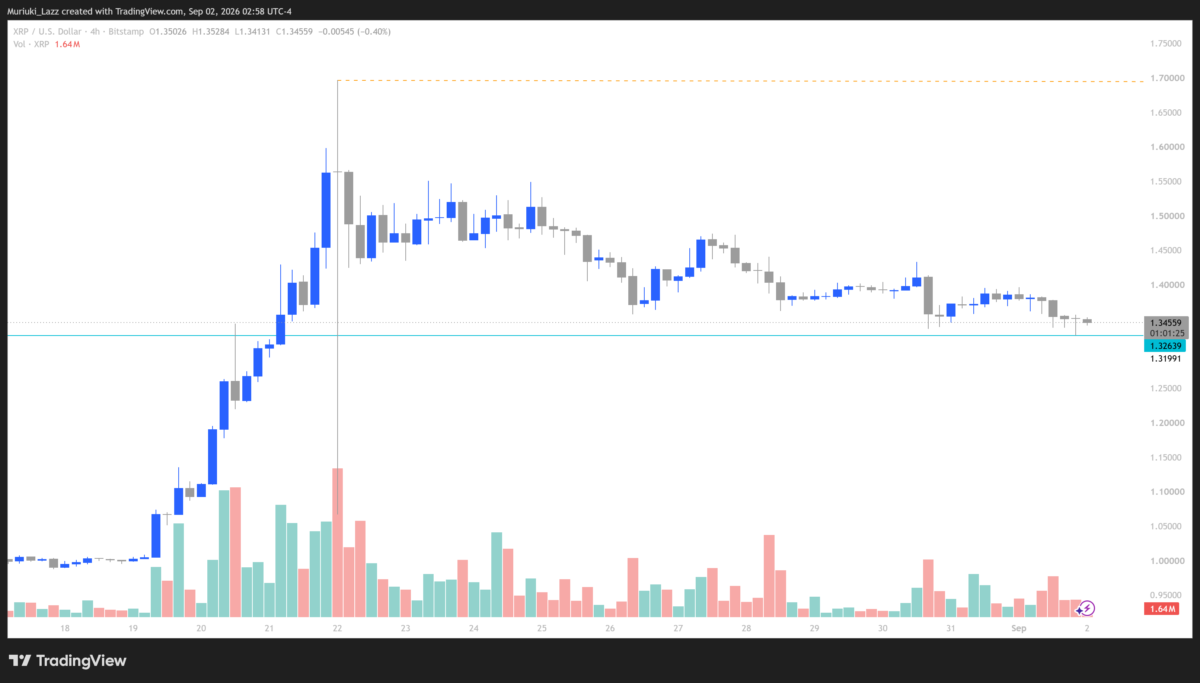
$XRP experienced a steep price correction on the 22nd of August. Yet, despite that momentum, one trend has quietly continued beneath the sell-off. Ripple [$XRP] tokens keep leaving the Binance exchange.
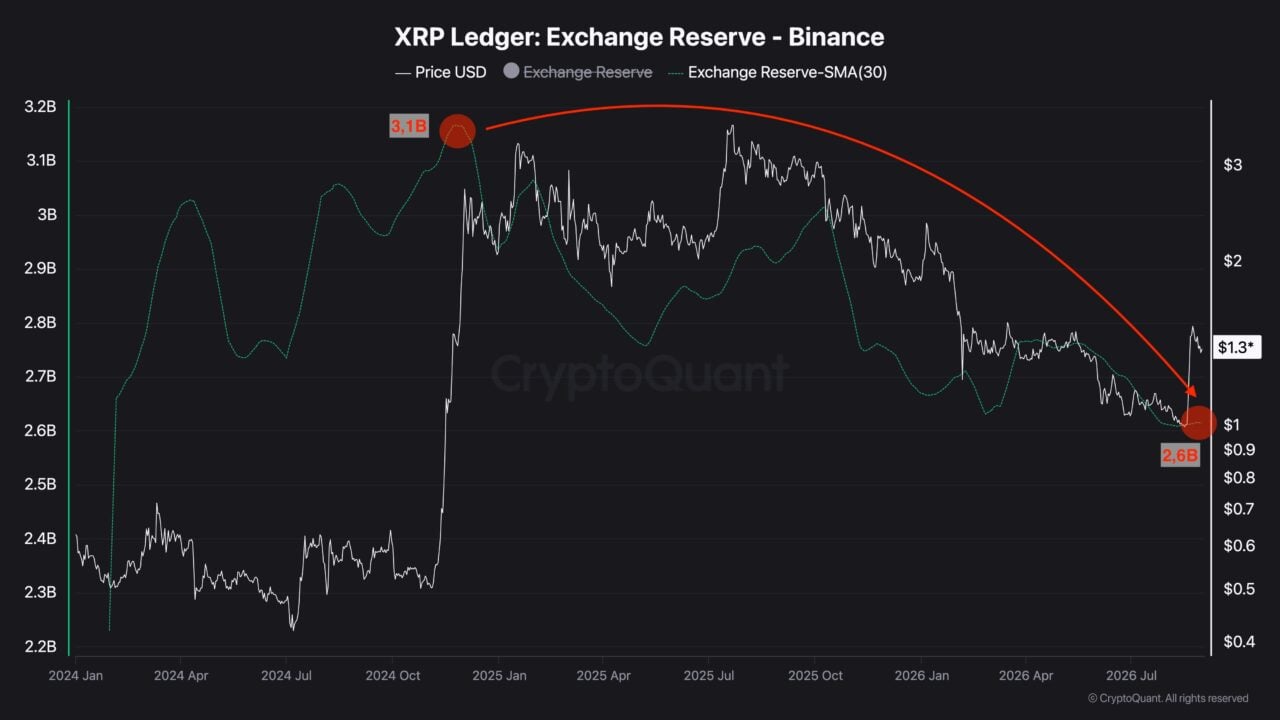
Since November 2025, the altcoin’s monthly reserves have fallen from 3.1 billion to 2.6 billion $XRP. This decline removed roughly 500 million tokens.
Normally, a 63% retreat from $3.66 toward $1.35 could encourage holders to return tokens for selling. Instead, reserves kept trending lower through rebounds and retracements, while the monthly average reached its weakest level since February 2024.
Source: CryptoQuant
Simply, that divergence in trends indicates that $XRP holders are increasingly moving $XRP from exchanges like Binance rather than returning it to an exchange. Despite this implying that holders show no intent of selling, it does not prove accumulation.
This is because custody changes and other Binance transfers can cause reserve balances to decline.
Still, fewer exchange-held tokens mean less $XRP sits immediately available for sale. Yet, if withdrawals persist when demand improves, tightening exchange supply could strengthen $XRP’s longer-term recovery.
Whale withdrawals dominate $XRP outflows
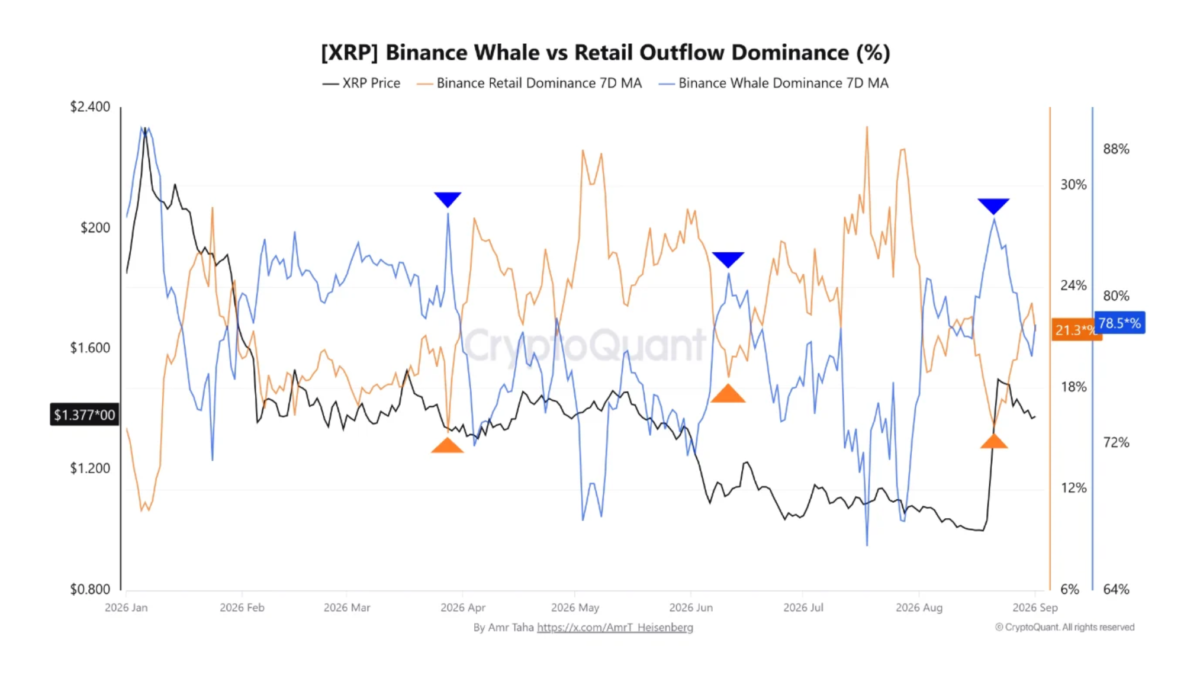
As $XRP continued leaving Binance, August revealed another shift. Larger holders were increasingly responsible for the sudden trend shift. Notably, whale outflow dominance reached 84.25% on the 21st of August, while retail slipped to just 15%.
That 69.25-point gap nearly replicated March’s 84.6% whale peak. In other words, this simply showed that large-holder activity had returned to an extreme.
Moreover, whales generated 5.6 times retail outflows. This was up from 4.5 times that experienced in June.
Source: CryptoQuant
This concentration matters because large transfers can reshape exchange liquidity faster than dispersed retail movements. Nevertheless, outflows cannot confirm whether whales are accumulating or simply relocating the tokens.
Meanwhile, with dominance now easing to 78.5%, sustained levels near 80% would indicate large holders remain the main force behind Binance withdrawals.
$XRP tests key support as selling pressure persists
Whale withdrawals may be reducing $XRP on Binance, but price action shows that scarcity alone has not brought buyers back. $XRP’s rally stalled near $1.56 before repeated lower highs dragged the price toward $1.35, keeping sellers firmly involved.
Source: TradingView
At press time the altcoin was trading at $1.32. However, a break above the current bearish trend line would provide bulls with the first real opportunity to reverse recent losses.
If the bulls can successfully defend this area, it will create a basis from which $XRP can build upon instead of just pausing before another leg lower.
However, weak volume shows buyers have not committed enough capital yet. A move through $1.42 would change that picture, opening $1.48–$1.50. Consequently, if the $1.3199 level breaks, bearish momentum could overwhelm reduced exchange supply
As a result, this would expose the $1.25–$1.28 zone, hence extending the correction and delaying any meaningful recovery.
Final Summary
$XRP Binance reserves fell 500 million tokens as whale withdrawals tightened exchange supply.
$XRP must hold $1.3199 and reclaim $1.42 to strengthen recovery prospects.
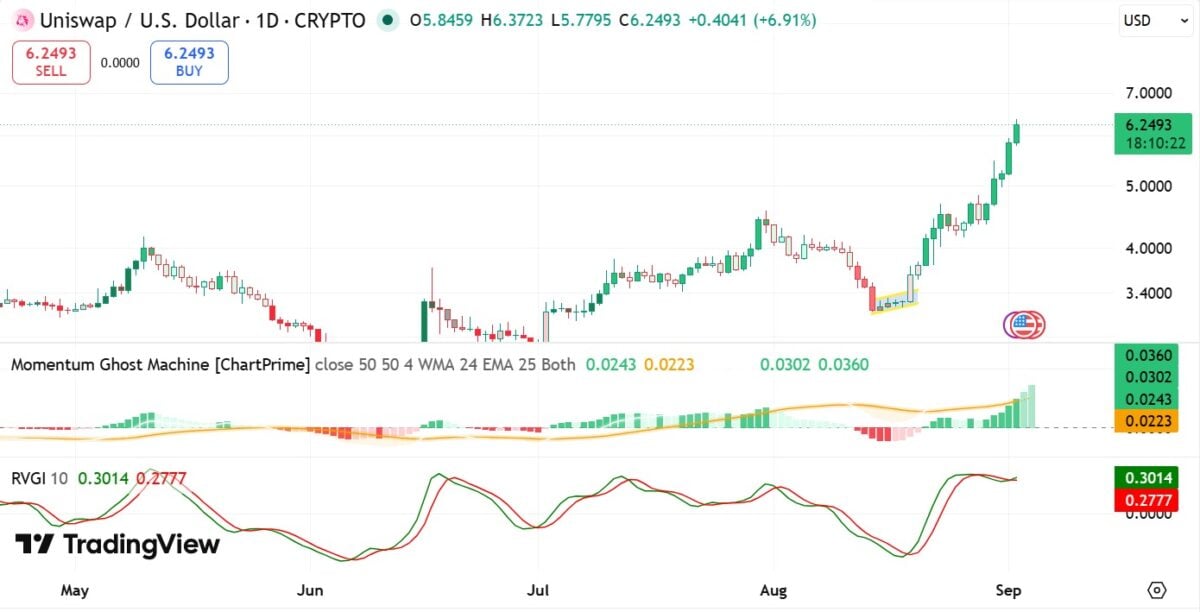
Uniswap extended its bullish streak, breaching the $6 resistance and reaching an eight-month high of $6.37. At press time, Uniswap [$UNI] traded near $6.20 after gaining 11.35% over 24 hours.
Trading Volume surged 153% alongside the price increase, reflecting heightened market activity. The move also brought $UNI close to recovering all its 2026 losses.
What is driving Uniswap’s rally?
Uniswap [$UNI] has continued to rally, mostly driven by strong activity from both whales and other institutional entities. Professor Onchain noted the move above $6 was fueled by heavy institutional inventory positioning.
According to the on-chain monitor, Wintermute absorbed 2.03 million $UNI worth $11.07 million into its primary market maker wallet. The same entity routed another $4.64 million worth of $UNI into Binance deposit lines.
In fact, top tracked wallets moved roughly $45 million in $UNI into active market circulation.
On top of that, whales are also aggressively buying. Nazoku reported that a whale purchased 540k $UNI worth $2.8 million, just before the price crossed the $6 mark.
The same wallet purchased 394k $UNI worth $1.71 days ago. In total, the wallet holds nearly $37 million worth of digital assets.
Often, strong whale and institutional activity has strengthened the demand side which precedes major price moves to the upside.
Will $UNI profit-taking derail the rally?
$UNI’s return to $6 for the first time since January encouraged holders to realize profits.
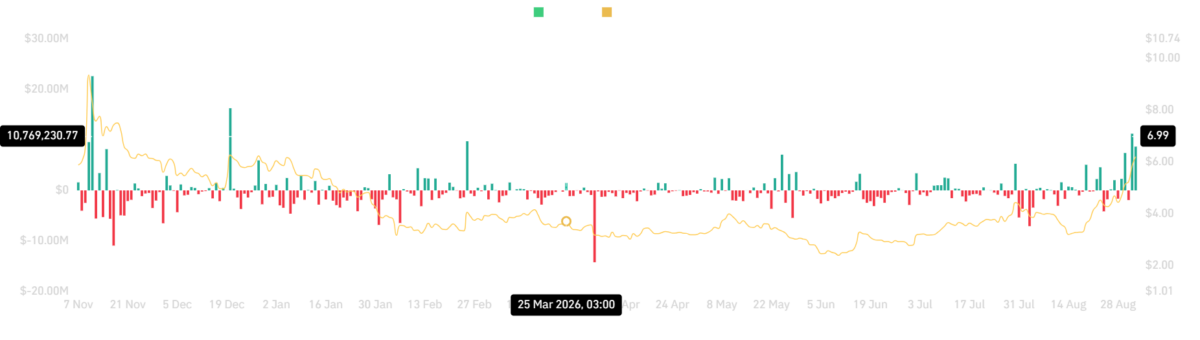
According to CoinGlass, Spot Netflow remained positive for two consecutive days. Spot Netflow climbed to $11.2 million on the 1st of September before easing to $8.6 million. The metric had not reached comparable levels since December 2025.
Source: CoinGlass
Positive Spot Netflow indicated that more $UNI entered exchanges than left them. Those deposits could increase sell-side liquidity and expose the rally to a pullback.
Can $UNI hold above $6?
For now Uniswap is under strong bullish pressure, driven by strong market demand. Looking at the momentum Ghost Machine, has remained positive and rising for 12 consecutive days.
When the indicator rises during an uptrend, it confirms buyers have gained considerable market control. Likewise, the Relative Vigor Index (RVGI) formed a bullish crossover, hiking to $0.3, further confirming this bullish pressure.
Source: TradingView
Taken together, these two indicator signal the likelihood of the current trend to hold. Therefore, if the demand holds, the uptrend will continue , with $UNI flipping $6.5 and eye a move above $7.
However, profit taking is especially strong and could poses another pullback risk. if the pressure persist, $6 will fail to hold and likely fall to $5.4.
Final Summary
Uniswap gained 11.35%, breached $6 and reached an eight-month high of $6.37.
Whale buying supported $UNI’s rally, while institutional wallet activity increased around the breakout. Rising Spot Netflow could test whether $UNI can defend $6 and extend its move toward $7.
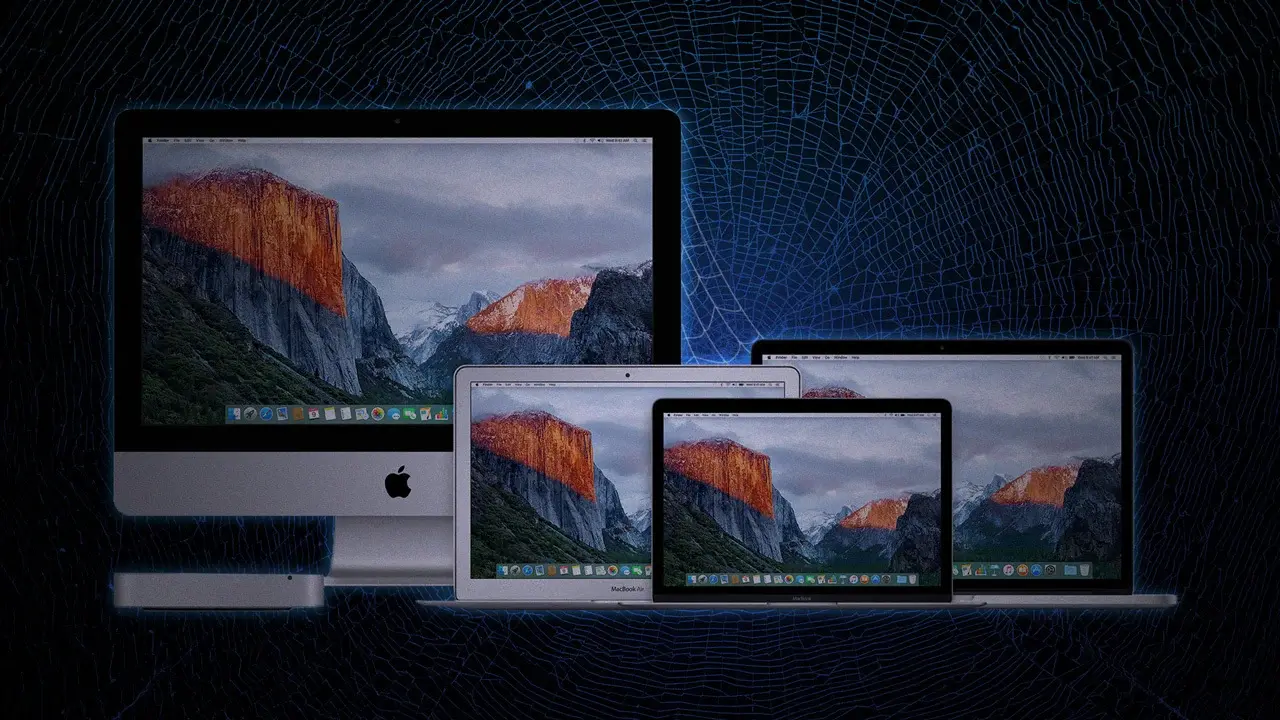
If you’re still using an Intel-powered Mac, here’s another bit of bad news. After dropping support for its own software on these PCs with macOS Golden Gate, Apple has now informed Mac App Store developers that they can also stop releasing updates for Intel Macs.
“We’re reaching out to let you know that universal macOS apps on the Mac App Store that require macOS 13 or later can now remove support for Intel-based Mac computers,” Apple writes in an email sent to developers, obtained by 9to5Mac. “By removing support for Intel-based Mac computers, you can simplify your development and optimize your download and on-device size.”
With this change, developers can focus on releasing apps optimized just for Apple’s M-series chips. Previously, developers who wanted to list their apps on the Mac App Store had to build versions that supported Intel processors as well.
“To remove Intel support, update your app build settings to ‘arm64’ only. Then rebuild and submit your app to the Mac App Store,” Apple adds.
Despite the phase-out, Intel Mac owners need not worry about losing access to their favorite apps. Even if a developer decides to stop releasing updates, users will be able to access the last version of the app that supports Intel processors.
Recommended by Our Editors
Apple first adopted Intel chips for Mac computers under Steve Jobs in 2005; the company began moving away from them with the introduction of its in-house M-series chips in 2020. Apple silicon has now reached its sixth generation.
MacOS 27, meanwhile, is still in beta. Apple’s latest Mac operating system is expected to become available on all compatible devices later this month. We’ll likely get a solid date at next week’s “Surprise and Shine” event.
About Our Expert
Experience
Jibin is a tech news writer based out of Ahmedabad, India. Previously, he served as the editor of iGeeksBlog and is a self-proclaimed tech enthusiast who loves breaking down complex information for a broader audience.
Dollywood unveiled a series of upcoming exhibits, experiences and park expansions on Wednesday that it said will pay tribute to its late founder Dolly Parton, as well as carry forward plans the late singer already had in the works for her beloved Tennessee theme park.
The theme park announced the news during a press conference on Wednesday afternoon that kicked off with a video tribute to Parton and ended with Heidi Parton Kin and Friends’ rendition of “9 to 5.” Shortly after, Parks & Resorts President Eugene Naughton took to the stage, where he revealed a new partnership with the city of Sevierville, Tennessee, and a number of key park expansions, which the dreamer-in-chief had approved.
“The curtain on this first act has fallen, and now time has come to start to talk about the journey forward, the next steps that we need to do,” Naughton said. “Because Dolly would be telling us to get back to work. She knew what she wanted Dollywood to be. She always wanted this to be a place of fun and togetherness, and most of all, as our love letter showed, she taught us here at Dollywood how to dream big.”
Naughton revealed the city of Sevierville will install, over the next couple of days, “In Dolly’s Footsteps,” a walkable tribute that lets fans trace her footsteps through the city, visiting and learning the stories of around 11 various locations, such as the Pines Theater, that held personal meaning to the life of the Grammy winner. Naughton also confirmed that the “I Will Always Love You” tribute banners inside the park raised around The Dolly Parton Experience, which last week was the site of a moment of silence held by fans as they remembered the singer, actress, and philanthropist, will remain.
The multimedia walkthrough that opened in 2024, with distinct zones moving through Parton’s life from Sevier County to global stardom in her own words, will also receive a new portal into its park zone that will extend the experience onto the show street. Inside, aspects of the experience, such as “Precious Memories” and the “I Will Always Love You” room, will also expand to celebrate the life of the late singer.
Within “Precious Memories,” a new video — narrated by Parton’s family sharing their best moments with the singer — will eventually be added to the current lineup of six videos, which sees Parton narrate stories of her family. For the Songteller experience, the park plans to add a new grand finale to the “I Will Always Love You” room.
Beyond the experience, the park announced the arrival of a new character in the Wildwood Grove area, as part of its plans to carry the singer’s spirit and care for children, which Naughton called “the most important thing to Dolly.”
Known as the Dream Maker, the character will embody Parton’s “great passion for dreaming big and telling stories” and allow younger guests to “learn some of the foundational things that Dolly talked about her whole life.” The area will also get a new Tribute Center, which will allow people to privately and publicly share memories of the singer. Public messages “will be used in a unique way within our storyline in the park,” he said.
The centerpiece of the park’s upcoming work is tied to the park’s Chapel, and unveiled alongside concept art and video of the coming expansion — one of the biggest looks at the plans for the church to date. In tribute to Dr. Robert F. Thomas, the Methodist minister and mountain doctor who birthed Parton in her family’s one-room cabin, the area will now feature a cascading mountainside waterfall outside the chapel’s front steps, with the chapel also receiving new stained-glass windows commissioned to reflect the Bible verse: “For everything there is a season, and a time for every matter under heaven.”
A special reflection and a sculpted guitar will also exist in the space. “I hope this will turn out to be the place on property that will give a chance for people to reflect on the impact that Dolly’s had on you,” Naughton told press.
Wednesday’s announcements were a mix of new and previously planned updates to the park, most of which Naughton confirmed should open around March 2027.
“The last seven days have been filled with a lot of grief, and that comes with feeling the loss of a loved one,” he said. “I know that we have all cried. I know I have spent a lot of time sharing with people on the midway their thoughts and feelings and the impact that Dolly had. But now it’s time to look at how we’re going to honor her on property moving forward.”
As for how future endeavors within the park will move forward without Parton to sign off on the vision and execution, Naughton confirmed she had rubber-stamped plans through 2036.
“She gave us the gift of time to be able to prepare what was going to eventually be happening here,” he said while taking press questions. “Her love of music and her love specifically of live music, the chance to bring those stories to life on the stages here will always be a really big part of who we are as a complex. We talked all the time about our future. She really didn’t get much into daily operations. That wasn’t her thing, but she really lit up when we talked about the future. So we have plans all the way through 2036 that she laid emphasis on for us as a leadership team, and I’m really confident in that.”
The Dollywood head also confirmed that key elements of the company’s previously announced half-billion-dollar investment strategy around the property’s five new resorts were also approved by the late singer. “Resort three, four, and five, and the outdoor resort, all planned on stories that Dolly already has approved,” he said. “She was really special with that for us, so I’m confident we’re not only going to be the same, but if she were looking right down here on me, she’d be kicking my rear if I didn’t say we’re going to get better every day.”
Following the announcement of Parton’s death last Wednesday at the age of 80 following a brief battle with cancer, Dollywood remained open as a “place of joy, hope and togetherness” in the spirit of her work ethic in an environment that could honor her spirit “with laughter, music and shared dreams,” according to an announcement by the park, which also encouraged fans to donate to Parton’s Imagination Library.
“The greatest privilege of my life has been helping Dolly bring her dreams to life at Dollywood,” Naughton said in a statement at the time. “Dolly’s heart was as vast as the mountains she cherished, and her compassion knew no bounds. She inspired generations to dream boldly and love deeply. While we grieve her loss, we are honored and committed to carry her light forward. Her legacy will continue to shine in every melody sung, every smile shared and every dream kindled within these gates.”
Within a day of the news of Parton’s passing, memorials both official and unofficial quickly appeared around the Pigeon Forge park. Outside, flowers and other items were left by fans near the entrance sign. Inside, guests left remembrances, including balloons, written messages, and butterflies — a personal symbol the late singer embraced — at a designated display in the park. The official memorial was erected in Dollywood’s welcome plaza, allowing park visitors and fans to not only reflect on her life, but honor her contributions and the joy she, her music and various ventures brought. Guests also congregated at the Chapel where they remembered the park’s dreamer-in-chief through service.
Naughton is unsure when or if that will come down. “I don’t really know how long it’s going to last because I don’t have all the answers and I don’t think anyone on our team really knows,” he said. “We want to give plenty of time to let people [to remember her] in a real special way.”
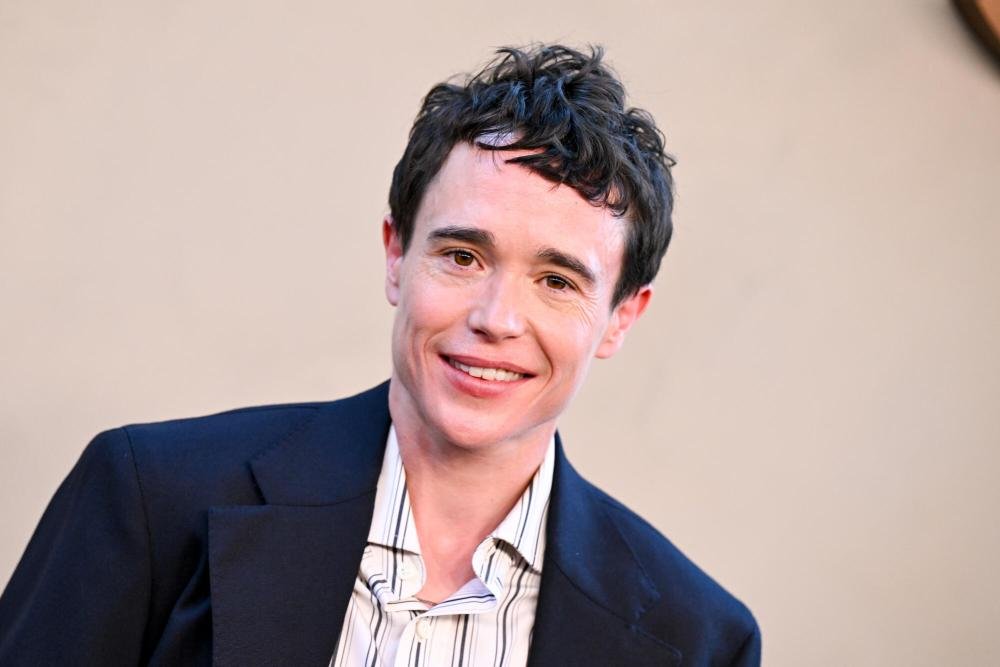
Elliot Page has never felt more comfortable on screen. Finding the right role, however, has proven to be more difficult. During his appearance on the “On Film… With Kevin McCarthy” podcast, Elliott revealed he hasn’t been able to find another great role after starring in “The Odyssey,” which hit theaters in July. The actor revealed he has no role currently lined up.
The “Umbrella Academy” actor, who came out as transgender in 2020, said he hopes to continue acting. Looking back at his experience filming Christopher Nolan‘s 2010 film “Inception,” Page recalled feeling uncomfortable in his own skin. But now that he’s embraced his true identity, he feels he’s in the perfect place to accomplish his “best work.”
“I had such a great time being in [“Inception”]. I had such a great time working with [writer-director Nolan], but I was also personally really uncomfortable,” the Oscar nominee shared. “Whereas a part like ‘Juno,’ I was able to feel more comfortable and embodied.”
While working on Nolan’s film, Page developed shingles after feeling out of place while working “in a cast full of cis men.” In his memoir, “Pageboy,” the actor shared the cast and crew were “delightful to work with,” but he still struggled to feel comfortable on set.
Page reunited with Nolan for “The Odyssey,” which he told McCarthy was a “cathartic” experience compared to working on “Inception.” On his last day filming Nolan’s epic, Page said it was an emotional day because it marked a full-circle moment.
“To come back now, as you can imagine, being more comfortable in yourself makes these sorts of projects more enjoyable,” Page said during the “X-Men: Days of Future Past” panel at New York City Comic Con in 2025 about “The Odyssey.” “To get to have a Chris Nolan experience again now meant so much to me selfishly.”
When Page’s casting as Sinon, the cousin of Odysseus (Matt Damon), was announced, the actor faced backlash online. Conservative commentator Ben Shapiro called the choice an “absolute puzzler,” noting that Page is “about 5’2 and 105 pounds soaking wet and has the voice of a woman. It doesn’t work.”
Whoopi Goldberg spoke out against Shapiro’s remark during an episode of “The View” in July, saying “A lot of conservatives who see this are going to feel the same way. That’s okay. But I don’t understand. Why go see the movie? If you don’t want to see it, don’t go see it. Why do you care who’s cast in it?”
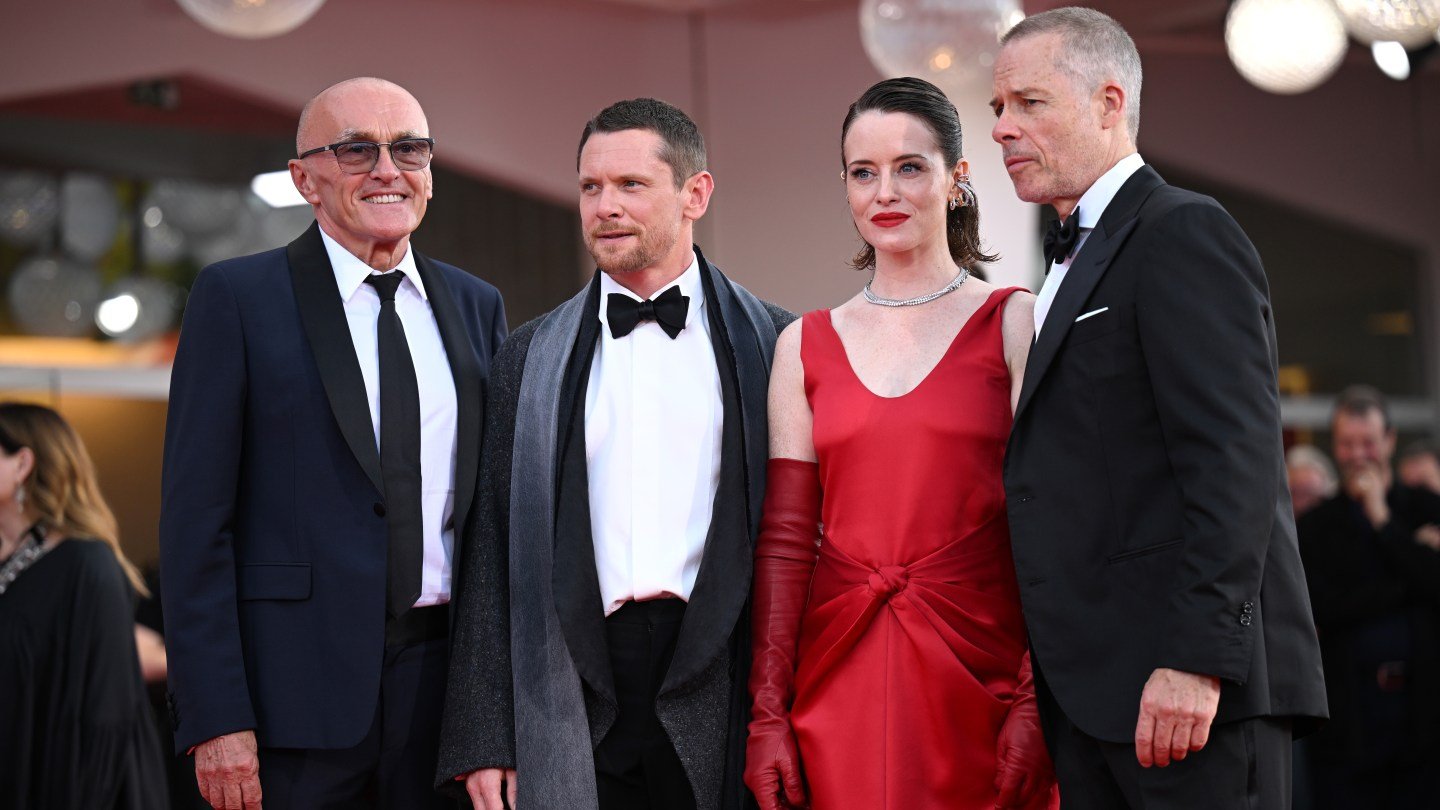
As the lights came up inside Venice’s Sala Grande, with stars Jack O’Connell, Guy Pearce and Claire Foy seated alongside their director, the black-tie crowd rose for a four-minute standing ovation in a warmly-received moment. After the cast exited, there was a bit of drama near the front of the theater as an unidentified man was suffering from a medical emergency and personnel were called in for help. As of press time, his condition was unclear.
Set in 1969, Ink chronicles Murdoch’s acquisition of the struggling British newspaper The Sun and his recruitment of editor Larry Lamb to reinvent it as a populist tabloid capable of overtaking the dominant Daily Mirror. Pearce plays Murdoch, with O’Connell as Lamb and Foy as Jules Davies. The film traces the creation of a formula built around sensationalism, celebrity, sex and an instinctive feel for readers’ baser instincts — an approach that would transform The Sun into Britain’s bestselling newspaper and presage many of the forces that later reshaped global media in the Murdoch model.
A still from Ink featuring Pearce and O’Connell. In his review, THR’s chief film critic David Rooney calls it an “irreverent and inventive recap” of what Murdoch created.
Courtesy of Netflix
Boyle’s film is adapted by James Graham from his acclaimed 2017 play of the same name. It also marks a surprising first for the Oscar-winning British filmmaker. Despite his lengthy career spanning Trainspotting, 28 Days Later, Slumdog Millionaire and last year’s 28 Years Later, Boyle had never previously brought a movie to Venice. He described the occasion as his “baptism” on the Lido, saying he was drawn to Graham’s account of how Murdoch and Lamb created a new breed of populist journalism decades before Fox News, social media and clickbait would fundamentally reshape the press and politics.
Speaking to reporters in Venice earlier Wednesday, Boyle and his cast addressed the film’s parallels with today’s divisive media environment. Boyle explained that he was careful, as with the stage version, not to “monsterize” Rupert Murdoch “because he represented at the time [a] breath of fresh air in what was a very rigid British society. It begins with something that’s fun and different, challenging a rigid order… It was important to us that the audience feels complicit.”
For her part, Foy said she savored diving into ’60s tabloid journalism as a “really intoxicating” plunge. “They had power at their fingertips. They knew what they wrote would be what people read and what people believed,” she said.
Pearce, who plays Murdoch, said he received some second-hand confirmation from the man himself that he gave a thumbs up to the casting choice. “I had some messaging with Elizabeth [Murdoch], his daughter, and she said ‘Dad’s very happy that you are playing him.’ But he hadn’t seen the film at that point,” Peace noted in today’s press conference.
Earlier in the evening, George Clooney brought the house down with a heartfelt speech as he accepted an honorary Golden Lion from his longtime friend Laura Dern during the festival’s opening ceremony. The Oscar winner took a walk down memory lane to detail how many artists and collaborators lifted him up on his journey while also taking aim at authoritarianism.
“Stories are always dangerous to people who peddle in fear. The people who are afraid of books and music and stories, they’re never the heroes in history. So yes, movies don’t stop wars. They don’t lower inflation. They don’t fix elections, but they do do something remarkable. They remind us that a stranger is never a stranger and that he might just be the hero in somebody else’s story,” he said. “And if we can still sit together in the dark and care about people that we have never met, I think maybe we’ll be OK.”
Ink is the first of the 21 films competing for this year’s Golden Lion to hit the screen. Other anticipated premieres coming in the next 10 days include Robert Pattinson thriller Primetime, Martin McDonagh’s Wild Horse Nine, Lee Chang-dong’s Possible Love, Florian Zeller’s Bunker and the Gaza documentary NAZA. A seven-member jury headed by Maggie Gyllenhaal will choose the winners, which will be revealed at Venice’s closing ceremony on Sept. 12.
![Uniswap [UNI] jumps 11% to 8 month high – But THESE 2 metrics warn of pullback](https://a.magazinaisle.com/wp-content/uploads/2026/09/uniswap-uni-jumps-11-to-8-month-high-but-these-2-metrics-warn-of-pullback_6a98b40aec49c.jpeg)