George Lucas previewed the long-in-the-works Lucas Museum of Narrative Art in Los Angeles on Wednesday, and Lucas said of the Herculean effort, “I’m fascinated by doing things that people say can’t be done.”
“I’m used to doing the impossible,” said the “Star Wars” creator, who, along with his wife Mellody Hobson, has been working on the museum concept for 17 years. “Part of the problem is I’m a contrarian. I’m fascinated by doing things that people say can’t be done. This one almost broke my will.”
In addition to a gallery packed with life-sized props from Star Wars movies, the 300,000 square foot spaceship-like museum next to the L.A. Memorial Coliseum features more than 30 galleries packed with Lucas’ collection of narrative art — from an extensive collection of Norman Rockwell paintings to works by Frida Kahlo, Diego Rivera, Maxfield Parrish and Frank Frazetta, to rooms of photography, comic book art and Western paintings and sculptures.
Why narrative art? For Lucas, art and culture are inextricably combined.
“It’s something that I felt very, very strongly about in terms of honoring illustrators, artists who illustrate stories that are already written, and most of the stories are myths; they’re not real, but the illustrations make them real,” Lucas said. “A picture is very powerful, and the stories are very powerful, and you combine them together, and those two elements create a society.”
Lucas also recognized the museum staff and creators, saying “the great people that we’ve assembled to do this have been a big advantage.” The museum is designed by Ma Yansong of MAD with Stansec, with landscape architecture by Mia Lehrer.
Check out some of the movie-themed pieces at the museum, which opens to the public Sept. 22.
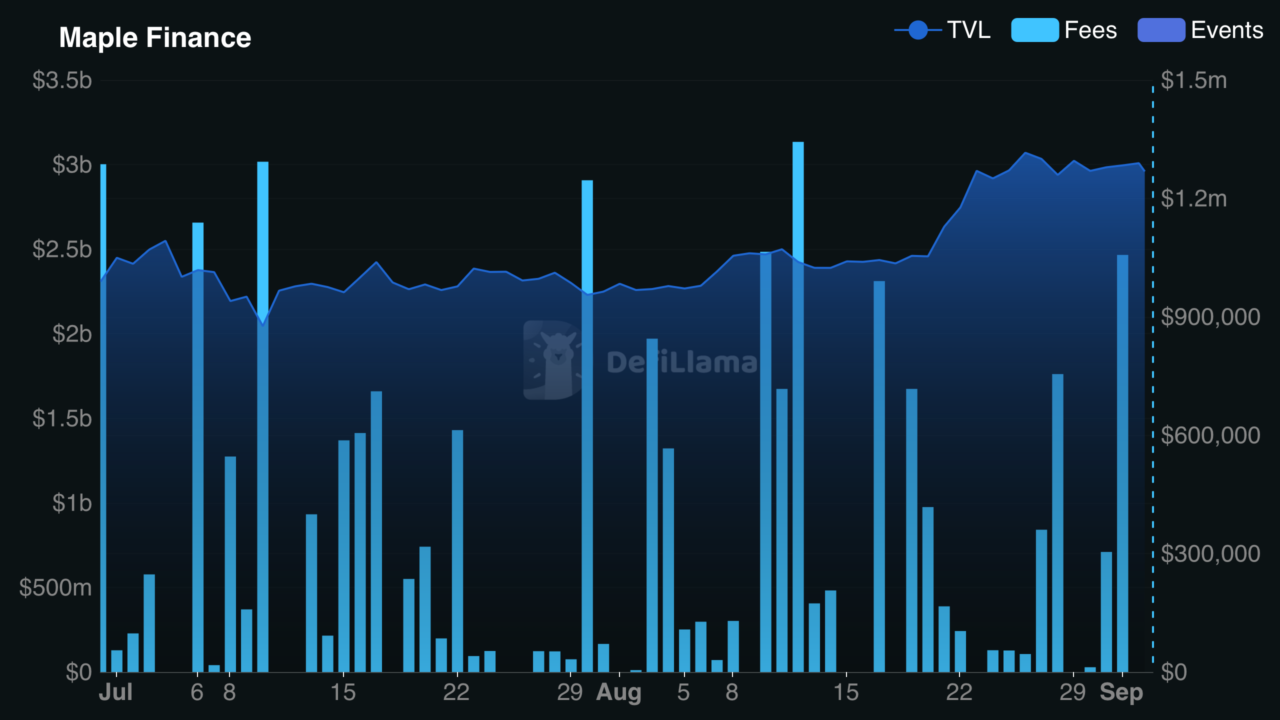
Maple Finance [$SYRUP] has rallied 14% rally in the past day at press time. $SYRUP’s price surge stemmed from its strong protocol-level performance, as Maple Finance hit new highs in earnings and total value locked (TVL).
$SYRUP’s protocol-level surge
The latest data from DeFiLlama on $SYRUP’s performance shows that the protocol’s monthly gross profit has reached its highest level since April 2026.
According to DeFiLlama, the protocol generated roughly $1.13 million in profit as the broader crypto market gradually recovered. This figure remains below April’s $1.32 million.
Source: DeFiLlama
The surge did not happen in isolation, with TVL also crossing $3 billion for the second time this year since early January. On the 25th of August, TVL hit $3.07 billion. However, it has since seen a slight decline to $2.97 billion.
TVL measures the amount of capital deposited into a protocol, and when it rises or remains at elevated levels, it suggests investors are committing more funds to the protocol to earn returns. This can add to the positive outlook when the token is also performing well.
Capital is concentrated for a rally
There is a massive concentration of capital among traders in $SYRUP contracts lately, with many taking long positions on the asset.
Press-time data shows that $SYRUP’s Open Interest (OI), the amount of capital locked in its perpetual contracts, hit $29 million over the past day after a 26% surge. When weighed against the Funding Rate, the data suggests that the majority of traders are positioned long.
The OI-Weighted Funding Rate at the time of this analysis had reached 0.0077%, remaining positive on the chart.
Source: CoinGlass
While this remains a moderate reading, one signal to watch is whether the funding rate surges or declines. A rise would imply that expectations for further gains are increasing, while a decline could suggest that traders are gradually shifting toward a sell-off or range-bound movement.
A continued rise or a range-bound move would still align with the present bullish narrative and the capital flow seen in $SYRUP’s perpetual market.
The bullish conviction remains strong
There is clear conviction among investors, as reflected in $SYRUP’s market sentiment and community sentiment profile.
Mindshare, which tracks how much traders are talking about the asset, saw a 20% surge over the past day, with mentions reaching 1,490, according to CoinMarketCap data.
Source: CoinMarketCap
Likewise, the market sentiment score, which ranges from -10 (extremely bearish) to 10 (extremely bullish), stood at 5.84, suggesting a strong bullish outlook for $SYRUP at the moment.
Final Summary
Maple Finance’s profit reached $1.13 million in August, while TVL crossed $3 billion for the second time this year.
$SYRUP’s 14% rally came as OI rose 26% and bullish sentiment strengthened.
The epic, starring Ranbir Kapoor, Yash and Sai Pallavi, follows exiled prince Rama (Kapoor) and his consort Sita (Pallavi) through exile into catastrophe, as Sita’s abduction at the hands of Ravana (Yash) sets in motion an epic war between righteousness and evil.
Nitesh Tiwari helms the two-part adaptation. Designed for audiences across cultures, it will be released in multiple languages, including English.
In a trailer released earlier this Summer, audiences got a glimpse of footage showcasing high-scale visual effects, mythological weaponry, and massive battles as Rama vows to defeat Ravana across the three worlds and rescue Sita, signaling the start of the era of Rama.
Hans Zimmer and A.R. Rahman join forces to deliver the film’s epic score. The production also features action choreography by Terry Notary and Guy Norris, and production design by Ramsey Avery and Ravi Bansal.
The film is produced by Namit Malhotra’s Prime Focus Studios and Yash’s Monster Mind Creations. “Ramayana” Part 1 opens during the Diwali holiday frame, with Part 2 following on Diwali 2027.
The choice of release window is no accident. Diwali – one of the most widely observed festivals in the Hindu calendar – marks the return of Rama to his kingdom of Ayodhya after 14 years of exile and his victory over Ravana. The lighting of lamps that defines the celebration is said to represent the illumination of Ayodhya on the night its beloved prince came home.
“Ramayana” is planned as a two-part movie event based on the 5,000-year-old saga and is envisioned as an unprecedented cinematic spectacle for global audiences, with both parts filmed for Imax.
DNEG – the eight-time Oscar-winning VFX house, whose credits include the “Dune” movies, “Interstellar” and “Inception” – is handling visual effects. Tiwari, whose “Dangal” remains the highest-grossing Indian film ever made, directs from a screenplay by Shridhar Raghavan.
The film’s Indian distribution will be handled by media personality Karan Johar’s Dharma Productions.
Prediction Markets Remain Skeptical of 2026 Passage
Washington’s effort to establish national rules for crypto trading, custody, and market oversight now centers on the CLARITY Act. The House-passed bill would divide federal responsibilities between the Securities and Exchange Commission (SEC) and the Commodity Futures Trading Commission (CFTC) while setting requirements for exchanges, brokers, dealers, disclosures, and customer asset protection.
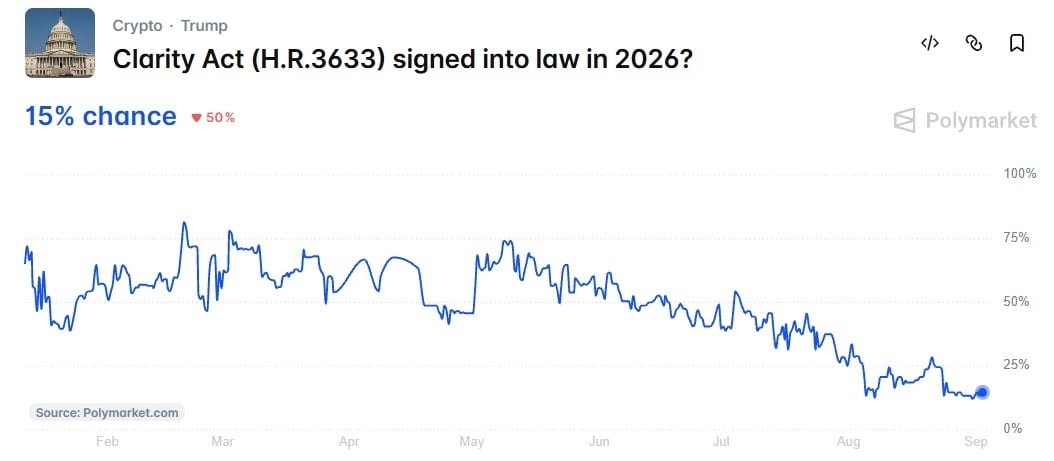
Prediction-market traders remain doubtful that the Digital Asset Market Clarity Act will complete the legislative process this year. A Polymarket contract on 2026 enactment showed a 15% chance on Sept. 2 that the CLARITY Act (H.R. 3633) would pass both chambers and receive the president’s signature by Dec. 31. Trading volume reached approximately $11.62 million.
Polymarket traders assigned the CLARITY Act a 15% chance of becoming law by Dec. 31. Source: Polymarket, Sept. 2, 2026.
The low probability contrasted with House Financial Services Committee Chairman French Hill’s renewed reference to the legislation during a Sept. 2 hearing on growth, affordability, innovation, and access to capital. In his prepared remarks, the Arkansas Republican listed House passage of the CLARITY Act among the committee’s accomplishments and called for permanent, predictable financial rules.
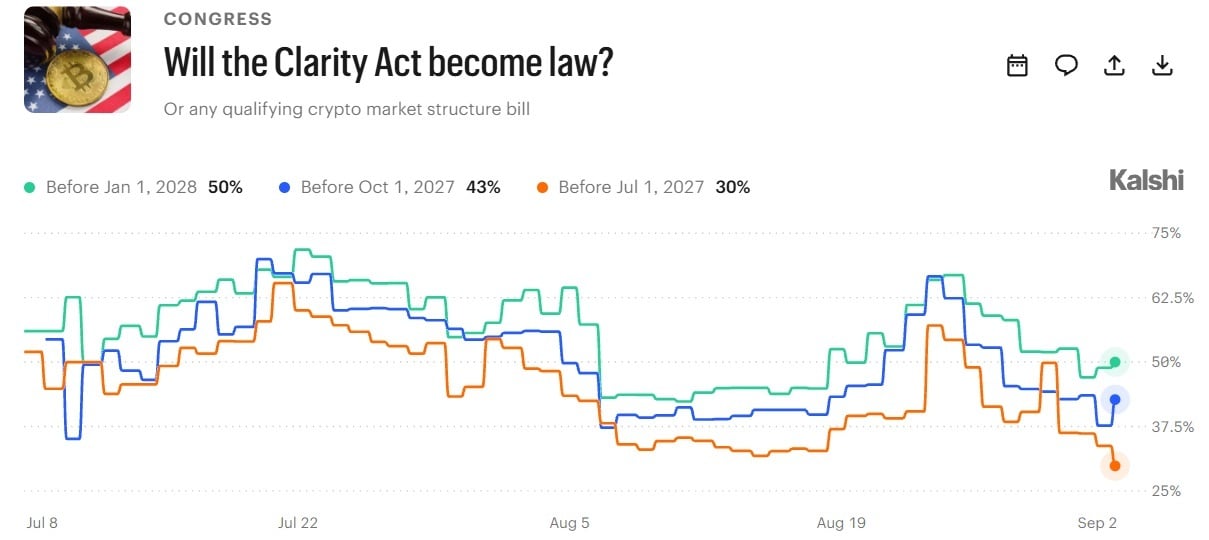
Kalshi’s longer-term contracts showed stronger probabilities, but they measure a broader outcome and cannot be compared directly with Polymarket’s 2026 contract. Kalshi gave the CLARITY Act, or another qualifying crypto market structure bill, a 30% chance of becoming law before July 1, 2027, and a 50% probability before Jan. 1, 2028. Volume totaled approximately $6.85 million.
Kalshi traders assigned a qualifying crypto market structure bill a 30% chance of passage before July 1, 2027, and a 50% chance before Jan. 1, 2028. Source: Kalshi, Sept. 2, 2026.
The latest figures show that traders distinguish between an imminent Senate vote and completed enactment. By Aug. 31, the market had already separated procedural progress from final passage, with traders assigning strong odds to a Senate vote but much weaker probabilities to the bill becoming law during 2026. Polymarket’s latest 15% reading rose from 13% but remained heavily weighted against enactment.
Sept. 15 Cloture Motion Becomes the Immediate Test
The next measurable step would be a procedural vote on the bill, which senators could hold as soon as Sept. 15. The official Senate schedule states that the cloture motion on proceeding to H.R. 3633 will ripen at 2:15 p.m. Cloture generally requires 60 votes, placing the bill’s future on its ability to retain bipartisan support.
The proposal has already demonstrated support across party lines at earlier stages. The Senate Banking Committee advanced H.R. 3633 by a 15-9 vote on May 14, moving it toward floor consideration. Democratic Senators Ruben Gallego and Angela Alsobrooks joined Republicans in supporting advancement, although committee approval did not establish sufficient support for cloture or final passage.
Senate negotiators subsequently released revised legislation combining work from the Banking and Agriculture committees. The updated CLARITY Act framework addresses SEC and CFTC jurisdiction, consumer protection, illicit finance, decentralized finance, intermediary oversight, disclosure requirements, and specified network tokens.
The revised language creates another timing consideration reflected in the low 2026 odds. Senate approval of provisions differing from the House-passed measure could require further action before the bill reaches the president. The Polymarket contract pays out only if H.R. 3633 completes every remaining step by the end of 2026.
Hill’s Regulatory Push Confronts the Legislative Clock
Hill placed CLARITY inside a wider economic program covering capital markets, housing, community financial institutions, and regulatory modernization. He stated: “Committee Republicans are working diligently to codify these reforms to make them permanent and predictable.” The prediction-market probabilities indicate that traders see the remaining congressional calendar as a significant obstacle to that objective.
The lawmaker did not deliver an extensive digital asset argument in the Sept. 2 statement, but he previously explained why he considers CLARITY essential. During a July field hearing marking one year since House passage, Hill compared stablecoin legislation without a crypto market framework to an incomplete communications system while the CLARITY Act remained unfinished in the Senate.
Hill stated:
“We need CLARITY in place because of a key point I always make: if you have GENIUS and dollar-backed stablecoin, which President Trump signed into law last July, but you do not have a market structure bill, you have passed authorization to have a cellphone but no cell network.”
The bill could affect centralized exchanges, decentralized platforms, brokers, dealers, token issuers, and customers. Centralized and decentralized cryptocurrency exchange structures raise different custody, compliance, and consumer-protection considerations that the proposed framework seeks to address.
If senators take up the cloture motion on Sept. 15, the vote would provide the next direct test of the market’s skepticism. Clearing the procedural threshold could improve expectations for Senate consideration, while failure would strengthen the 85% probability currently assigned to H.R. 3633 not becoming law during 2026.
Could this sudden uptick in STORJ’s price signal a larger trend? In just 15 minutes, STORJ surged by 7.12%, climbing from $0.0281 to a current price of $0.0301. This quick movement showcases the dynamic nature of the cryptocurrency market, drawing attention from traders keen on capitalizing on momentum. The trading volume during this period reached $882,793.71, indicating active participation.
The Story So Far
The broader cryptocurrency market is exhibiting mixed signals, with various assets experiencing fluctuations. STORJ’s price spike comes despite a 24-hour decline of 6.52%, which indicates a potential rebound or corrective movement. Over the last hour, STORJ also saw a modest increase of 2.38%. The sudden rise within such a short timeframe suggests traders might be responding to short-term sentiment shifts, possibly driven by speculative trading rather than fundamental changes.
Market Snapshot
In the last 24 hours, STORJ hit a low of $0.0281 and a high of $0.038, demonstrating significant volatility. The price movement is notable, particularly as it approaches the recent high, prompting traders to monitor key levels. Current market conditions reflect a cautious optimism among traders, with many looking for further signals that could influence future price action.
Historical Context
The recent price action may be linked to broader trends in the derivatives market, including open interest and funding rates. With traders looking for opportunities, the quick surge could have been fueled by short-covering or a reaction to broader market sentiment. However, without confirmed catalysts, the reasons behind this move remain speculative and warrant careful observation.
The Road Ahead
What Traders Are Watching Next. Traders are closely watching STORJ’s next moves, especially as it approaches key resistance levels around $0.038. Support is seen near $0.0281, and a break below this could signal further downside. The current trading environment remains volatile, influenced by sentiment shifts and potential market reactions.
More than 11,000 people have fallen ill in the largest Cyclospora outbreak ever recorded in the US. A string of food safety scares are raising questions whether Trump’s cuts to the FDA, CDC and state health systems impacted how the US monitors food safety.
Al Jazeera’s Noor Wazwaz explains.
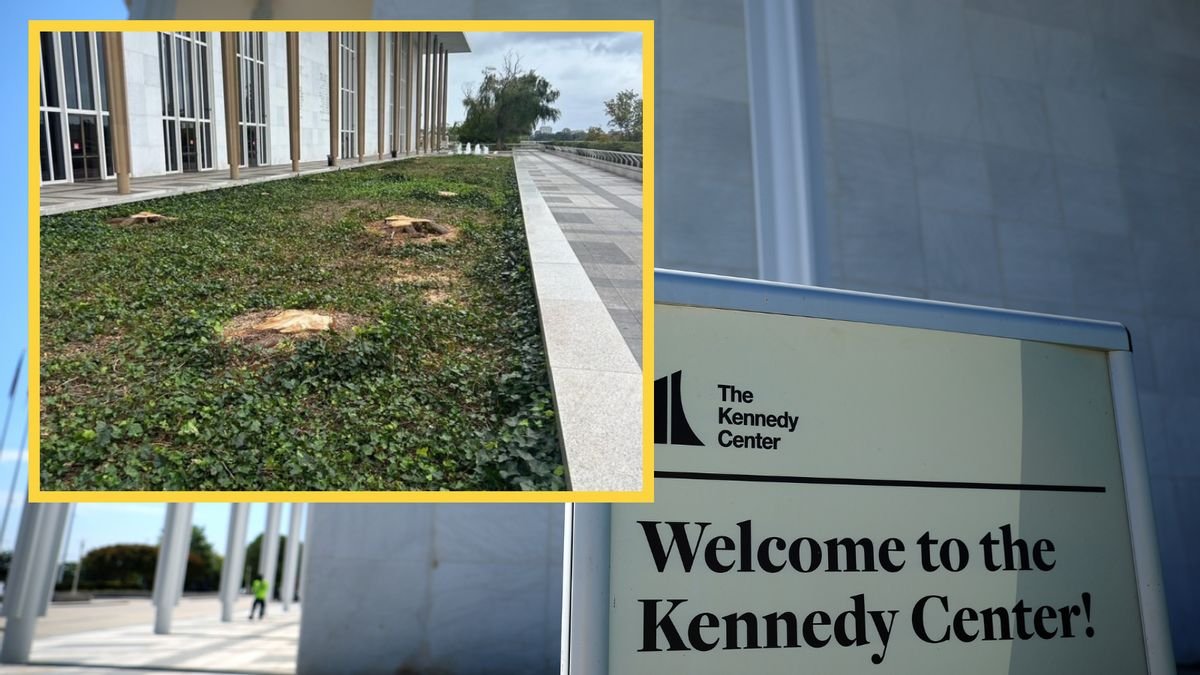
In the summer of 2026, U.S. President Donald Trump ordered the removal of weeping willow trees outside the John F. Kennedy Memorial Center for the Performing Arts in Washington, D.C.
Rating:
Context
Matthew Floca, the Kennedy Center’s vice president of facilities, said in April 2026 sworn testimony that the center felled its weeping willows “because they were falling down.” He also confirmed Trump was not involved in the decision.
In late August and early September 2026, a claim (archived) circulated online that U.S. President Donald Trump ordered the removal of weeping willow trees outside the John F. Kennedy Memorial Center for the Performing Arts in Washington, D.C.
“The iconic weeping willow trees outside the Kennedy Center have been cut down by Trump,” Adam Parkhomenko, a former Hillary Clinton adviser, wrote on X.
The iconic weeping willow trees outside the Kennedy Center have been cut down by Trump. pic.twitter.com/5bZ0AnaPDx
That was not the case. Rather, Matthew Floca, the Kennedy Center’s vice president of facilities, said in April 2026 sworn testimony that the center felled its weeping willows “because they were falling down” (Page 27). Floca’s testimony was part of a lawsuit seeking to block Trump’s planned renovations of the center.
Floca said in his testimony that the center felled the trees because of a “maintenance need” (Page 28) and that it was “contemplating” their replacements. Floca added that he had not spoken to Trump, who is the chair of the Kennedy Center Board of Trustees, about the weeping willows or what should replace them (Page 28).
Given the above, we rate the claim that Trump ordered the removal of the Kennedy Center’s weeping willow trees false. Rather, the center’s management said it felled the trees because of a maintenance need and confirmed Trump was not involved in the decision.
We contacted the Kennedy Center to ask when it cut down the weeping willows and whether it had any plans to replace the trees, but did not receive a response by the time of publication. A White House spokesperson referred our request for comment to the Kennedy Center.
Citing a spokesperson for the Kennedy Center, Newsweek reported that the center removed its weeping willow trees in October 2025. Snopes found one image published by Reuters that showed weeping willows at the Kennedy Center in September 2025 and a geo-tagged image from Google that showed at least one such tree cut down in October, supporting this reported timeline.
The neighborhood blog PoPville, which covers Washington, D.C., reported on the removal of the weeping willows on October 14, 2025. Snopes could not view metadata for the images in order to establish their authenticity, but had no reason to believe they were inauthentic.
What we know about the trees
Floca told a Washington, D.C. district court on April 29, 2026, that the weeping willows at the Kennedy Center had to be removed because they were in poor health. He said (Page 28):
Ninety percent of the trees were decaying and every time there was a heavy wind or rain a tree would fall down. If you walk around the center at that time, you would see limbs falling and trees falling down.
When asked whether he discussed what tree would replace the weeping willows with the Kennedy Center chairman (meaning Trump), Floca said (Page 28):
We haven’t specifically talked about the weeping willows or the replacement. I think that a weeping cherry tree would be perfect. But we are going to come up with a complete landscape — a comprehensive landscape plan that doesn’t only talk to the planters and the willow trees, and that will be part of the plan, the replacement.
As of this writing, it was unclear what tree would replace the weeping willows, which lawyer Abbe David Lowell claimed were meant to represent “the grief of the nation” for the death of former U.S. President John F. Kennedy (Page 27).
Trump posted digital renderings of his suggested “new, highly improved” Kennedy Center in March 2026 that replaced the weeping willows with either pink or orange-leafed trees. Though weeping willows change color in the fall, their leaves turn yellow or gold, not orange, red or pink like the trees in Trump’s renderings, which appeared to suggest the president wanted to replace the weeping willows with a different kind of tree.
Floca’s testimony was part of a lawsuit brought by several conservation groups that sought to stop Trump and the Kennedy Center’s board from carrying out proposed renovations without third-party review. On May 29, a federal judge denied the conservation groups’ request for a preliminary injunction that would stop the renovations while the court case was ongoing.
Nonetheless, the center remained open at the time of this writing, despite Trump initially saying it would close on July 4, 2026, for renovations.
For further reading, Snopes previously investigated whether Trump cut down dozens of cherry trees in Washington, D.C., to make way for a golf course.
Sources
‘Claim Trump Cut down Weeping Willow Trees Outside Kennedy Center Debunked’. Newsweek, 1 Sept. 2026, https://www.newsweek.com/claim-trump-cut-down-weeping-willow-trees-outside-kennedy-center-debunked-12393047.
‘DC PRESERVATION LEAGUE v. BOARD OF TRUSTEES OF THE JOHN F. KENNEDY CENTER FOR THE PERFORMING ARTS, 1:26-Cv-00981 – CourtListener.Com’. CourtListener, https://www.courtlistener.com/docket/72528661/dc-preservation-league-v-board-of-trustees-of-the-john-f-kennedy-center/. Accessed 2 Sept. 2026.
‘Google Maps’. Google Maps, https://www.google.com/maps/place/John+F.+Kennedy+Center+for+the+Performing+Arts/@38.8958482,-77.0556827,3a,75y,90t/data=!3m7!1e2!3m5!1sCIABIhA3zF20BdcOkWqG4ifvYvbT!2e10!3e12!7i2252!8i4000!4m9!3m8!1s0x89b7b7ad23ab0839:0xb70ae9e47907589d!8m2!3d38.8958482!4d-77.0556827!10e5!14m1!1BCgIgAQ!16zL20vMDIxam5n?entry=ttu&g_ep=EgoyMDI2MDgzMS4wIKXMDSoASAFQAw%3D%3D. Accessed 2 Sept. 2026.
Kennedy Center Announces New Additions to Its Executive Team. 2 May 2024, https://www.kennedy-center.org/news-room/press-release-landing-page/kennedy-center-announces-new-additions-to-its-executive-team/.
Petworth, Prince Of. What the Helen of Troy Happened to the Trees at the Kennedy Center!?! Willow Trees Gone – PoPville. 14 Oct. 2025, https://www.popville.com/2025/10/dc-trees-cut-kennedy-center-willow-trees-gone/.
@realDonaldTrump. ‘After a One Year Review of The Trump Kennedy Center, That Has Taken Place with Contractors, Musical Experts, Art Institutions, and Other Advisors and Consultants, Deciding between Either Construction with Closure and Re-Opening or, Partial Construction While Continuing Entertainment Operations through a Much Longer Period of Time, Working in and around the Performances, I Have Determined That The Trump Kennedy Center, If Temporarily Closed for Construction, Revitalization, and Complete Rebuilding, Can Be, without Question, the Finest Performing Arts Facility of Its Kind, Anywhere in the World.’ Truth Social, 1 Feb. 2026, https://truthsocial.com/@realDonaldTrump/posts/115997939705121174.
———. ‘Two Renderings of the New, Highly Improved, TRUMP KENNEDY CENTER!’ Truth Social, 13 Mar. 2026, https://truthsocial.com/@realDonaldTrump/posts/116223100937937927.
‘Vigil for Conservative Activist Charlie Kirk in Washington, D.C.’ Reuters, 15 Sept. 2025, https://www.reutersconnect.com/item/vigil-for-conservative-activist-charlie-kirk-in-washington-dc/dGFnOnJldXRlcnMuY29tLDIwMjU6bmV3c21sX1JDMjBTR0FDU09DNQ.
The claim that a U.S. airman’s widow was denied death benefits because he died in the context of the war in Iran, which Congress hadn’t officially declared, is still under investigation.
The rumor stems from an Instagram post by a woman named Libby Klinner, whose bio says she is the “surviving spouse of Maj. Klinner.” On Aug. 29, 2026, she posted a video of herself rocking a baby, with on-screen text that read “The Air Force recently told me that because we haven’t officially declared war, my kids and I aren’t eligible for some benefits.” The caption said, “The missing benefits are combat pay-related and were missing from his final paycheck.”
Snopes found no reason to doubt Klinner’s assertions. However, we were unable to independently verify details about the benefits in question without access to documentation or correspondence between Klinner and the Air Force. As a result, we also could not confirm whether Klinner was denied benefits because Congress hadn’t declared war on Iran. For these reasons, we’ve left the claim unrated.
On Sept. 1, 2026, Under Secretary of Defense for Personnel and Readiness Anthony Tata said in a post on X that someone had reached out to Klinner “to confirm they have received all of the entitlements they are owed.” Tata did not specify if Klinner had received the missing benefits she referred to in her post. A spokesperson for the Air Force told Snopes in an email that officials spoke to Klinner on Aug. 31.
Snopes will update this report if and when additional information surfaces. We have reached out to both Klinner and Air Force Mortuary Affairs Operations and await responses.
In September 2026, a rumor spread that a U.S. airman’s widow was denied death benefits because he died in the context of the war in Iran, which Congress hadn’t officially declared.
The rumor appeared on Facebook, Reddit and X. One meme in particular made the rounds. For example, one X post shared it, saying “it’s a bad look” (archived):
The meme included two images: one of a young man smiling as he posed in front of a U.S. flag and another of a couple posing on a tarmac, in which the man wore Army fatigues and a woman with long blonde hair smiled in his arms. The meme read:
This is Major Alex Klinner, a U.S. Air Force airman from Alabama. He was killed in Iran on March 12 during Trump’s ILLEGAL “Operation Epic Fury” war.
On Sunday, his widow exposed that Trump is REFUSING to give her death benefits, as Trump never actually formally declared war.
Let that sink in. Trump and Republicans are too weak to actually declare war as the Constitution demands, and they’re leaving dead soldiers’ families holding the bag. BEYOND DEPLORABLE!
Several Snopes readers shared the meme via email, asking us to verify its claims.
The rumor stems from an Instagram post by a woman named Libby Klinner, whose bio says she is the “surviving spouse of Maj. Klinner,” a former teacher and a mother to a toddler and twins. On Aug. 29, 2026, she posted a video of herself rocking a baby, with on-screen text that read “The Air Force recently told me that because we haven’t officially declared war, my kids and I aren’t eligible for some benefits.”
A review of Klinner’s Instagram feed indicated she lost her husband Alex Klinner, who had been deployed to the Middle East, on March 12, 2026. According to a March 14 announcement from the U.S. Department of Defense, Maj. John A. Klinner died two days earlier in a plane crash in Iraq, 12 days after the U.S. and Israel launched attacks on Iran. (A separate post by Klinner said her husband went by his middle name, Alex, though his first name was John.)
On Sept. 1, 2026, Under Secretary of Defense for Personnel and Readiness Anthony Tata said on X that someone had reached out to Klinner and her family “to confirm they have received all of the entitlements they are owed,” though he did not specify if these included the alleged missing benefits Klinner referred to in her post.
Snopes found no reason to doubt Klinner’s assertions. However, we were unable to independently verify details about the benefits in question without access to documentation or correspondence between Klinner and the Air Force. As a result, we also could not confirm whether Klinner was denied benefits because Congress hadn’t declared war on Iran. For these reasons, we’ve left the claim unrated.
A spokesperson for the U.S. Air Force told Snopes via email that they had spoken with Klinner to ensure she is receiving the benefits she’s entitled to and to answer her questions. We reached out to Klinner for further confirmation and await a response.
Klinner’s claims about missing benefits
Klinner regularly posted on Instagram until March 11, talking about the difficulties of a loved one’s deployment and sharing teaching tips. On March 14, she shared several photos of her husband, saying he had died. Her next post was dated May 9, asking her followers to support the families of other service members who died in the March 12 plane crash. The text in her images discussed grief and her husband’s death.
On Aug. 29, Klinner posted on Instagram a video of her rocking a baby with the caption “Six months of a war we can’t call a war…” (archived).
“The Air Force recently told me that because we haven’t officially declared war, my kids and I aren’t eligible for some benefits,” the video’s on-screen text read. “So not only was my husband killed in a war he never wanted to participate in, but now the benefits we’re left with are being dictated by semantics and public perception.”
“The missing benefits are combat pay-related and were missing from his final paycheck,” the caption said.
On Aug. 31, Klinner posted again, saying the director of Air Force Mortuary Affairs Operations told her the agency was launching an audit into her benefits to ensure that she receives everything to which she is entitled, but provided no further details (archived).
We reached out to Air Force Mortuary Affairs Operations but did not receive a response by the time of publication.
Officials’ response
In an email to Snopes on Sept. 2, the Air Force spokesperson said officials had talked to Klinner on Aug. 31:
We understand this matter has been difficult for Mrs. Klinner and her family, and we are committed to addressing her concerns with care and respect. Department of the Air Force officials spoke with Mrs. Klinner on Monday [Aug. 31] to ensure she is receiving all eligible benefits she and her family are entitled to, as well as ensure all her questions are fully addressed. We remain committed to providing clear information and continued support to Mrs. Klinner, as well as all the families of the Airmen who died in the KC-135 crash.
In his Sept. 1 post on X, Tata underscored the Department of Defense’s commitment “to providing Major Klinner’s wife and children with seamless, long-term support,” but he did not reveal any details about possible missing benefits or whether Klinner may have received them (archived):
The photos look glamorous but off camera, festivals can be a grind.
That’s certainly true in Venice, where it’s common to encounter packed boats, sweaty lines and crowded screening rooms all in a day’s work every September. But Hotel Cipriani — the luxury oasis opened in 1958 and home over the years to A-listers like Sophia Loren, Cary Grant, George Clooney, Julia Roberts and Lady Gaga — opened doors to a chic relaxation escape just in time for this year’s film fest.
As part of an expansion of its collaboration with Belmond, Hotel Cipriani now hosts Dior Spa, a “haute wellness” destination that launched in June. Designed by architect Peter Marino, who also steered a renovation of the hotel, the space mixes “Venetian aesthetic codes with those of Dior” across five cabins (including one double), a relaxation lounge and a boutique where Dior wares (fragrances, skincare and makeup) are on display and for sale.
A view inside the new Dior Spa at Hotel Cipriani in Venice, Italy.
Courtesy of Dior
The spa menu features three exclusive signature treatments designed to “revive the skin and the body, or impart a glow to the face while soothing the mind.” There’s “Theatre Corporel” for the body at 90 minutes, a treatment that features a four-hand ritual thanks to two Dior wellness experts working in sync using Ayurvedic traditions. “Mascarade” focuses on the face over 90 minutes after beginning with a gentle abdominal stimulation to restore balance and release tension. Also employed: ultrasound, microdermabrasion, microcurrents, LED mask, cryotherapy and an oxygen mask.
Lastly, there’s “Grand Bal,” a multi-sensory treatment spread across 120-240 minutes focused on the entire body with a glam treatment to finish for hair and/or makeup styling. It begins with a reviving scalp treatment with hydra dermabrasion and a stimulating massage, and is followed by a facial to exfoliate, cleanse and tighten the skin. The treatment closes with a glam session tailored to the client’s choices, and can include hair styling, makeup, manicure, pedicure and more.
A view inside the new Dior Spa at Hotel Cipriani in Venice, Italy.
Courtesy of Dior
The three offerings are in addition to a healthy range of typical spa choices like massages, scrubs, facials, red light therapy, dry brushing and more. But wait, there’s more: Dior Spa also offers yoga, pilates, sound healing, breathwork and mindfulness, and a piéce de résistance: a self alignment cruise on a private boat. Curated by Rose Ferguson, a global Dior wellness expert in nutrition and functional medicine, the 120-minute jaunt takes guests for a cruise on the Venetian lagoon while they journal, experience guided visualization, sensory meditation and a healthy snack and light drink to close.
Opening a Dior Spa in Venice has historical roots for house founder Christian Dior, who was invited to attend what was billed the “ball of the century” by flamboyant millionaire art collector and interior decorator Charles de Beistegui in 1951. “It was the most beautiful evening of my life, and one that I will never experience again,” Dior once said. The house currently operates a luxury boutique in Venice, and has regularly participated in the Art Biennale.
The Dior Spa in Venice follows pop-up spas and takeovers at other properties, including the popular industry hangout, the Beverly Hills Hotel. In 2024, Dior returned to the Beverly Hills Hotel for a second edition of its Dioriviera luxury pop-up, including a pool takeover, special boutique and spa treatments. The residency — one in a series of Dioriviera global activations that included eight Dior boutiques, 12 resort stores and six pop-ups — featured splashes of Dior’s Toile de Jouy print seen everywhere from deck chairs and umbrellas to towels, not to mention an exclusive spa experience.
A view inside the new Dior Spa at Hotel Cipriani in Venice, Italy.
Courtesy of Dior
A view inside the new Dior Spa at Hotel Cipriani in Venice, Italy.
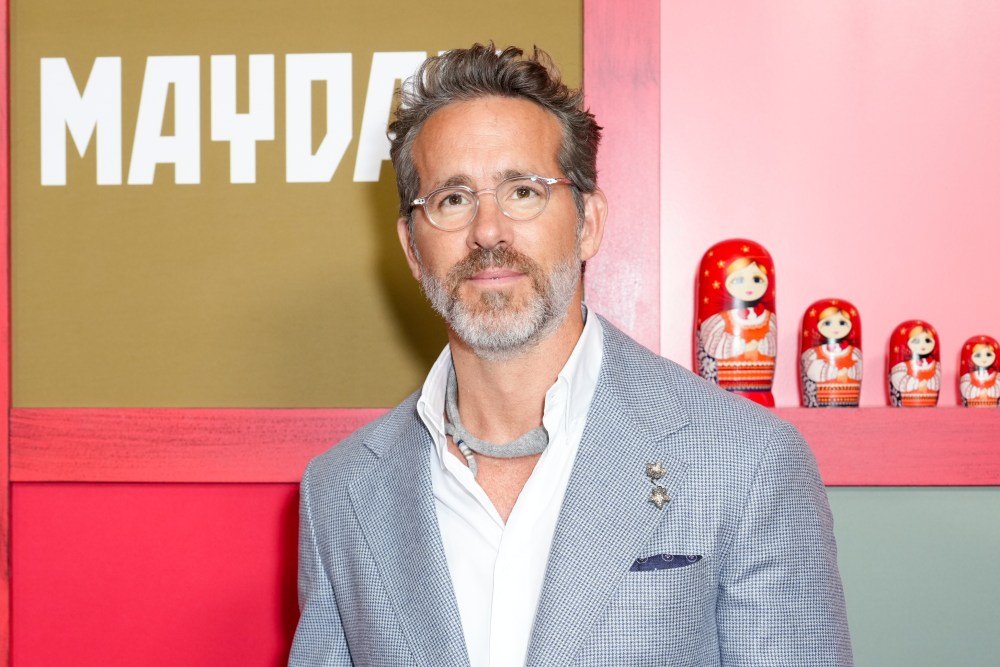
“Obviously, [‘The Odyssey’] is an incredible, incredible movie. Christopher Nolan literally breathes the rarest air on Earth. He’s a singular filmmaker,” Reynolds told Variety at the “Mayday” premiere at AMC Lincoln Square in New York City on Tuesday night. “I mean, Matt Damon, Tom Holland, who’s clearly batting a thousand stars with Zendaya. I just love that people are going to the movie theaters. I don’t even care why or for what reason. Just go to the movie theaters. There’s no better shared experience.”
Ryan Reynolds praises Christopher Nolan after “The Odyssey” beats “Deadpool & Wolverine” to become the biggest R-rated movie ever:
“Obviously, [‘The Odyssey’] is an incredible, incredible movie. Christopher Nolan literally breathes the rarest air on Earth. He’s a singular… pic.twitter.com/ydNoZxvggF
Apple Original Films’ “Mayday” marks Reynolds’ first major movie role since “Deadpool & Wolverine” hit theaters more than two years ago. Set at the end of the Cold War, he stars as a U.S. Navy pilot who becomes trapped behind enemy lines and forms an unlikely friendship with an eccentric ex-KGB agent (Kenneth Branagh) who idolizes ’80s American culture. Reynolds believes that the rosy-colored nostalgia surrounding the decade, popularized in modern-day projects like “Stranger Things,” tends to gloss over the more turbulent nature of the era.
“When you get far enough away from a time period that’s quite distinct, there’s always a lovely feeling associated with it, almost like you pave over all the trauma with puppy dogs and ice cream,” Reynolds said. “The 80s was a brutal, brutal time for people. It was a fucking mess and people forget that.”
Reynolds was quick to point to the fear of nuclear war that lingered over Americans as U.S.-Soviet tensions surged again in the early ’80s. The decade also saw the decline of American manufacturing devastate many working-class communities, along with the AIDS epidemic, which became the country’s most urgent health crisis.
“It was a tremendous strife,” Reynolds explained. “Socio political tensions everywhere. We were still pretty fresh off a Cuban missile crisis, which was only 15-20 years before. It’s a tumultuous period, but you look back at it now and you’re like, ‘Oh, yeah. ‘Top Gun.’ Cocaine!’ Like, ‘No!’ It was really scary.”
When the time comes to dissect the 2020’s in decades to come, Reynolds predicts that creatives will “pick on the big ticket items that didn’t really leave the footprint culturally that you would think they would.”
“So much of the aughts were like a mix of all the decade’s previous, whereas the decade’s previous were their own thing. I wonder if it’s going to be the Covid era or something. I have no idea. We are living in the friggin’ salad days right now! We just don’t know it.”
While “Mayday” isn’t getting a theatrical release, Reynolds teased at this year’s San Diego Comic-Con that he could return as Deadpool later this year in Marvel’s “Avengers: Doomsday.” Reynolds snuck into the Marvel presentation at Hall-H in a grey denim Deadpool suit and asked Paul Rudd a question from the crowd: “Mr. Paul Rudd: where is Thor, and why was he crying?”
Branagh, who also directed the first “Thor” movie with Chris Hemsworth in 2011, says Reynolds never brought up the ongoing Thor gag while filming together on “Mayday.”
“He worries about offending me, that’s what it is,” Branagh joked. “That was my baby, you know! Way back before you came in.”