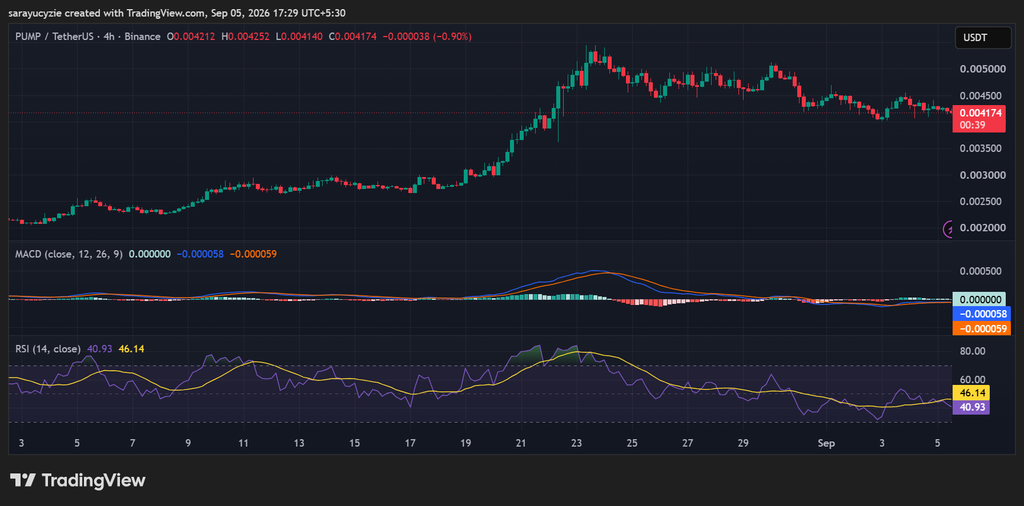
$PUMP is currently hovering around the $0.0041 mark.
There’s a bullish attempt to counter a macro downtrend.
As the first week of September closes, Pump.fun ($PUMP) is trading at $0.004195. Buyers have stepped in and defended the $0.0040 zone twice, printing a double bottom and showing that the sellers can’t push through that floor with any conviction.
The neckline likely sits at $0.00455. A clean breakout above that level with volume behind it confirms the double bottom and opens the door toward the projected target at around $0.0052, a crucial move from current levels. Until that breakout is confirmed, the bulls are in a waiting game.
In the early hours, the asset traded at a bottom of $0.004096. With a shift in momentum, it tested and broke multiple price ranges and gradually drove the $PUMP price to a high level of $0.004405. Besides, the 24-hour volume has potentially reached the $147.17 million zone.
Near-Term Price Levels to Watch for $PUMP
With the negative outlook, the recent trading pattern might slip even deeper and test the key support at the $0.004139 range. Further correction on the downside could likely trigger the emergence of the death cross in the $PUMP market, and the bears would send the price below $0.0040.
On the upside, if the bulls re-entered the market, the asset’s price could instantly rise to its nearest resistance level at $0.004251. Extended bullish pressure might push for the formation of the golden cross. Eventually, it could drive the $PUMP price even higher, above the $0.0043 mark.
Where Will $PUMP Take its Current Momentum?
The Moving Average Convergence Divergence line is slightly above the signal line, while both lines remain below the zero line; it is an early sign of bullish momentum forming within a broader downward trend. The overall background of the $PUMP market is still bearish.
Short-term price moving averages are lower than long-term averages, confirming sustained selling pressure. MACD crossing one point above it forms a fresh bullish crossover, showing that buyers are stepping in and driving price up faster than the immediate recent average. This represents a bullish attempt to counter a macro downtrend.
(Source: TradingView)
Moreover, the daily Relative Strength Index reading positioned at 40.93 hints at weak or neutral-bearish territory. The sellers currently hold a slight edge over buyers, with average price losses outperforming average gains over the recent lookback period.
The asset still has room to fall further before becoming overextended to the downside. A drop toward 40 signals a healthy pullback before the broader trend resumes. If the broader market is already bearish, an RSI staying in the 40–30 range confirms sustained selling pressure without enough buying momentum to reverse direction.
Bitcoin holders whose coins have remained dormant for more than five years have doubled their spending activity since May, pushing the cohort’s 90-day average to about 1,500 $BTC.
Bitcoin OG activity doubles from May levels
CryptoQuant analyst Darkfost reported that activity among Bitcoin’s oldest holders has increased during the latest period of price consolidation. The analyst defines the group as investors whose coins had remained unspent for more than five years before moving onchain.
🗞️ OG Bitcoin Holders Are on the Move
OG activity has intensified during this consolidation phase.
The 90-day moving average of spent UTXOs (STXO) from holders who have held $BTC for more than 5 years just climbed to 1,500 $BTC.
As a reminder, a UTXO (Unspent Transaction Output)… pic.twitter.com/8kXvJ06XKH
— Darkfost (@Darkfost_Coc) September 5, 2026
The 90-day moving average of spent outputs from the cohort has reached about 1,500 $BTC, twice the level recorded in May, according to Darkfost. A moving average smooths daily changes, making it less sensitive to isolated transfers from a few large wallets.
At 1,500 $BTC, the current average is also about 56% above the 962 $BTC reported on June 24. At the time, the reading had fallen below 1,000 $BTC for the first time since November 2024, indicating that activity from older holders had slowed to its lowest point in nearly two years.
As previously reported by crypto.news, earlier peaks appeared in May 2024, February 2025, and September 2025. Daily movements during those periods exceeded 10,000 $BTC, 30,000 $BTC, and, in one case, 142,000 $BTC.
Darkfost linked the latest increase to unease created by Bitcoin’s consolidation. Even investors who have held through several market cycles appear more active, the analyst said, although the data cannot identify the reason behind each transaction.
Bitcoin traded near $79,600 at the time of writing, down about 1.8% over 24 hours after moving between an intraday low of $78,723 and a high of $81,370. The price has struggled to establish a lasting move above $80,000 following several sharp swings around the level.
Spent UTXOs do not prove Bitcoin was sold
A spent UTXO records Bitcoin that has been used as an input in a new transaction. Because Bitcoin’s ledger tracks transaction outputs rather than account balances, an output becomes “spent” whenever its owner moves the coins to another address.
Movement alone does not identify the purpose of a transaction. An investor can send $BTC to an exchange for a possible sale, transfer it to a new custodian, consolidate several outputs, divide a balance across wallets or replace an old security setup.
Darkfost cautioned against treating the 1,500 $BTC average as confirmed selling. Some of the transactions may represent holders moving their coins to safer storage after the Coldcard security incident rather than exiting their positions.
Destination data provides more useful evidence when an old wallet sends coins to a labeled exchange or trading firm. Even then, an exchange deposit shows that the Bitcoin became available for trading; it does not establish that the owner completed a sale.
Recent dormant-wallet transfers illustrate the limitation. During a 10-day period in August, six wallets that had remained inactive for almost 12 to more than 15 years moved 553.59 $BTC worth $40.15 million.
Five transfers went to addresses with no identified exchange connection. One wallet sent 40 $BTC to an address labeled Boerse Stuttgart Digital, which provides custody and trading infrastructure. Neither the unlabeled destinations nor the custody provider established whether the owners sold, changed custodians, or reorganized their holdings.
Another 28 dormant wallets moved 1,314.41 $BTC on Aug. 20, including more than 1,200 $BTC from addresses created in 2014. Blockchain records documented the transfers but did not reveal the owners’ intentions.
Coldcard incident complicates onchain readings
The Coldcard incident created an unusual source of Bitcoin activity after a firmware flaw exposed seed phrases generated by affected hardware wallet models. Owners were advised to create new seeds and transfer their holdings because installing corrected firmware could not repair credentials produced by vulnerable software.
In early August, K33 Research found that nearly 890,000 $BTC had moved over seven days, the highest seven-day active supply recorded in 2026. The surge occurred while Bitcoin was trading within one of its narrowest 30-day ranges since 2023, separating the rise in network activity from a major price breakout.
Researchers linked the activity partly to Coldcard users migrating funds and attackers draining vulnerable wallets. Galaxy Research had confirmed the theft of 1,596 $BTC from about 7,300 addresses across three attack waves by Aug. 5.
Galaxy estimated that losses could reach approximately 2,055 $BTC, then worth close to $130 million, if a suspected fourth wave was confirmed. Around 90% of the stolen Bitcoin had not moved after the initial attacks at that stage, according to the research firm.
Transfers made for seed migration still consume old UTXOs, so they can raise spending metrics even when the owner keeps control of the coins. The effect can reach age-based cohorts if affected wallets contain Bitcoin that has remained untouched for five years or longer.
Wallet consolidation can produce a similar result. Combining several old outputs into one new output records the original UTXOs as spent without changing the owner’s total balance, apart from the network fee.
U.S. investors can hold Bitcoin without managing seeds
For U.S. investors, the Coldcard incident has renewed attention on the custody differences between directly held Bitcoin and shares of a spot Bitcoin exchange-traded fund. Direct holders control spendable $BTC but remain responsible for seed creation, backups, firmware updates, and wallet migration.
ETF investors do not manage private keys because the fund and its service providers handle custody. Bloomberg Intelligence senior ETF analyst Eric Balchunas argued in August that the Coldcard losses strengthened the case for ETFs among investors who only want exposure to Bitcoin’s price.
An earlier report on the U.S. custody debate noted that no verified flow data had tied ETF demand directly to the incident. Investor responses could also include multisignature wallets, new hardware devices, institutional custodians, or the division of funds across several storage methods.
BlackRock’s iShares Bitcoin Trust uses Coinbase Custody to hold its Bitcoin in segregated cold-storage wallets, according to the fund’s SEC filing. The trust may also use Anchorage Digital Bank as an additional custodian.
ETF ownership transfers personal seed risk to fund operators, custodians, and other service providers. BlackRock’s filing warns that hacking, employee misconduct, technical failures and unauthorized transfers could still cause losses, while available insurance may not cover every event.
Unlike direct holders, retail ETF shareholders cannot withdraw the underlying Bitcoin to a personal wallet or use it for onchain payments. Fund shares trade during U.S. market hours, while Bitcoin transactions remain available around the clock.
A meme accurately cites facts and fundraising figures in comparing prosecutors charging Lindsay Clancy with killing her three children, with Clancy receiving more than $1 million in fundraising, and the story of Emma Schols sustaining severe burns while rescuing her six children from a house fire, then receiving only $42,000 in fundraising.
Rating:
What’s True
The meme provides some factual information about both stories and, as of this writing, an accurate GoFundMe tally of donations earmarked to defray Clancy’s parents’ travel and housing costs as they attended the trial. Also, it’s true that a Swedish news outlet reported that a church deacon in that country organized a fundraiser equaling, at current currency conversion rates, about $42,000. However …
What’s False
… the meme omits additional fundraisers and sponsors who pledged to help rebuild Schols’ home, according to information found in the same Swedish news outlet mentioned above and her 2022 book.
In late August and early September 2026, people shared a meme comparing the alleged stories of two mothers.
Emma Schols’ story of heroism, which involved saving her six children from a house fire and sustaining severe burns in the process, appears on the meme’s left side, with a fundraising figure of $42,000.
The right side features Lindsay Clancy, the mother at the center of a highly-publicized Massachusetts murder trial — which ended in a mistrial Sept. 4 — in which prosecutors charged her with killing her three young children, along with a purported GoFundMe fundraising figure exceeding $1 million.
X user @CodyManners2 posted (archived) the meme, which reads under photos of Schols: “Mother pulls all 6 of her children out of raging house fire, going back in three times despite burns covering 93% of her body. Money raised: $42,000.” Clancy’s caption reads: “Mother kills all 3 of her children by strangling them to death with exercise bands. Claims she is victim. GoFundMe: $1,044,318+.”
In sum, Schols’ book and news media outlets’ reporting confirm the meme features a few specific facts but also omits key information. For these reasons, we have rated the meme’s content as a mixture of true and false information.
Snopes emailed Kevin Reddington, Clancy’s attorney, and Schols to request comment. A reverse image search found no posts displaying the meme older than X user @CodyManners2’s post. We reached out to that user to ask whether they created the meme and will update this article if we receive further information.
Breaking down the Schols-Clancy meme
Schols, who lives in Sweden, saved all six of her children in a Sept. 3, 2019, house fire, taking three trips to remove all of them from the inferno. Her 2022 coauthored book, “Ärren bär jag med stolthet: branden i Edsbyn och livet efteråt,” which translates to “I Carry the Scars with Pride: The Fire in Edsbyn and Life Afterwards,” tells her harrowing story, including the fact that 93% of her body sustained burns, as the meme claims.
In September 2019, Swedish news media outlet SVT, quoting church deacon Christer Schwartz, reported Schols’ fundraising total at 400,000 Swedish krona, or at current exchange rates about $42,000. According to that report, Schwartz’s fundraiser was one of several on Schols’ behalf but no other figures were reported.
On top of Schwartz’s and other fundraisers, a February 2020 charity hockey match reportedly collected an additional 200,000 Swedish krona ($21,000). Schols says in her book that people and companies also initially pledged to sponsor the rebuilding of her house, though she adds some of those sponsors pulled out after she separated from her partner.
As for Clancy, The Associated Press, Reuters and other outlets reported she admitted strangling her children with exercise bands on Jan. 24, 2023, and pleaded not guilty to her initial charges, which included three counts each of first-degree murder, strangulation and assault and battery with a dangerous weapon. Prosecutors later dropped the strangulation charges, saying they were redundant to the murder charges.
The organizer of the Clancy case GoFundMe (archived), titled “The Musgrove Family Fund,” described the purported recipients of the fundraiser as Clancy’s parents, Mike and Paula Musgrove, citing their hotel, travel and relocation costs to stay close to their daughter over more than three years. The in-question meme does not mention Clancy’s parents, instead making the allegation that Clancy herself will one day collect the funds. At last check, the fundraiser had grown to more than $1.1 million with a goal of $2 million, bringing in more than 33,500 individual donations.
The meme adds that Clancy has claimed she’s the victim. During her criminal trial in summer 2026, Reddington, her attorney, said “there is evidence of lack of criminal responsibility” and suggested “a required finding of not guilty should be entered on the case.” He repeatedly argued Clancy suffered from postpartum psychosis, a disorder an estimated one or two in 1,000 women experience after giving birth that can include delusions, depression, hallucinations, insomnia, paranoia and other changes in behavior. Prosecutors, on the other hand, argued she knew what she was doing.
Schols’ harrowing rescue story
On Sept. 3, 2019, Schols awoke before 6 a.m. in her home to early-morning light shining through her window, with the faint memory of minutes earlier hearing some of her children playing in another room.
In Schols’ book, which we translated to English, she said her then-partner, Anders, was working a night shift, leaving her to sleep alone. She wrote of the morning, “Great, I think, now I have a few minutes to lie down and catch up before I have to start my morning routine.”
Moments later, the book recounts, she felt a very different sense of “fear, panic and desperation” when one of her children screamed from downstairs, “Help, mom, there’s a fire. There’s a fire in the TV room!”
She wrote, “To make sure all the children have woken up, I scream at the top of my lungs: ‘Everyone has to get out of the house!’”
In the minutes that followed, Schols first managed to guide her young children Albin and Oliwer out the front door, then looked for William, Melwyn and Nellie. After seeing William and showing Melwyn to safety, she made it to her youngest child, Mollie, who was standing in her crib with a full diaper.
Schols became unable to move from the flames covering her body. She wrote, “If I have managed to give birth to six children, I will swear to get six children out of this burning house,” and that she gathered strength, picked up Mollie and looked to escape. She described William as positioning a ladder they happened to have left out from a long-neglected painting job as their method of escape from the balcony.
Once outside, Schols described hearing her dog, Sally, inside making noises and thinking of her cat as well. A neighbor, seeing burns all over Schols’ body, told her it was too late to save her pets.
Several Swedish outlets publishednews of the fire on the same day.
Following extensive hospital stays for her burns and a period of rehabilitation, Schols returned home.
In her book, Schols wrote of Schwartz, the deacon, organizing the fundraiser following the fire. A Facebook post from days after the incident mentions Schwartz by name.
Schols said locals helped find clothes for her children, writing, “I am struck by the incredible care that exists in our country.” Other examples of that care included “Playing for Emma,” a charity hockey match organized in Schols’ honor in February 2020. Schols wrote about the match, as well as her family’s home insurance situation at the time of the fire:
On Sunday, February 2nd, a tribute match will be held for me, where the money raised will go to help me and my family get back on their feet. For all the years we have had home insurance, but just a month or so before the accident, we had, due to our financial situation, fallen behind on that particular bill. This fact is something I am ashamed of today. As I have been mulling this question over here in the hospital. This very month, when the house burns down, we were forced to skip that bill. What are the odds of that?
Later in December 2020, the Swedish Heroes Gala awarded Schols the title “Lifesaver of the Year.”
Near the end of her book, Schols wrote that some companies and people sponsoring the rebuilding of their former home pulled out after she and Anders separated.
To close her book, Schols thanked numerous locals and medical personnel, as well as her family, former partner and friends, saving a message for her children for last:
My biggest thanks go to William, Nellie, Melwin, Albin, Oliwer and Mollie. I may have saved your lives, but you are the absolute biggest heroes in this whole story. You are my everything and I love you with all my heart.
Barry, Ellen. “A Troubled Mother Faces Murder Charges in Her Young Children’s Deaths.” The New York Times, 8 Feb. 2023, https://www.nytimes.com/2023/02/08/health/lindsay-clancy-child-murder-charges-massachusetts.html.
Bergström, Marie. “Så mycket samlades in under Playing for Emma: ‘Känns fantastiskt att kunna göra något.’” Söderhamns-Kuriren, 29 Mar. 2020, https://www.soderhamnskuriren.se/halsingland/sa-mycket-samlades-in-under-playing-for-emma-kanns-fantastiskt-att-kunna-gora-nagot/.
Casey, Michael, and Jennifer Peltz. “What to Know about the Lindsay Clancy Murder Trial.” The Associated Press, 27 Aug. 2026, https://apnews.com/article/lindsay-clancy-murder-trial-what-to-know-775003a75689cfde13750257849187ae.
“Children in Sweden.” Sweden.Se, 9 July 2026, https://sweden.se/life/society/children-in-sweden.
Cruz, Timothy J. “Duxbury Woman Arraigned in Murder of Her Three Children.” Plymouth County District Attorney’s Office, Plymouth County Office of the District Attorney, 7 Feb. 2023, https://plymouthda.com/wp-content/uploads/2023/02/DuxburyARR2.7.23.pdf.
Eriksson, Jan-Peter, and Emma Åhlström. “Dramatisk Räddning När Mamma Fick Ut Sina Sex Barn Ur Brinnande Villa i Edsbyn.” SVT Nyheter, 3 Sept. 2019, https://www.svt.se/nyheter/lokalt/gavleborg/brand-i-villa-i-edsbyn-pa-morgonen. Gävleborg.
Fagerström, John. “Mamma räddade sina sex barn från villabrand – blev svårt brännskadad.” Aftonbladet, 3 Sept. 2019, https://www.aftonbladet.se/a/zGbobb.
Kammerland, Erik. “Insamlingen till Edsbyfamiljen Förlängs – 400 000 Kronor Har Skänkts Hittills.” SVT Nyheter, 19 Sept. 2019, https://www.svt.se/nyheter/lokalt/gavleborg/insamlingen-ar-uppe-i-400-000-kronor-till-edsbyfamiljen. Gävleborg.
Khan, Melina. “What Could Happen to Lindsay Clancy after Trial Verdict.” USA TODAY, 24 Aug. 2026, https://www.usatoday.com/story/news/crime/2026/08/24/lindsay-clancy-verdict-what-happens-next/91382978007/.
Öhagen, Angelica. “Sexbarnsmamman Är Årets Livräddare: “Nu Känner de Igen Mig”.” Aftonbladet, 17 Dec. 2020, https://www.aftonbladet.se/a/2dvlV4.
Raymond, Nate. “Family Says Massachusetts Mother Who Killed Children Struggled with Mental Illness.” Reuters, 17 Aug. 2026, https://www.reuters.com/legal/government/massachusetts-woman-searched-online-postpartum-psychosis-days-before-killing-2026-08-17/.
Rev.Com. https://www.rev.com.
Schols, Emma, and Frida Funemyr. Ärren bär jag med stolthet: Branden i Edsbyn och livet efteråt. Norstedts, 2022. Google Books, https://www.google.com/books/edition/%C3%84rren_b%C3%A4r_jag_med_stolthet/cNMRzwEACAAJ.
“TV: Se höjdpunkterna från galan Playing for Emma – allt det bästa på under 15 minuter.” Hudiksvalls Tidning, 4 Feb. 2020, https://www.ht.se/halsingland/tv-se-hojdpunkterna-fran-galan-playing-for-emma-allt-det-basta-pa-under-15-minuter/.
Ungar, Laura. “What to Know about Postpartum Psychosis, Which Can Affect a New Mom’s Sense of Reality.” The Associated Press, 28 July 2026, https://apnews.com/article/postpartum-psychosis-baby-blues-e1dd28bee97a984f3d58132c4fbd2e28.
Yee, Curtis. “As It Happened: Deliberations in Lindsay Clancy Murder Trial End for the Day without a Verdict.” The Associated Press, 27 Aug. 2026, https://apnews.com/live/lindsay-clancy-trial-08-27-2026.
———. “Live Updates: Mistrial Is Declared in Lindsay Clancy Child Killings Case after Jury Deadlocks.” The Associated Press, 4 Sept. 2026, https://apnews.com/live/lindsay-clancy-trial-09-04-2026.
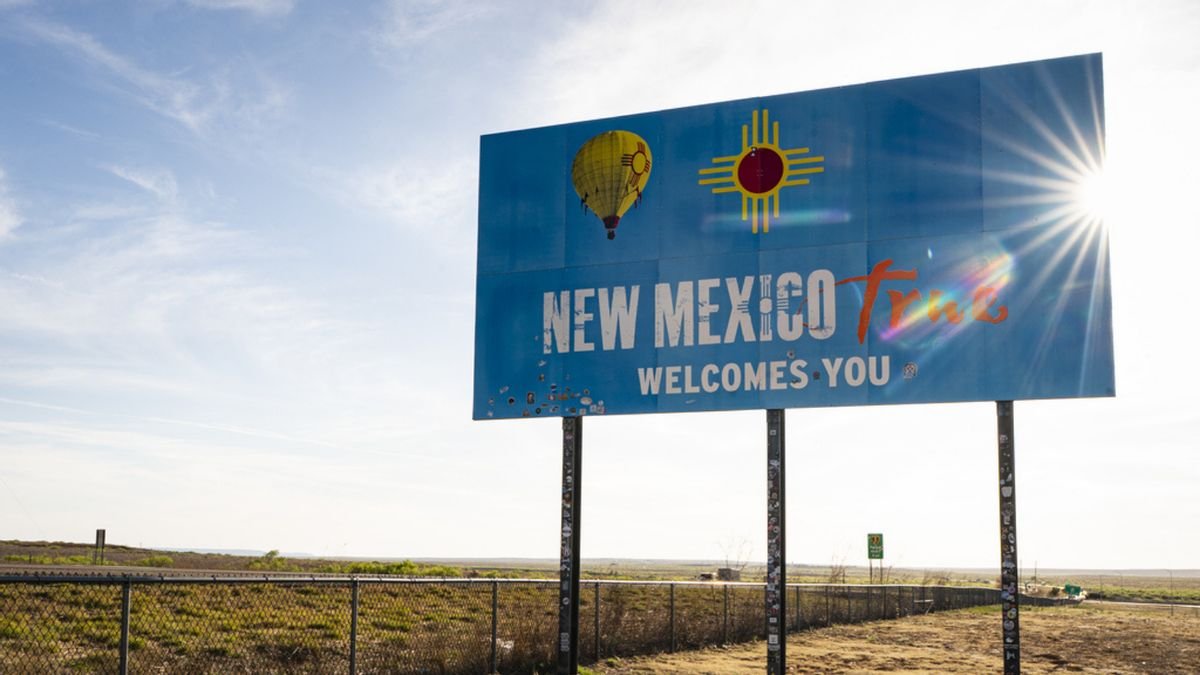
In early September 2026, U.S. President Donald Trump signed an executive order to change the name of New Mexico to “New America.”
Rating:
A claim that federal officials approved a plan to change the name of the state of New Mexico to “New America” spread online, with one popular post going so far as to claim U.S. President Donald Trump signed an executive order changing the state’s name in early September 2026.
The claim emerged following a real order Trump signed Aug. 27, 2026, to change Lake Ontario to “Lake America” in the United States.
X user @DailyNoud shared the claim on Sept. 1 that New Mexico’s name also would be changed (archived), writing: “Donald Trump has signed an executive order to change the name of New Mexico to New America.” The post received more than 2.7 million views, as of this writing:
Variations of the claim also spread on Instagram, Threads and Facebook. Some people seemed to interpret it as true, and Snopes readers contacted us in search of more information.
To investigate the claims legitimacy, we first used search engines such as DuckDuckGo and Bing. If officials in Trump’s administration had really approved plans to change the state’s name — or if Trump had signed any such executive order — these searches would have uncovered such evidence.
That was not the case. We did not find any credible reporting about an official move to change the name of New Mexico.
We identified the claim’s original source: satirical social media account Casper Planet, which describes its output as “Snews that doesn’t matter.” This post didn’t explicitly say Trump signed an executive order, rather — it claimed that “federal officials have reportedly approved plans to rename the state of New Mexico to New America.” (X user @DailyNoud also was a satire account.)
New Mexico To Be Renamed New America Following Federal Geographic Naming Changes
WASHINGTON – Federal officials have reportedly approved plans to rename the state of New Mexico to New America, continuing a recent effort to update geographic names across the country.
According to officials familiar with the change, the word “Mexico” was identified during a routine review of American maps and was determined to be geographically confusing.
The change is expected to affect highway signs, government documents and approximately 14 million souvenir coffee mugs.
Residents will officially become New Americans, while people born there before the change will reportedly be allowed to continue identifying as New Mexicans during a two-year transition period.
Mexico has not been consulted.
In addition to a location tag on “Satire Street,” its Facebook bio reads (archived):
Delivering the Snews that doesn’t matter directly to your Snews feed. Did we say this is satire? Well it is, names/locations are made up
We reached out to the page owner for comment in January 2026 regarding a claim about AI-generated images of massive snow bank on Wyoming’s Devils Tower. The account’s administrator, Justin Hathaway, told Snopes over the phone: “I just love doing this satire stuff, it’s such an outlet for me.” He continued: “Another reason is people don’t really read things fully anymore, and it’s a good way to educate people on reading stories fully if they sound somewhat unbelievable.”
Other Casper Planet posts Snopes has debunked include a claim that Yellowstone National Park rangers warned the public that ravens had learned to open car doors and another that a man received a DUI while riding a bear.
Apple has been part of the smart speaker market since it shipped the original HomePod in 2018. But though users did have the option to hook up two HomePods to play their music in stereo, surround sound (where audio is divided up between four different speakers across a room) has never been on the table as an option. Even if users did happen to own four HomePods and were willing to set it up manually.
Now, things could be set to change. According to a trusted Apple leaker, posting on the MacRumors forum, lines of code in the latest audioOS 27 beta reference “tuning files” that interact with speakers in front-left, front-right, rear-left, and rear-right positions.
According to pdxfu, in the four-speaker placement, the front speakers will use left- and right-specific audio processing, while the rear HomePods will utilize omnidirectional processing “designed to fill the space behind and around the listener.”
The code also hinted at a new device on the way. According to the leaker, some of the code references a device that doesn’t appear to match any of the currently available HomePods, including the original, 2nd-gen, or HomePod mini. Pdfu says it’s impossible to say if this is a reference to a 3rd-gen HomePod or a HomePod mini sequel.
A new Party Mode could also be on the table. Party Mode, when enabled, will use an audio-rendering mode called diffuse. This means the sound will be spread into “a wider, more ambient mix,” which will “fill a room more evenly instead of creating a perfect listening spot in front of the speakers.”
Apple Insider notes that as the code references new hardware, it’s likely we’ll have to wait for Apple to release new devices to see these features in action, and Apple still doesn’t have anything officially announced yet.
About Our Expert
Experience
I’m a reporter covering weekend news. Before joining PCMag in 2024, I picked up bylines in BBC News, The Guardian, The Times of London, The Daily Beast, Vice, Slate, Fast Company, The Evening Standard, The i, TechRadar, and Decrypt Media.
I’ve been a PC gamer since you had to install games from multiple CD-ROMs by hand. As a reporter, I’m passionate about the intersection of tech and human lives. I’ve covered everything from crypto scandals to the art world, as well as conspiracy theories, UK politics, and Russia and foreign affairs.
This delightful if darkness-tinged documentary is comprised of footage shot by then not yet fully-fledged cameraman Seamus McGarvey (who went on to be DP for Atonement and The Hours among other features) on the set of Derek Jarman’s 1991 adaptation of Edward II. For reasons not explained here, McGarvey’s material was left sitting in a cupboard for 30-odd years, unedited into the making-of documentary it was meant to be, even after Jarman’s death from AIDS-related illness not long after EdwardII came out.
But maybe all things happen for a reason because now, thanks to young British director Theo Rollason and their team, the original footage gets to be part of a larger documentary. Filled out with vintage archive that supplements the portrait built here of the irrepressibly charming Jarman and his highly talented team of collaborators, this easily tallies up as more than the sum of its parts. It’s also guaranteed to induce swooning nostalgia in those who remember queer life, London and the filmmaking scene thereof in the early 1990s. Those too young, like Rollason, to have lived through those thrilling if dangerous times will have to contend with the complicated jealousy this will induce. And hopefully take away sadly timely history lessons about the necessity of resisting despotic, homophobic authoritarians, especially if you can do it with men dressed as nuns.
Queer Edward II
The Bottom Line
An insightful and delightful nostalgia trip.
Venue: Venice Film Festival (Venice Open — Out of Competition) Director/screenwriter: Theo Rollason Producers: Ben Fowlie, Sebastien Rabas, Michael Sherman
1 hour 37 minutes
Fans of Jarman can spend happy hours debating which of his features — Latin-language trailblazer Sebastiane, punk fetish object Jubilee, irreverent The Tempest, painterly Caravaggio, to name just a few — is the best, and Edward II definitely has its passionate defenders. It certainly deftly collated together key Jarmanian features, such as giving an English Lit classic (Christopher Marlowe’s 16th century play) a pointedly political contemporary frame, mixing opulence and austerity in its sets and costumes, and serving up lashings of hot boy-on-boy action and a diva or two. (Annie Lennox has a walk-on moment singing Cole Porter’s ‘Ev’ry Time We Say Goodbye.’)
As is pointed out here, this was also his most expensive feature up until then, costing about £900K, hardly a princely sum even then. Presumably a goodly chunk of that change went to proper professional actors (including Steven Waddington and Andrew Tiernan as Edward and his lover Gaveston) who could cope with the Elizabethan verse, as well as regular Jarman chums in the cast like Tilda Swinton, who played Edward’s sulky French wife. (She looks unspeakably radiant here in Sandy Powell’s gorgeous costumes.) But McGarvey also captures the comic horror show of low-budget filmmaking in Britain at the time as one producer dips into his own pocket to pay off some bolshy background artists demanding extra to cover their expenses.
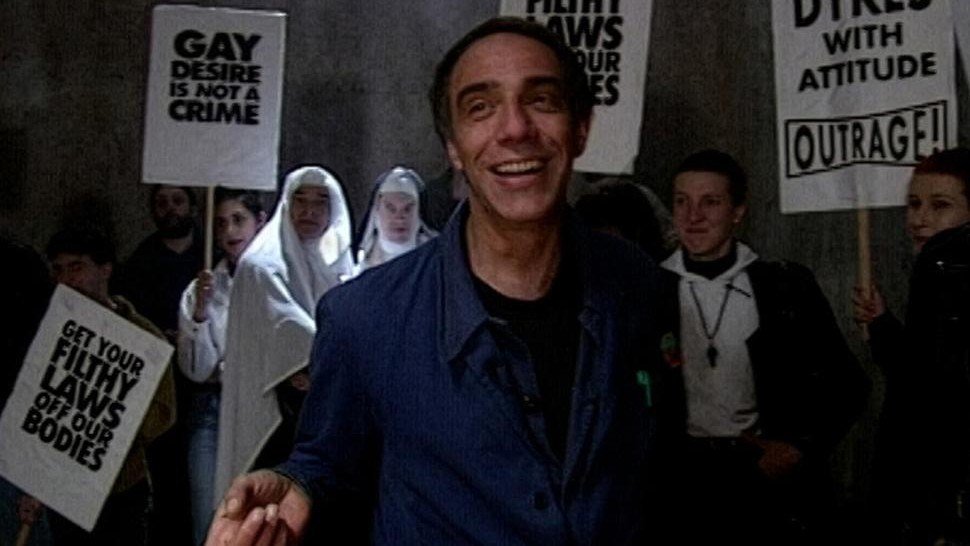
Indeed, the footage of the harried production staff trying to keep the show going on from the office at Bray Studios where the shoot is happening sometimes plays like a vintage workplace comedy but with a dark undertow. The highlight is the sequence where visiting extras from the queer activist group Outrage! decide to invade a neighboring studio where popstar Cliff Richard, long rumored to be gay, is rehearsing and offer him keys to help him come out of the closet.
At first, it all looks like juvenile hijinks, the attempted outing (all the rage in those days) now looking very much not cool to contemporary eyes. Jarman, when told about it, looks more like he’s trying to keep a straight face than channel censorious disapproval. But when someone leaks the story to the tabloids and the scandal threatens to shut down production if Richard sues, it’s suddenly not such a lark, especially for production manager Sarah Swords, who’s left manning the phones, trying to negotiate with the tabloid reporters the way a canary negotiates with a cat.
Luckily both for Swords and the film itself, and of course this documentary about the film, the whole thing blows over and the team goes on to fight other battles and make more films. Younger viewers and those not from Britain will learn here about Clause 28, proposed legislation that would criminalize the “promotion of homosexuality” in state schools, which campaigners such as Jarman, the Outrage! protesters and many others fought hard against. (It did become law but was repealed in the 2000s.) The footage here follows Jarman as he and others voluntarily “surrender” en masse to London police stations as a publicity stunt, the kind of disruptive, playful non-violent intervention that’s all too thin on the ground these days, in both the U.K. and offshore.
Rollason and fellow editor Nicole Halova, with supervision provided by the legendary longtime Werner Herzog-collaborator Joe Bini, effortlessly weave this material into the filmmaking story, underscoring how intimately intertwined politics, protest and art were at the time — a rebellious spirit of the times that will induce nostalgia almost as much as the intarsia knitwear and early ’90s haircuts seen here.
TL;DR: Get five years of Flowkey Classic, including interactive courses, instant feedback, and more than 1,000 songs, for $67.97 through September 10.
Starting piano can feel overwhelming—from learning notes and chords to reading sheet music, it’s easy to get stuck in the basics without making real progress. Flowkey brings a structured, interactive approach that guides learners from first-time players to confident pianists, on sale for $67.97.
The app combines step-by-step courses with over 1,000 songs from Bach, Mozart, Chopin, and more. You’ll learn proper technique, read sheet music, and practice notes and chords with instant feedback that helps you improve faster.
Key Features That Make Practice Easier:
Slow motion, looping, and separate hand practice help you master tricky passages without frustration
Video lessons with synced sheet music make every session clear and engaging
Lessons cover everything from scales and chords to advanced arrangements
Accessible across laptops, tablets, and smartphones so you can practice anywhere
Prices subject to change. PCMag editors select and review products independently. If you buy through StackSocial affiliate links, we may earn commissions, which help support our testing.
About Our Expert
StackCommerce Team (Sponsored)
Experience
Products featured in these stories are selected by our partners at StackCommerce. If you buy something through links on our site, PCMag may earn an affiliate commission.
Did celebrated Italian auteur Nanni Moretti, known at home and abroad for his leftist political satires and introspective human comedies, just make his first straight-up soap opera? The answer is mostly yes, which begs yet another question: Is that actually a good thing?
With a hefty filmography that includes one Palme d’Or winner, a Silver Lion and a Silver Bear among countless Italian prizes, the 73-year-old director clearly has nothing left to prove when it comes to arthouse cinema, for which he’s been his country’s most consistent commodity since the 1980s. Not unlike Woody Allen, but minus the disastrous personal life, Moretti puts out a new film as often as he can, testing out different genres while maintaining his deadpan humor and personal touch. Not all Moretti movies are created equal — and some deserve more praise, such as his 2011 Vatican dramedy, We Have a Pope — but they’re always made with intelligence and a fair amount of levity undercut by darker currents swirling beneath the surface.
It Will Happen Tonight
The Bottom Line
High-end arthouse soap with a dash of humor.
Venue: Venice Film Festival (Competition) Cast: Louis Garrel, Jasmine Trinca, Hippolyte Girardot, Angela Finocchiaro, Melina Akerman, Elena Lietti, Andrea Lattanzi, Antonio De Matteo, Nanni Moretti Director: Nanni Moretti Screenwriters: Nanni Moretti, Federica Pontremoli, Valia Santella, based on Hungry Heart by Eshkol Nevo
1 hour 43 minutes
That hot and cold, funny and tragic tone is present throughout the early parts of his searing 17-year romance, It Will Happen Tonight (Succederà questa notte), until the film swerves into pure melodrama later on, taking Moretti to places he hasn’t necessarily gone before — except, perhaps, in The Son’s Room, which remains one of his biggest successes to date.
The sharp and luminous Jasmine Trinca (also headlining Venice competition title The Spiral) made her screen debut in that 2001 movie and is well-served here by a role in which she has to constantly contain her passion for a total stranger, until finally deciding it’s time to go for it. Her paramour is played by hunky French charmer Louis Garrel, who flexes his Italian skills, as well as a handlebar mustache that makes him look like a forgotten member of the Red Brigades, as a man so smitten with an unknown woman that he never forgets her despite all the time gone by.
Is the film often cheesy and a tad ridiculous? Certo. But it’s also rather watchable if you accept its mass of coincidences, hopping as easily as an Alitalia frequent flyer to multiple destinations (Rome, Oslo, Turino, San Sebastian and Mumbai) and spanning several decades to tell the tale of two lovers who keep serendipitously crossing paths. As the years go by, babies are born, parents get sick and die, careers are started then ended, wives and husbands are thwarted, and, eventually, sheets are strewn and booties are tapped. Despite some questionable hair styles, Trinca and Garrel remain agelessly attractive throughout all of this, proving that their characters’ undying love, whether unrequited or not, is all they ever needed.
Adapted by Moretti, Federica Pontremoli and Valia Santella from the stories of Israeli writer Eshkol Nevo, the script requires a sizeable leap of faith from the get-go, although the director sprinkles early scenes with just enough humor to make the medicine go down.
We are simultaneously introduced to Matteo (Garrel) and Greta (Trinca), two 20-somethings undergoing major romantic crises in two parts of the globe. The former just had a kid in Oslo with his younger Norwegian girlfriend (Melina Akerman), who abandons them when Matteo decides to move back to Rome to spend more time with his domineering Italian mother (Angela Finocchiaro). Greta, meanwhile, is living in India when her expat boyfriend proposes to her out of the blue, making her question whether she wants a marriage and prompting her to ask her father (Moretti, providing most of the movie’s laughs) to swoop in and act as a sounding board.
The film then skips ahead to seven years later: Matteo is out playing tennis in Rome with his brother and, what do you know, Greta just happens to be getting married to a new man (Antonio De Matteo) in the garden right next door. She strolls onto the court in her wedding dress for a quick game with Matteo, who falls head over heels for her but is unable to jump in like Dustin Hoffmann in The Graduate to break up the ceremony. Did I say this film is corny?
Several more improbable twists occur over the next decade, throwing Matteo and Greta into each other’s paths until they can no longer quell their burning mutual attraction. Before that happens, the film takes a long detour to focus on Matteo’s relationship with his cancer-stricken French father (Hippolyte Girardot), who’s dying wish is to attend a Bruce Springsteen concert. Off they go to Spain, where Matteo somehow runs into Greta a second time, then heads over to see The Boss with his dad, prompting a teary-eyed singalong of “Hungry Heart” (also the title of Nevo’s short story collection) before the inevitable death scene that follows.
Moments like these can definitely be a bit overwrought (and humor-wise, Moretti should probably refrain from the Viagra jokes), but they’re also handled with a fair amount of tongue-in-cheek tact despite the unbelievable circumstances. The director has always excelled at shifting moods from light to dark and back again — his most beloved work, Caro Diaro, is all about that — and It Will Happen Tonight benefits from that tone until the gloves finally come off along with all the clothes, and the movie starts laying on the sauce too thickly.
By then, Greta and Matteo have been through a lot — there’s a whole subplot involving Greta’s depressed teenage daughter (Elisabetta Traversa), but it feels too sketched out to carry weight — and this in part explains why they’ve never been available for each other, even if they’ve clearly had a few too many chances over the years. The gloomy reality of not getting what you want, because life keeps getting in the way, is the main ingredient that holds this otherwise tawdry romance together, though not entirely.