Blog

  • Pay $40 Just Once for 1TB of Cloud Storage for Life

    Pay $40 Just Once for 1TB of Cloud Storage for Life

    TL;DR: LifetimeCloud Secure Storage is just $39.99 (MSRP $199) for lifetime access to 1TB with zero-knowledge AES-256 encryption.

    Paying for the same cloud space every month or year isn’t the only option. LifetimeCloud Secure Storage gives you lifetime access to 1TB for $39.99 (MSRP $199), with no monthly or annual renewal fees.

    The ownership model is the main attraction. For comparison, Dropbox Plus costs about $120 per year, while this LifetimeCloud plan is a single $39.99 purchase.

    Privacy is another key distinction. LifetimeCloud uses zero-knowledge AES-256 encryption, which means your files are encrypted before leaving your device and can’t be read by LifetimeCloud itself. Data is hosted in Italy under EU regulations, and the service is GDPR compliant.

    The 1TB account can store photos, videos, documents, and other files, with access from an unlimited number of devices. Everything runs through supported web browsers, including Chrome, Safari, Edge, and Firefox, so there’s no software to install.

    You also get file version history, a built-in editor, simple file and folder sharing, and family sharing for up to five people. Updates and security improvements are included automatically.

    Recommended by Our Editors

    Don’t miss out on lifetime access to 1TB of LifetimeCloud for just $39.99.

    LifetimeCloud Secure Storage

    Lifetime Subscription (1TB)


    $39.99
    at StackSocial

    $199.00
    Save $159.01


    Get Deal

    Prices subject to change. PCMag editors select and review products independently. If you buy through StackSocial affiliate links, we may earn commissions, which help support our testing.

    About Our Expert

  • BBC, Bobby Prod, Folivari, Gao Shan Pictures Honored by Europe’s Animation Industry at Cartoon Forum

    BBC, Bobby Prod, Folivari, Gao Shan Pictures Honored by Europe’s Animation Industry at Cartoon Forum

    Cartoon Forum, the leading co-production event in Europe for animated series, has unveiled the winners of this year’s Cartoon Tributes, recognizing the dedication and creativity of key players in the European animation industry.

    Chosen by the event’s attendees gathered in Toulouse, the winners in the three established categories (Producer, Broadcaster and Investor/Distributor of the Year) were celebrated today as the Forum slowly comes to a close after three days of intense pitching sessions, networking and debates around the state of European animated TV industry.

    This year, the Producer of the Year went to Bobby Prod (France), who presented “The Broos” back in 2024 at Cartoon Forum. Now streaming on ARTE France, the series (which originated on social media before being developed as an animated series in co-production with ARTE) highlights the potential of digital-first storytelling to reach wider audiences, with creators and communities deeply tied together.

    An approach that’s been at the heart of Bobby Prod for more than 15 years, as the studio built its strong identity around irreverent humour, creative freedom and bold storytelling. From bringing known IPs to life with “Creatures Commandos” or “Dead Cells,” Bobby Prod and sister company Bobbypills are now expanding into their own originals IPs with French hit queer animated feature “Jim Queen” now being presented at TIFF, and Jordan Firstman announced as lead voice cast.

    France’s Folivari International takes home the Investor/Distributor of the Year award. Two year since its creation by Folivari, the independent sales agency carefully built its distinctive slate blending in-house titles and third-party acquisitions, with hit series such as “Samuel,” and buzzy titles currently in production and/or development, such as “Pil’s Adventures,” “Ted & Paula’s Tadpole Journey,” “Nino Dino” and “The Baker Street Four,” all presented at Cartoon Forum.

    BBC, UK’s public-service broadcaster and a major player in the global economy of animated TV series, received the Broadcaster of the Year award, emphasizing the enduring ties between European animation and the post-Brexit United Kingdom. With its children’s services CBeebies and CBBC catering respectively to preschool and school-age audiences, BBC remains a major commissioner and co-producer of children’s animation, with a strong focus on original content and partnerships with independent production companies. A long-standing presence at Cartoon Forum, BBC boarded several European series to its slate after their Forum pitches, including “Duck & Frog,” “Maddie + Triggs,” “Piggy Builders,” “Pablo” and “Dungeons & Kittens.”

    This year’s Tributes also introduced a fourth category, the Ecoprod-Cartoon Tribute, honoring a European animation production company or initiative that has made a significant contribution to advancing sustainability in the sector.

    Presented in partnership with Ecoprod, a French non-profit organisation supporting the audiovisual industry’s environmental transition, the new award featured three nominees, with the winner selected by Ecoprod in recognition of its commitment to sustainability across its operations, production methods and storytelling.

    The very first Ecoprod-Cartoon Forum Tribute went to French, Réunion Island-based Gao Shan Pictures, a 2D and 3D animation service studio and production company creating bold, distinctive and meaningful films for international audiences with sustainability at its core. A stance that is reflected both in the stories it chooses and in the way they are produced, with credits including “In Waves,” “The Smurfs,” “Jim Queen” and “Allah is Not Obliged.” At Cartoon Forum 2026, Gao Shan Pictures presented “The Roots of My Hair,” a 2D animated series for teenagers aged 12 to 15 adapted from the eponymous best-selling graphic novel.

    This year, all nominees had strong ties to Cartoon Forum, having participated in the event both to pitch their projects and to connect with the European animation industry. Companies from the Czech Republic, Germany, Ireland, Luxembourg, Spain and Sweden were also among this year’s nominees.

    Created in 1990 to boost the co-production and distribution of European animation across television and new media platforms, Cartoon Forum has since helped more than a 1,000 1,053 animation series obtain financing, totaling more than €3.83 billion ($4.39B).

  • Nex Playground Gaming Console Maker Raises More Than $150 Million in Funding, Niantic’s Jeff Shouger Joins as CFO

    Nex, the company behind the popular family gaming console Nex Playground, has secured more than $150 million in new financing to support expansion across retail distribution and growing its content ecosystem with major gaming and entertainment partners.

    According to Nex, the company plans to roll out “connected play,” which will allow families to play together across households and distances. Nex also plans to expand across Europe and Asia, following its recent expansion into Canada, the United Kingdom and Republic of Ireland. Nex will move into Germany later this year, with Japan and Korea planned for 2027.

    Nex Playground’s current lineup consists of 60 games, including globally recognized franchises and characters such as Bluey, Barbie, Kung Fu Panda and Peppa Pig, with experiences spanning music, sports, fitness, party, and learning. The slate will continue to grow this fall and holiday season with NFL Flag, Dude Perfect Trickshot Challenge, PAC-MAN with Bandai Namco Entertainment, and more.

    The late-stage funding comes in the same year that Nex Playground crossed more than one million units sold, with the system now distributed across more than 7,000 U.S. retail locations, including Costco, Sam’s Club, Target, Walmart and Best Buy. Nex’s subscriber base has grown sevenfold over the past 18 months and is approaching 1 million subscribers, a milestone the company expects to surpass by year-end.

    This new round of financing includes a Series E led by Baillie Gifford and BAI Capital, with participation from NBA Investments, Logitech, Medici Capital Partners, and the Raine Group, alongside a new credit facility with JPMorgan.

    Additionally, Nex has brought on Ninantic vet Jeff Shouger as its chief financial officer and set Shouger and gaming and technology industry veteran Bing Gordon as new members of the company’s board of directors.

    “Families have timeless needs: to move, grow, connect, and have fun. The response to Nex Playground
    has shown us that active play can serve those needs at a meaningful scale,” Lee said. “We are building Nex to be a 100-year company. This investment gives us the resources to bring active play to millions more families around the world, and Jeff and Bing bring extraordinary experience building enduring gaming and technology companies. I’m thrilled to have them with us for this next chapter.”

  • Avalanche’s Helicon upgrade cuts validator lockups from 14 days to 48 hours

    Avalanche’s Helicon upgrade cuts validator lockups from 14 days to 48 hours

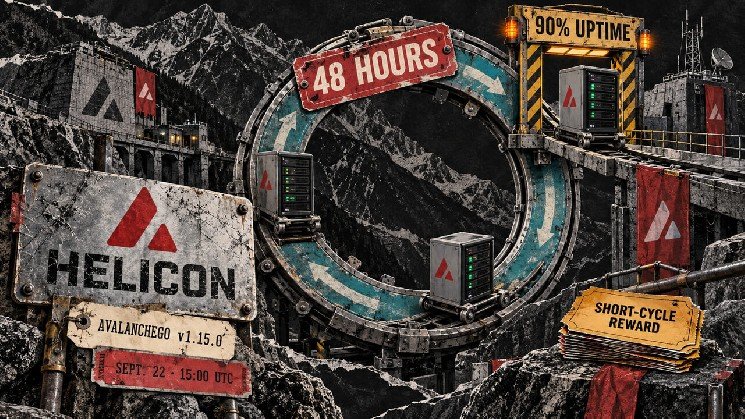
    Avalanche’s Helicon upgrade is scheduled to give validators shorter, auto-renewing commitments while raising the uptime cutoff for rewards and reducing returns at the shortest durations.

    The network upgrade is set to activate on Avalanche Mainnet on Sept. 22 at 15:00 UTC. Validators must install AvalancheGo v1.15.0 beforehand to remain compatible with the upgraded chain.

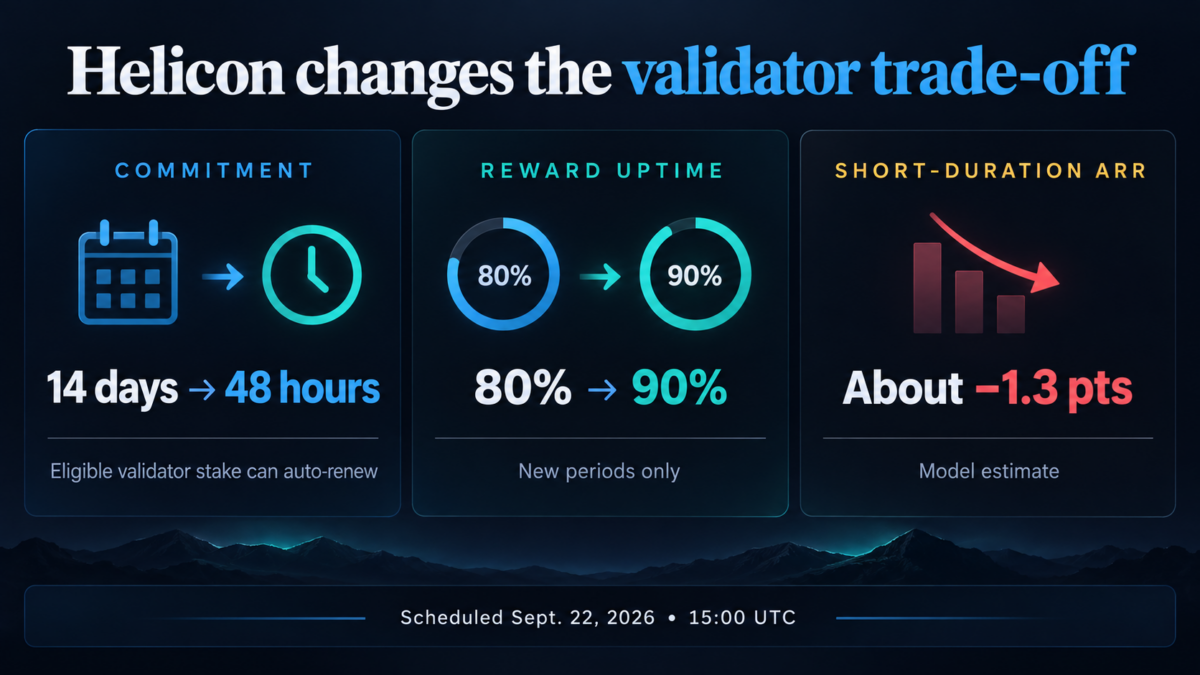
    Infographic shows Helicon reducing validator commitments from 14 days to 48 hours, raising reward uptime to 90%, and lowering short-duration ARR by 1.3 points.

    What changes for validators

    Helicon will cut the minimum Primary Network validation period from 336 hours to 48 hours. It will also let eligible validators automatically begin another cycle when the current one ends, reducing manual signing work and potential reward gaps from repeatedly leaving and rejoining the validator set.

    Operators can choose how much of each cycle’s reward to compound into the next one and can update the configuration for a future cycle. That creates a way to combine brief capital commitments with continuous validation, instead of choosing between a long lockup and repeated manual restaking.

    The feature applies only to the validator’s own stake. Delegations will not auto-renew, and each delegation must fit inside one validator cycle because the validator is not guaranteed to continue beyond that boundary.

    Validation periods that start on or after Helicon activation must achieve at least 90% uptime to earn rewards, up from 80%. The rule is not retroactive: periods that began before activation remain subject to the existing 80% requirement even if they extend beyond Sept. 22.

    Avalanche’s uptime measurement will not change, and rewards will remain all or nothing. Falling below the applicable threshold forfeits the full reward for that period, though the validator’s principal is not slashed.

    For a validator using auto-renewal, missing the threshold has an additional consequence. The position will not roll into another cycle, and the validator will exit. Its principal and rewards accrued in earlier cycles are returned, but the failed cycle’s reward is lost.

    Short cycles reduce how long capital is committed, while the higher threshold raises the operational reliability required to collect each cycle’s reward and continue automatically. For operators, that links continuity to cycle-by-cycle performance without changing how Avalanche measures peer responsiveness or adding a partial-reward buffer.

    How short-duration Avalanche rewards change

    Helicon will also begin a 90-day adjustment to Avalanche’s reward curve. The protocol’s minimum consumption rate, an input that helps determine staking rewards, is scheduled to decline linearly from 10% to 7.5%. The maximum rate at the one-year duration will remain unchanged.

    Avalanche’s modeling estimates that this adjustment will reduce the annualized reward rate at the shortest duration by about 1.3% after the phase-in. The exact realized yield will remain variable because it depends on factors including $AVAX supply, duration, and compounding choices.

    The same modeling projects annual $AVAX inflation falling by roughly 0.5% to 1% and the stake-weighted average duration increasing by about two months. Those outcomes are estimates depending on how validators and delegators respond.

    The mechanical trade-off is more certain: Helicon makes short, renewable validator commitments easier to use, but sets a lower reward at the short end while preserving the one-year rate and demands more reliable uptime for new validation periods.

  • Bizarre ‘footprints’ spotted on Mars leave scientists scratching their heads

    Bizarre ‘footprints’ spotted on Mars leave scientists scratching their heads

    To view this video please enable JavaScript, and consider upgrading to a web
    browser that
    supports HTML5
    video

    Scientists are perplexed by the discovery of what looks like footprints on the surface of Mars.

    Images captured by the Curiosity Rover show an unusual feature on the Red Planet’s surface – broad, shallow pits unlike anything researchers have previously spotted.

    The discovery was made as Curiosity explored Mount Sharp, a vast mountain rising from the floor of Gale Crater.

    The rover has been exploring Mars since landing in 2012, and despite more than a decade on the planet, it continues to find things that puzzle scientists back on Earth.

    These mysterious markings on Mars’ surface were found by the Curiosity Rover (Picture: NASA/JPL-Caltech/MSSS/Cover Images)

    Small pits and depressions are relatively common on Mars. They can form when harder nodules or pebbles embedded in rock gradually weather away, leaving a hollow behind.

    But the newly observed features are different. They are much wider and shallower than similar pits seen previously, and researchers could not identify obvious objects that might once have occupied them.

    The Curiosity team used the rover’s cameras and instruments to examine the features in detail.
    MAHLI and the Mastcam instrument captured overlapping images that can be combined to produce three-dimensional models of the pits and their structure.

    Detail of a mosaic taken by NASA?s Perseverance rover shows a boulder field on ?Mount Washburn? on May 27. Intrigued by the diversity of textures and chemical composition in the light-toned boulder at centre, the rover?s science team nicknamed the rock ?Atoko Point.? Scientists say they are puzzled over a bright white rock never seen before on Mars. The 14-inch-high boulder stands out among a large field of dark rocks and is described as
    Nasa’s Perseverance rover previously captured what appeared to be a boulder field on the Red Planet (Picture: NASA/JPL-Caltech/ASU/MSSS / SWNS)

    The team does not believe the marks are actual footprints, but the unusual formations provide a new clue about the geological processes that have shaped this part of Mount Sharp.

    The surrounding bedrock also provided plenty for Curiosity’s instruments to investigate. Mastcam images and measurements from the ChemCam instrument revealed layers whose texture and structure changed over relatively short distances.

    Maybe astronauts could whip up a mushroom risotto on Mars once Starship gets going? (Picture: Nasa/UFO Sightings Daily)
    People think they spotted a mushroom on Mars in previous images released by Nasa (Picture: Nasa/UFO Sightings Daily)

    Scientists say these variations could indicate changes in the conditions under which the sediments were deposited.

    The rover also examined rough, grey layers that were more resistant to erosion than the surrounding rock. ChemCam, MAHLI and the Alpha Particle X-ray Spectrometer (APXS) analysed the material, which may have a different chemical composition from the bedrock around it.

    After almost 14 years on Mars, Curiosity continues to provide scientists with new glimpses of the planet’s geological history – and, occasionally, features they have never seen before.

    In an image taken in 2013, UFO hunters thought they’d spotted a wrinkly mushroom on the planet’s surface.

  • House Lawmakers Launch Movies, Music, Entertainment & Sports Caucus

    House Lawmakers Launch Movies, Music, Entertainment & Sports Caucus

    EXCLUSIVE: A group of House lawmakers is launching a new caucus focused on the economic and cultural impact of movies, music, entertainment and sports.

    The Movies, Music, Entertainment & Sports (MoMEntS) Caucus is being launched by Rep. Sydney Kamlager-Dove (D-CA), whose district includes Culver City, and she will co-chair it along with Rep. María Elvira Salazar (R-FL) and Troy Carter (D-LA).

    Kamlager-Dove said in a statement, “America’s creative and entertainment sectors are economic powerhouses, generating more than $1 trillion each year and supporting over five million good-paying jobs. Yet for far too long, Congress has failed to give these industries and the workers and creators who power them the attention and support they deserve.”

    The caucus comes amid an industry push for the establishment of a federal film and TV tax incentive as a way to address the flight of production to other countries.

    The caucus will have a broader focus than TV and film, and also include broadcasting; music; sports and live entertainment; fashion and beauty; gaming, esports, and interactive media; streaming and digital platforms; content creators and the influencer economy; literary and publishing; and visual and performing arts, organizers said.

    Salazar said in a statement that the caucus “will bring lawmakers and creative industries together to better understand the challenges they face, protect creative rights, and keep American talent and innovation leading on the world stage.”

    Carter said the caucus “provides a critical opportunity for us to prioritize America’s creative and entertainment industries, which contribute so much to our nation’s history, economy, and culture.”

    The caucus also will focus on innovation, competition, and responsible platform practices, among other aims.

    Other members of the caucus include Rep. Joe Wilson (R-SC), Rep. André Carson (D-IN), Rep. Gilbert R. Cisneros, Jr. (D-CA), Rep. Jared Moskowitz (D-FL), and Rep. Ted W. Lieu (D-CA).

    Among those praising the formation of the caucus were Recording Academy President Harvey Mason Jr., TKO Group Chief Legal Officer Riché McKnight, TikTok USDS Joint Venture”s head of public policy Nicole Nason and Kathryn Busby, head of orginal programming at Starz.

    Congress also has a Creative Rights Caucus, focused on copyrights, First Amendment rights and intellectual property rights. It is co-chaired in the House by Rep. Judy Chu (D-CA) and Rep. Laurel Lee (R-FL), and in the Senate by Sen. Thom Tillis (R-NC) and Sen. Mazie Hirono (D-HI).

    Rep. Laura Friedman (D-CA) and Rep. Brian Jack (R-GA) appeared on a press call on Tuesday to call for a federal film incentive, telling reporters that legislation is being drafted. President Donald Trump announced his support for a federal film incentive earlier this month.

  • House Lawmakers Form American Film & TV Production Caucus Amid Push For Federal Incentive

    House Lawmakers Form American Film & TV Production Caucus Amid Push For Federal Incentive

    Key House supporters of a federal film & TV incentive are establishing a congressional caucus, as work continues on legislation establishing the nationwide production credit.

    The Congressional American Film & TV Production Caucus will “work to revitalize, strengthen, and expand film production across the United States,” per an announcement on Wednesday.

    The founding members of the caucus include Rep. Brian Jack (R-GA), Rep. Laura Friedman (D-CA), Rep. Nathaniel Moran (R-TX), Rep. Linda Sánchez (D-CA), Rep. Nicole Malliotakis (R-NY) and Rep. Tom Suozzi (D-NY).

    The organizers cited the loss of more than 100,000 film and television production jobs since a 2022 peak, and a fall in production spending by 20% while such output grew in the U.K. and Eastern Europe.

    They cited the lure of subsidies offered by foreign countries, and argued that states are unable to compete on their own.

    Supporters of an incentive are emphasizing support on both sides of the aisle.

    President Donald Trump recently announced his support for a federal incentive, and there are hopes among supporters that will generate momentum for congressional action when Congress returns after the midterms.

    Moran, Sánchez, Malliotakis and Suozzi are members of the Ways & Means Committee, which writes tax law. Jack serves on the Rules Committee, essential to getting a bill to the floor.

    Friedman, a former film producer, said in a statement, “Film and television work is leaving this country because 65 other nations decided to compete for these hundreds of thousands of good-paying jobs. A national film tax credit is how we bring that work home, and this caucus is a key step to build support for it.”

    Moran said, “Every production that sets up here ripples out, supporting the businesses around it and pumping money into local communities. We need to keep that going and keep American storytelling in America.”

    Supporters have not given any timeline for introduction of legislation, but it could be in the coming weeks. Friedman and Jack appeared in a press call on Tuesday organized by the Motion Picture Association to outline the urgency for a production credit.

  • Why is inflation rising again around the world?

    Rising energy prices are pushing inflation higher again, forcing major central banks to raise interest rates.

    For decades, central banks treated oil shocks as temporary, something to wait out, not hike rates over.

    And that’s because raising rates in this case can slow growth without bringing down the price of a single barrel of oil.

    But this time might be different.

    Oil surged past $100 a barrel last week.

    Six months into the Iran war, the Strait of Hormuz remains disrupted and Houthi advances threaten Saudi oil supplies, too.

    Energy costs are feeding through into household and business bills.

    That is forcing policymakers to reconsider the old rulebook even though tighter policy means higher borrowing costs.